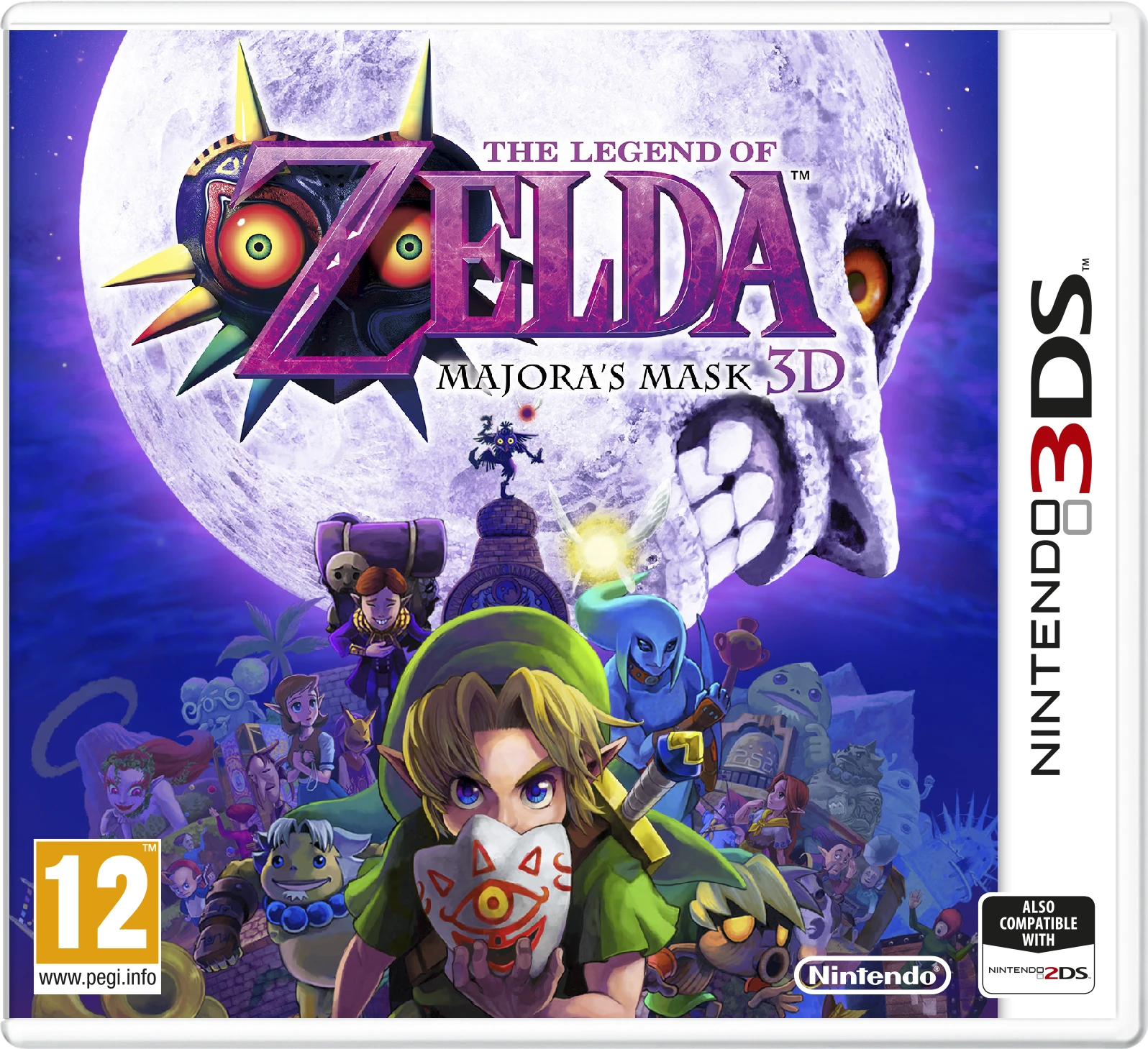
Termina’s last three days, rebuilt from the ground up for the 3DS: sharper, smoother and far kinder to anyone who lost their way on the Nintendo 64, yet still the strangest Zelda of them all.
Released13 February 2015 (NA, EU) · 14 February 2015 (JP, AU)
More than 2 million by 31 March 2015; 3.44 million worldwide by December 2022
Review average
89 on Metacritic, from 82 reviews
Overview
Fifteen years after it first unsettled Nintendo 64 owners, Majora’s Mask came back in February 2015 as a full remake for the Nintendo 3DS. It is the same adventure as the 2000 original: young Link, stranded in the land of Termina, has three days to stop a leering moon from flattening Clock Town, and a Song of Time that lets him live those three days again and again. What has changed is almost everything around that story. The models and textures are new, the action runs at 30 frames per second in stereoscopic 3D, and a long list of rough edges has been filed down.
The work was done by Grezzo, the Tokyo studio that had already rebuilt Ocarina of Time for the 3DS in 2011, with Eiji Aonuma, co-director of the original, producing. Shigeru Miyamoto wanted the remake because so many players had given up on the Nintendo 64 game before seeing what was in it. Aonuma, by his own account, did not want to go back at all. When he finally replayed it he filled a list with moments that made him ask “what in the world?!”, and that list became the plan.
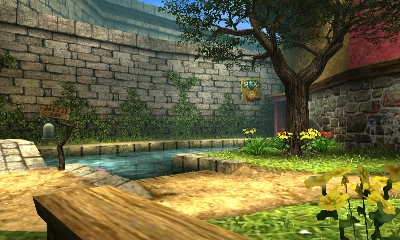
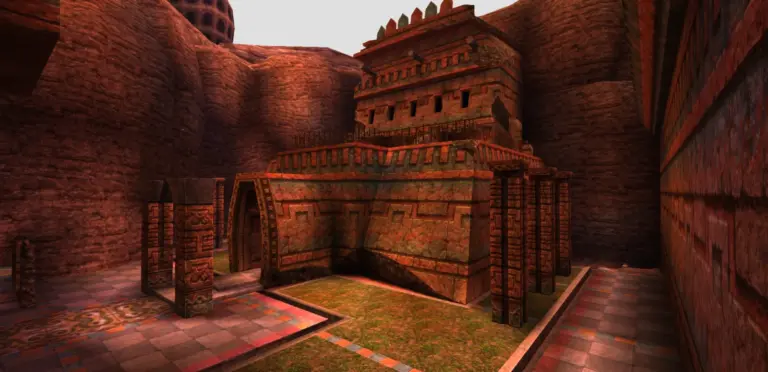
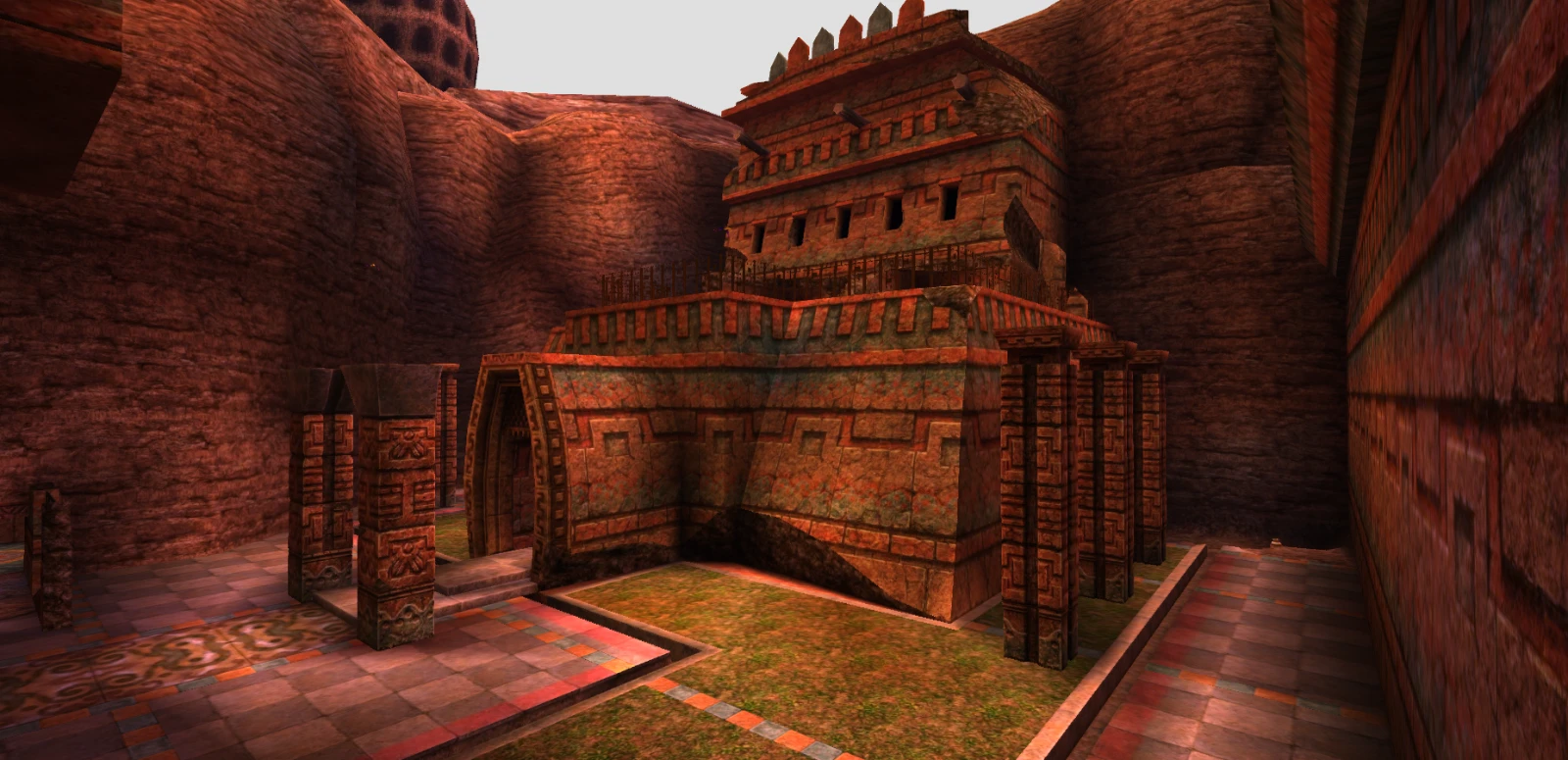
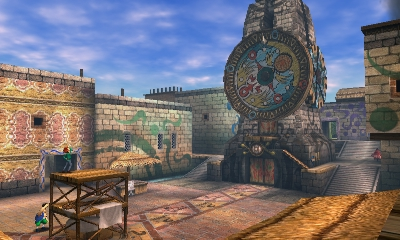
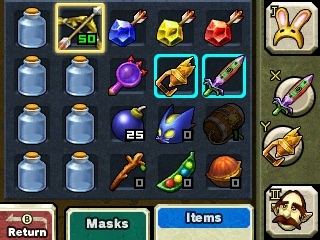
South Clock Town, rebuilt and enlarged for the 3DS.Both screens: the adventure on top, items, map and clock controls below.The moon over the Clock Tower, now with a free camera to stare back at it.
So this is a remake that changes how the game plays as well as how it looks. You save at statues instead of by rewinding time. The Song of Double Time skips ahead to any hour you choose. The Bombers’ Notebook has grown from a diary of twenty people into a proper quest log with an alarm. Every temple boss has been redesigned, there are two fishing holes where there were none, and on a New Nintendo 3DS, which launched the same day in North America and Europe, the C-Stick swings the camera wherever you like.
Critics welcomed it warmly (89 on Metacritic) and it sold more than two million copies by the end of March 2015; by the end of 2022 its total of 3.44 million had edged past the figure usually quoted for the Nintendo 64 version. Not every change pleased long-time fans, though: Zora Link’s slower swimming and a couple of the new boss fights are still argued over. The game has never left the 3DS, and since the eShop closed to purchases in March 2023 the only way to buy it is on a second-hand Game Card.
Race against time and save a doomed land in The Legend of Zelda: Majora’s Mask 3D, only on Nintendo 3DS family systems.
That is the first line of Nintendo UK’s product page for the game, which sits under the heading “The time has come…”. The page presents it as the Nintendo 64 classic remastered with refreshed visuals and features, and then runs through what is new: motion controls, item switching on the Touch Screen, free camera control with a Circle Pad Pro or the New Nintendo 3DS C Stick, a Bombers’ Notebook with alarms, hints from a Sheikah Stone and, when it all gets too much, a break at a fishing hole.
— Official description: Nintendo UK, product page for The Legend of Zelda: Majora’s Mask 3D (nintendo.com/en-gb). Opening line quoted; the rest summarised.
Quick Answers
The questions people most often ask about the 3DS version, answered briefly here and in more detail further down the page.
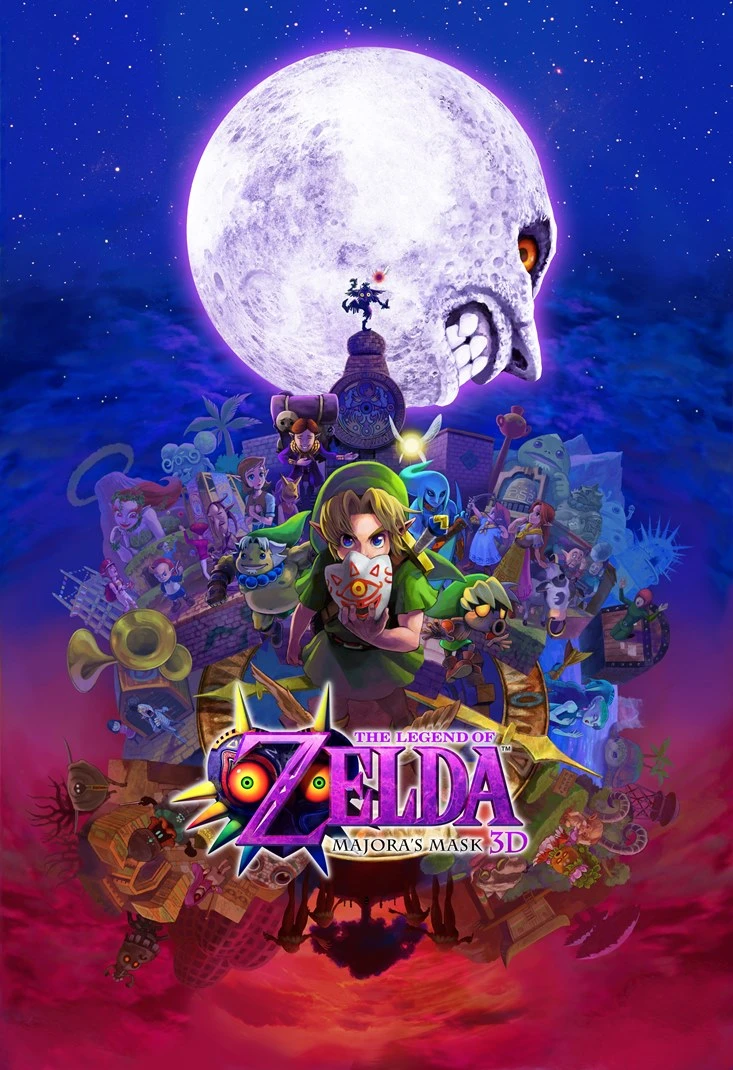
Official artwork for Majora’s Mask 3D.
Is Majora’s Mask 3D the same game as the Nintendo 64 original?
The story, the world, the masks and the four temples are the same. The graphics were rebuilt, and a good deal of how it plays was changed: saving, the Bombers’ Notebook, all four temple bosses, Zora swimming and more. More →
What is new in Majora’s Mask 3D?
Permanent saving at owl and quill statues, a Song of Double Time that jumps to any hour, a far bigger Bombers’ Notebook with an alarm, a Sheikah Stone that shows hint videos, rebuilt boss fights, two fishing holes, touch-screen items, gyro aiming and stereoscopic 3D. More →
How does saving work in the 3DS version?
You save for good at any owl statue or at one of the new quill statues dotted around Termina. Playing the Song of Time still takes you back to the first day, but it no longer saves the game. More →
Do you need a New Nintendo 3DS to play it?
No. It runs on every system in the 3DS family, including the 2DS. A New Nintendo 3DS adds free camera control on the C-Stick and steadier 3D; owners of the original models can get the same camera with a Circle Pad Pro. More →
Why is Zora swimming different?
Zora Link’s normal swimming is slower and easier to steer, and the fast swim now uses magic. Eiji Aonuma said the aim was to make swimming more comfortable. Many fans of the original disagree. More →
Which version should I play?
The 3DS version is the friendlier one: better saving, clearer side quests and a smoother picture. The Nintendo 64 original, which is on Nintendo Switch Online + Expansion Pack, keeps the old swimming and the original boss fights. Either is a fine way to see Termina. More →
Can you still buy Majora’s Mask 3D?
Only second-hand. Nintendo ended purchases in the 3DS eShop on 27 March 2023 and the remake has not been released on any later console. More →
Who made Majora’s Mask 3D?
Grezzo, the studio behind Ocarina of Time 3D. Mikiharu Ooiwa directed, with Eiji Aonuma of Nintendo and Grezzo’s founder Koichi Ishii as producers. More →
What’s different from the Nintendo 64 original
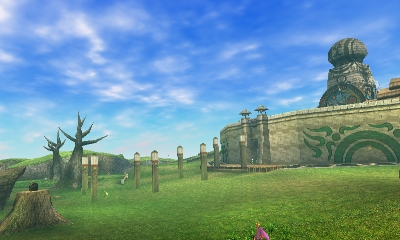
Termina Field on the 3DS: the same place, redrawn.
Majora’s Mask 3D keeps every temple, mask, song and side story of the Nintendo 64 game, all of which are covered on our Majora’s Mask page. This section is about what is different. Eiji Aonuma’s instruction to Grezzo was blunt, as he told Satoru Iwata: “I repetitively told the staff to never make this game easier.” The goal was a game that explained itself better, so that when you fail you know why.
The table gives the headline differences. The sections below it look at the ones that matter most, including the handful that fans of the original have never forgiven.
Feature
Nintendo 64 (2000)
Majora’s Mask 3D (2015)
Graphics
Ocarina of Time’s engine with the Expansion Pak, at about 20 frames per second
New models and textures, stereoscopic 3D, 30 frames per second
Screens and items
One screen; items on the three C buttons
Clock and button prompts on top, everything else on the Touch Screen; items on X, Y and two touch slots, with fixed buttons for the ocarina and the Pictograph Box
Camera
No free camera control
Free camera with the New Nintendo 3DS C-Stick or a Circle Pad Pro; optional motion-controlled aiming
Saving
The Song of Time saves for good; owl statues give a one-off save that is deleted when you load it; two files
Owl statues and new quill statues save permanently; the Song of Time no longer saves; three files
Song of Double Time
Jumps to the next dawn or dusk
Jumps forward to any hour you pick on the current day
Inverted Song of Time
Slows the clock to about a third of its normal speed
Slows it to half speed
Bombers’ Notebook
Handed over by Jim of the Bombers; follows twenty people
Handed over by the Happy Mask Salesman; adds an events list, rumours from the Bombers and an alarm
Hints
No hint videos
A Sheikah Stone in the Clock Tower plays hint videos
Temple bosses
Weak points are not marked
All four rebuilt around a large eye that appears when the boss is stunned; Gyorg and Twinmold gain a second phase
Giant’s Mask
In a chest in Stone Tower Temple, guarded by an Eyegore
Appears in the boss arena once the blue Twinmold is beaten
Zora Link
Fast swimming costs nothing; only the electric barrier uses magic
A slower, steadier stroke by default; fast swimming is tied to the barrier and drains magic
Deku Link
Skips across water freely
Needs a run-up before he can hop far across water
Ice Arrows
Freeze water throughout Great Bay Temple and in several places outside it
Outside boss rooms, only sparkling patches of water will freeze
Fishing
None
Two fishing holes, in the swamp and at Zora Cape
A sharper, smoother Termina
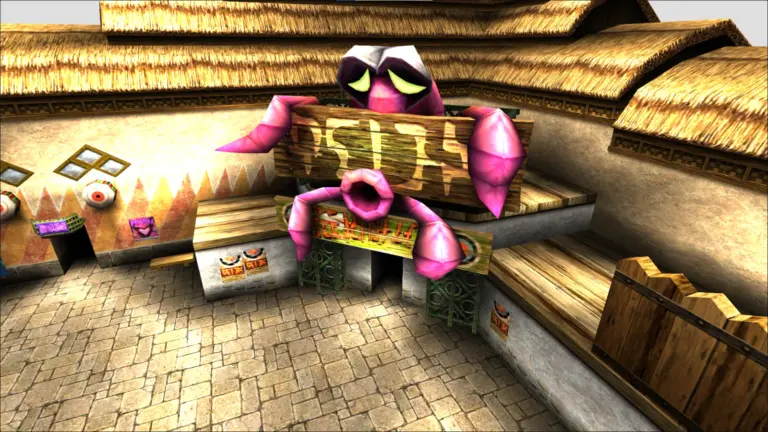
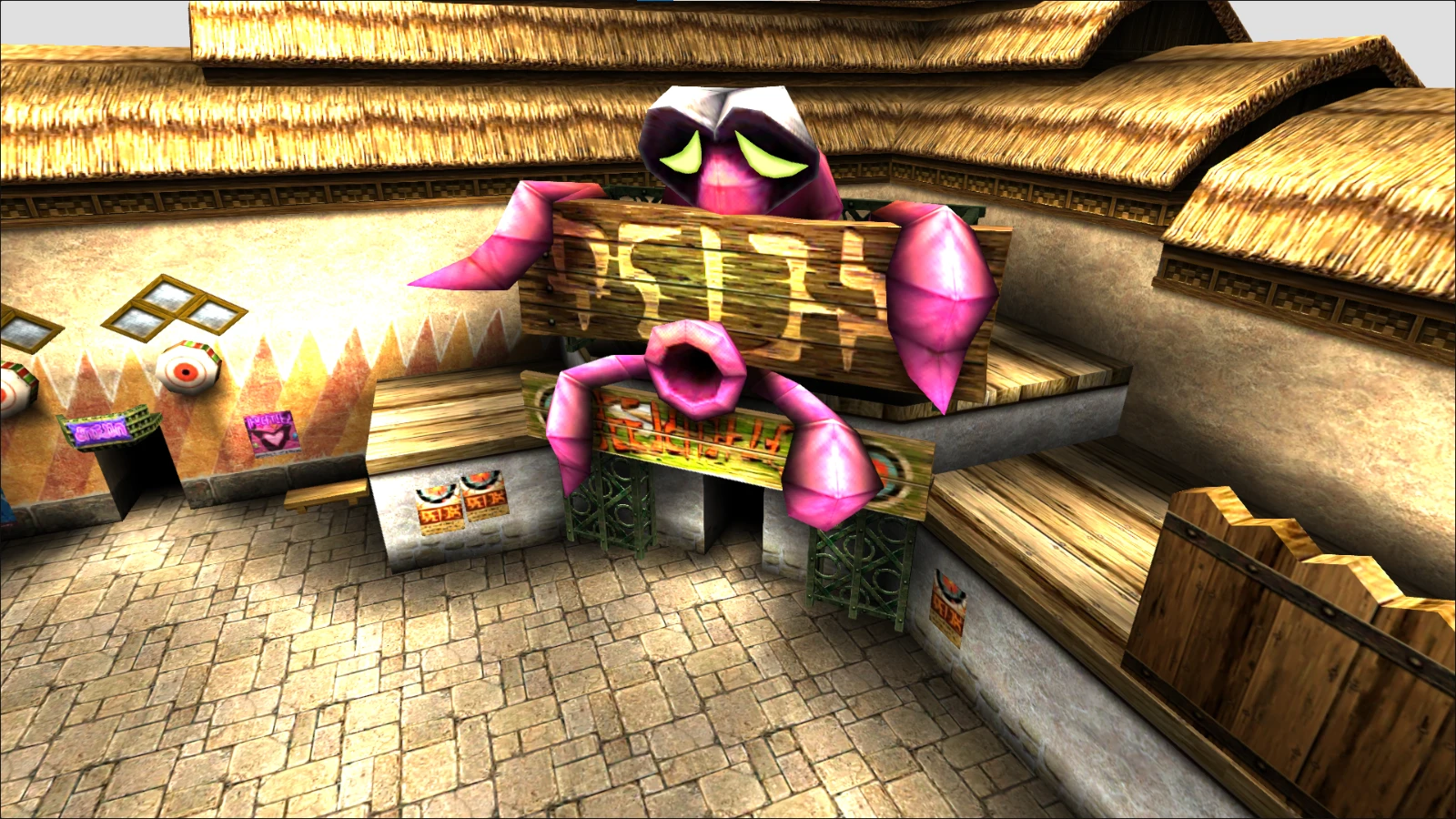
The Clock Town Bank, which now stands in South Clock Town under the Clock Tower.
Like Ocarina of Time 3D before it, this is a rebuild and not a straight copy of the old game running on new hardware. Characters and scenery have more detailed models and textures, familiar faces match their Ocarina of Time 3D looks, and the frame rate climbs from the original’s 20 frames per second to 30. Nintendo’s Tomohiro Yamamura argued that stereoscopic 3D suits this game in particular, because its towns and dungeons are so intricate that a sense of depth helps you judge what is in front, behind, above and below; Aonuma added that it helps Deku Link pick a landing spot in mid-flight.
The second screen clears the clutter. The top screen keeps only the button prompts and the clock; hearts, magic, Rupees, the map and the inventory all live on the Touch Screen, where the ocarina and, once you have it, the Pictograph Box get permanent buttons of their own. The clock itself has been redrawn as a bar that shows the whole three-day cycle at a glance. The first-person view, and with it the bow, can be aimed by tilting the console itself, as in Ocarina of Time 3D, and the Pictograph Box now takes its pictures in colour.
Clock Town has been rearranged a little too. South Clock Town has a larger plaza, and the bank now stands there, built into the back of the Clock Tower and close to the town’s owl statue. Repeated cut-scenes are shorter the second time round, and the Song of Soaring’s flight can be skipped.
Saving and bending time
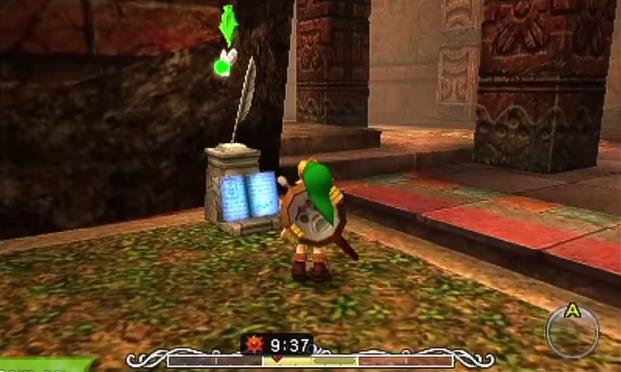
A quill statue, one of the new save points, in the Ancient Castle of Ikana.
The original’s save system was the first thing most people wanted changed. On the Nintendo 64 the only permanent save came from playing the Song of Time and going back to the first morning; owl statues offered a temporary save that vanished as soon as you loaded it. On a handheld that was never going to work. In the remake you simply walk up to an owl statue, or to one of the new quill statues (the name comes from Nintendo’s own manual), and save properly. Quill statues cannot be used as Song of Soaring destinations, but they turn up all over Termina, including inside the temples. Nintendo’s Japanese site sold the feature as a way to play in short bursts on the move. The trade-off is that the Song of Time has stopped saving, so rewinding and then switching off without visiting a statue loses your progress. There are now three save files where the Nintendo 64 game had two.
The time songs have been retuned. The Song of Double Time used to lurch forward to the next dawn or dusk; now it lets you choose the exact hour to skip to, forwards only. Zelda Universe’s reviewer reckoned this cut the long Anju and Kafei quest from nearly an hour to under twenty minutes. Going the other way, the Inverted Song of Time is weaker than it was, slowing the clock to half speed where the original managed about a third. The Song of Soaring, meanwhile, is now learned at the entrance to the Southern Swamp, not at Woodfall.
The Bombers finally earn their keep
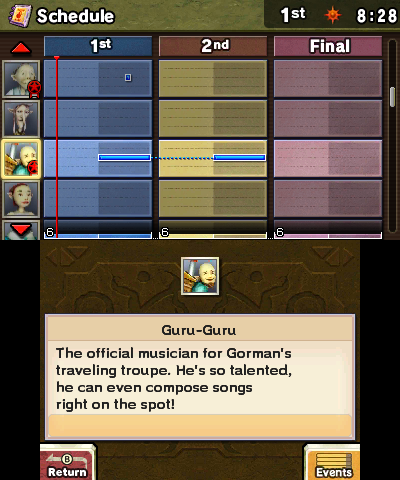
The schedule in the new Bombers’ Notebook, spread across both screens.
Aonuma admitted to Iwata that the Bombers, Clock Town’s gang of do-gooding boys, claimed to gather information on the Nintendo 64 but never told you anything useful. In the remake they run up to Link with rumours about people in trouble, which matters in a game where events happen at fixed times and are easily missed if you are standing in the wrong street. His verdict on his own creations had changed completely: “Wow, you kids are quite useful!”
The notebook they are named after is the biggest beneficiary. It is now handed over by the Happy Mask Salesman once he has taught Link the Song of Healing, so nobody can miss it. Where the old book followed twenty people, the new one logs many more, and splits into a schedule and an events list that shows which troubles are solved, which are under way and where to go next. You can set one alarm at a time, and the game alerts you when the hour arrives.
For anyone properly stuck there is a Sheikah Stone inside the Clock Tower, borrowed from Ocarina of Time 3D, which plays short hint videos. Yamamura told Iwata the team had ruled out simply handing players the answers; the idea was to get across what each task was asking for and leave the doing to you.
Every boss, rebuilt
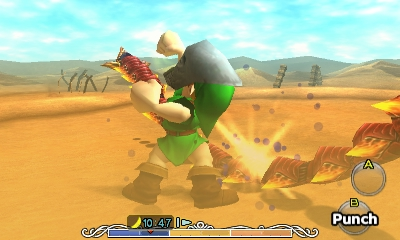
Giant Link throws a punch in the rebuilt Twinmold fight.
“I’ve been saying that all of the boss battles are weird. All of them,” Aonuma told Iwata. His complaint about the Nintendo 64 fights was that you could not see where the bosses were vulnerable, so players tended to win by flailing. Grezzo felt the same way, and every one of the four temple bosses was redone so that each fight has a moment where the trick clicks. The models are, in Aonuma’s words, virtually the same as before, but Yamamura said the new movements and strategies took about as much effort as building new stages from scratch.
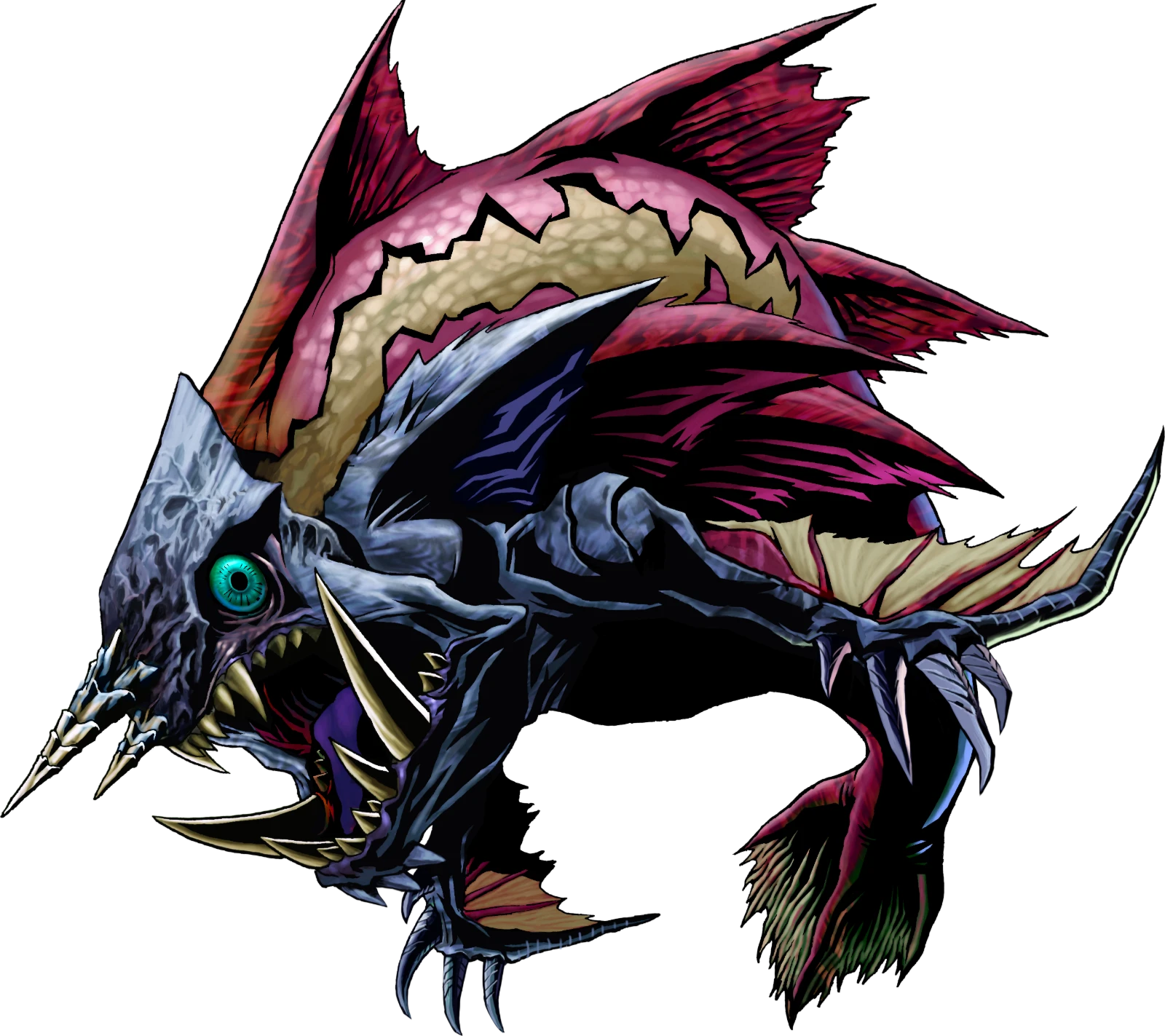
The shared idea is a large eye that pops out when a boss is stunned. Odolwa’s is on the back of his head, and there are more Deku Flowers in his room so that Deku Link can bombard him with Deku Nuts from the air. Goht carries its eye on its back: Goron Link bowls the mechanical bull over, then switches to arrows or his fists. Gyorg hides one in its mouth and now fights in two halves, first from the surface and then, after it smashes the central platform and sinks it, underwater, where Zora Link has to trick the fish into swallowing a spiked mine.
Twinmold changed most. The blue worm is brought down with arrows fired at the eyes along its underside. Only then does a chest appear with the Giant’s Mask, which on the Nintendo 64 was found earlier, in the temple itself. The red worm is then fought as a giant, with no sword: Link punches it, hurls boulders at it and, once it is dazed, grabs it by the tail and swings it round. Reviewers were split. Zelda Universe thought Odolwa and Gyorg much improved and Goht weaker, if understandably so; EGM’s Josh Harmon wrote that the new Twinmold “doesn’t add challenge so much as tedious length”.
Zora, Deku and Goron: the changes that split fans
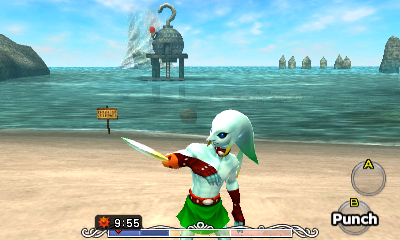
Zora Link in the remake, where swimming at full speed now costs magic.
Zora Link is where the remake and many of its fans part company. On the Nintendo 64 he tears through the water at full speed for nothing, and only his electric barrier costs magic. On the 3DS his ordinary stroke is slower and easier to steer, and the old torpedo speed has been folded into the barrier, so swimming fast drains the magic meter. Aonuma explained the thinking in an IGN interview, reported by Zelda Dungeon in February 2015: the team “wanted to make the experience a comfortable one for players”, and coming back to the game after fifteen years he felt the swimming needed work. Zelda Universe’s review backed him, arguing that the original’s fluid swimming “serves almost no purpose in the game”.
Plenty of others did not. Before launch, Zelda Dungeon worried that crossing Great Bay and gathering the Zora eggs would turn into a slog. Nintendo World Report’s Neal Ronaghan called his March 2015 editorial “Drowning as a Zora in Majora’s Mask 3D” and reckoned the Zora trial on the moon took him thirty or forty attempts. Among the reviews gathered by Metacritic, one describes the new swimming as clumsier and another calls the Zora changes a step back from the rest of the improvements.
The other forms were adjusted as well. Deku Link picks up speed more gradually and needs a run-up before he can skip far across water. Goron Link comes off best: his attacks are quicker, and a single press of A curls him into a ball and another uncurls him, though he turns less sharply at speed. The Ice Arrows were reined in, too. Outside boss rooms they now freeze only marked, sparkling patches of water, which takes away the old freedom to lay ice wherever you fancied in Great Bay Temple.
The complaints eventually produced a fan-made answer. By July 2019 a modder called Leoetlino had released Project Restoration, a patch for the 3DS game that, in its own words, “restores some mechanics from the original game to get the best of both worlds”. It makes fast swimming free again, undoes the Deku change, puts the Inverted Song of Time back to a third of normal speed, lets Ice Arrows work across Great Bay Temple and, in later versions, removes the eyes from Odolwa, Goht and Gyorg and shortens the Twinmold fight, while keeping the remake’s saving and notebook.
Fishing holes and other additions
The Ocean Fishing Hole, one of the two new fishing holes.
The Nintendo 64 game had no fishing, an odd gap after Ocarina of Time’s famous pond; Zelda Dungeon notes that leftover fishing rod data in the original suggests it was once planned. The remake adds two fishing holes, one on the road to the Southern Swamp and one at Zora Cape, each stocked with a dozen kinds of fish, several of which will only show themselves to the right mask. Aonuma, talking to Famitsu before release, enjoyed the absurdity: “I know that the world is about to end, but here I am fishing.”
There is plenty more for returning players to trip over. A new errand for the troupe leader Gorman earns a seventh empty bottle. Shiro, the soldier nobody notices, who hands over the Stone Mask in return for a potion, has moved from Ikana Canyon to the Pirates’ Fortress. Two of the Great Fairies, Power and Wisdom, have swapped places and rewards. The Gibdos under Ikana’s well ask for one of each item where they used to demand ten Bombs or five Magic Beans, Powder Kegs cost 20 Rupees and not 100, and the Giant Wallet can be won on any of the three days. After the original credits, a new roll for the 3DS staff plays to an orchestral medley.
Small touches are everywhere, from the corrected spellings of Dinolfos and Wizzrobe to Stray Fairies with proper 3D models. The Zelda Wiki on Fandom keeps the fullest list.
The story in brief
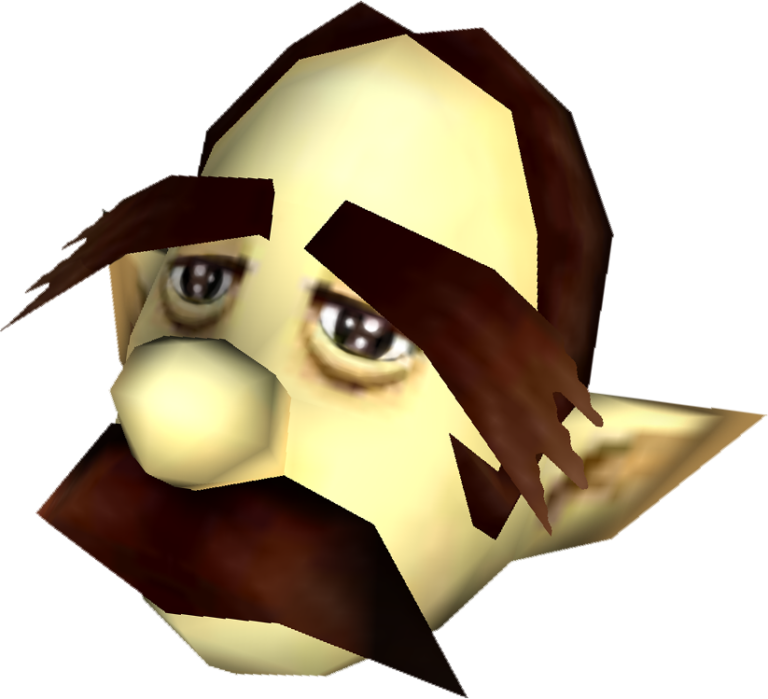
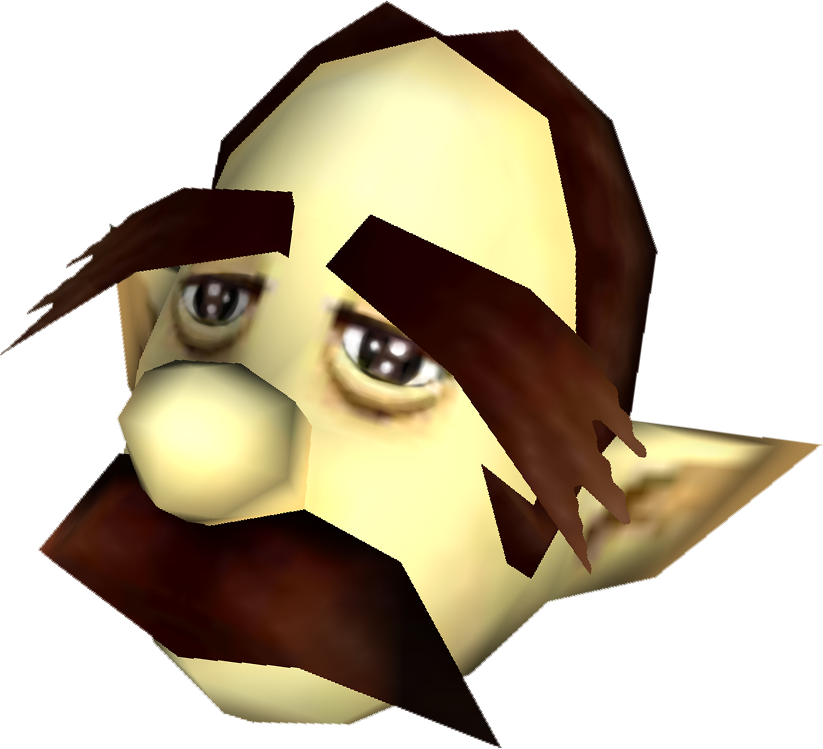
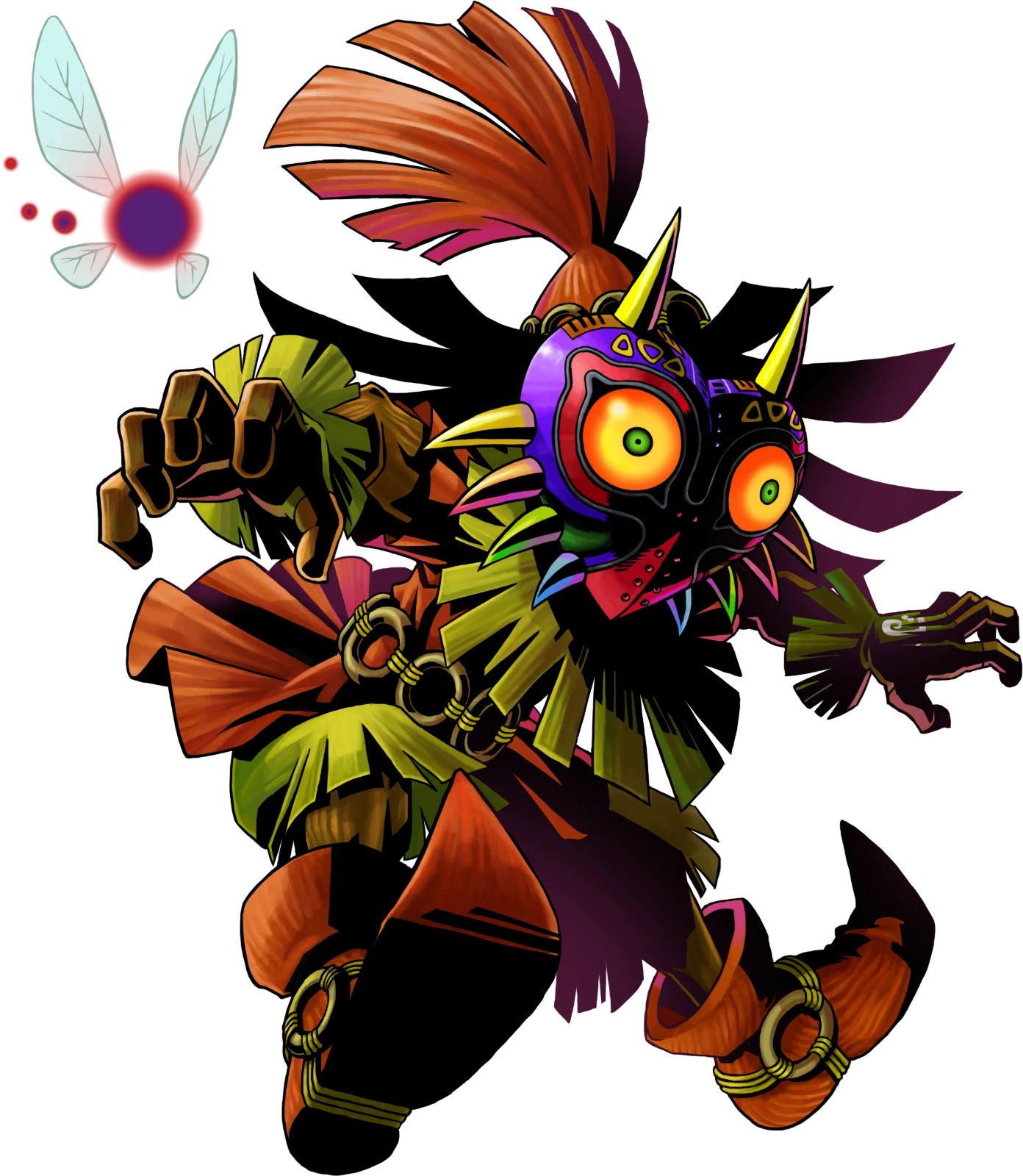
Official art of the Skull Kid from Majora’s Mask 3D.
Nothing in the story has been changed. Some months after Ocarina of Time, Link is riding through a misty wood in search of a lost friend when a Skull Kid in a spiked, heart-shaped mask waylays him and makes off with the Ocarina of Time. Link gives chase, tumbles down a hollow tree and is cursed into the body of a Deku Scrub. With Tatl, the sharp-tongued fairy the Skull Kid leaves behind, he comes out inside the Clock Tower of Clock Town, in a land called Termina, where the Happy Mask Salesman is waiting with an offer and a deadline.
Termina has three days left. The moon is sinking towards Clock Town and will hit the ground at the end of the third night. Link wins back his ocarina at the last moment, plays the Song of Time and wakes at dawn on the first day, and from then on the game is a loop. Seventy-two hours at a time he cleans the poisoned swamp at Woodfall, ends the long winter at Snowhead, clears the murky waters of Great Bay and brings peace to the dead of Ikana, freeing one of the Four Giants in each temple. The Song of Healing draws his own curse out into the Deku Mask, and later turns the spirits of the Goron hero Darmani and the Zora guitarist Mikau into masks that let Link take their shapes.
Between temples there is a town full of people to help, none more memorable than Anju and Kafei, the engaged couple kept apart by the Skull Kid’s magic. When all four Giants are free, Link calls them with the Oath to Order and they catch the moon; Majora’s Mask then casts off its puppet and flees inside it, for a last battle that begins in a strangely sunny meadow. The remake tells all of this as it was told in 2000. For the whole tale, with every region and character, see the story on our Majora’s Mask page.
Special editions, bundles & guides
Majora’s Mask 3D arrived with an unusual amount of fanfare: boxed special editions on both sides of the Atlantic, a gold console that sold out within minutes, and extras that differed in every region.
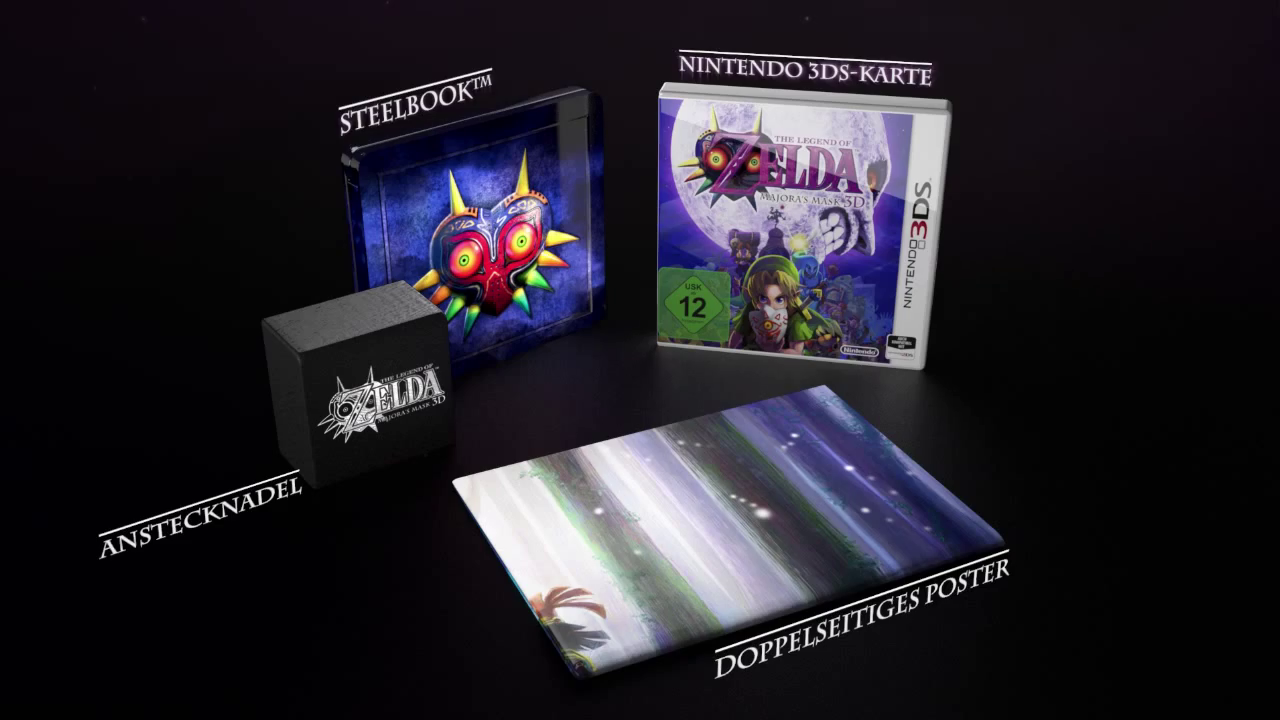
Special Edition (Europe)Nintendo · 13 February 2015Announced alongside the game in November 2014 and made in limited numbers: a SteelBook case, the game in its normal packaging, a Majora’s Mask pin badge and a double-sided poster.
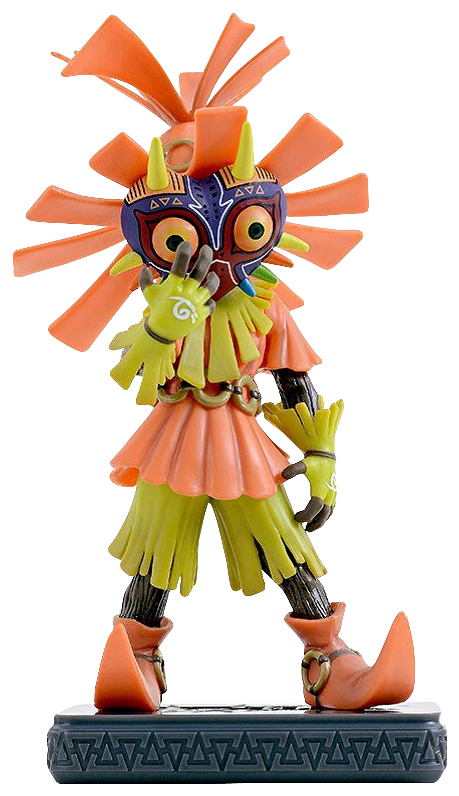
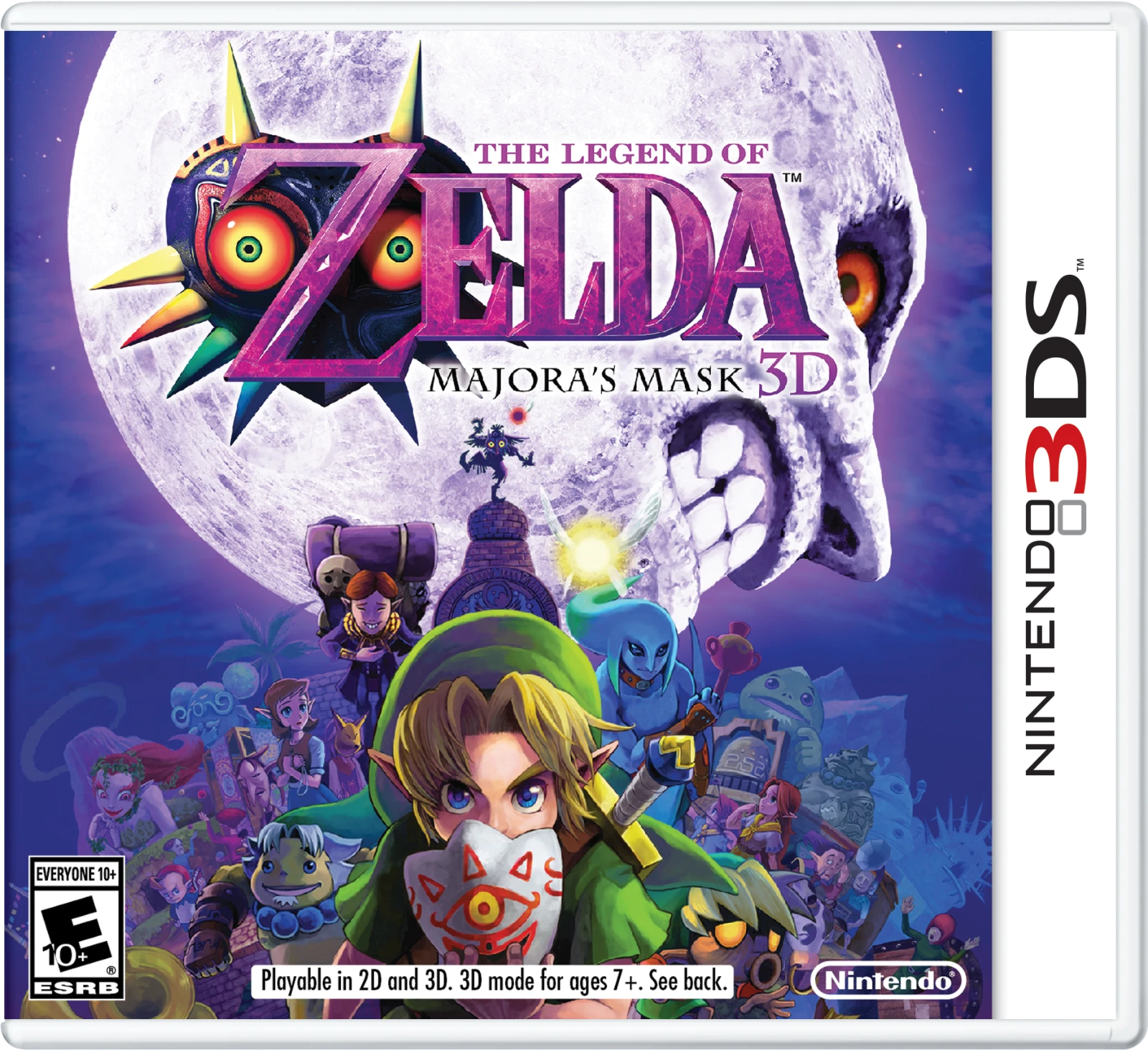
Limited Edition (North America)Nintendo of America · 13 February 2015 · $49.99Announced on 6 January 2015: the game packed with a figurine of the Skull Kid wearing the mask. It cost $54.99 in Canada.
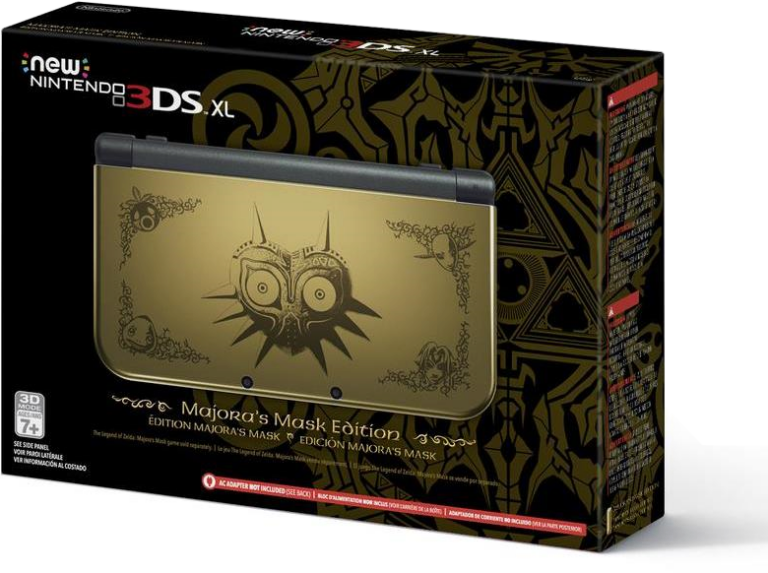
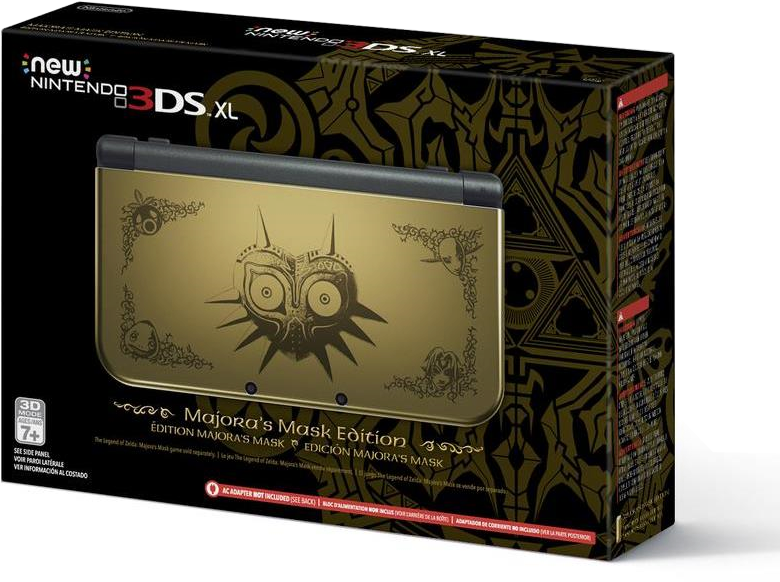
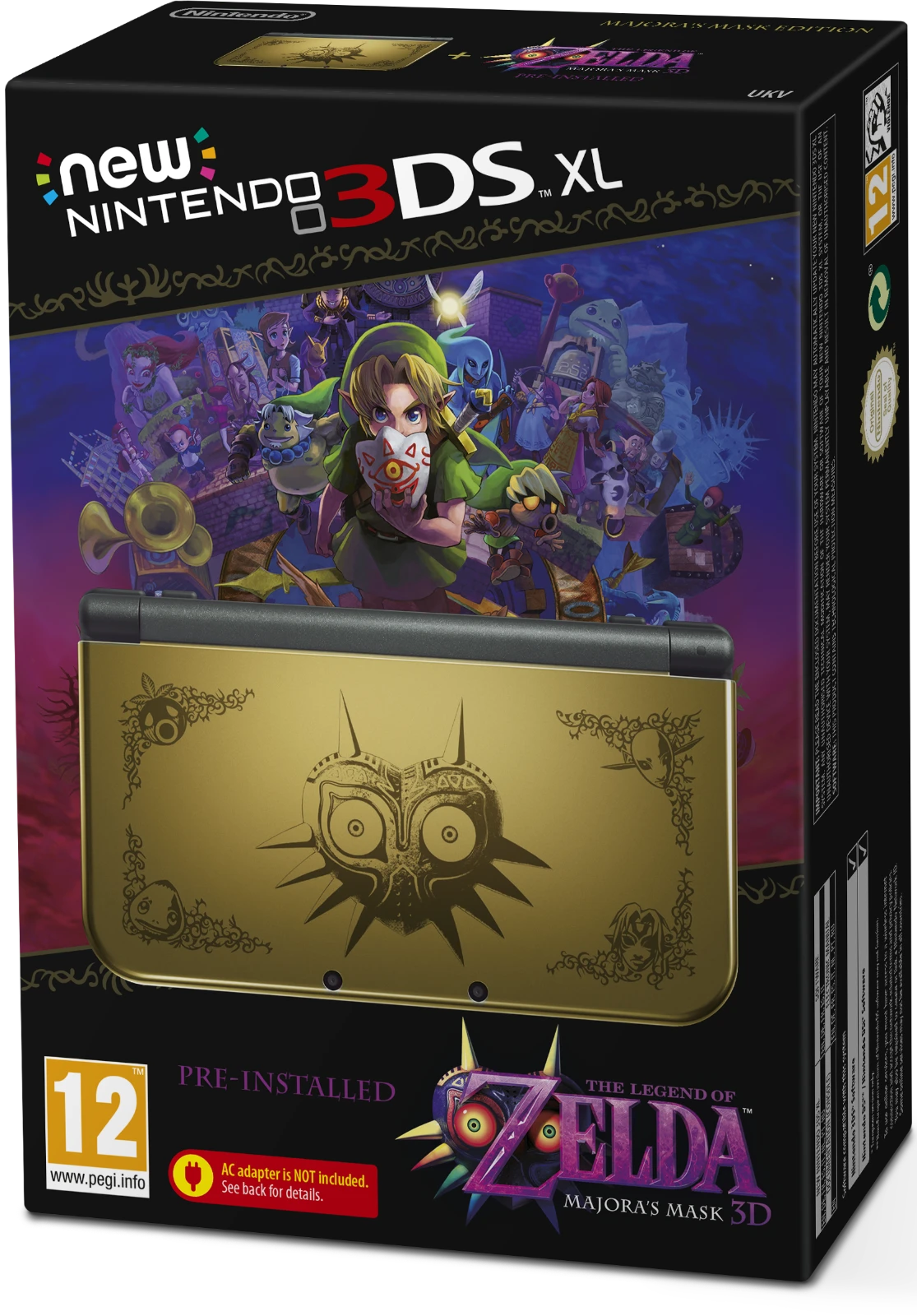
New Nintendo 3DS XL Majora’s Mask EditionNorth America and Europe · 13 February 2015A black New Nintendo 3DS XL with a gold top and bottom, decorated with Majora’s Mask and other masks from the game. In North America it cost $199.99, the same as the plain red and black models, and came with neither the game nor an AC adapter. Online pre-orders opened on the morning of 14 January 2015 and were gone within minutes, and Game Informer found finished eBay auctions at up to $500 the same day. The European console had the game pre-installed, and Nintendo’s own UK store sold it with a wall charger and the Skull Kid figurine; that bundle had to be restocked at the end of January.
New Nintendo 3DS LL Majora’s Mask 3D Pack (Japan)Nintendo · 14 February 2015 · ¥23,000 before taxJapan’s limited-quantity version of the console, with the download edition of the game supplied on a microSDHC card. No AC adapter was included.
Cover plates and HOME Menu themes (Japan)Nintendo · February and April 2015Two Majora’s Mask kisekae plates for the smaller New Nintendo 3DS, numbers 055 (2 April 2015) and 056 (14 February 2015), at ¥2,000 each before tax, plus two HOME Menu themes at ¥200 each from launch day.
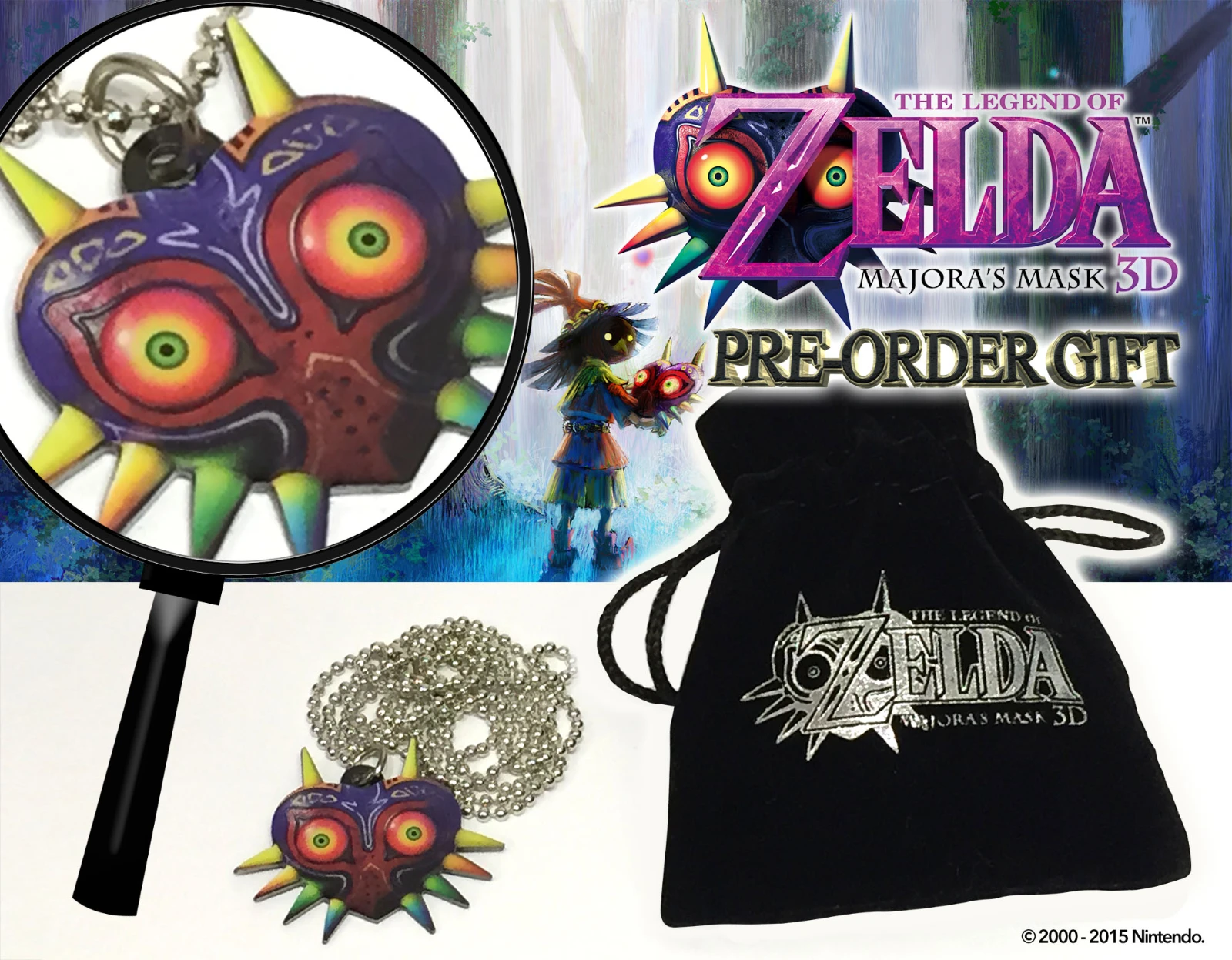
Pre-order giftsRetailers · early 2015GAME in the UK offered a Majora’s Mask paperweight with the standard edition; other European retailers gave away a necklace and a black sack printed with the logo; Amazon Japan included a set of 24 postcards. In the United States, GameStop handed out the European edition’s pin badge with pre-orders of Code Name: S.T.E.A.M.
Official guidebooks (Japan)Shogakukan and KADOKAWA · 14 February 2015Two guides came out with the game at ¥1,300 each before tax: Shogakukan’s 224-page Nintendo Official Guidebook, which lists every Bombers’ Notebook entry, Piece of Heart and all 24 masks, and the 384-page Perfect Guide from KADOKAWA and Enterbrain.
Nintendo SelectsNorth America · 4 February 2019 · $19.99The game joined Nintendo’s budget range in North America four years after launch, on the same day as Super Mario Maker for Nintendo 3DS and Star Fox 64 3D.
How it was made
Nintendo told most of this story itself. For the launch in February 2015 Satoru Iwata sat down with Eiji Aonuma, Grezzo’s Mikiharu Ooiwa and Nintendo’s Tomohiro Yamamura and Tomomi Sano for an Iwata Asks interview, the one with which he restarted the series after a break for surgery and illness. The fans’ side of the story began three and a half years earlier.
The people behind the remake
A small cast, split between Grezzo in Tokyo and Nintendo in Kyoto.
Eiji AonumaProducer (Nintendo); co-director of the 2000 originalReplayed his own game at Miyamoto’s insistence, wrote the first draft of the “what in the world” list and steered the changes while also making A Link Between Worlds.
Mikiharu OoiwaDirector (Grezzo)Presented Grezzo’s new ideas to Miyamoto at the end of 2011 and was made director partway through, at Aonuma’s request.
Koichi IshiiProducer (Grezzo)Founder and president of Grezzo, set up in December 2006, and known before that for his work on Square Enix’s Mana series.
Tomohiro YamamuraNintendo Software Planning & Development, liaisonThe go-between who carried Aonuma’s wishes to Grezzo and Grezzo’s answers back, and who compiled the final list.
Tomomi SanoNintendo Software Planning & Development, liaisonJoined for the second half to judge which of the testers’ trouble spots were unfair and which were fair challenge. A fan of the original who never finished it.
Shigeru MiyamotoNintendoProposed the remake, would not let Aonuma duck it, and heard Grezzo’s pitch.
Shingo Watanabe and Tatsuya AwataProgrammer and artistThe remake’s credited lead programmer and artist, according to Wikipedia’s staff summary.
Koji KondoComposerCredited as composer, as he was on the Nintendo 64 game.
Satoru IwataPresident of Nintendo; interviewerInvited Grezzo to Kyoto to see the unannounced New Nintendo 3DS, and came back from illness to host the launch interview.
Operation Moonfall: the fans ask first
The Majora’s Mask that fans spotted in A Link Between Worlds in 2013.
The campaign for a 3DS Majora’s Mask began almost as soon as Ocarina of Time 3D reached the shops in June 2011. In an interview with Nintendo Power, Eiji Aonuma said fan demand had helped that remake happen, and that with a similar show of interest the same treatment for Majora’s Mask was “not an utter impossibility”. Fans took him at his word. On 25 July 2011 Zelda Universe, together with Zelda Informer and other fan sites, launched Operation Moonfall, named after Operation Rainfall, the campaign to bring three Wii role-playing games to North America. Supporters were asked to sign a petition, write politely to Nintendo and make themselves heard on Facebook and Twitter.
The petition passed 10,000 signatures in five days and 16,000 inside a week, reached 35,000 by late September 2011 and stood at more than 50,000 by the autumn of 2012. A Nintendo of America representative replied to one supporter’s email that the comments had been passed on and that “no official announcements have been made”. Aonuma told GamesRadar in November 2011 that he had heard about the website and hoped to do something with the game one day. In October 2013, asked about a remake in a question-and-answer session on his next game, he said that anyone who played through A Link Between Worlds “may find an answer”, and a Majora’s Mask had indeed been spotted in footage of that game.
Nintendo of America’s president, Reggie Fils-Aimé, was cooler. Asked by Siliconera in late 2013 about fan campaigns of this kind, he said they did not drive Nintendo’s decisions: “100,000 signatures doesn’t mean 100,000 sales”. What nobody outside Nintendo knew was that the remake had been in production the whole time.
The lid Aonuma did not want to open
Eiji Aonuma, co-director of the original and producer of the remake, with a Zora Mask.
Inside Nintendo the push came from Shigeru Miyamoto. He proposed putting Majora’s Mask on the 3DS because he believed many people had abandoned the Nintendo 64 game partway through and never saw most of what the team had made. Tomomi Sano, one of Nintendo’s two liaisons on the remake, was exactly that player: a fan who had played it when it was new and could not clear it.
Aonuma accepted the argument and still could not say yes. He had made the original as a much younger man, against a one-year deadline, and told Iwata he would rather have pretended the whole thing had never happened. Miyamoto would not let him off, and asked him to play the entire game again and judge it as a player of today would. Iwata likened that to rubbing salt into a wound; an old wound from fifteen years ago, Aonuma agreed. He did it anyway, and by the end of the interview he told Iwata he was “really glad” he had opened that lid again.
What he found were moments that made him say “what in the world?!” about his own work. Zelda games, he explained, usually carry you through the hard stretches because you sense something good waiting ahead; in the Nintendo 64 Majora’s Mask some of those promises led nowhere, and some secrets had no clues at all. Sano put the player’s side of it: losing is fine when you can blame yourself, but the original sometimes gave no visible reason for a failure, and that is when people give up.
Grezzo and the “what in the world” list
Grezzo had earned the job with Ocarina of Time 3D. Aonuma said the studio knew the old program so well from that remake that it could find its way around Majora’s Mask quickly. By his later account on Miiverse, work started almost immediately after Ocarina of Time 3D was finished; that game came out in June 2011. Grezzo’s team began by playing the Nintendo 64 version exhaustively, capturing video and drawing up notes of its own. When Aonuma asked for new ways to play as well as repairs, the studio brainstormed a set of ideas and presented them to Miyamoto, through Aonuma, near the end of 2011. Ooiwa remembered being nervous. It went well.
The famous list came afterwards. Aonuma drafted it from his replay, Yamamura played each item to confirm it, the testers at Mario Club played them too, and everything was merged into one document and handed to Grezzo with a question: where shall we start? Aonuma’s comments ran all the way through it, some of them closer to confessions than instructions, and by Ooiwa’s account he said much the same thing at every meeting. In the end, Ooiwa said, every item on it was fixed.
Aonuma had meant to run the project himself and at first thought a remake needed no director at all; Ocarina of Time 3D had not had one. But he was also making A Link Between Worlds, a brand-new game released in November 2013, and could not give the remake the time. Partway through he asked for Ooiwa to be made director, something Ooiwa learned the reason for only during the interview. Ideas from A Link Between Worlds kept spilling over into Majora’s Mask, which helps to explain why the remake took, by Iwata’s reckoning, about three times as long to make as the original.
Fairer, not easier
Goht’s new eye, one of the weak points added to the redesigned bosses.
The rule behind every fix was Aonuma’s: never make the game easier. The three-day limit stayed because, as Iwata put it, the game would be forgettable without it, and Sano added that reaching the end without once seeing the moon fall would leave little impression either. Yamamura said the team agreed early on what to mend and what to leave alone, and turned down the easy option of showing players the answers. Sano’s job in the second half of development was to go through the problems reported by Mario Club and decide which should be fixed and which were simply the game being hard.
The boss fights were Aonuma’s chief example and the Bombers his chief regret; both are described under what changed. Grezzo brought plenty of proposals of its own. Aonuma admitted he turned many down as too over the top, but said the studio also caught problems Nintendo had missed, and that its contribution went well beyond what a remake normally asks of a developer. “Although this is technically a remake,” he said, “we’ve crammed in a ton of new elements into this game.”
A secret trip to Kyoto
A Zelda-themed New Nintendo 3DS, the model with the C-Stick.
In the second half of development, with the conversion largely done and the new material going in, the routine changed. Meetings were normally held at Grezzo’s office in Tokyo, but this time, Ooiwa recalled, Iwata proposed: “How about having a meeting in Kyoto for a change?” The reason was a console that had not been announced. In Kyoto the team was shown the New Nintendo 3DS, with its extra C-Stick, and Aonuma reacted on the spot: “I immediately requested to add a feature to spin the camera with the C-Stick in-game.” A free camera was something he had first used in The Wind Waker.
It was a lot to ask so late. Because the hardware was secret, only a few people at Grezzo, such as the programmers responsible, could be told. Majora’s Mask also has more camera routines than Ocarina of Time, with separate ones for climbing ladders, for flying as Deku Link and so on, and Link’s forms are different heights, so each needed its own treatment. A camera that could look anywhere also exposed corners players were never meant to see. Aonuma owned up that the game probably took so long partly because “we were waiting for the New Nintendo 3DS systems to arrive!”
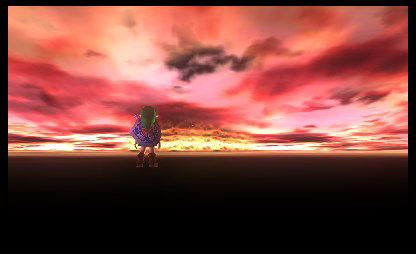
The reward, for the team, was the moon. On the Nintendo 64 it was hard to get a clear look at it; now you can tilt the camera up at any moment and watch it grow. “But now, you can enjoy gazing at the Moon whenever you want!” said Sano. Aonuma also found that the new console’s face-tracking stopped the 3D picture from blurring, so he could play with the 3D on without strain. Owners of older 3DS models get the same camera from the Circle Pad Pro accessory.
Reveal, launch and patch
Majora’s Mask 3D in a Nintendo Direct.
Nintendo announced the remake in a Nintendo Direct on 5 November 2014, for release the following spring, and Europe’s Special Edition was confirmed straight away. Iwata said the reaction was much stronger than Nintendo had expected. Three days later Aonuma wrote on Miiverse that the team had stayed silent until it could say with confidence that “this is not going to be just another remake”, and that whenever fans had asked him about one he had been silently pleading with them to wait a little longer. Speaking to Famitsu that month he promised two fishing ponds and insisted, again, that the game had not been made easier.
A second Direct on 14 January 2015 fixed the date: 13 February in North America and Europe, the day the New Nintendo 3DS went on sale there, with Japan and Australia a day later. (Japan already had the new console, since October 2014, and Australia since November.) In North America the game shared its launch day with Monster Hunter 4 Ultimate. In Japan, Aonuma promoted it with “Termina Quest”, a series of videos on Nintendo’s website and YouTube channel in which he played the mini-games himself. A version 1.1 update followed at the end of February to fix a handful of bugs.
Secrets & extras
There are still no button codes in Termina, but the remake adds a good few secrets of its own. These are the new ones. The classics, from the Fierce Deity’s Mask to Chateau Romani, are on our Majora’s Mask page.
The two fishing holes
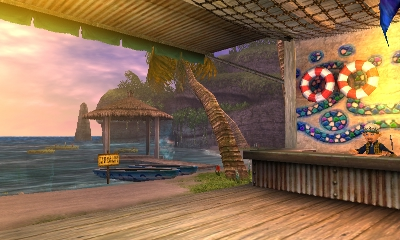
The Swamp Fishing Hole.
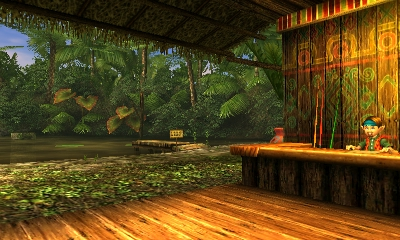
The Swamp Fishing Hole is on the road to the Southern Swamp, next to the Swamp Shooting Gallery; the Ocean Fishing Hole is at Zora Cape and is run by the swamp owner’s younger brother. A session costs 50 Rupees, and you choose between a standard rod and one with a sinking lure. Each hole has twelve kinds of fish, and Zora Link can scout the water before you pay.
Masks as bait
Romani’s Mask, bait for the Mooranha.
Many of the fish respond to masks. In the swamp, the Mooranha comes to Romani’s Mask, the Postal Salmon stops for the Postman’s Hat, the Cuccofish follows the Bremen Mask’s march and the Fragrant Reekfish is given away by the Mask of Scents, while Epona’s Song draws the Sweet Ranchfish. At sea, the Bashful Angler approaches the Stone Mask, the Dancing Sea Bream likes Kamaro’s Mask, the Skullfish comes by night to the Captain’s Hat, the Nuptuna to the Couple’s Mask and the Fairy Fish to the Great Fairy’s Mask. Keep a Fairy Fish on the line and the Great Fairy Fish may take it as bait.
The big ones
The Grand Swordfish, one of the Ocean Fishing Hole’s big catches.
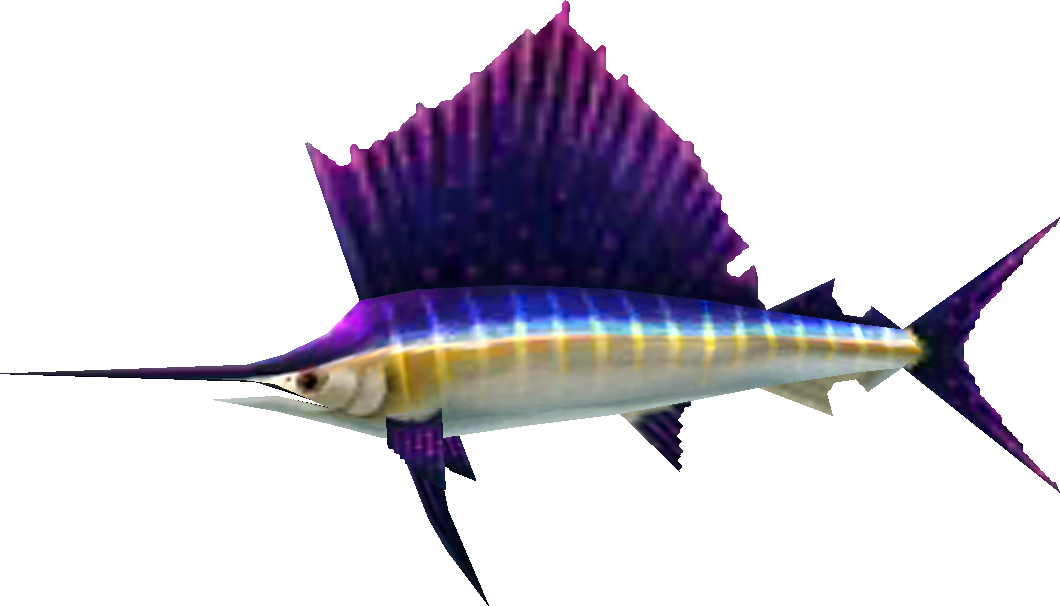
The swamp’s giants are announced by the boss music. The Ferocious Pirarucu goes for a small fish already on your hook, and the Colossal Catfish appears only on the final day, when Goron Link’s ground pound or the day’s earth tremors reveal its shadow. Lord Chapu-Chapu is missing from the posters, looks very like Lord Jabu-Jabu and turns up only after several rare catches in one visit. The ocean has heavyweights of its own in the Grand Swordfish and the Savage Shark.
Fishing Hole Passes
A Fishing Hole Pass.
A pass buys one free session. Passes take the place of Purple Rupees and other consolation prizes in some mini-games and side quests once you already have the main reward.
The Fierce Deity goes fishing
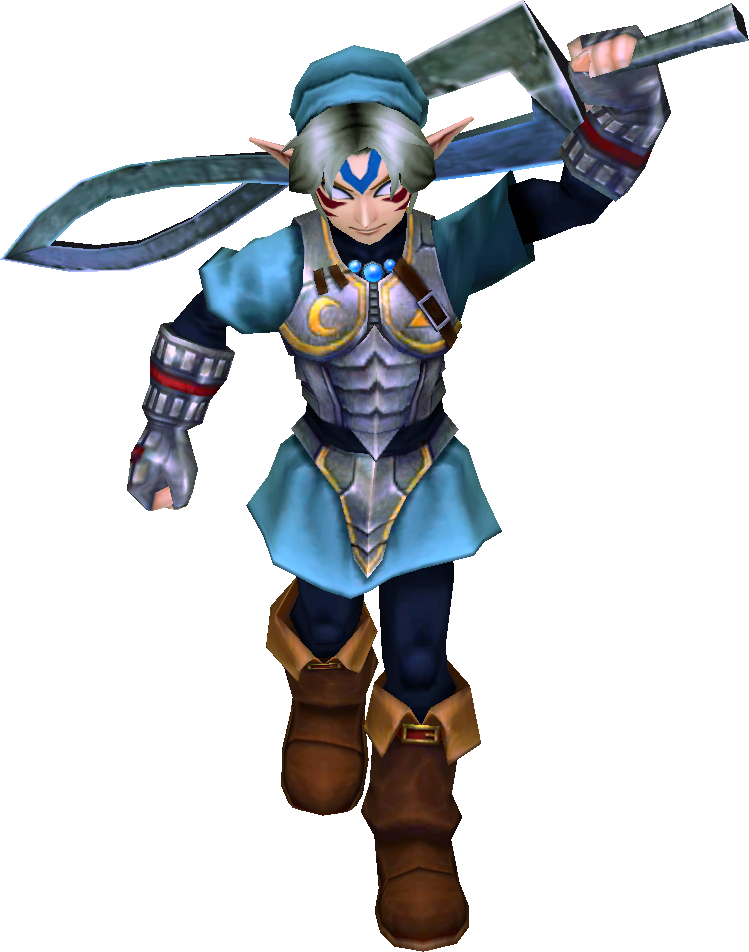
Fierce Deity Link: boss rooms and, now, fishing holes.
The Fierce Deity’s Mask normally works only in boss rooms. In the remake the two fishing holes are the one other place it can be worn, though Link cannot fight in there or leave until he takes it off.
A seventh bottle
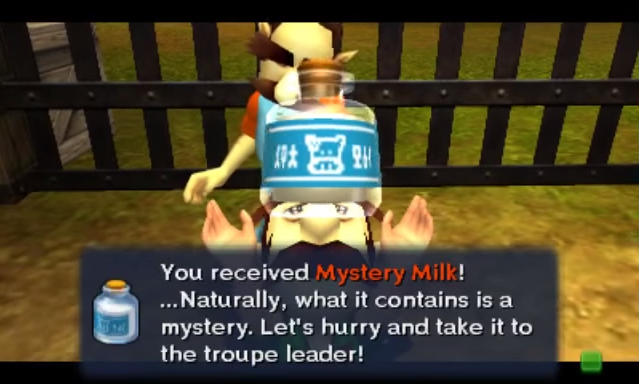
Mystery Milk: deliver it before it turns.
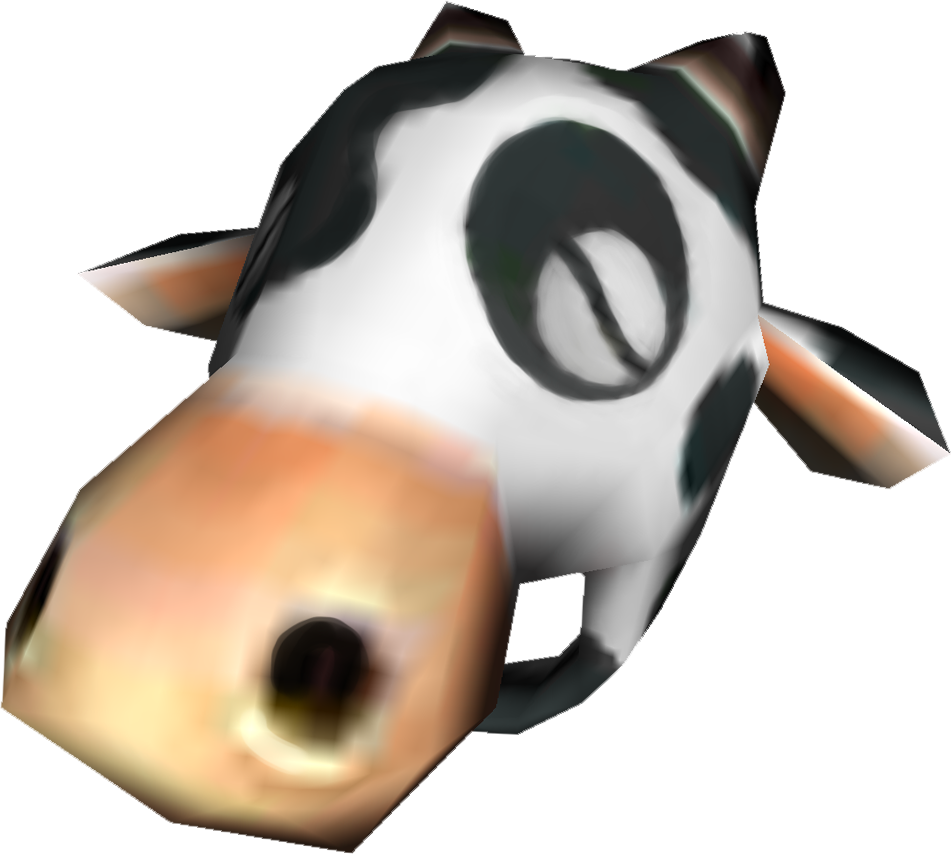
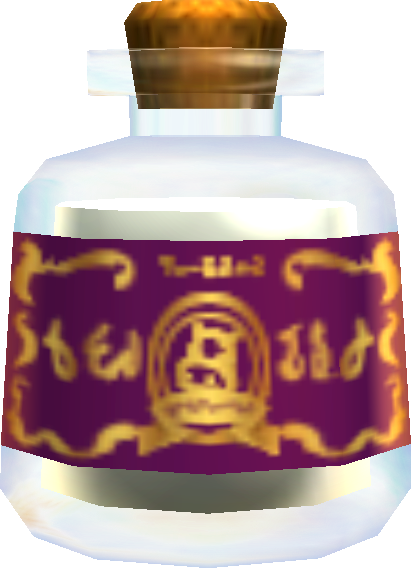
Wear the Troupe Leader’s Mask and speak to Gorman as he lies in bed at the Stock Pot Inn on the morning of the second day, and he asks for a special milk to settle his stomach. That afternoon, still wearing the mask, see the Gorman brothers at their track for a bottle of Mystery Milk, then hurry: it goes off in about two minutes. Get it to him in time and Gorman lets you keep the empty bottle.
Keep everything after the credits
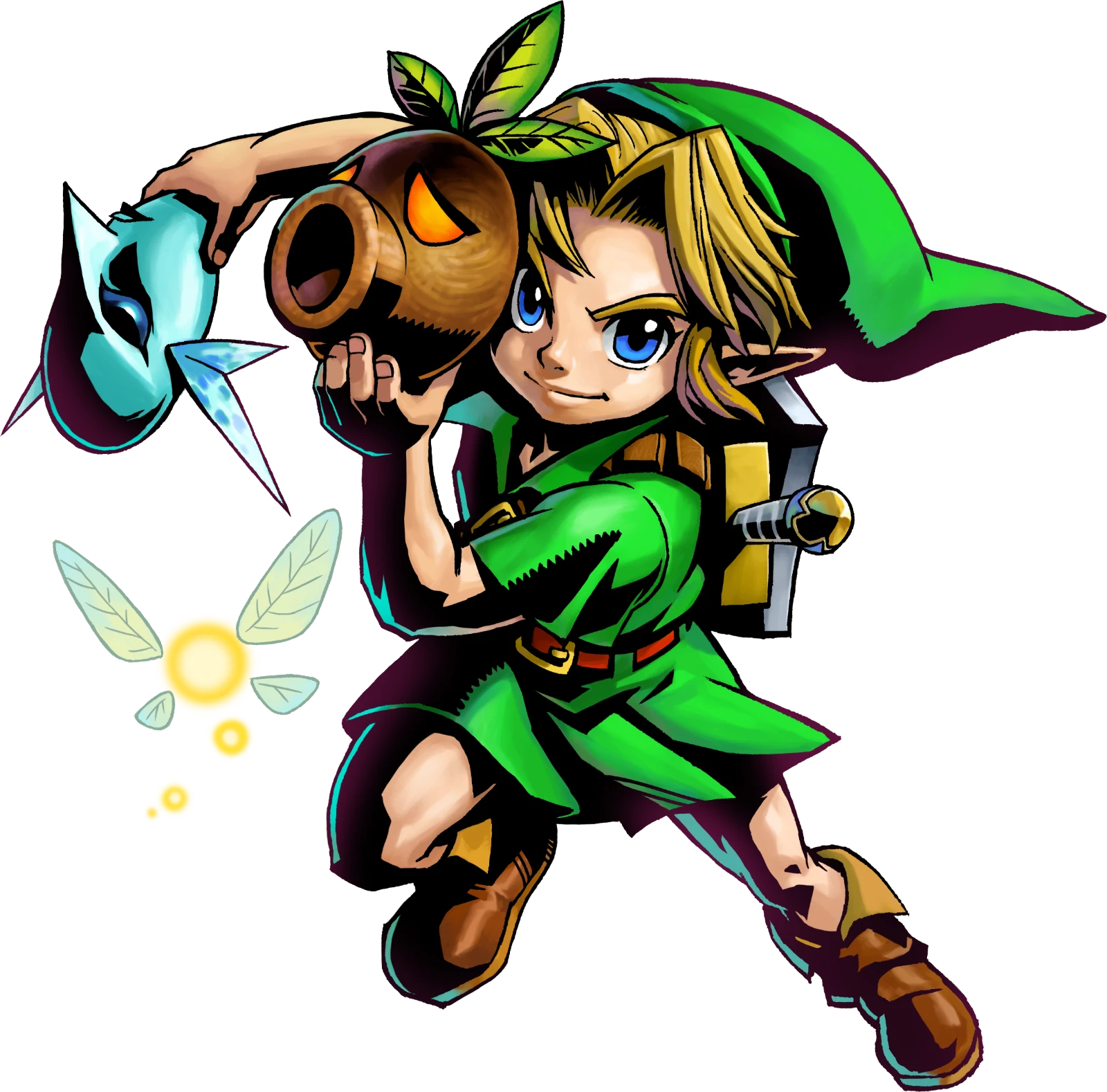
Official art of Link and his masks.
The game offers a save once the credits have finished. Load it and Link is back on the first day with every mask he owned, the Fierce Deity’s Mask included.
Visions for collectors
The Sheikah Stone’s Visions screen.
The Sheikah Stone in the Clock Tower does more than nudge you through the story. Its Visions also show where Pieces of Heart and Stray Fairies are hidden.
Swim like the old days
Chateau Romani, the milk that gives unlimited magic.
Chateau Romani gives Link unlimited magic until the cycle ends. Since Zora Link’s fast swim now runs on magic, a bottle from the Milk Bar is the simplest way to tear around Great Bay as you could on the Nintendo 64.
Checked against the Zelda Dungeon wiki, the Zelda Wiki on Fandom and Nintendo’s own pages, November 2026.
Glitches, fixes and oddities
The remake put right some of the original’s bugs, added a few of its own and left a trail of curiosities in its files. Most of what follows was documented by The Cutting Room Floor.
Version 1.1
Honey and Darling’s shop, home of one of the glitches that version 1.1 fixed.
A free update at the end of February 2015 (The Cutting Room Floor dates it to the 26th; Nintendo’s support note is dated the 27th) fixed four things. Two were tricks inherited from the Nintendo 64 game: hanging off a ledge in Honey and Darling’s shop just as the timer ran out could leave Link without his sword and with the Ocarina of Time on the B button, and a bottle-duplication glitch let masks overwrite bottles. Two were new: the European English version froze if you deposited 0 Rupees at the bank, and talking to the Gorman brothers in a certain order produced a message reading “ERROR!”. Later Game Cards have the update built in.
Old faults put right
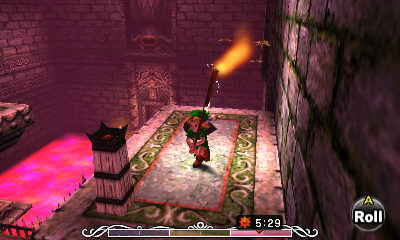
A torch in Woodfall Temple in the 3DS remake.
On the Nintendo 64 the bases of the metal torches show garbled textures that change as Link swaps masks; the remake finally fixed them. It also corrected the names of the Dinolfos and the Wizzrobe, which the original had misspelled.
New bugs
The Laundry Pool, where the moon sometimes fails to appear.
The Zelda Wiki’s list of the remake’s own bugs includes a moon that fails to appear over the Laundry Pool on certain days, a workman carrying a beam in South Clock Town who stops moving whenever he is off screen, and Gorman facing the wrong way as he sets off for the mayor’s residence.
Ganondorf, gone fishing
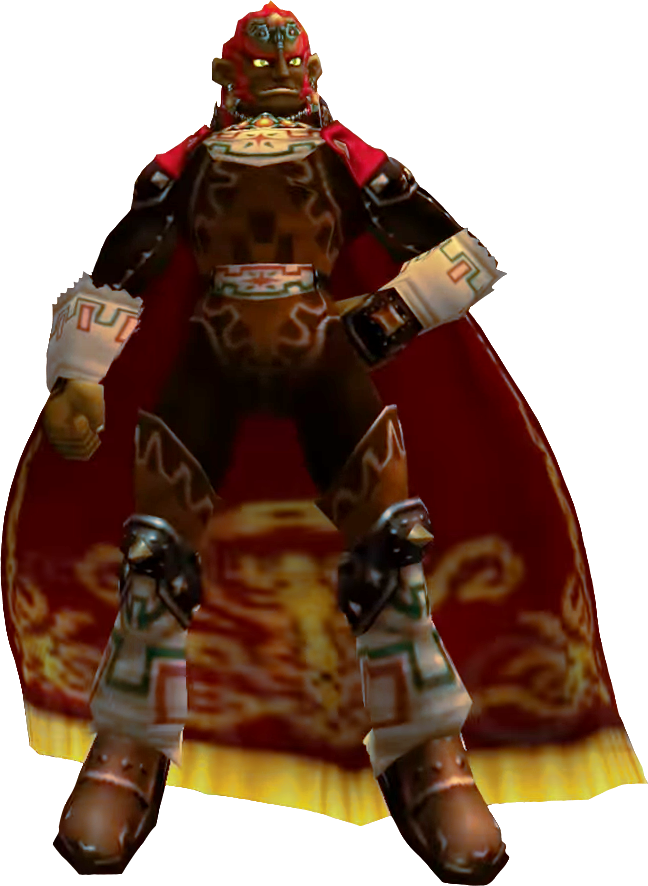
Ganondorf’s Ocarina of Time 3D model, a copy of which sits unused in this game’s files.
Among the unused files are Ocarina of Time 3D’s Ganondorf and Sheik (complete with harp), stored as “fishing man” models, and Impa as the “fishing woman”. Going by the file names they were connected with the fishing holes in some way. Saria and her Fairy Ocarina are in there too, along with two pictures from Ocarina of Time 3D’s ending and that game’s logo.
Built on the Japanese game
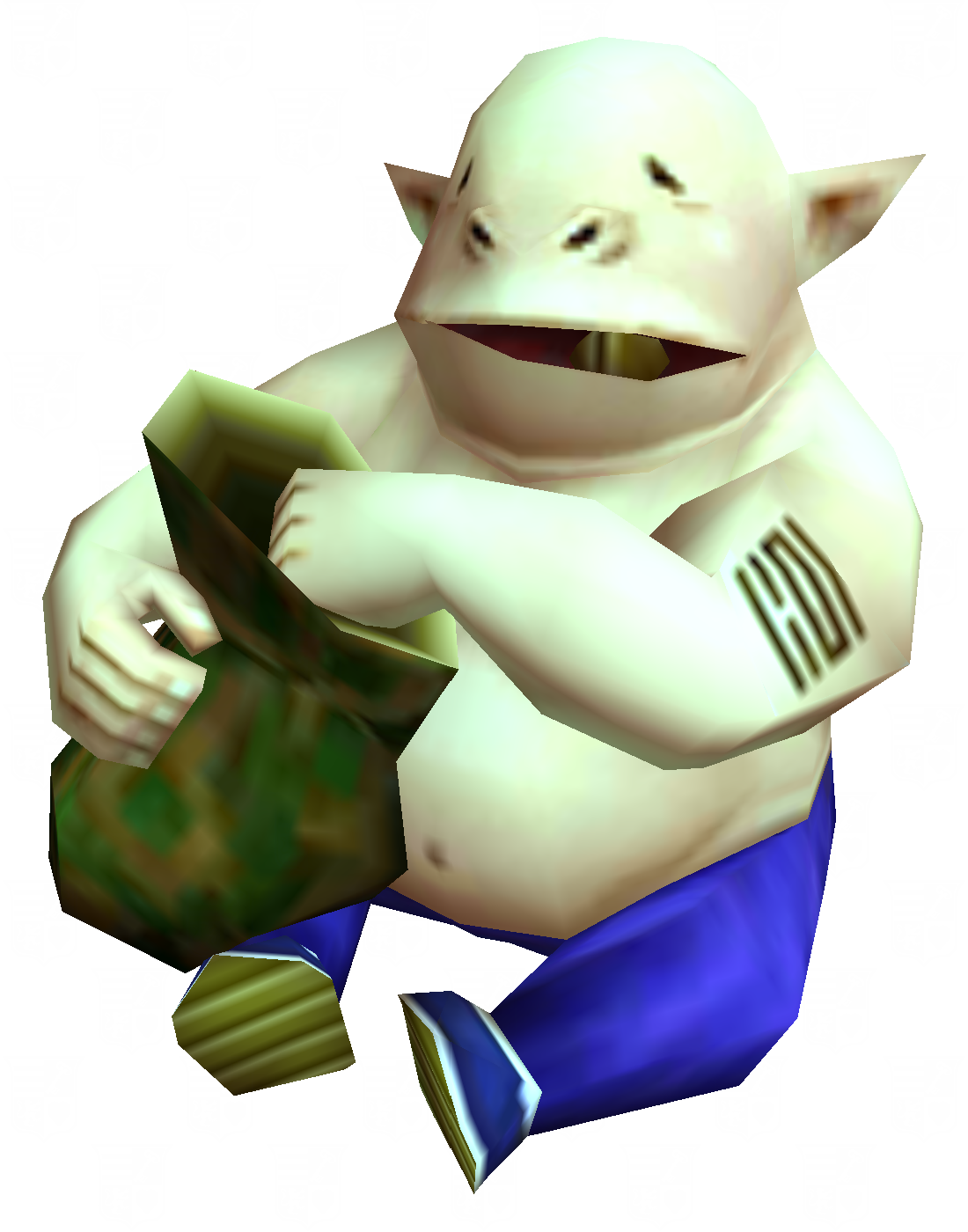
The bean seller, whose Deku Palace grotto changed between versions.
According to the Zelda Wiki, drawing on The Cutting Room Floor’s comparison of the Nintendo 64 revisions, the remake is based mostly on Japanese version 1.1 of the original, which was less polished than the game the rest of the world received. The test map from the Japanese Nintendo 64 game came across with it, complete with an owl statue on its stairs, and map data survives for the grottoes that the Japanese version made you cross to reach the Deku Palace bean seller.
Things left unfinished
A placeholder picture for a Bombers’ Notebook quest map says there is no map yet, which points to a feature that was planned and dropped. There are unused notebook icons for Professor Shikashi and for another cursed Skulltula, and a temporary icon marked “KARI”, Japanese for provisional. The European game carries a language file containing the single word “Link”, whose name hints that a Dutch translation was once considered. The Sun’s Song is still among the sound files, unused.
Speedrunning the remake
The Zelda Wiki’s table of records, as it stood in November 2026, credits every main category to one runner, iwabi74: 33 minutes 23 seconds for any% (March 2021), 1 hour 33 minutes 35 seconds without wrong warps and 2 hours 52 minutes 1 second glitchless (both January 2022), and 5 hours 21 minutes 34 seconds for 100% (March 2019).
Videos & media
Two official films from Nintendo UK’s YouTube channel: the gameplay trailer from January 2015, which showed how much had changed, and the trailer for the European Special Edition.
Nintendo UK’s gameplay trailer (January 2015), which shows the redesigned bosses, eyes and all, and giant Link taking on Twinmold with his fists.
Nintendo UK’s trailer for the European Special Edition, with its SteelBook, pin badge and poster.
Trivia & facts
Inside its own files the game is called “Joker”. Zelda projects of the period shared a playing-card theme: Ocarina of Time 3D was “Queen”, The Wind Waker HD “King”, A Link Between Worlds “Jack” and Tri Force Heroes “Alice”.
Aonuma’s last word in the Iwata Asks interview, after a whole conversation spent owning up to his younger self’s mistakes: “My traumas from 15 years ago have finally disappeared!”
Tomomi Sano, who judged the remake’s difficulty for Nintendo, had played the Nintendo 64 game as a fan when it was new and never finished it. Aonuma kept asking how each change would feel to a player like that.
The Clock Town shooting gallery.In Nintendo’s Japanese “Termina Quest” videos, Aonuma hit a perfect score in the Clock Town archery game on his third try with the gyro controls, a success he put down partly to Grezzo’s adjustments to the game’s timing. He told Iwata he had never managed one on the Nintendo 64.
The New Nintendo 3DS was still a secret when Grezzo first saw it. The invitation, as Ooiwa remembered it, was simply: “How about having a meeting in Kyoto for a change?”
The North American box of the New Nintendo 3DS XL Majora’s Mask Edition.The North American Majora’s Mask Edition console sold out online within minutes on 14 January 2015. The same day, pre-orders were changing hands on eBay for as much as $500, two and a half times its $199.99 price.
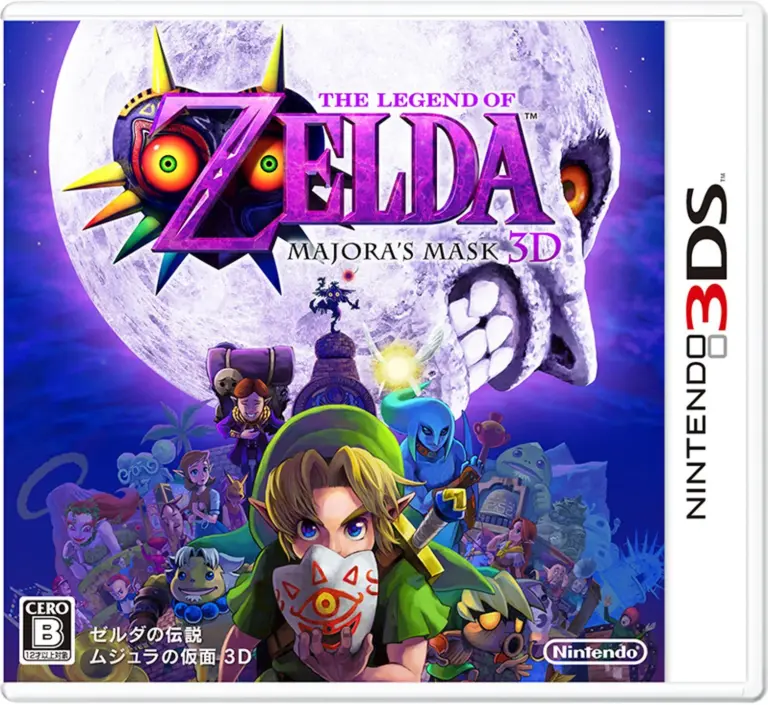
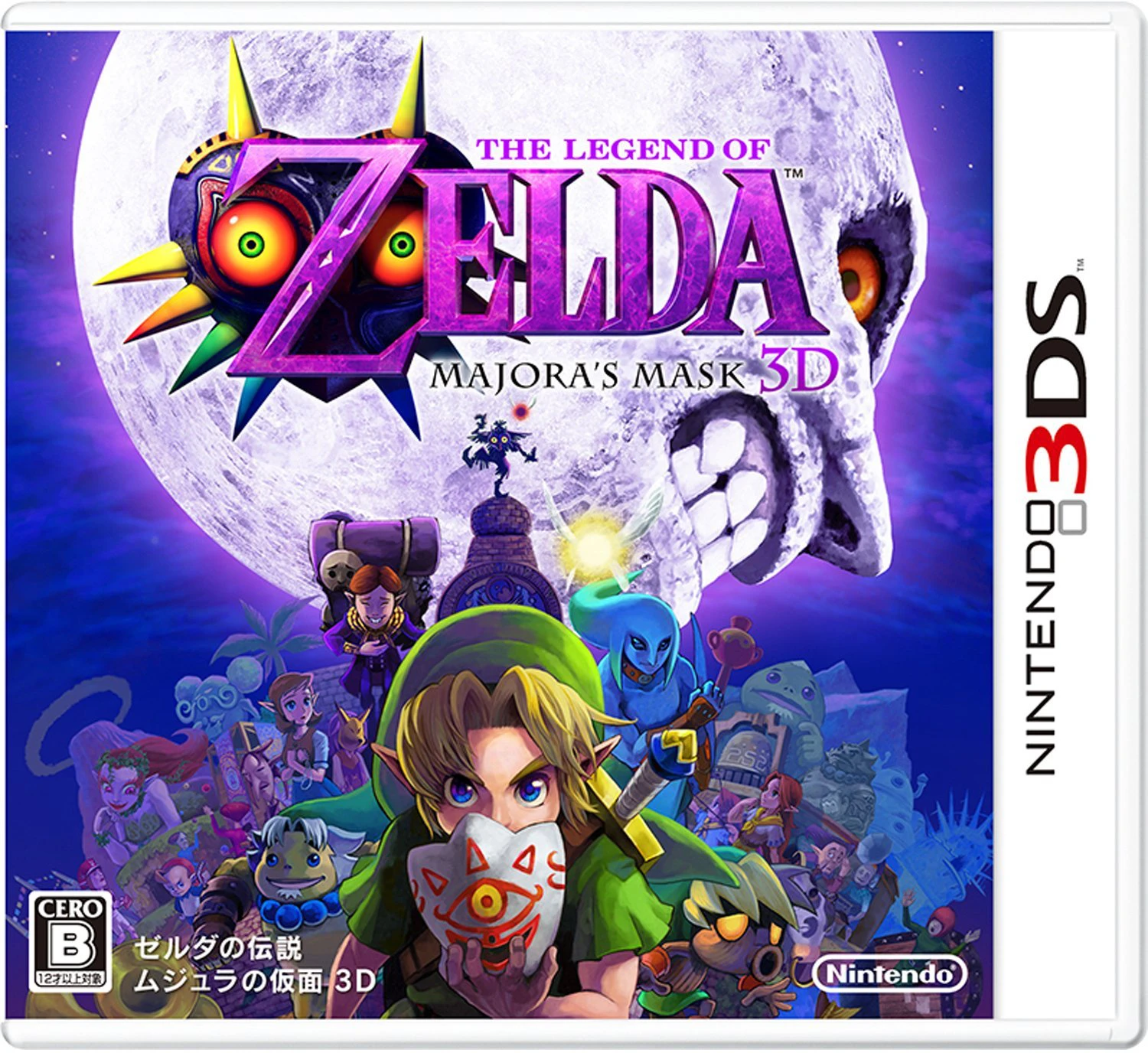
The Japanese box.In Japan the game sold 230,065 copies in its first week, a bigger opening than either Ocarina of Time 3D (164,110) or A Link Between Worlds (224,143).
Nintendo of America called it the fastest-selling handheld Zelda in US history after it sold more than 515,000 copies there in February 2015.
The Troupe Leader’s Mask, once the Circus Leader’s Mask.Two masks were altered for the remake: the Circus Leader’s Mask was renamed the Troupe Leader’s Mask, and Garo’s Mask was redrawn to resemble the Garo Master.
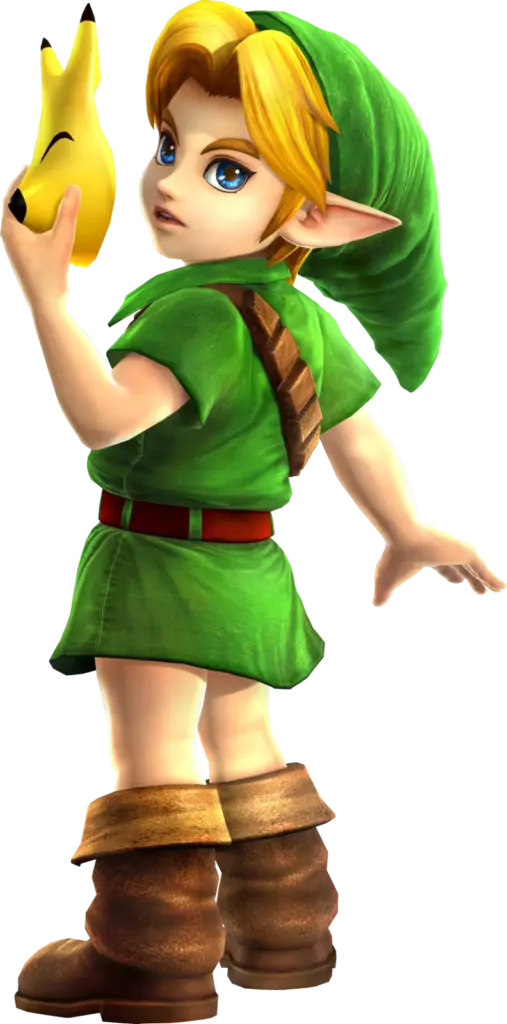
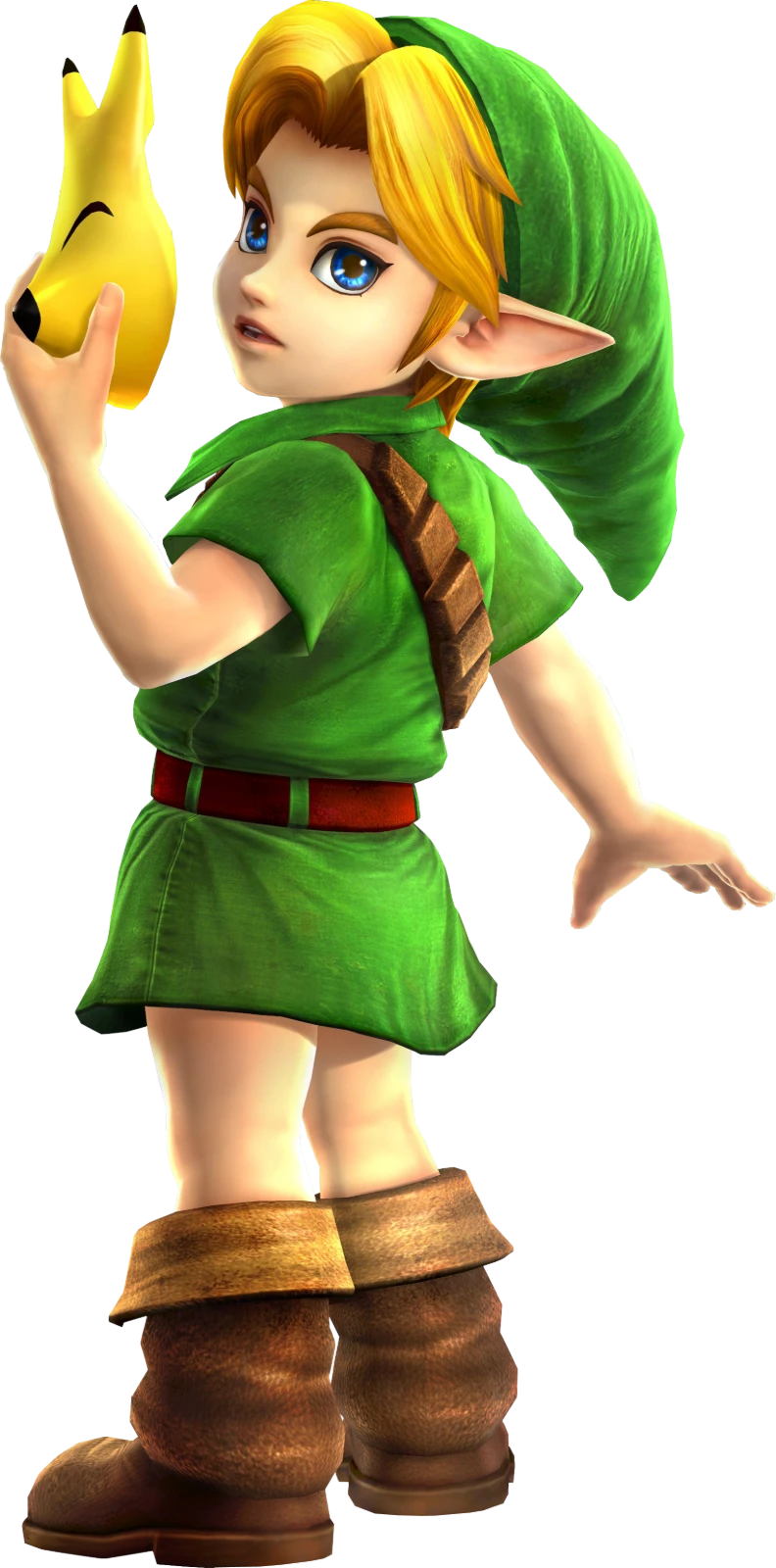
Young Link in Hyrule Warriors, one of the two fighters added by the Majora’s Mask Pack.The Majora’s Mask Pack for Hyrule Warriors, with Young Link, Tingle and a Termina map, came out on 29 January 2015 in Japan and Europe and on 5 February in North America, shortly before the remake.
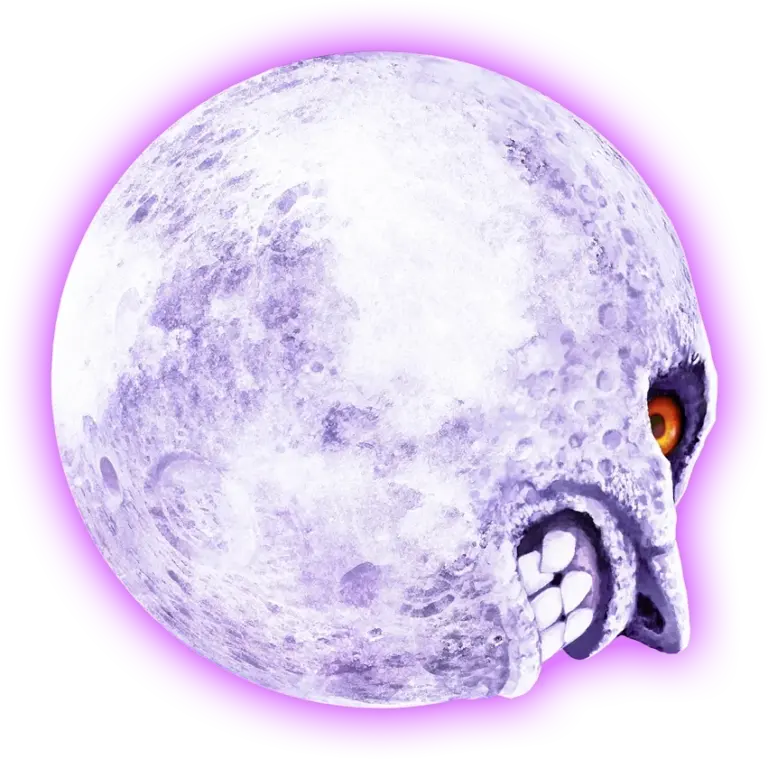
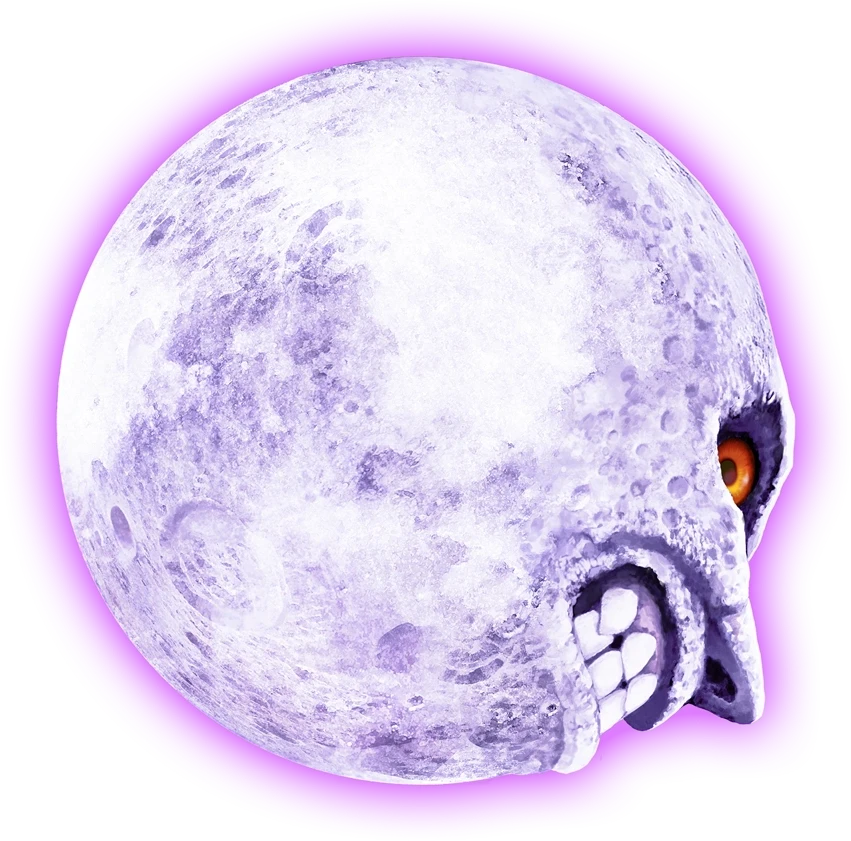
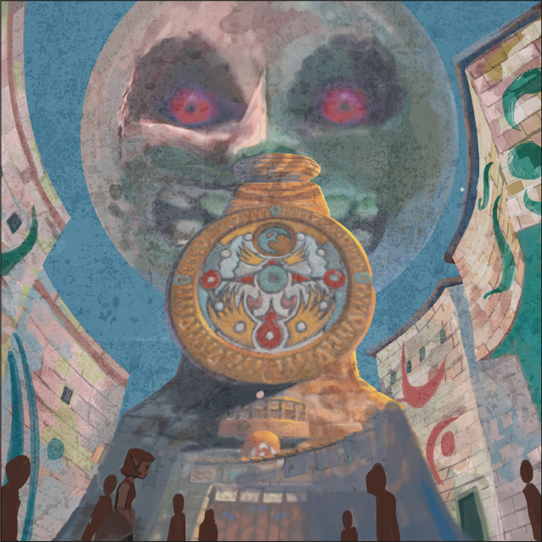
Official art of the moon from Majora’s Mask 3D.Aonuma told Iwata he had expected other studios to borrow the three-day idea after 2000. Fifteen years later, he said, “no one created a game like this”.
The Ancient Castle of Ikana, where the ReDeads now dance.The ReDeads in the Ancient Castle of Ikana were given two new dance routines for the remake.
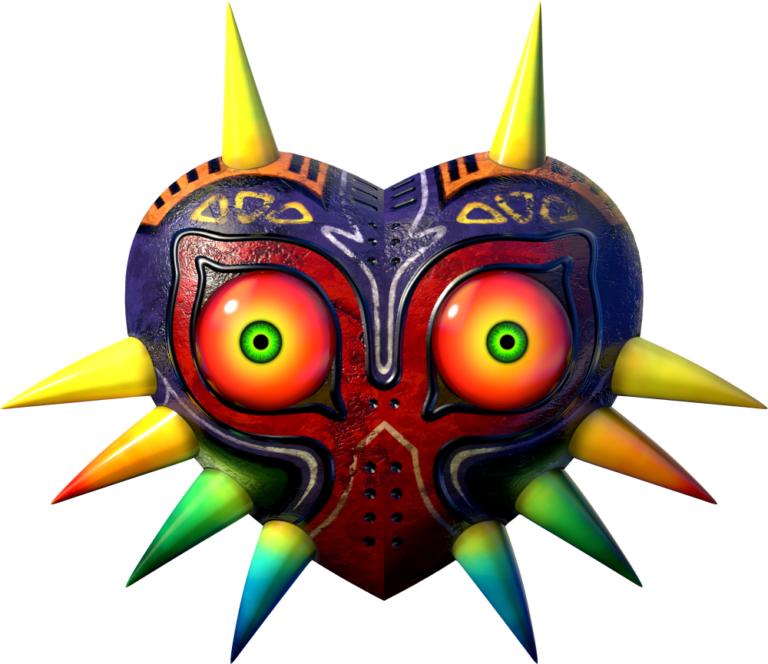
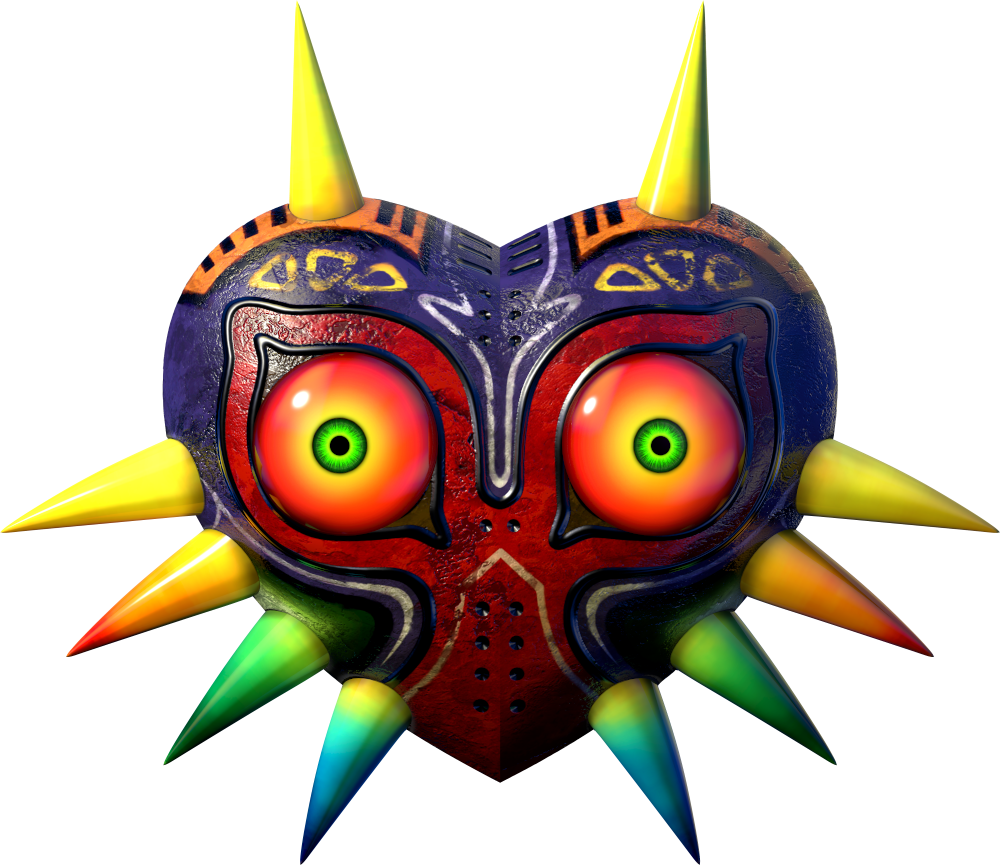
Majora’s Mask, rendered for the 3DS remake.Reassuring fans on Miiverse that the look and mood were untouched, Aonuma said the remake still lived up to the original’s Japanese slogan, given in Nintendo’s translation as “this Zelda has a scary vibe”.
Media & artwork
Box art from each region, the special editions and the Majora’s Mask Edition console, official artwork and screenshots of the remake. Select any image to view it larger.
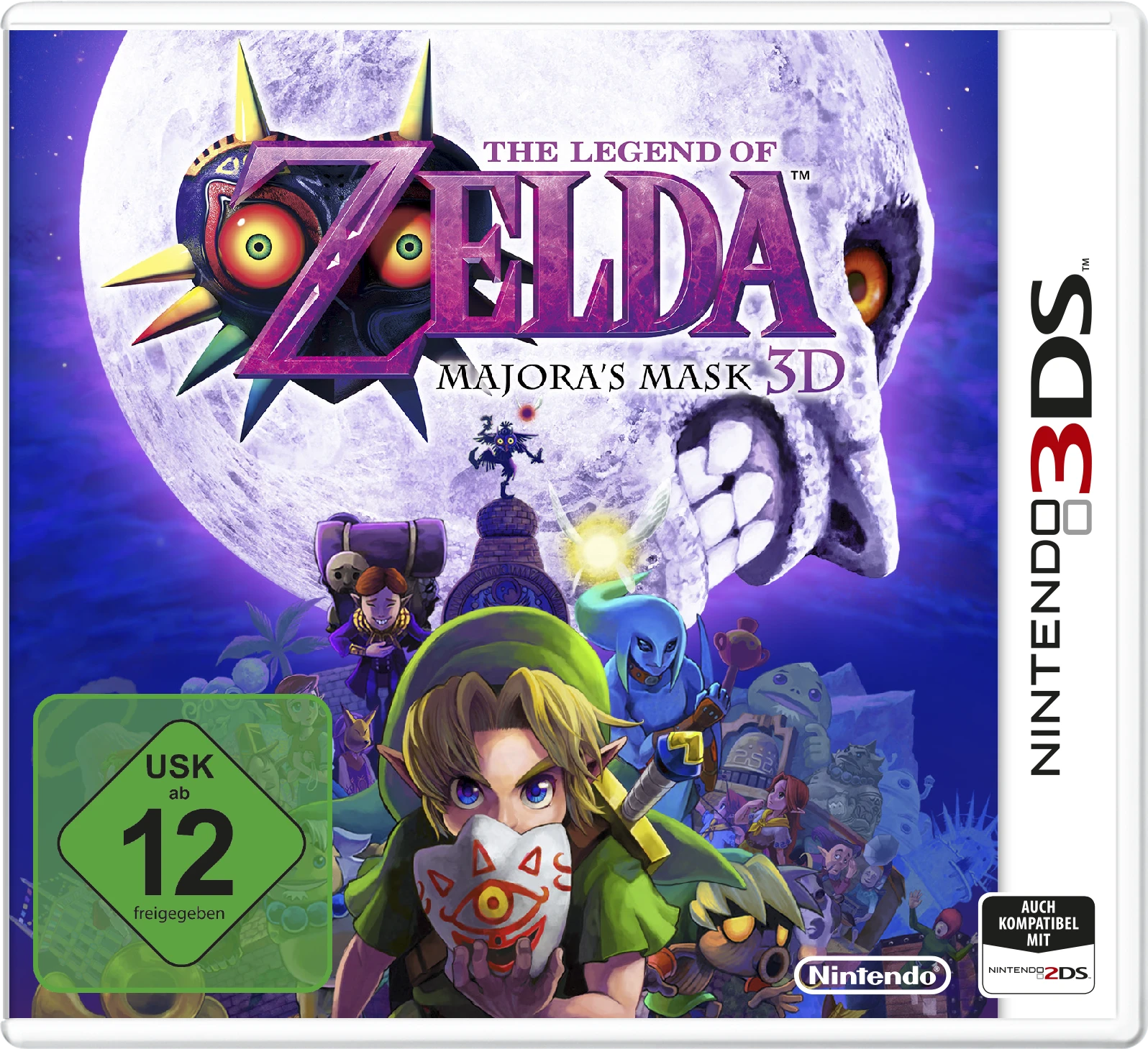
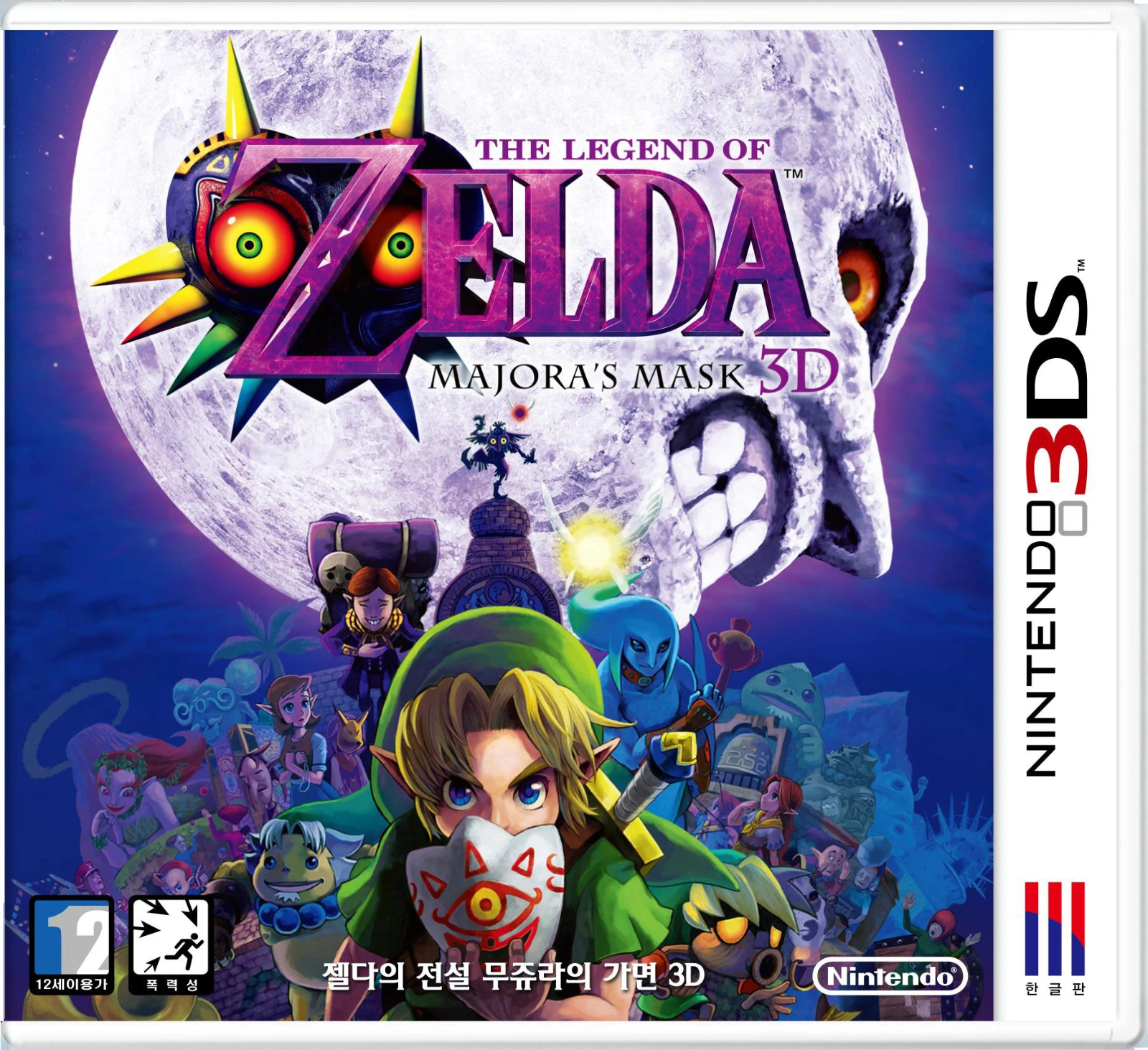
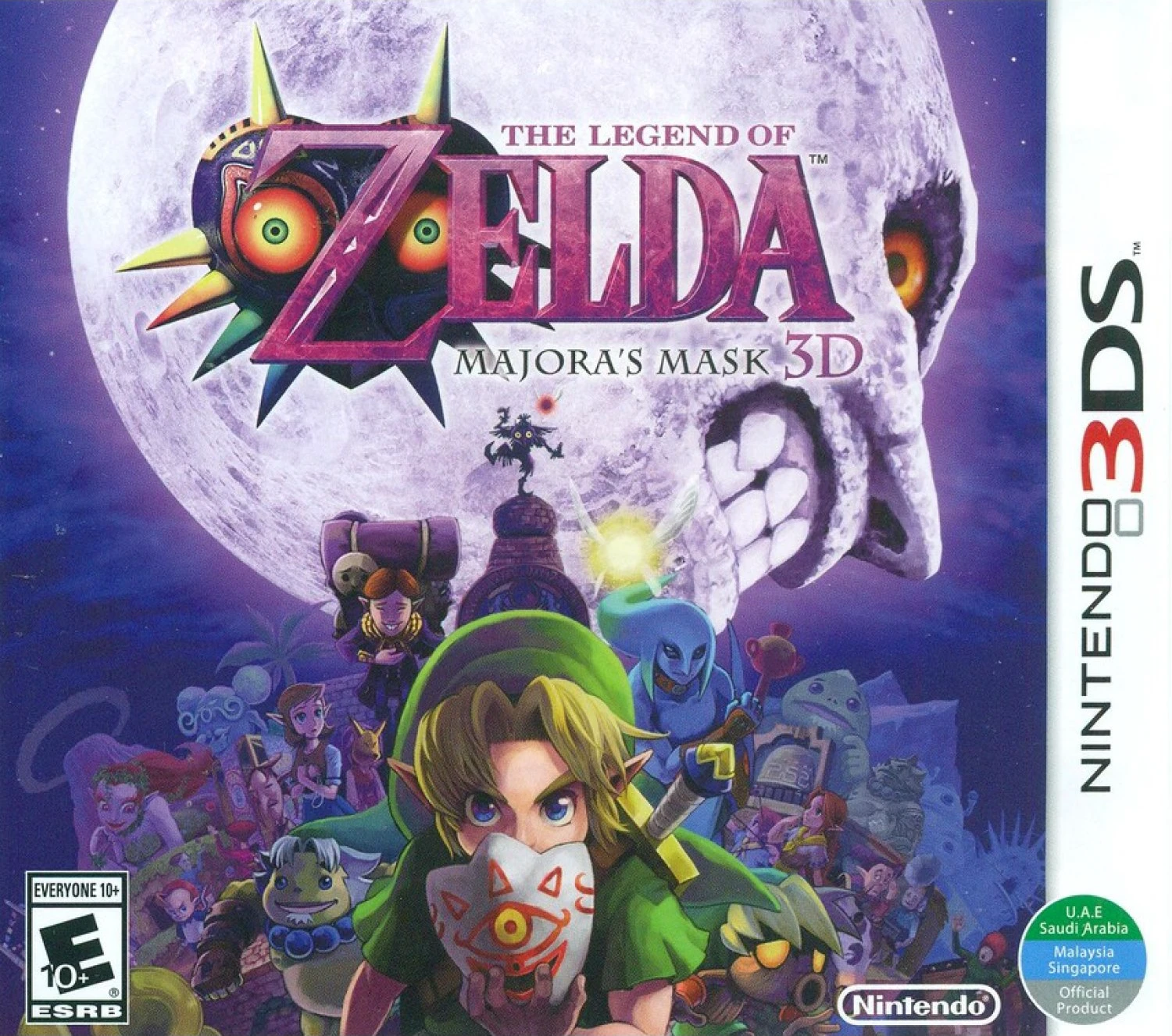
German box (Nintendo 3DS, 2015)South Korean boxBox for the Middle East and South-East AsiaThe European Special Edition (2015)The Skull Kid figurine from the North American Limited EditionBox of the New Nintendo 3DS XL Majora’s Mask EditionThe Majora’s Mask necklace, a European pre-order giftOfficial map art of TerminaPrima’s collector’s edition strategy guide
Majora’s Mask 3D had one platform and one big moment, and it made the most of both. This is its own timeline, what came after it and how to play it now. The original’s long history of re-releases is on our Majora’s Mask page.
Release timeline
Operation Moonfall25 July 2011 – Zelda Universe and other fan sites launch their campaign for a 3DS remake.
Grezzo’s pitchLate 2011 – Mikiharu Ooiwa’s team presents its ideas to Shigeru Miyamoto, about six months after Ocarina of Time 3D.
Announced5 November 2014 – Revealed in a Nintendo Direct for spring 2015.
Date confirmed14 January 2015 – A second Nintendo Direct sets 13 February; the Majora’s Mask Edition console goes up for pre-order the same day.
Nintendo 3DS13–14 February 2015 – North America and Europe on 13 February, with the New Nintendo 3DS; Japan and Australia on 14 February.
Version 1.126–27 February 2015 – A bug-fix update, later built into new Game Cards.
South Korea14 July 2016 – A Korean release, according to The Cutting Room Floor.
Nintendo Selects4 February 2019 – Budget re-release in North America at $19.99.
eShop closes27 March 2023 – Nintendo ends purchases in the 3DS eShop, and with them sales of the download version.
What came next
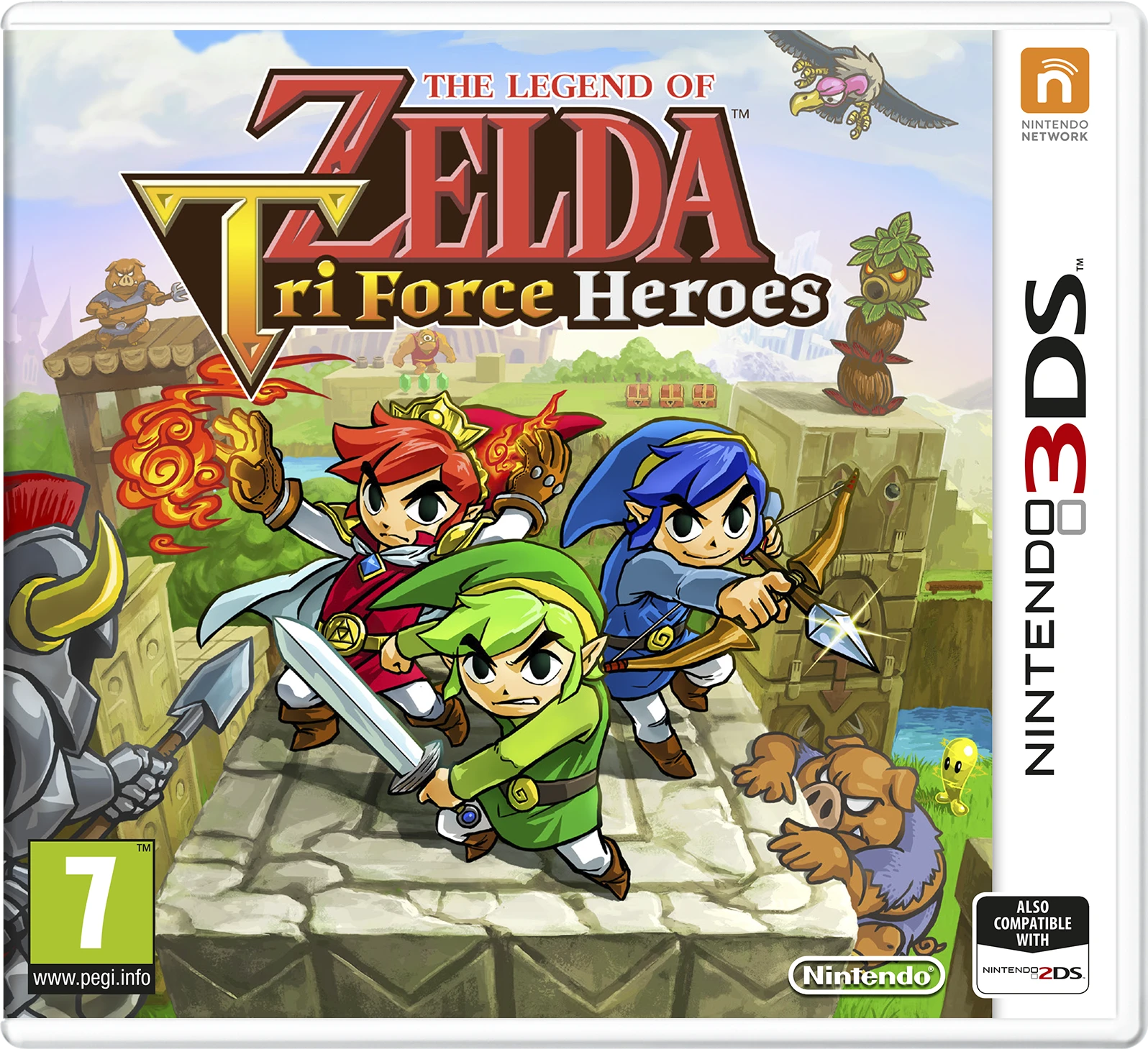
The European box of Tri Force Heroes, Grezzo’s next Zelda.
The remake itself has stayed where it was. When Majora’s Mask reached Nintendo Switch Online + Expansion Pack on 25 February 2022 it was the Nintendo 64 original that Nintendo chose, so none of Grezzo’s changes, from the notebook to the fishing holes, can be played on anything newer than a 3DS.
Reputation
Official art of Gyorg, whose new second phase drew complaints.
For most critics, and for anyone who bounced off the Nintendo 64 game, this is the version to play; Zelda Universe’s reviewer called it “the definitive version of Majora’s Mask”. It did what Miyamoto wanted, giving people who had given up a way back in, and by CESA’s count it has sold slightly more copies than the original is usually credited with.
It has also kept an argument going. Zelda Dungeon was still asking its readers whether the changes were justified in August 2016, with the eyes on the bosses, the second phase of Gyorg, the new Twinmold and Zora Link’s swimming among the complaints, and the fan patch Project Restoration, which reached version 1.5.9 in January 2022, exists to put several of them back as they were. That people cared enough to patch it says as much about the affection for Majora’s Mask as about the remake.
Where to play it today
The European box: a second-hand Game Card is now the only way to buy the remake.
You need a Nintendo 3DS, 2DS or New Nintendo 3DS and a Game Card. Nintendo stopped selling the download on 27 March 2023, when purchases in the 3DS eShop ended, so new players are limited to second-hand copies: the 2015 release in each region and, in North America, the 2019 Nintendo Selects reprint. On a New Nintendo 3DS you also get the free camera and steadier 3D.
If you only own a Switch, the Nintendo 64 original is part of Nintendo Switch Online + Expansion Pack. It is the same story with the old save system, the old bosses and the old, faster Zora.
Sales & reviews
Sales figures
The remake started fast. In Japan it sold 230,065 copies in its first week (9 to 15 February 2015), topping Media Create’s chart with a bigger debut than either Ocarina of Time 3D or A Link Between Worlds, and it had passed 390,000 after five weeks. In the United States, Nintendo of America reported more than 515,000 physical and digital sales in February alone and called it the fastest-selling handheld Zelda in the country’s history; the figure was 730,000 by the end of March.
Nintendo’s results for the year to 31 March 2015, published on 7 May, said it had sold more than two million copies worldwide in about six weeks (2.03 million, as Zelda Dungeon reported it). Japan’s CESA white papers put the total at 3.36 million by the end of 2020 and 3.44 million by the end of 2022, just ahead of the 3.36 million usually quoted for the Nintendo 64 original.
230,065first week in Japan
515,000+United States, February 2015
2.03mworldwide by 31 March 2015
3.44mworldwide by December 2022
Reception and review scores
Reviews were excellent. These are the main scores, as collected by Wikipedia from each outlet, with the reviewer and date where they are given. Scores not out of 100 are converted.
Nintendo LifeUK · Martin Watts, 4 February 2015
10/10
Game InformerUS · Kyle Hilliard, 4 February 2015
9.25/10
GameSpotUS
9/10
PolygonUS · 4 February 2015
9/10
GamesRadar+UK · 4 February 2015
4.5/5
GameRevolutionUS · Peter Paras, 12 February 2015
4.5/5
Hardcore GamerUS · Dermot Creegan, 14 February 2015
4.5/5
IGNUS · Marty Sliva, 4 February 2015
8.7/10
GameTrailersUS
8.5/10
Nintendo World ReportUS · Aaron Kaluszka, 4 February 2015
8.5/10
DestructoidUS · 13 February 2015
8/10
Metacritic’s average is 89 from 82 reviews: 81 positive, one mixed and none negative. On OpenCritic, 96% of critics recommended it. Nintendo Life’s Martin Watts gave it full marks and called it “a masterpiece that every 3DS owner should play”, though he would have liked the three transformation masks to have fixed places on the Touch Screen. Polygon praised the notebook, the visuals and the bosses, and Game Informer liked the changes while still finding the time management repetitive in places.
The praise was for much the same things everywhere: the new saving, the notebook, the free camera on a New Nintendo 3DS and the way the game now explains itself without taking over. EGM’s Josh Harmon called the accessibility changes “surprisingly subtle and smart”. The doubts were about Zora Link’s swimming, a camera that sometimes misbehaves underwater and, for some reviewers, the long new Twinmold fight.
Reader reviews
No reader reviews yet. Played it? Give it a score out of 10 and tell other fans what you think.
Every fact on this page was checked against the sources below in November 2026. IGN, Polygon and Eurogamer could not be read directly, so their reviews and interviews are used only as reported by Wikipedia and Zelda Dungeon; Zelda Wiki (zeldawiki.wiki) blocks automated reading and was not used. Facts about the Nintendo 64 original follow our Majora’s Mask page, which was checked separately.
To provide the best experiences, we use technologies like cookies to store and/or access device information. Consenting to these technologies will allow us to process data such as browsing behavior or unique IDs on this site. Not consenting or withdrawing consent, may adversely affect certain features and functions.
Functional
Always active
The technical storage or access is strictly necessary for the legitimate purpose of enabling the use of a specific service explicitly requested by the subscriber or user, or for the sole purpose of carrying out the transmission of a communication over an electronic communications network.
Preferences
The technical storage or access is necessary for the legitimate purpose of storing preferences that are not requested by the subscriber or user.
Statistics
The technical storage or access that is used exclusively for statistical purposes.The technical storage or access that is used exclusively for anonymous statistical purposes. Without a subpoena, voluntary compliance on the part of your Internet Service Provider, or additional records from a third party, information stored or retrieved for this purpose alone cannot usually be used to identify you.
Marketing
The technical storage or access is required to create user profiles to send advertising, or to track the user on a website or across several websites for similar marketing purposes.

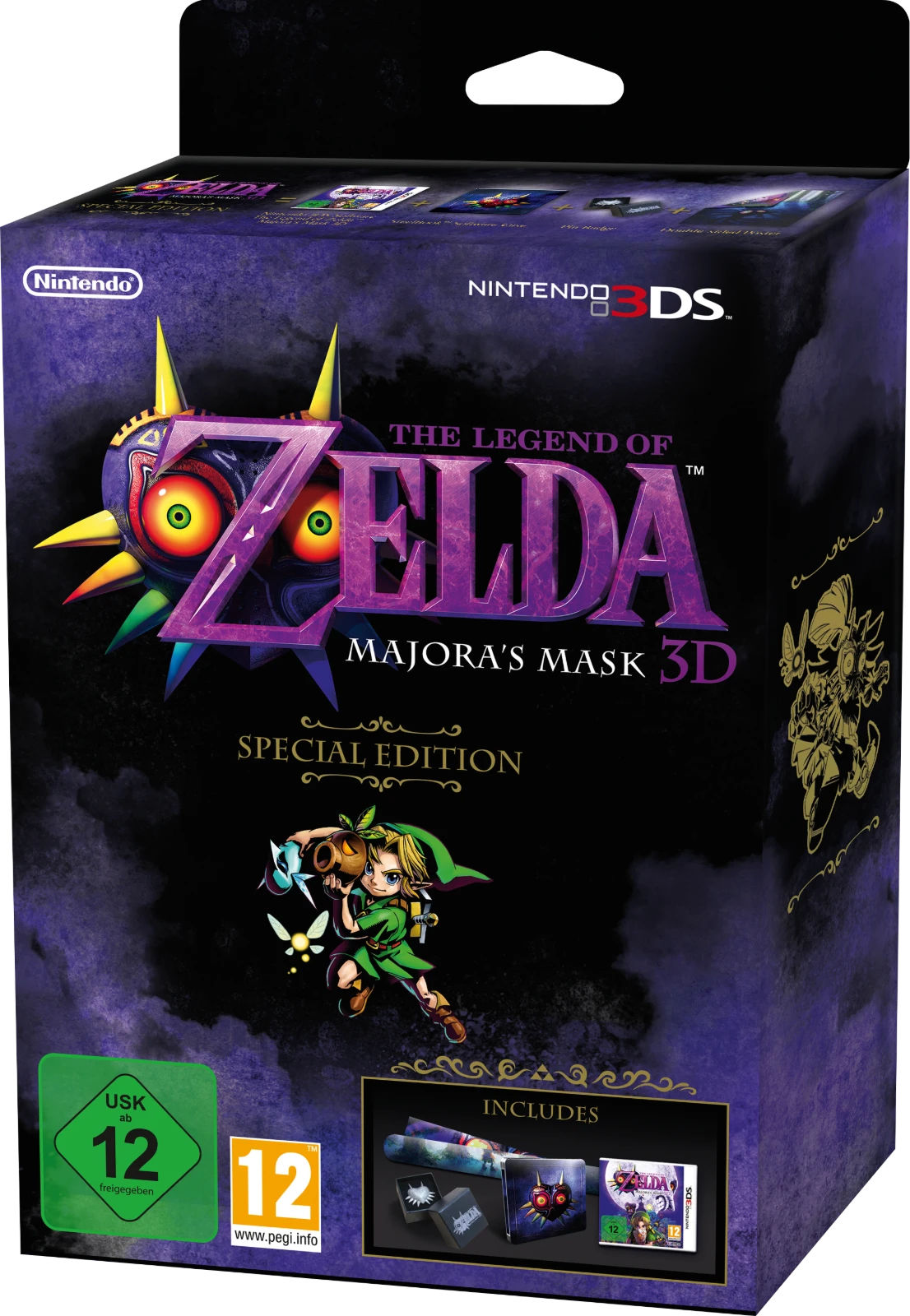 Special Edition (Europe)Nintendo · 13 February 2015Announced alongside the game in November 2014 and made in limited numbers: a SteelBook case, the game in its normal packaging, a Majora’s Mask pin badge and a double-sided poster.
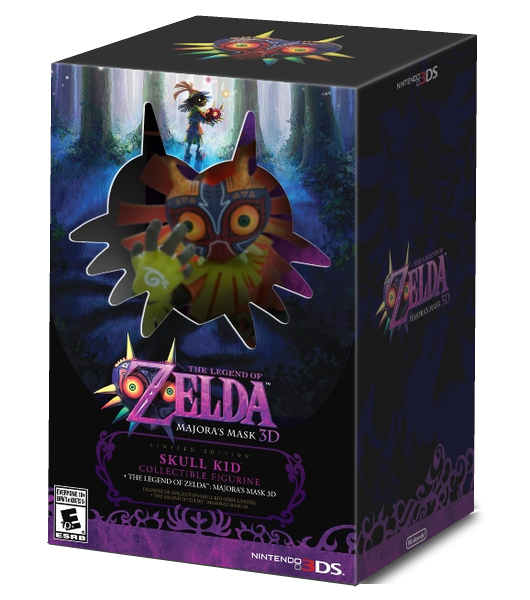 Limited Edition (North America)Nintendo of America · 13 February 2015 · $49.99Announced on 6 January 2015: the game packed with a figurine of the Skull Kid wearing the mask. It cost $54.99 in Canada.
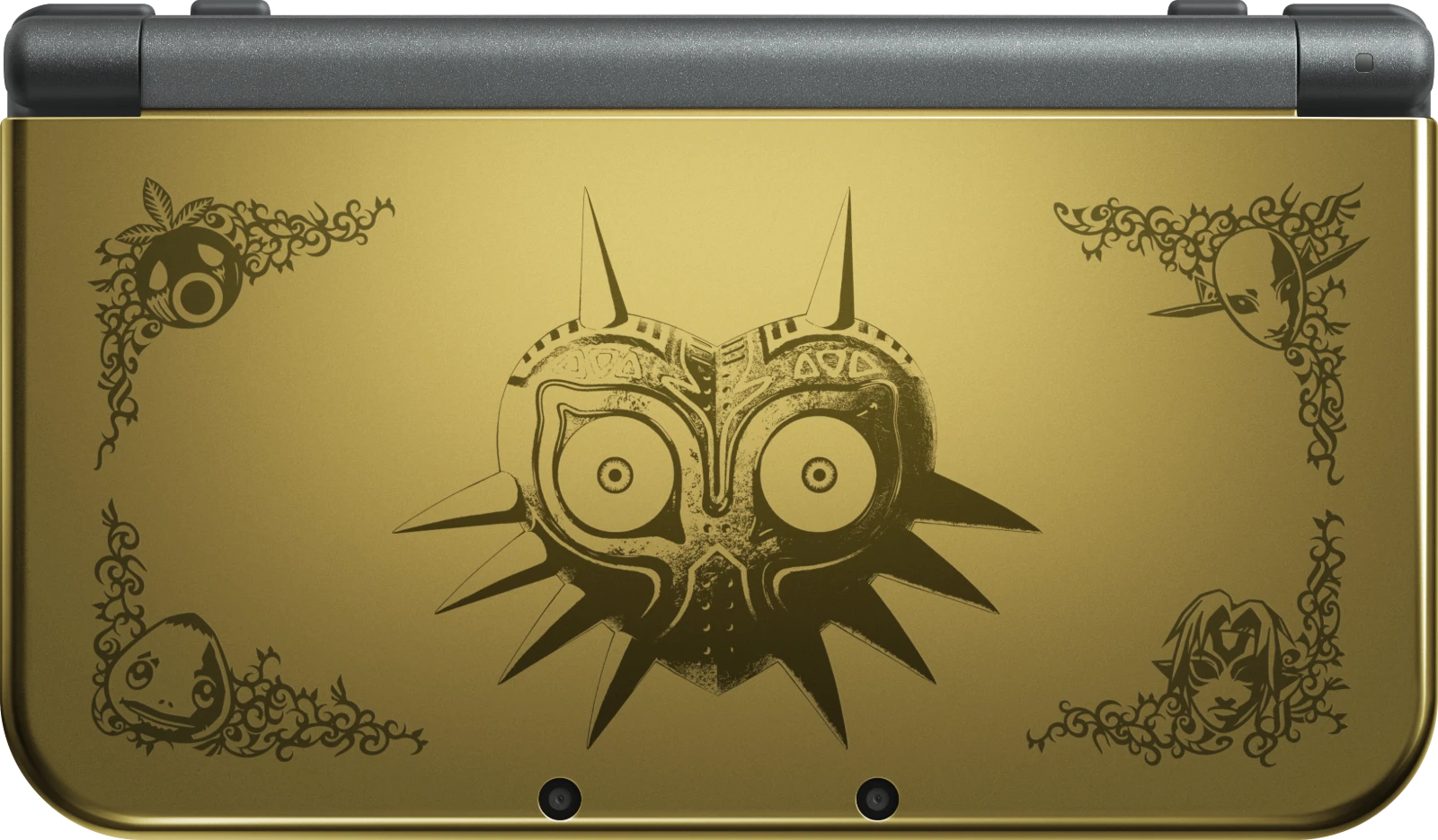 New Nintendo 3DS XL Majora’s Mask EditionNorth America and Europe · 13 February 2015A black New Nintendo 3DS XL with a gold top and bottom, decorated with Majora’s Mask and other masks from the game. In North America it cost $199.99, the same as the plain red and black models, and came with neither the game nor an AC adapter. Online pre-orders opened on the morning of 14 January 2015 and were gone within minutes, and Game Informer found finished eBay auctions at up to $500 the same day. The European console had the game pre-installed, and Nintendo’s own UK store sold it with a wall charger and the Skull Kid figurine; that bundle had to be restocked at the end of January.
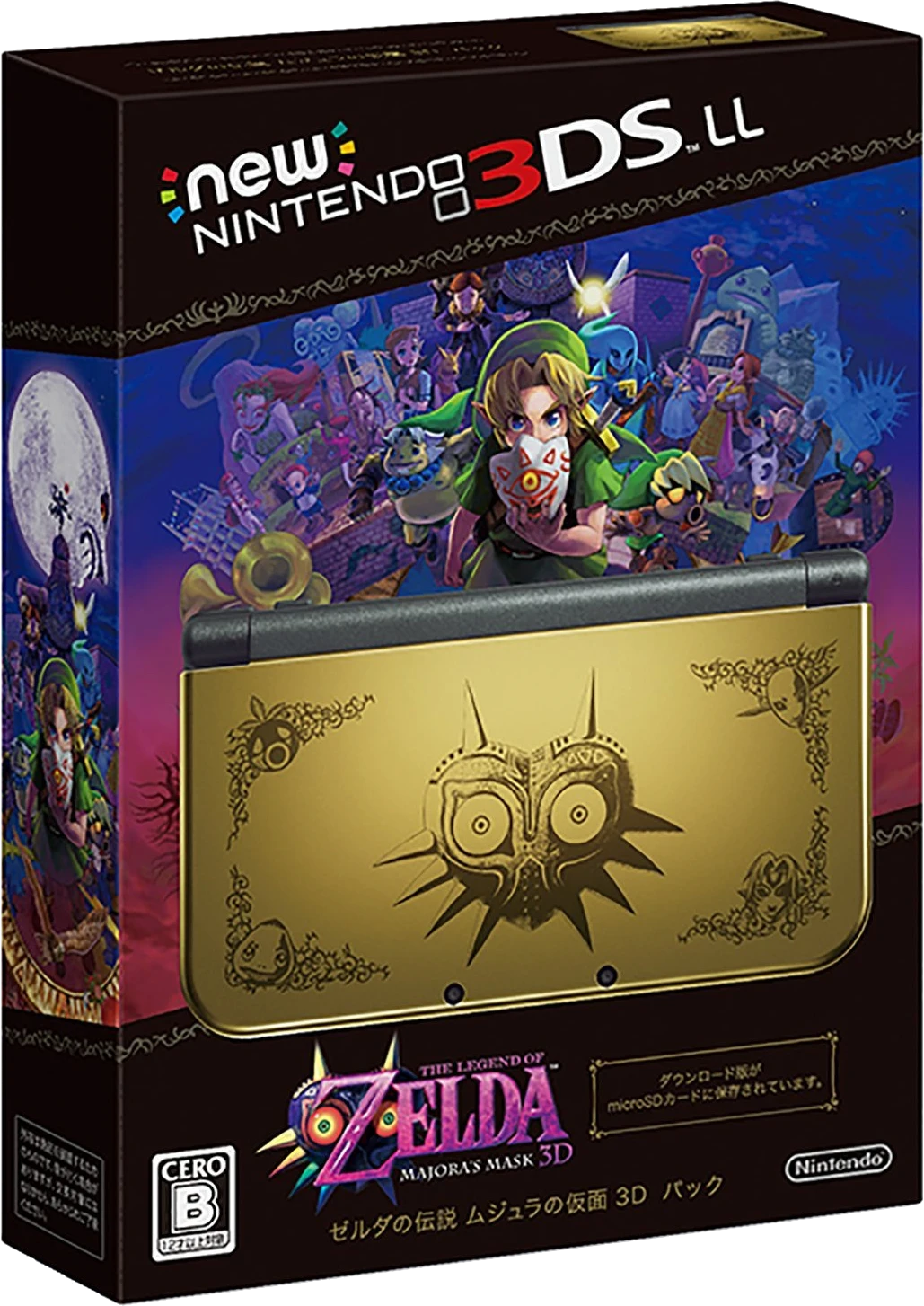 New Nintendo 3DS LL Majora’s Mask 3D Pack (Japan)Nintendo · 14 February 2015 · ¥23,000 before taxJapan’s limited-quantity version of the console, with the download edition of the game supplied on a microSDHC card. No AC adapter was included.
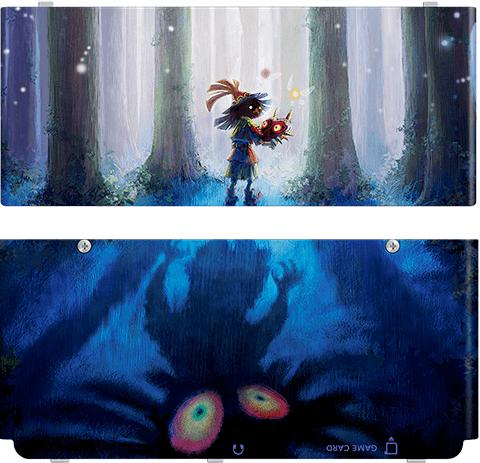 Cover plates and HOME Menu themes (Japan)Nintendo · February and April 2015Two Majora’s Mask kisekae plates for the smaller New Nintendo 3DS, numbers 055 (2 April 2015) and 056 (14 February 2015), at ¥2,000 each before tax, plus two HOME Menu themes at ¥200 each from launch day.
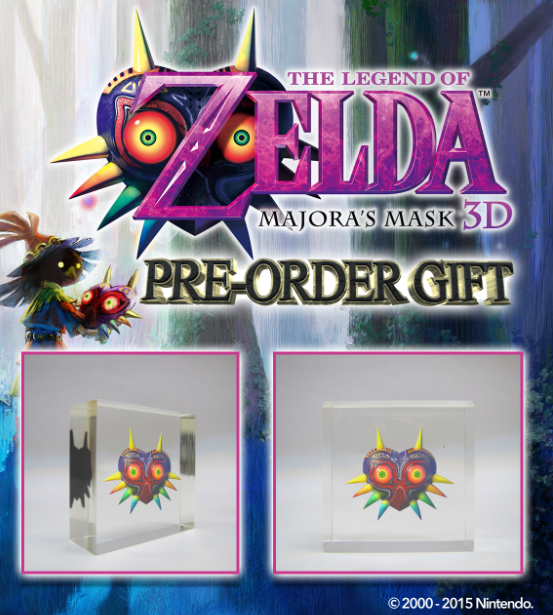 Pre-order giftsRetailers · early 2015GAME in the UK offered a Majora’s Mask paperweight with the standard edition; other European retailers gave away a necklace and a black sack printed with the logo; Amazon Japan included a set of 24 postcards. In the United States, GameStop handed out the European edition’s pin badge with pre-orders of Code Name: S.T.E.A.M.
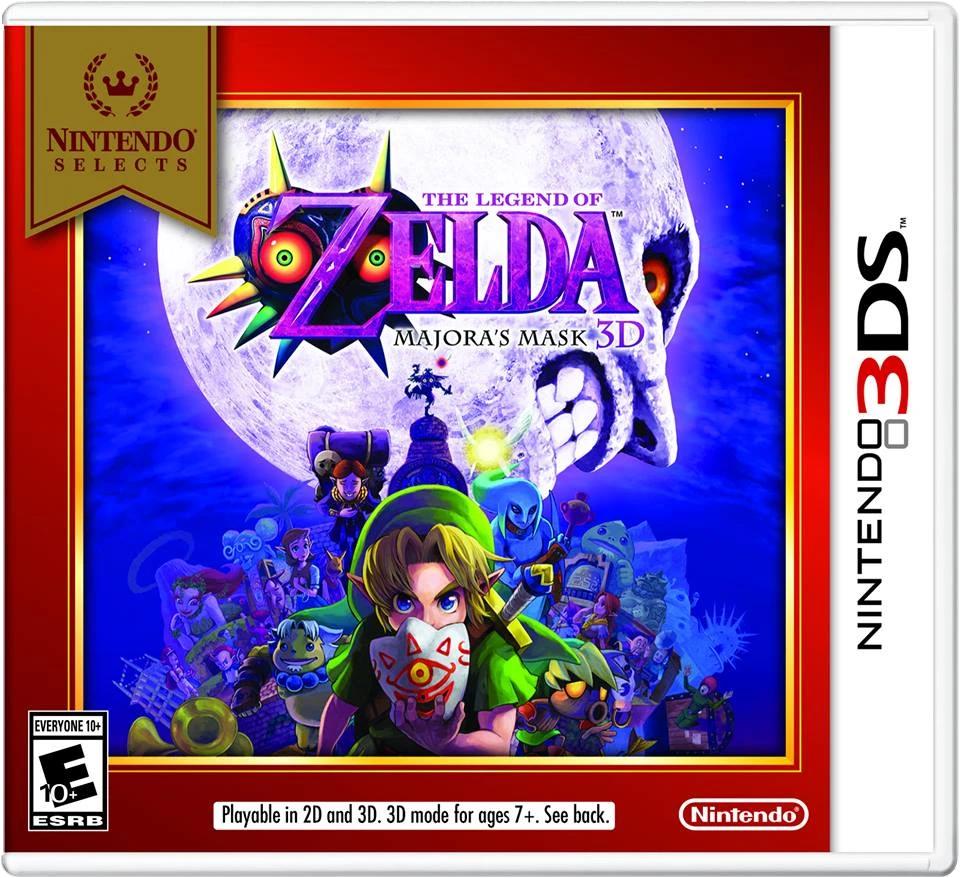 Nintendo SelectsNorth America · 4 February 2019 · $19.99The game joined Nintendo’s budget range in North America four years after launch, on the same day as Super Mario Maker for Nintendo 3DS and Star Fox 64 3D.