Three days. One falling moon. A cursed mask, a lonely imp and a town full of people who will all be dead by Friday unless a boy in green can bend time to his will. The strangest, saddest and most daring Zelda of them all.
Released27 April 2000 (JP) · 26 October 2000 (NA) · 17 November 2000 (EU)
DeveloperNintendo EAD
DirectorsEiji Aonuma, Yoshiaki Koizumi
MusicKoji Kondo, Toru Minegishi
SettingTermina, a world parallel to Hyrule
Sales3.36 million (Nintendo 64)
Title
The Legend of Zelda: Majora’s Mask ゼルダの伝説 ムジュラの仮面 (Zeruda no Densetsu: Mujura no Kamen)
Platform
Nintendo 64 (the Expansion Pak is required)
Developer
Nintendo EAD
Publisher
Nintendo
Directors
Eiji Aonuma, Yoshiaki Koizumi
Producer
Shigeru Miyamoto
Story and script
Story by Shigeru Miyamoto and Yoshiaki Koizumi; script by Mitsuhiro Takano (writers credited: Takano, Aonuma, Koizumi)
Art
Takaya Imamura (art director), Yusuke Nakano
Programming
Toshio Iwawaki, Toshihiko Nakago
Music
Koji Kondo, with Toru Minegishi
Players
1
Released (Japan)
27 April 2000
Released (North America)
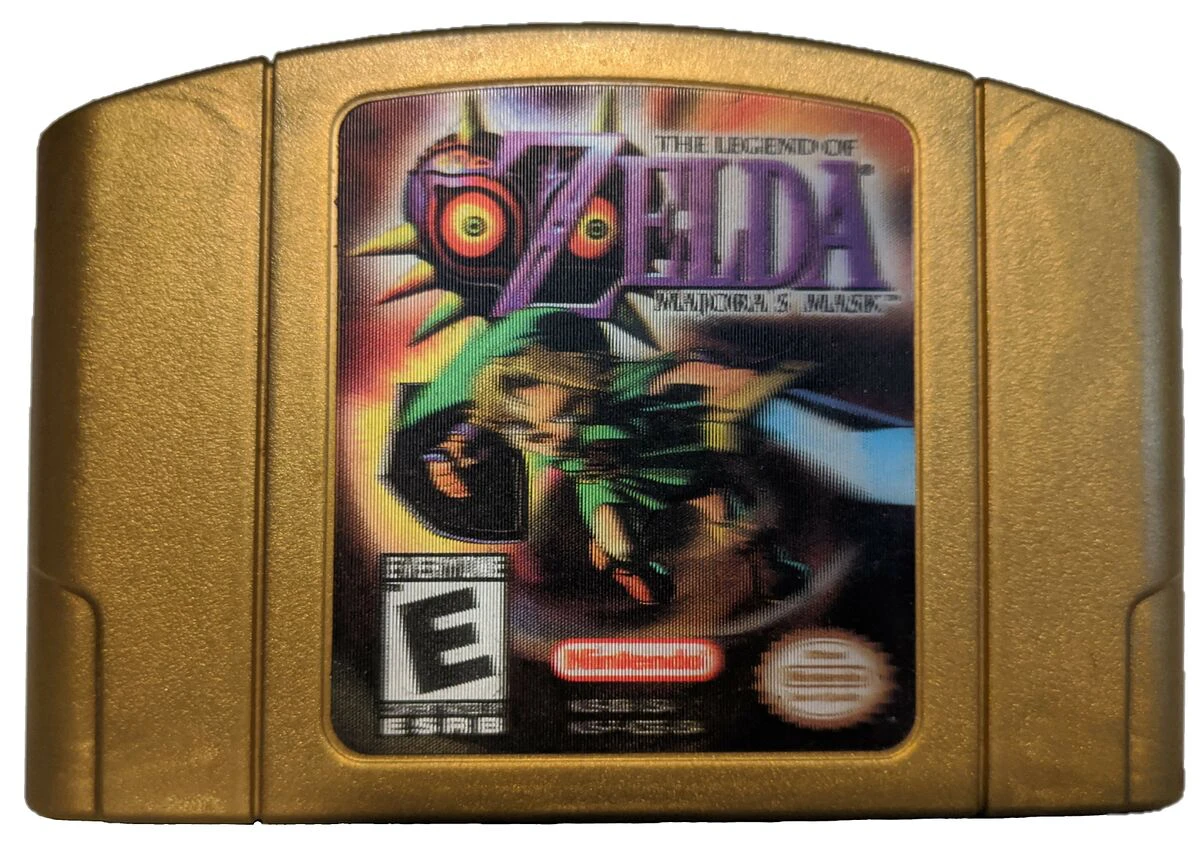
26 October 2000, on a gold cartridge (one Wikipedia list gives 25 October)
601,542 in Japan by the end of 2000; 1,206,489 in the US in 2000; 3.36 million worldwide
Honours
Console Action/Adventure and Game Design, 4th Interactive Achievement Awards (2001)
Overview
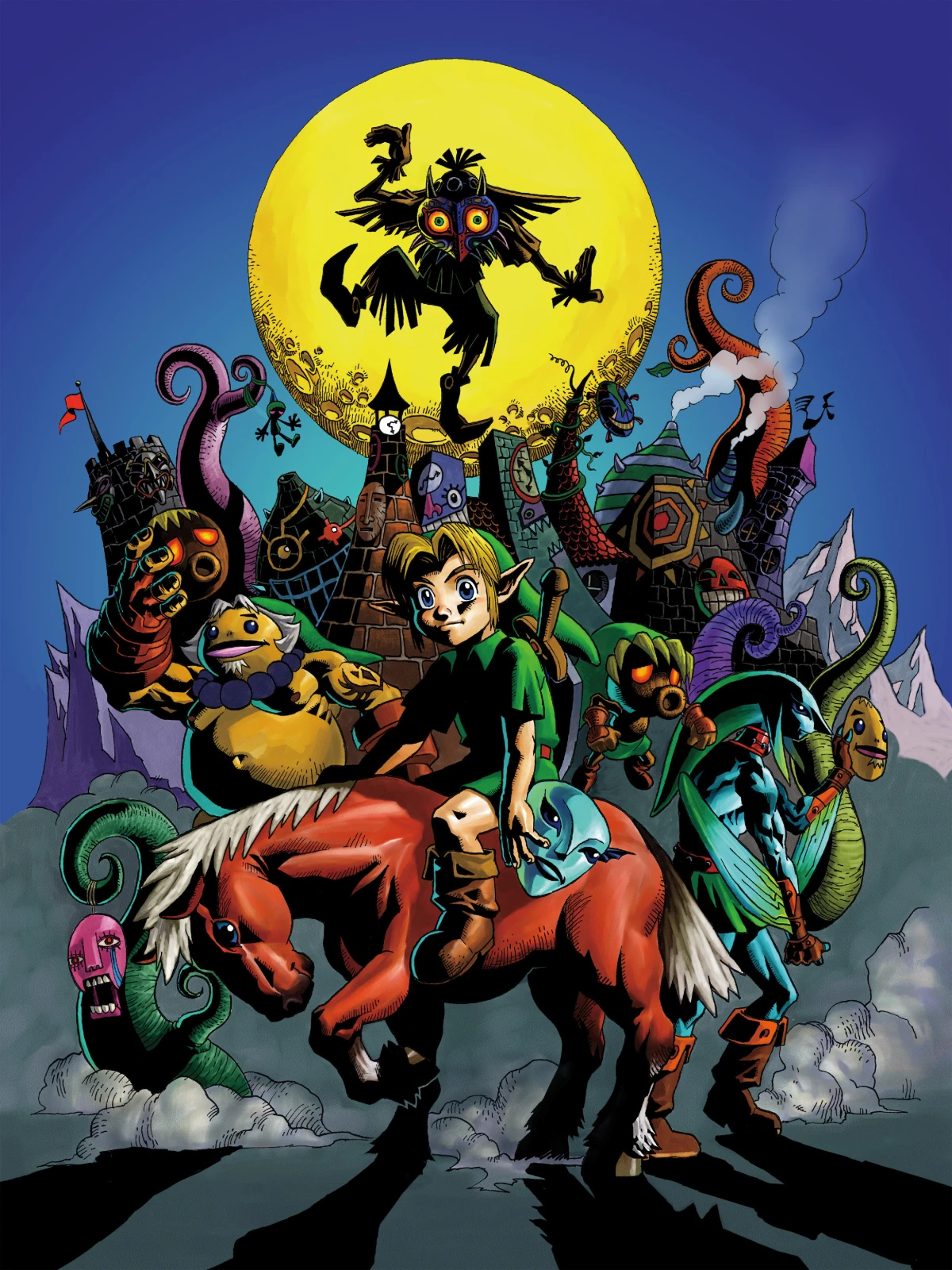
Majora’s Mask is the game Nintendo was never supposed to make. With Ocarina of Time barely on the shelves, the plan was a remixed version of it for the 64DD disk drive. Instead, Shigeru Miyamoto challenged a small team to build a brand-new Zelda in a single year on top of Ocarina’s engine and character models. Eiji Aonuma and Yoshiaki Koizumi took the dare, and the result arrived in Japan in April 2000: a direct sequel starring the same young Link, set not in Hyrule but in Termina, a mirror-world where the moon will hit the ground in exactly three days.
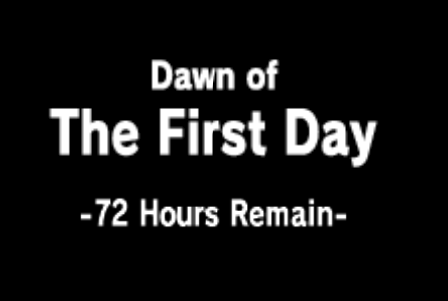
Everything in the game flows from that deadline. A clock ticks at the bottom of the screen, the townsfolk of Clock Town go about their business to a fixed timetable, and when the 72 hours run out the world ends. Link’s only way out is the Song of Time, which drags him back to the dawn of the first day with his weapons, masks and songs intact but every good deed undone. The game becomes a puzzle of loops: learn who will be where and when, then use the time you have to put things right before you rewind again.
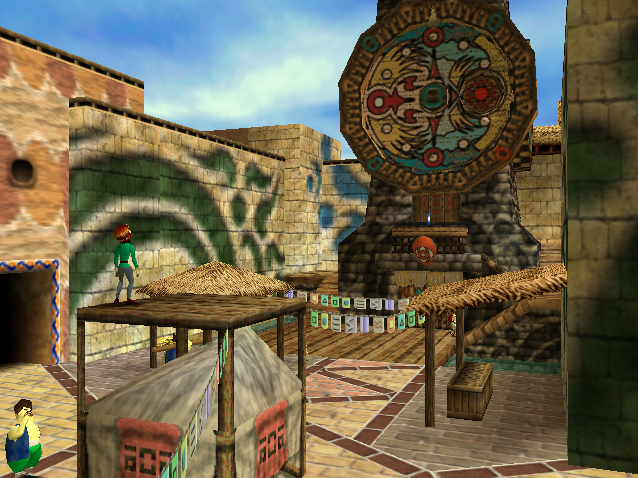
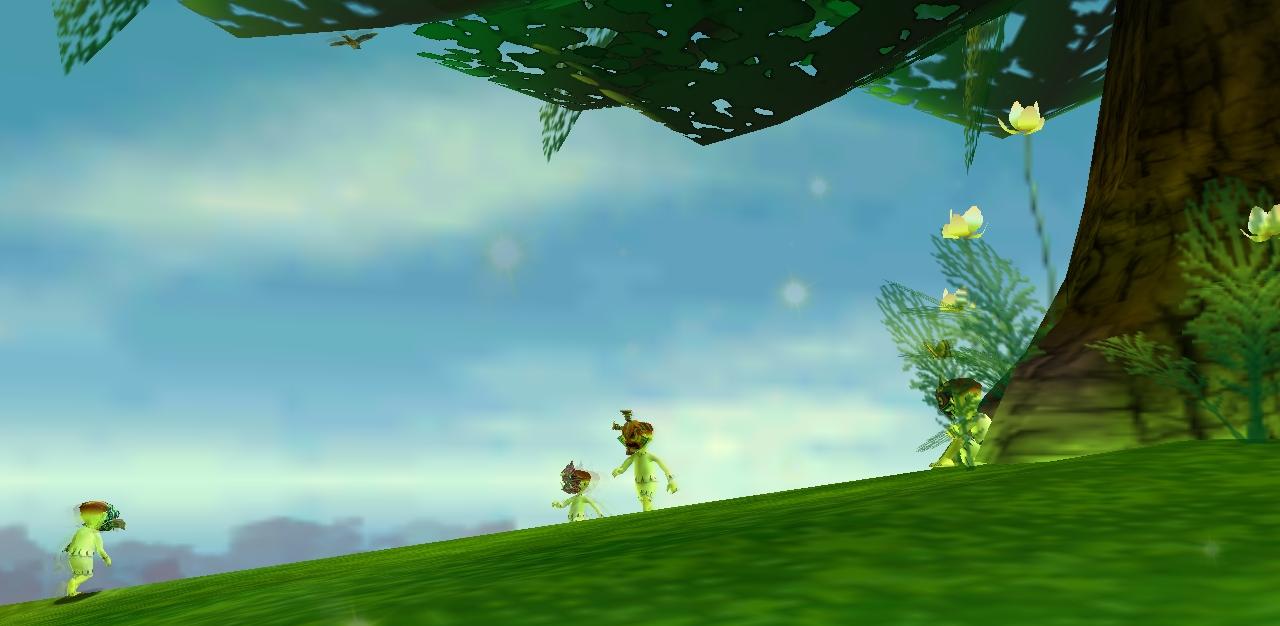
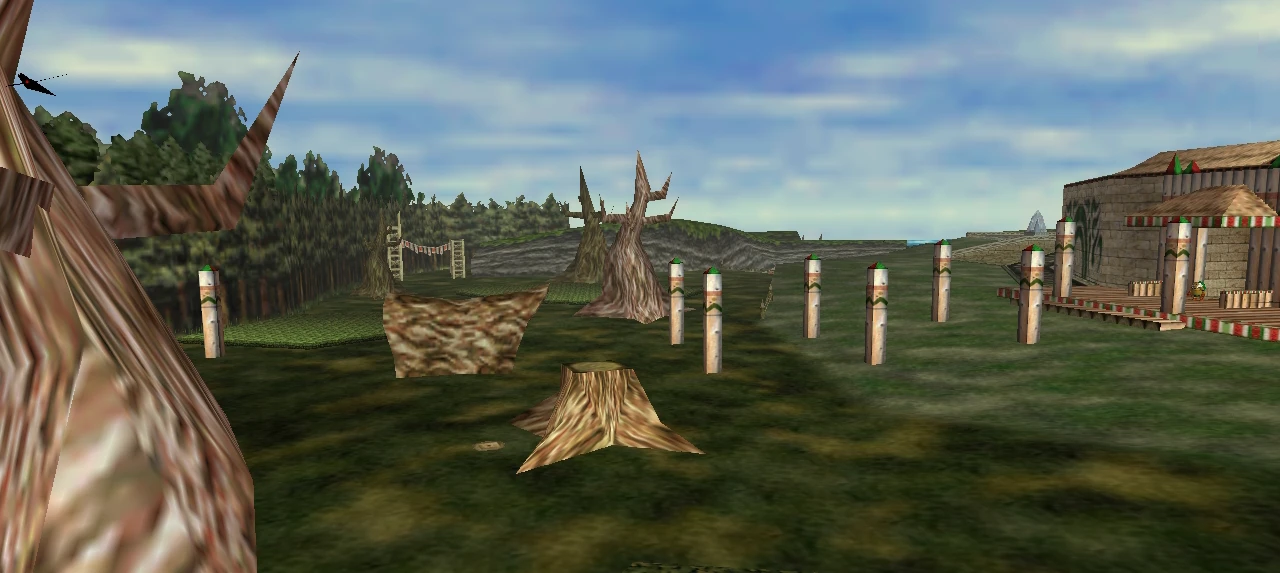
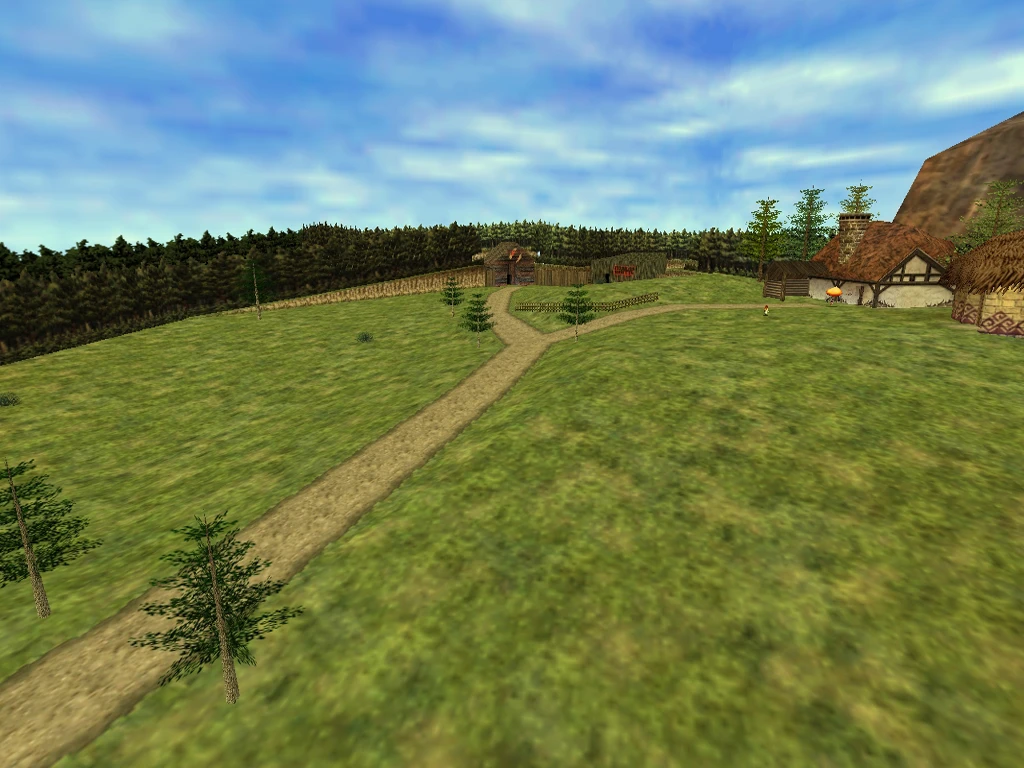
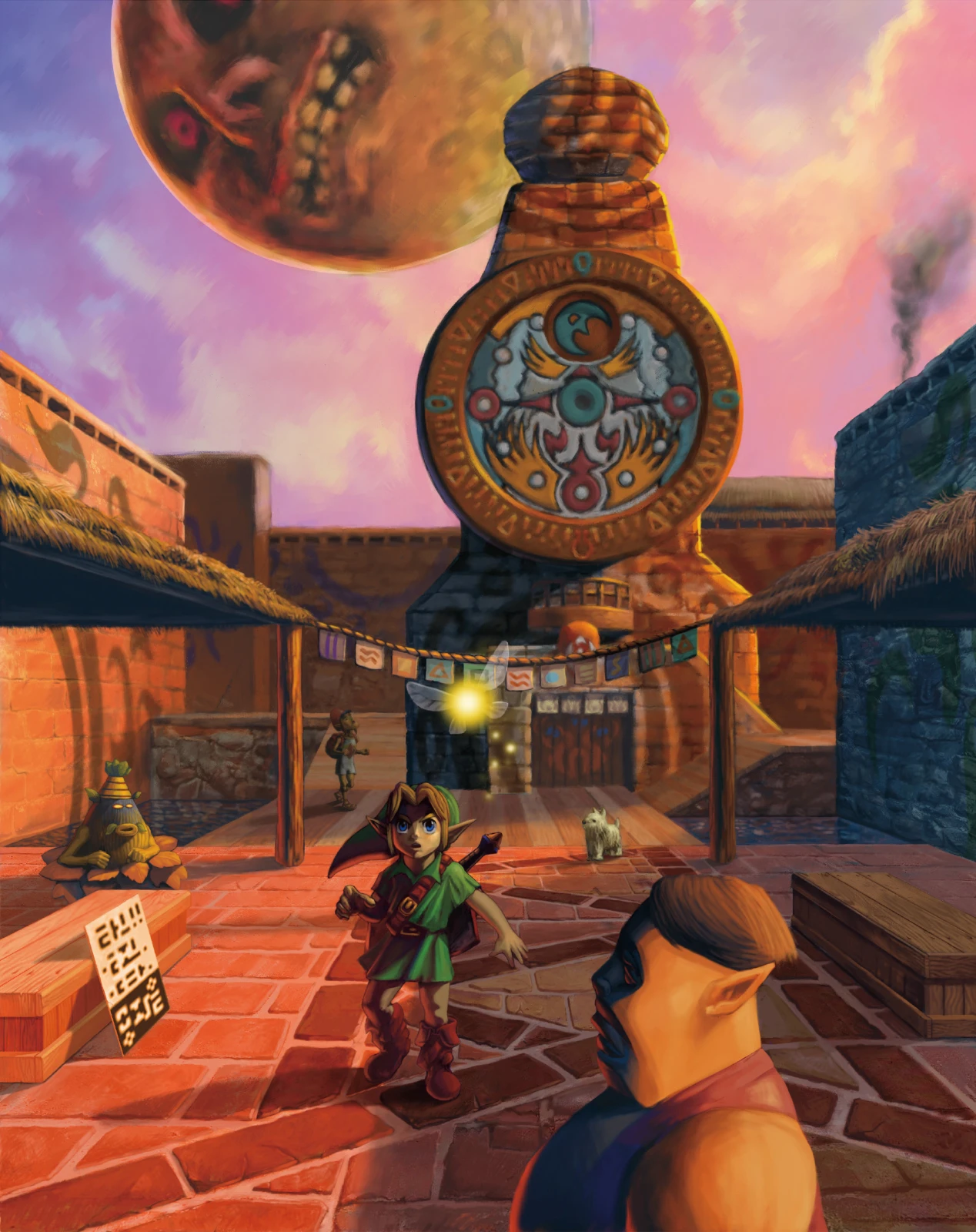
South Clock Town on the first day, with the half-built festival tower beside the great clock.The moon looms over the Clock Tower. By the final day it fills the sky.Termina Field, the ring of grassland that links Clock Town to the four regions.
Then there are the masks, two dozen of them. Three let Link take the shape of a Deku Scrub, a Goron and a Zora, each with its own body, moves and problems; others open doors in people’s lives, from a postman’s cap to a wedding mask. Coupled with the Bombers’ Notebook, a diary of the twenty troubled people Link can help, they give Majora’s Mask one of the richest casts of side characters in the series, and some of its saddest stories.
Reviewers called it darker and denser than Ocarina, and some found the ticking clock stressful, but it scored 95 on Metacritic and has only grown in stature since. Nintendo remade it for the 3DS in 2015, and today it is regularly named among the finest games in the series.
Hidden within the mask resides tremendous power – a power that not even he understands.
That is how Nintendo’s own manual introduces the Skull Kid and the mask he has stolen. Its “Welcome to Termina” pages explain that Link, several months after saving Hyrule, wanders into this strange land and hears a frightening rumour that the moon will crash down in three days. Tatl is introduced as a rather bossy fairy who is worried sick about her little brother, and the Deku, Goron and Zora are each shown in a homeland that has fallen on hard times.
— Official description: Nintendo, The Legend of Zelda: Majora’s Mask Nintendo 64 instruction manual (English, 2000), “Welcome to Termina”, p. 6. One line quoted; the rest summarised.
Quick Answers
The questions people most often ask about Majora’s Mask, answered briefly here and in more depth further down.
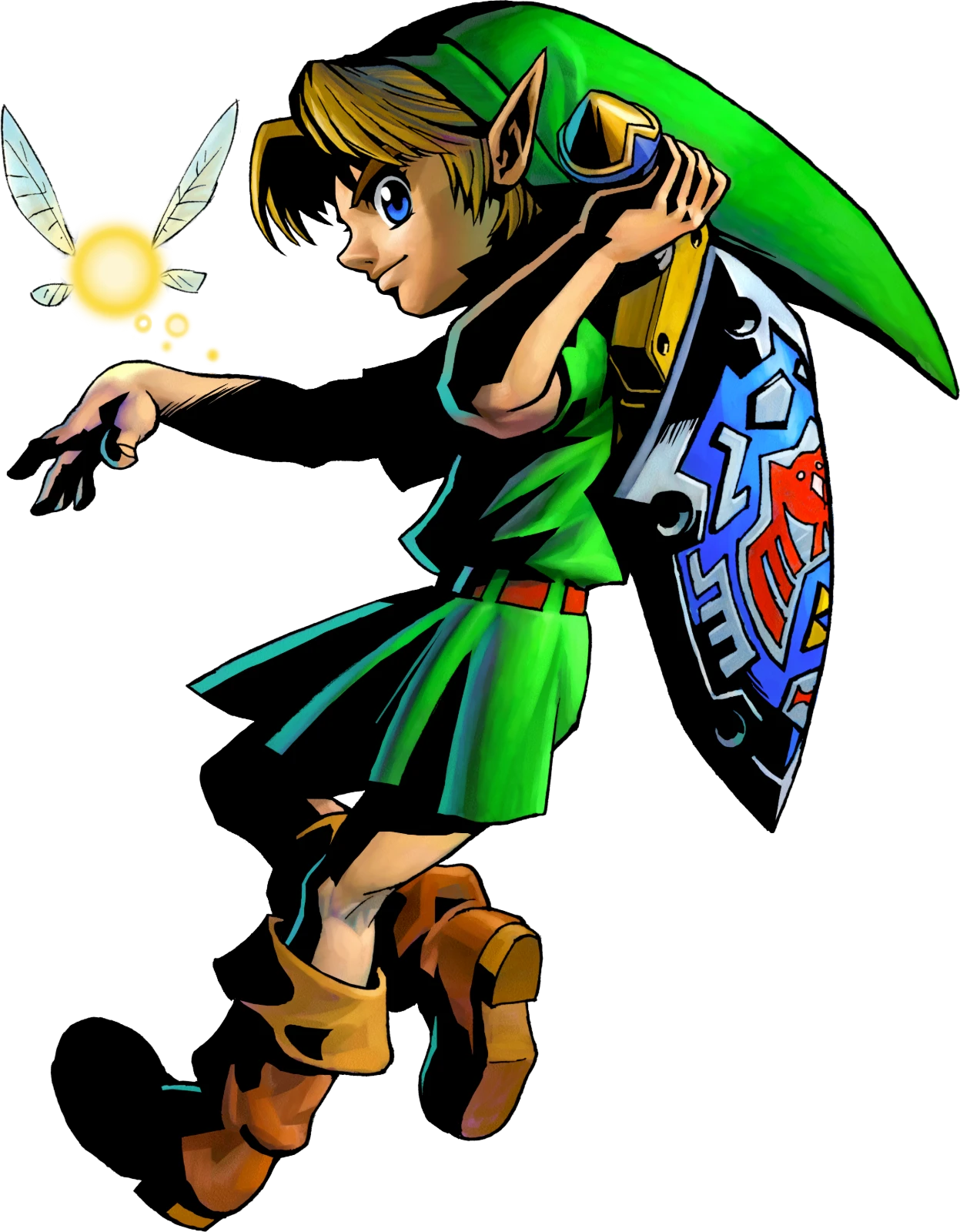
Official artwork for Majora’s Mask.
When did Majora’s Mask come out?
27 April 2000 in Japan, 26 October 2000 in North America and 17 November 2000 in Europe, all on Nintendo 64. More →
Is Majora’s Mask a sequel to Ocarina of Time?
Yes. It stars the same Link, the Hero of Time, a few months after Ocarina’s ending, while he searches for his lost fairy, Navi. A Skull Kid in a cursed mask waylays him in the woods and he ends up in Termina. More →
Do you need the Expansion Pak?
Yes. Majora’s Mask will not run without the 4MB Expansion Pak. It and Donkey Kong 64 are the only two Nintendo 64 games that require it. More →
How long is the three-day cycle in real time?
About 54 minutes if you let the clock run. The Inverted Song of Time slows it down and the Song of Double Time jumps ahead, while the Song of Time sends Link back to 6am on the first day. More →
How many masks are there?
Twenty-four. Four of them transform Link (Deku, Goron, Zora and the Fierce Deity); the other twenty range from handy tools to keepsakes from side quests. More →
How do you get the Fierce Deity’s Mask?
Collect all twenty non-transformation masks, then hand them over to the children playing on the moon. The child wearing Majora’s Mask gives you the Fierce Deity’s Mask in return. More →
How many dungeons are there?
Four temples, one in each region: Woodfall, Snowhead, Great Bay and Stone Tower. The moon serves as the final area, with a short trial for each of the four bosses. More →
Where did Majora’s Mask come from?
The Happy Mask Salesman says an ancient tribe used it in hexing rituals before sealing it away. He found it, and the Skull Kid stole it from him. The game never tells the full story. More →
Who made it, and how long did it take?
Nintendo EAD, directed by Eiji Aonuma and Yoshiaki Koizumi with Shigeru Miyamoto producing. Miyamoto asked for it to be made in a year; it took about fifteen months. More →
Where can I play Majora’s Mask today?
The Nintendo 64 original is part of Nintendo Switch Online + Expansion Pack (since 25 February 2022). The remake, Majora’s Mask 3D, is on Nintendo 3DS. More →
Plot / Story
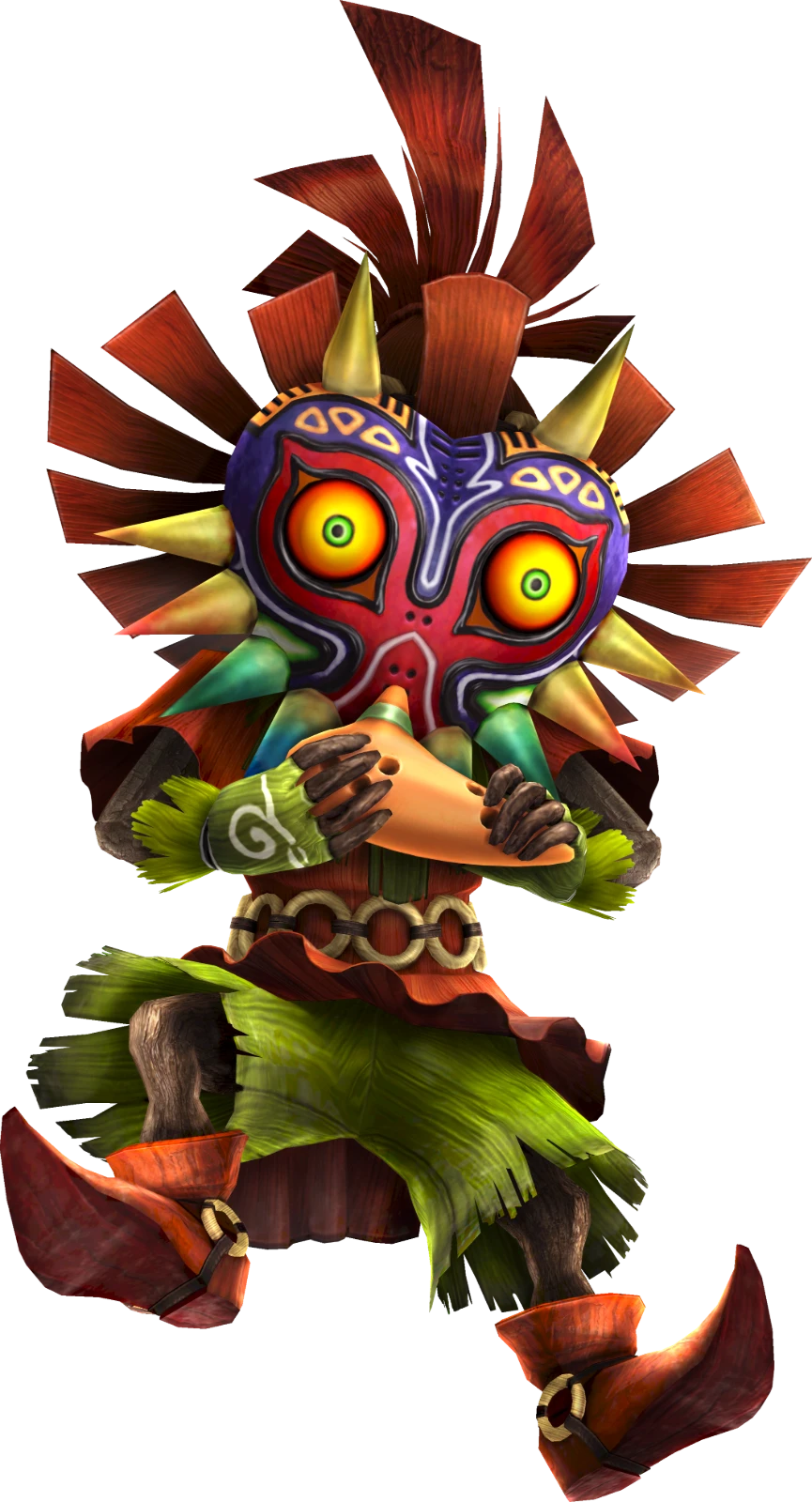
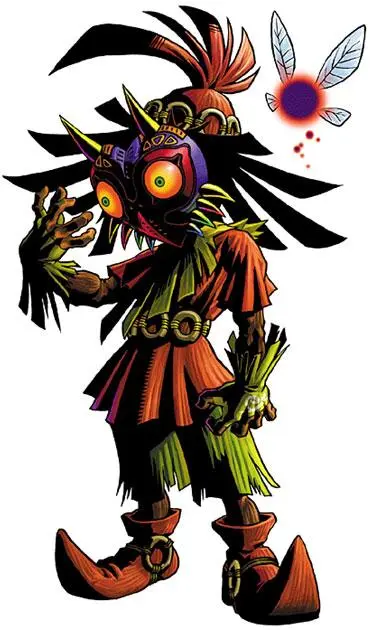
The Skull Kid wearing Majora’s Mask, in Nintendo’s official artwork.
Hyrule is saved, Ganondorf is sealed away and the Hero of Time has gone back to being a boy. But something is missing. Navi, the fairy who guided him through Ocarina of Time, has flown off, and Link has set out on Epona to find her. The trail leads him into a deep, misty forest, and into the path of a Skull Kid wearing a heart-shaped mask covered in spikes and staring eyes.
The Skull Kid has two fairy friends, the prickly Tatl and her gentle little brother Tael. They spook Epona, Link is thrown, and while he lies dazed the imp rifles through his things and makes off with the Ocarina of Time. Link gives chase into a hollow tree, tumbles down a seemingly endless drop and lands at the Skull Kid’s feet, where the mask’s power twists him into a Deku Scrub. In the scramble, Tatl is shut out on the wrong side of a door and left behind. She and Link are stuck with each other.
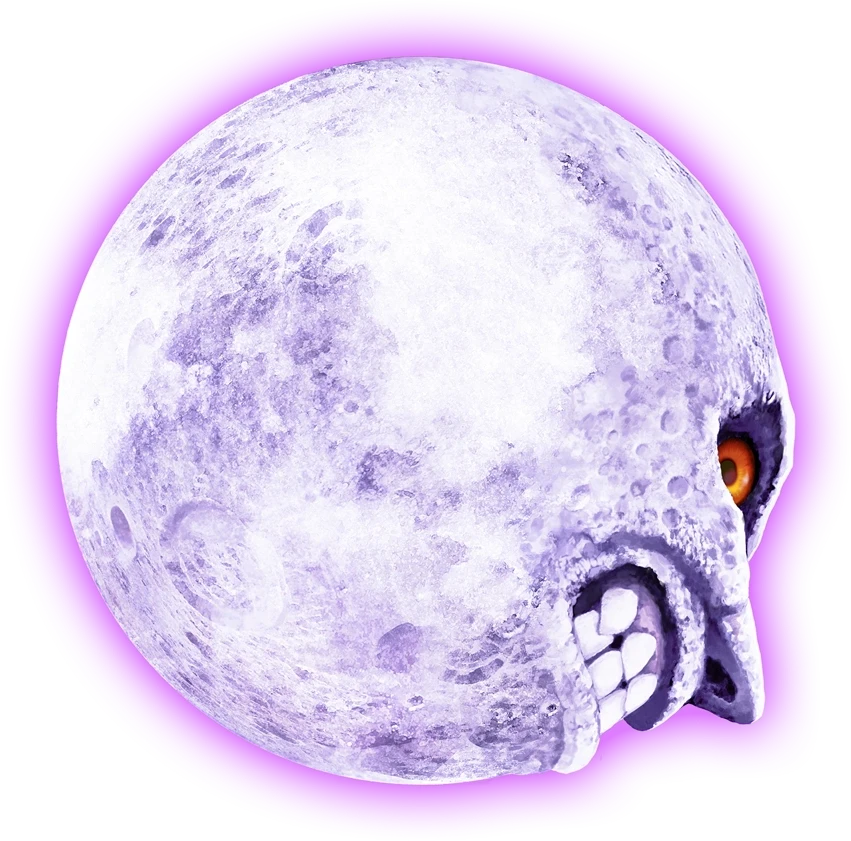
Beyond the tunnel lies Termina, a land that feels oddly familiar. Many of its faces look like people Link knew in Hyrule, but their lives are different, and they are all living under the same shadow: a vast moon with a furious, grimacing face that is sinking lower over Clock Town by the hour. In three days it will hit the ground.
A terrible fate in Clock Town
Link emerges inside the Clock Tower, where a familiar figure is waiting: the Happy Mask Salesman, whose prized mask was stolen by the very same Skull Kid. He can lift Link’s curse, he says, if Link brings back the instrument the imp took, and he has to move on in three days, so time is short. Outside, Clock Town is preparing for its Carnival of Time while arguing about whether to flee, and the Skull Kid is up to mischief everywhere. With Tatl’s grudging help, Link finds a scattered Great Fairy, joins (or tries to join) the children of the Bombers gang, and climbs to the town’s observatory, where a telescope shows the Skull Kid perched on top of the Clock Tower.
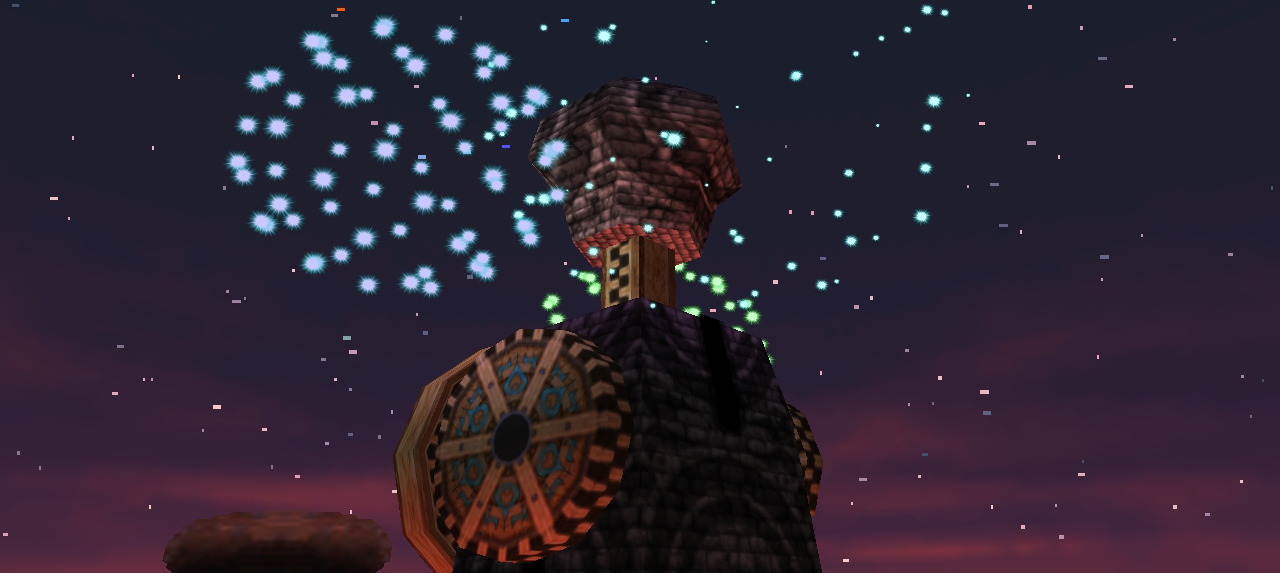
At midnight on the final night, as the tower’s doors open for the carnival, Link climbs up to face him. A well-aimed bubble knocks the Ocarina from the Skull Kid’s grasp. Holding it, Link remembers Princess Zelda teaching him the Song of Time, plays it, and the world rewinds to the dawn of the first day. Before the Skull Kid’s attack Tael had managed to blurt out a clue about four places: the swamp, the mountain, the ocean and the canyon.
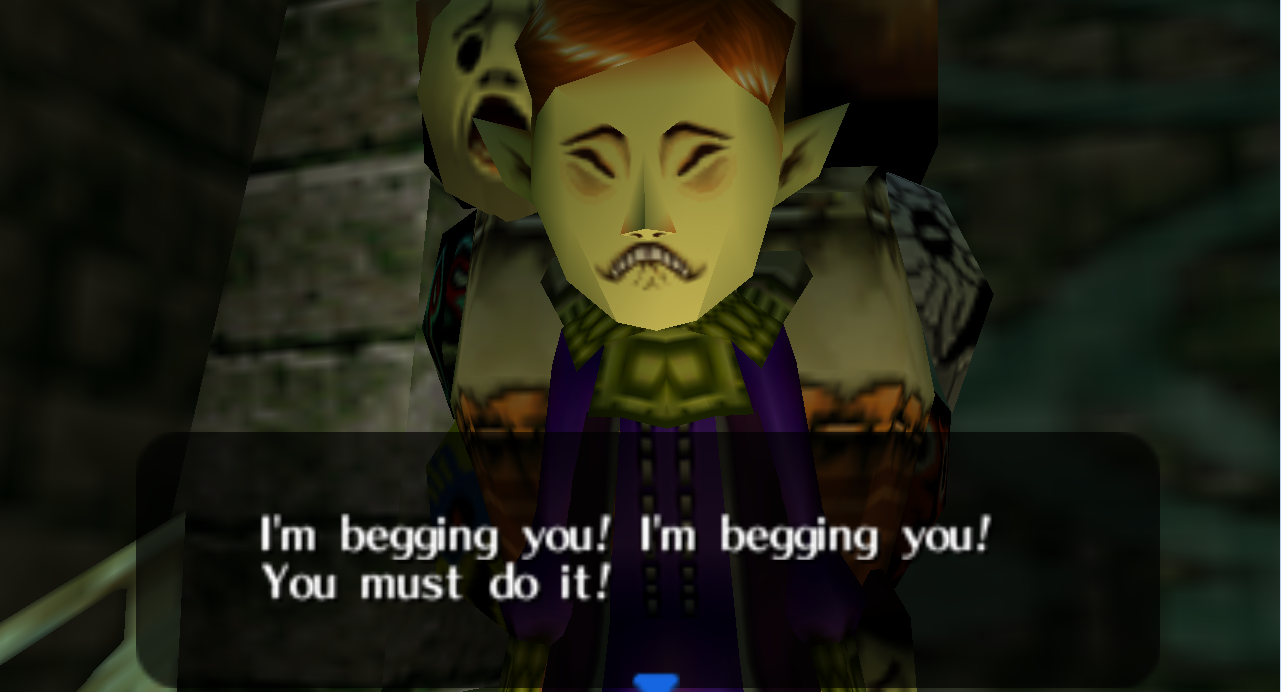
Back in the Clock Tower, the Happy Mask Salesman, who greeted the cursed Link on his arrival with the game’s most famous line, “You’ve met with a terrible fate, haven’t you?”, teaches Link the Song of Healing, which draws the curse out into a wooden mask Link can slip on and off at will, and then reveals what the Skull Kid really stole. It is Majora’s Mask, used long ago by an ancient tribe in its hexing rituals, and whoever wears it carries a power for evil. If Link cannot get it back, the salesman warns, something terrible will happen.
Cursed: Link wakes up as a Deku Scrub.The Happy Mask Salesman waits inside the Clock Tower.Midnight on the final night: the showdown on top of the Clock Tower.
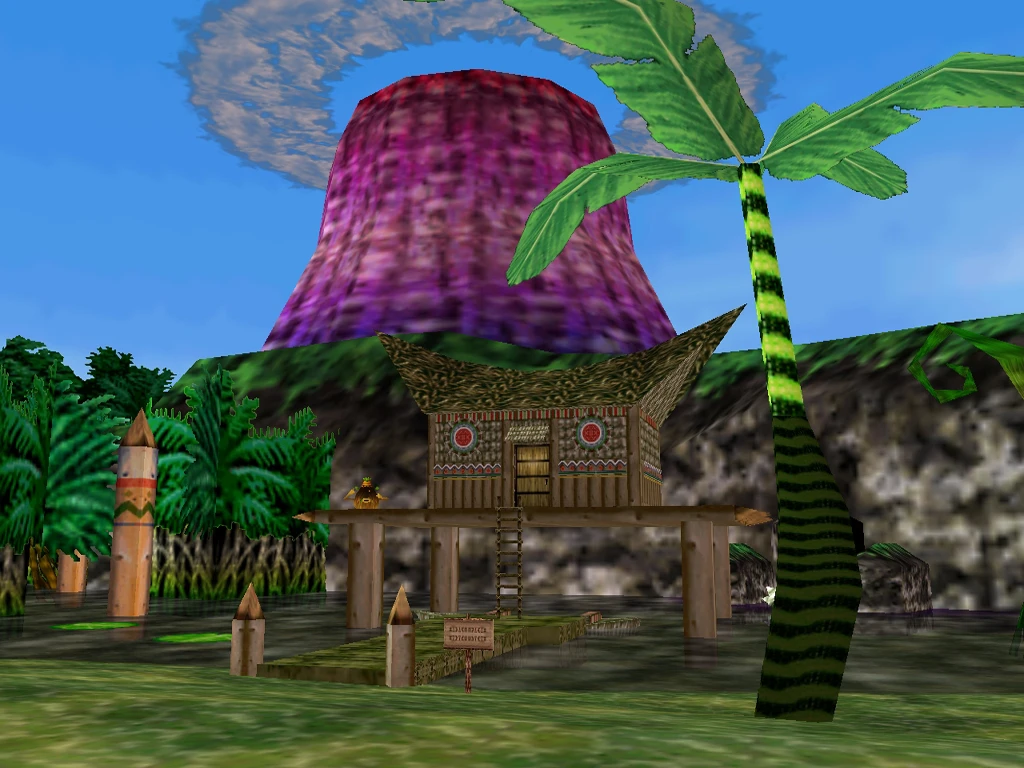
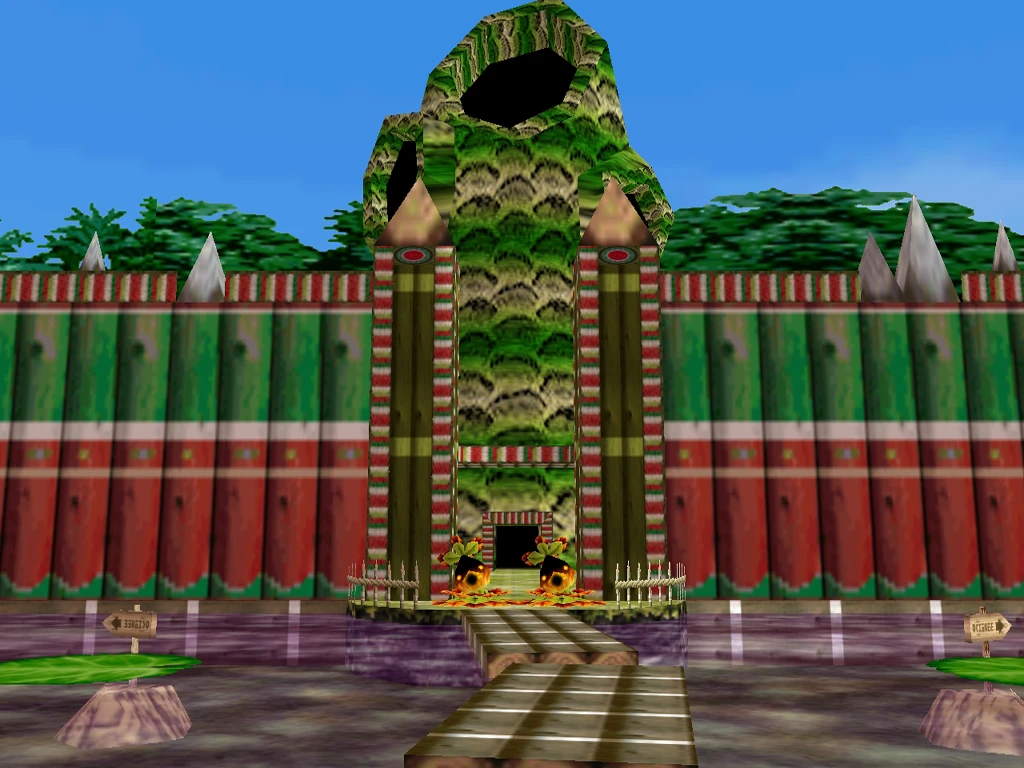
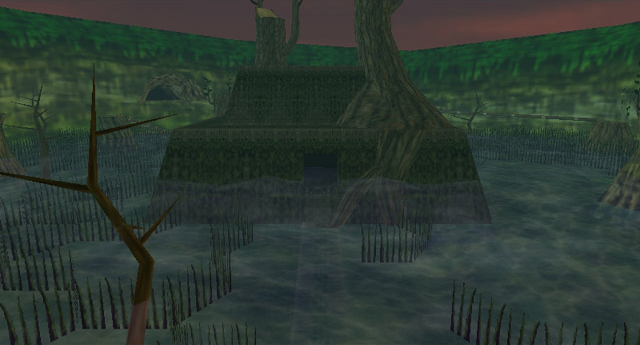
The swamp: Woodfall
Tael’s clue points south first, to a swamp whose water has turned to poison. A witch named Koume has been hurt in the woods, the Deku Princess has gone missing, and the Deku King has decided a captured monkey is to blame and plans to punish it. Link saves Koume with a potion from her sister Kotake, rides the swamp’s boat tour, slips into the Deku Palace in his Deku form, and learns from the imprisoned monkey the Sonata of Awakening.
The song opens Woodfall Temple, where the masked jungle warrior Odolwa holds the swamp in thrall. Beating him frees the first of the Four Giants, Termina’s sleeping guardians, and from inside the Giant’s realm Link learns the Oath to Order, the song that will call them. The princess, rescued in a bottle, flies home and gives her father a piece of her mind, and the monkey goes free.
The poisoned Southern Swamp.Sneaking into the Deku Palace as a Deku Scrub.Woodfall Temple rises out of the swamp.
The mountain: Snowhead
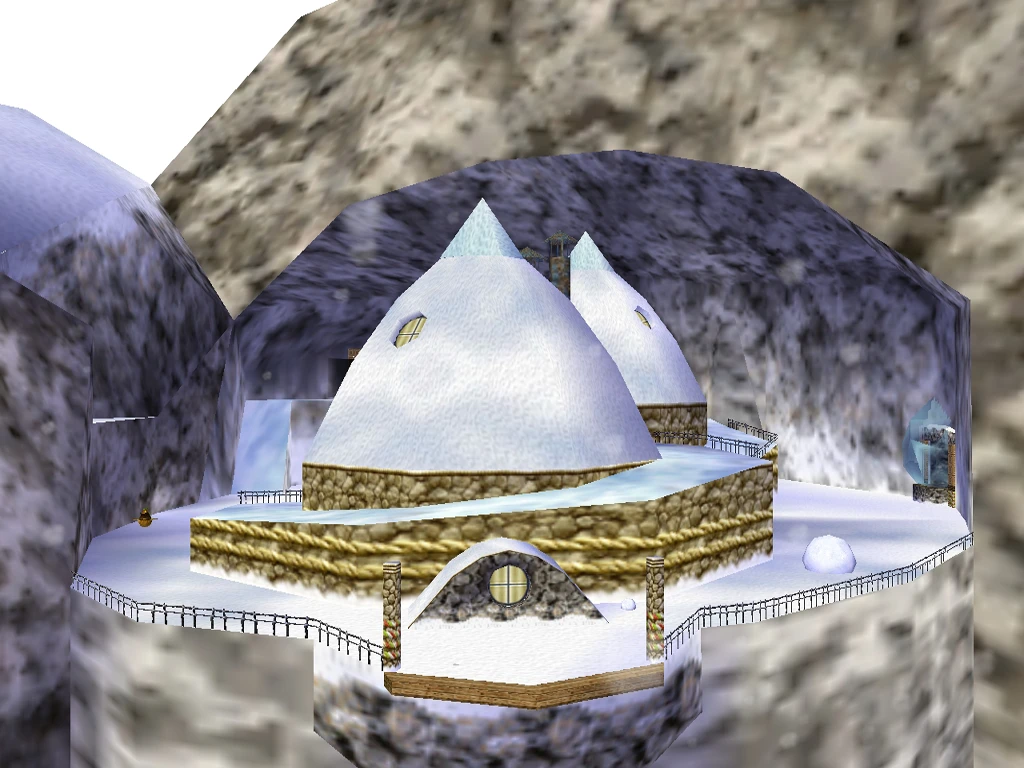
In the north, spring has never arrived. The Gorons are freezing, their elder has gone missing in the blizzard and his baby son will not stop crying. Link meets the ghost of Darmani, the Gorons’ greatest hero, who died trying to end the winter and cannot rest. The Song of Healing soothes his spirit and leaves behind the Goron Mask, turning Link into a rolling, punching powerhouse.
Finding the frozen elder and learning his lullaby lets Link put to sleep the gigantic Goron whose breath blocks the path, and then storm Snowhead Temple. Its master is Goht, a mechanical bull that Link chases around a racetrack of a boss room. With Goht beaten, the snow melts, the Goron races start up again and a second Giant awakes.
The endless winter around Goron Village.Darmani’s ghost by his grave.Snowhead Temple.
The ocean: Great Bay
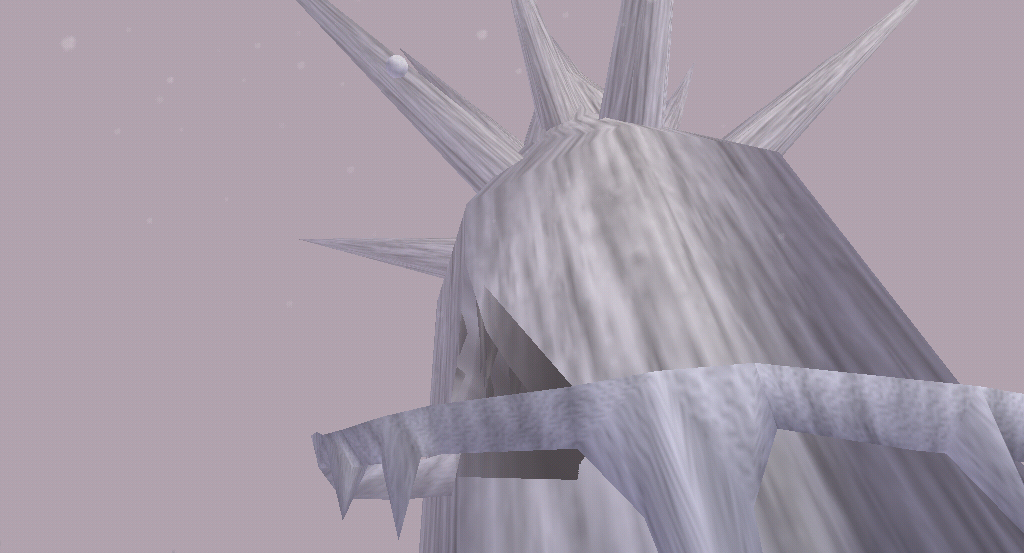
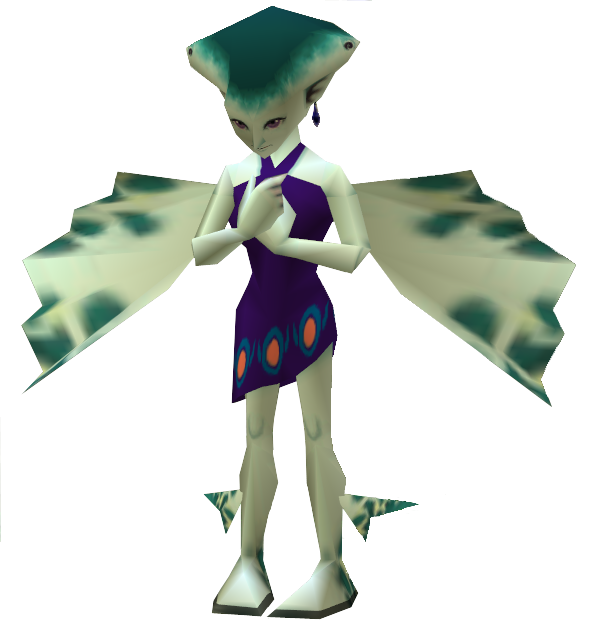
To the west, the waters of Great Bay are warming and murky, and the Zora rock band the Indigo-Go’s has a crisis. Pirates have stolen the eggs of their singer, Lulu, and she has lost her voice. Their guitarist Mikau tried to win them back from the Gerudo pirates’ fortress and was beaten half to death; Link finds him washed up on the shore and plays the Song of Healing as he dies. His spirit becomes the Zora Mask.
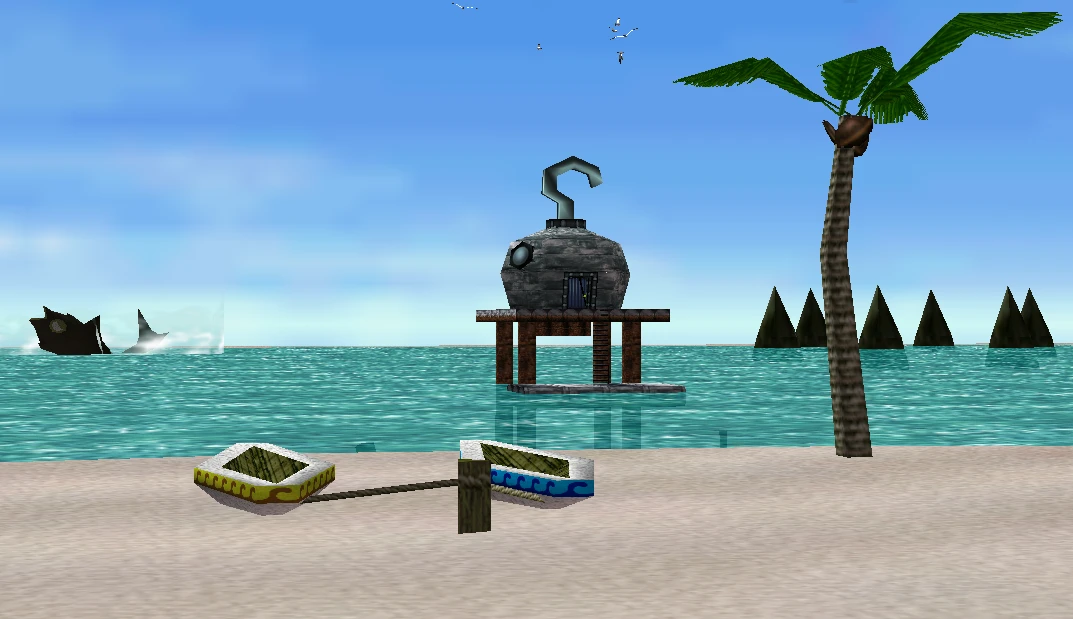
In Mikau’s shape, Link raids the pirates’ fortress and the sea snakes’ rock for the seven eggs, which hatch at the marine research lab into baby Zora who line up like notes on a stave and teach him the New Wave Bossa Nova. Played for Lulu, the tune summons a giant turtle that carries Link to Great Bay Temple, where the gargantuan fish Gyorg waits. Defeat it and the bay runs clear again.
Mikau, washed up on the beach at Great Bay.The Gerudo pirates’ fortress.Lulu, who lost her voice when her eggs were stolen.
The canyon: Ikana
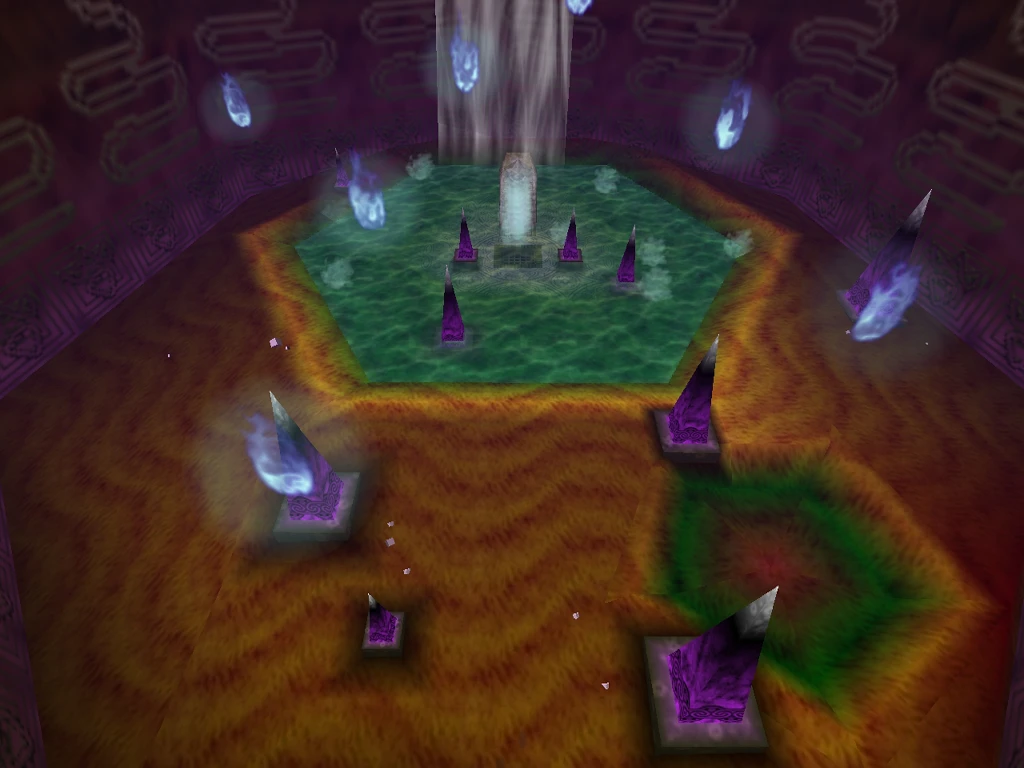
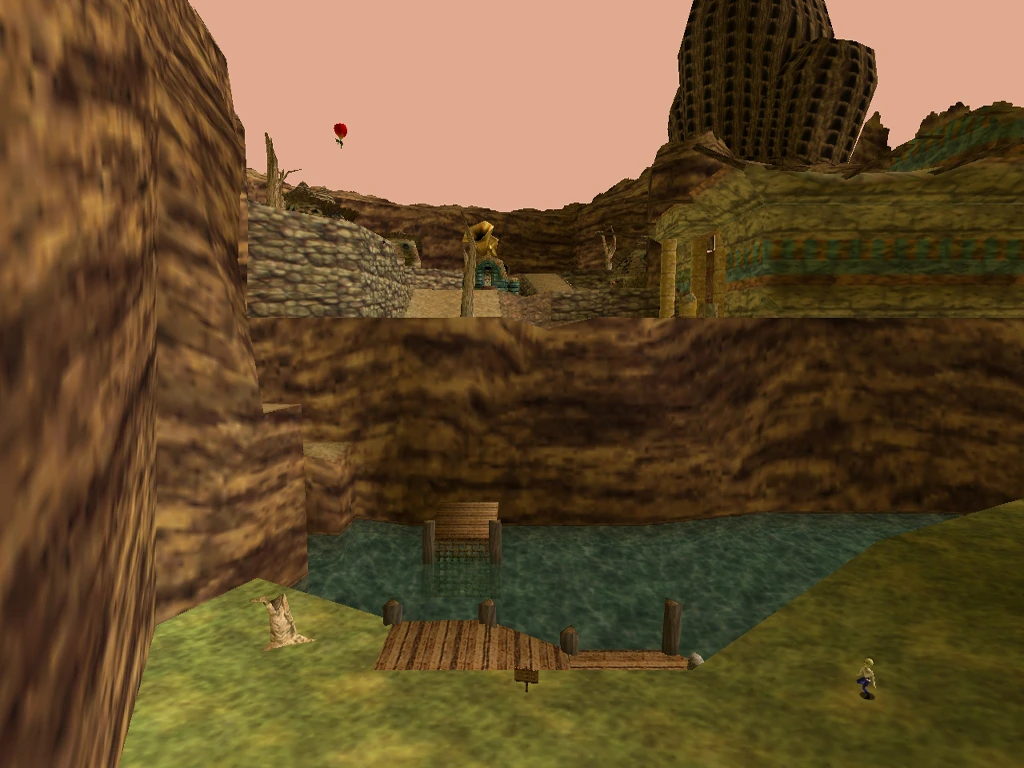
East lies Ikana, the bleakest place in Termina: a ruined kingdom of ghosts, mummies and old soldiers who never stopped fighting. A girl named Pamela guards her father, a researcher of the supernatural who has been cursed into a Gibdo; healing him earns the Gibdo Mask. Link frees the composer Flat from his grave, learns the Song of Storms, and uses it to lay to rest his brother Sharp, whose cursed music drains the life from anyone who hears it. Deeper in, King Igos du Ikana broods in his ruined castle, and defeating him earns the Elegy of Emptiness, a dirge that leaves behind statues of Link’s different forms.
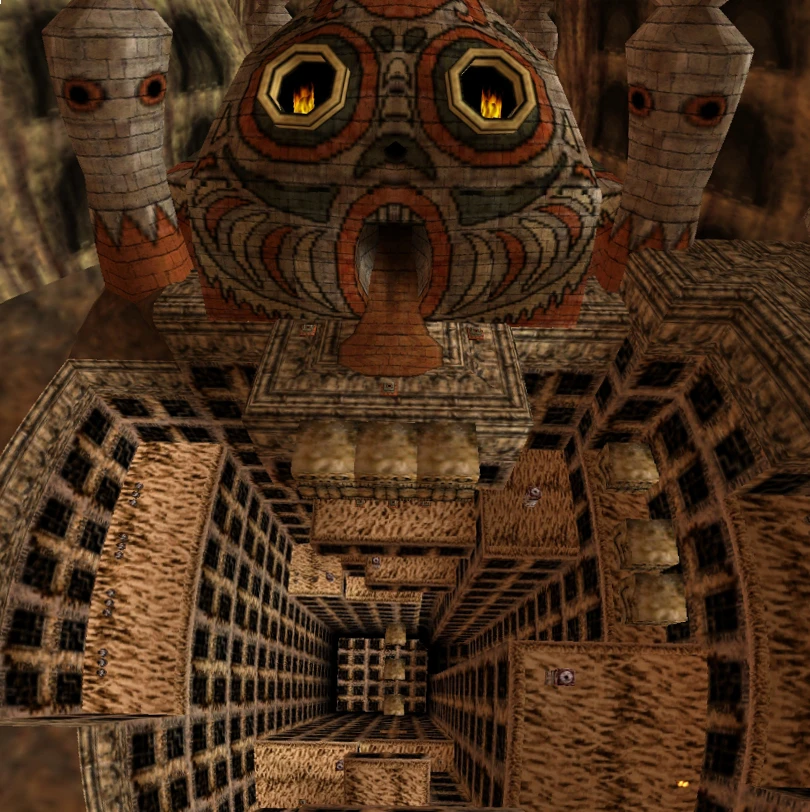
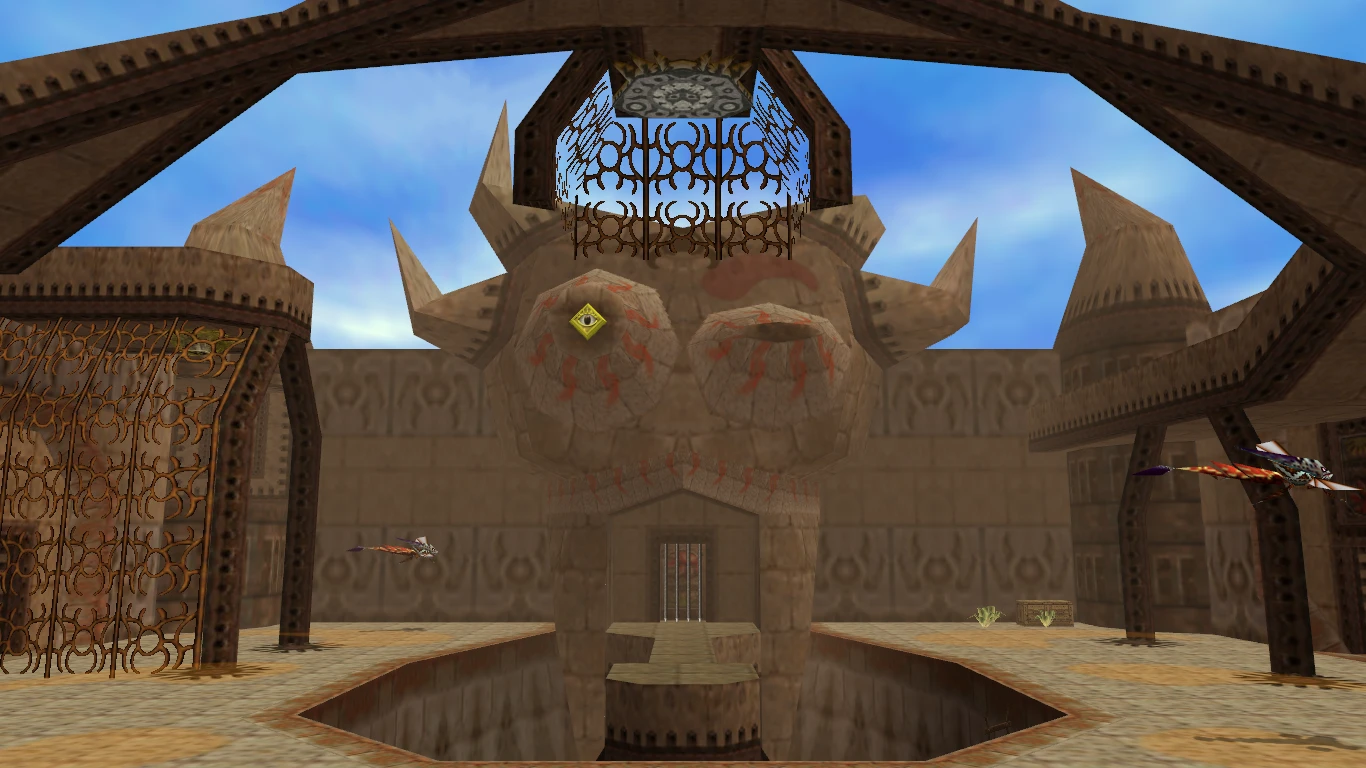
Those statues are the key to Stone Tower, a needle of stacked blocks that ends in a temple Link has to turn upside down to explore. At the top waits Twinmold, a pair of giant masked insects, and the Giant’s Mask, which lets Link grow to their size and wrestle them in the sand.
Ikana Canyon, home of the restless dead.Stone Tower Temple, flipped upside down with a Light Arrow.
Anju and Kafei
The heart of the game is not a temple at all. Anju, the nervous young innkeeper of the Stock Pot Inn, is due to marry Kafei, the mayor’s son, at the carnival. But Kafei vanished a month ago. The truth is that the Skull Kid’s magic turned him into a child, and a grinning thief called Sakon then stole the Sun’s Mask he was to bring to the wedding. Too ashamed to face Anju, Kafei has been hiding in the back room of the Curiosity Shop, writing letters.
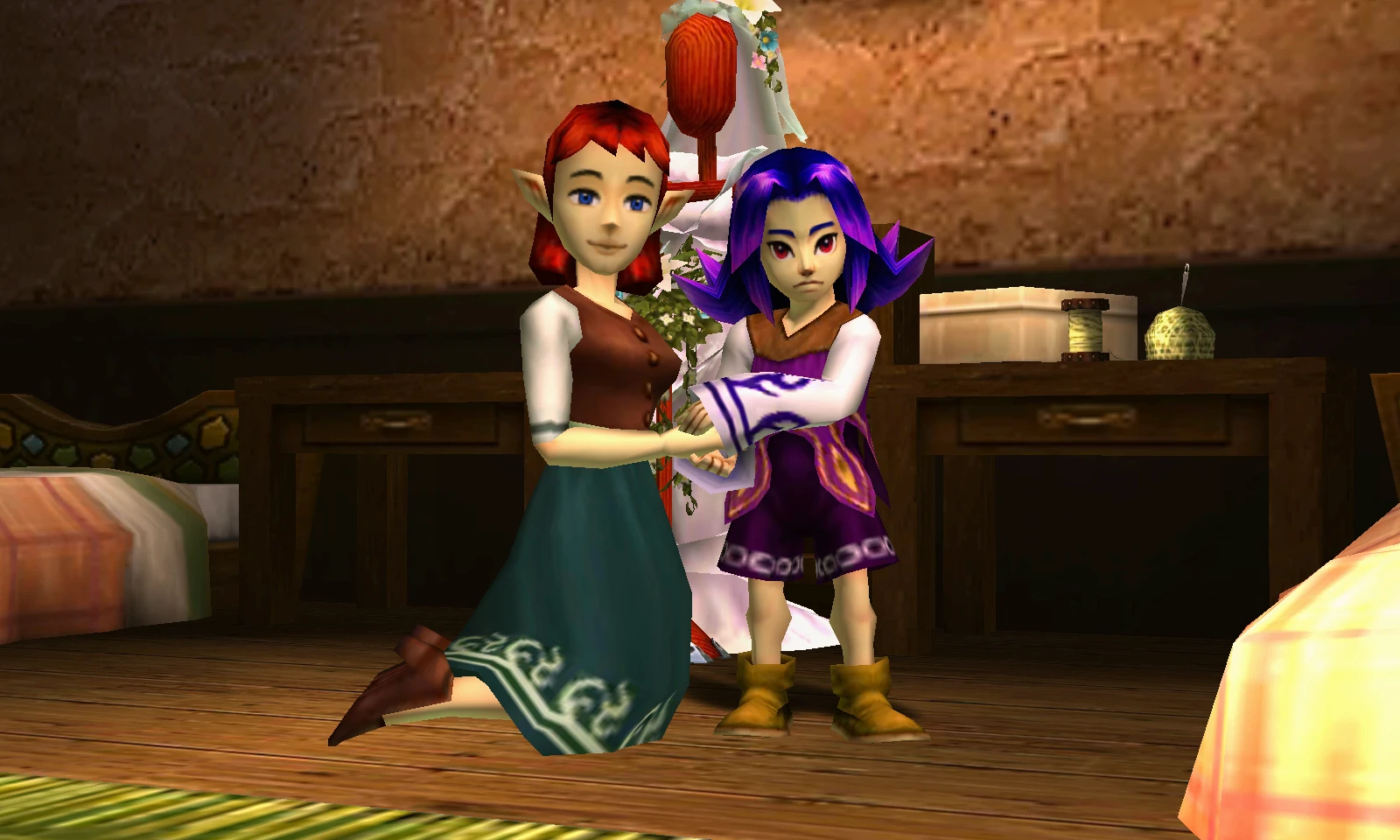
Link can follow the whole thing across three days: taking a missing-person job from Kafei’s mother, Madame Aroma, carrying a pendant from Kafei to Anju, persuading Anju not to run, and tracking Sakon to his hideout in Ikana Canyon. If everything goes right, Kafei walks into the inn shortly before the moon falls and the two marry there and then, with Link and Tatl as their only witnesses. Their two masks become the Couple’s Mask. On the next loop, of course, none of it has happened, but Link remembers.
Anju and Kafei, reunited on the final night.
Other lives in Termina
Dozens of smaller stories run alongside. At Romani Ranch, little Romani is practising her archery to defend the cows against “them”, ghostly visitors who come on the first night, while her sister Cremia worries about the rival Gorman brothers. A postman runs his rounds to the second, a Gorman troupe has had its carnival show cancelled, and the mayor is trapped in an endless meeting between the guard captain who wants to evacuate and the carpenter who insists the festival must go on. The Bombers’ Notebook tracks twenty of these people, logging their schedules and the promises Link has made.
Romani Ranch, where Romani waits for “them”.The Bombers’ Notebook: twenty people, their timetables and Link’s promises.
Inside the moon
With all four guardians freed, Link returns to the Clock Tower at the last midnight and plays the Oath to Order. From the four corners of Termina the Giants stride in and catch the moon on their shoulders. The mask, it turns out, was pulling the strings all along: Majora’s Mask casts off the Skull Kid like a worn-out puppet and flies up into the moon.
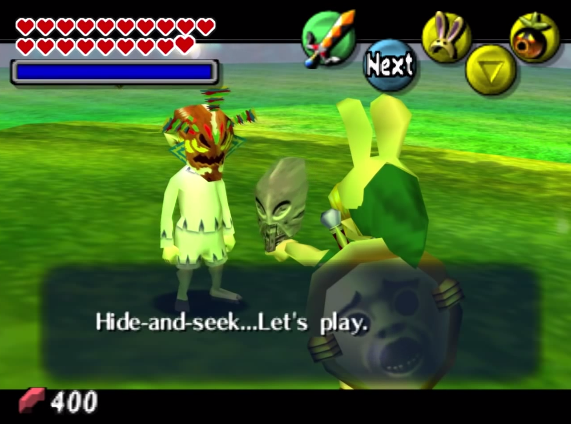
Link follows, and finds not rock but a sunny meadow with a single tree and a group of children, each wearing the mask of a boss he has beaten. Each one leads to a short trial, and each asks him for masks. Under the tree sits a child wearing Majora’s Mask, who invites him to play a game of good guys against bad guys. Link plays the part of the good guy: the mask grows tentacles, then legs, then whips, as Majora’s Mask, Majora’s Incarnation and finally Majora’s Wrath. Players who have handed over every mask can fight it as the Fierce Deity, a towering warrior with a huge two-handed sword.
The Four Giants hold back the moon.The meadow inside the moon, and the child wearing Majora’s Mask.
Dawn of a new day
The moon crumbles and the sun rises on a morning nobody in Termina expected to see. The Giants, who had already asked Link to forgive the Skull Kid, tell the imp that they always thought of him as a friend; he had been sulking ever since they left to guard the four lands, and the mask fed on his loneliness. Tatl and Tael are reunited, and the Skull Kid, sniffing at Link, realises he smells just like the fairy boy who once taught him a song in the woods: the same Link from Ocarina of Time.
The Happy Mask Salesman takes back his mask, now drained of its evil, and is gone. As the credits roll, the Carnival of Time goes ahead, the wedding takes place, and the people Link helped carry on with their lives. Link rides off on Epona to continue his search, leaving behind a tree stump on which the Skull Kid has drawn a picture of himself with his friends. According to Nintendo’s chronology in Hyrule Historia, nobody knows where the hero went next.
The Skull Kid’s drawing on the tree stump, the game’s final image.
Regions and temples of Termina
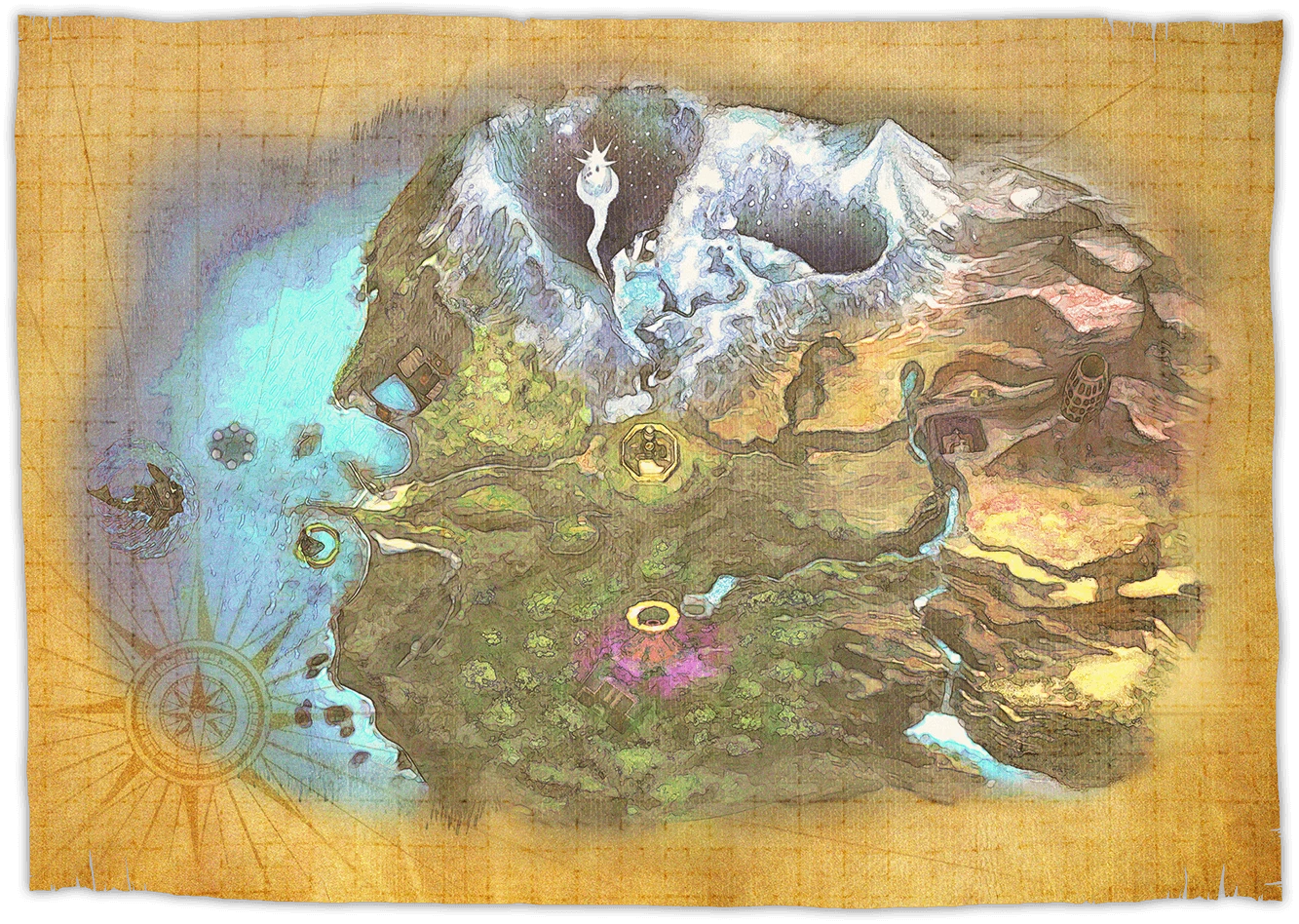
Termina is laid out like a compass. Clock Town sits in the middle, wrapped in Termina Field, and each point of the compass leads to a region with its own people, its own problem and its own temple. A Giant sleeps inside each temple’s boss.
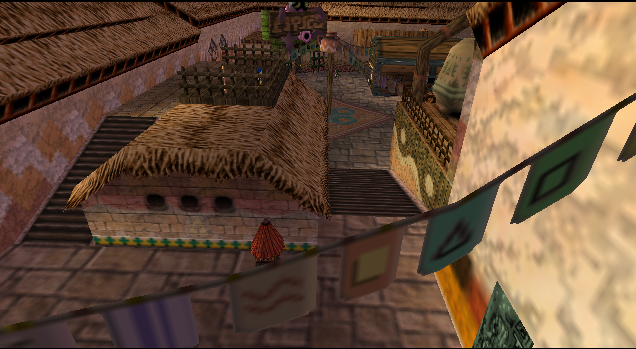
Clock TownCentreThe walled festival town, split into four districts round the great clock. Shops, the Stock Pot Inn, the bank, the Milk Bar, the Bombers’ hideout and the observatory.
Southern Swamp and Woodfall TempleSouthHome of the Deku Scrubs and the witches’ potion shop. Boss: Odolwa, Masked Jungle Warrior. Temple treasure: the Hero’s Bow.
Snowhead and Snowhead TempleNorthGoron Village, the smithy and the Goron racetrack. Boss: Goht, Masked Mechanical Monster. Temple treasure: Fire Arrows.
Great Bay and Great Bay TempleWestZora Hall, the pirates’ fortress, the fisherman’s hut and the marine research lab. Boss: Gyorg, Gargantuan Masked Fish. Temple treasure: Ice Arrows.
Ikana Canyon and Stone Tower TempleEastIkana Graveyard, the Ancient Castle of Ikana, the well and the Music Box House. Boss: Twinmold, Giant Masked Insect. Temple treasure: Light Arrows.
Milk Road and Romani RanchSouth-westThe Gorman racetrack and the ranch run by Cremia and Romani. No temple, but a vital stop for Epona.
The MoonFinal areaA meadow with four short trials, one for each boss, and Majora waiting beneath the tree.
Each temple is a puzzle box built around one of Link’s forms, and each hides stray fairies that a local Great Fairy will reward you for bringing home.
In comics, TV & other media
Majora’s Mask has had a long and strange afterlife: a manga, a fan film that became a game studio’s calling card, a cult internet ghost story, and plenty of cameos in Nintendo’s own games.
The Legend of Zelda: Majora’s Mask (manga)Akira Himekawa · Shogakukan (Japan) · Viz Media 2009A one-volume adaptation by Akira Himekawa, the pen name of the duo behind most of the official Zelda manga. It picks up where their Ocarina of Time books left off, makes Anju and Kafei’s story much bigger, keeps Link out of the temples (Odolwa is fought at the Deku Palace and Gyorg out at sea), and adds a bonus chapter imagining where the mask came from: armour taken from a monster called Majora. Viz published it in English as volume 3 of its Zelda line on 3 February 2009, and later reissued it with A Link to the Past in a Legendary Edition.
Terrible FateEmber Lab · short film · 2016An animated fan short retelling the Skull Kid’s story, named after the Happy Mask Salesman’s famous line. It put the studio Ember Lab on the map and led directly to its own game, Kena: Bridge of Spirits.
Ben DrownedAlexander D. Hall · web serialAn internet horror story about a haunted Majora’s Mask cartridge, told through forum posts and doctored videos. It became one of the defining creepypastas.
Super Smash Bros.Nintendo · 2001 onwardsGreat Bay is a stage in Melee and returns in Ultimate. The Skull Kid is an Assist Trophy in the 3DS and Wii U games and in Ultimate, where the moon itself also turns up as an Assist Trophy.
Hyrule WarriorsNintendo and Koei Tecmo · 2015–2016The Majora’s Mask Pack (Japan and Europe 29 January 2015, North America 5 February) added Young Link and Tingle as fighters and a Skull Kid costume for Lana. The Skull Kid himself joined the roster in Hyrule Warriors Legends on 3DS.
Hyrule HistoriaNintendo · book · 2011Nintendo’s official history places Majora’s Mask on the “child” branch of the timeline, right after Ocarina of Time, and explains that masks hold the souls of the dead, which is how Link takes on their forms.
Breath of the Wild and Tears of the KingdomNintendo · 2017, 2023The Fierce Deity’s mask, armour and boots return as an outfit. In Breath of the Wild they drop at random from the Link (Majora’s Mask) amiibo; in Tears of the Kingdom a bandit called Misko has hidden them in three caves.
Characters
Majora’s Mask has the most memorable supporting cast in the series, and almost every face has a story. These are the people who matter most, with a note on where else in Zelda history you might have met them.
Character
Who they are
In this game
Stats & abilities
LinkThe Hero of Time
The same boy who saved Hyrule in Ocarina of Time. Sent back to his childhood at the end of that game, he has set off alone to look for Navi, the friend who left him. Nintendo’s Hyrule Historia says nobody knows what became of him afterwards.
Cursed into a Deku Scrub and stranded in Termina, he has three days to stop the moon. He can never fix everything in one loop, so he must learn the town’s rhythms and come back again and again.
Sword and shield, Hero’s Bow, bombs, Hookshot, Deku Nuts
Elemental arrows: fire, ice and light
Ocarina of Time: Song of Time, Song of Healing, Song of Soaring and more
Kokiri Sword, which Termina’s smithy can improve
Twenty-four masks
Deku, Goron, Zora and Fierce Deity LinkThe transformation masks
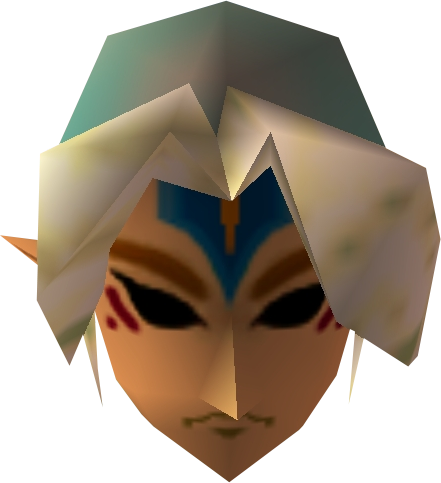
According to Hyrule Historia, masks hold the souls of the dead, which is how Link takes on their forms. The Deku Mask is the curse the Skull Kid cast, drawn out by the Song of Healing; the Goron Mask is the spirit of the hero Darmani; the Zora Mask is the guitarist Mikau. The Fierce Deity’s origins are never explained, and in Japan he is nicknamed “Oni Link”.
The masks are the core of the game. Every temple is built around one of the forms, and people react to Link differently depending on whose face he is wearing.
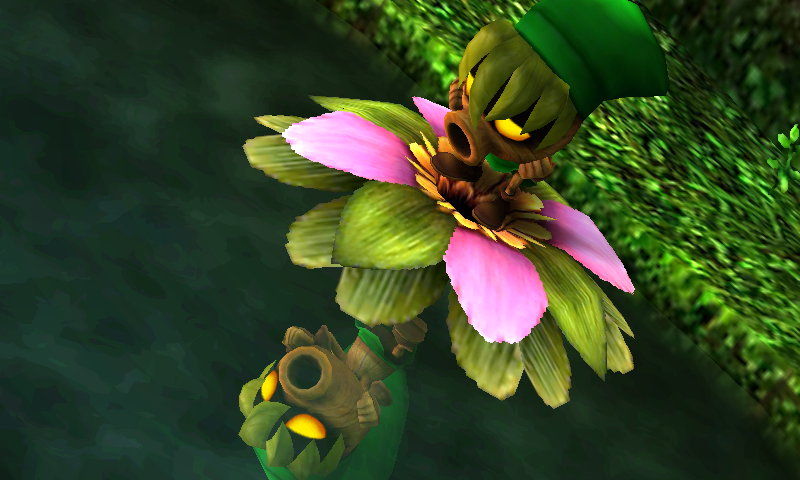
Deku: spins, shoots bubbles, launches from Deku Flowers to glide, skips across water; weak to fire
Goron: rolls at speed, punches, pounds the ground, walks on lava; sinks in deep water
Zora: swims fast, throws boomerang fins, raises an electric barrier; weak to fire and ice
Fierce Deity: a huge two-handed sword that fires beams, usable only in boss rooms
TatlLink’s fairy (and her brother Tael)
A fairy who was the Skull Kid’s friend, along with her younger brother Tael. Where Navi was earnest, Tatl is sharp-tongued and impatient; Nintendo’s manual calls her somewhat overbearing and worried about her little brother. When she sees the Skull Kid hurt Tael, she resolves to stop him herself. She and Tael are unique to Majora’s Mask.
Separated from her brother in the opening, she guides Link through Termina, gives hints and targets enemies. Tael, left with the Skull Kid, risks a beating to shout the clue about the four regions.
Z-targeting and hints, like Navi
Tatl comments on people and places
Reunited with Tael after Majora is defeated
Skull KidThe masked imp
Skull Kids first appeared in Ocarina of Time’s Lost Woods, where young Link could play Saria’s Song with one in exchange for a Piece of Heart. Majora’s Mask reveals that this Skull Kid was that very one. He has since cameoed in the Sacred Grove of Twilight Princess, as an Assist Trophy in Super Smash Bros. and as a playable fighter in Hyrule Warriors Legends.
Long ago the Four Giants were his friends; when they left to guard Termina’s four corners he felt abandoned and turned to pranks. Stealing Majora’s Mask gave him terrible power, but the mask was using him all along. He steals the Ocarina, curses Link and drags the moon down.
Flies, teleports and casts curses with the mask
Seals each Giant inside a temple boss
Forgiven by the Giants in the ending
Majora’s MaskThe true villain
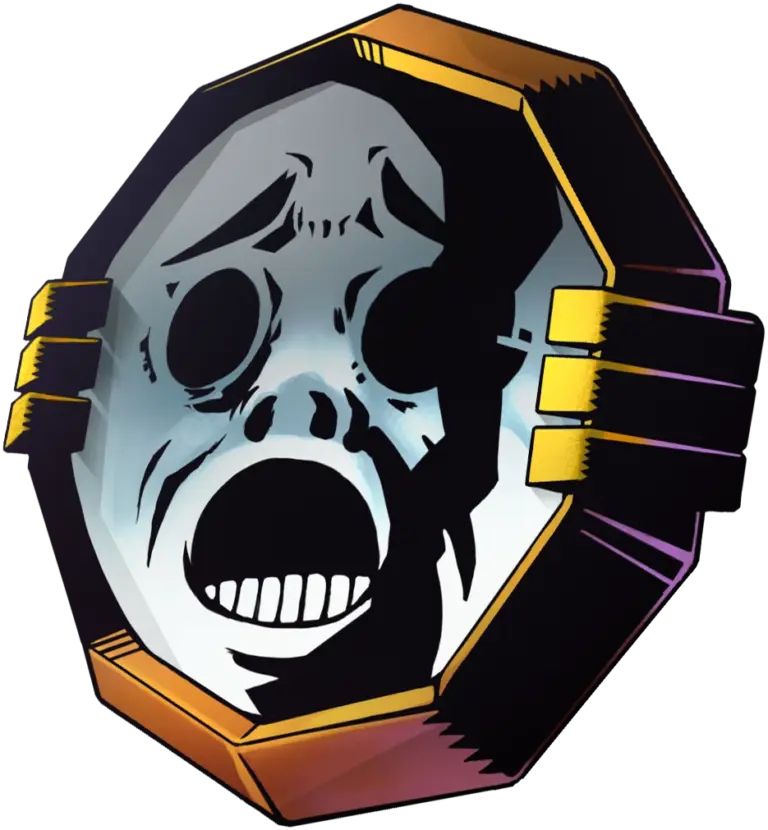
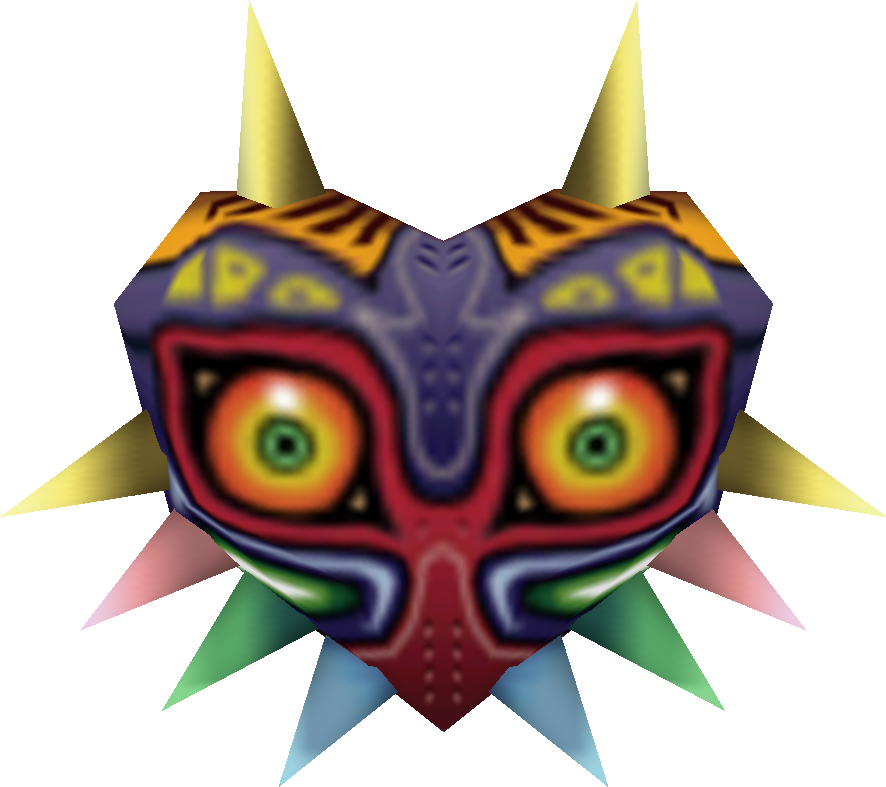
A heart-shaped mask ringed with spikes, with two great staring eyes. The Happy Mask Salesman says an ancient tribe used it in hexing rituals and then hid it away for fear of its power. Art director Takaya Imamura designed it. The mask is unique to this game.
It possesses the Skull Kid and, when he is no longer useful, abandons him and flies into the moon, where it fights Link in three forms.
Final boss: Majora’s Mask, Majora’s Incarnation, Majora’s Wrath
Spins, fires beams, dances and lashes with whips
Light Arrows and the Fierce Deity make short work of it
Happy Mask SalesmanThe travelling mask dealer
In Ocarina of Time he ran the Happy Mask Shop in Hyrule Castle Town, lending Link masks to sell on. He also turns up, very hungry, in Oracle of Ages. Permanently smiling, he can switch from cheerful to furious in a heartbeat, and he has a habit of appearing somewhere new without seeming to move.
Robbed by the Skull Kid, he offers to break Link’s curse if Link brings back the Ocarina and the stolen mask. He teaches the Song of Healing, gives Link his first mask, and in the end walks off with Majora’s Mask, now powerless.
Teaches the Song of Healing on a magically summoned organ
Carries a pack of masks, including one of Mario
“You’ve met with a terrible fate, haven’t you?”
The Four GiantsTermina’s guardian gods
Four enormous, gentle beings, worshipped as the creators and protectors of Termina. They promised to watch over its four lands and to come if the people called them with a song. They appear only in Majora’s Mask.
The Skull Kid has sealed each of them inside a temple boss. Once all four are freed, the Oath to Order calls them to hold back the moon, and as the last of them is freed they ask Link to forgive their old friend.
Freed by beating Odolwa, Goht, Gyorg and Twinmold
Teach Link the Oath to Order
AnjuInnkeeper of the Stock Pot Inn
A kind, flustered young woman who runs the Stock Pot Inn with her family, apologises constantly and is a famously bad cook.
Her fiancé Kafei has vanished a month before their wedding. Whether she stays or flees on the last day depends on what Link does.
Runs the Stock Pot Inn
Marries Kafei if the quest is completed
Reward: the Couple’s Mask
KafeiThe mayor’s missing son
The son of Mayor Dotour and Madame Aroma, and a former member of the Bombers. He is unique to Majora’s Mask, but his story is the game’s emotional centre.
The Skull Kid turned him into a child and the thief Sakon stole his wedding mask. He hides in the back of the Curiosity Shop, and Link can help him recover the mask and reach Anju in time.
Gives Link the Pendant of Memories to deliver
Letters through the Postman
Never seen as an adult: only Anju appears in the credits’ wedding scene
Romani and CremiaThe sisters of Romani Ranch
Romani is Termina’s counterpart of Malon from Ocarina of Time’s Lon Lon Ranch. Cremia, the elder, has run the ranch and its famous milk since their father died; Romani, the younger, talks about herself in the third person and is practising with a bow.
Romani needs help fending off “them”, the ghostly visitors who come for the cows at 2am on the first night, and teaches Link Epona’s Song. Cremia’s milk run to town is targeted by the Gorman brothers.
Romani: Epona’s Song, archery training
Cremia: milk delivery escort
Romani’s Mask lets Link into the Milk Bar
TingleMap seller in a balloon
A 35-year-old man in a green bodysuit who is convinced he is a fairy. Designed by Takaya Imamura, he makes his debut here and went on to a big role in The Wind Waker, minor parts in several other games and his own spin-offs, starting with Freshly-Picked Tingle’s Rosy Rupeeland.
Floats around Termina on a red balloon selling maps of each region. His father runs the swamp’s tourist centre and pictograph contest and is ashamed of him.
Sells region maps
Pop his balloon to bring him down
Kaepora GaeboraThe great owl
The wise owl who popped up to advise Link throughout Ocarina of Time. Here, unlike in Hyrule, he gives no hint of who he really is.
Teaches the Song of Soaring, which warps Link to the owl statues he has activated, guides him to the Lens of Truth and asks him to look after the Gorons.
Song of Soaring
Owl statues double as save points
DarmaniHero of the Gorons
The proudest Goron of them all, a keen racer who went up the mountain to end the winter and died in the attempt. He is unique to Majora’s Mask.
His ghost lingers at his grave above Goron Village, unable to rest. The Song of Healing puts his regrets to sleep and leaves Link the Goron Mask.
Source of the Goron Mask
The Gorons think Link is Darmani back from the dead
Mikau and LuluThe Indigo-Go’s
Mikau is the band’s guitarist and comes from a line of Zora heroes; Lulu is its lead singer, and the mother of seven stolen eggs; the two are clearly close. The band also includes bassist Japas and leader Evan. Eiji Aonuma based the idea on his own student band days.
Mikau dies of his wounds after trying to recover Lulu’s eggs, and his spirit becomes the Zora Mask. Lulu cannot sing until the eggs are home and Great Bay is cleansed.
Zora Mask (Mikau)
New Wave Bossa Nova (from the hatchlings)
The Deku Butler and the Deku PrincessThe Deku royal household
The Deku Butler is the royal family’s prim, loyal servant, still mourning a son who has gone missing; the princess is the clever, fiery daughter of the hot-headed Deku King. Fans have long noticed that the twisted tree near the start, and the Butler’s sad visit to it in the credits, suggest Link’s Deku form came from the Butler’s son.
The princess is captured in Woodfall Temple and rescued in a bottle. Afterwards the Butler challenges Link to a race through the Deku Shrine and rewards him with the Mask of Scents.
Mask of Scents: sniff out magic mushrooms
The Deku King nearly punishes an innocent monkey
Koume and KotakeThe swamp witches
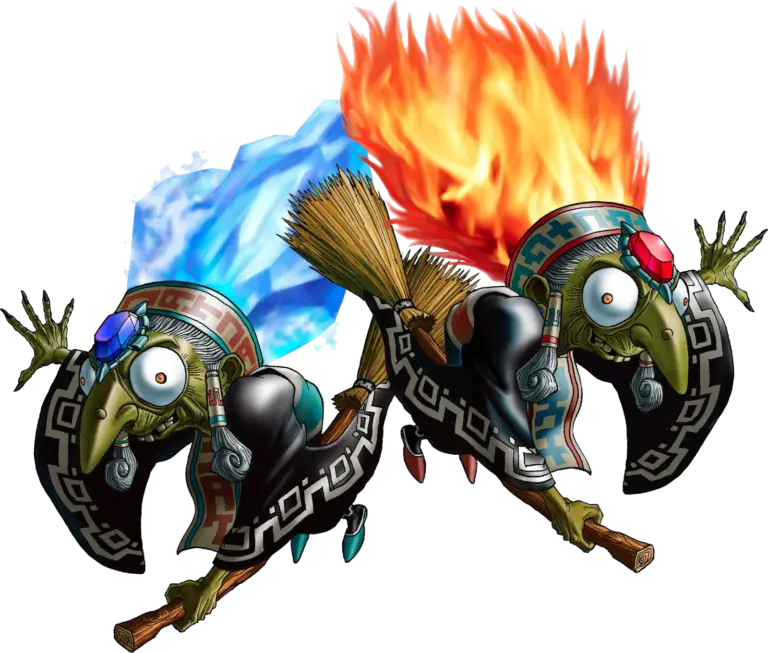
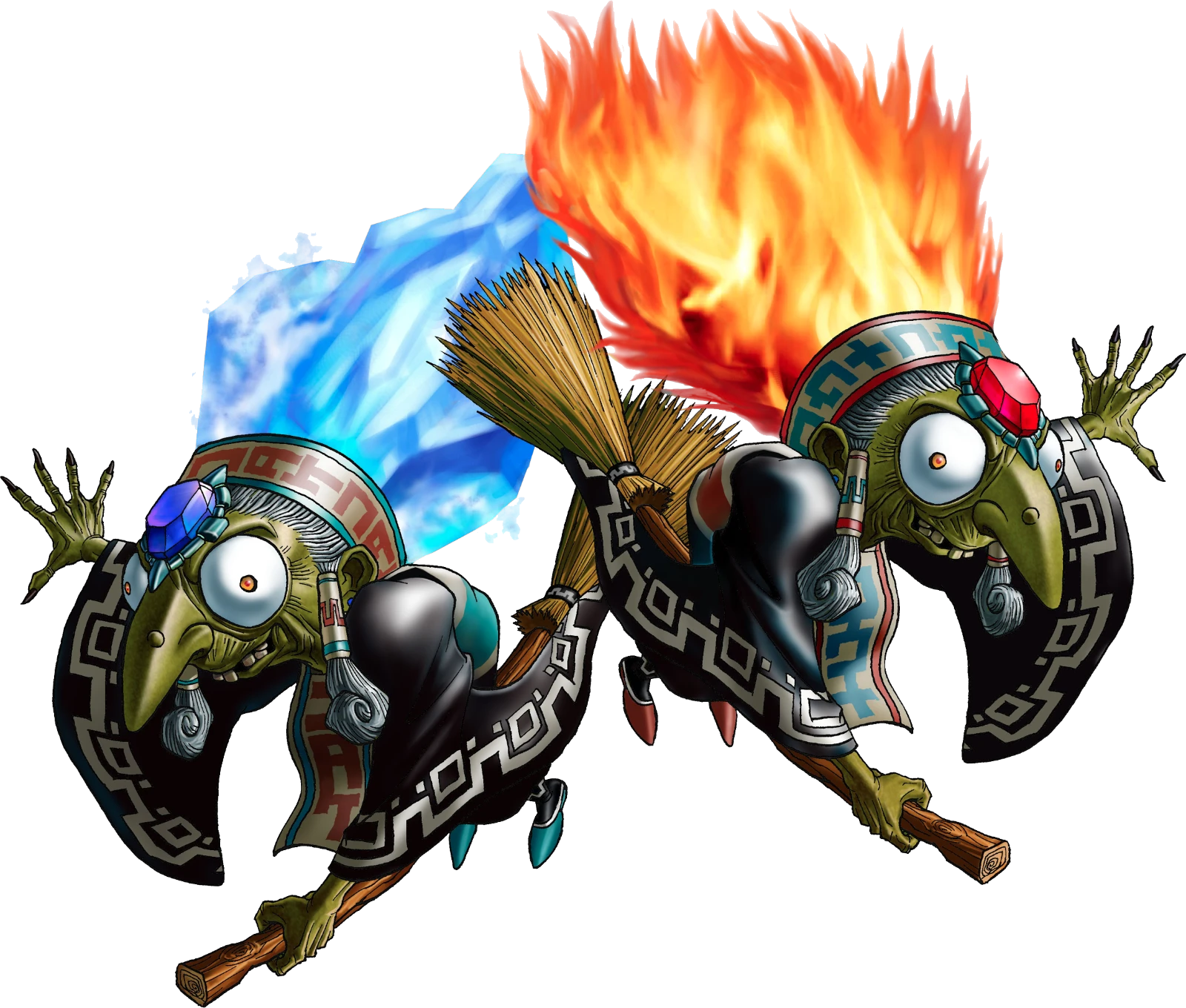
In Ocarina of Time the twin witches were enemies, fought as Twinrova in the Spirit Temple. In Termina they are a pair of cheerful old ladies who run a potion shop and a boat tour.
Koume is injured in the Woods of Mystery; Link saves her with Kotake’s red potion. Kotake later brews blue potion from magic mushrooms, and Koume runs an archery game on the swamp tour.
Pictograph Box from the swamp tour
Blue Potion from magic mushrooms
Pamela and her fatherThe Music Box House
Pamela is a brave girl living in Ikana Canyon; her father is a self-styled expert on the supernatural who got too close to his subject. Aonuma named her after a song that was stuck in his head and gave her father his troubled backstory on purpose.
Cursed into a Gibdo, her father is hidden in the basement. Once the music box plays again, Link can slip in and cure him with the Song of Healing.
Reward: the Gibdo Mask
Mayor Dotour and Madame AromaThe first family of Clock Town
The mayor is a decent man paralysed by indecision; his wife runs the carnival committee and the post office and is beside herself about their missing son, Kafei.
Madame Aroma mistakes Link for a detective and gives him Kafei’s Mask to help the search. The mayor’s meeting can only be broken up by someone wearing the Couple’s Mask.
Kafei’s Mask (Madame Aroma)
Piece of Heart for ending the mayor’s meeting
The BombersClock Town’s secret society
A gang of children led by Jim who call themselves a secret society of justice. Both Kafei and the Skull Kid once ran with them.
Beat them at hide and seek as a human and Jim gives Link the Bombers’ Notebook. In the 3DS remake they are far more helpful and give hints about the townsfolk.
Bombers’ Notebook (twenty entries)
Secret passcode to their hideout
The PostmanA slave to the timetable
Clock Town’s postman lives for his rounds and will not break his schedule even with the moon overhead.
Carries the letters between Kafei and Anju. Give him a reason to deliver priority mail and he finally feels free to flee, handing Link the Postman’s Hat.
Postman’s Hat: lets Link check postboxes
Runs a ten-second counting game
Bosses and notable enemies
Each temple ends with a masked monster holding a Giant prisoner, and the road to it is guarded by mini-bosses that hand over the temple’s main treasure or its boss key.
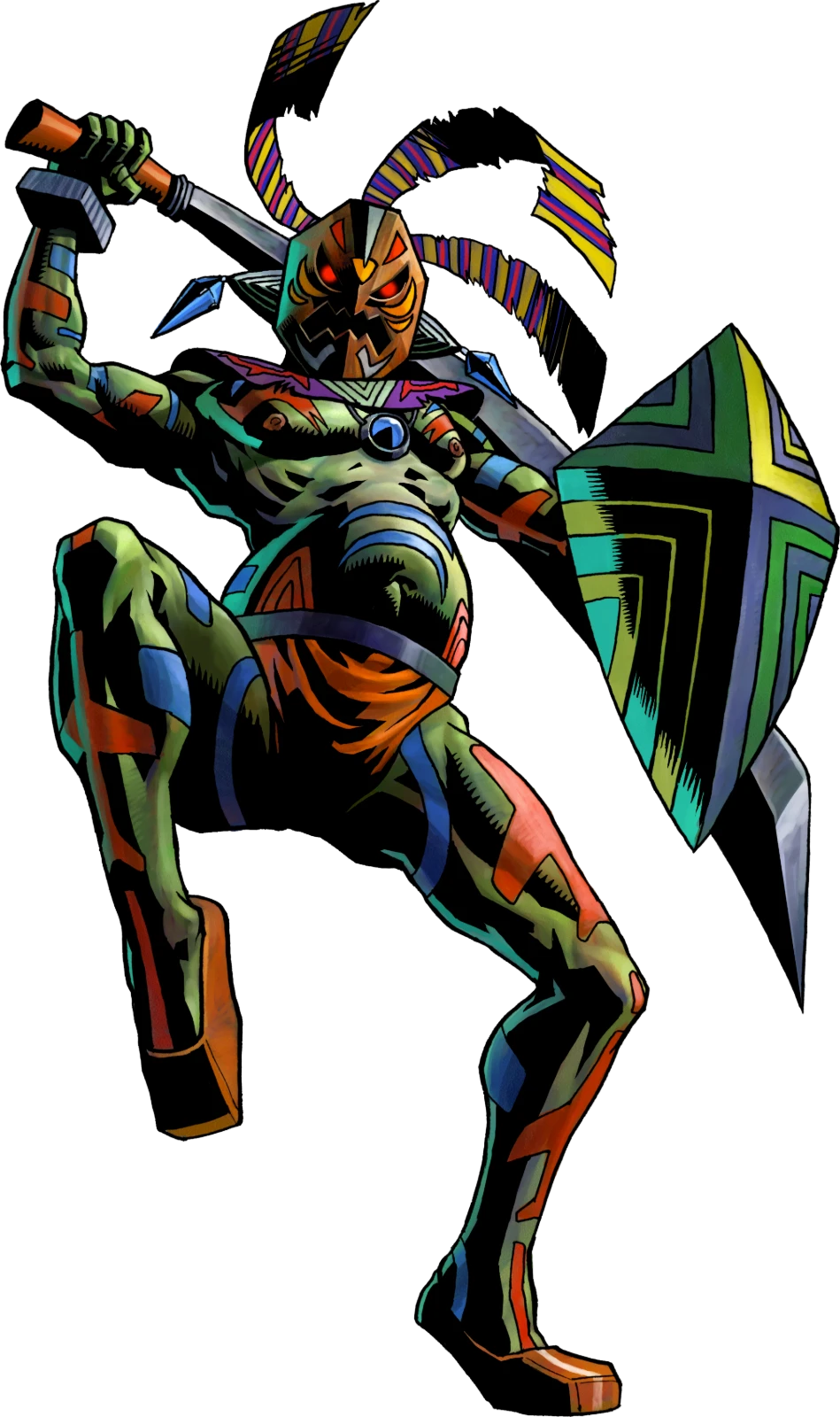
Odolwa, Masked Jungle WarriorWoodfall TempleA sword-and-shield giant who dances and summons moths. Stun him with arrows or bombs and strike while his guard is down.
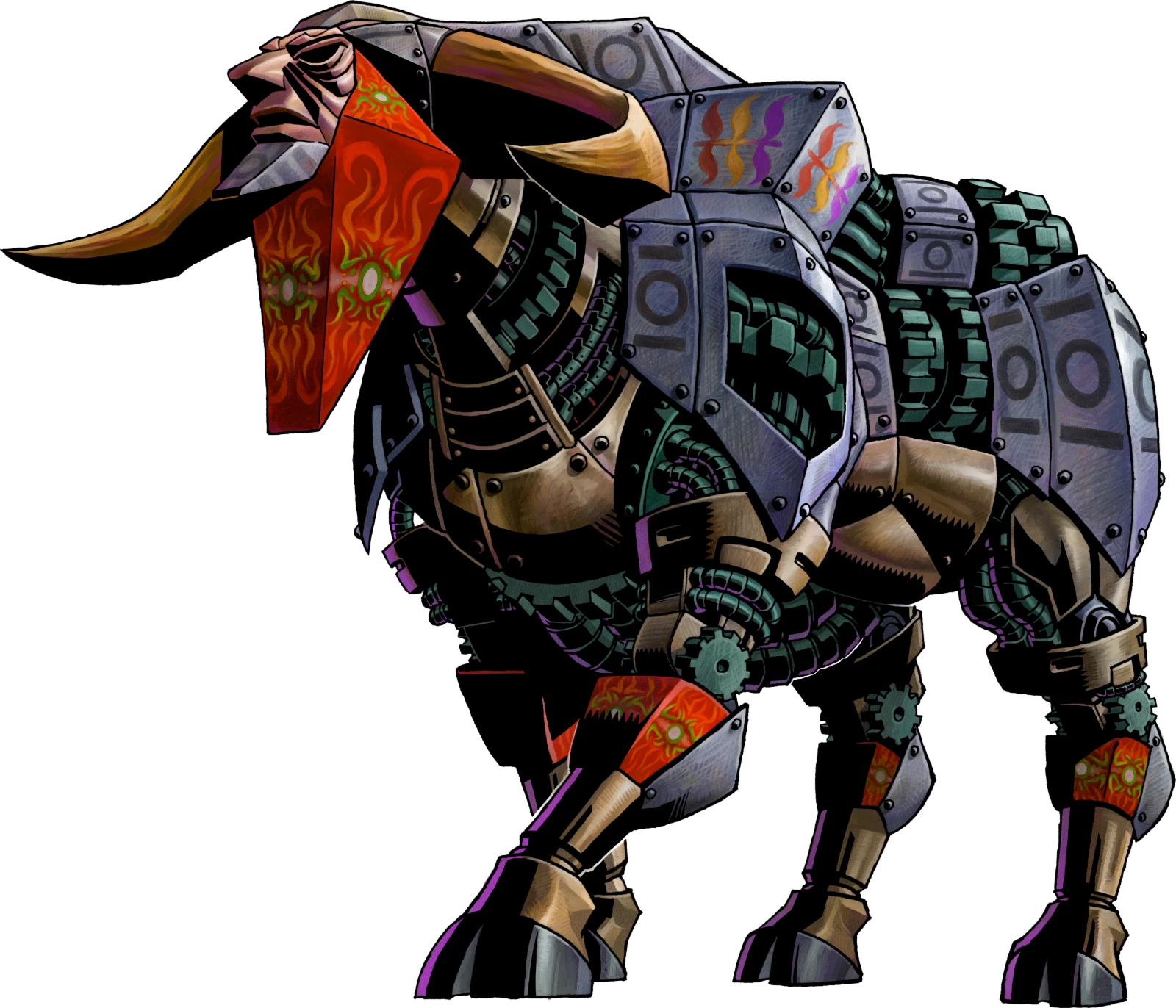
Goht, Masked Mechanical MonsterSnowhead TempleA clockwork bull frozen solid until a Fire Arrow wakes it. Chase it round a looping track as Goron Link and ram it.
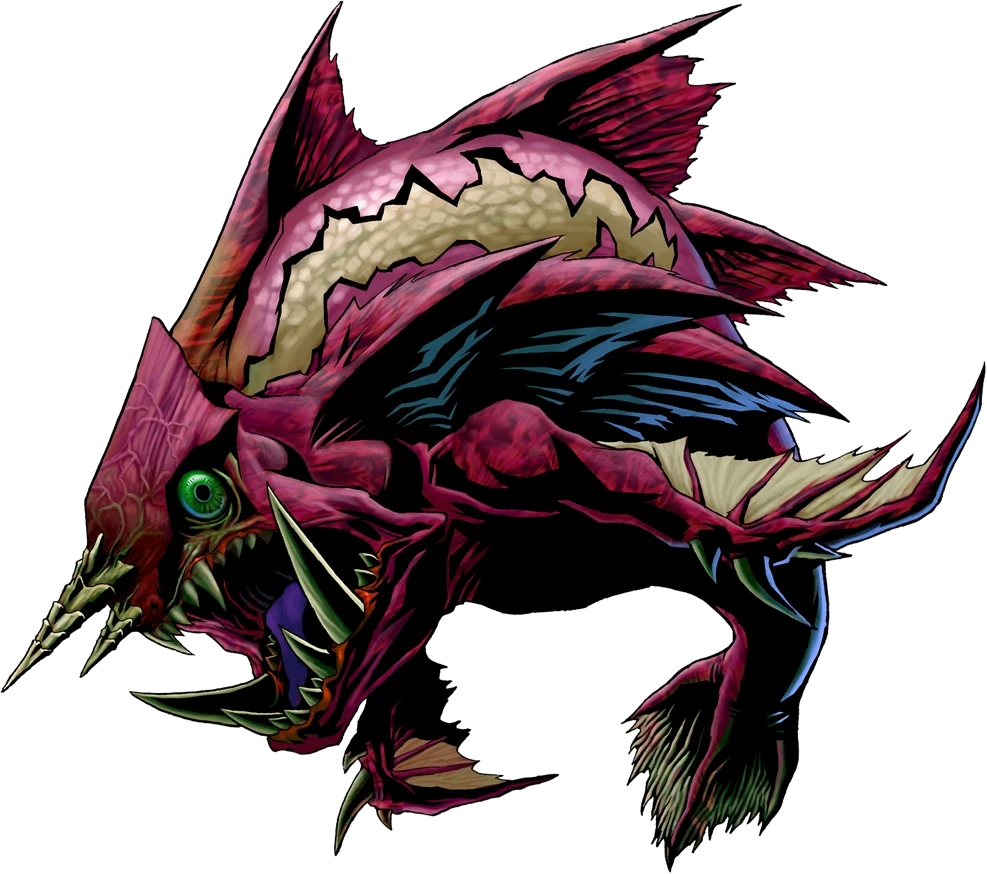
Gyorg, Gargantuan Masked FishGreat Bay TempleA huge fish that rams the platform in its tank. Stun it with arrows, then dive in as Zora Link and shock it.
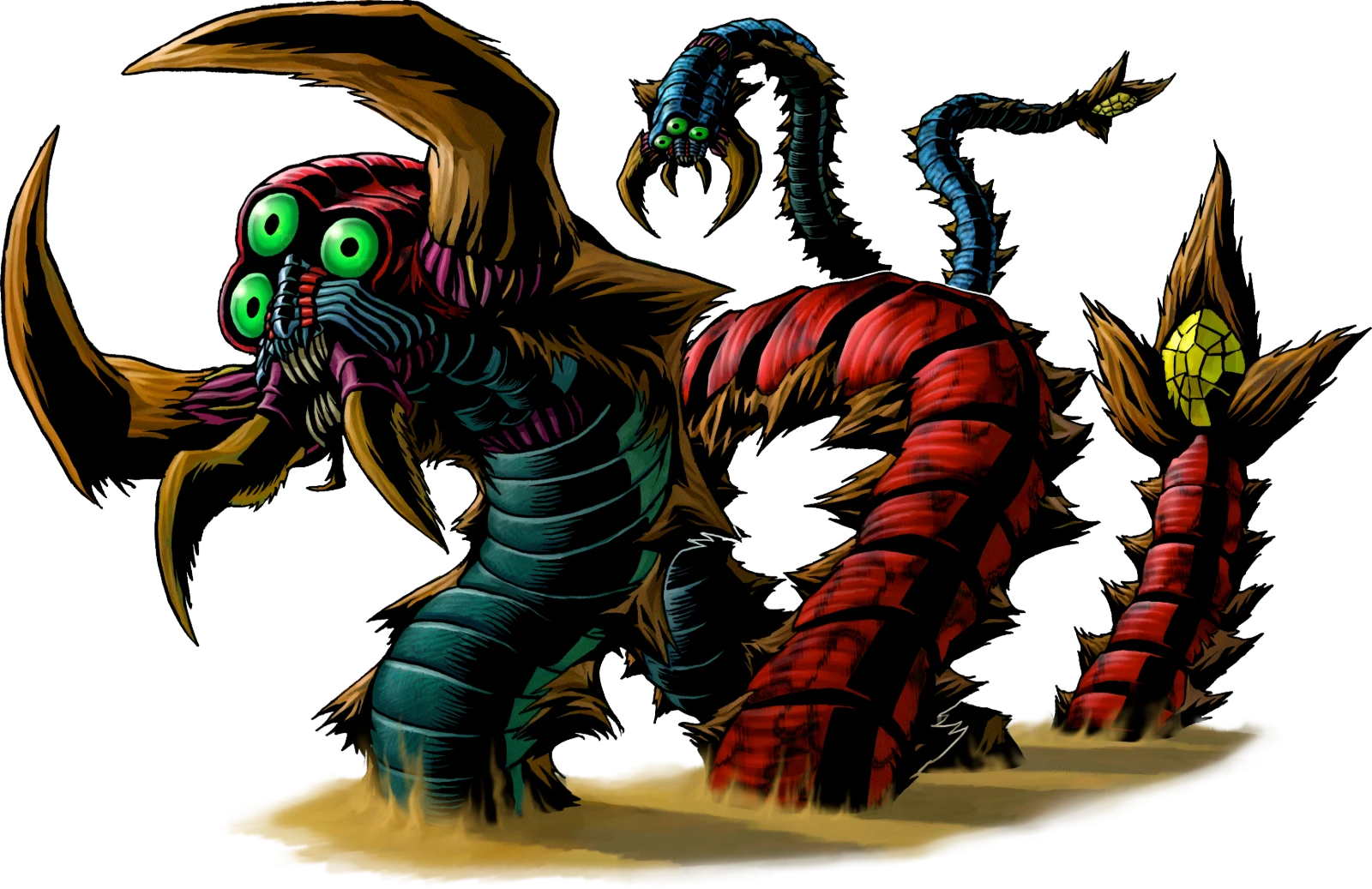
Twinmold, Giant Masked InsectStone Tower TempleTwo giant burrowing worms, one red and one blue. The Giant’s Mask lets Link grow to their size and fight hand to hand.
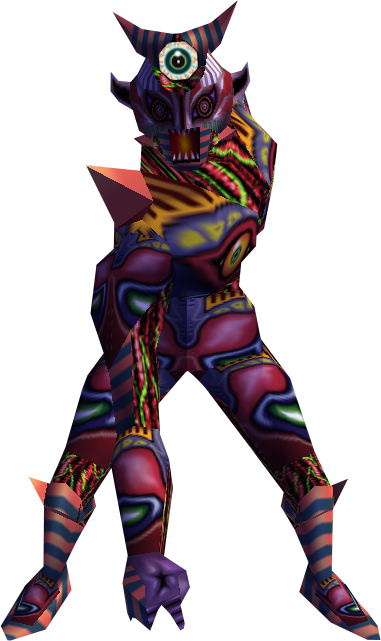
Majora’s Mask / Incarnation / WrathThe MoonThe final boss in three stages: a spinning mask with the boss masks as helpers, a capering humanoid, and a lanky figure lashing with whips.
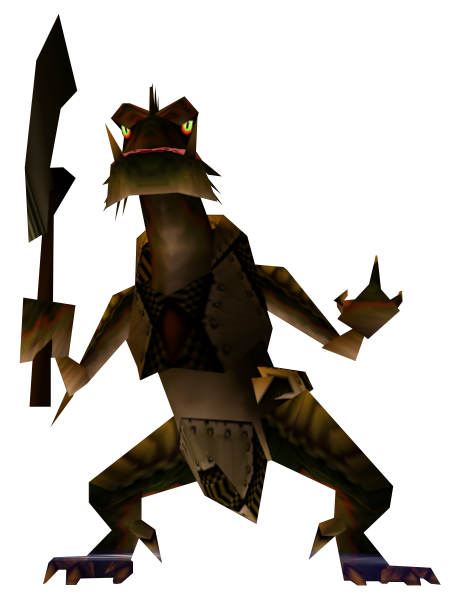
DinolfosWoodfall, Snowhead, Ikana and the MoonFire-breathing lizard warriors. The first one guards the Hero’s Bow in Woodfall Temple.
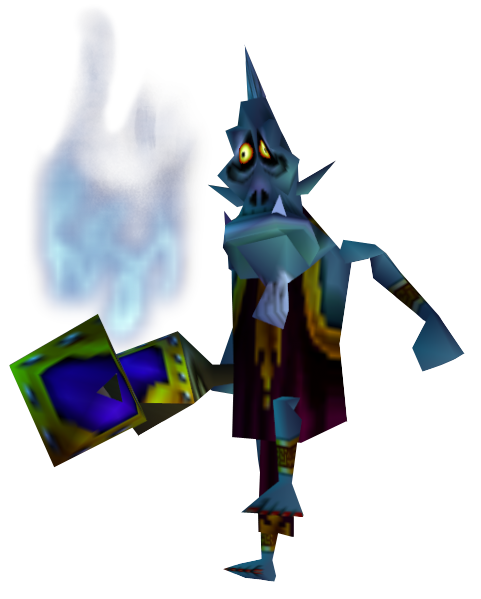
WizzrobeSnowhead, Ikana Castle, Stone TowerA teleporting sorcerer who splits into decoys. Beating him in Snowhead earns the Fire Arrows.
WartGreat Bay TempleA giant eye shielded by bubbles. It guards the Ice Arrows.
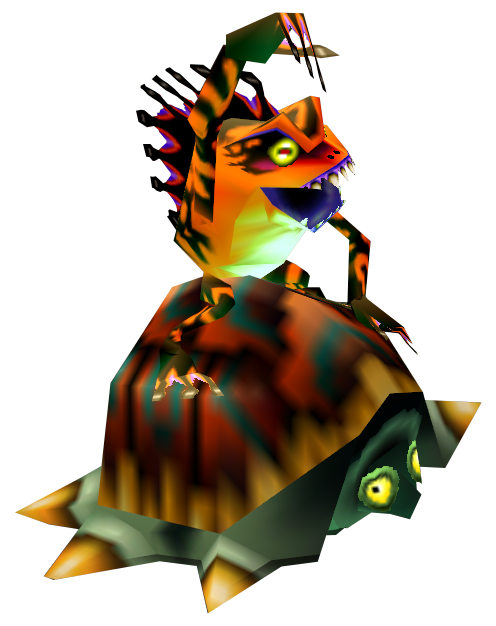
GekkoWoodfall and Great Bay TemplesA cheeky frog who rides a Snapper turtle in Woodfall and a Mad Jelly in Great Bay. He guards both boss keys.
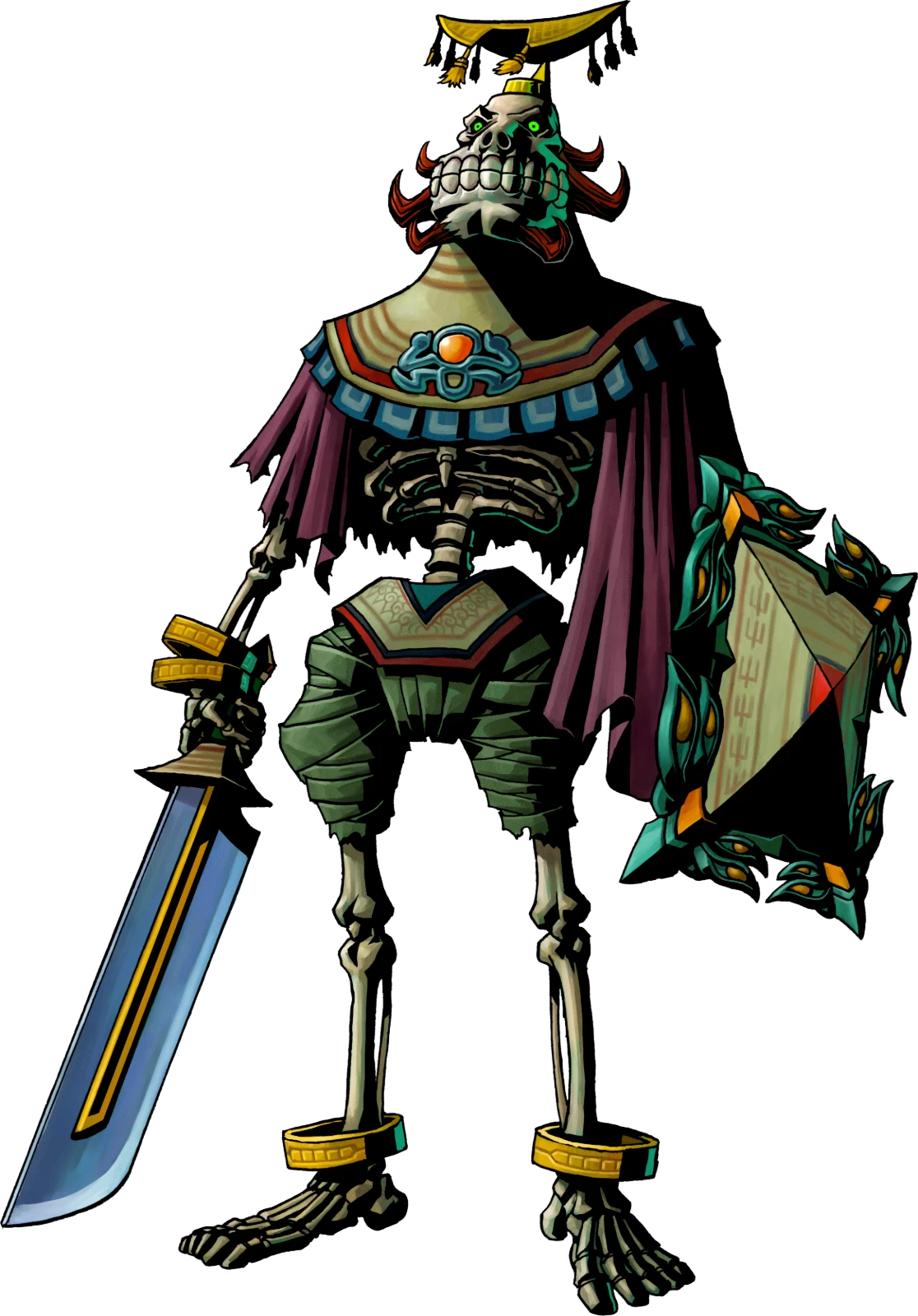
Captain KeetaIkana GraveyardA giant skeletal general who still thinks the war is on. Chase him down and beat him and he hands over the Captain’s Hat.
Igos du IkanaAncient Castle of IkanaThe undead king and his two servants, beaten with sunlight and steel. He teaches the Elegy of Emptiness.
Garo MasterStone Tower TempleThe leader of the ninja-like Garo spirits. He guards the Light Arrows.
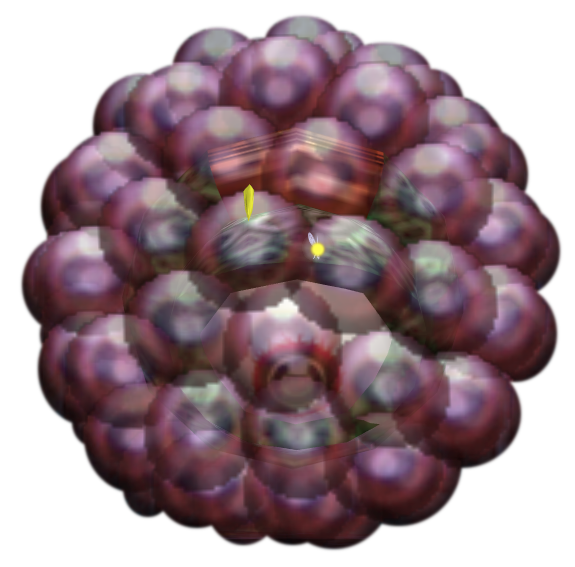
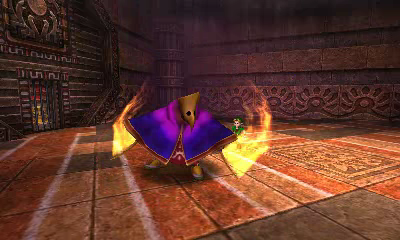
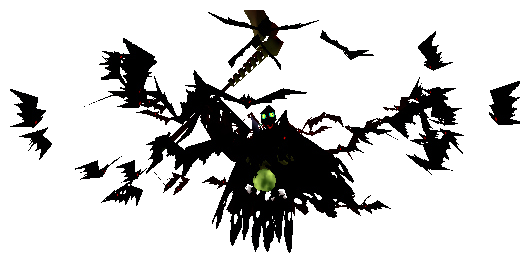
GomessStone Tower TempleA scythe-swinging reaper wrapped in bats. Clear them with a Light Arrow to reach his core.
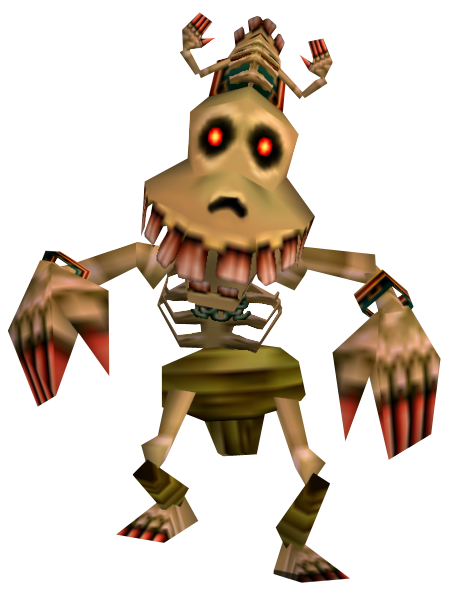
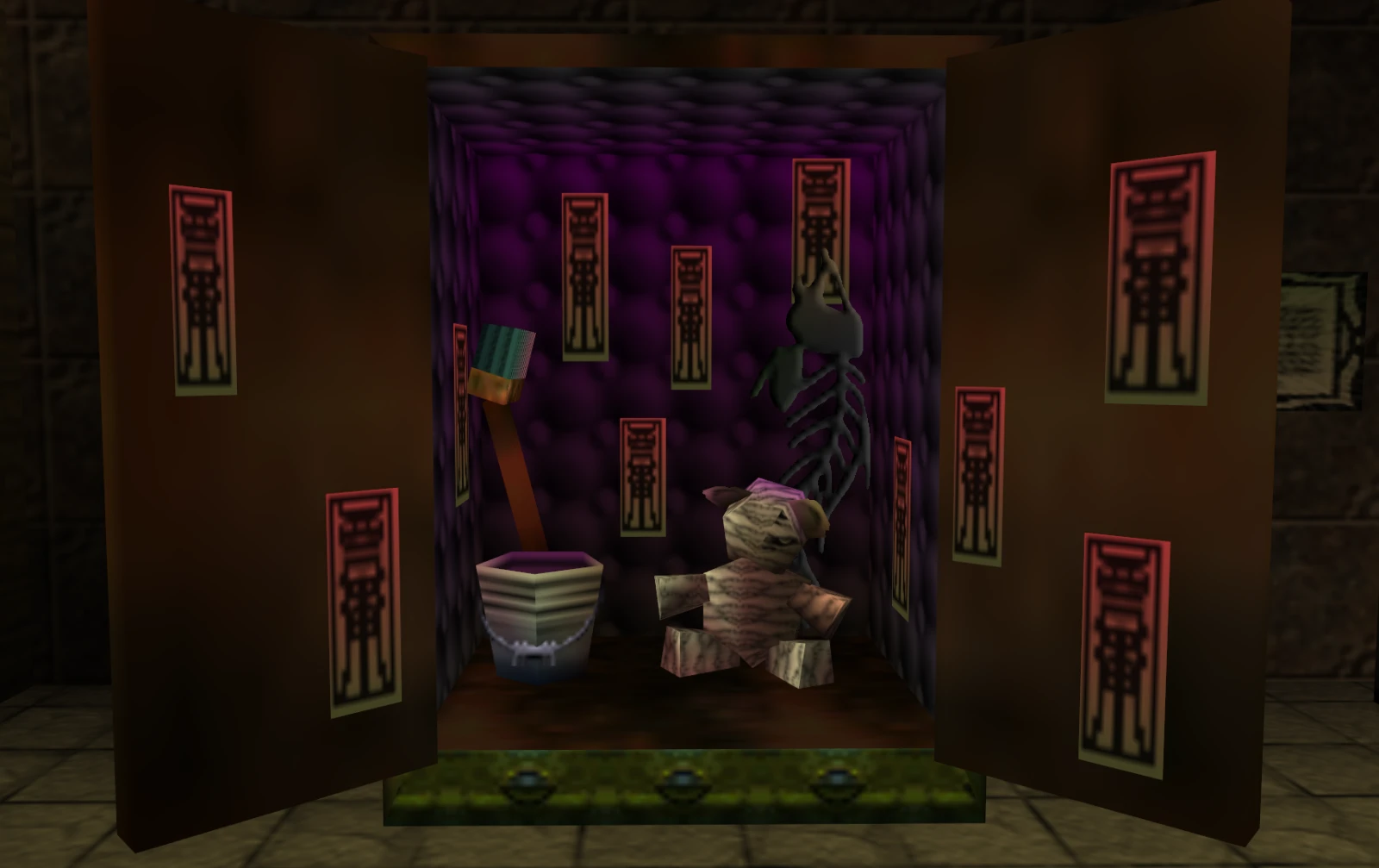
GibdoIkanaBandaged mummies that haunt Ikana and the well beneath it; Pamela’s father has become one.
The people who made it
A smaller team than Ocarina’s, working against a one-year deadline. Credits from Wikipedia’s infobox and Nintendo’s Iwata Asks.
Eiji AonumaDirectorOcarina’s dungeon designer, who balked at remixing its dungeons for the 64DD and started secretly designing new ones. He planned the areas around Clock Town and the temples, and later produced the 3DS remake.
Yoshiaki KoizumiDirectorBrought the idea of a small world played through again and again, which became the three-day cycle; planned the events inside Clock Town and Romani Ranch, and dreamed up the falling moon.
Shigeru MiyamotoProducerSet the challenge of making a new Zelda in a year and co-created the story with Koizumi.
Mitsuhiro TakanoScriptTurned Miyamoto and Koizumi’s story into the game’s script.
Takaya ImamuraArt directorDesigned Majora’s Mask and Tingle, and says “Mujura” came from his own surname plus a bit of Jurassic Park.
Yusuke NakanoArtistCredited artist alongside Imamura.
Koji KondoMusicThe series’ composer since 1986, reworking much of Ocarina’s music alongside new themes.
Toru MinegishiMusicContributed music alongside Kondo.
Toshio Iwawaki and Toshihiko NakagoProgrammingCredited programmers; the game runs on an upgraded version of Ocarina’s engine.
How it was made
Majora’s Mask was made at a sprint. Nintendo’s own Iwata Asks interview from 2015, and interviews Aonuma gave Nintendo Dream the same year, tell most of the story.
From Ura Zelda to a whole new game
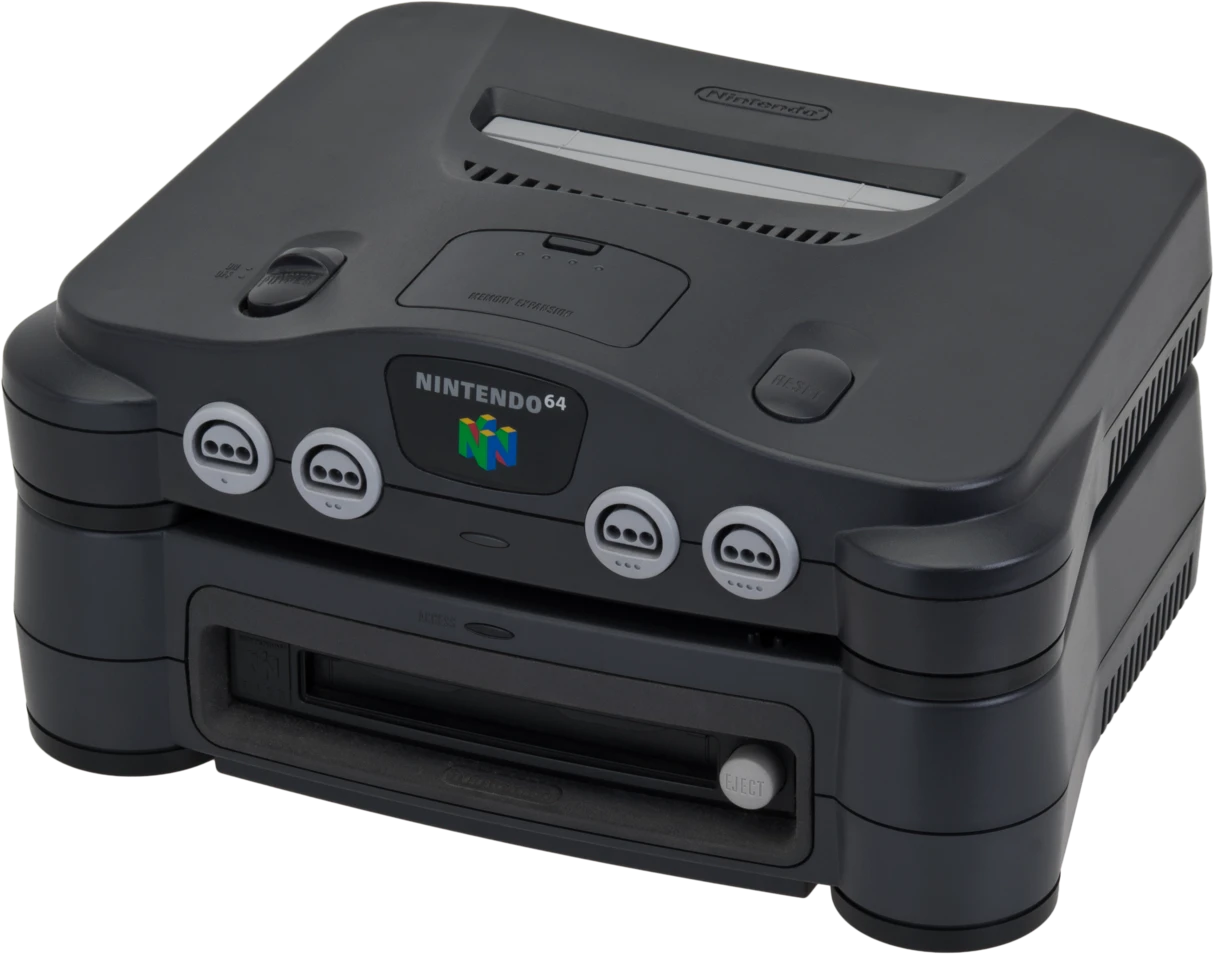
The 64DD disk drive attached to a Nintendo 64.
After Ocarina of Time launched in November 1998, the next job was meant to be “Ura Zelda”, a reworked version of the game for the 64DD disk drive with redesigned dungeons. Eiji Aonuma, who had built Ocarina’s dungeons, felt they were already the best he could make and did not want to tear them up. He began quietly designing new dungeons instead, which he found far more fun.
Shigeru Miyamoto then asked whether the team could make a new game in a year by reusing Ocarina’s 3D models, which had taken so long to build. He agreed to a fresh adventure only on that condition. Aonuma has admitted to feeling dismayed. Ocarina had taken around three years. Work started early in 1999, and the game was finished in roughly fifteen months. Ura Zelda was finished by a separate team, but the 64DD flopped; it finally came out as Ocarina of Time Master Quest on GameCube in 2002.
A week, cut down to three days
“Dawn of the First Day”, the title card that opens each three-day cycle.
Yoshiaki Koizumi had been toying with a game in a small world that you play through repeatedly, rooted in a cops-and-robbers board game idea. Ocarina’s day-and-night clock fitted neatly, and he agreed to join if they could use the passing of time to repeat the same stretch over and over.
The first plan was a seven-day cycle. Going all the way back to day one each time felt like too much to replay, and keeping track of a whole town’s routines over a week was too much to build. So the team squeezed the week into three days; as Aonuma put it to Satoru Iwata, they “compressed all sorts of things we had planned for over a week into three days”. That compression is why Termina feels so dense.
Clock Town and the world beyond
Official artwork of Clock Town.
Koizumi planned the events inside Clock Town, while Aonuma took the regions around it and the temples. Aonuma has said he was told to keep the time-management ideas inside the town, though he smuggled a few time-based touches into the wider world, such as the frozen Goron elder who moves depending on the hour. Koizumi also planned Romani Ranch, since Cremia’s milk run along Milk Road tied it into the town’s schedules, and the team felt a ranch was expected after Ocarina.
A moon, a missile scare and a band
The moon, in artwork for Majora’s Mask 3D.
Koizumi told Official Nintendo Magazine that the falling moon came from a daydream: he used to look up at the moon and wonder what would happen if it started to fall. Anju and Kafei’s wedding has a stranger origin. Aonuma and Koizumi were at a colleague’s wedding during a scare over North Korea’s Taepodong missile tests and joked about how odd it was to celebrate when missiles might fall that day; a wedding under a falling moon followed naturally.
Aonuma also proposed the Indigo-Go’s, drawing on his own experience of playing in a band as a student, and used their concert in Clock Town as a thread tying the town to the regions. Pamela of Ikana is named after a song that was stuck in his head at the time.
Naming Majora and Termina
Majora’s Mask (in-game model).
In 2015 Aonuma told Nintendo Dream that art director Takaya Imamura coined “Mujura” (the Japanese name) by mixing his own surname with the film Jumanji. Imamura, interviewed by VGC in 2023 after his retirement, remembered it differently: he took the “Jura” from Jurassic Park, of which he is a big fan, to make “Ima-Jura”. Termina, Aonuma said, comes from “terminal”, a place where people come and go. He also revealed that the pattern on the Mirror Shield was adapted from the face of one of the Happy Mask Salesman’s masks.
Ocarina’s engine, with the Expansion Pak
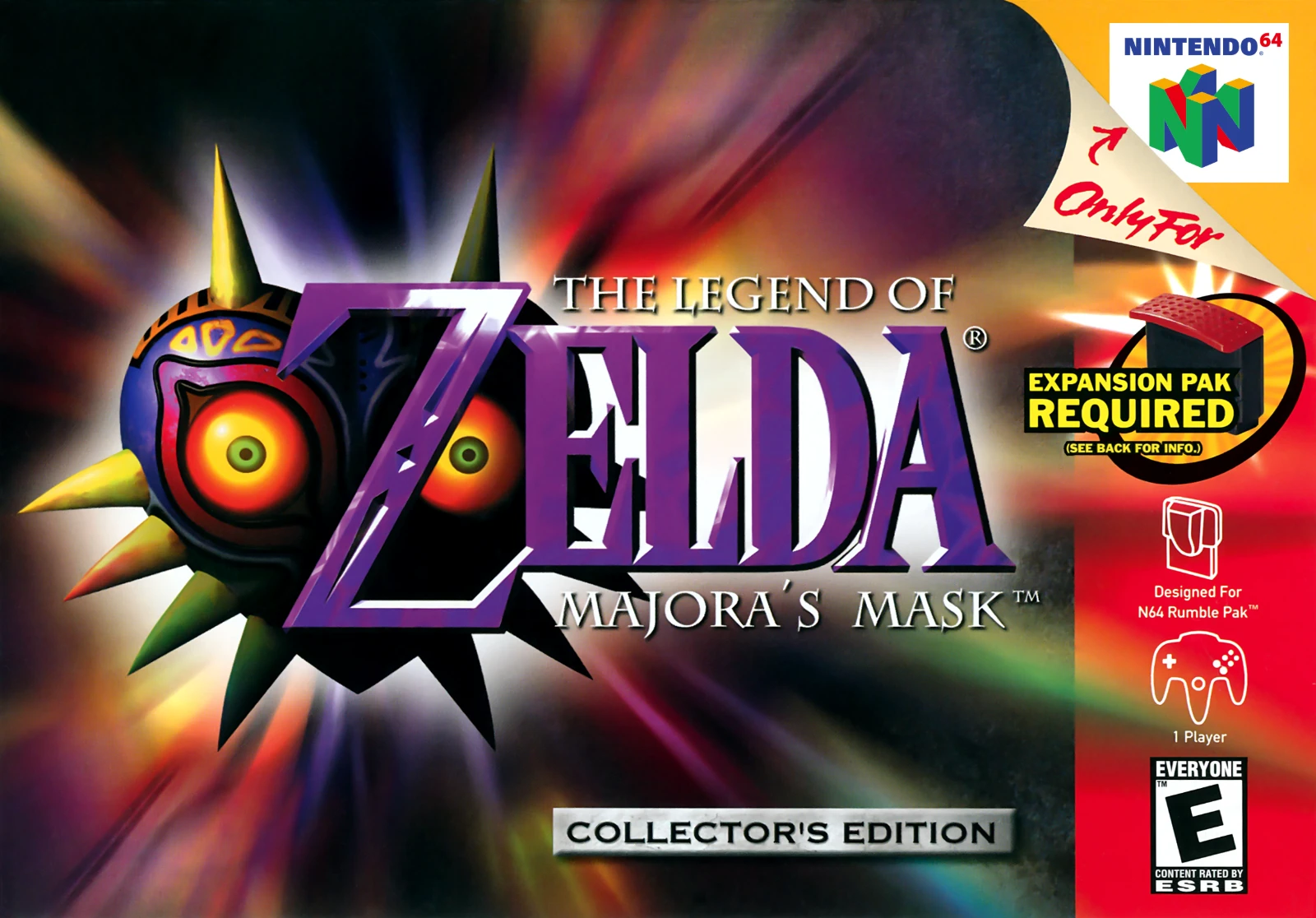
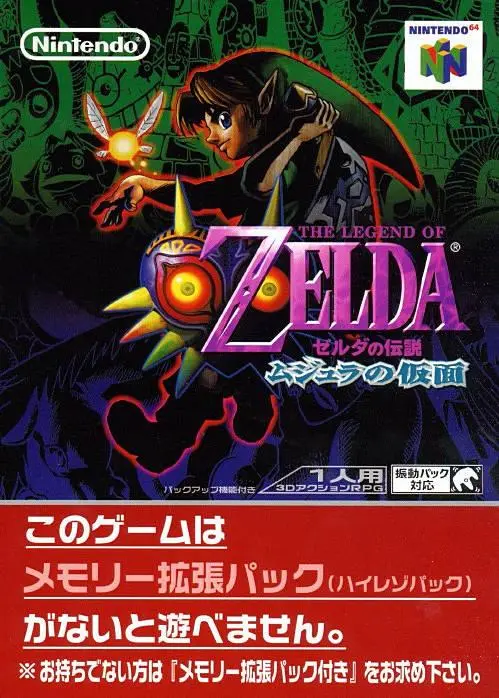
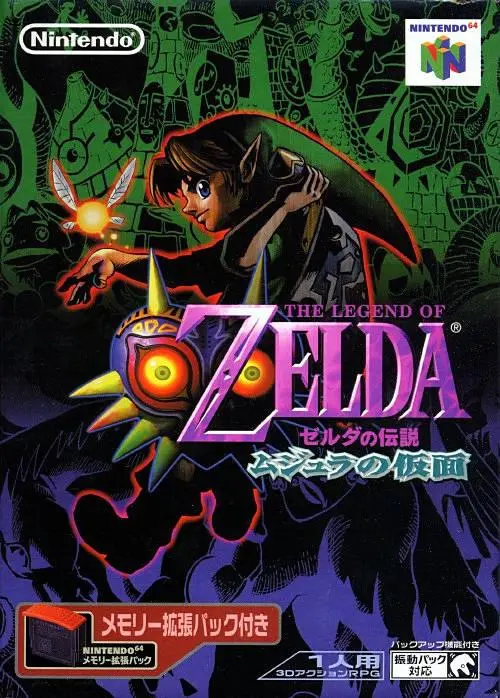
The Japanese box of the edition bundled with the Expansion Pak.
The game runs on an upgraded version of Ocarina’s engine and reuses many of its character models, which saved time and let the team recast familiar faces as new people in a gloomier world. It requires the 4MB Expansion Pak, which makes possible longer draw distances, more detailed textures, motion blur and more characters on screen at once. Only Donkey Kong 64 joins it as a Nintendo 64 game that will not run without the Pak.
From Zelda Gaiden to Majora’s Mask
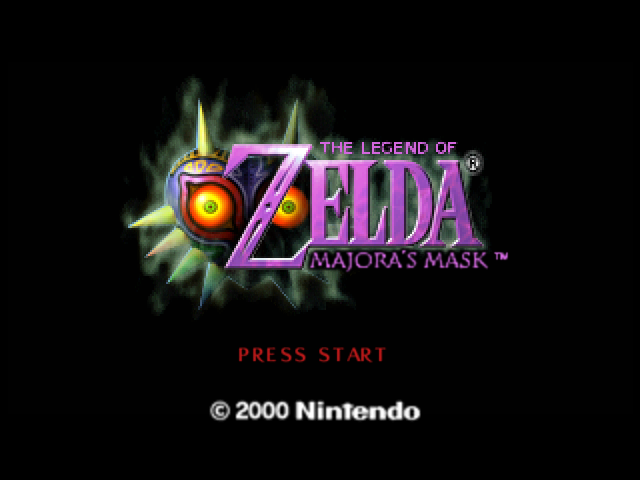
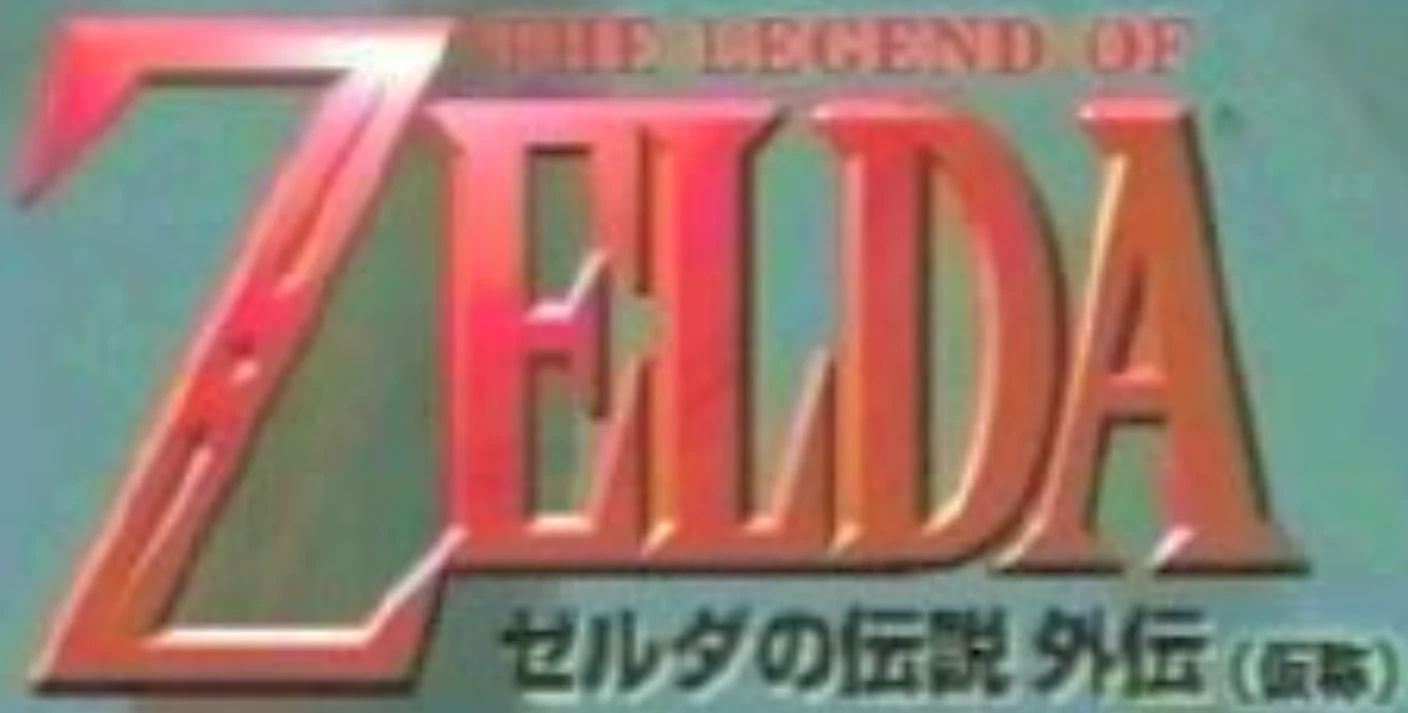
An early concept version of the Japanese logo.
Famitsu reported in May 1999 that a Zelda expansion for the 64DD had long been planned. The game was playable at Nintendo Space World on 27 August 1999 under the name Zelda Gaiden, with the clock in the middle of town, a countdown timer and mask transformations already in place. Nintendo announced a holiday 2000 date for the West that November, and the final title was revealed in March 2000. In America it was backed by a marketing campaign said to be worth eight million dollars.
One all-nighter
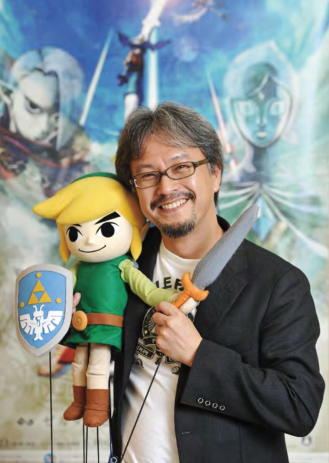
Eiji Aonuma, co-director of Majora’s Mask.
The deadline took its toll. Aonuma has said that the only all-nighter of his entire Zelda career came on Majora’s Mask, when he, Koizumi and a colleague named Kawagoe stayed up to redo a cut-scene that Miyamoto had rejected.
What got left out
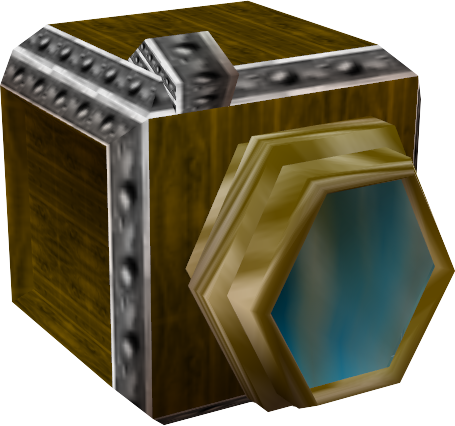
The Pictograph Box (in-game model), which one unused voice command would have triggered.
Majora’s Mask was built to recognise Nintendo’s Voice Recognition System microphone (the Japanese unit). The modder Zoinkity documented the leftover code around 2019, and it reached a wider audience in January 2025, after Skawo came across it in the community’s decompilation of the game. Hidden routines let a player take pictures, ask cows for milk, ask how long is left before the moon falls, wake a sleeping Deku Scrub and spur Epona on with carrots, plus an unused “sit” command. A switch that would have turned them on is never set, so the feature has never worked in a retail copy.
Coming back for the 3DS
South Clock Town in Majora’s Mask 3D (2015).
Aonuma did not want to revisit the game. It was Miyamoto, he told Iwata, who insisted on a 3DS version so that players who had given up could finally see what the team had built, and who made him replay the whole thing. Aonuma came away with a long list of moments he labelled “what in the world?!”, places where the N64 version gave no hints or promised a payoff that never came. Grezzo, the studio behind Ocarina of Time 3D, pitched its ideas to Miyamoto in late 2011, Mikiharu Ooiwa took over as director while Aonuma was busy with A Link Between Worlds, and the remake ended up taking about three times as long as the original.
Firsts: what this game introduced
Majora’s Mask reused Ocarina’s engine, but very little else about it was ordinary. These are the things it brought to the series.
1The three-day cycleA world on a 72-hour countdown that resets every time Link plays the Song of Time. The series had never tried anything like it.
2The Bombers’ NotebookA diary of twenty Termina residents, their timetables and the promises Link has made, updated automatically as he helps them.
3Playing as other racesFor the first time Link could become a Deku Scrub, a Goron and a Zora, each with its own moves, strengths and weaknesses.
4TingleThe 35-year-old would-be fairy makes his debut here, selling maps from his balloon. He later became a series regular and the star of his own games.
5Termina and Clock TownA whole new world parallel to Hyrule, with a festival town at its centre that runs to a schedule.
6The Song of HealingFirst taught here by the Happy Mask Salesman; it returns in Twilight Princess and Spirit Tracks.
7The Fierce DeityLink’s most powerful form debuts here. The Fierce Deity’s outfit later returned in Breath of the Wild and Tears of the Kingdom.
8Tatl, the Skull Kid as villain, and MajoraA new fairy partner and a new kind of villain: a lonely prankster manipulated by an ancient mask rather than a would-be conqueror.
Cheats & secrets
Majora’s Mask has no button-code cheats, but it is stuffed with secrets, side quests and time-bending songs. These are the ones worth knowing.
The Fierce Deity’s Mask
The Fierce Deity’s Mask (in-game model).
Collect all twenty ordinary masks (everything except the four transformation masks). On the moon, give the children the masks they ask for and play their games; once you have handed over every mask, the child wearing Majora’s Mask swaps you the Fierce Deity’s Mask. It only works in boss rooms, but it turns the final battle on its head.
Bending time
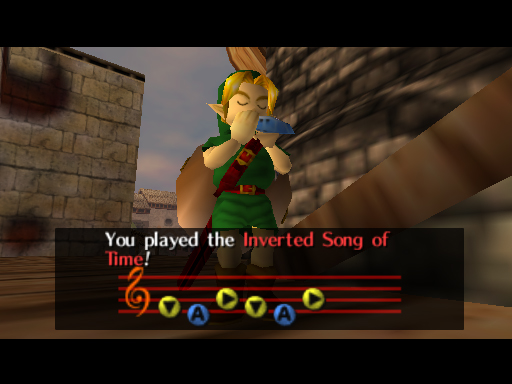
Playing the Inverted Song of Time.
Play the Song of Time backwards (the Inverted Song of Time) and the clock slows to a crawl, giving you far longer in each cycle. The Song of Double Time skips you forward to the next dawn or dusk. On the 3DS, Double Time lets you choose any hour.
Owl statues and the Song of Soaring
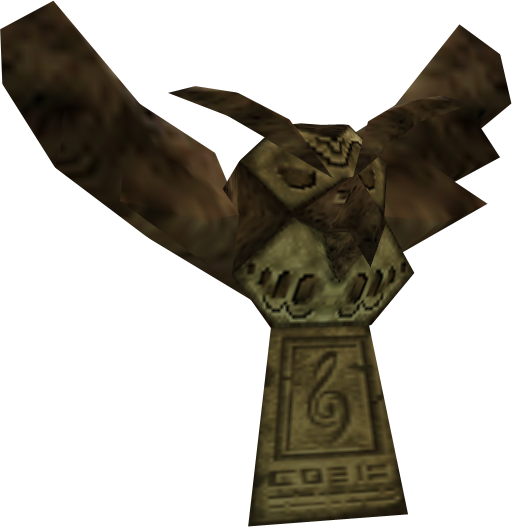
An owl statue (in-game model).
Hit an owl statue with your sword to activate it. Kaepora Gaebora’s Song of Soaring warps you to any active statue, and on the Nintendo 64 the statues also offer a temporary save that is deleted once you load it. The only permanent save is playing the Song of Time. In the 3DS remake, owl statues and new save statues give permanent saves.
The masks that help most
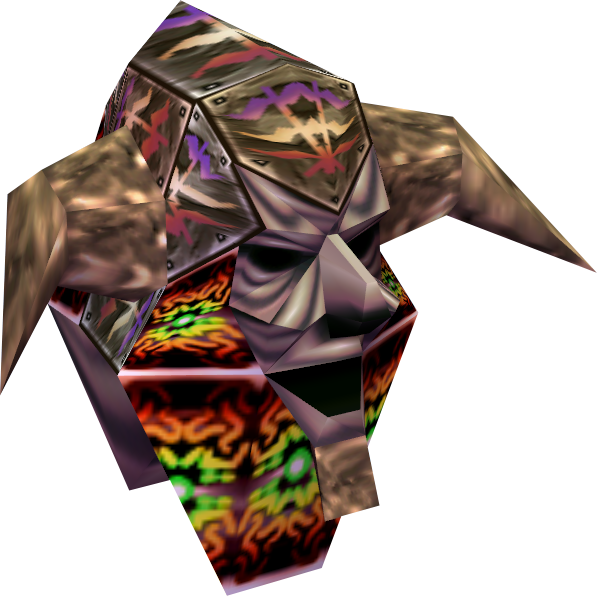
The Stone Mask (in-game model).
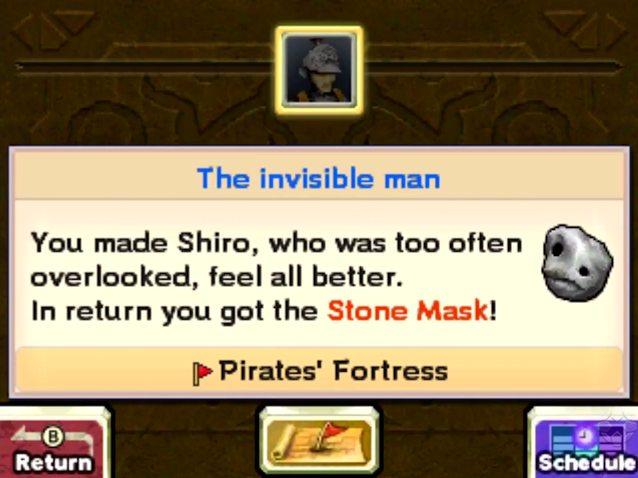
The Bunny Hood makes Link run faster; the Stone Mask makes most enemies ignore him; the Great Fairy’s Mask draws stray fairies to him; the Mask of Truth helps you spot the most confident dog at the Romani Ranch races.
Chateau Romani
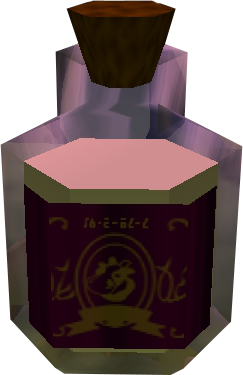
A bottle of Chateau Romani (in-game model).
Wearing Romani’s Mask gets Link into Latte, the Milk Bar. A bottle of Chateau Romani costs 200 Rupees and gives unlimited magic until the end of the current three-day cycle.
A few Pieces of Heart
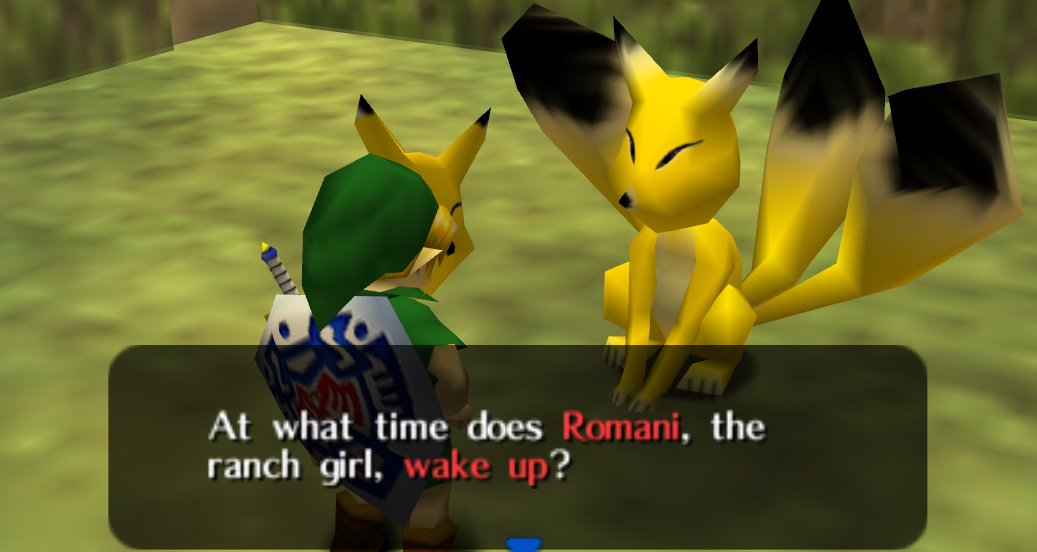
Keaton’s quiz.
Answer Keaton’s quiz correctly (cut the moving bushes while wearing the Keaton Mask); win 150 Rupees at the dog races; score 20 hits in Koume’s archery game on the swamp tour; break up the mayor’s meeting while wearing the Couple’s Mask; and, without the Zora Mask, play the song from Zora Link’s jam session with the bassist Japas to the band leader Evan.
The Giant Wallet
Clear the Oceanside Spider House of its cursed Skulltulas on the first day and the man waiting there gives you the Giant Wallet (later days earn a Rupee reward instead).
3DS extras
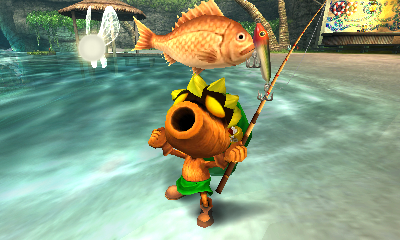
Deku Link fishing in Majora’s Mask 3D.
Majora’s Mask 3D adds fishing, Sheikah Stones that show hint videos when you are stuck, a far more detailed Bombers’ Notebook with alarms for timed events, and redesigned boss fights.
Secrets checked against the Zelda Dungeon wiki, StrategyWiki and Wikipedia.
Glitches, exploits and oddities
Majora’s Mask was made in a hurry, and speedrunners have spent two decades taking it apart. A few of the best-documented oddities:
The owl statue nobody was meant to find
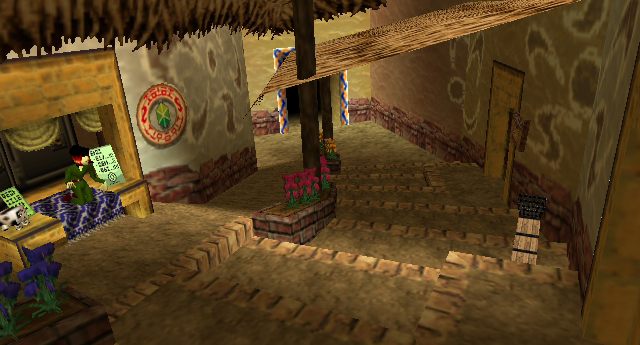
West Clock Town, where the path to the hidden owl statue begins.
On the path between West and South Clock Town a loading zone hides a second owl statue that you cannot normally reach. Get past the loading zone with a trick such as hovering on a Bombchu and you can activate it with your sword. Saving there breaks the game in interesting ways: reload and you appear in the mayor’s house instead, a quirk known as the Mayor’s Warp.
Index warping
Stone Tower, the one destination that crashes the game.
That hidden statue also opens the Song of Soaring’s warp menu with no proper destinations listed. Players discovered that where you leave the cursor on the pause screen’s world map decides where the song sends you, so you can fly almost anywhere without having found the real statues. A YouTuber called Indextic showed it off in early 2014, some thirteen years after release. Picking Stone Tower crashes the game.
Sixty-three songs to the end
Goht’s Remains (in-game model), one of the four boss remains.
In 2019 speedrunners found that playing the Song of Soaring in a particular way, 63 times over, overflows the memory used by the text box that follows. It opens a hidden debug menu from which a runner can grab all four boss remains and the Fierce Deity’s Mask and head straight for the moon. Swedish runner ennopp112 used it to set an any% record of 49 minutes 42 seconds.
Sticks and torches
The Deku Stick asks for a 16 by 16 texture when the real one is only 8 by 8, so it reads the next chunk of memory, leftover Link model data from Ocarina of Time, and comes out oddly patterned. The bases of the metal torches show corrupted textures that change as Link swaps masks; that one was finally fixed in the 3DS remake.
Other leftovers
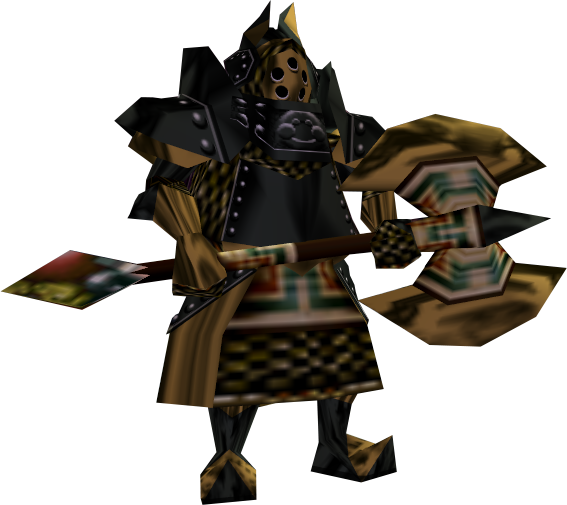
The Iron Knuckle (in-game model).
The Iron Knuckle’s model still carries an early version of Nabooru’s head from Ocarina, the Ikana Great Fairy fountain is the wrong colour in the American and Japanese versions (Europe fixed it), and on the moon, playing the Song of Storms in front of certain Gossip Stones in Link’s trial skips its puzzles.
Videos & media
Two films: Nintendo’s own trailer announcing the 3DS remake, and a well-researched look at the original’s history and hidden details.
Nintendo Australia’s official announcement trailer for Majora’s Mask 3D (November 2014).
Did You Know Gaming’s episode on the game’s development and secrets (2015), featured by Game Informer.
Trivia & facts
The logo of Ocarina of Time Master Quest, the finished Ura Zelda.Majora’s Mask began life as “Ura Zelda”, a remix of Ocarina for the 64DD. That project was later finished by another team and released as Ocarina of Time Master Quest.
The Japanese title is Mujura no Kamen. Eiji Aonuma said in 2015 that the name mixed Takaya Imamura’s surname with Jumanji; Imamura said in 2023 it was his surname plus Jurassic Park.
Termina is named after a “terminal”, a place where people come and go.
The Mirror Shield, in artwork for Majora’s Mask 3D.The Mirror Shield’s face pattern was adapted from one of the Happy Mask Salesman’s masks.
The three-day cycle was originally going to last a week.
Yoshiaki Koizumi got the idea of the falling moon from staring at the real one and wondering what would happen if it fell.
Anju and Kafei’s wedding was inspired by a staff wedding held during a scare over North Korea’s Taepodong missile.
Aonuma pulled the only all-nighter of his Zelda career on this game.
Tingle makes his debut.Tingle, the balloon-riding map seller, made his first appearance here. He is 35 and believes he is a fairy.
The old Indigo-Go’s number that Link performs on stage at the Milk Bar to lift the spirits of the Gorman troupe’s leader is the Ballad of the Wind Fish, the song at the heart of Link’s Awakening.
The Happy Mask Salesman carries a mask of Mario on his backpack.
Twinrova, the witches’ combined form, in official art for Ocarina of Time.Koume and Kotake, the bosses known as Twinrova in Ocarina, run a friendly potion shop and boat tour here.
Majora’s Mask and Donkey Kong 64 are the only Nintendo 64 games that need the Expansion Pak.
When the Wii Virtual Console version came out in North America on 18 May 2009, it was the 300th Virtual Console game released there.
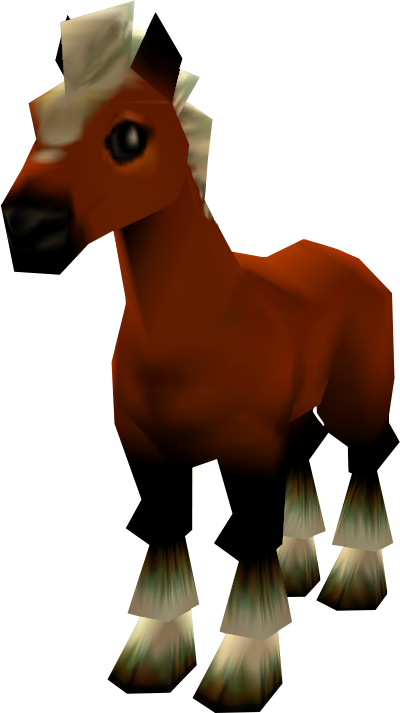
Epona (in-game model).Hidden code for the Japanese Voice Recognition System microphone lets you ask cows for milk and feed Epona carrots, if only it could be switched on.
The Iron Knuckle’s model still has an early version of Nabooru’s head inside it.
Only the Japanese Nintendo 64 versions keep a development test map, “Test01”.
The Fierce Deity is nicknamed “Oni Link” in Japan.
Majora’s Mask 3D (2015).Majora’s Mask 3D took about three times as long to make as the original game.
The Skull Kid in Majora’s Mask is the same one Link met in Ocarina of Time’s Lost Woods; he recognises Link’s smell in the ending.
Media & artwork
Box art, artwork and screenshots of Majora’s Mask. Select any image to view it larger.
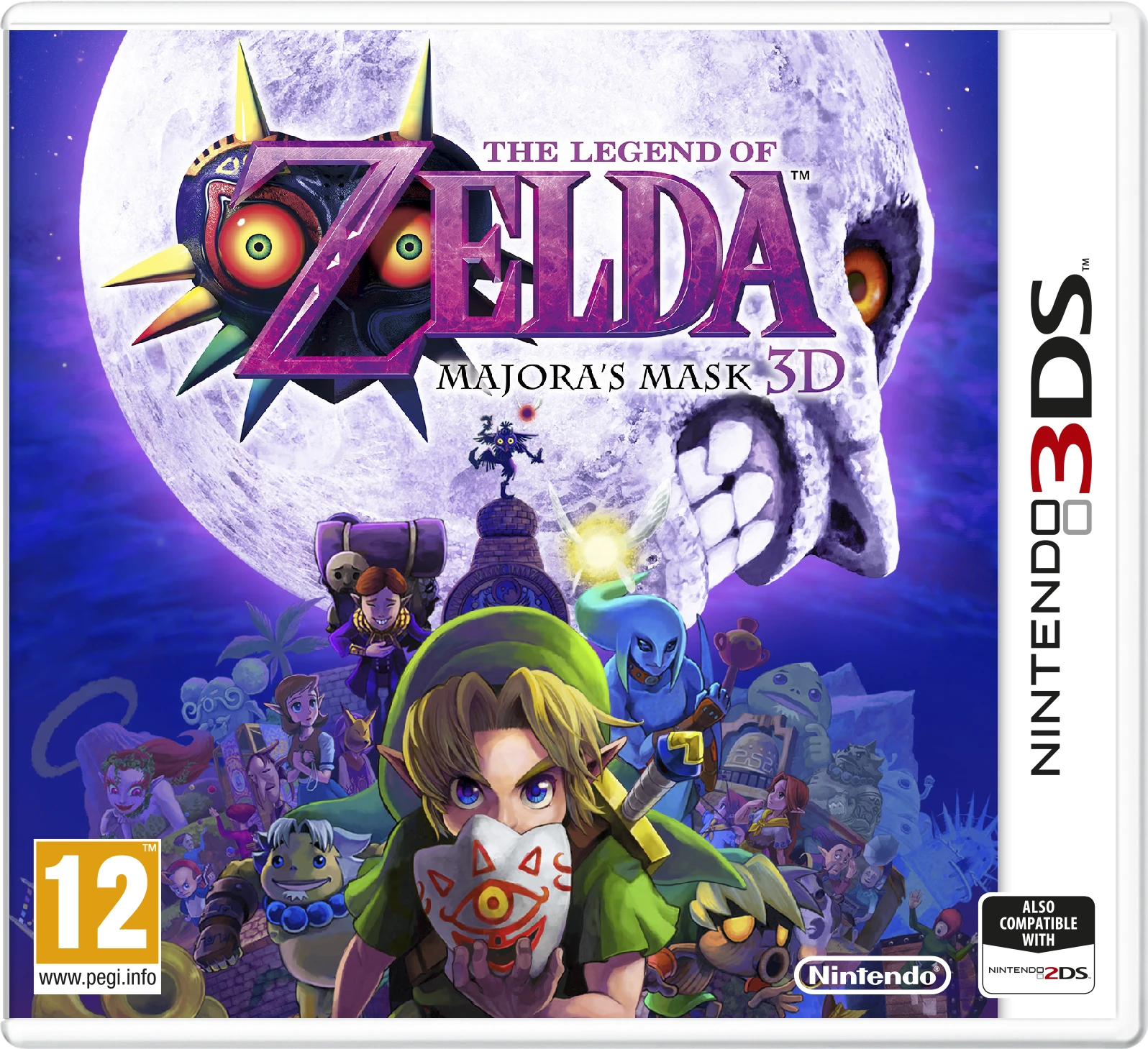
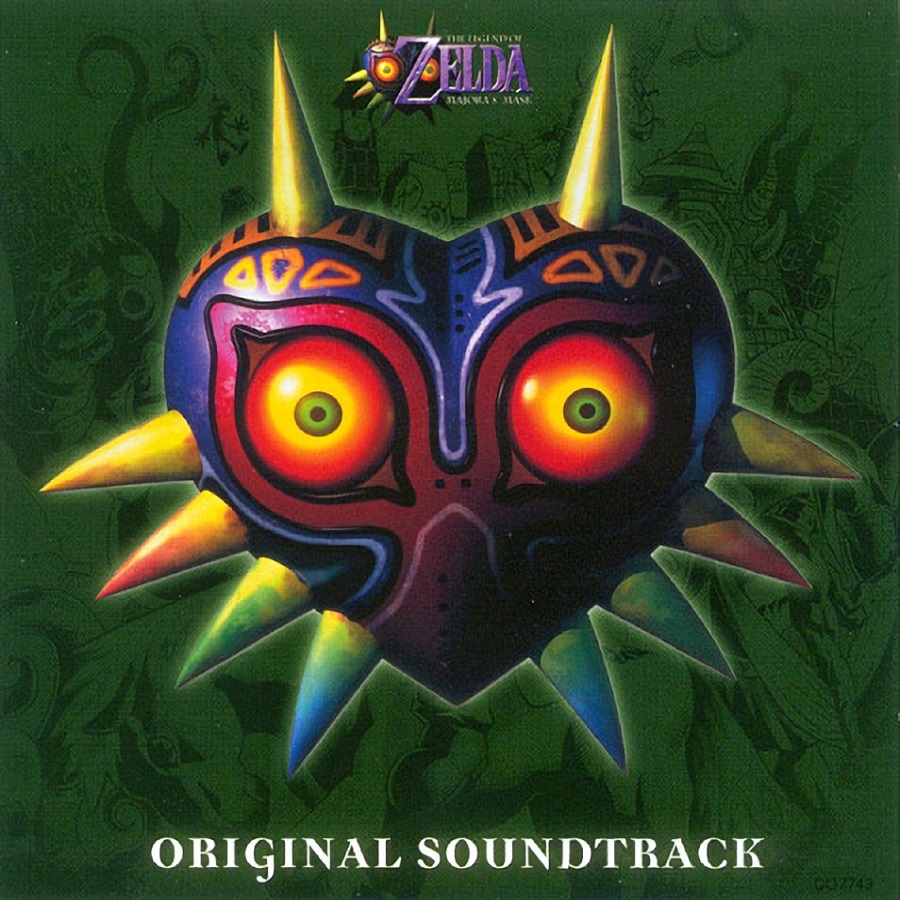
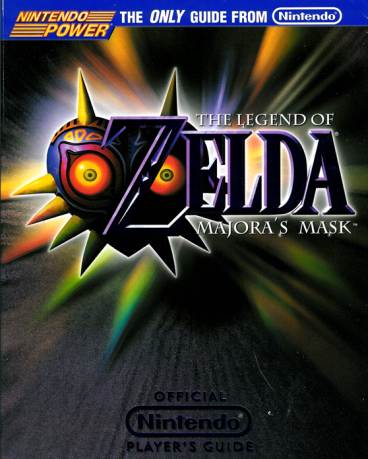
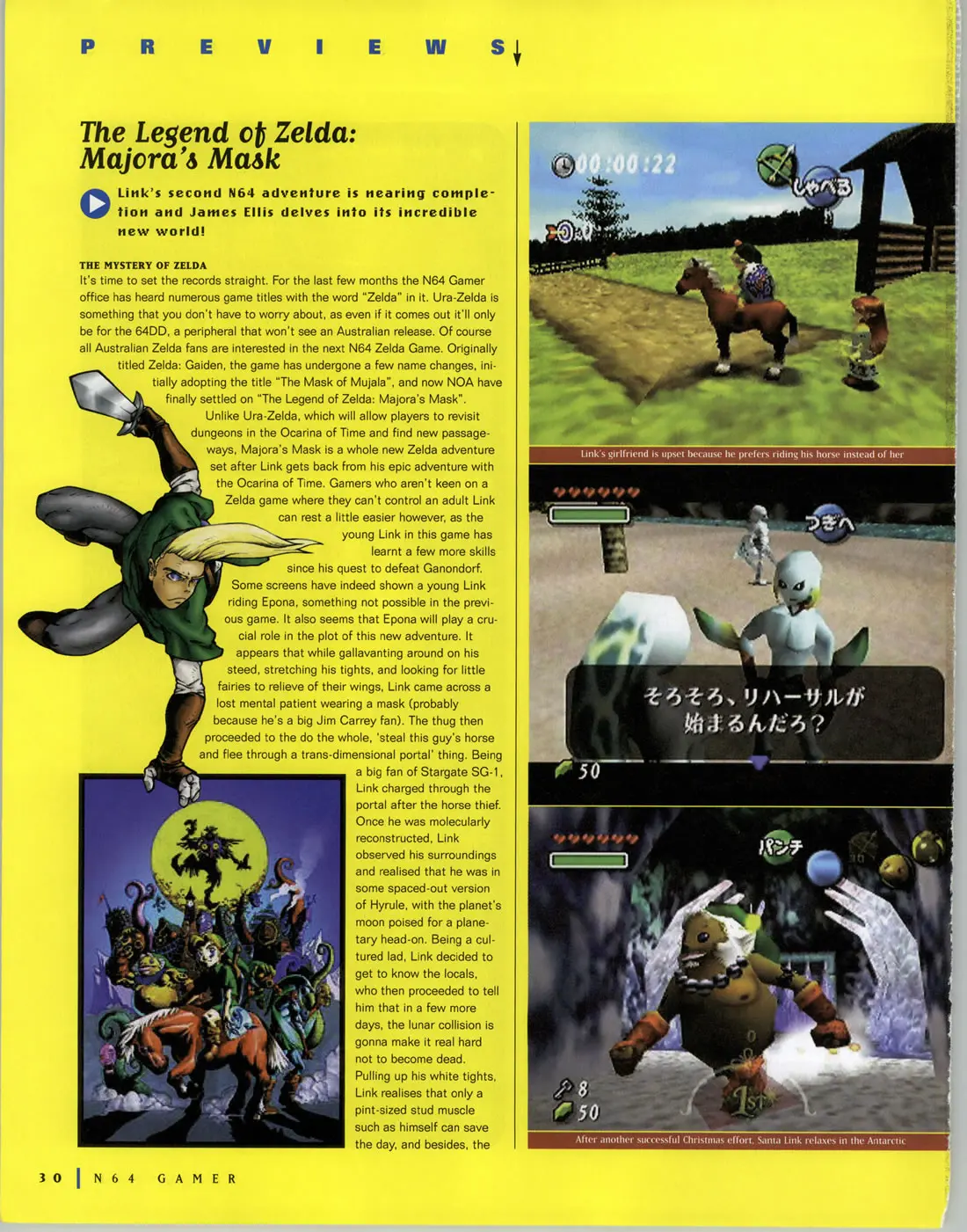
European Nintendo 64 box (2000)Australian and New Zealand limited edition boxThe English logoThe gold Collector’s Edition cartridgeMap of Termina, in artwork for Majora’s Mask 3DNorth American box of Majora’s Mask 3D (2015)GameCube bundle box with The Legend of Zelda: Collector’s EditionOriginal soundtrack coverNintendo Power’s player’s guidePreview in N64 Gamer (Australia), volume 28, June 2000
Majora’s Mask has been re-released on almost every Nintendo home console since the N64, and remade for the 3DS. Its influence has spread well beyond Nintendo.
From Nintendo 64 to Nintendo Switch
Nintendo 64April–November 2000 – Japan 27 April, North America 26 October (gold cartridge), Europe 17 November.
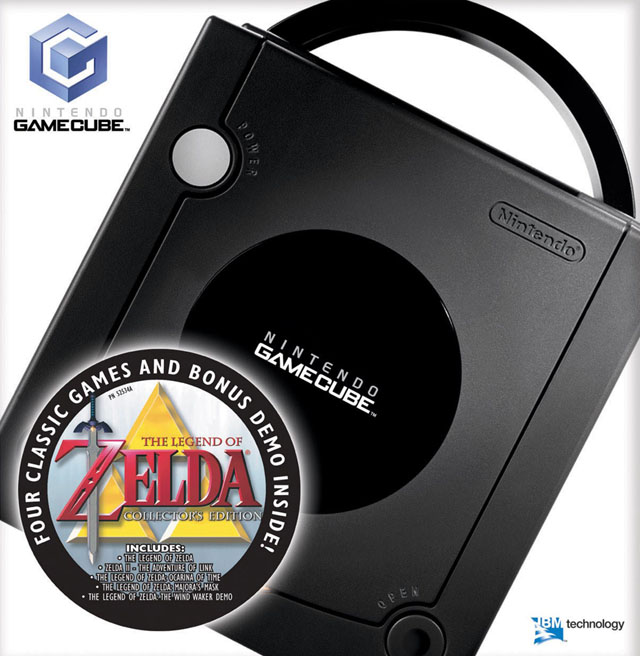
The Legend of Zelda: Collector’s Edition2003–2004 – A promotional GameCube disc with the first two Zelda games, Ocarina and Majora’s Mask. Europe 14 November 2003, North America 17 November, Japan 18 March 2004, Australia 19 March 2004.
Wii Virtual ConsoleApril–May 2009 – Europe and Australia 3 April, Japan 7 April, North America 18 May.
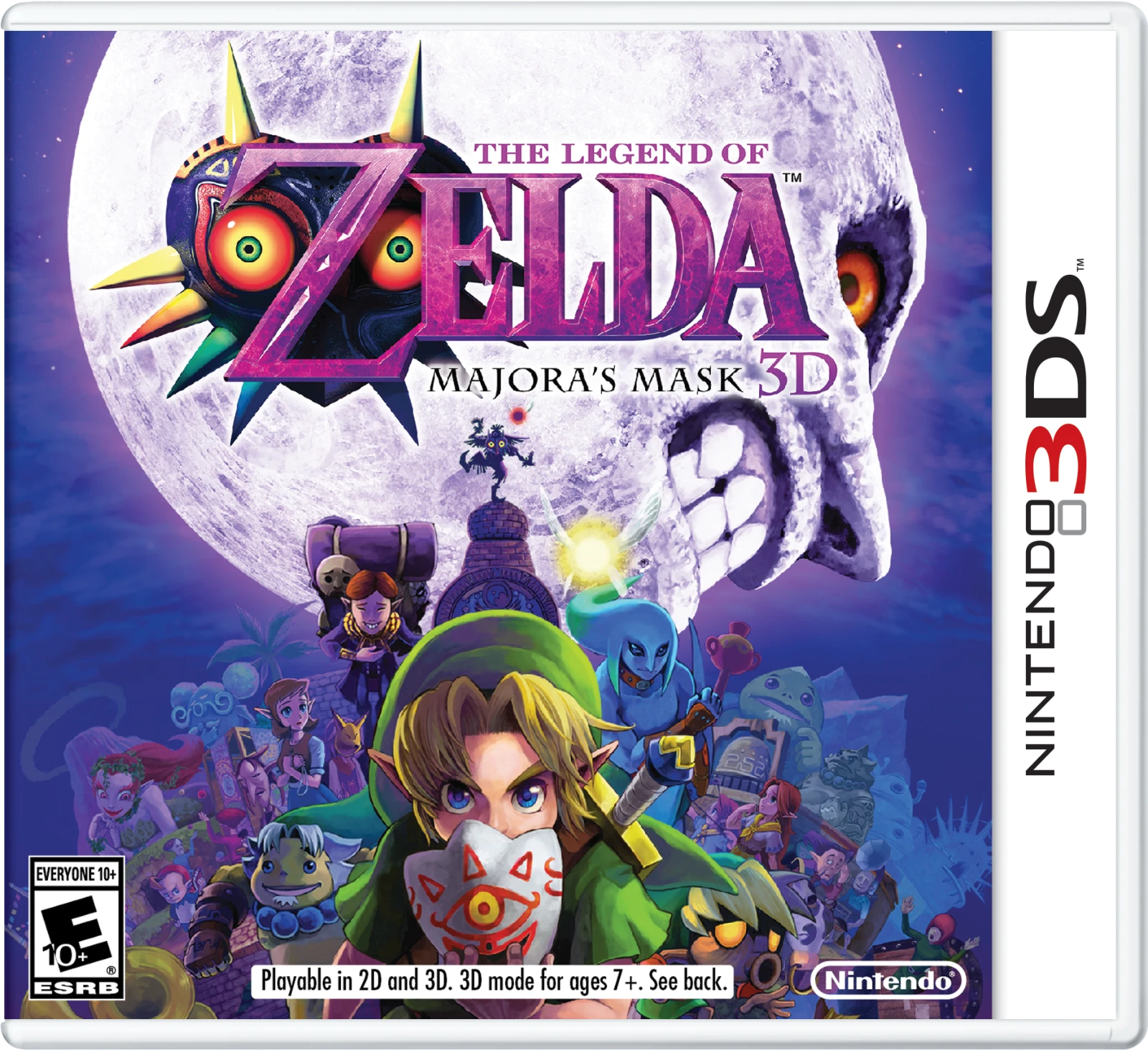
Majora’s Mask 3DFebruary 2015 – Grezzo’s remake for Nintendo 3DS. North America and Europe 13 February, Japan and Australia 14 February.
Wii U Virtual ConsoleJune–November 2016 – Europe and Australia 23 June, Japan 29 June, North America 24 November.
Nintendo Switch Online + Expansion Pack25 February 2022 – Added to the Nintendo 64 library on Switch.
Majora’s Mask 3D
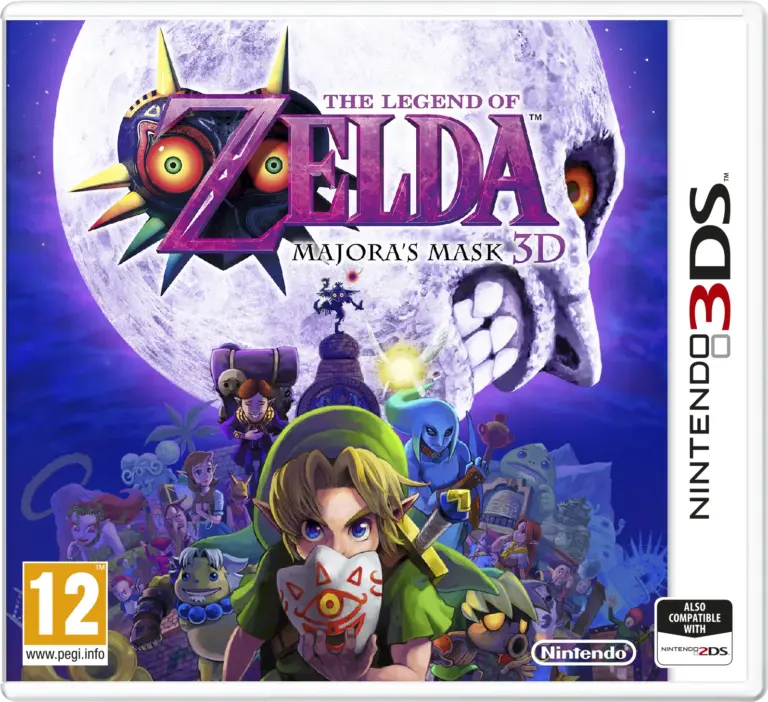
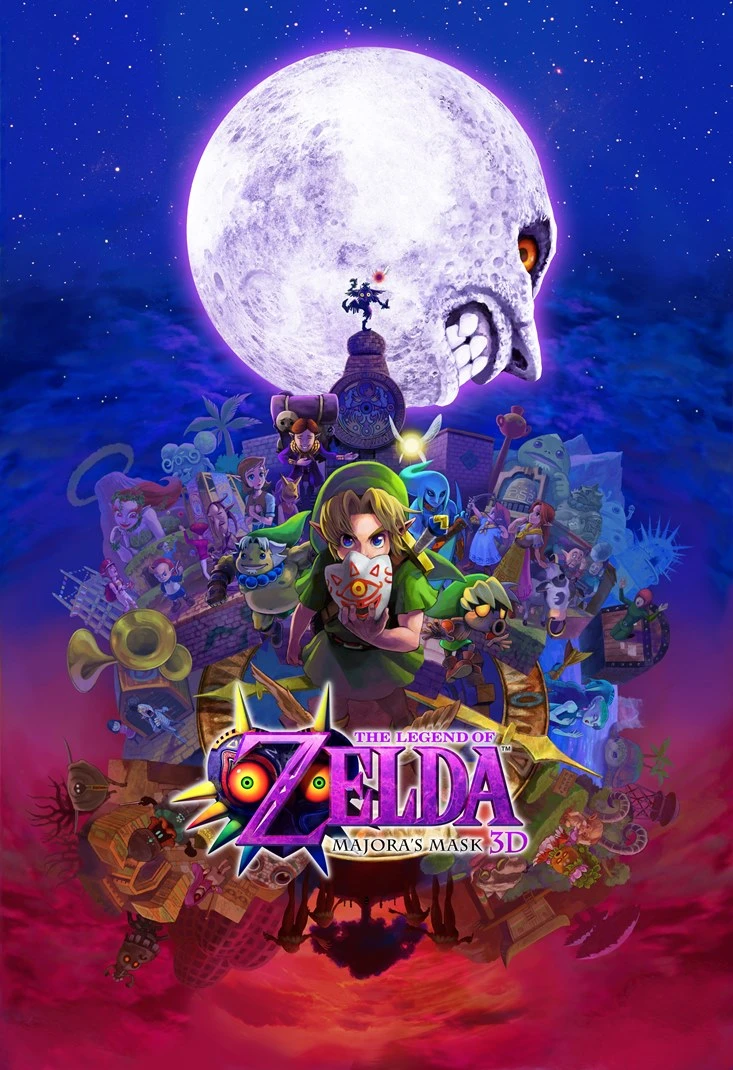
Official artwork for Majora’s Mask 3D.
Announced in a Nintendo Direct in November 2014 and released alongside the New Nintendo 3DS in North America and Europe, the remake was directed by Mikiharu Ooiwa at Grezzo and produced by Aonuma and Koichi Ishii. Aonuma told the team never to make the game easier, only fairer. Every boss fight was rebuilt to make its weak point clearer, the Bombers give hints, the notebook now tracks almost everyone involved in a quest and can alert you to timed events, and a Sheikah Stone offers hint videos. Saving is permanent at owl statues and new save statues, the Song of Double Time can skip to any hour, Zora Link’s swimming is slower, with only the fast swim costing magic, but is easier to control, Deku Link needs a run-up to skip across water, and there is a new fishing game. The frame rate rises to 30 frames per second and the New 3DS’s C-stick controls the camera.
It scored 89 on Metacritic, sold 230,065 copies in its first week in Japan and passed two million worldwide by the end of March 2015. By the end of 2022 it had reached 3.44 million, according to Japan’s CESA.
Back in later games
The Skull Kid in Hyrule Warriors Legends.
Majora’s Mask lives on in Nintendo’s other games. Great Bay is a stage in Super Smash Bros. Melee and Ultimate, the Skull Kid and the moon appear as Assist Trophies, and the Majora’s Mask Pack for Hyrule Warriors made Young Link and Tingle playable, with the Skull Kid joining in Hyrule Warriors Legends. The Song of Healing came back in Twilight Princess and Spirit Tracks, Tingle became a star in The Wind Waker, and the Fierce Deity’s armour returned in Breath of the Wild and Tears of the Kingdom.
A cult classic
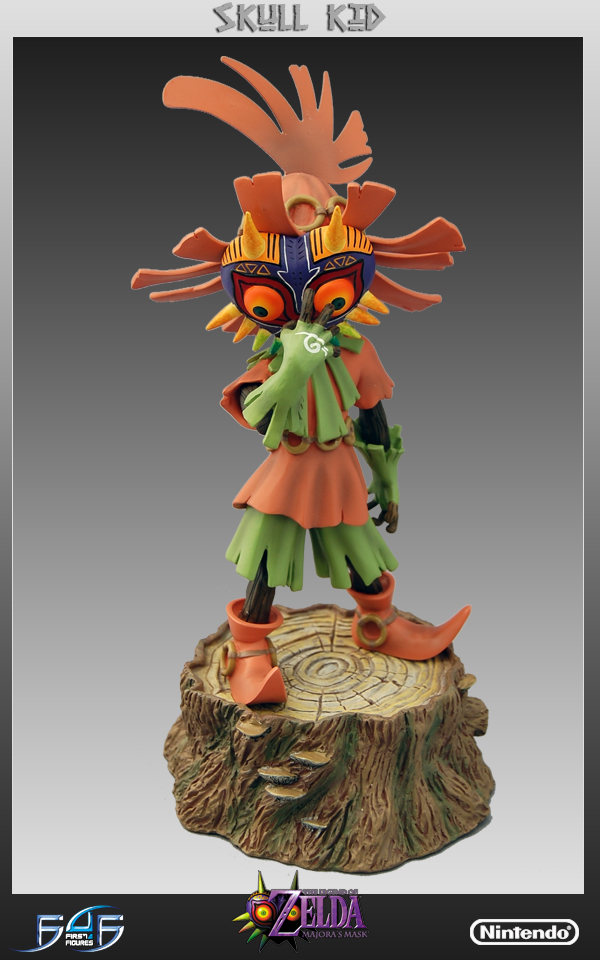
The Skull Kid statue from First 4 Figures.
Fans campaigned for years for a remake: the Operation Moonfall petition gathered 16,000 signatures in a week, and Aonuma and Miyamoto both said they were interested before the 3DS version was confirmed. The game’s time loop has been credited as an influence on games such as Outer Wilds and Elsinore, its mood on Kena: Bridge of Spirits, whose studio Ember Lab first made its name with the Majora’s Mask fan film Terrible Fate, and its cursed-cartridge legend gave the internet Ben Drowned.
Where to play it today
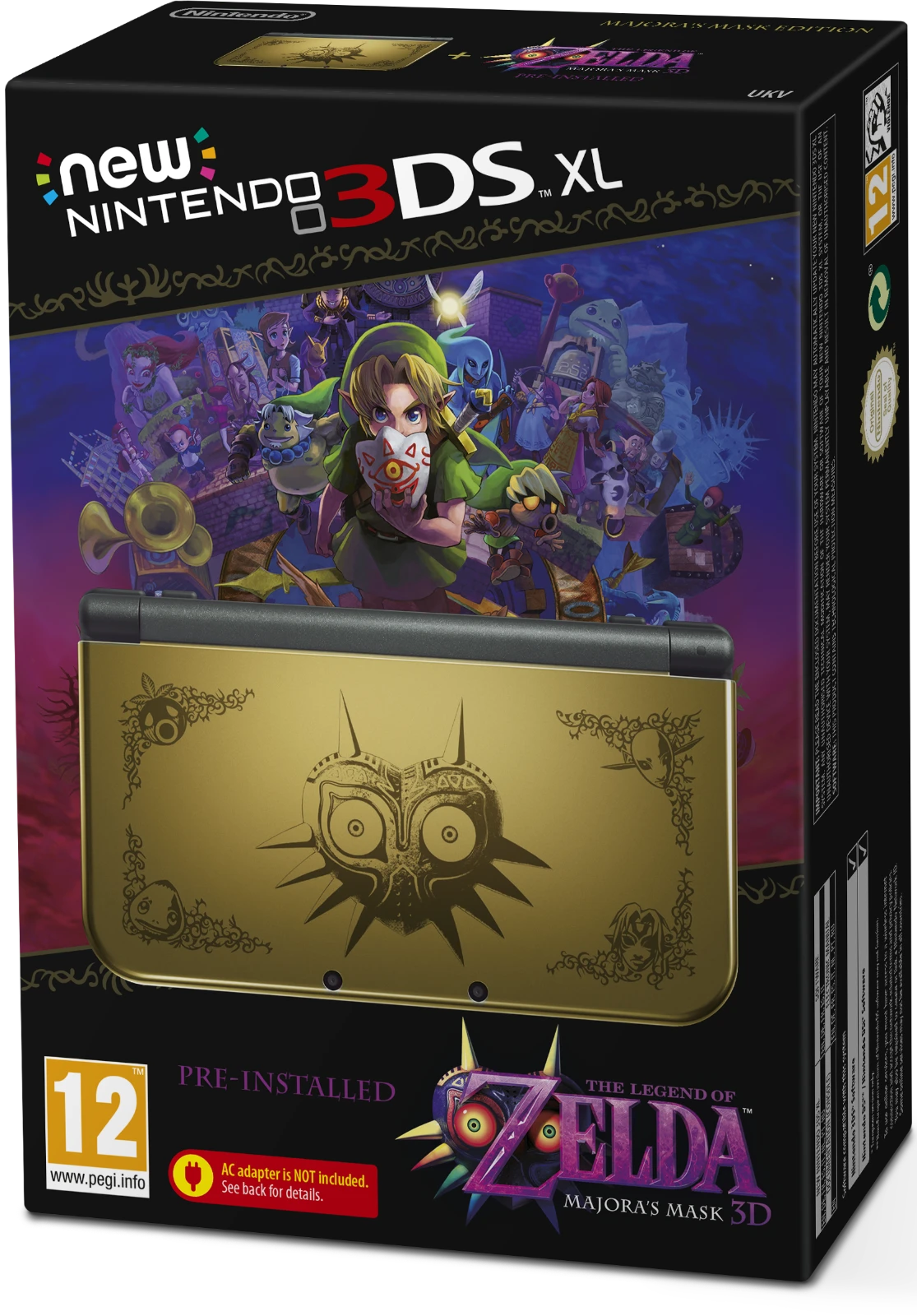
A New Nintendo 3DS XL box from the Majora’s Mask 3D release.
The original Nintendo 64 version is part of the Nintendo Switch Online + Expansion Pack library, and Majora’s Mask 3D remains the definitive handheld version on Nintendo 3DS.
Sales & reviews
Sales figures
Majora’s Mask sold 601,542 copies in Japan by the end of 2000, according to Famitsu. It sold 1,206,489 copies in the United States in 2000, which put it among the year’s ten best-sellers there, and in Europe it was the year’s eighth highest-grossing game. Lifetime Nintendo 64 sales are usually given as 3.36 million worldwide. The 3DS remake added 3.44 million more by the end of 2022.
601,542sold in Japan in 2000
1.2msold in the US in 2000
3.36mNintendo 64 copies worldwide
3.44mMajora’s Mask 3D by December 2022
Reception and review scores
Critics loved it, though not all of them loved the clock. These are the main period reviews of the Nintendo 64 original, with the outlet and issue where we could confirm them.
Electronic Gaming MonthlyUS · issue 137, December 2000
10/10
IGNUS · Fran Mirabella III, 25 October 2000
9.9/10
Game InformerUS · issue 91, November 2000
9.75/10
Nintendo PowerUS
9.4/10
FamitsuJapan · 9, 9, 9, 10
37/40
GameProUS · 30 October 2000
4.5/5
EdgeUK · issue 92, Christmas 2000
9/10
GameSpotUS · Jeff Gerstmann, 25 October 2000
8.3/10
Next GenerationUS · vol. 3 no. 12, December 2000
4/5
Metacritic’s average is 95 from 27 reviews, all of them positive. Reviewers praised the time cycle (several compared it to Groundhog Day), the Bombers’ Notebook, the transformations and the sheer density of Termina, as well as the extra detail the Expansion Pak allowed. The doubters focused on the pressure of the clock and the heavy emphasis on side quests. GameSpot’s Jeff Gerstmann summed up the split with the verdict that it was a great game, but not one for everybody; some felt it broke less new ground than Ocarina, or complained about blurry textures and dips in frame rate.
The 3DS remake was just as well received: 89 on Metacritic, with 10/10 from Nintendo Life, 9.25 from Game Informer, 9/10 from GameSpot and Polygon, and 8.7 from IGN.
Honours
Academy of Interactive Arts & Sciences · 2001Console Action/AdventureWon at the 4th Interactive Achievement Awards, where it was also nominated for Game of the Year and Console Game of the Year.
Academy of Interactive Arts & Sciences · 2001Game DesignAlso won at the 4th Interactive Achievement Awards.
GameSpot · Best and Worst of 2000Runner-up, Best Nintendo 64 GameBeaten only by Perfect Dark.
Reader reviews
No reader reviews yet. Played it? Give it a score out of 10 and tell other fans what you think.
Every fact on this page was checked against the sources below in November 2026. Zelda Wiki (zeldawiki.wiki) could not be read automatically and was not used. Review issue numbers come from the citations in Wikipedia’s article, read in full in an offline copy.
To provide the best experiences, we use technologies like cookies to store and/or access device information. Consenting to these technologies will allow us to process data such as browsing behavior or unique IDs on this site. Not consenting or withdrawing consent, may adversely affect certain features and functions.
Functional
Always active
The technical storage or access is strictly necessary for the legitimate purpose of enabling the use of a specific service explicitly requested by the subscriber or user, or for the sole purpose of carrying out the transmission of a communication over an electronic communications network.
Preferences
The technical storage or access is necessary for the legitimate purpose of storing preferences that are not requested by the subscriber or user.
Statistics
The technical storage or access that is used exclusively for statistical purposes.The technical storage or access that is used exclusively for anonymous statistical purposes. Without a subpoena, voluntary compliance on the part of your Internet Service Provider, or additional records from a third party, information stored or retrieved for this purpose alone cannot usually be used to identify you.
Marketing
The technical storage or access is required to create user profiles to send advertising, or to track the user on a website or across several websites for similar marketing purposes.

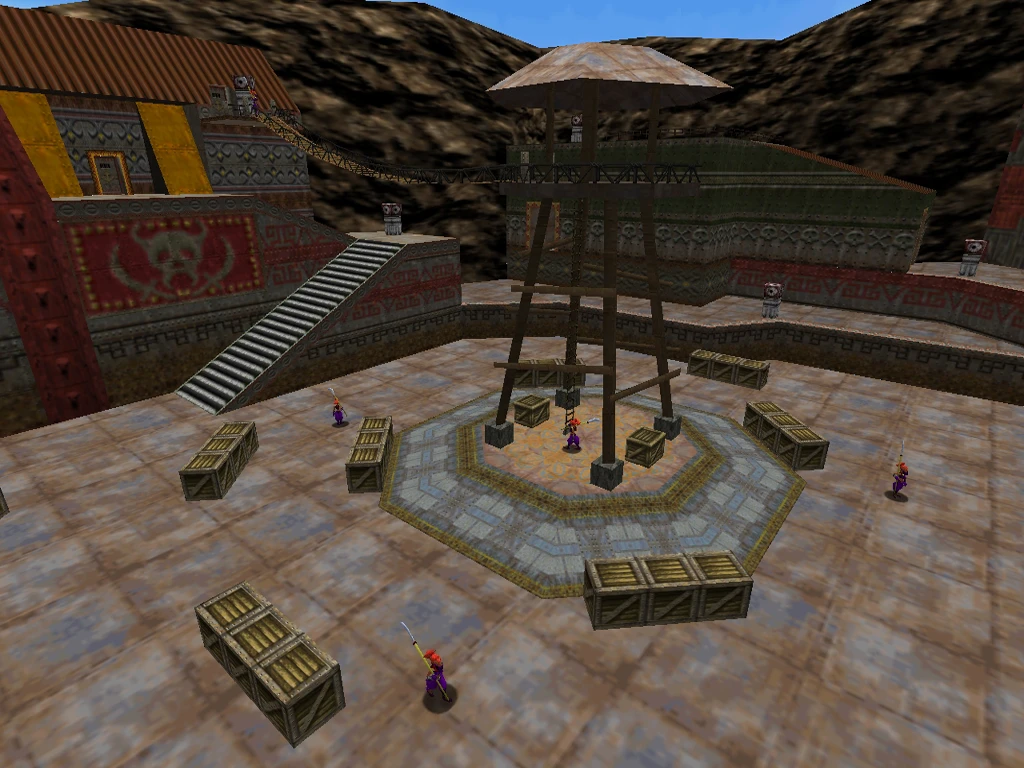
 Clock TownCentreThe walled festival town, split into four districts round the great clock. Shops, the Stock Pot Inn, the bank, the Milk Bar, the Bombers’ hideout and the observatory.
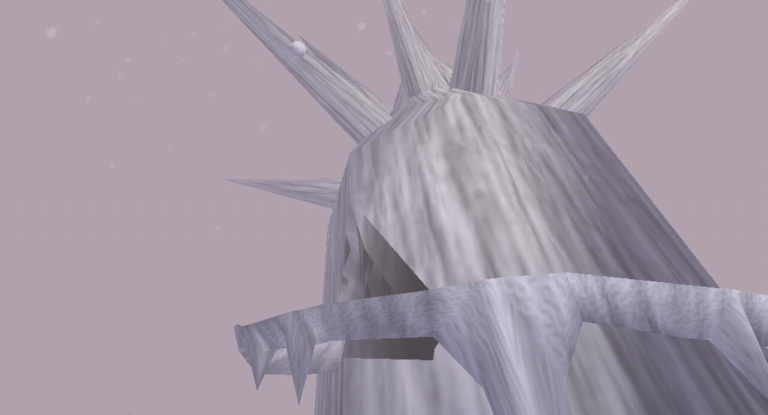 Snowhead and Snowhead TempleNorthGoron Village, the smithy and the Goron racetrack. Boss: Goht, Masked Mechanical Monster. Temple treasure: Fire Arrows.
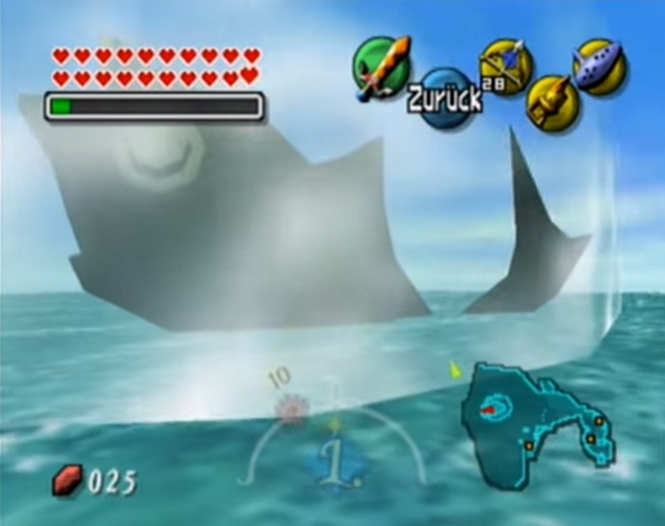 Great Bay and Great Bay TempleWestZora Hall, the pirates’ fortress, the fisherman’s hut and the marine research lab. Boss: Gyorg, Gargantuan Masked Fish. Temple treasure: Ice Arrows.
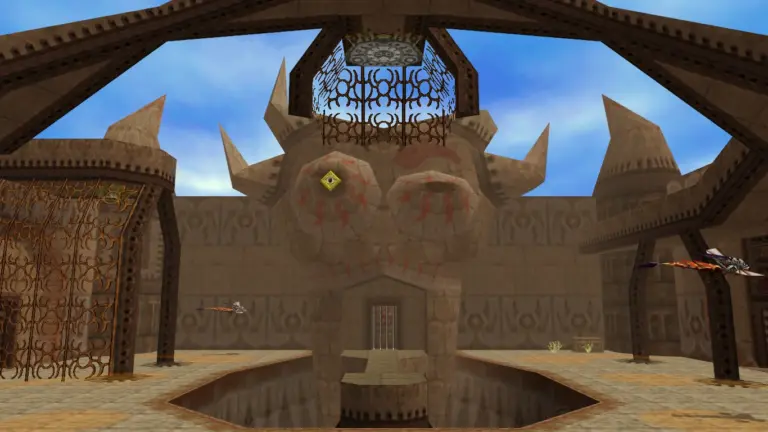 Ikana Canyon and Stone Tower TempleEastIkana Graveyard, the Ancient Castle of Ikana, the well and the Music Box House. Boss: Twinmold, Giant Masked Insect. Temple treasure: Light Arrows.
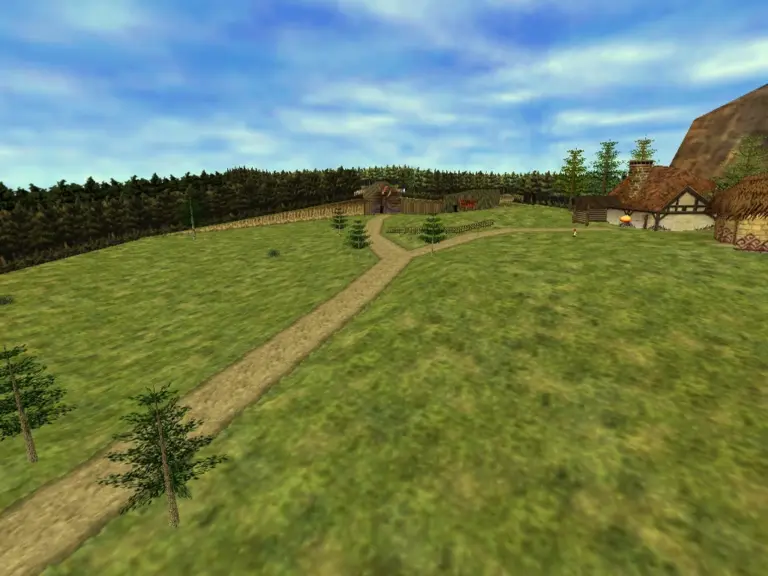 Milk Road and Romani RanchSouth-westThe Gorman racetrack and the ranch run by Cremia and Romani. No temple, but a vital stop for Epona.
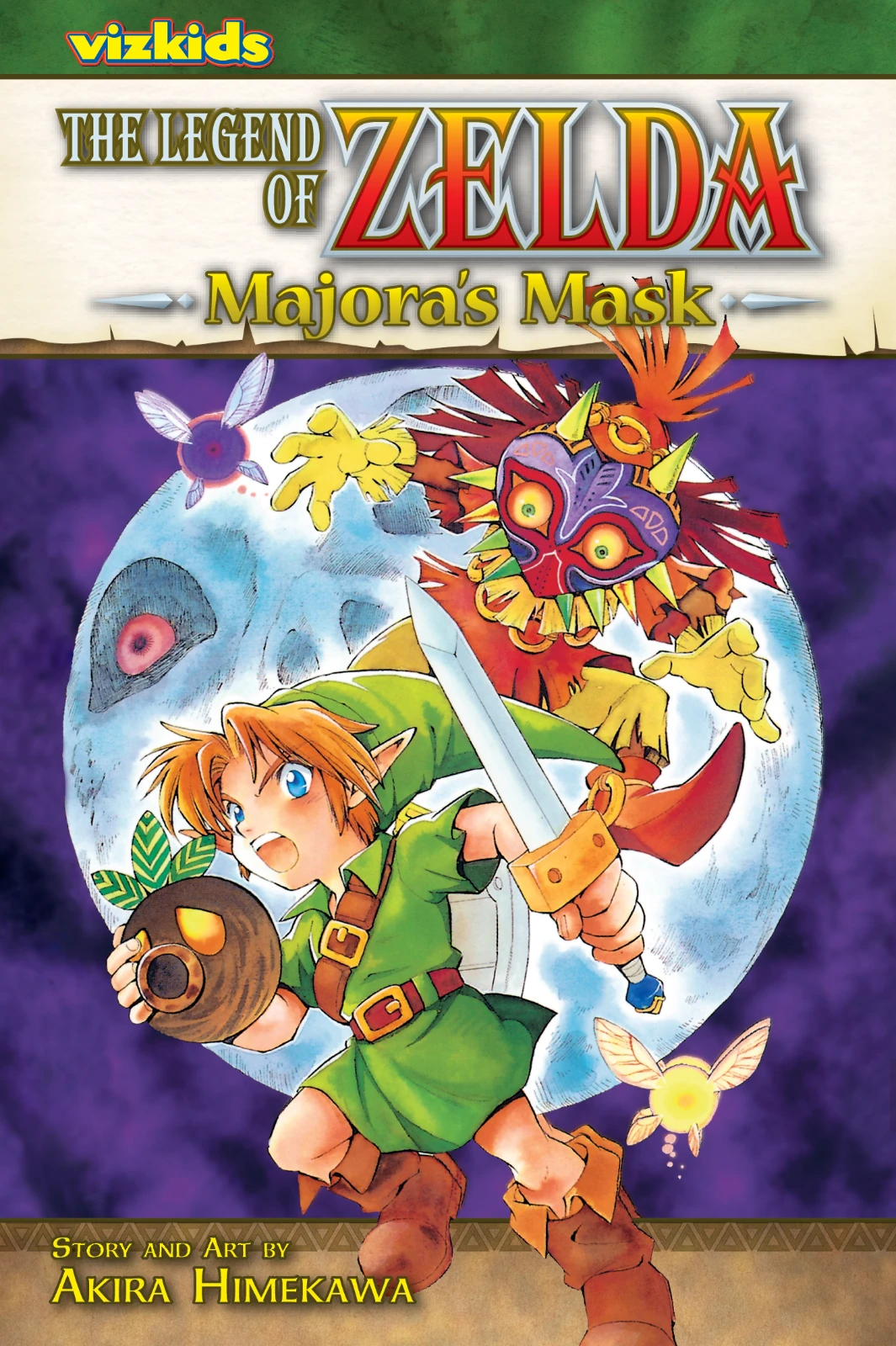 The Legend of Zelda: Majora’s Mask (manga)Akira Himekawa · Shogakukan (Japan) · Viz Media 2009A one-volume adaptation by Akira Himekawa, the pen name of the duo behind most of the official Zelda manga. It picks up where their Ocarina of Time books left off, makes Anju and Kafei’s story much bigger, keeps Link out of the temples (Odolwa is fought at the Deku Palace and Gyorg out at sea), and adds a bonus chapter imagining where the mask came from: armour taken from a monster called Majora. Viz published it in English as volume 3 of its Zelda line on 3 February 2009, and later reissued it with A Link to the Past in a Legendary Edition.
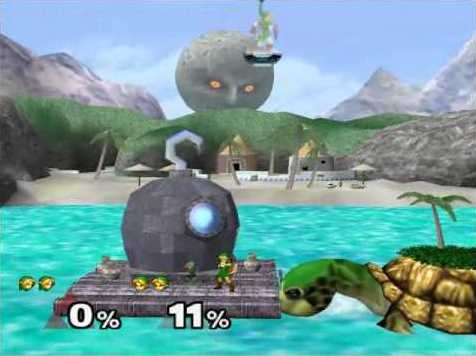 Super Smash Bros.Nintendo · 2001 onwardsGreat Bay is a stage in Melee and returns in Ultimate. The Skull Kid is an Assist Trophy in the 3DS and Wii U games and in Ultimate, where the moon itself also turns up as an Assist Trophy.
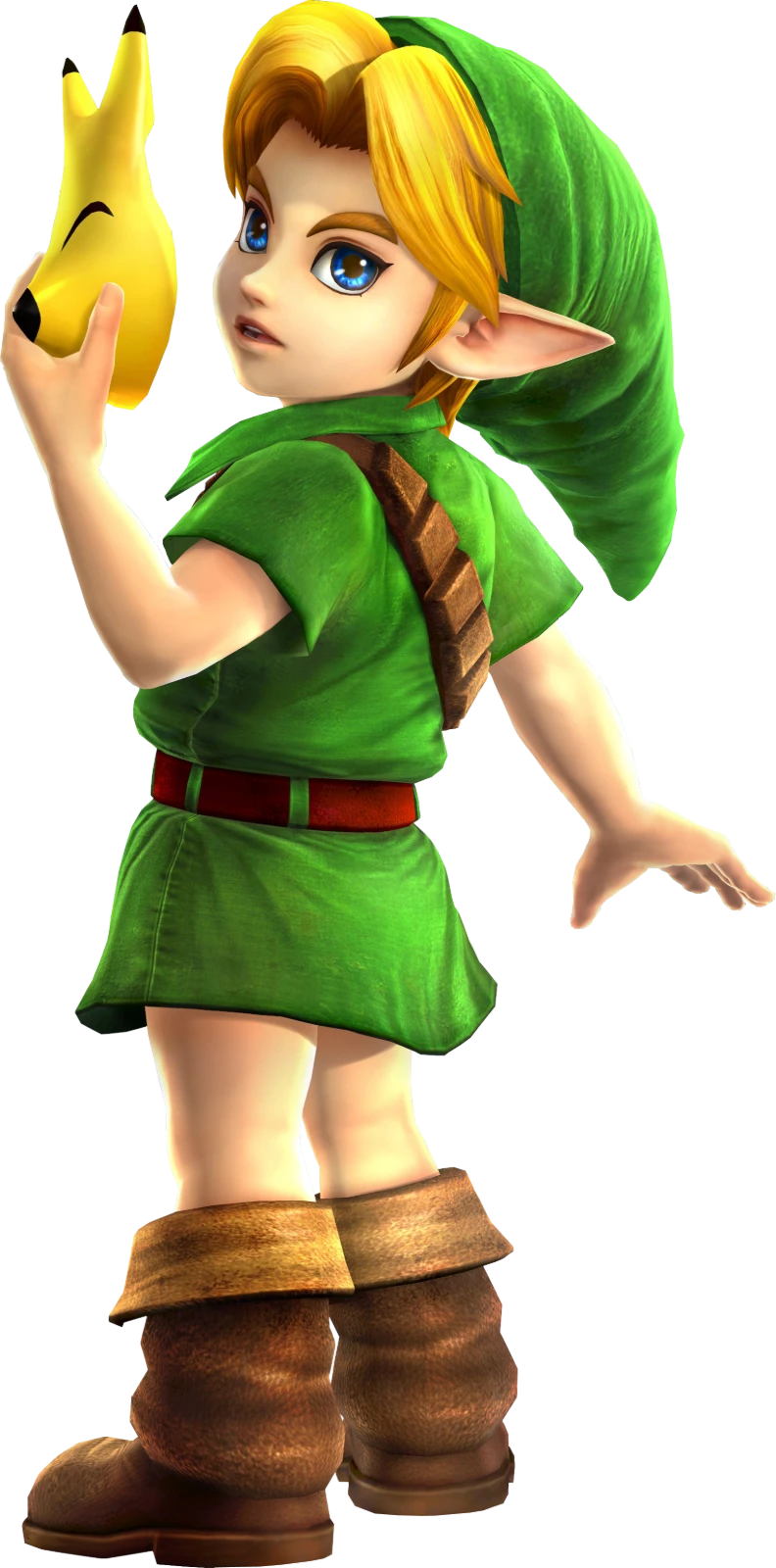 Hyrule WarriorsNintendo and Koei Tecmo · 2015–2016The Majora’s Mask Pack (Japan and Europe 29 January 2015, North America 5 February) added Young Link and Tingle as fighters and a Skull Kid costume for Lana. The Skull Kid himself joined the roster in Hyrule Warriors Legends on 3DS.
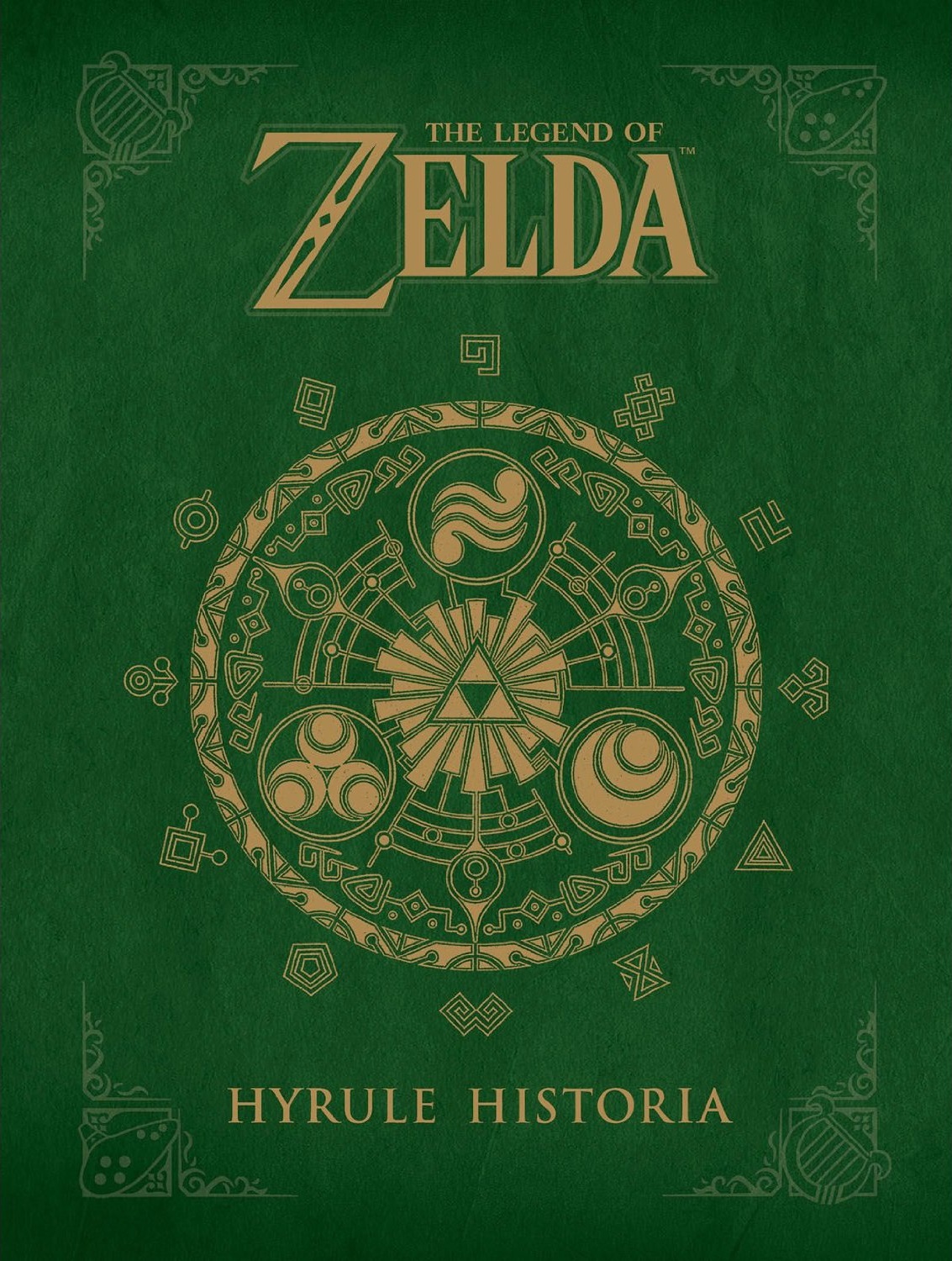 Hyrule HistoriaNintendo · book · 2011Nintendo’s official history places Majora’s Mask on the “child” branch of the timeline, right after Ocarina of Time, and explains that masks hold the souls of the dead, which is how Link takes on their forms.
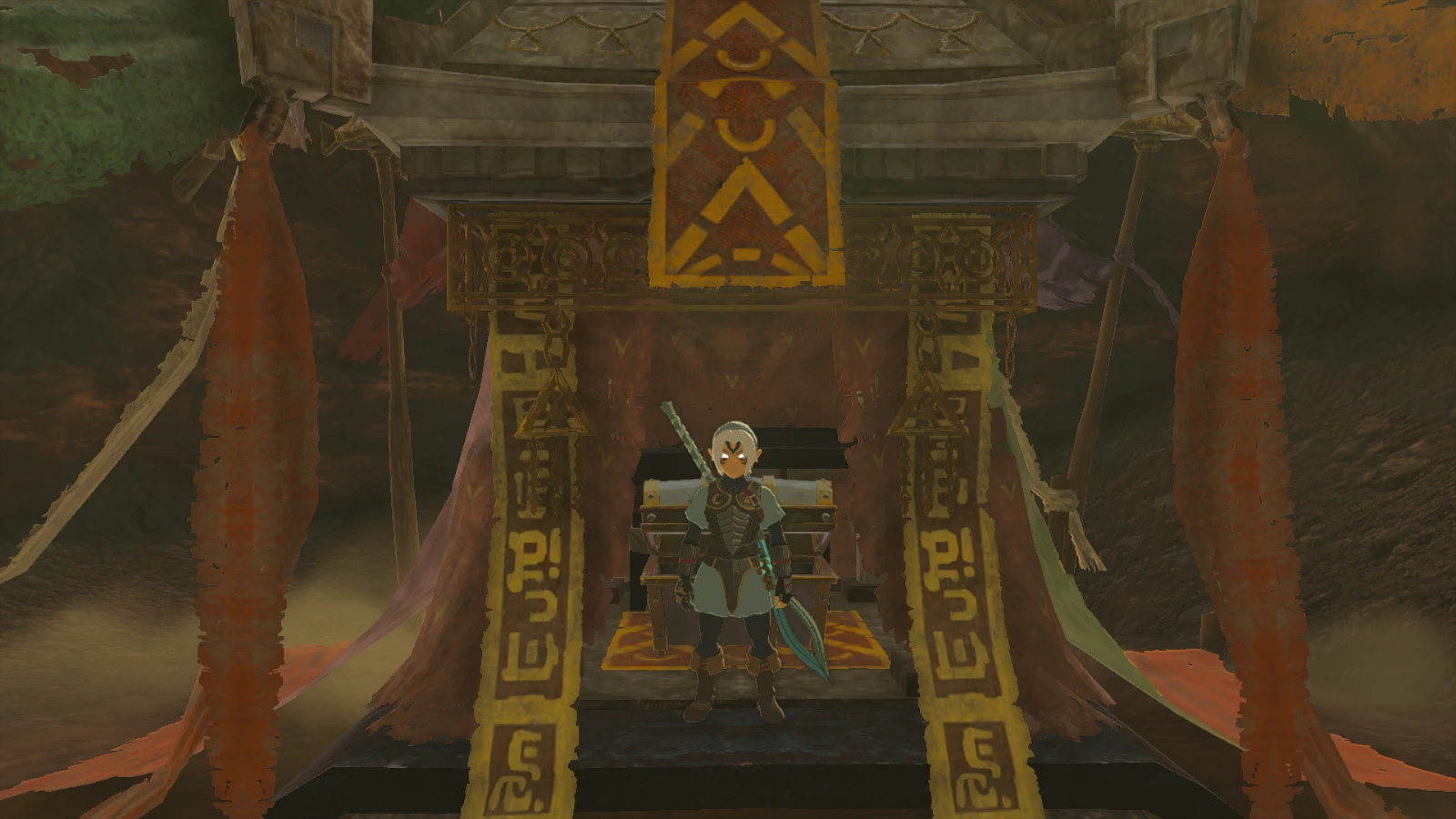 Breath of the Wild and Tears of the KingdomNintendo · 2017, 2023The Fierce Deity’s mask, armour and boots return as an outfit. In Breath of the Wild they drop at random from the Link (Majora’s Mask) amiibo; in Tears of the Kingdom a bandit called Misko has hidden them in three caves.
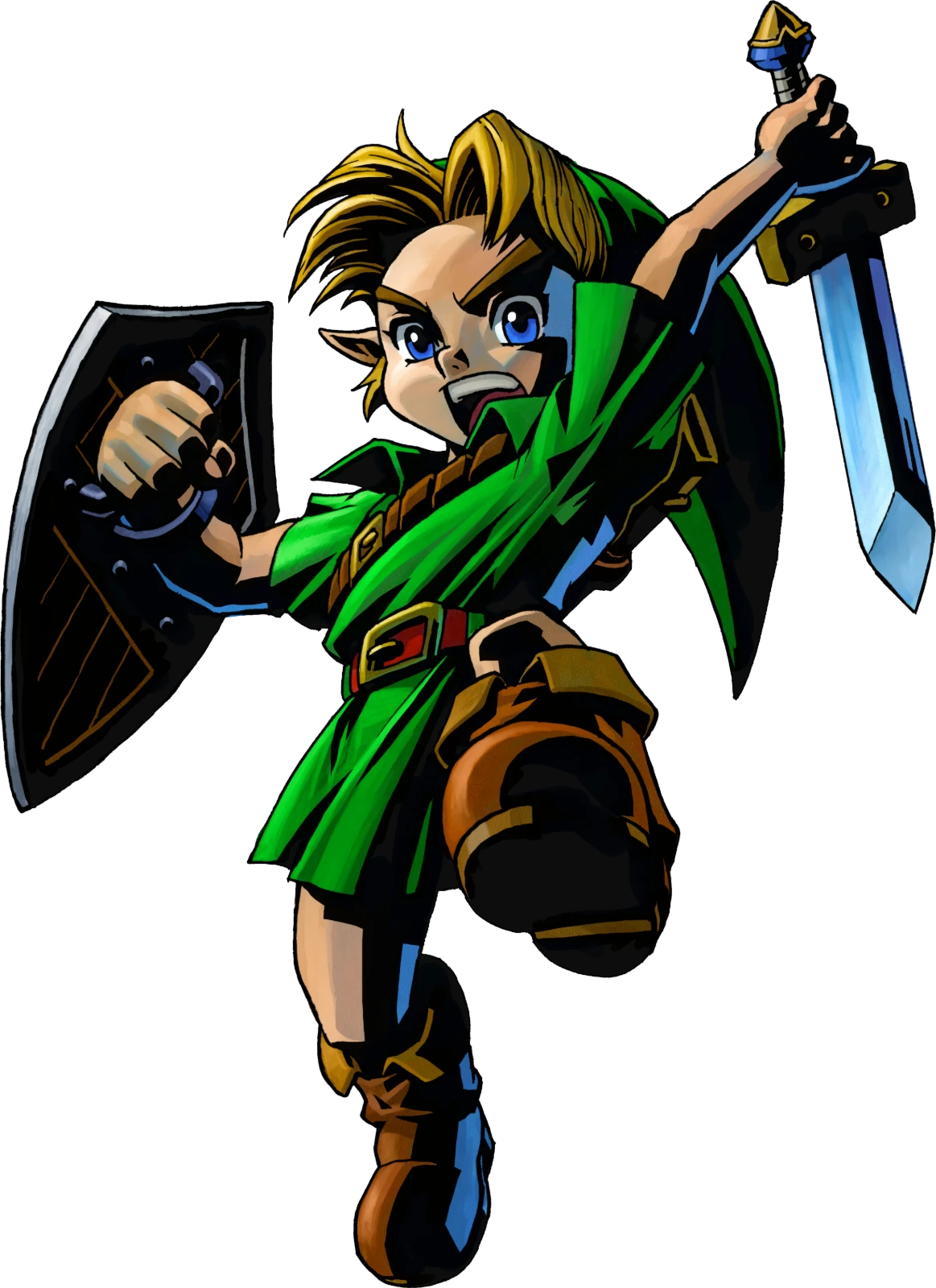 LinkThe Hero of Time
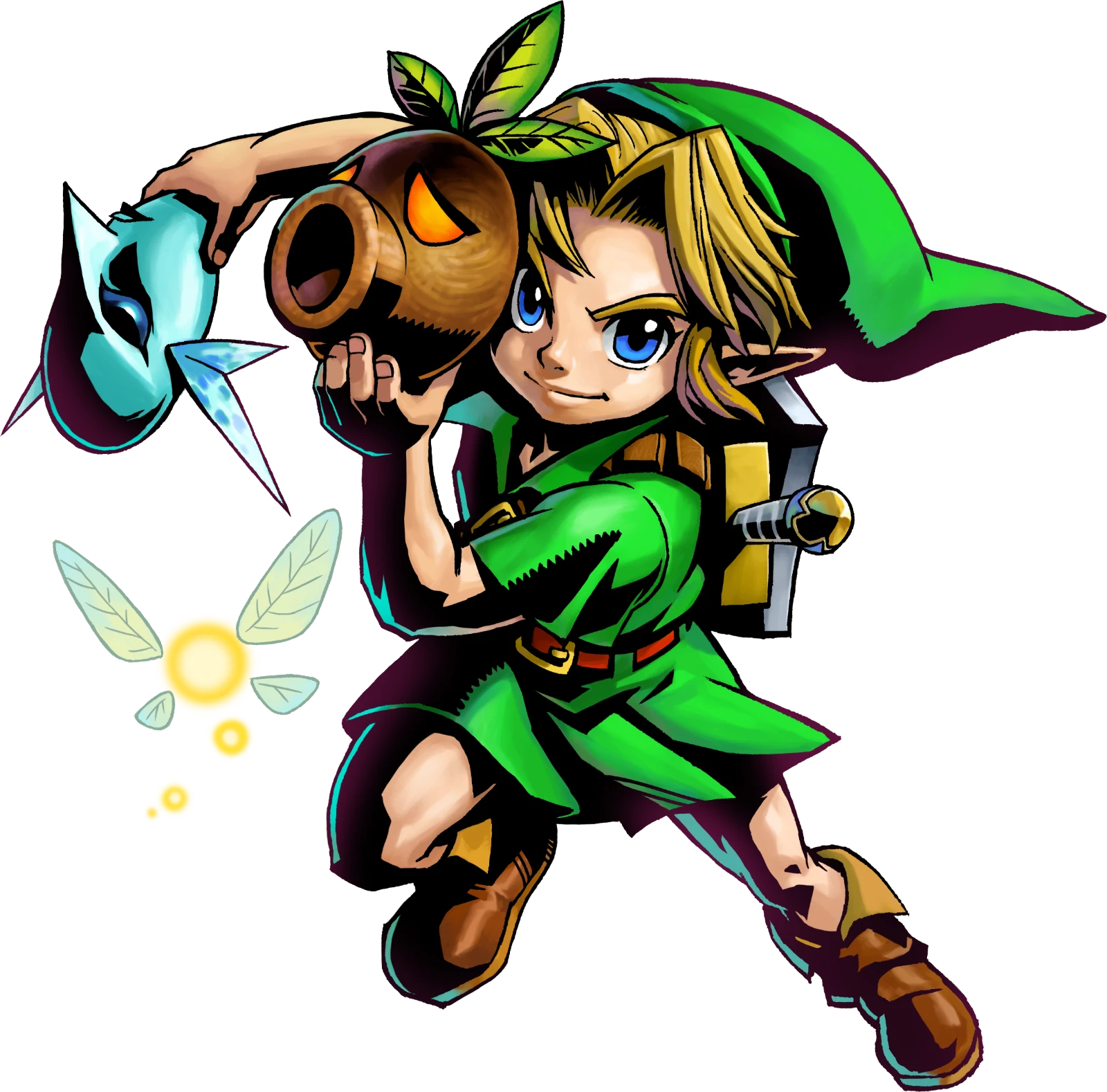 Deku, Goron, Zora and Fierce Deity LinkThe transformation masks
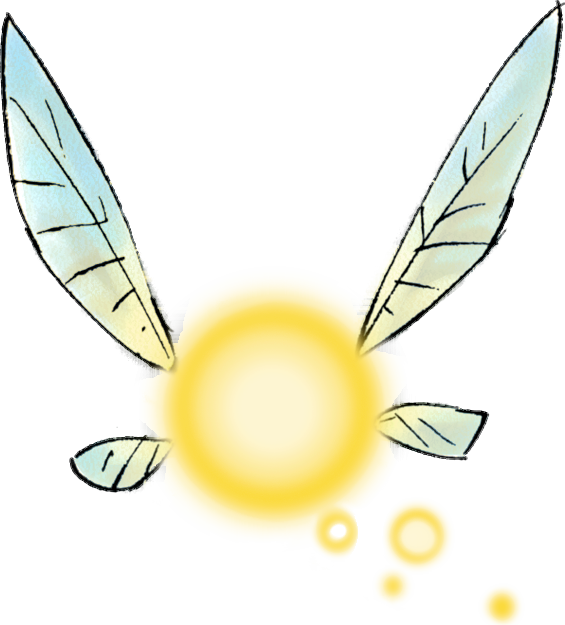 TatlLink’s fairy (and her brother Tael)
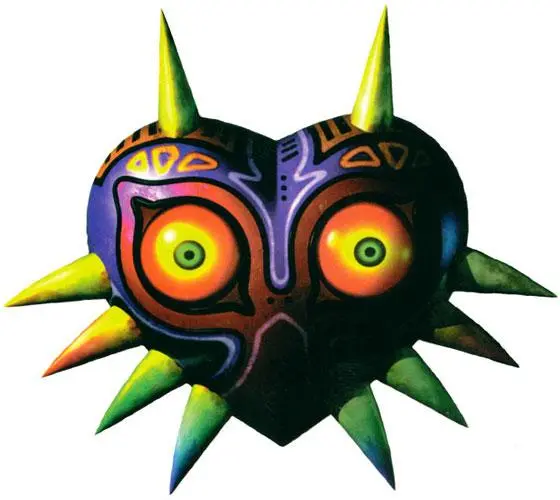 Majora’s MaskThe true villain
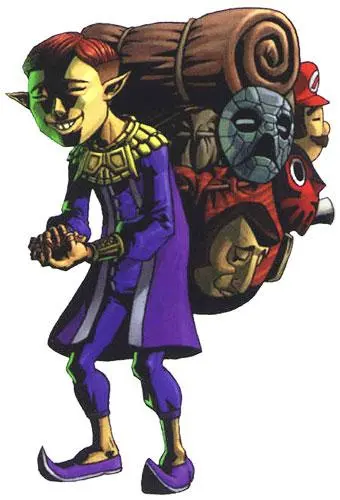 Happy Mask SalesmanThe travelling mask dealer
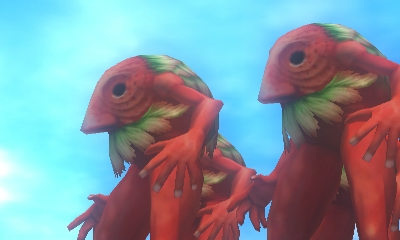 The Four GiantsTermina’s guardian gods
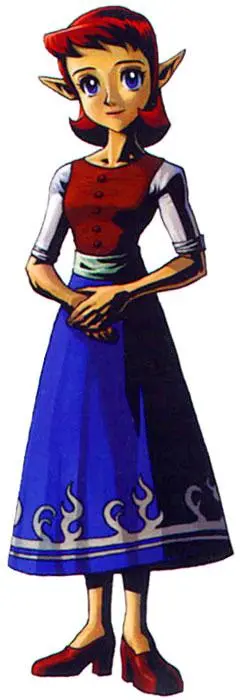 AnjuInnkeeper of the Stock Pot Inn
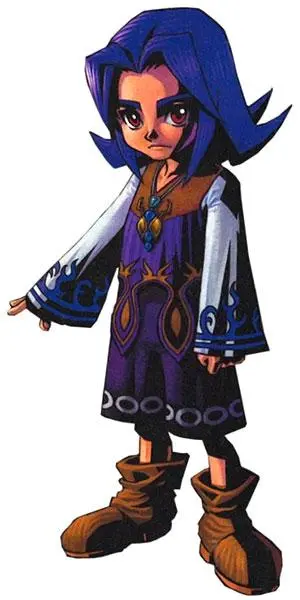 KafeiThe mayor’s missing son
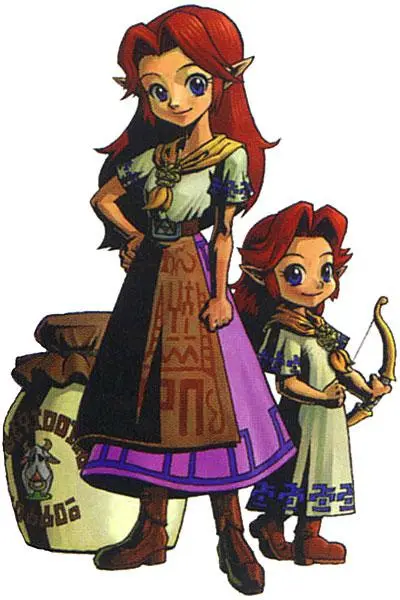 Romani and CremiaThe sisters of Romani Ranch
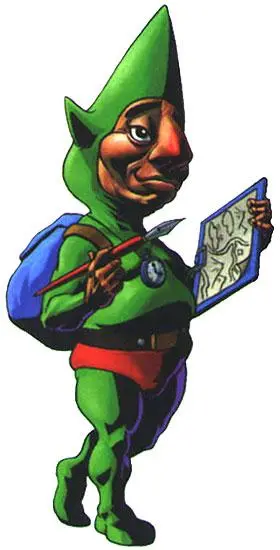 TingleMap seller in a balloon
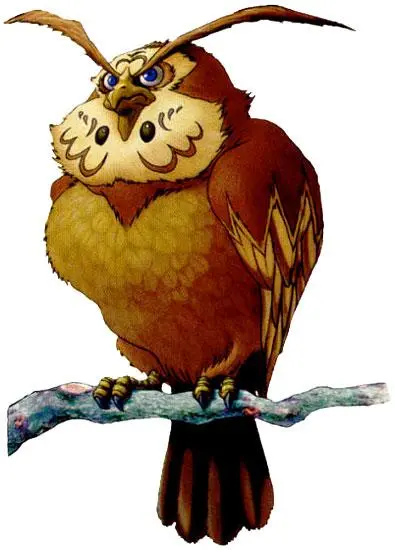 Kaepora GaeboraThe great owl
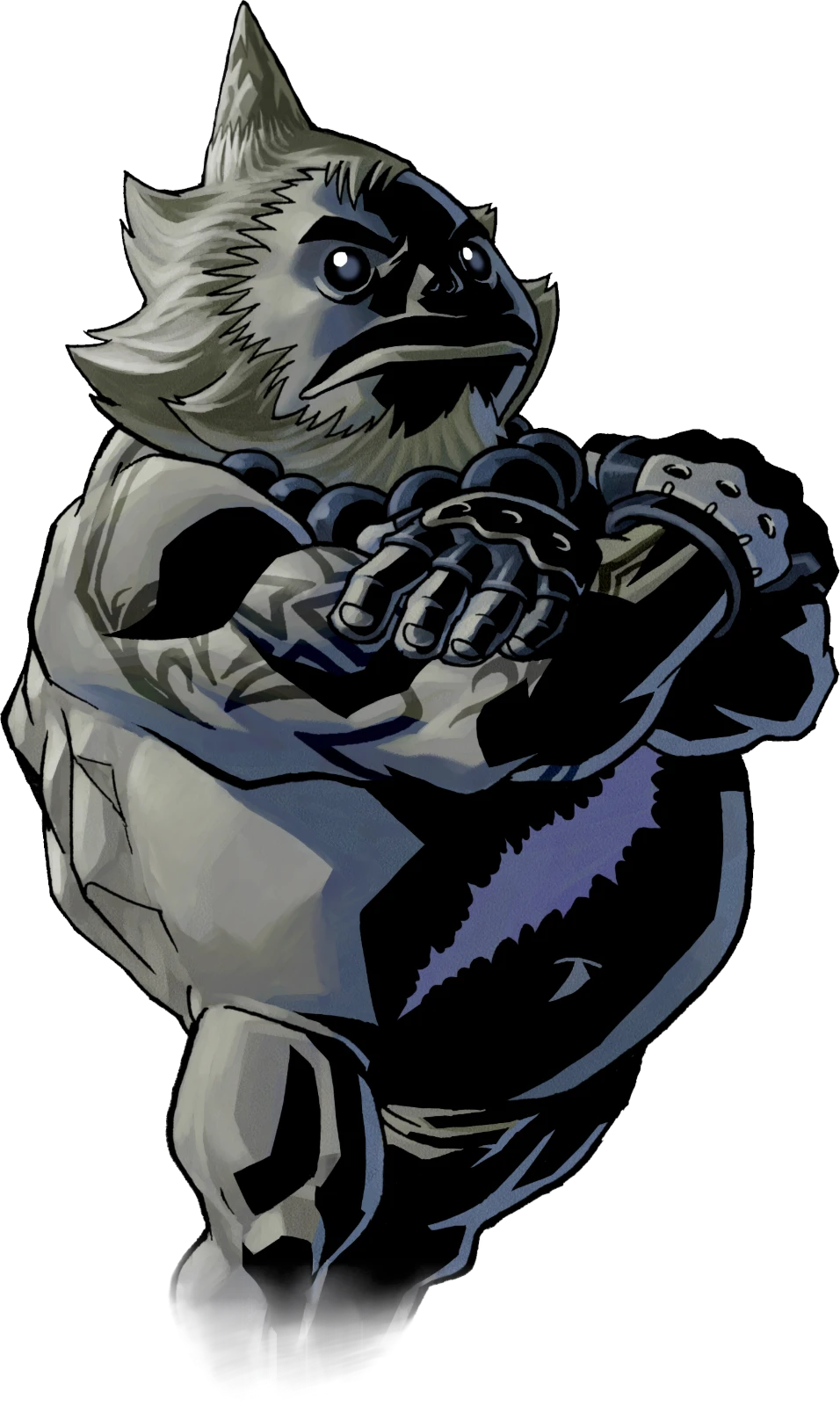 DarmaniHero of the Gorons
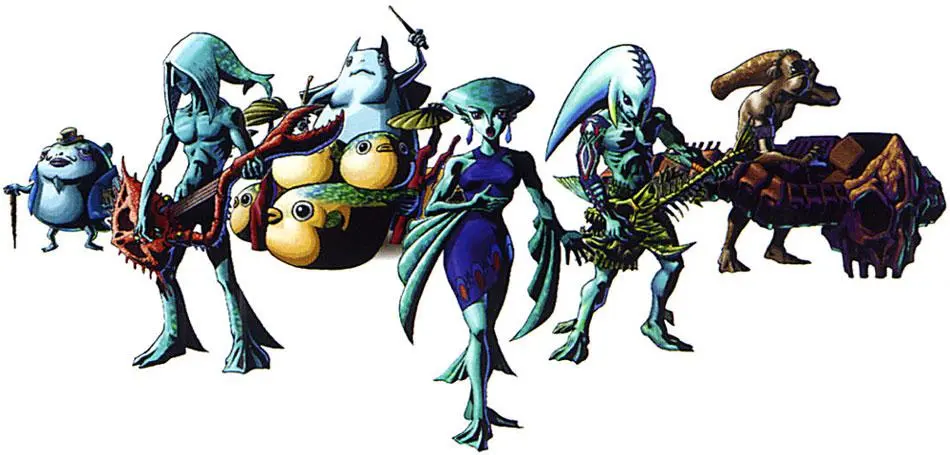 Mikau and LuluThe Indigo-Go’s
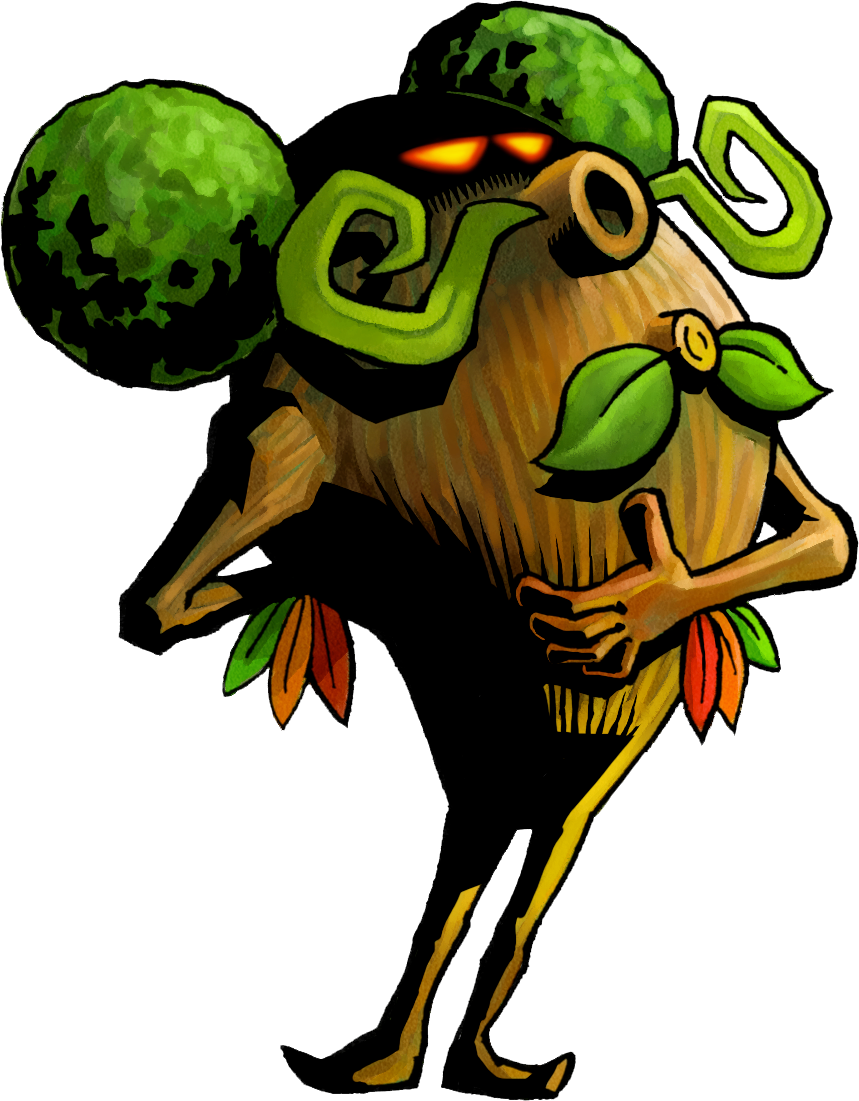 The Deku Butler and the Deku PrincessThe Deku royal household
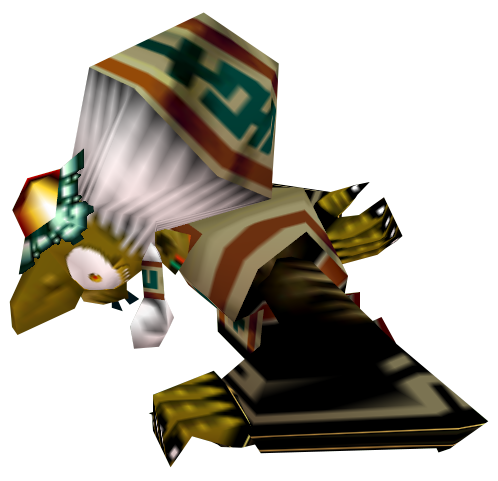 Koume and KotakeThe swamp witches
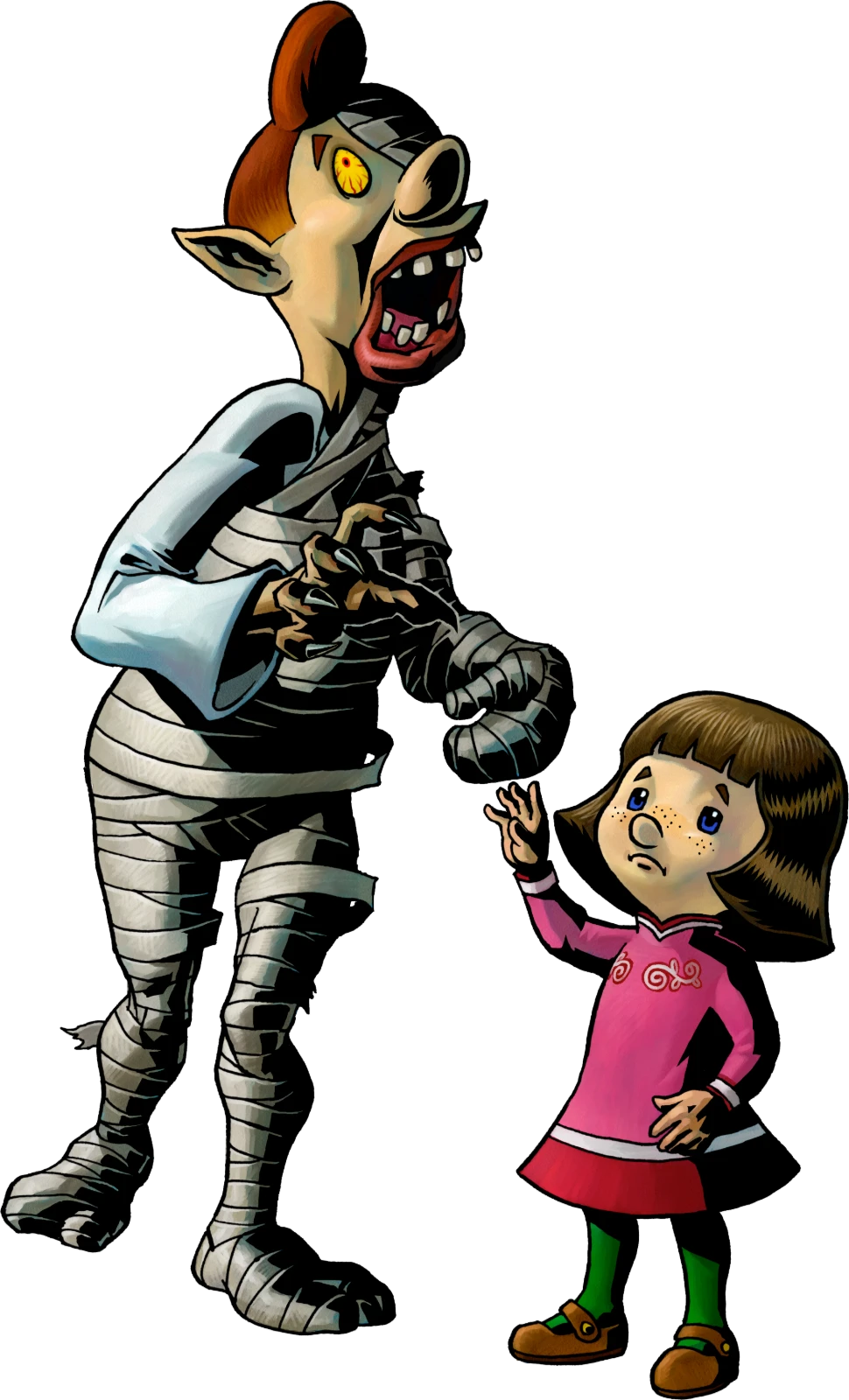 Pamela and her fatherThe Music Box House
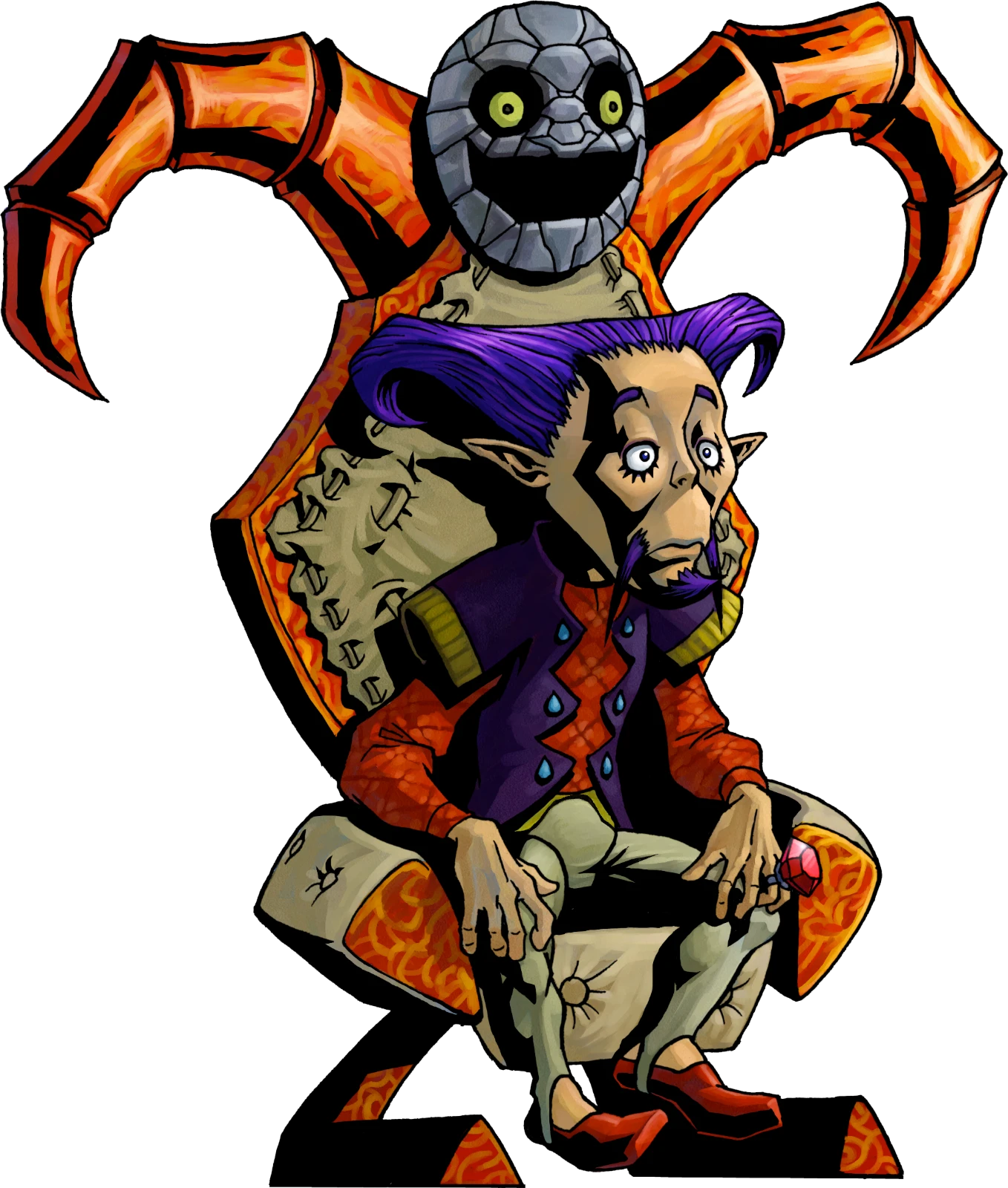 Mayor Dotour and Madame AromaThe first family of Clock Town
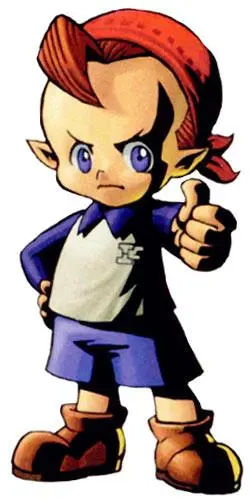 The BombersClock Town’s secret society
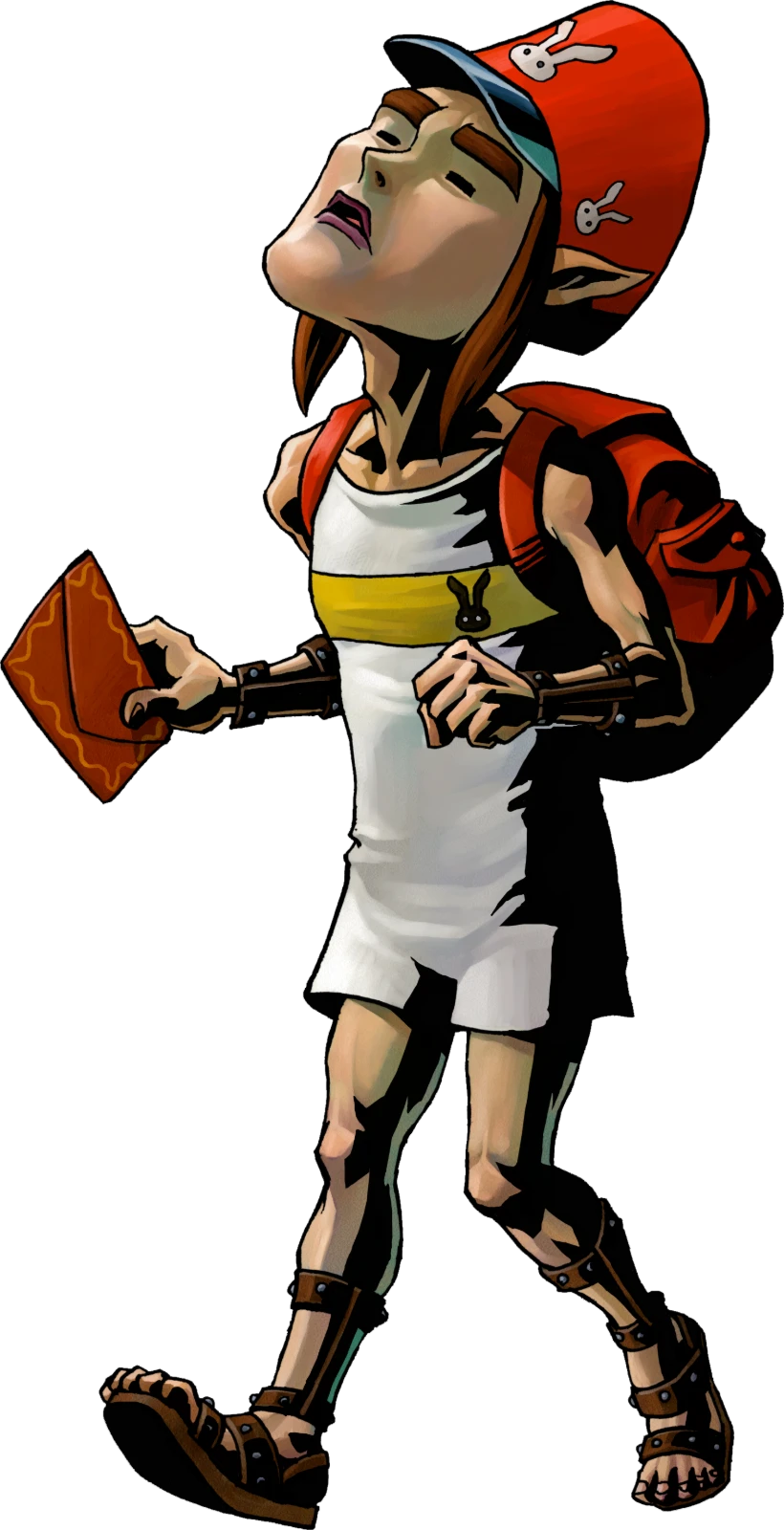 The PostmanA slave to the timetable
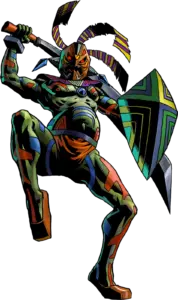 Odolwa, Masked Jungle WarriorWoodfall TempleA sword-and-shield giant who dances and summons moths. Stun him with arrows or bombs and strike while his guard is down.
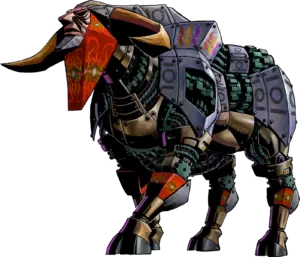 Goht, Masked Mechanical MonsterSnowhead TempleA clockwork bull frozen solid until a Fire Arrow wakes it. Chase it round a looping track as Goron Link and ram it.
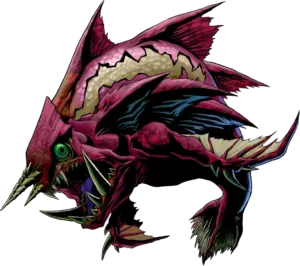 Gyorg, Gargantuan Masked FishGreat Bay TempleA huge fish that rams the platform in its tank. Stun it with arrows, then dive in as Zora Link and shock it.
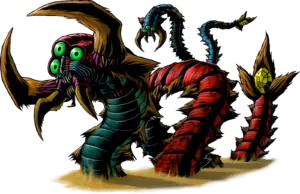 Twinmold, Giant Masked InsectStone Tower TempleTwo giant burrowing worms, one red and one blue. The Giant’s Mask lets Link grow to their size and fight hand to hand.
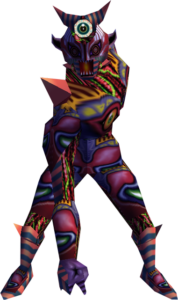 Majora’s Mask / Incarnation / WrathThe MoonThe final boss in three stages: a spinning mask with the boss masks as helpers, a capering humanoid, and a lanky figure lashing with whips.
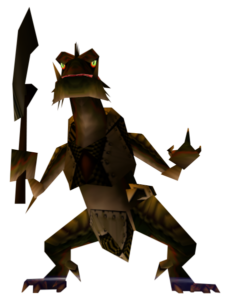 DinolfosWoodfall, Snowhead, Ikana and the MoonFire-breathing lizard warriors. The first one guards the Hero’s Bow in Woodfall Temple.
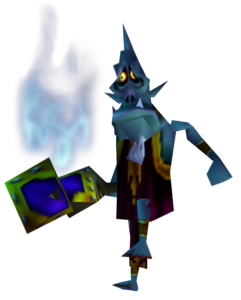 WizzrobeSnowhead, Ikana Castle, Stone TowerA teleporting sorcerer who splits into decoys. Beating him in Snowhead earns the Fire Arrows.
 WartGreat Bay TempleA giant eye shielded by bubbles. It guards the Ice Arrows.
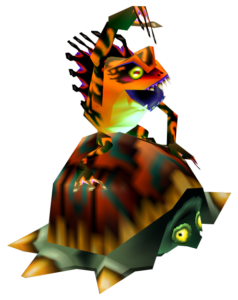 GekkoWoodfall and Great Bay TemplesA cheeky frog who rides a Snapper turtle in Woodfall and a Mad Jelly in Great Bay. He guards both boss keys.
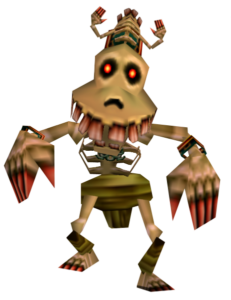 Captain KeetaIkana GraveyardA giant skeletal general who still thinks the war is on. Chase him down and beat him and he hands over the Captain’s Hat.
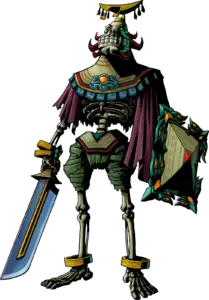 Igos du IkanaAncient Castle of IkanaThe undead king and his two servants, beaten with sunlight and steel. He teaches the Elegy of Emptiness.
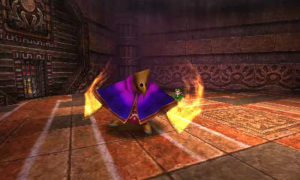 Garo MasterStone Tower TempleThe leader of the ninja-like Garo spirits. He guards the Light Arrows.
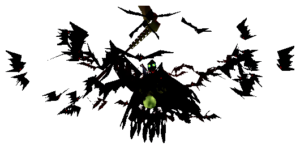 GomessStone Tower TempleA scythe-swinging reaper wrapped in bats. Clear them with a Light Arrow to reach his core.
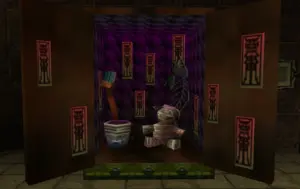 GibdoIkanaBandaged mummies that haunt Ikana and the well beneath it; Pamela’s father has become one.
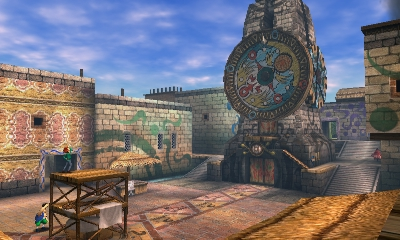
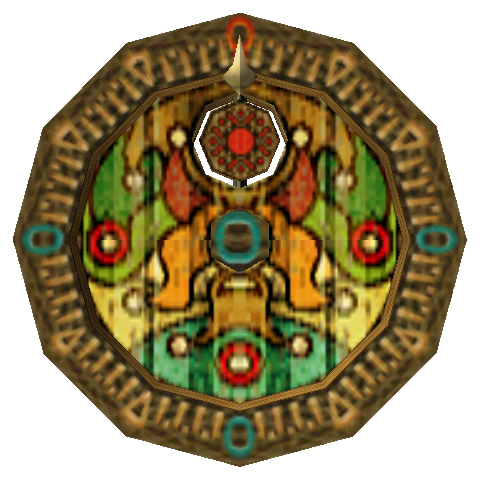 The three-day cycleA world on a 72-hour countdown that resets every time Link plays the Song of Time. The series had never tried anything like it.
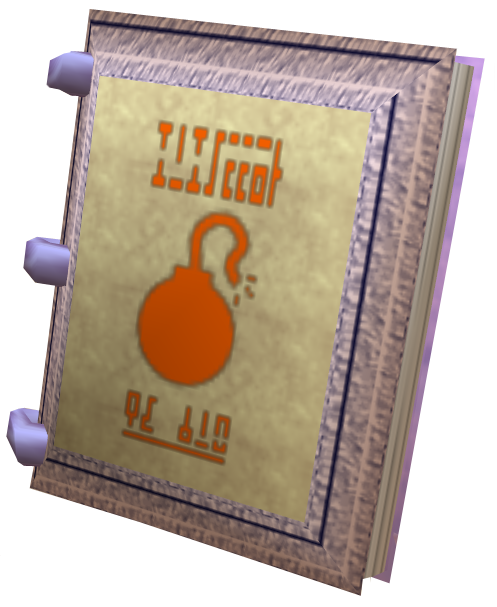 The Bombers’ NotebookA diary of twenty Termina residents, their timetables and the promises Link has made, updated automatically as he helps them.
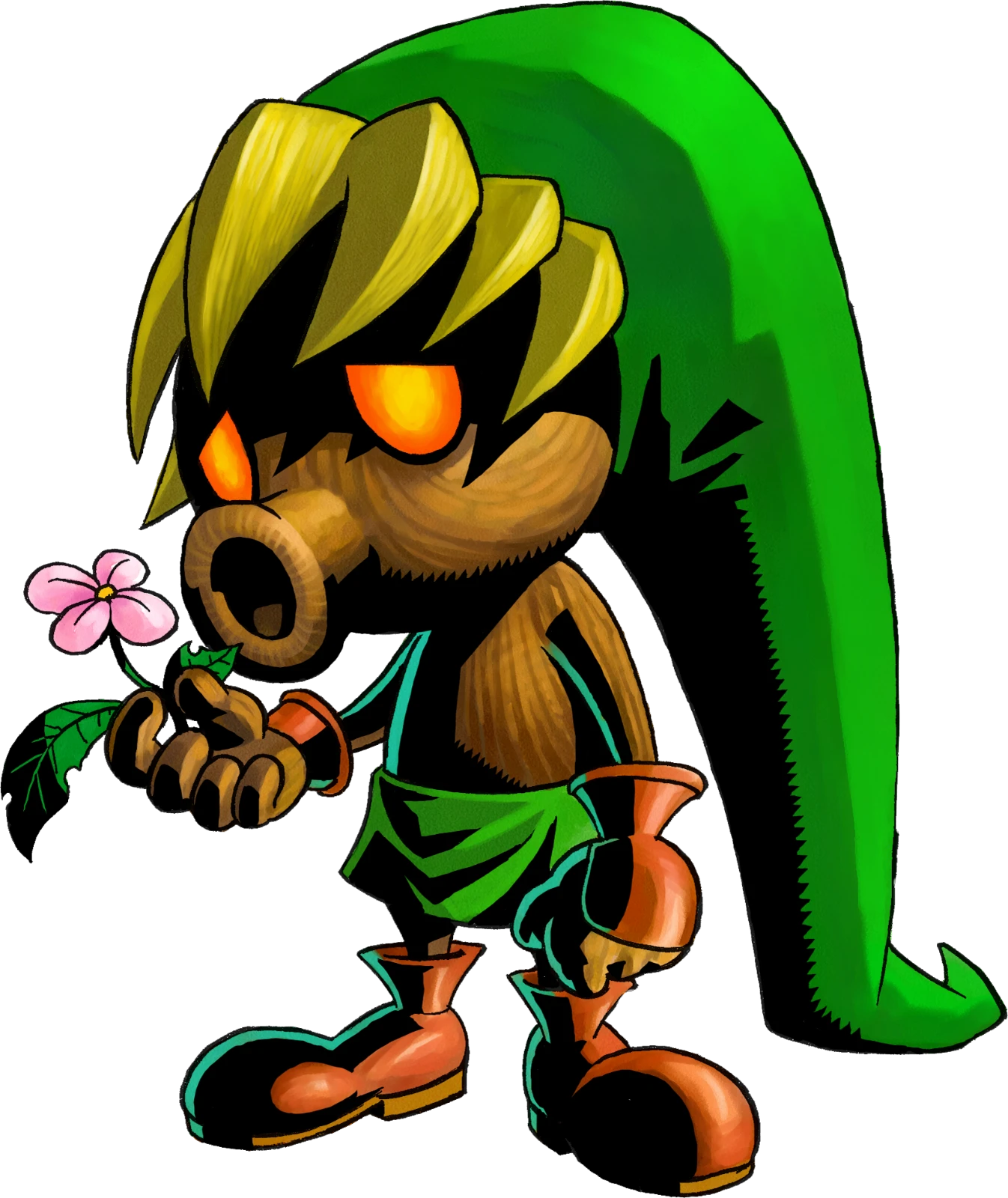 Playing as other racesFor the first time Link could become a Deku Scrub, a Goron and a Zora, each with its own moves, strengths and weaknesses.
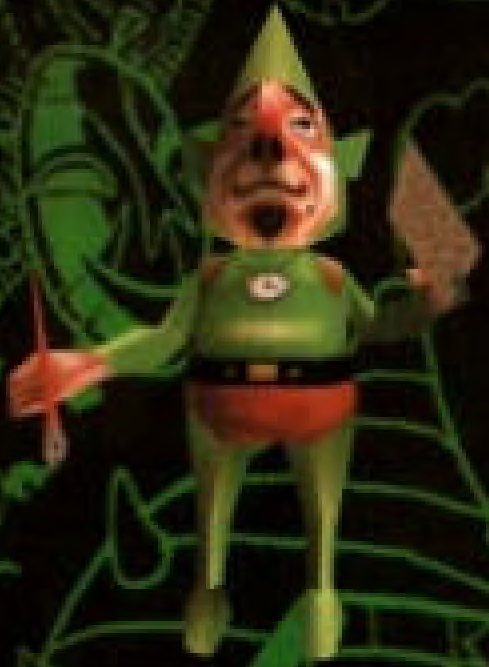 TingleThe 35-year-old would-be fairy makes his debut here, selling maps from his balloon. He later became a series regular and the star of his own games.
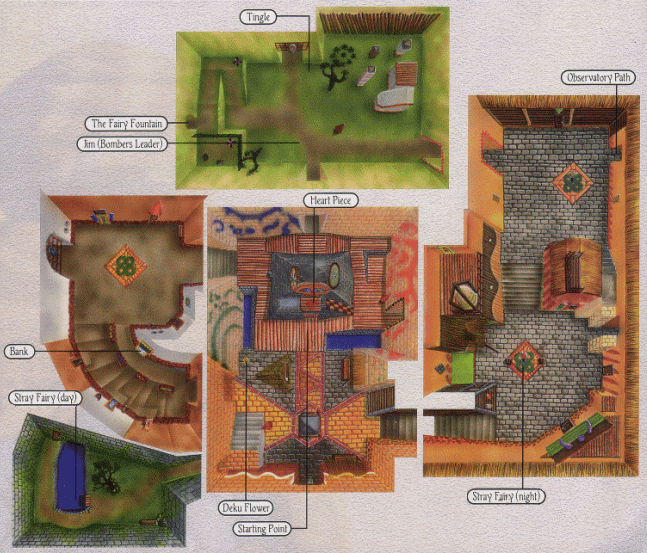 Termina and Clock TownA whole new world parallel to Hyrule, with a festival town at its centre that runs to a schedule.
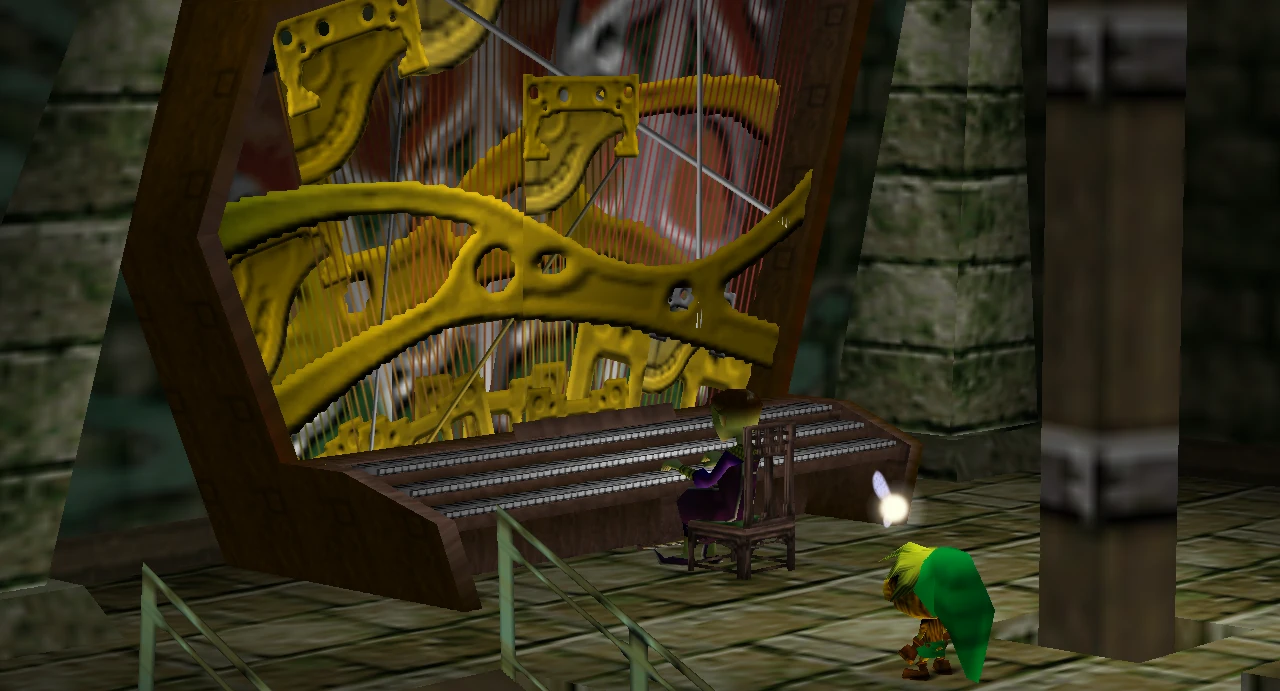 The Song of HealingFirst taught here by the Happy Mask Salesman; it returns in Twilight Princess and Spirit Tracks.
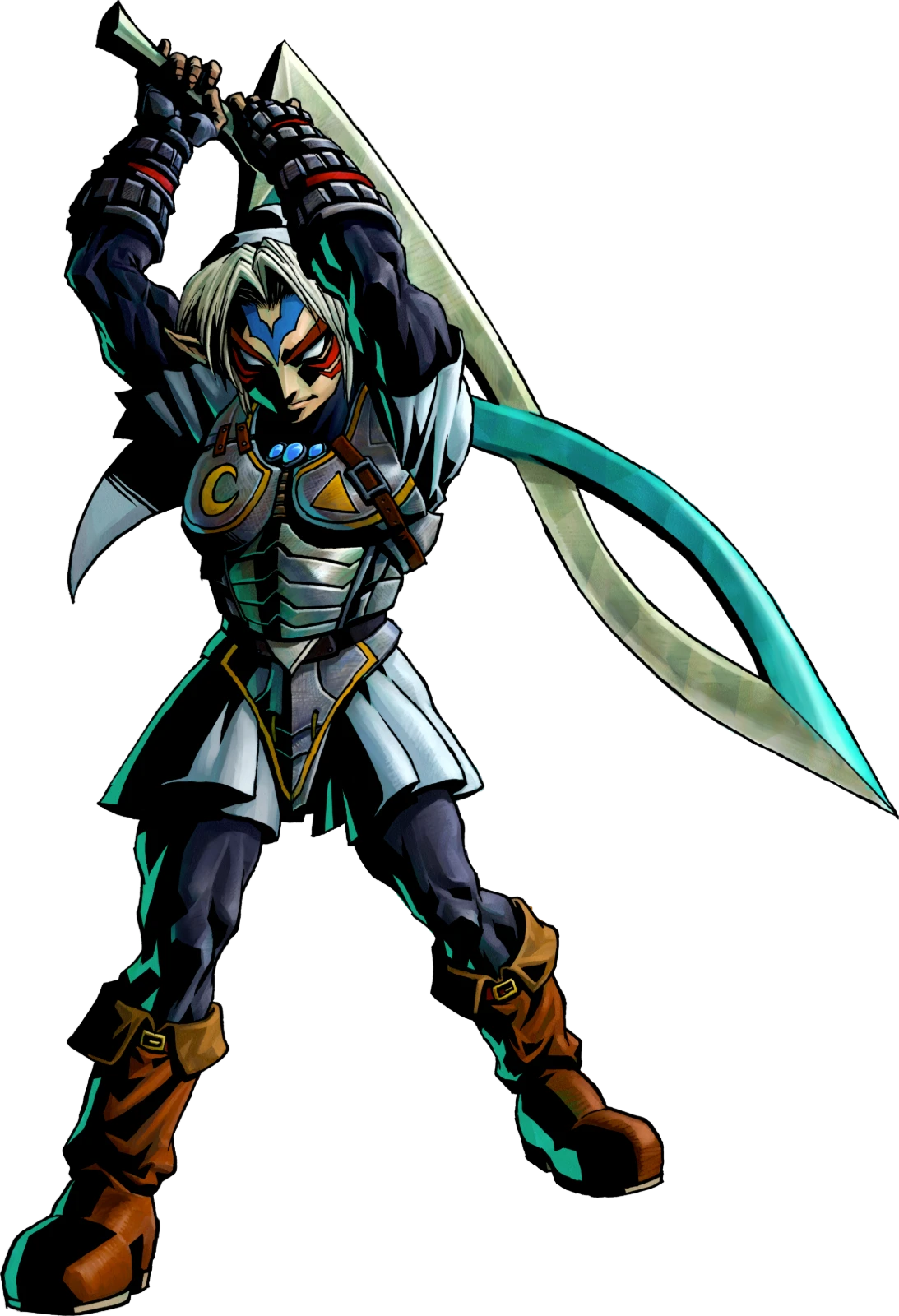 The Fierce DeityLink’s most powerful form debuts here. The Fierce Deity’s outfit later returned in Breath of the Wild and Tears of the Kingdom.
 Tatl, the Skull Kid as villain, and MajoraA new fairy partner and a new kind of villain: a lonely prankster manipulated by an ancient mask rather than a would-be conqueror.