A drowned kingdom, a talking boat and a boy in borrowed green: the cel-shaded Zelda that split the fans in 2001 and has been winning them back ever since.
Released13 December 2002 (JP) · 24 March 2003 (NA) · 2 May 2003 (EU)
DeveloperNintendo EAD
DirectorEiji Aonuma
MusicKenta Nagata, Hajime Wakai, Toru Minegishi, Koji Kondo
Players1 (a second player can join as Tingle via a Game Boy Advance)
SalesAbout 4.6 million
Title
The Legend of Zelda: The Wind Waker ゼルダの伝説 風のタクト (Zeruda no Densetsu: Kaze no Takuto, “the wind baton”)
Platform
Nintendo GameCube
Developer
Nintendo EAD
Publisher
Nintendo
Director
Eiji Aonuma
Producers
Shigeru Miyamoto, Takashi Tezuka
Script
Mitsuhiro Takano (script and event planning), Hajime Takahashi
Imagine waiting a year for the most realistic Zelda ever, and being handed a cartoon. That is roughly what happened to Zelda fans in August 2001, when Nintendo swapped the moody Link-versus-Ganondorf duel it had shown off the year before for a big-eyed, cel-shaded boy pulling faces at a Moblin. The internet was not amused. Then the game came out, and it turned out to be one of the warmest, funniest and most adventurous Zeldas ever made.
Set centuries after Ocarina of Time, The Wind Waker drowns Hyrule under a vast ocean dotted with islands. Young Link sets out from tiny Outset Island to rescue his kidnapped sister, sails the Great Sea in a talking red boat, and learns to conduct the wind itself with a magic baton. Along the way he meets a hot-headed pirate captain called Tetra, a tribe of bird people, a forest full of leaf-faced Koroks and an old enemy who never really went away.
Eiji Aonuma directed it for Nintendo EAD, with Shigeru Miyamoto and Takashi Tezuka producing. It earned a perfect score from Japan’s Famitsu, a Metacritic average of 96, and roughly 4.6 million sales. Its toon look became a series fixture through two DS sequels, a run of Smash Bros. appearances and a 2013 HD remaster on Wii U, and in June 2025 the original GameCube version came back as a launch title for Nintendo Switch 2’s GameCube library.
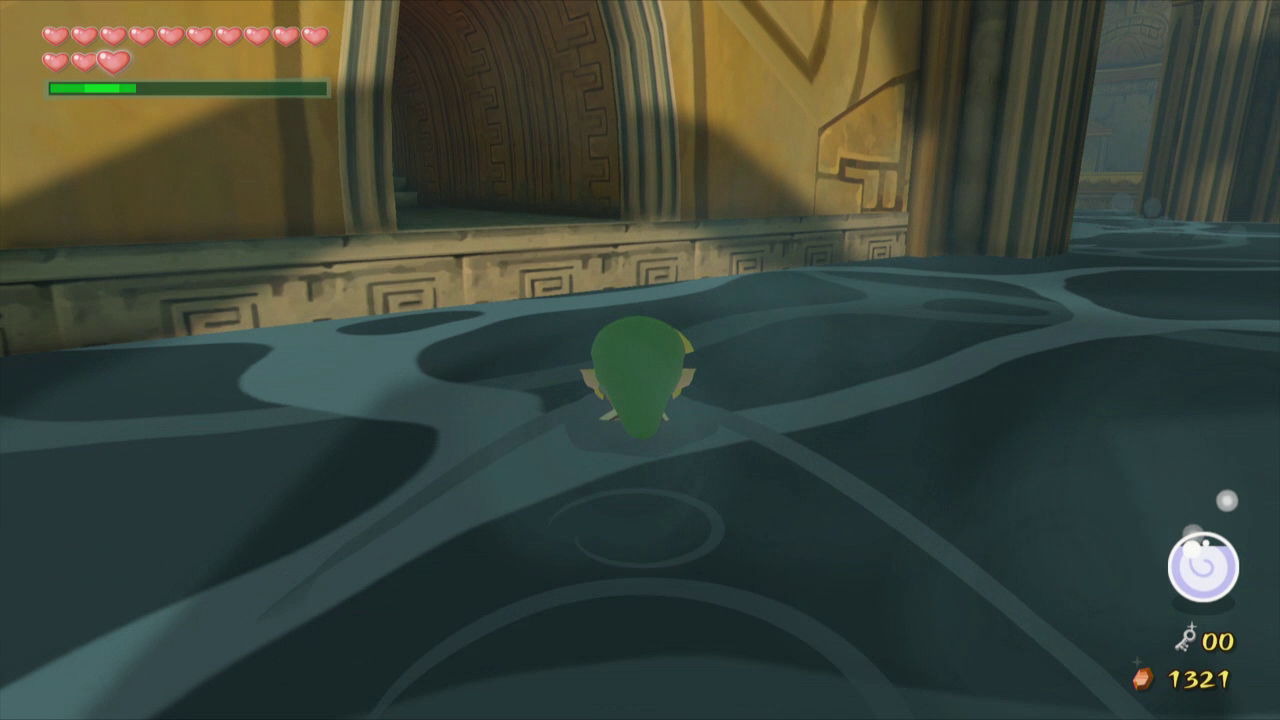
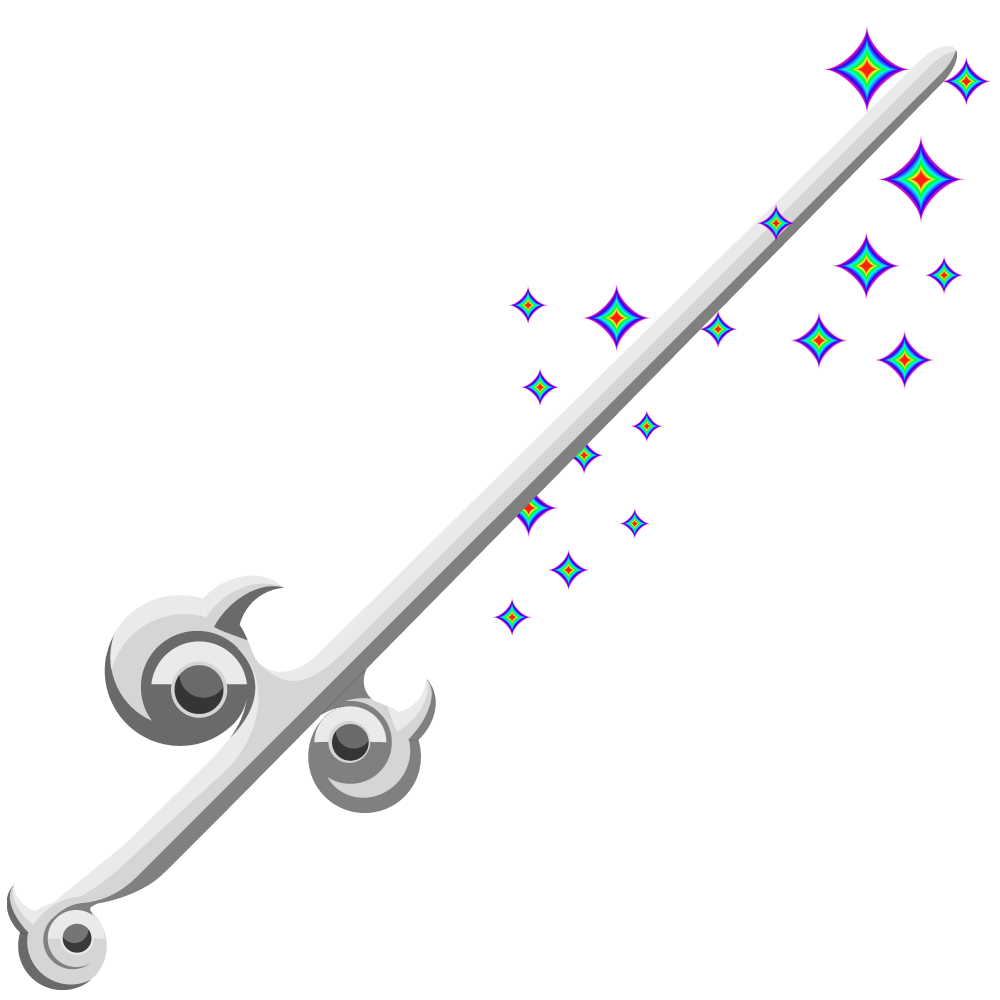
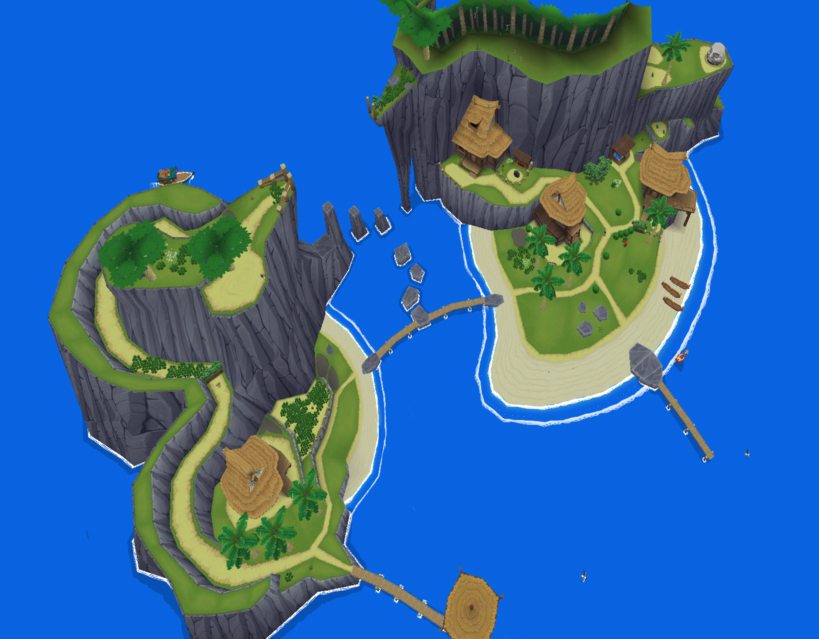
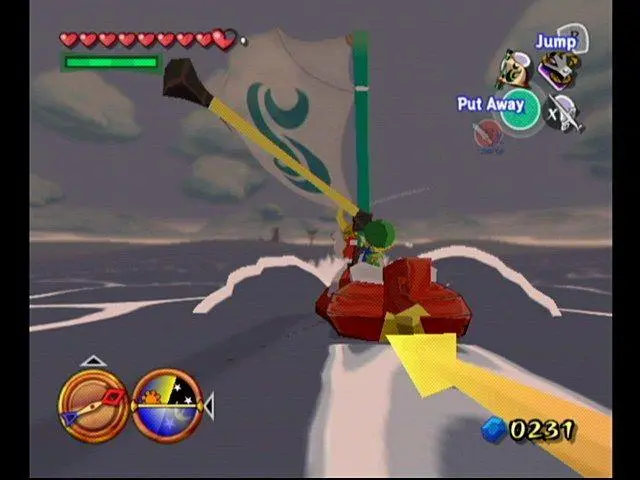
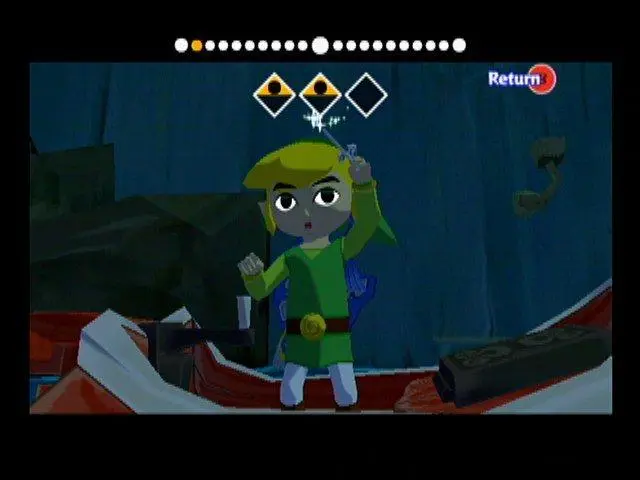
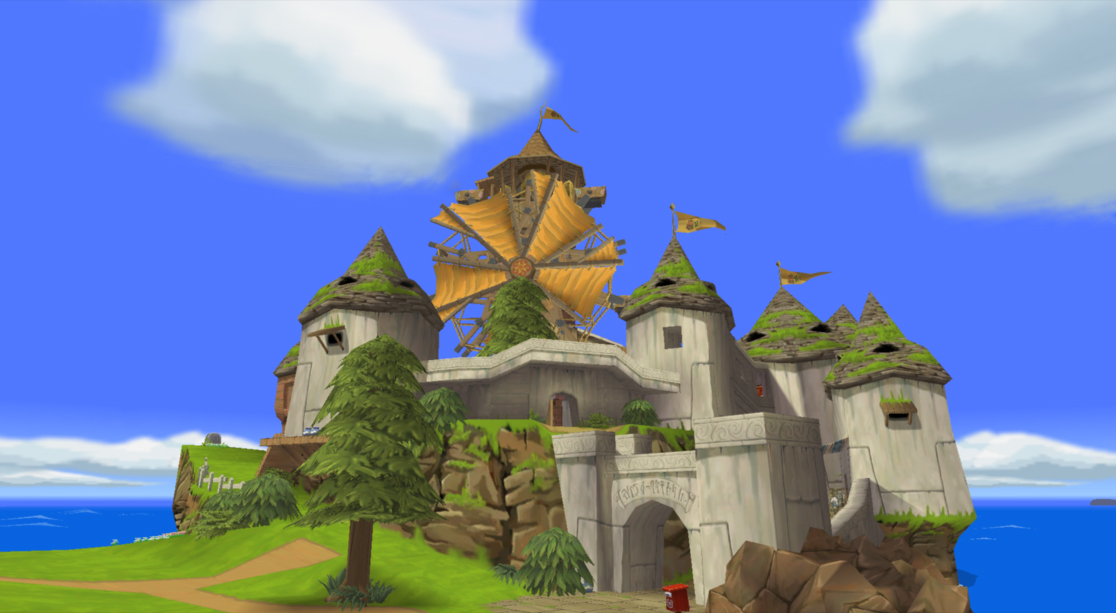
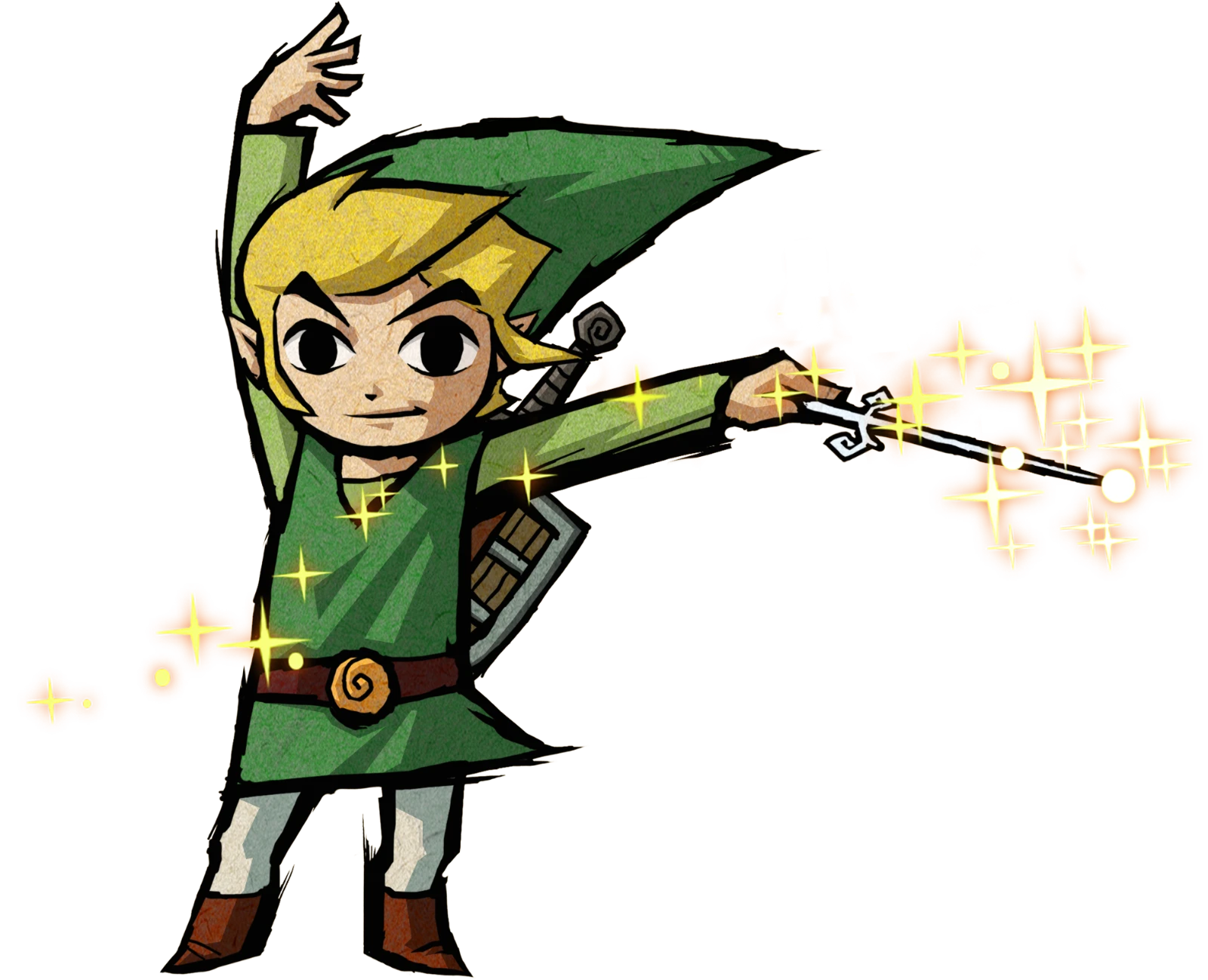
Outset Island, where Link’s story begins.Sailing the Great Sea in the King of Red Lions.Conducting a song with the Wind Waker.
Using the Wind Waker, Link learns to compose songs that control wind patterns and even summon cyclones.
That is how Nintendo of America pitched its magic baton in February 2003, a month before the game reached the shops. The same release promised a sea-going epic and drew attention to Link’s expressive eyes, which show his feelings and also flick towards hidden dangers and clues.
— Official description: Nintendo of America press release, “Zelda Pre-Orders Look Strong”, 13 February 2003. One line quoted; the rest summarised.
Quick Answers
The things people most often want to know about The Wind Waker, answered in a line or two. Follow the links for the full story.
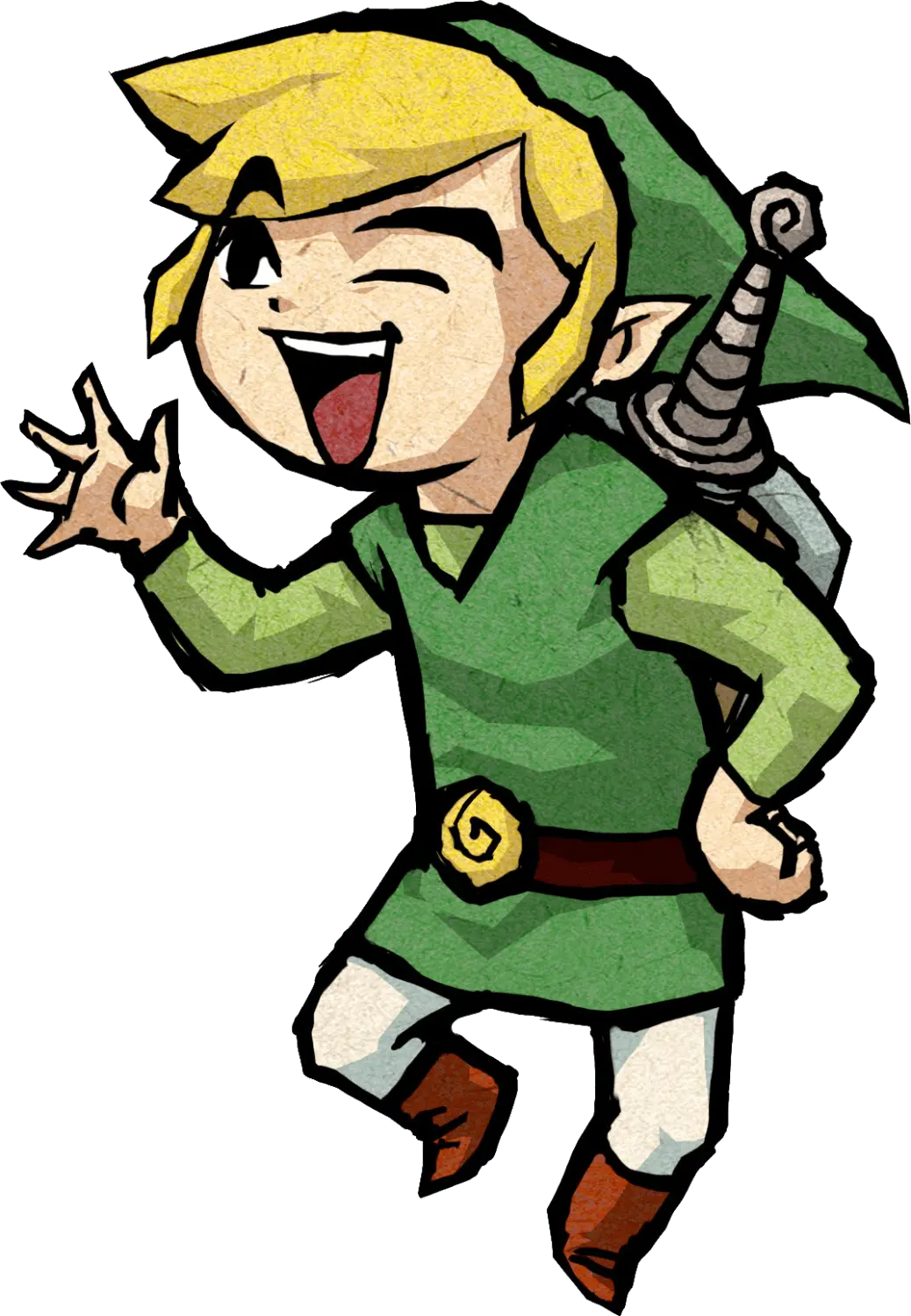
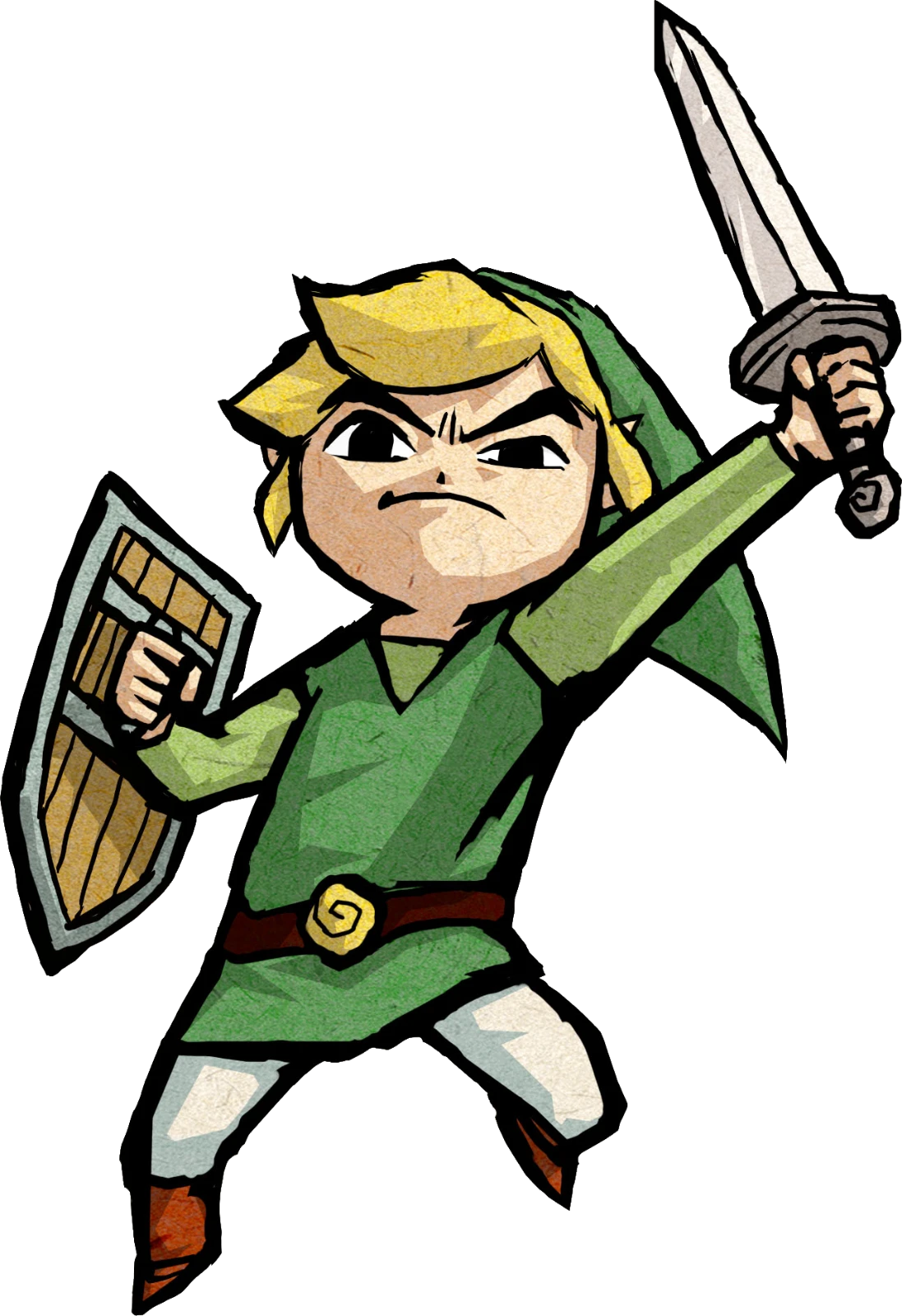
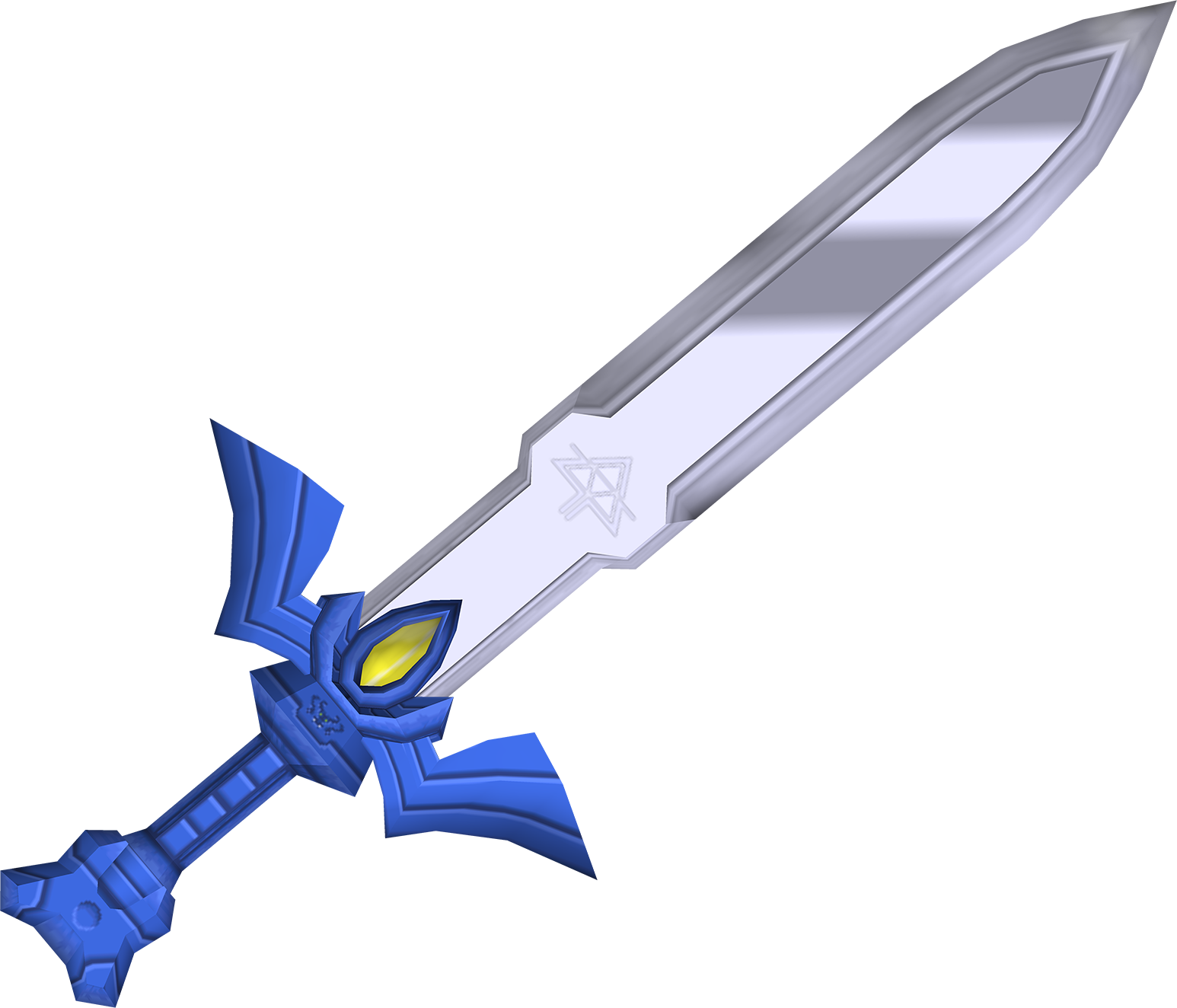
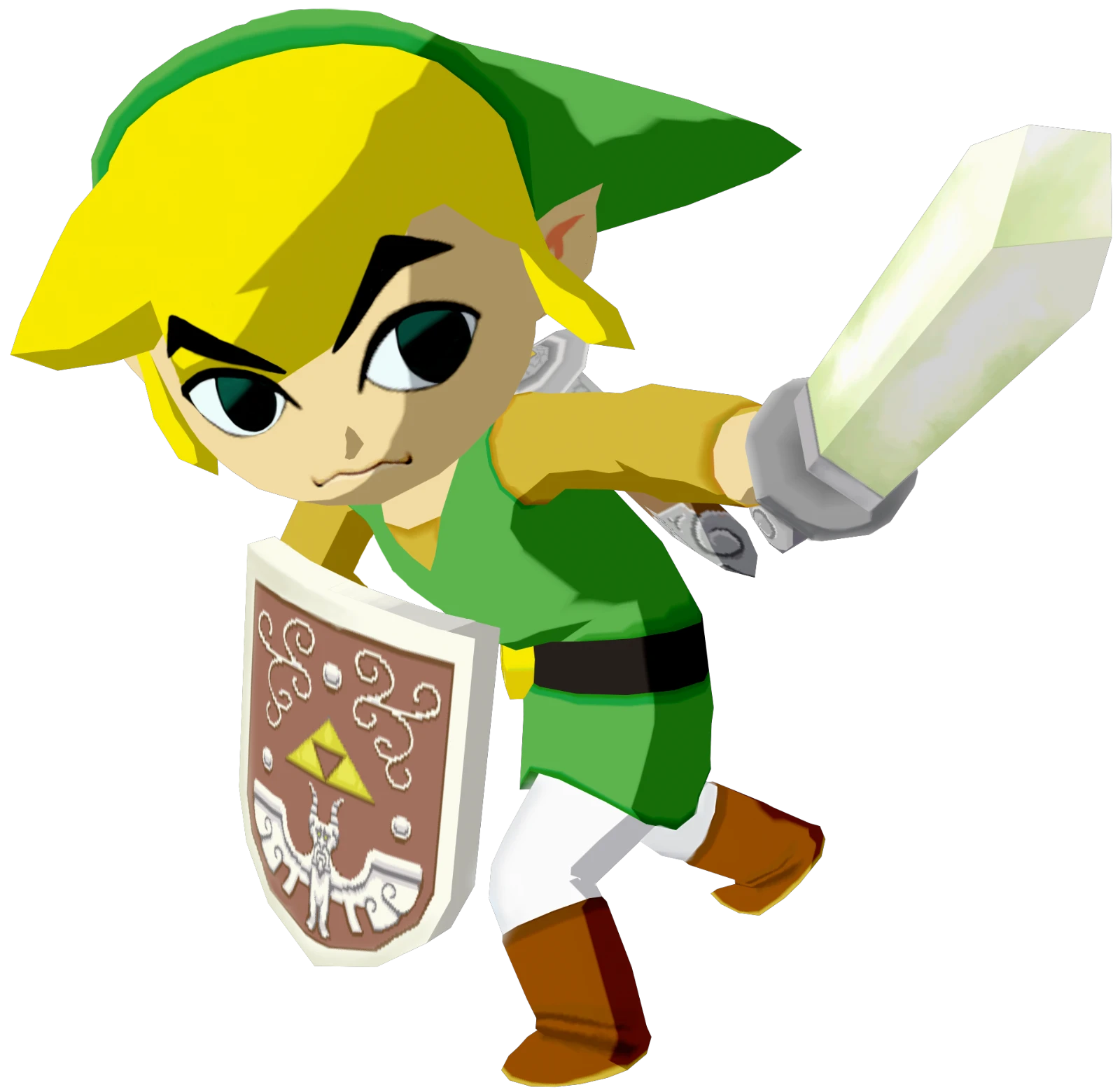
Official art of Link from The Wind Waker.
When did The Wind Waker come out?
On 13 December 2002 in Japan, 24 March 2003 in North America, 2 May 2003 in Europe and 7 May 2003 in Australia, all on GameCube. More →
Who made The Wind Waker?
Nintendo EAD. Eiji Aonuma directed it, Shigeru Miyamoto and Takashi Tezuka produced it, and Yoshiki Haruhana’s sketch of a new, cartoon Link set its look. More →
Why does The Wind Waker look like a cartoon?
The team felt a more realistic follow-up to Ocarina of Time looked ordinary. When Haruhana drew a stylised young Link, the designers found it easier to make lively animation, readable puzzles and new kinds of combat, so cel-shading won out. More →
What was the Space World 2000 Zelda demo?
A short tech demo of a realistic adult Link duelling Ganondorf, shown when Nintendo unveiled the GameCube in August 2000. It was never a game, and Aonuma later said it did not feel like Zelda to him. More →
Where does The Wind Waker fit in the Zelda timeline?
Nintendo’s Hyrule Historia places it in the “adult” branch after Ocarina of Time: the Hero of Time vanished, Ganon returned, and the gods flooded Hyrule. Phantom Hourglass and Spirit Tracks follow it. More →
How many dungeons are in The Wind Waker?
The story takes you through the Forsaken Fortress (twice), Dragon Roost Cavern, the Forbidden Woods, the Tower of the Gods, the sunken Hyrule Castle, the Earth and Wind Temples and finally Ganon’s Tower, with the Triforce hunt before the end. More →
Were dungeons cut from The Wind Waker?
Yes. Aonuma has said the game had to be made more compact to hit its deadline, and that ideas from two unfinished dungeons were reused in later games. The Triforce hunt partly filled the gap. More →
What is the difference between The Wind Waker and The Wind Waker HD?
The 2013 Wii U remaster adds HD visuals and lighting, the Swift Sail, a shorter Triforce hunt, Hero Mode, a bigger Picto Box and Miiverse messages in a Tingle Bottle, and uses the Wii U GamePad for maps and items. More →
What was the Master Quest bonus disc?
A pre-order bonus that put Ocarina of Time and its harder remix, Master Quest (originally planned for the 64DD), on one GameCube disc. Europe packed it in the box with the game. More →
Can I play The Wind Waker on Switch?
On Nintendo Switch 2, yes: the GameCube original is part of Nintendo GameCube – Nintendo Classics for Nintendo Switch Online + Expansion Pack members, since 5 June 2025. More →
Plot / Story
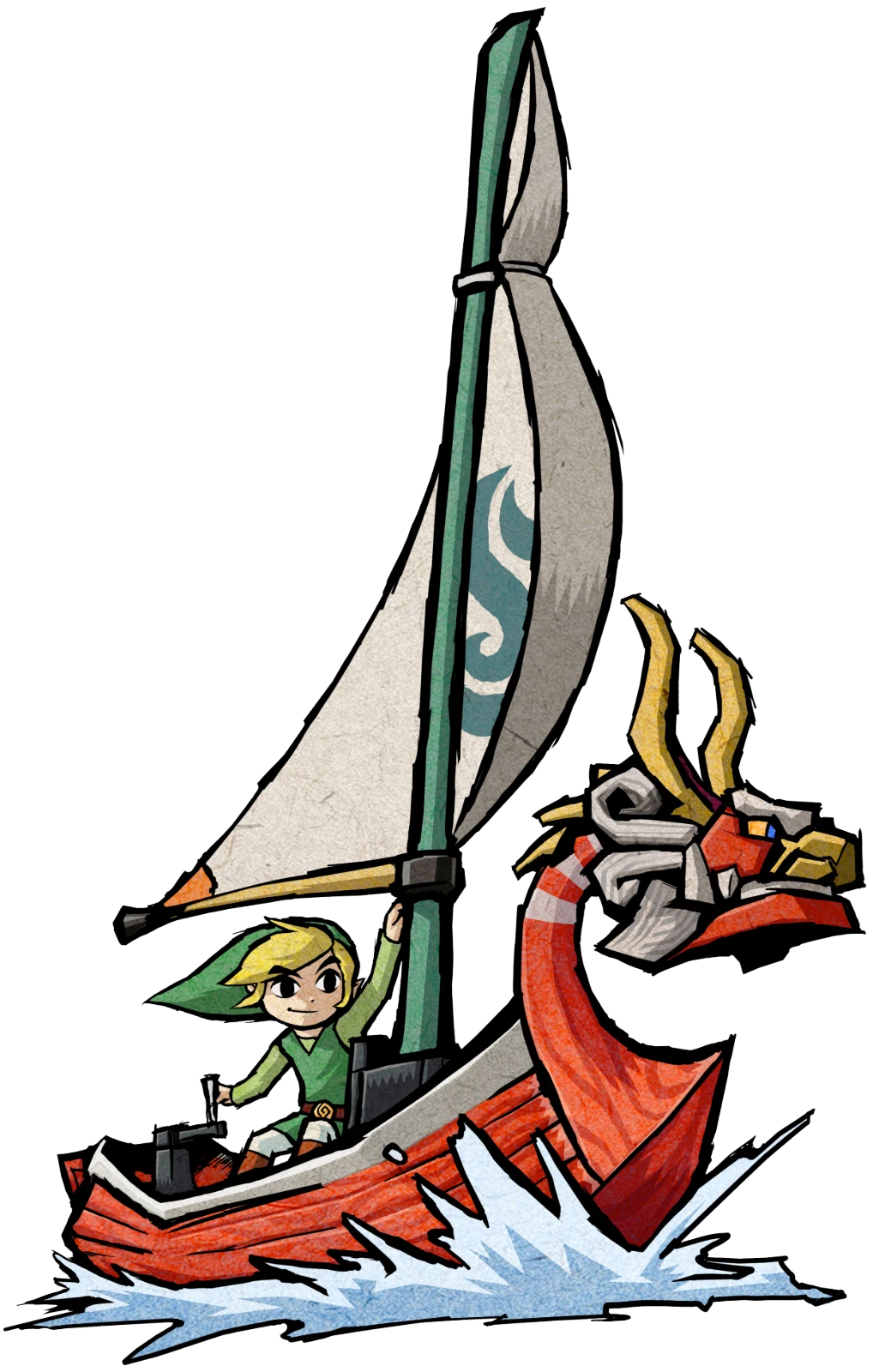
Link and the King of Red Lions, in Nintendo’s official artwork.
Every Zelda game retells a legend. The Wind Waker is the one where the legend went wrong. Long ago, the game’s opening scrolls explain, a wicked man seized the golden power hidden in a prosperous kingdom, and a boy clothed in green travelled through time to seal him away. The kingdom celebrated. Then the darkness came back, the people prayed for their hero, and this time nobody came.
What happened next is left as a mystery for most of the adventure. All the islanders of the Great Sea know is that the old kingdom is gone, and that on Outset Island boys are dressed in green when they reach the age of the legendary hero, in the hope that some of his courage will rub off. Our Link is the latest boy to get the outfit, tights and all.
A birthday on Outset Island
It is Link’s birthday. His grandmother hands over the traditional green tunic, and his little sister Aryll lends him her most treasured possession, a telescope, for the day. Through it, Link spots something extraordinary: an enormous bird flapping over the sea with a girl dangling from its talons, chased by a pirate ship firing cannonballs. One hit, and the girl tumbles into the woods on the island’s peak.
Link borrows a sword from his neighbour Orca and charges up the mountain to help. The girl turns out to be Tetra, the sharp-tongued captain of the pirate crew, and she is distinctly unimpressed by her rescuer. Moments later the bird swoops again, misses Tetra, and carries off Aryll as she crosses a bridge.
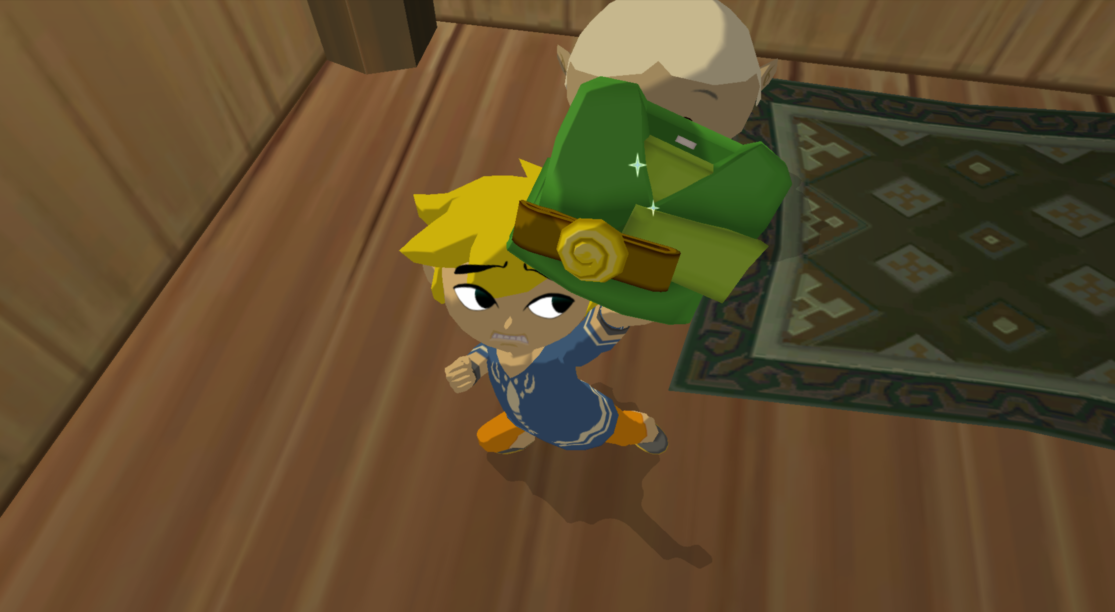
Grandma gives Link the hero’s green clothes.Aryll’s telescope spots the giant bird.The Helmaroc King snatches Aryll.
Into the Forsaken Fortress
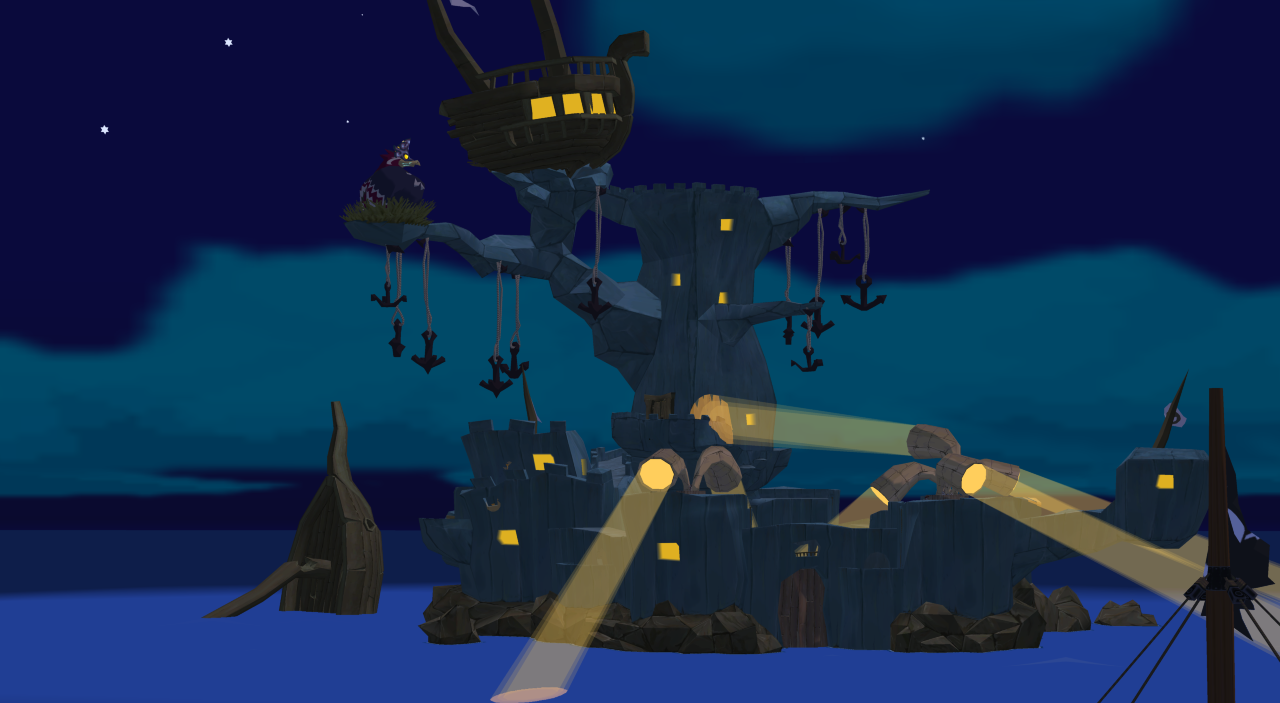
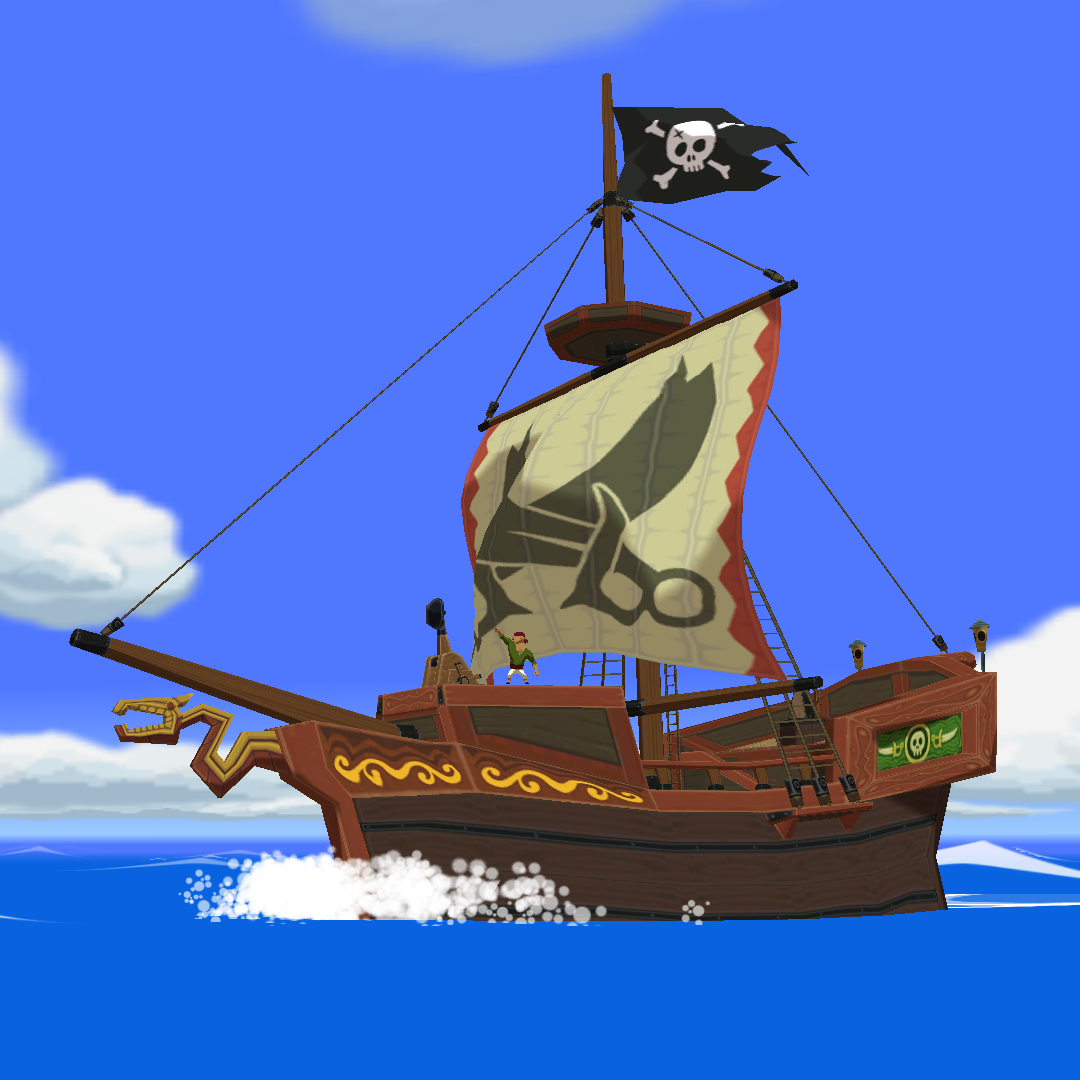
The bird is the Helmaroc King, and it has been snatching long-eared girls from all over the Great Sea and dropping them at the Forsaken Fortress, a monster base that looks as if it was cobbled together from the wrecks of sunken ships. Tetra grudgingly agrees to take Link there, once he has found himself a shield and survived her crew’s rope-swinging test aboard ship.
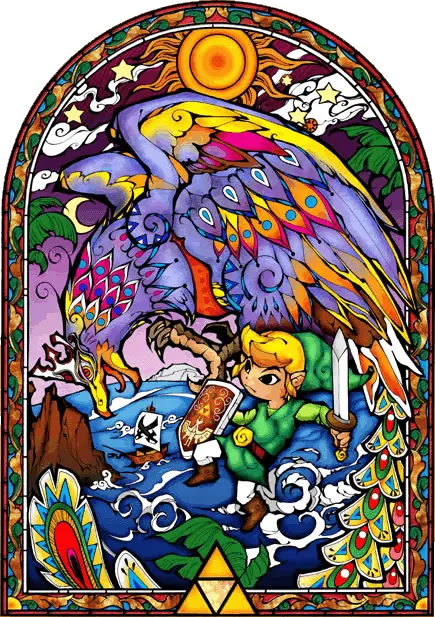
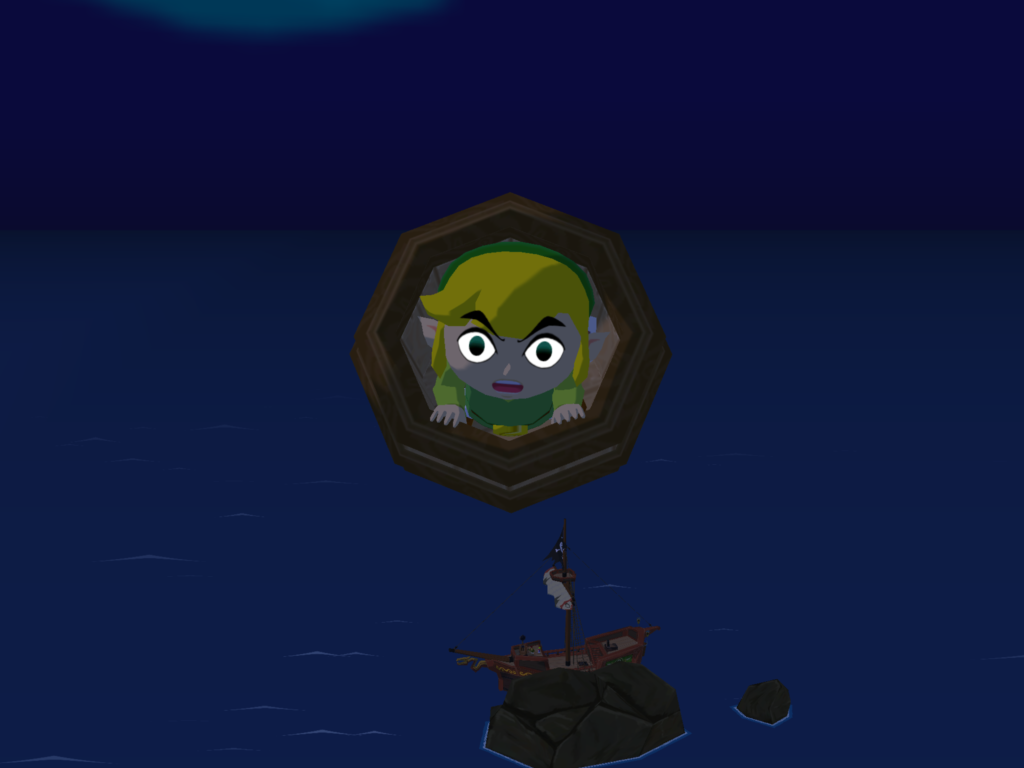
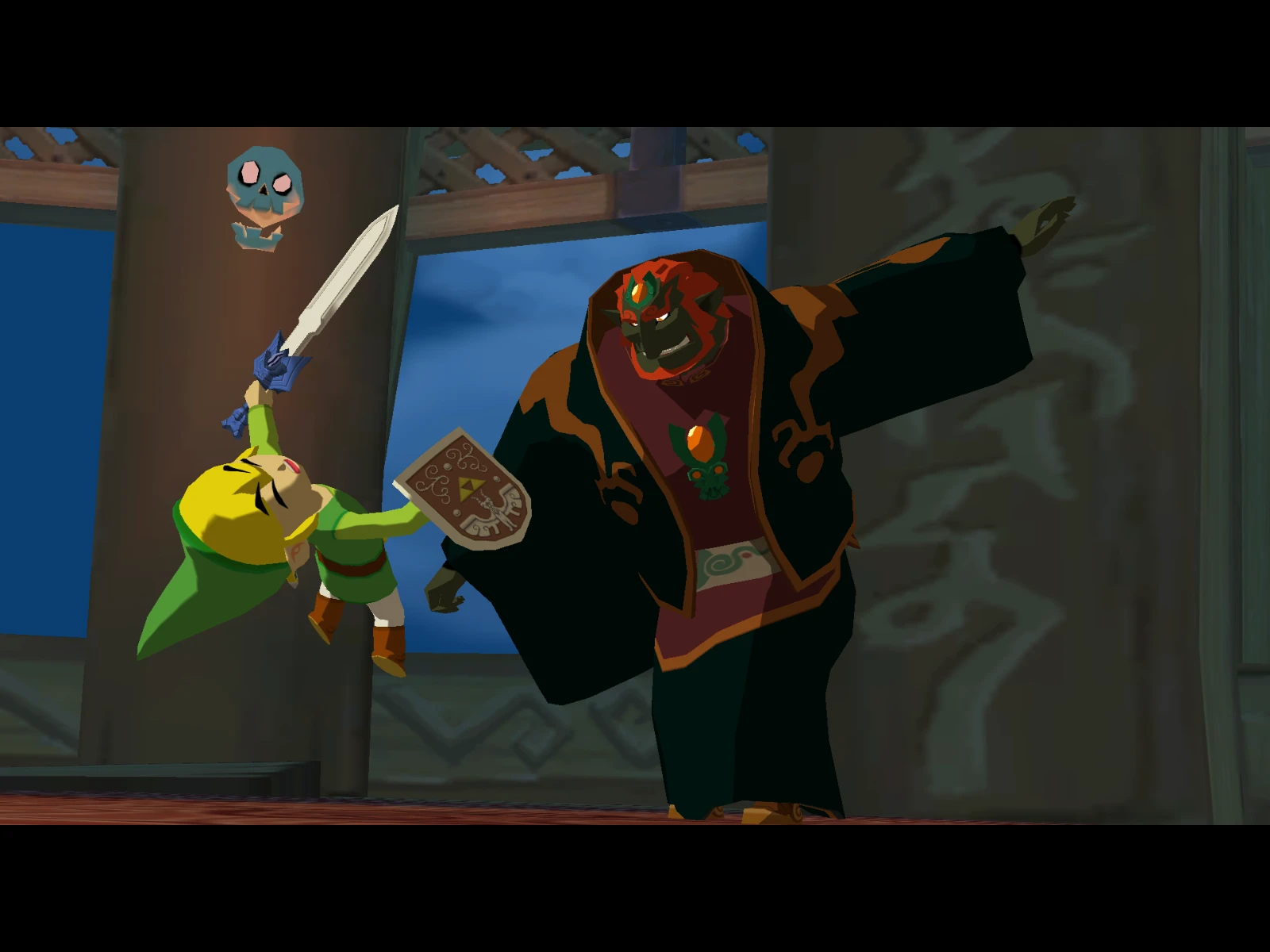
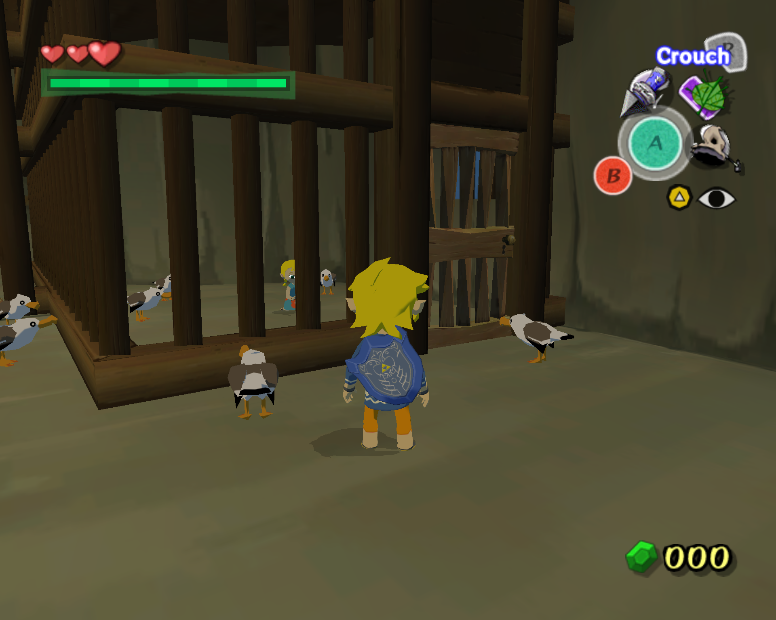
Searchlights and patrols keep the pirate ship at a distance, so the crew simply launch Link over the walls inside a barrel. He lands without his sword, creeps around knocking out the searchlights, and finally finds Aryll locked up with other kidnapped girls. Before he can free her, the Helmaroc King seizes him and carries him to the top of the fortress, where a tall, shadowy man orders the bird to throw the boy into the sea.
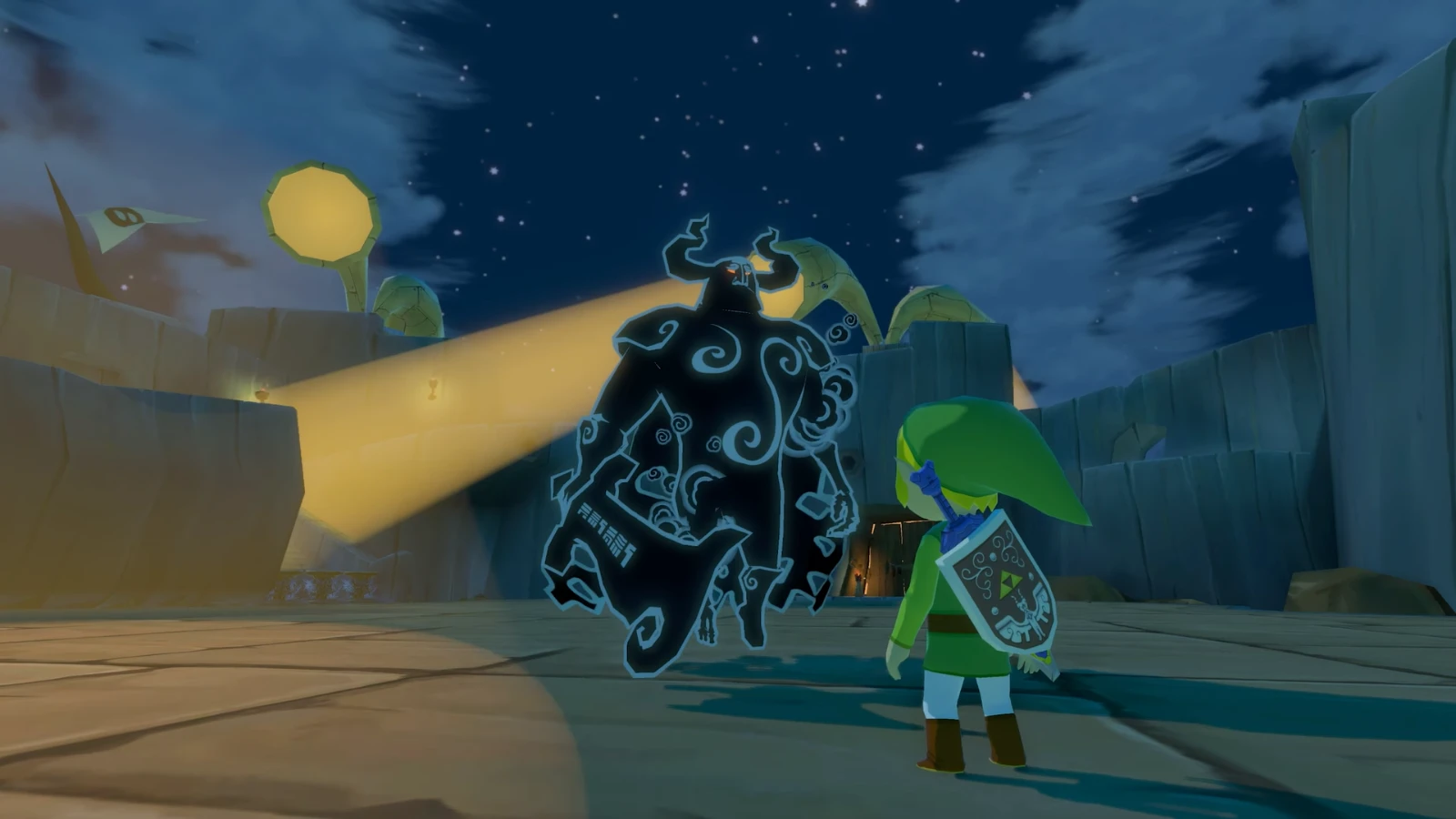
The Forsaken Fortress at night.Launched into the fortress in a barrel.
A boat that talks
Link wakes up off Windfall Island beside a small sailing boat with a carved red lion’s head, which promptly starts talking. The King of Red Lions has been watching for a boy like him. The man at the fortress, he says, is Ganondorf, the same evil from the old legend, and Link can only hope to save his sister by finding the power of the hero who once defeated him.
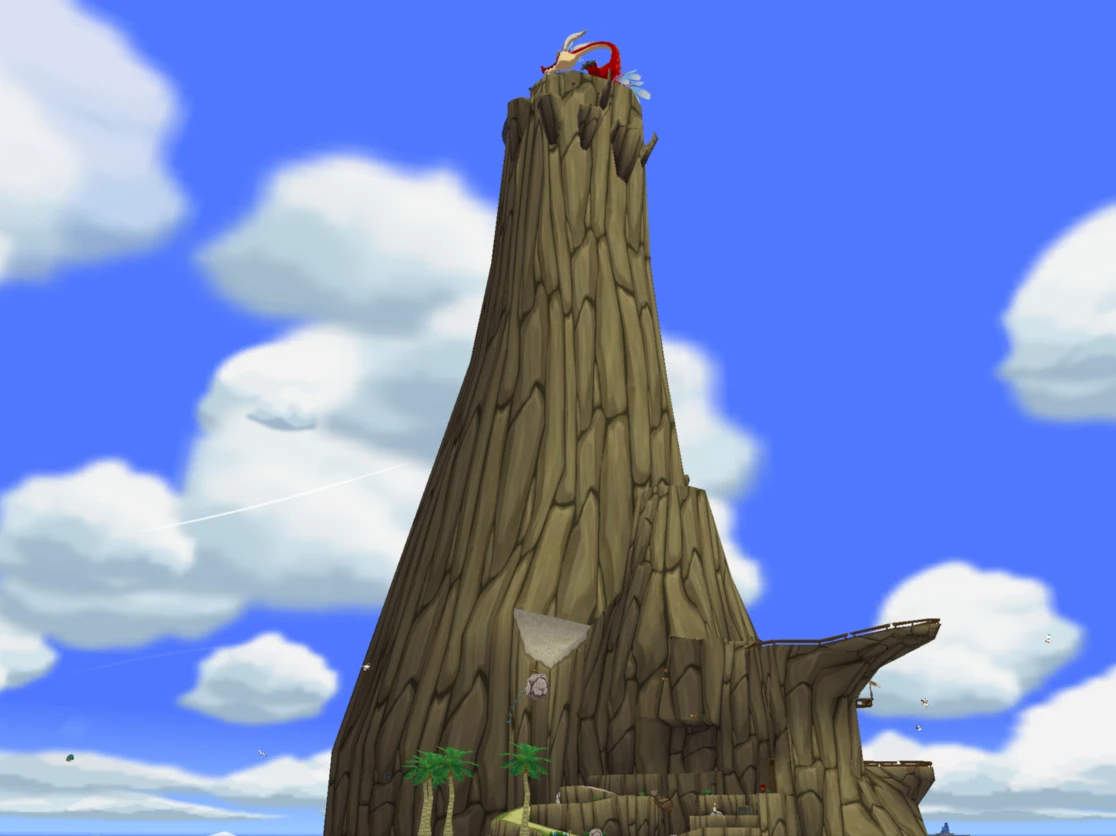
First the boat needs a sail, which a travelling merchant on Windfall is happy to sell. The first big task is to gather the three Pearls of the Goddesses, held by the spirits who guard the Great Sea, and on reaching Dragon Roost Island the King of Red Lions hands Link the Wind Waker, a conductor’s baton that lets him change the direction of the wind.
Windfall Island, the Great Sea’s busiest town.The King of Red Lions hands over the Wind Waker.
Three pearls, three spirits
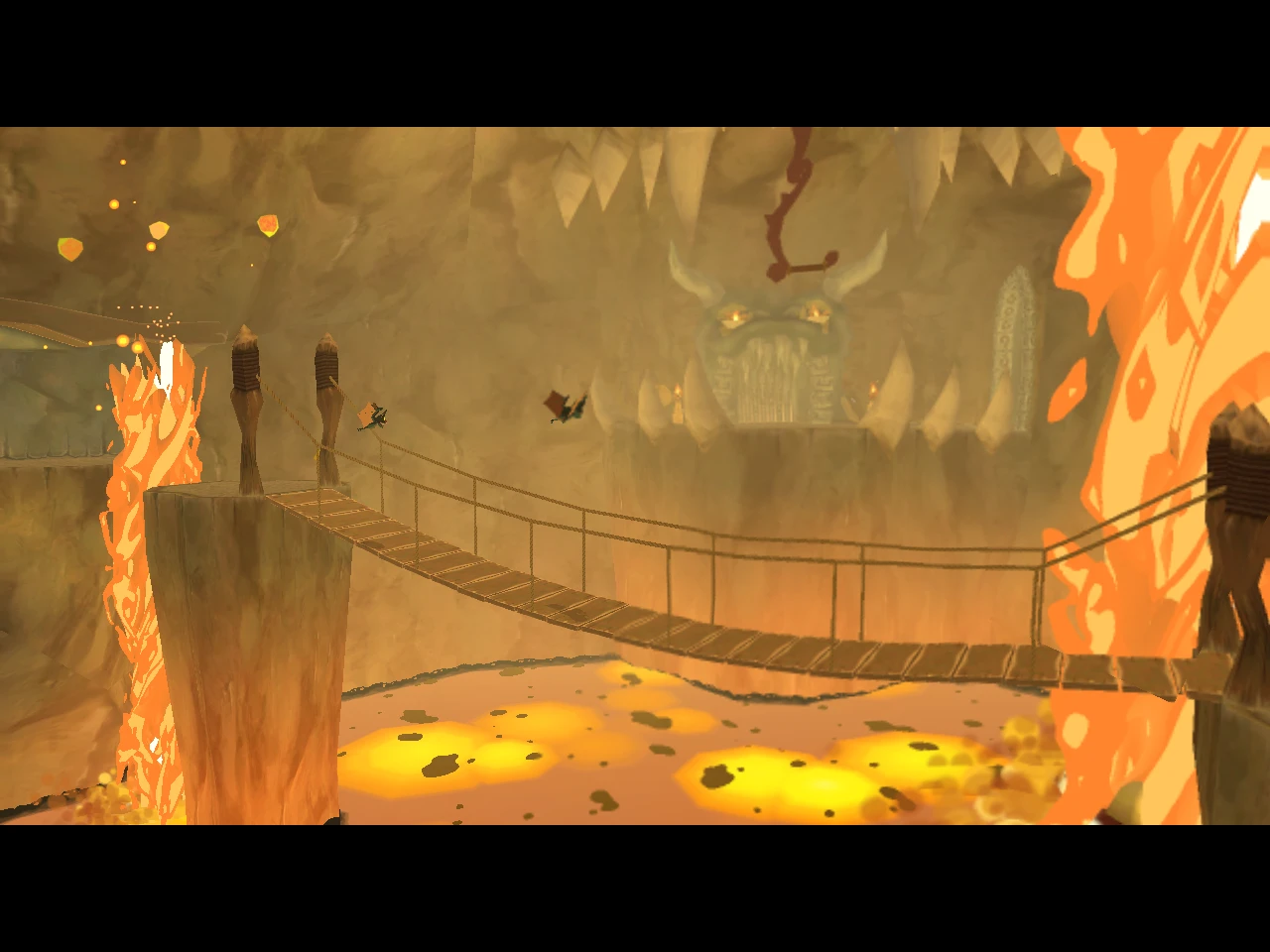
Din’s Pearl is on Dragon Roost Island, home of the bird-like Rito. Their guardian, the sky spirit Valoo, is raging because a monster has crept into the mountain beneath his perch, and without his blessing the young Rito cannot receive their wings. The pearl is clutched by the sulking Prince Komali, a keepsake from his late grandmother. Link climbs through the volcanic Dragon Roost Cavern, rescues the Rito attendant Medli along the way and defeats the giant one-eyed Gohma. A humbled Komali hands over the pearl.
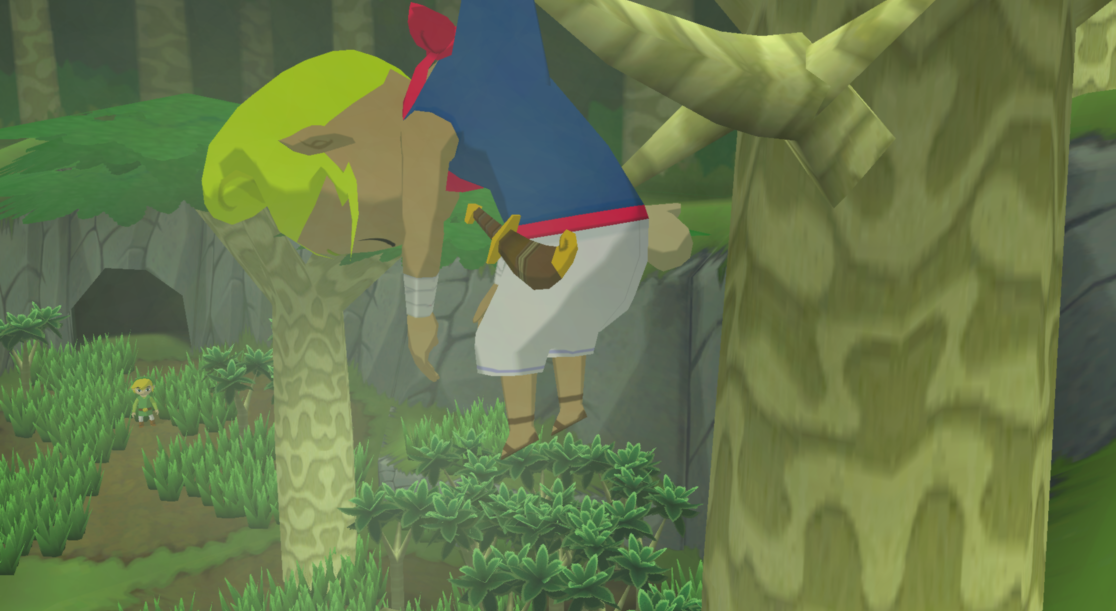
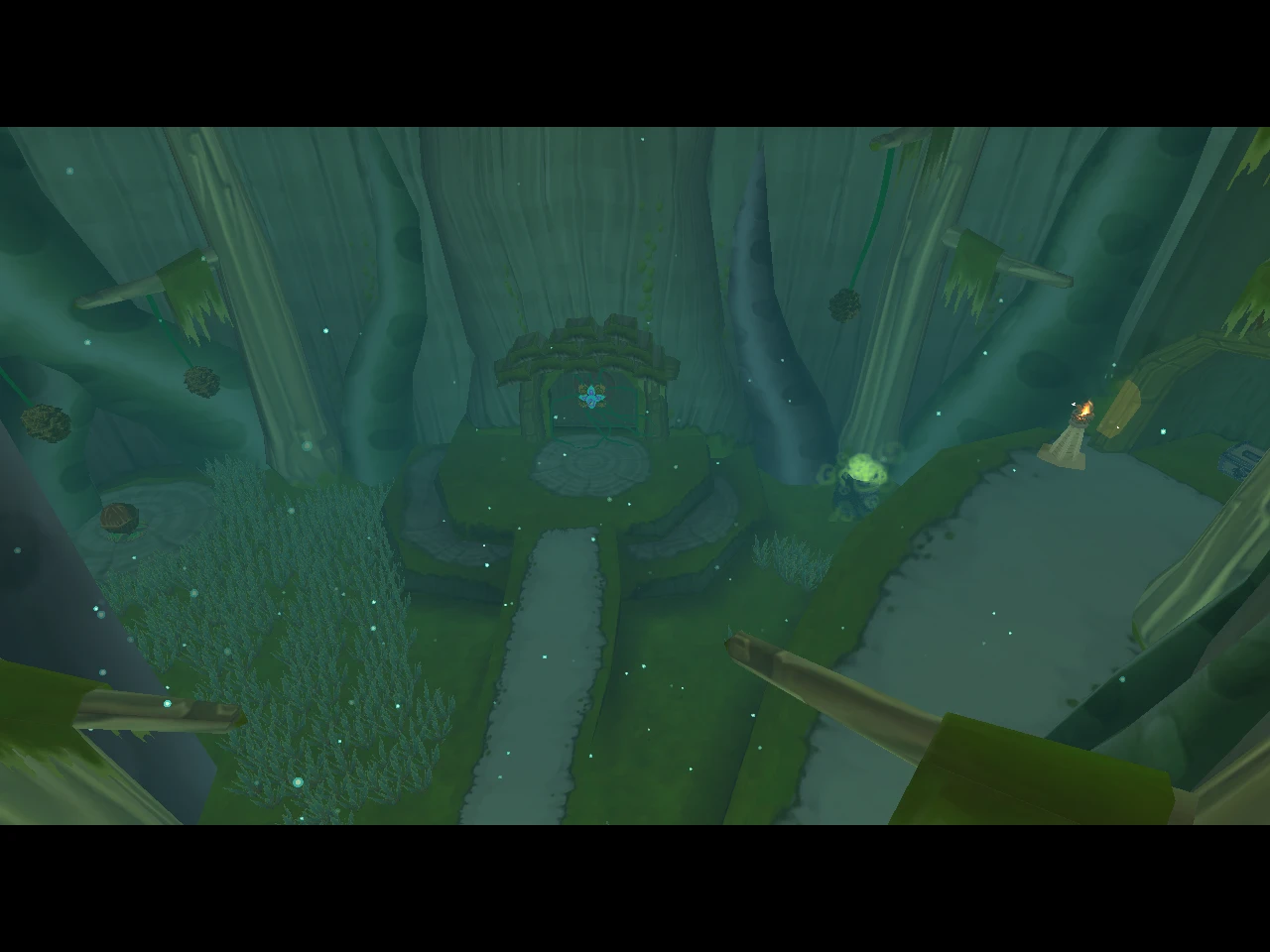
Farore’s Pearl belongs to the Great Deku Tree in the Forest Haven, where the tiny Koroks are preparing for their yearly ceremony. Their musician, Makar, has been blown into the Forbidden Woods. Link floats over on a Deku Leaf, cuts down the vine-swaddled Kalle Demos and returns Makar in time to play.
Nayru’s Pearl was kept by the water spirit Jabun on Greatfish Isle, but by the time Link arrives Ganondorf has flattened the island. The Rito postman Quill reveals that Jabun escaped to a cave behind Outset Island, sealed with a stone wall only bombs will open. Tetra’s pirates happen to have just robbed Windfall’s bomb shop, so Link sneaks aboard their ship on Windfall, passes another of Niko’s rope challenges and walks away with a bag of explosives. Back home on Outset he cheers up his worried grandmother, blasts open Jabun’s cave, and receives the final pearl.
Dragon Roost Island, home of the Rito.The Great Deku Tree in the Forest Haven.Jabun, the water spirit, in his cave behind Outset.
The Tower of the Gods and a frozen kingdom
Placed on three islands, the pearls raise the Tower of the Gods from the sea. Its trials test Link’s courage and end in a duel with the giant stone head Gohdan. Ringing the bell at the very top opens a way down to the bottom of the ocean.
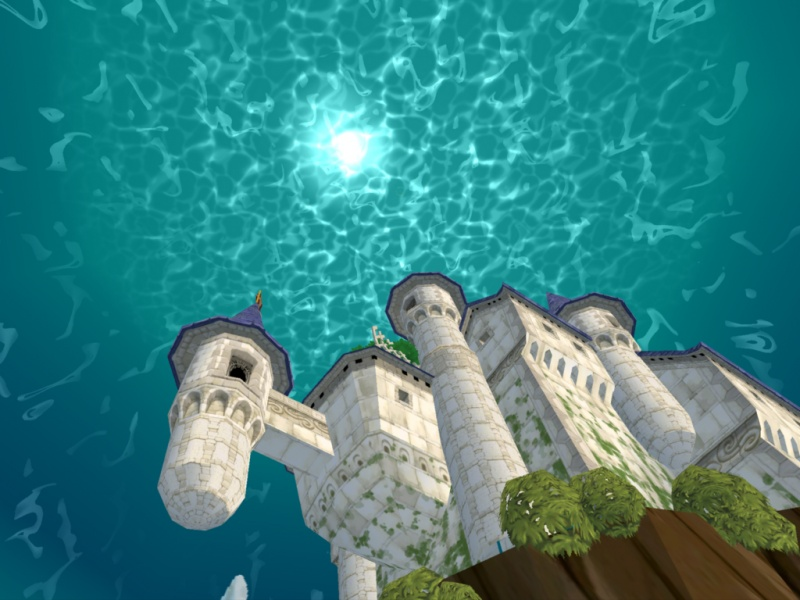
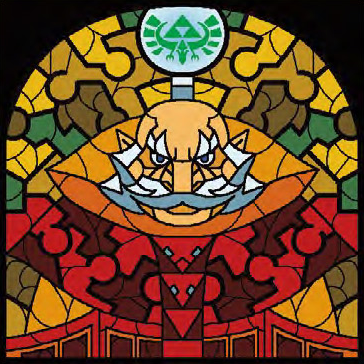
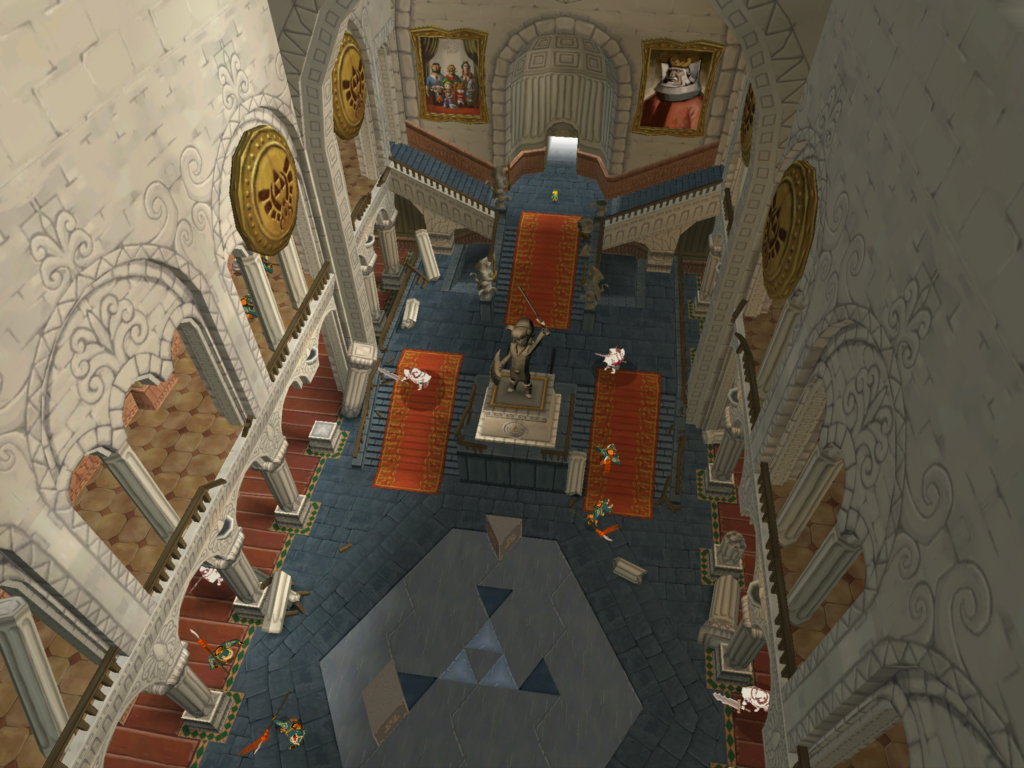
There, kept dry by a magical barrier, lies Hyrule. The castle is drained of colour, its knights and monsters frozen in mid-step, because time itself has stopped. In the basement, under stained-glass windows of the old sages, the Master Sword waits in its pedestal. Link pulls it out, colour floods back into the kingdom, and every frozen monster comes to life at once.
The Tower of the Gods rises.Hyrule Castle, frozen in time beneath the sea.Link draws the Master Sword.
Princess Zelda, pirate captain
Sword in hand, Link storms back to the Forsaken Fortress. He frees Aryll and the other girls, who are packed off home on Tetra’s ship, and smashes the Helmaroc King’s steel mask with the Skull Hammer, a prize for beating Phantom Ganon on the way up. But at the top of the tower Ganondorf simply brushes the Master Sword aside. It has lost its power.
Tetra bursts in to help and is caught, and as she struggles Ganondorf feels his own piece of the Triforce stir. The necklace she wears holds part of the Triforce of Wisdom, and she never knew. Komali, now flying on his new wings, and the postman Quill carry the pair to safety while Valoo sets Ganondorf’s lair ablaze, and the King of Red Lions takes them down to Hyrule. There he reveals his true form: Daphnes Nohansen Hyrule, the last King of Hyrule. Tetra, he explains, is the heir of the royal family. In a flash of light the pirate becomes Princess Zelda, and she is left safe in the castle while Link goes back to work.
Ganondorf senses the Triforce of Wisdom in Tetra.Tetra becomes Princess Zelda.
New sages for an old sword
The king finally tells the story the opening left out. When Ganon returned and no hero appeared, the gods drowned Hyrule under a torrent of rain to seal him away, after telling a chosen few to take refuge on the mountaintops, which are now the islands of the Great Sea. The Master Sword’s power to repel evil came from two sages who prayed in the Earth and Wind Temples, and Ganondorf has had them both killed.
Link has to find their heirs. In the Earth Temple the ghost of Laruto, a Zora, points him to whoever carries her harp: Medli, who turns out to be the new Sage of Earth and helps him through the temple by flying, carrying him and bouncing light from her harp. In the Wind Temple the ghost of Fado, a violinist, leads him to Makar, who plays the very same instrument. With the bosses Jalhalla and Molgera defeated and both sages praying, the Master Sword glows again.
Medli in the Earth Temple.Makar in the Wind Temple.
The Triforce of Courage
One last key is missing. The Triforce of Courage, once carried by the Hero of Time, was split into eight shards and scattered across the sea. Link must track down the Triforce Charts, pay Tingle a small fortune to translate them and haul each shard up from the sea floor, using the Grappling Hook as a crane. With all eight reunited, the gods recognise him as the Hero of Winds and reopen the way to Hyrule.
Salvaging a Triforce Shard from the sea bed.Tingle Island, where the charts are deciphered.
Ganon’s Tower
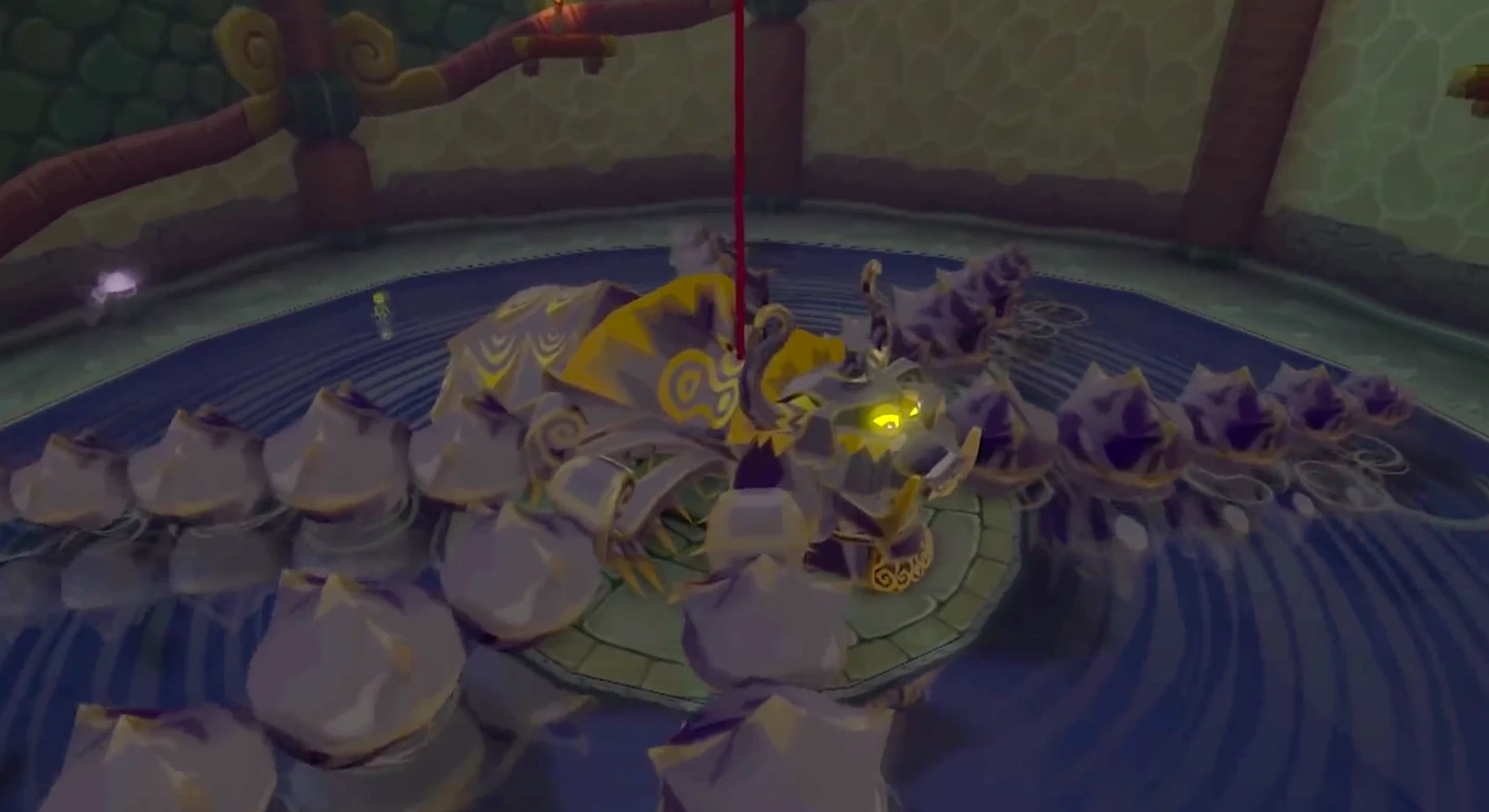
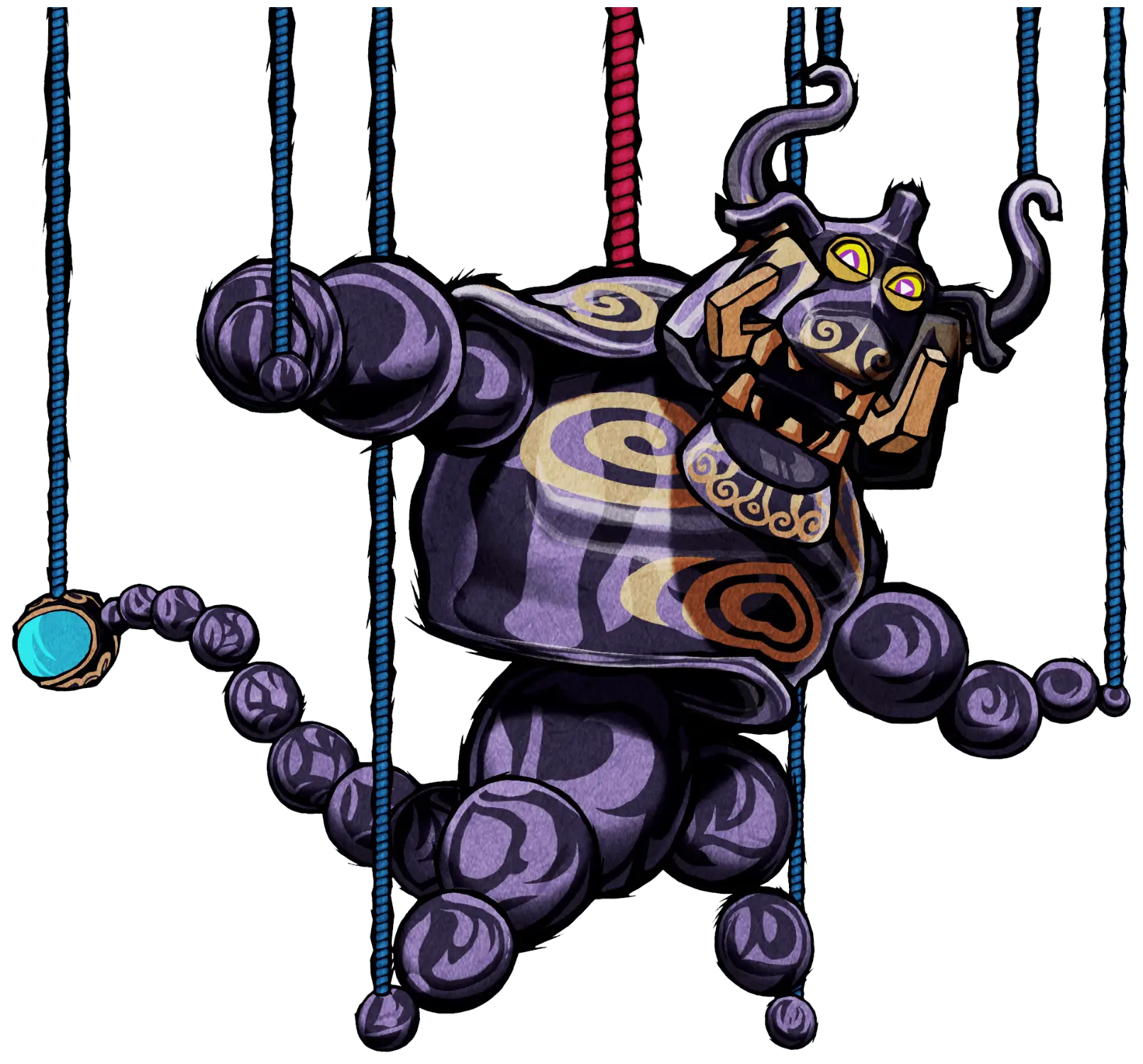
He returns too late. Ganondorf has broken into the castle, seized Zelda and taken her to his tower nearby. Link fights through echoes of Gohma, Kalle Demos, Jalhalla and Molgera, a maze haunted by Phantom Ganon, and the giant marionette Puppet Ganon in three shapes.
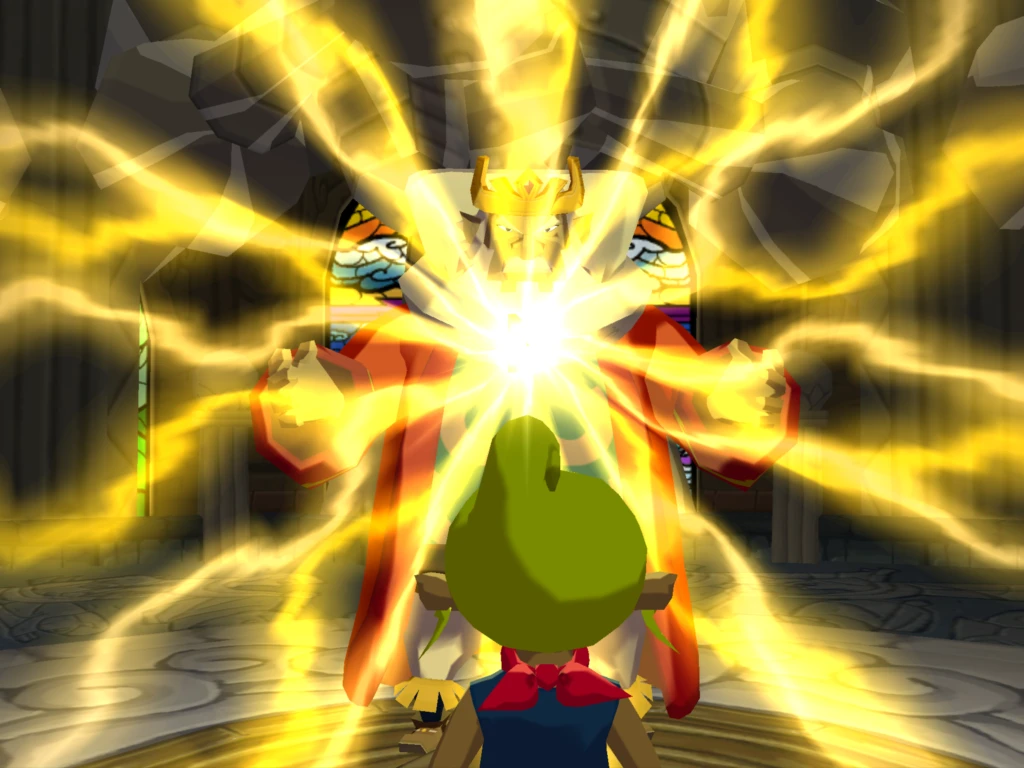
At the summit Ganondorf talks about the desert where he grew up, and the wind that brought Hyrule joy and his own people only hardship. He knocks Link down, takes his piece of the Triforce and joins all three. But before he can make his wish, the King of Hyrule lays his hand on the golden power first. He wishes for the old kingdom to be washed away for good, and for the children to be given a future.
Ganon’s Tower.Puppet Ganon.
The final battle
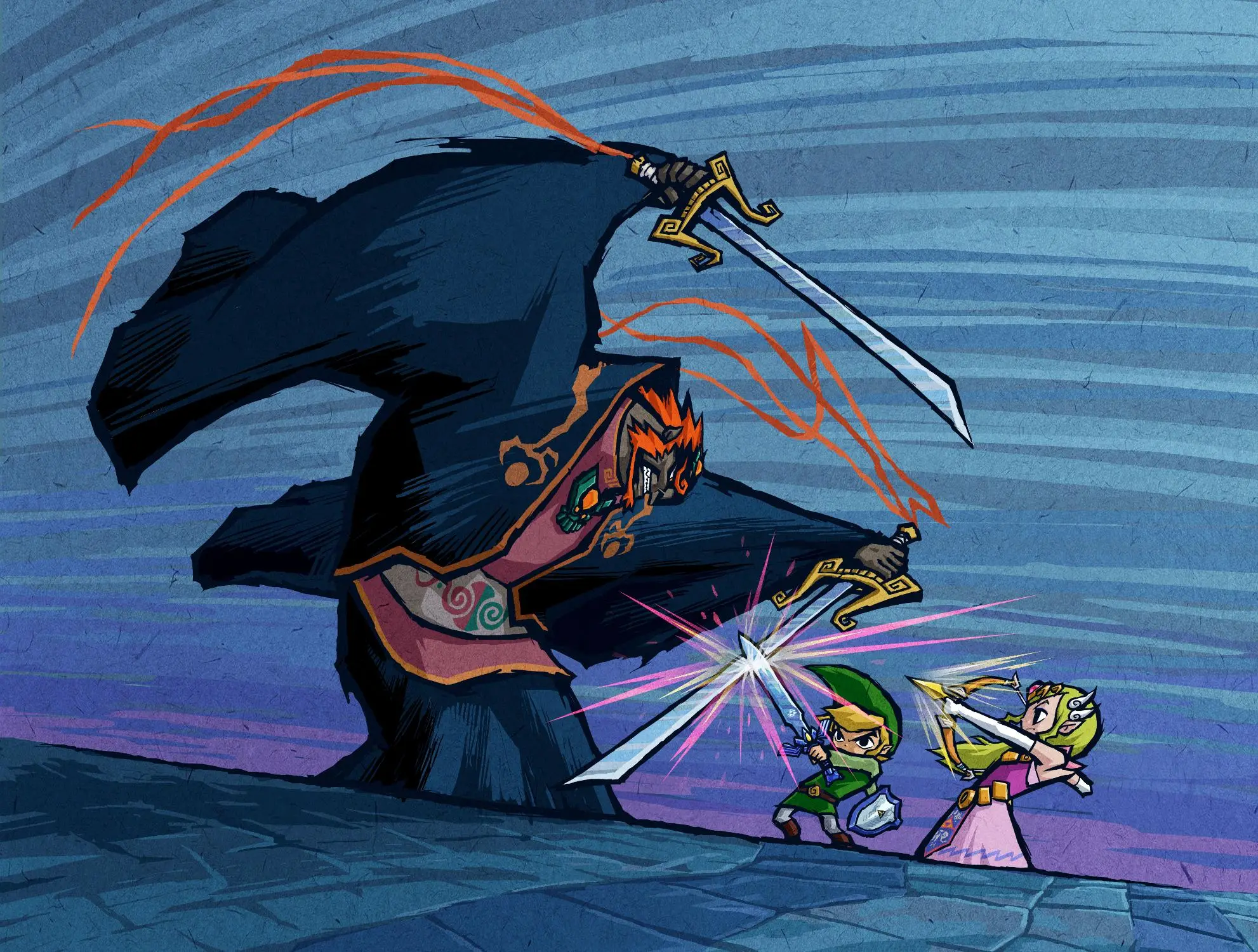
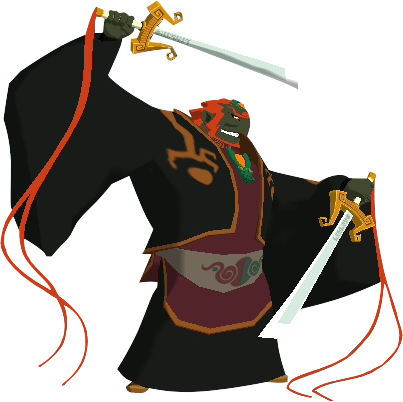
The sea begins pouring in as Ganondorf, furious, draws two swords. Zelda fires Light Arrows to stun him and Link presses the attack, until a final blow drives the Master Sword into Ganondorf’s forehead and turns him to stone. As the water closes over Hyrule, the king says goodbye and stays with his kingdom, sending Link and Zelda up to the surface.
Tetra’s crew fish them out and bring them home to their friends. The last scene sees Link and Tetra set sail together, with the wind behind them, to look for a new land of their own, which is where Phantom Hourglass picks up the story.
Link and Zelda face Ganondorf.Setting sail for a new land.
Dungeons of the Great Sea
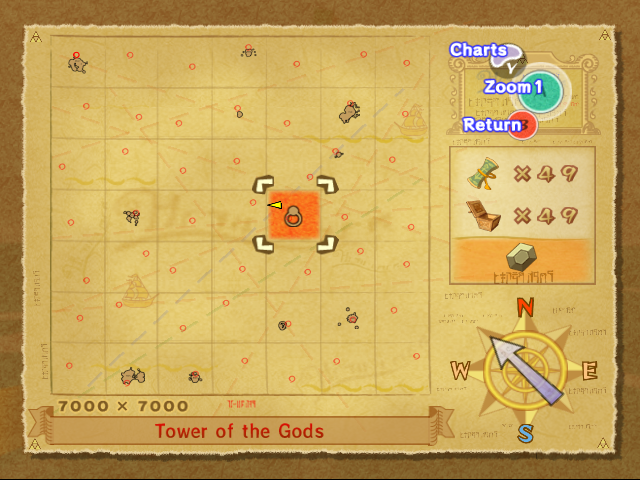
The Great Sea is a grid of 49 squares, each holding an island or a cluster of islands. Most are optional, packed with secrets, caves, treasure and side quests; these are the dungeons the story takes you through, in order.
Forsaken Fortress (first visit)StealthSneak in without a sword to find Aryll. No boss: it ends with the Helmaroc King throwing Link out.
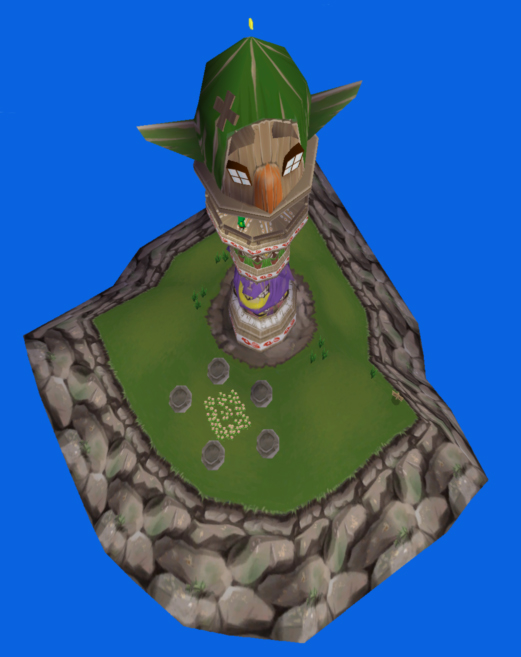
Forbidden WoodsBoss: Kalle DemosAn overgrown island next to the Forest Haven. Item: Boomerang. Reward: Farore’s Pearl.
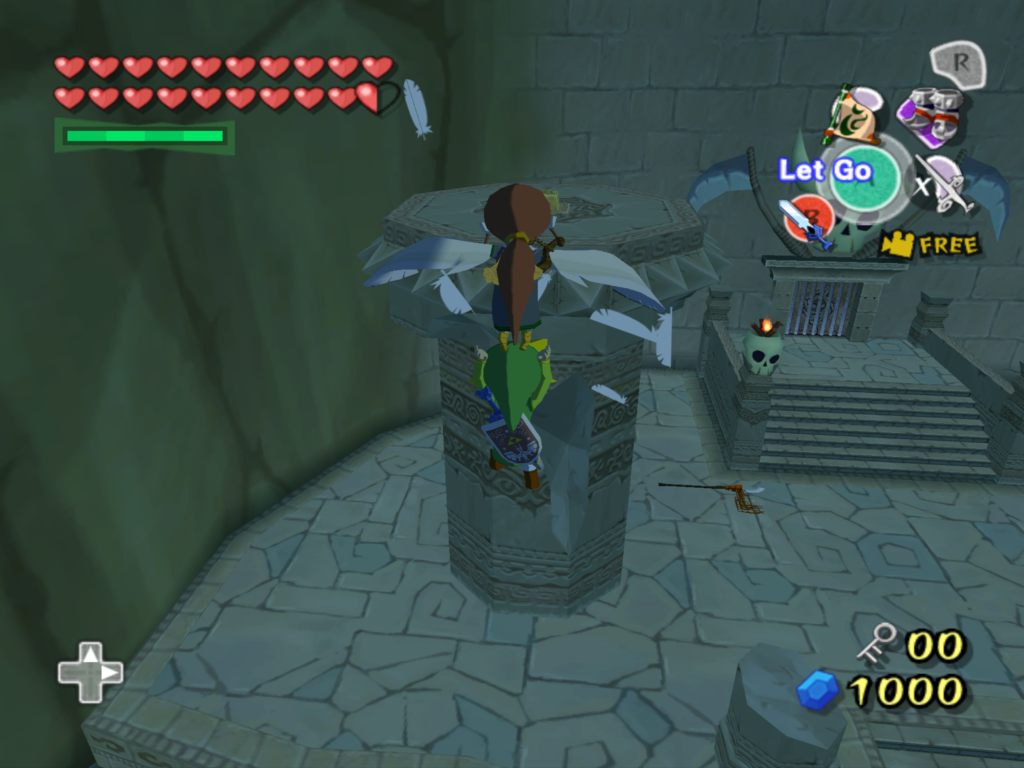
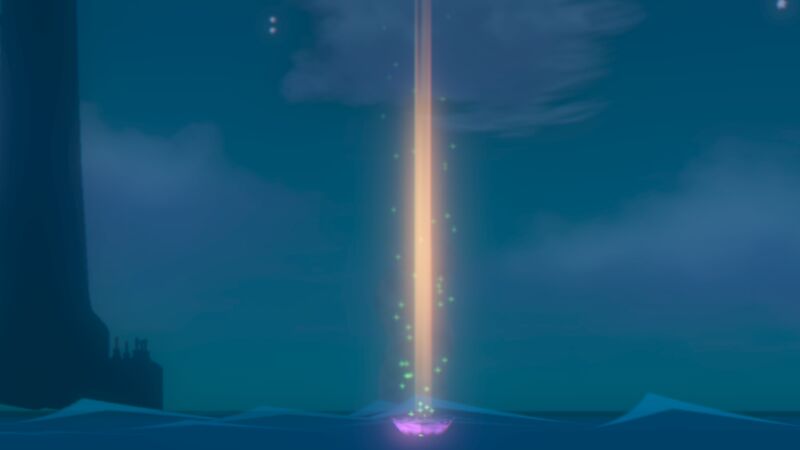
Tower of the GodsBoss: GohdanRaised by the three pearls; a test of courage. Item: Hero’s Bow.
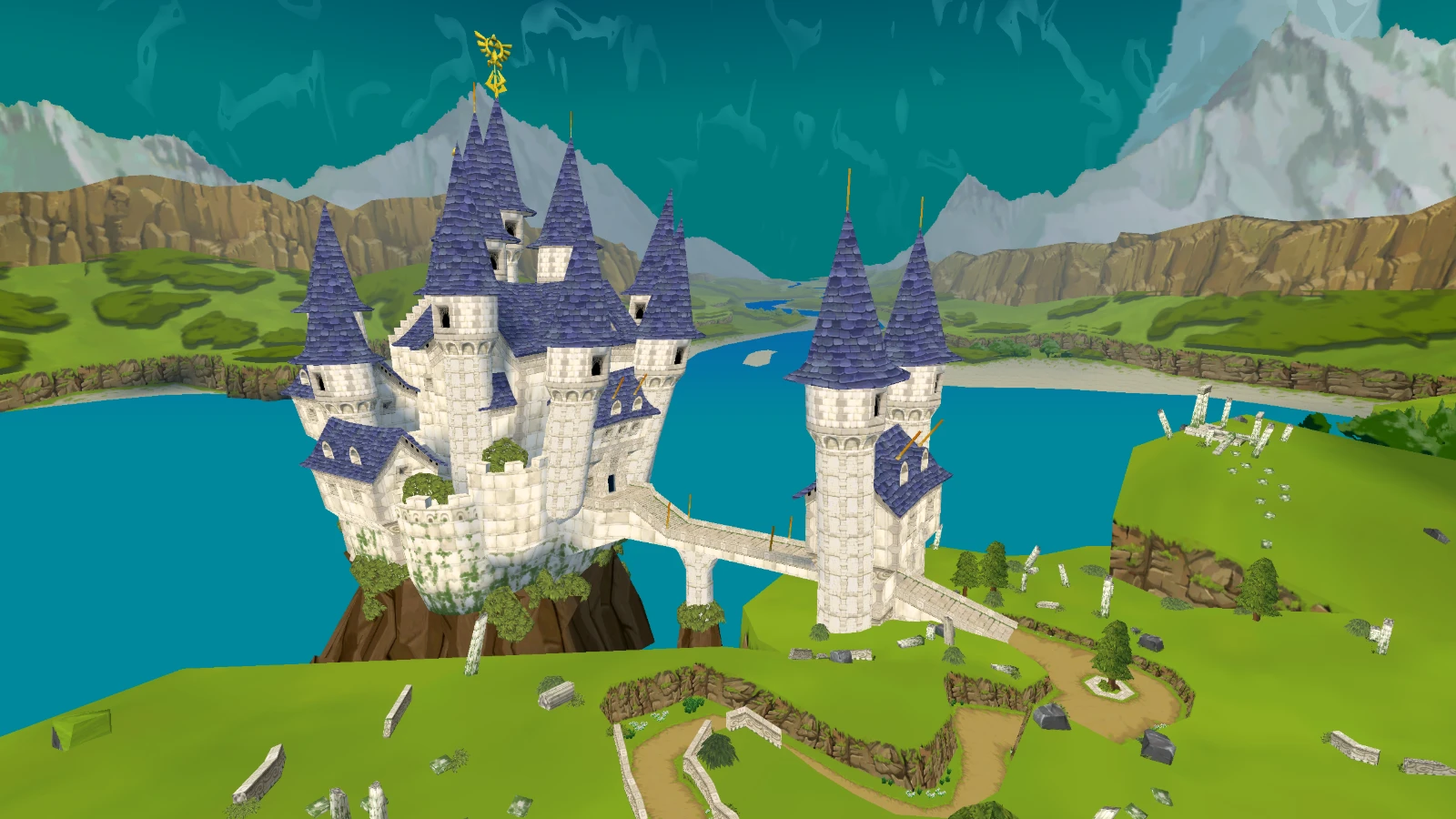
Hyrule CastleMaster SwordThe kingdom frozen beneath the sea, where Link draws the Master Sword.
Forsaken Fortress (second visit)Boss: Helmaroc KingPhantom Ganon guards the way. Item: Skull Hammer. Aryll is rescued here.
Earth TempleBoss: JalhallaOn Headstone Island, with Medli. Item: Mirror Shield.
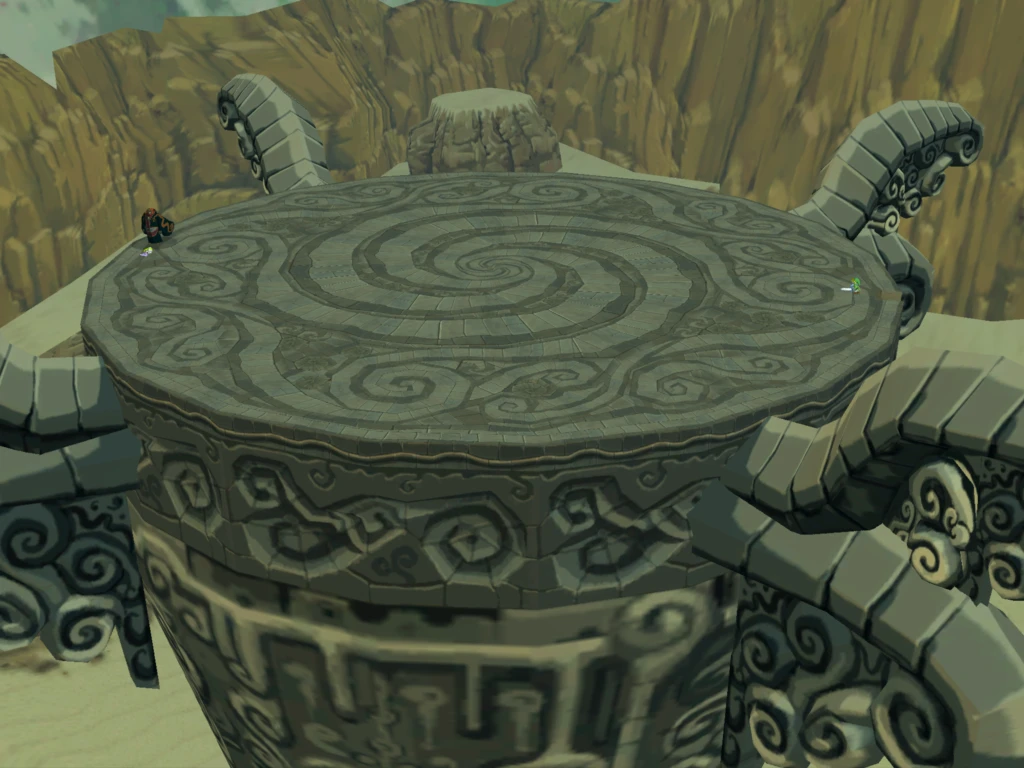
Wind TempleBoss: MolgeraOn Gale Isle, with Makar. Item: Hookshot.
Ganon’s TowerBosses: Puppet Ganon, GanondorfRematches with four earlier bosses, Phantom Ganon’s maze and the Light Arrows.
Between the Wind Temple and Ganon’s Tower comes the hunt for the eight Triforce Shards. Two of the Triforce Charts are found aboard the Ghost Ship and on the 30th floor of the Savage Labyrinth on Outset Island; the labyrinth’s deeper floors are an optional challenge.
In comics, TV & other media
The Wind Waker never got a cartoon of its own, but its Great Sea has been charted in Nintendo’s own books, and its cast has sailed into a surprising number of other games.
Hyrule HistoriaNintendo · book · 2011The official history that put the series timeline on paper. It places The Wind Waker in the branch where the Hero of Time is sent back to childhood and never returns to the adult future, and names Laruto as the Sage of Earth before Medli.
Zelda BoxJapan · guidebook · 2002A Japanese companion book with concept art and developer commentary. In it Aonuma explains that the Rito are an evolved form of the Zora, and that the Kokiri left their forest and became the Koroks.
The Legend of Zelda: Art & ArtifactsNintendo · art book · 2017Includes an interview in which Haruhana and Takizawa, who made the Space World 2000 footage, explain why they turned away from realism.
Phantom Hourglass and Spirit TracksNintendo DS · 2007 and 2009The direct sequel follows Link and Tetra across a new ocean; the second is set about a century later in a new Hyrule, and remembers Tetra in a stained-glass window in the castle.
Super Smash Bros.Wii, 3DS, Wii U, Switch · 2008 onwardsToon Link has been playable since Super Smash Bros. Brawl, and characters such as Tetra, Medli and Aryll turned up as trophies and stickers.
Hyrule Warriors Legends3DS · 2016Toon Link, Tetra (with cutlass and pistol) and King Daphnes, wielding a sail, became playable; Medli joined in a later update.
Super Mario MakerWii U · 2015Tetra is one of the costumes Mario can wear.
Breath of the Wild and Tears of the KingdomSwitch · 2017 and 2023The Rito and the Koroks, both introduced in The Wind Waker, are major peoples of the later Hyrule.
Characters
The Wind Waker has one of the series’ most lovable casts, and it is easy to see why: with no voice acting, the team told the story through faces and body language. Here are the people (and fish, and boats) who matter most.
Character
Who they are
In this game
Stats & abilities
LinkThe Hero of Winds
A boy from Outset Island who lives with his grandmother and younger sister. He is not the Hero of Time, just a kid dressed up in that hero’s colours for his birthday, which is the whole point. His big-eyed, cel-shaded look, drawn by Yoshiki Haruhana, became known as Toon Link and was reused in several later games.
Sets out to rescue Aryll, finds himself caught up in Ganondorf’s return and ends the game recognised by the gods as the Hero of Winds. His eyes do a quiet job too: when he stands still, they turn towards hidden switches, enemies and points of interest.
Hero’s Sword (from Orca), later the Master Sword
Wind Waker baton: six songs
Deku Leaf, Grappling Hook, Boomerang, Hero’s Bow, Hookshot, Skull Hammer, Iron Boots, Power Bracelets, Mirror Shield
Parry attacks
AryllLink’s little sister
A cheerful girl who adores seagulls and treasures her telescope, which is decorated with them. Aonuma has said she was first going to be called Mariru, in the same family of names as Marin and Malon.
Kidnapped by the Helmaroc King, who mistakes her pointed ears for Tetra’s. Held at the Forsaken Fortress, rescued on Link’s second visit, then sent home on Tetra’s ship, after which she writes Link letters.
Lends Link her telescope. Wears a different dress on a second playthrough.
GrandmaLink’s grandmother
The kindly head of Link’s household on Outset Island, who keeps the island’s tradition of dressing boys in the hero’s green.
Gives Link his birthday clothes. Heartbroken after Aryll is taken and Link sails away, she pines so badly she makes herself ill; Link cures her by bringing her a fairy, and she rewards him with her Elixir Soup.
Gives Link Elixir Soup.
TetraPirate captain and Princess Zelda
The bossy, quick-witted leader of a pirate crew she inherited from her mother. She keeps a picture of the Hero of Time in her cabin and wears a necklace that, unknown to her, holds part of the Triforce of Wisdom. She is also the heir of Hyrule’s royal line, though she has no idea.
Ferries Link to the Forsaken Fortress, talks to him through a family Gossip Stone, and rescues him from Ganondorf, who recognises her Triforce piece. The King of Red Lions awakens her as Princess Zelda, and she fights at Link’s side in the final battle. She returns as the heroine of Phantom Hourglass and, generations later, as the great-great-grandmother of Spirit Tracks’ Zelda.
Light Arrows in the final battle
Playable in Hyrule Warriors Legends with cutlass and pistol
King of Red LionsKing Daphnes Nohansen Hyrule
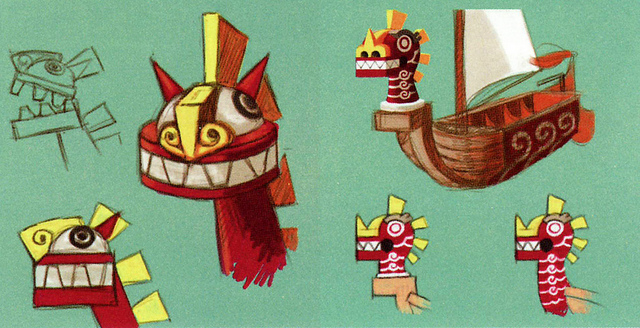
A talking boat with a carved red lion’s head, and secretly the spirit of the last King of Hyrule, who could not save his kingdom and left its fate to the gods. Aonuma wrote his lines while his son was newborn, as if he were talking to his own child.
Rescues Link, gives him the Wind Waker and guides him across the Great Sea. In Hyrule he shows his human form and awakens Zelda. At the very end he wishes on the Triforce before Ganondorf can, and goes down with his kingdom.
Link’s boat; carries a cannon, and the Grappling Hook doubles as a salvage crane
Speaks the ancient Hylian of the spirits
Playable in Hyrule Warriors Legends
GanondorfThe Great King of Evil
The desert king who became the beast Ganon in Ocarina of Time. Sealed away by the Hero of Time, he broke free in the adult timeline, and Hyrule was drowned to stop him. Centuries later he is back, older and strangely reflective.
Rules from the Forsaken Fortress and later his own tower, sends the Helmaroc King after girls who might be Zelda, has the two sages killed and finally unites the Triforce, only to have the king steal his wish. Link turns him to stone with the Master Sword.
Holds the Triforce of Power
Fights with two swords
Commands Phantom Ganon and Puppet Ganon
MedliRito attendant and Sage of Earth
A serious, hard-working young Rito who serves as attendant to the dragon Valoo, trained by Komali’s late grandmother. Her golden harp has been handed down for generations and matches that of Laruto, the Zora sage before her.
Link helps her up to Valoo’s shrine and frees her from Moblins. Later the Earth God’s Lyric awakens her as the Sage of Earth; she partners Link through the Earth Temple and prays there to empower the Master Sword.
Can fly (not very confidently) and carry Link
Her harp reflects light onto Mirror Shield puzzles
Playable in Hyrule Warriors
MakarKorok musician and Sage of Wind
A little Korok of the Forest Haven and the musician at its yearly ceremony. His instrument looks like a cello but is a violin, the same as Fado, the Kokiri sage before him.
Blown into the Forbidden Woods and rescued by Link. Awakened as the Sage of Wind with the Wind God’s Aria, he plants seeds that sprout into trees in the Wind Temple, then plays alongside Fado’s ghost to restore the sword.
Flies on a Deku Leaf; plants seeds in soft soil. Link can steer him with the Command Melody.
Prince KomaliRito prince
The son of the Rito Chieftain. Since his grandmother died he has shut himself away, curled around the pearl she left him.
Refuses to help until Link clears Dragon Roost Cavern, then hands over Din’s Pearl and goes to earn his wings. He comes back grown up, flying, and helps pull Link and Tetra out of Ganondorf’s grasp.
Holds Din’s Pearl.
ValooThe sky spirit
A great dragon who lives on top of Dragon Roost Mountain and protects the Rito. He speaks only ancient Hylian, and gives each young Rito one of his scales, which is how they earn their wings.
Tormented by Gohma hiding inside his mountain; once Link deals with her, the wing ceremony can resume. Later flies to the Forsaken Fortress with the Rito and sets Ganondorf’s lair alight.
One of the three spirits tied to the Pearls of the Goddesses.
Great Deku TreeGuardian of the Forest Haven
The ancient tree spirit who watches over the Koroks and calls them his children. Fans have long suspected he is the sprout seen growing in Kokiri Forest at the end of Ocarina of Time.
Gives Link the Deku Leaf, sends him after Makar and holds the yearly ceremony in which the Koroks carry his seeds across the sea. Guardian of Farore’s Pearl.
His Forest Water revives withered trees on other islands.
JabunThe water spirit
A gigantic fish, said to be a descendant of Lord Jabu-Jabu, who once lived at Greatfish Isle. He speaks only ancient Hylian.
Fled to a sealed cave behind Outset Island when Ganondorf destroyed his home. After a long talk with the King of Red Lions he gives Link Nayru’s Pearl.
On a second playthrough Link can understand what he says.
TingleMap-maker and chart translator
The eccentric grown man in a green bodysuit, first met floating on a balloon and selling maps in Majora’s Mask. His brothers Ankle and Knuckle turn up here too, along with David Jr., who wears a white Tingle suit but is no relation; Ankle and David Jr. work on Tingle Island.
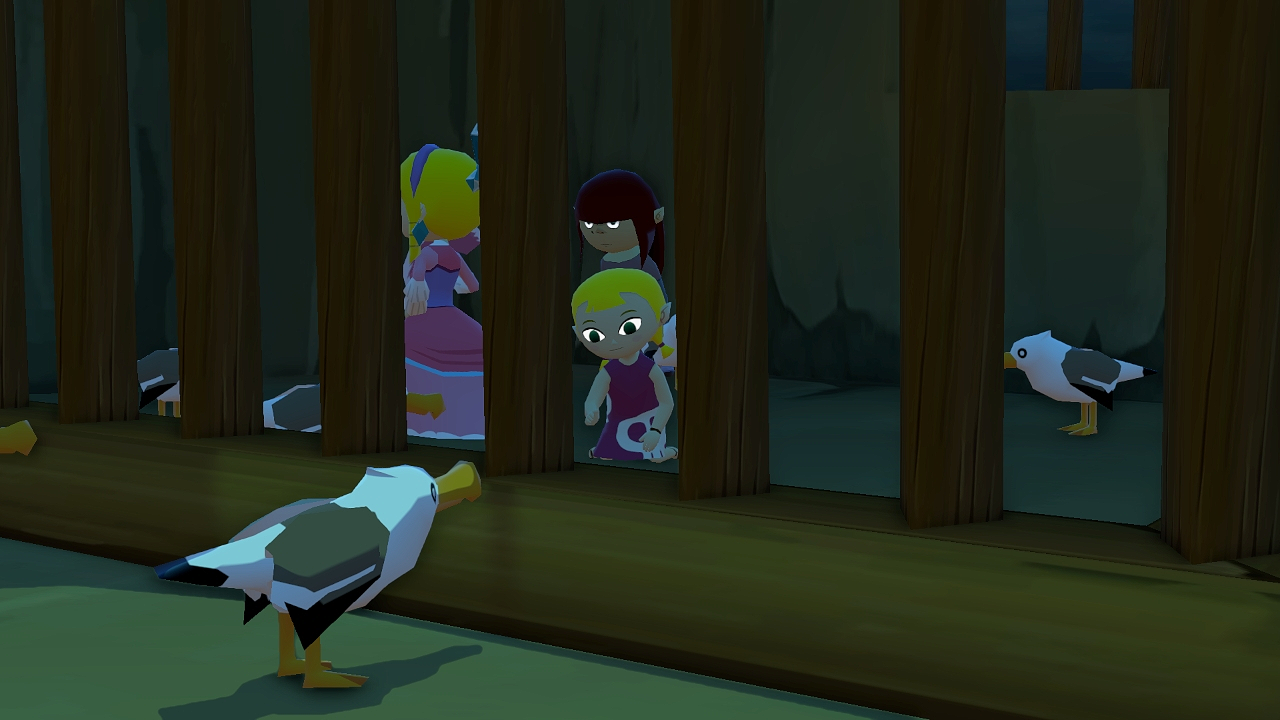
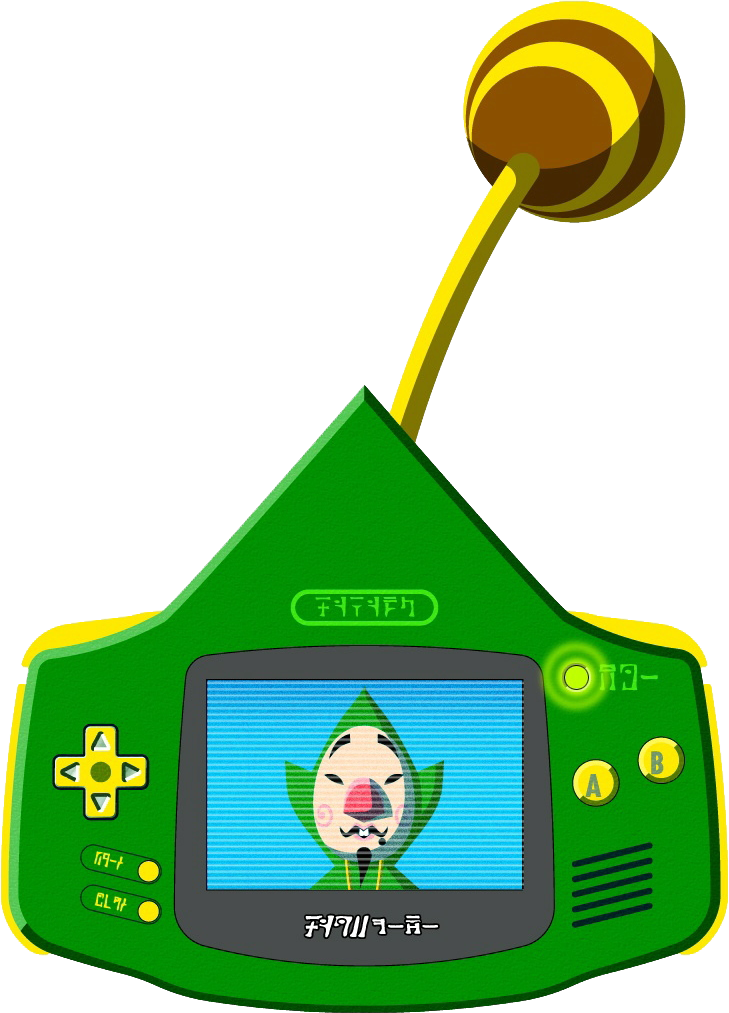
Locked in Windfall’s jail until Link frees him. He translates the Triforce Charts for 398 Rupees each, and through the Tingle Tuner a friend with a Game Boy Advance can control him and help with hints and Tingle Bombs.
Tingle Tuner (GameCube); Tingle Bottle (HD)
Hidden Tingle Statues in the dungeons
QuillRito postman
A conscientious Rito mail carrier, trusted by the chieftain, who flies letters all over the Great Sea.
Sees Tetra fall on Outset, gives Link the Delivery Bag on Dragon Roost, and at ruined Greatfish Isle tells him Jabun has fled to Outset.
Delivery Bag; the Rito postal service runs several side quests.
OrcaOutset Island swordsman
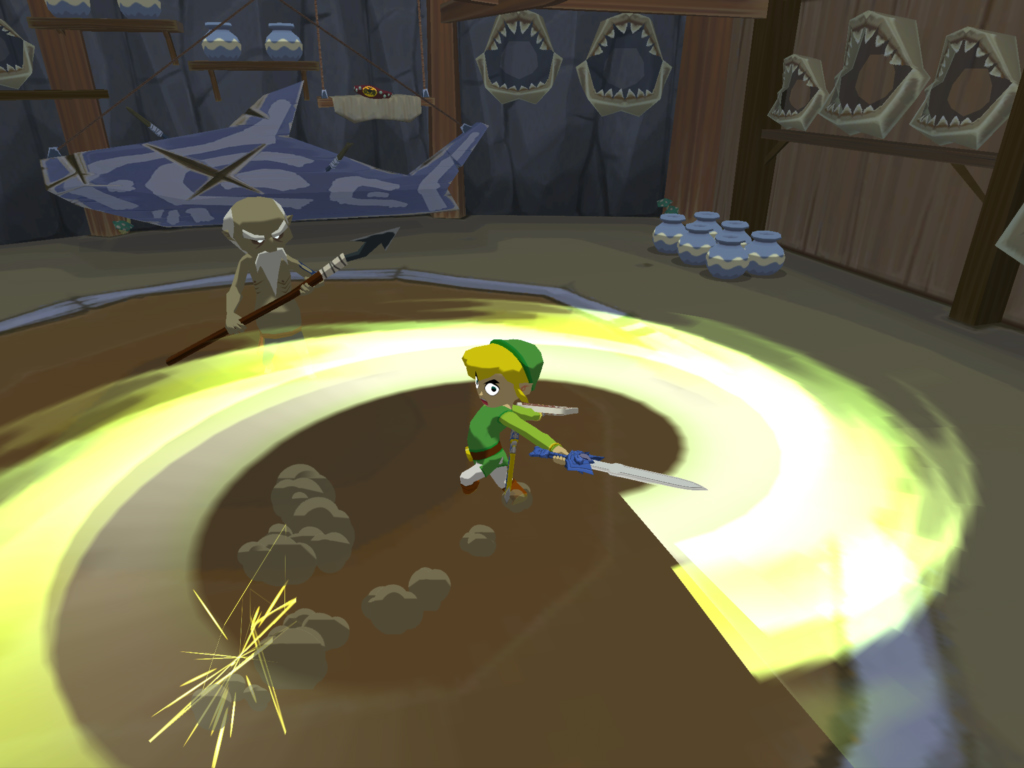
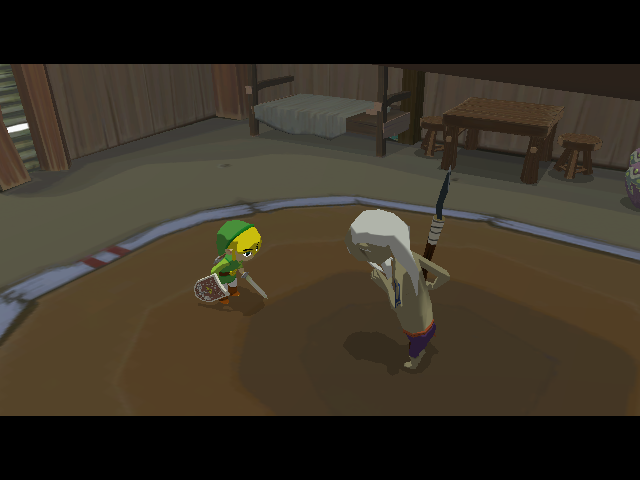
An elderly fisherman who once dreamed of being a great swordsman, until a serious injury ended it. He shares a house with his brother Sturgeon.
Lends Link the Hero’s Sword and teaches him to fight. Later, if Link collects ten Knight’s Crests, Orca teaches him the Hurricane Spin.
Sword training: a Piece of Heart for 500 hits, and the title “Master Link” at 999.
Laruto and FadoThe lost sages
The two sages who prayed in the Earth and Wind Temples to keep the Master Sword able to repel evil: Laruto, a Zora harpist, and Fado, a violinist. Ganondorf had them both killed; Laruto fell to his monster Jalhalla.
Their spirits wait in their temples for the Wind Waker, point Link to their heirs, Medli and Makar, and help restore the sword.
Teach the Earth God’s Lyric and the Wind God’s Aria.
Niko and the piratesTetra’s crew
Tetra’s loyal, rough-and-ready crew of sailors. Niko is the lowest-ranked of them, at least until Link joins.
Niko sets Link the rope-swinging test all new pirates must pass, guards the ship’s password-locked door and parts with the stolen bombs. He later narrates the opening of Phantom Hourglass and becomes Link’s roommate in Spirit Tracks.
Gives Link the Spoils Bag.
BeedleTravelling merchant
A cheerful travelling shopkeeper who sails the Great Sea in his Shop Ship. This is his first appearance; he went on to sell his wares in The Minish Cap, Phantom Hourglass, Spirit Tracks, Skyward Sword, Breath of the Wild and Tears of the Kingdom.
Sells supplies and, at steep prices, rarer treasures such as Pieces of Heart and Bottles, with points for loyal customers.
His shops are dotted around the map.
Bosses and notable enemies
The main bosses in the order Link meets them, with a few of the Great Sea’s regular troublemakers.
GohmaDragon Roost CavernAn armoured one-eyed monster under Valoo’s peak. Drop rubble on her shell with the Grappling Hook, then strike the eye.
Kalle DemosForbidden WoodsA giant plant that swallows Makar. Cut its vines with the Boomerang to bring it down.
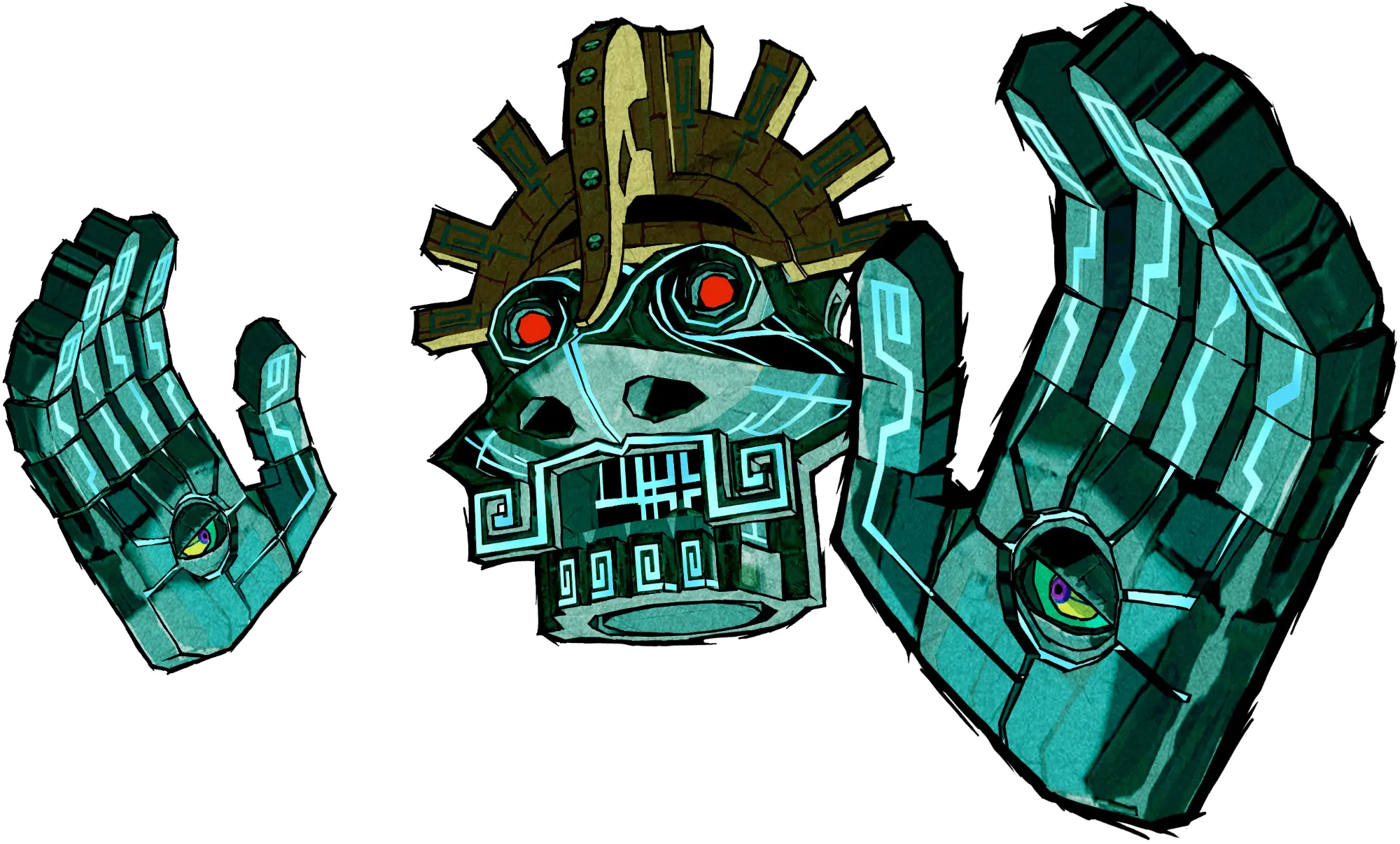
GohdanTower of the GodsA giant stone head with floating hands, testing the hero with arrows and bombs.
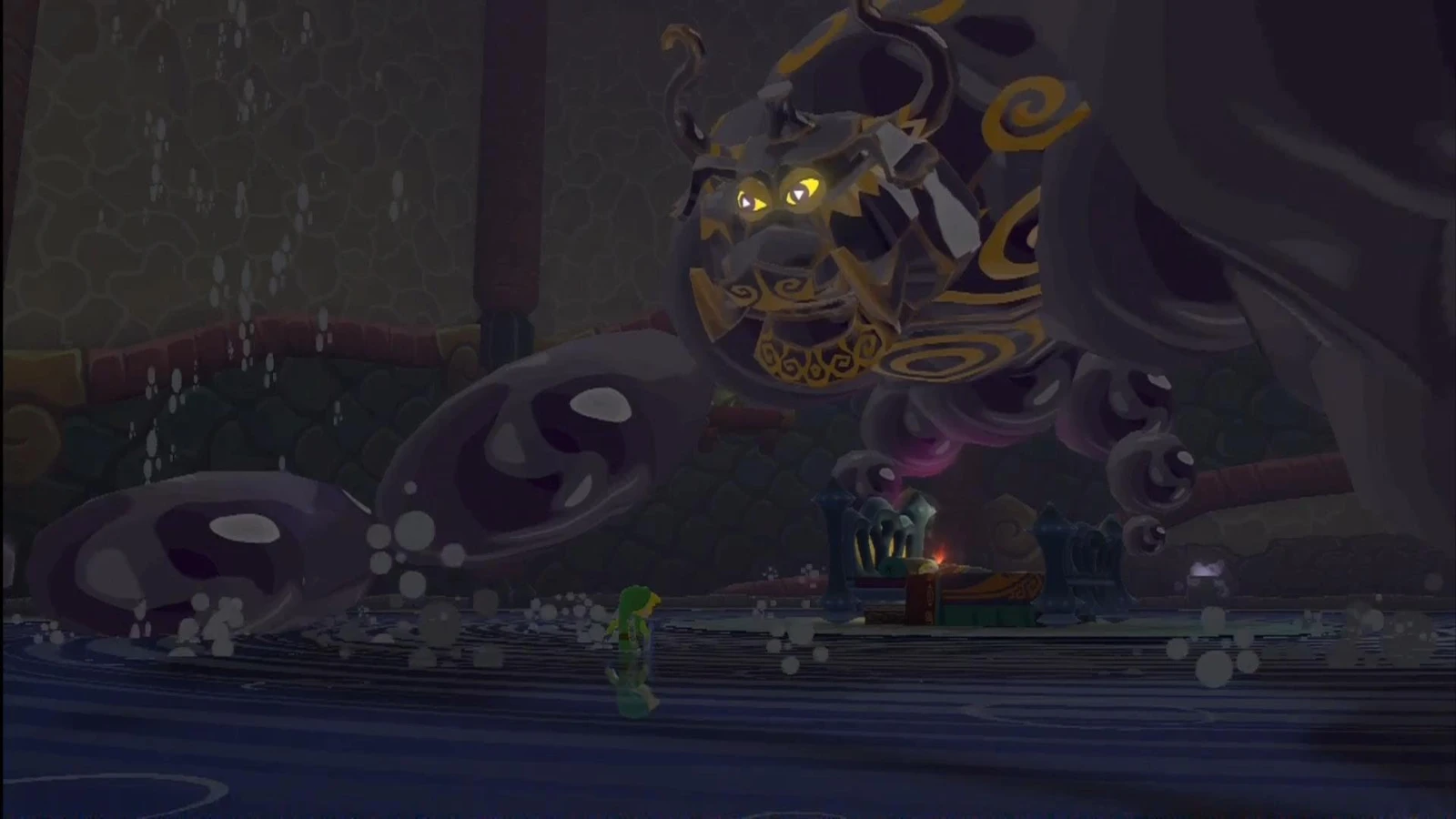
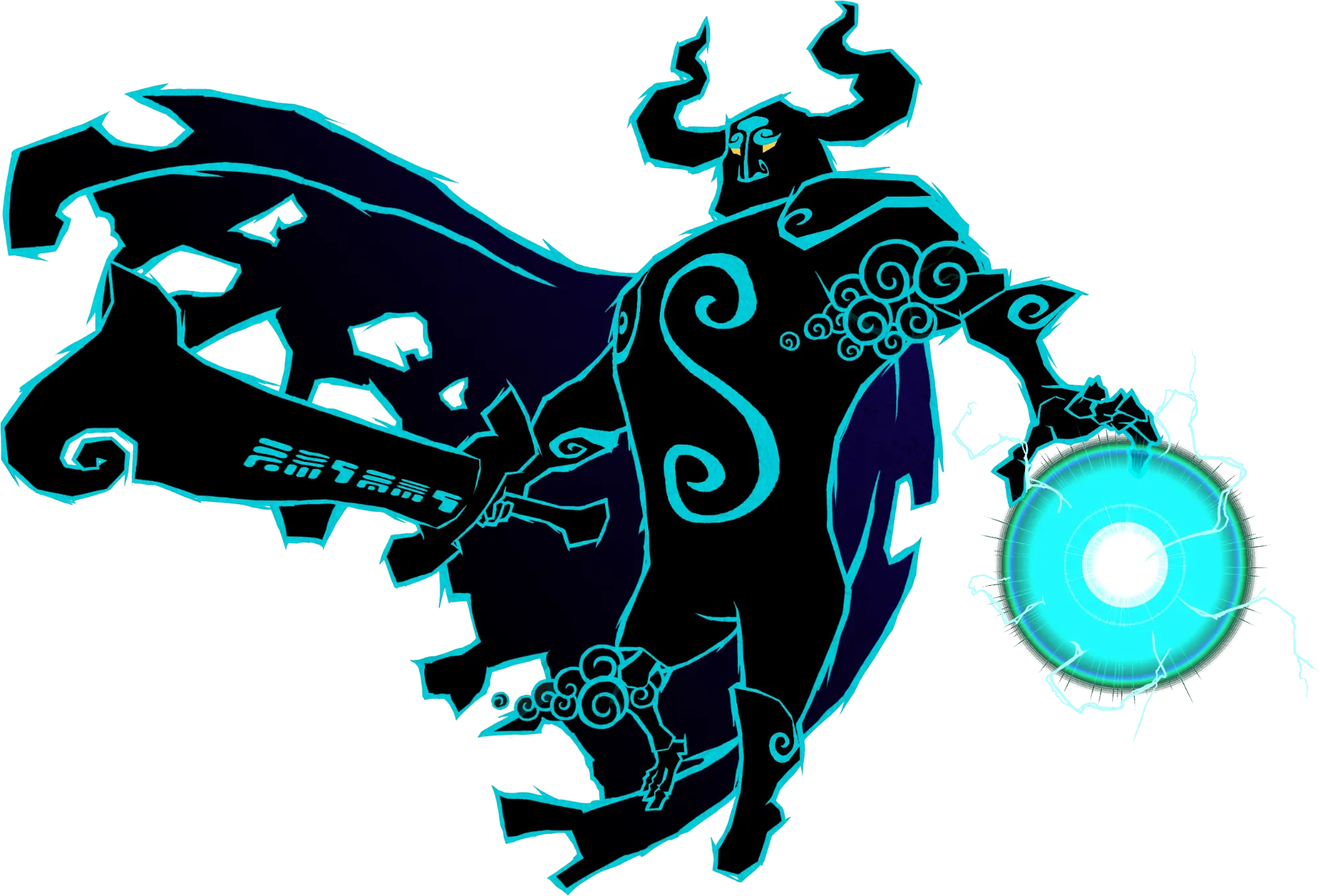
Phantom GanonForsaken Fortress · Ganon’s TowerGanondorf’s shadowy double, fought with energy-ball tennis and finished with the Light Arrows.
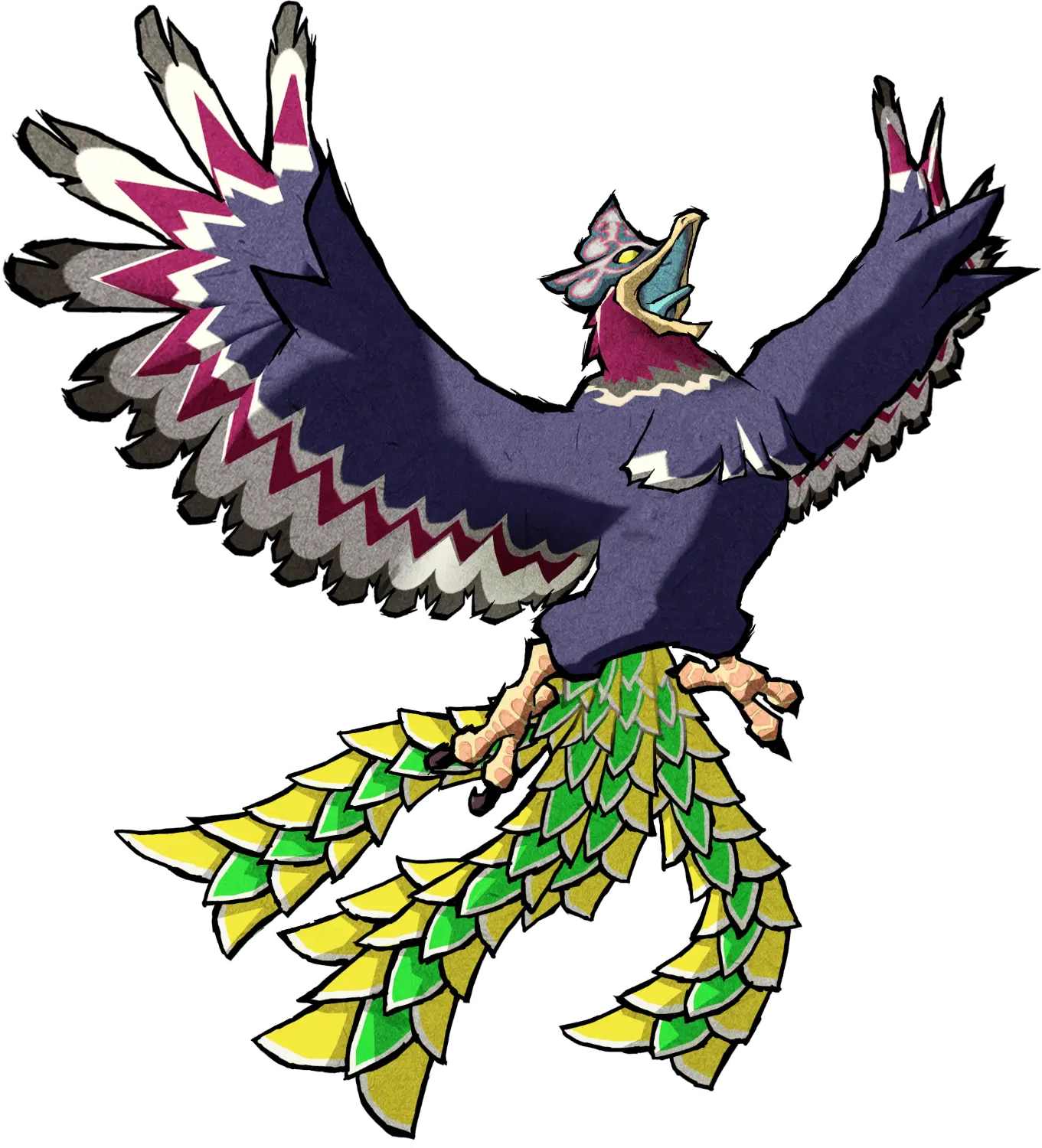
Helmaroc KingForsaken FortressThe masked giant bird that kidnapped Aryll. Crack its steel mask with the Skull Hammer.
JalhallaEarth TempleA huge ghost made of Poes, the killer of Laruto. Expose it with light from the Mirror Shield.
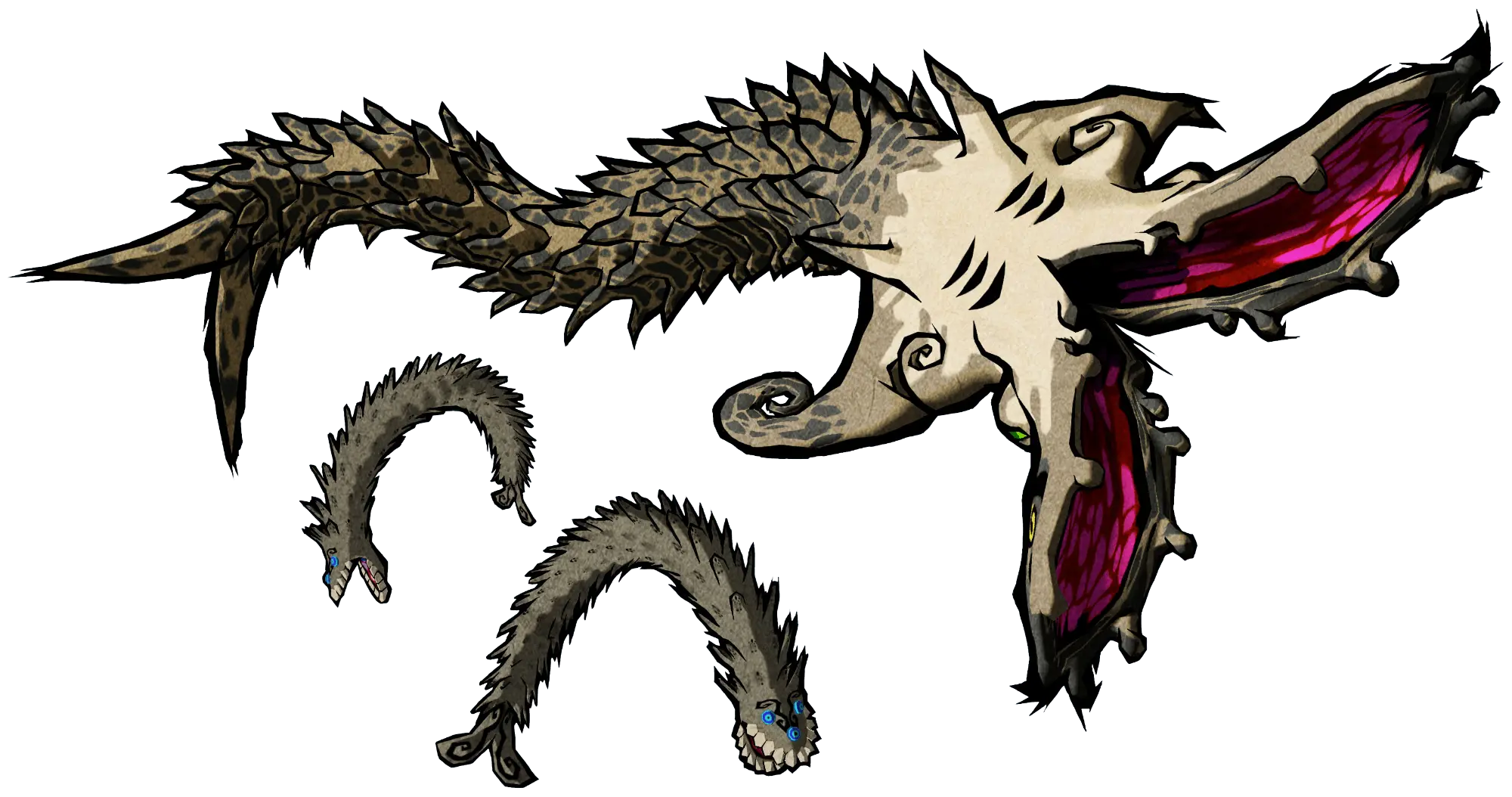
MolgeraWind TempleA sand-swimming worm. Hookshot its tongue to drag it out.
Puppet GanonGanon’s TowerA three-stage marionette of Ganon; shoot the glowing ball on its tail or leg.
GanondorfGanon’s TowerThe final duel, with Zelda’s Light Arrows and Link’s parries.
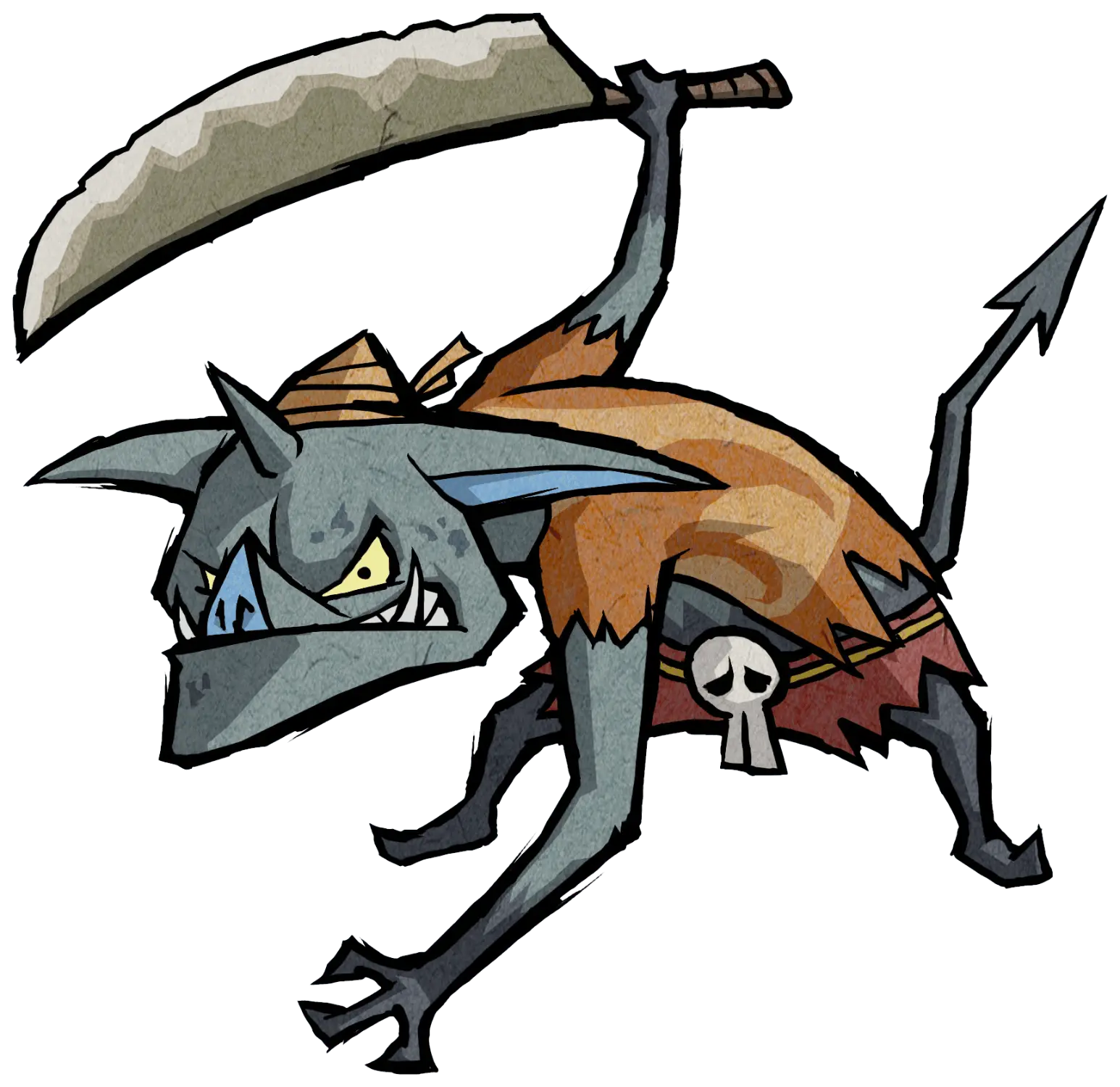
BokoblinEverywhereGoofy goblin foot soldiers in blue, green and red; the red ones keep lookout with telescopes.
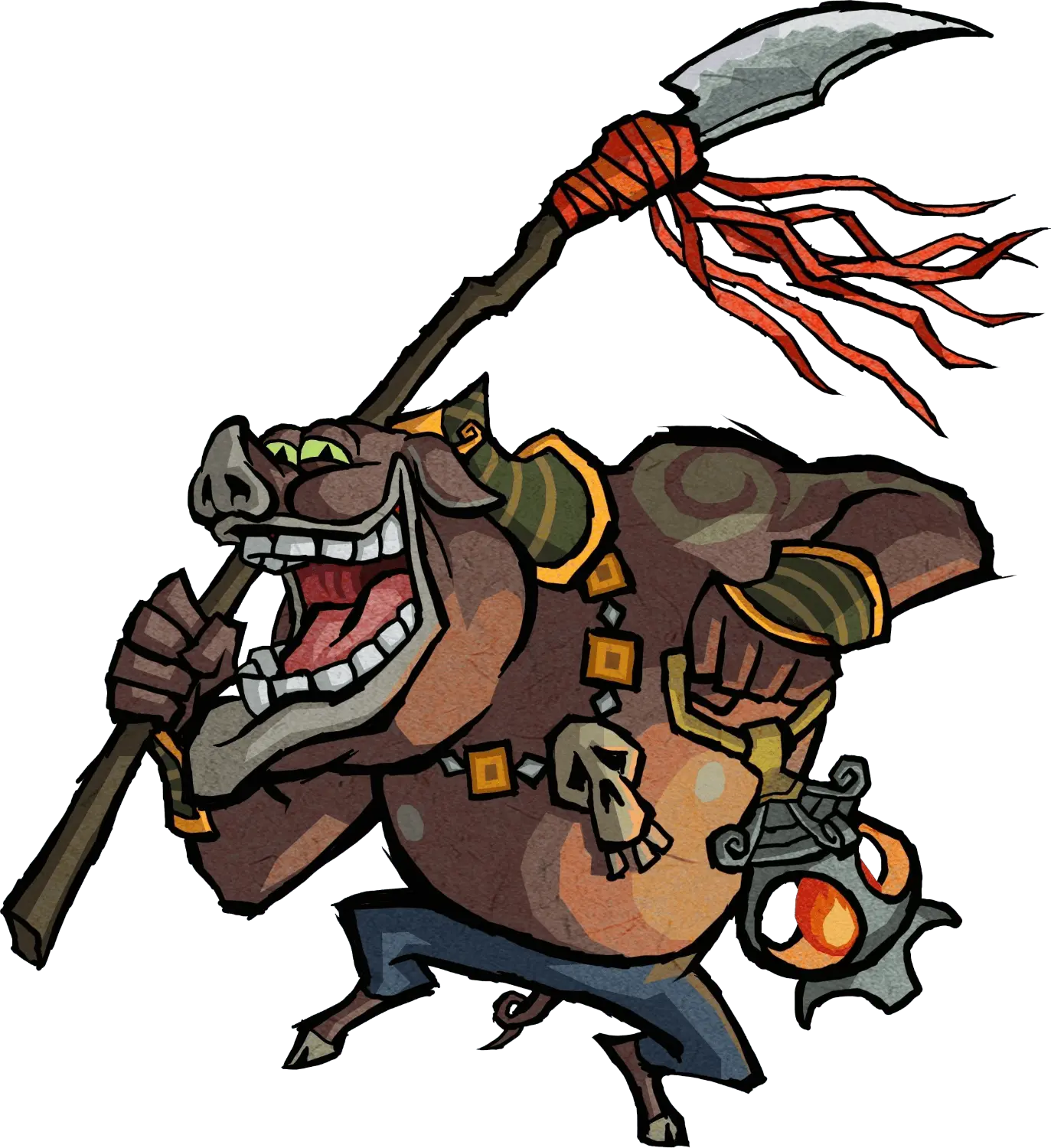
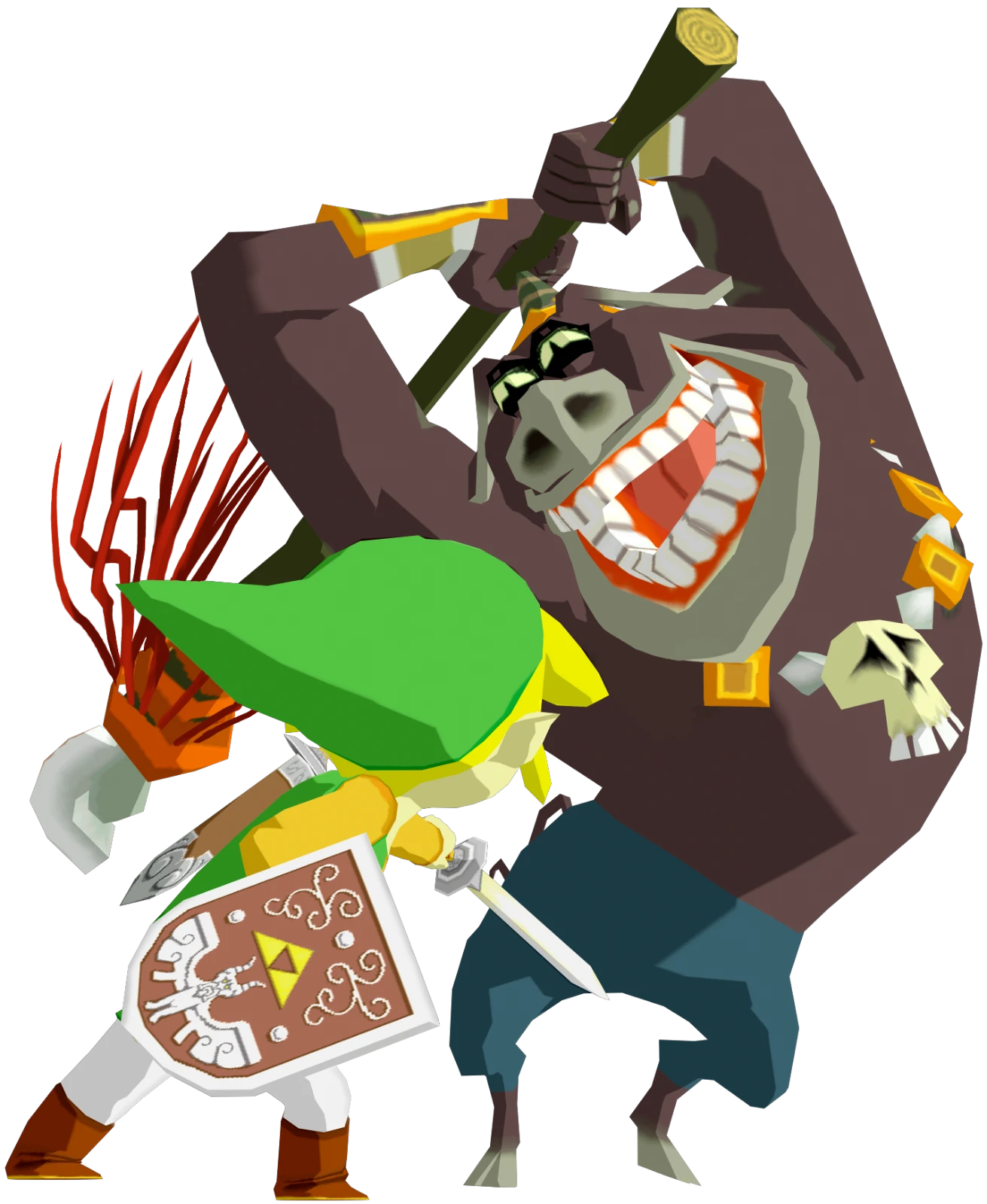
MoblinForsaken Fortress and beyondBig, burly brutes; Takizawa’s Moblin sketch was one of the first drawings in the new style.
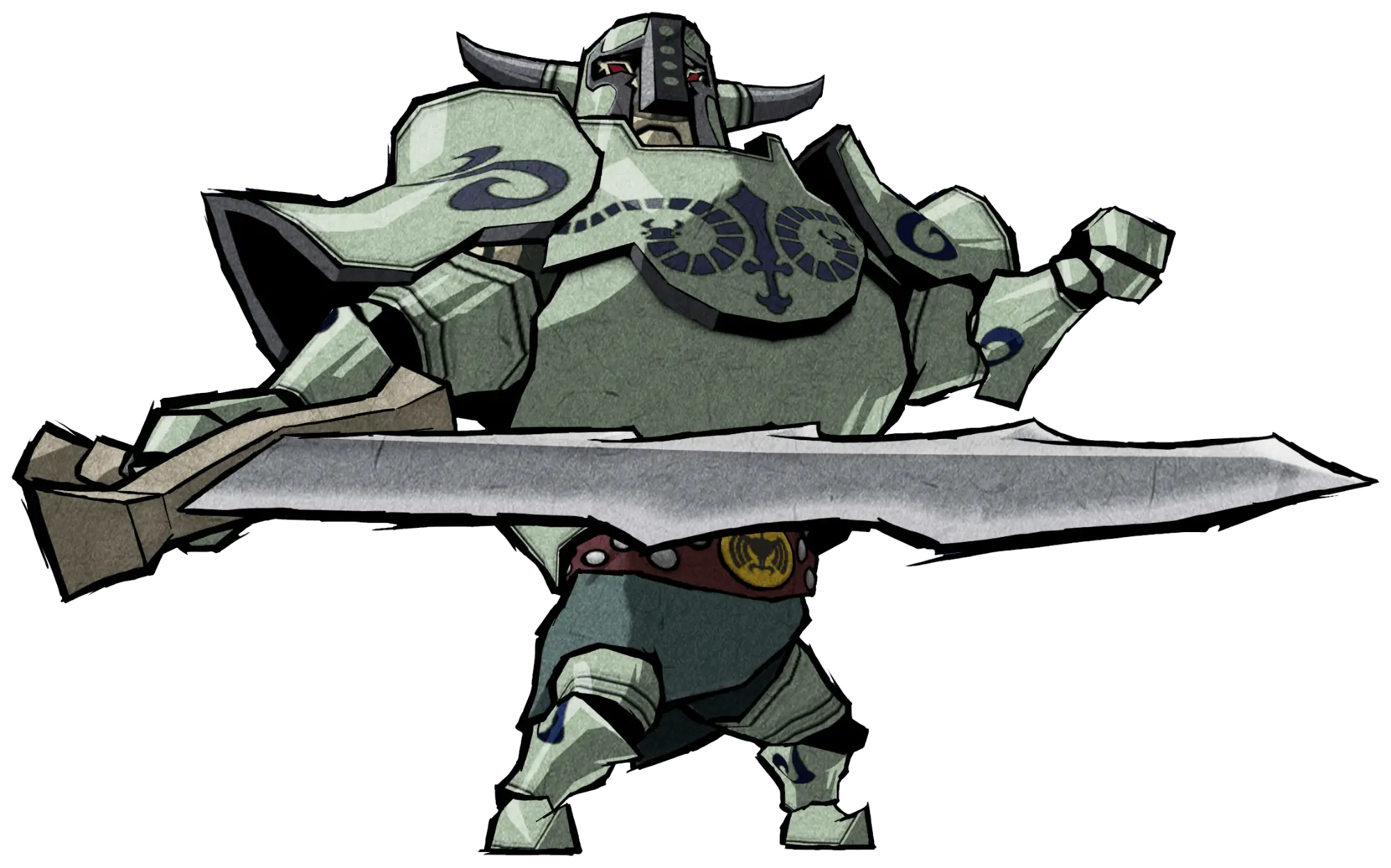
DarknutLater dungeonsArmoured knights whose plate has to be stripped off with parries before they can be hurt.
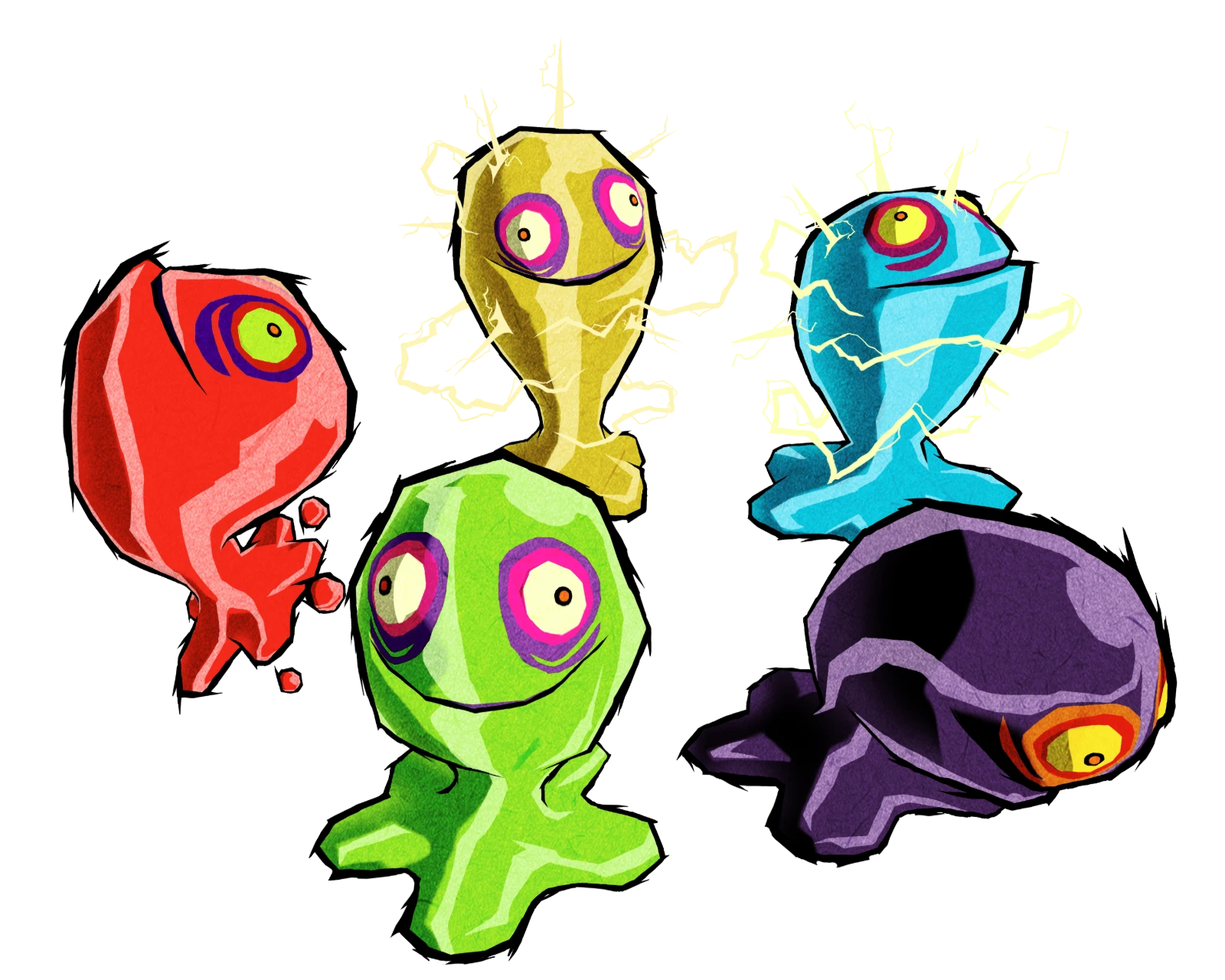
ChuChuEverywhereJelly blobs in several colours; the dark ones in the Earth Temple must be turned to stone with light.
The people who made it
A selection of the key staff on the GameCube original, plus the two who led the HD remaster.
Eiji AonumaDirectorDirected Majora’s Mask before this. Backed the toon style, cut the game down to make its deadline, and later produced the HD remaster.
Shigeru MiyamotoProducerQuestioned the big eyes, then backed the look, and held back new footage after the cool reception in 2001.
Takashi TezukaProducerPushed, with Miyamoto, for a reason for Link’s oversized eyes.
Yoshiki HaruhanaDesign managerDrew the sketch of a cartoon Link that changed the whole project, and helped make the Space World 2000 footage.
Satoru TakizawaDesign managerResponsible mainly for enemies and effects; drew the first new-style Moblin. Art director on the HD refit.
Masanao ArimotoDesign managerBuilt the world around the new characters and worked on Link’s reactions, including his roving eyes.
Mitsuhiro TakanoScript and event planningAlso worked on Ocarina of Time, Majora’s Mask and Twilight Princess.
Toshio Iwawaki & Kazuaki MoritaProgrammingThe game’s credited lead programmers.
Kenta Nagata, Hajime Wakai, Toru Minegishi & Koji KondoMusicA sea-going, folk-flavoured score that reworks old Zelda themes; the soundtrack album runs to 133 tracks over two discs.
Daiki Iwamoto & Takuhiro DohtaHD director · HD refining program directorLed the 2013 Wii U version; Dohta had played the original as a fan before joining Nintendo.
How it was made
The Wind Waker’s story is one of a team talking itself out of the obvious. This account is built from Nintendo’s own Iwata Asks for the HD remaster, the artists’ interview in Art & Artifacts, Aonuma’s interviews with IGN, Edge and Wired, and reporting from the time.
The demo that wasn’t Zelda
The realistic Link and Ganondorf of the Space World 2000 demo.
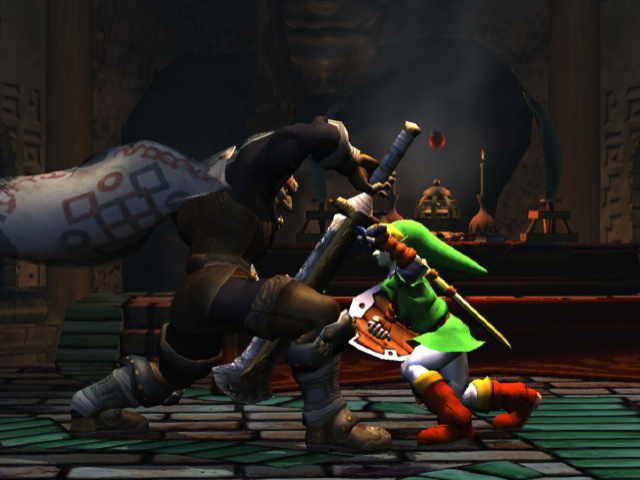
When Nintendo unveiled the GameCube at its Space World show in Chiba, in August 2000, one of the short clips that stole the show was a moody, realistic duel between an adult Link and Ganondorf. Fans took it as a sneak peek of the next Zelda. It was nothing of the sort: it was a tech demo, made possible, Miyamoto later explained, by early experiments on the new hardware before Majora’s Mask was even finished.
The demo’s own makers were already having doubts. Yoshiki Haruhana and Satoru Takizawa, who produced the footage, said years later that making it convinced them realism was the wrong road. Haruhana remembered leafing through a games magazine full of near-identical realistic games and worrying Zelda would vanish among them. “Does realistic equal a good game?” he asked. Eiji Aonuma was blunter. Seeing the clip, he told IGN in 2013, his reaction was: “No, this isn’t Zelda. This isn’t Zelda at all.”
A sketch out of the blue
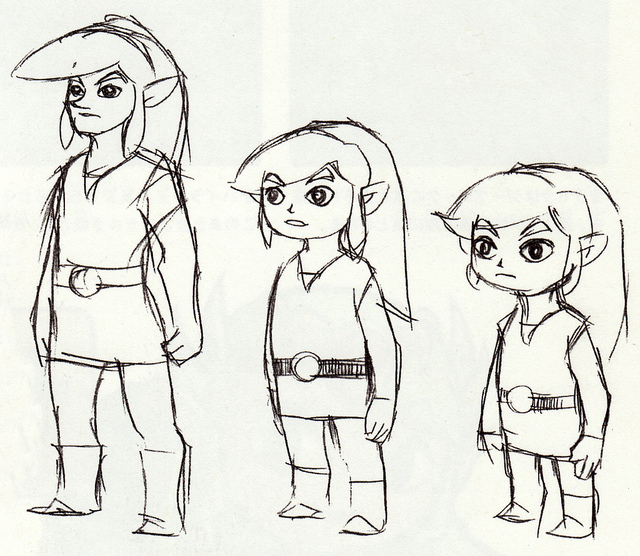
Concept art of the new, cartoon Link.
The team had started down the expected path, a beefier Ocarina of Time, and Aonuma admits the prototype was competent but dull. Then Haruhana, who had been pitching unusual characters since Ocarina, turned up with a drawing of a small, wide-eyed, cartoon Link. Takizawa says it lit him up at once, and he immediately dashed off a Moblin in the same style.
Suddenly the ideas came easily. A character drawn that way could pull exaggerated, satisfying moves in any direction, enemies could react in funny, readable ways, and puzzle objects stood out clearly. The team rendered its 3D models with cel-shading so the whole world looked hand-painted.
Why Link has such big eyes
A concept render of the new Link.
Miyamoto and Tezuka were not sold straight away. If the eyes were going to be that big, they argued, there had to be a reason. Somebody in the team floated firing beams out of them, which Takizawa admits was never a serious option. The answer they settled on was subtler: when Link stands still, his eyes glance around, and they turn towards anything worth noticing. It became a hint system without a single on-screen arrow, and Aonuma says the idea was later borrowed for Ocarina of Time 3D.
Winds and waves
Concept art of the King of Red Lions.
The ocean setting was chosen early, partly because open water suited the way the team wanted the game to play, and it turned travelling into an adventure in its own right. Miyamoto has said Nintendo wanted to show real wind in a game and that the GameCube finally made it possible, which goes some way to explaining how a conductor’s baton ended up as the title item.
There was no voice acting. Aonuma felt spoken lines might clash with each player’s own idea of Link, so the story leans on mime and subtitles. He also poured a lot of himself into the King of Red Lions: he wrote the boat’s lines just as his son was born, and called it the first game he made as a father.
Space World 2001 and “Celda”
A concept render of Link fighting a Moblin.
The new look was shown to the press in late August 2001, at the last Space World. The slapstick trailer, full of winks and pratfalls, split the audience. Some loved it; many fans who had been dreaming about the 2000 demo were furious, and the game picked up the mocking nickname “Celda”. Satoru Iwata later admitted the announcement left Zelda fans surprised and puzzled, and Aonuma said the reaction in North America was mostly negative.
Miyamoto’s response was to stop showing trailers until the game was much further along. The press, he felt, had read the cartoon style as a bid for younger children, which had never been the plan.
Winning people round at E3 2002
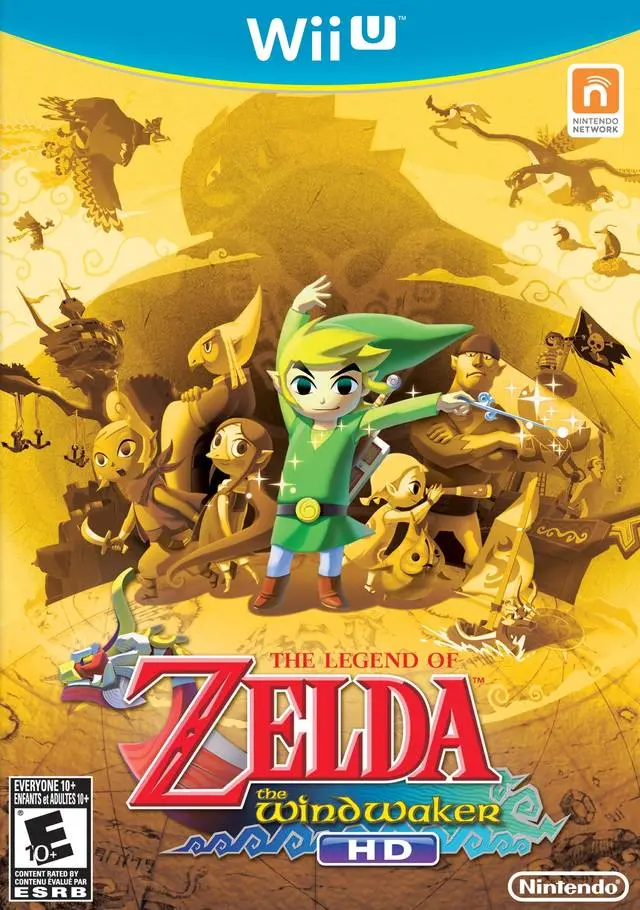
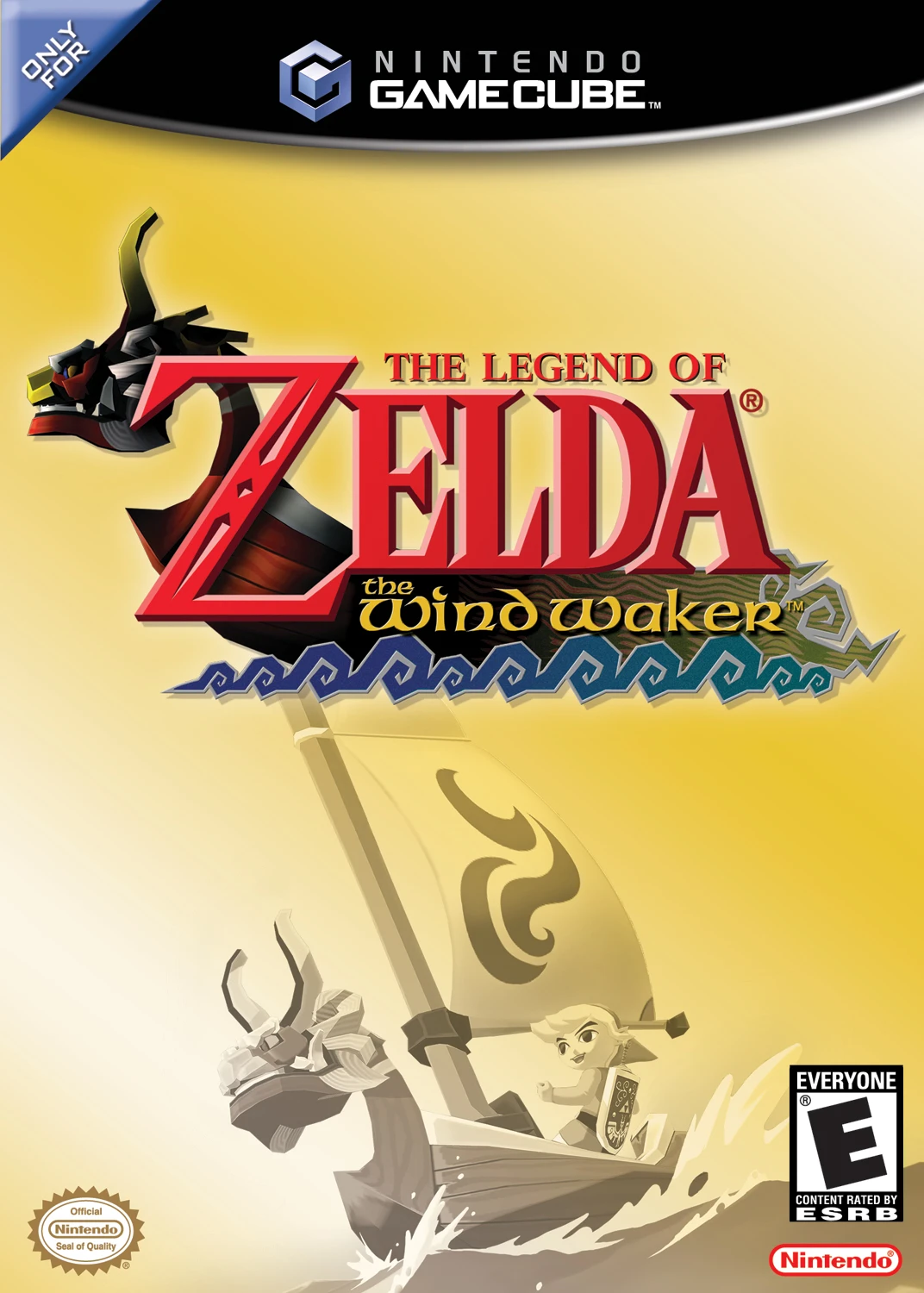
Pre-release North American box art.
The turning point came with a playable demo at E3 2002. Getting hands on the game changed minds, and the E3 Game Critics Awards named the untitled Zelda the Best Console Game of E3, and runner-up for Best of Show. The demo also showed off the Game Boy Advance link-up with Tingle.
The Japanese subtitle, Kaze no Takuto, followed in October 2002, and the English name, The Wind Waker, that December, just ahead of the Japanese launch.
Cut for time
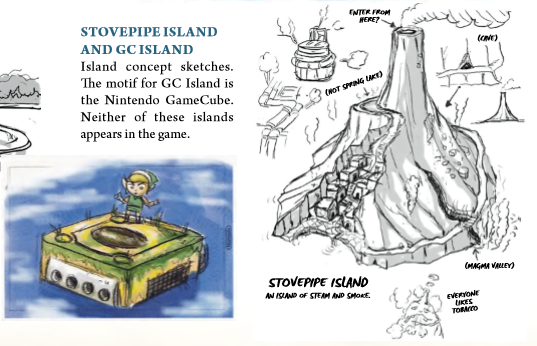
Concept art of islands that were scrapped.
The schedule was tight, and it shows in the second half. Speaking to Edge in 2005, Aonuma said the team had first imagined something bigger and had to make it more compact to finish on time, and that he considered that his fault. In 2013 he confirmed that two dungeons which did not make it were mined for ideas in later games, so they could not simply be restored in the remaster. In their place, the original asks players to sail around collecting Triforce Charts.
Even the Western release was tweaked. Comparing the versions, the Western game makes one of the Triforce Charts quicker to obtain than in the Japanese original, moves a Piece of Heart, and redraws the wind compass without Japanese characters.
The Master Quest bonus disc
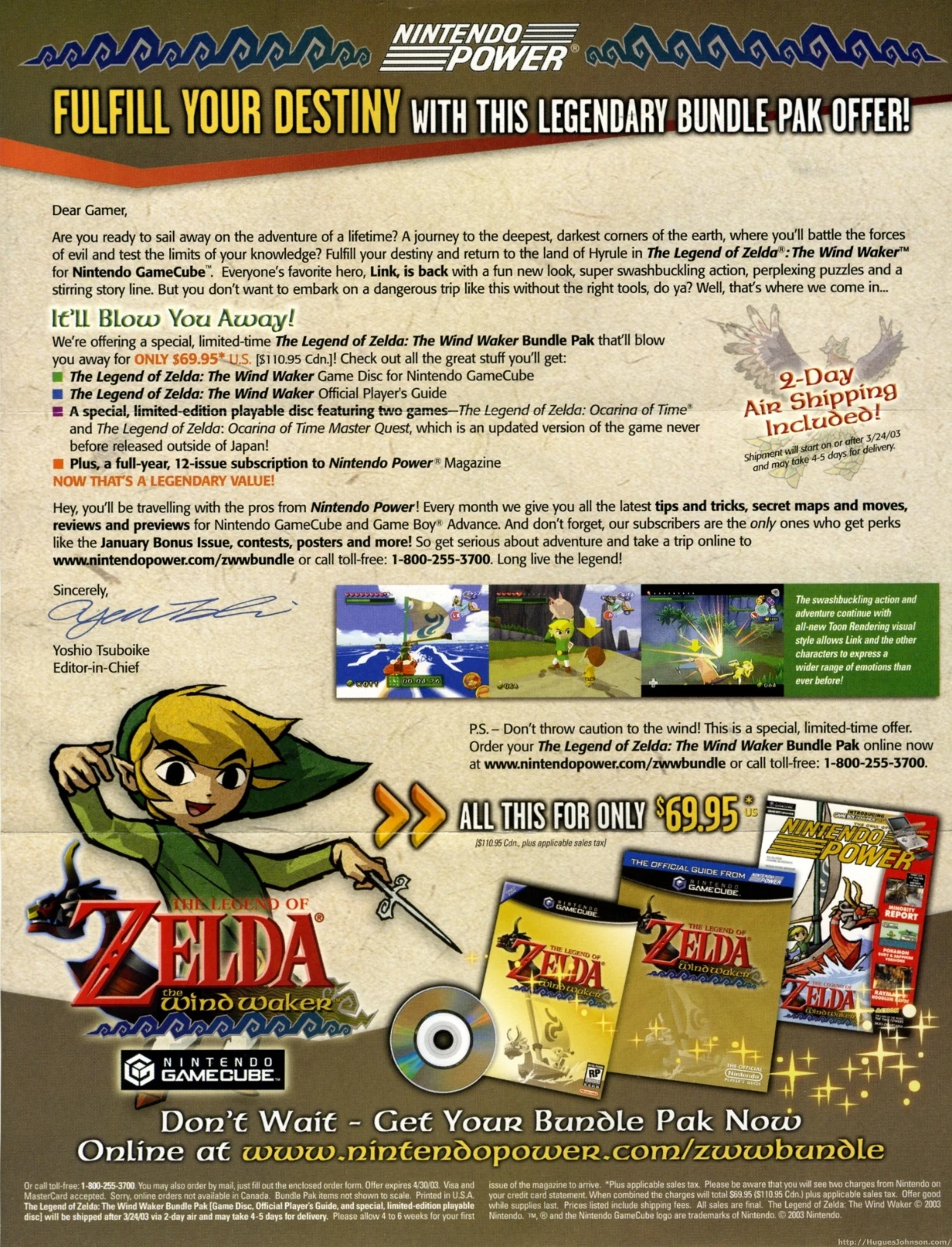
The Wind Waker pre-order bundle.
To drum up pre-orders, Nintendo offered something fans had wanted for years: a GameCube disc holding Ocarina of Time plus “Ura Zelda”, the remixed version with rearranged dungeons that had been planned for the ill-fated 64DD add-on. In Japan it was announced as a limited pre-order gift, but on 22 November 2002, six days before pre-orders opened, Nintendo changed the plan so that every pre-order would get one.
Western fans noticed, and Nintendo of America followed suit. Its pre-sell began on 16 February 2003 with the disc renamed Ocarina of Time Master Quest; NoA’s Peter MacDougall said fans had been “begging us to do it here”. By 12 March more than 560,000 people had reserved the game, which Nintendo called its most successful pre-sell ever. In Europe the disc simply came in the box.
Music of the Great Sea
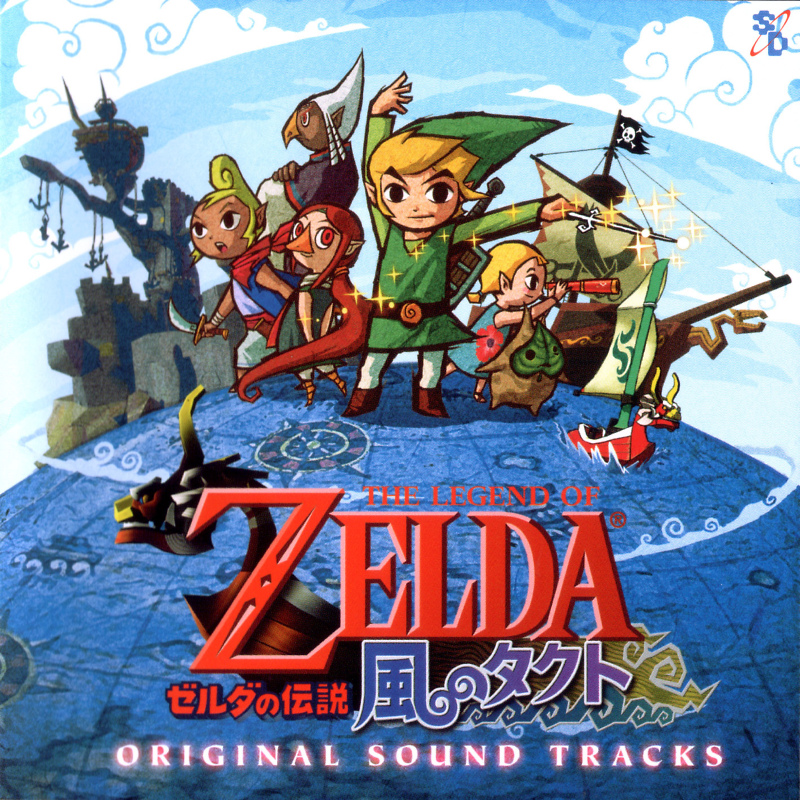
Cover of The Wind Waker Original Sound Tracks.
Kenta Nagata, Hajime Wakai, Toru Minegishi and veteran Koji Kondo wrote a score that changes with place, time and situation, from breezy sailing tunes to tense dungeon music. Its folk instruments give it a distinctly Irish feel, and several classic Zelda melodies were reworked for it. Scitron released a two-disc soundtrack with 133 tracks in Japan in 2003.
Firsts: what this game introduced
Plenty of series staples made their debut on the Great Sea.
1Cel-shading and Toon LinkThe first Zelda drawn in a cel-shaded, cartoon style, and the debut of the Link design later called Toon Link.
2The Rito and the KoroksTwo new peoples, both descended from older ones: the Rito from the Zora, the Koroks from the Kokiri. Both are central to Breath of the Wild.
3TetraZelda reimagined as a pirate captain who has no idea she is a princess.
4BeedleThe travelling merchant made his debut here and has turned up in many Zeldas since.
5Eyes as hintsLink’s gaze points to things worth checking, an idea Aonuma says began here.
6A sea to sailA whole overworld of open water, with wind direction, sea charts and salvage.
7ParryingTimed counter-attacks, essential for stripping the armour off Darknuts.
8Free cameraFor the first time in a 3D Zelda, players could swing the camera around Link themselves.
Cheats & secrets
The Wind Waker has no cheat codes, but it is stuffed with secrets. These are the best ones.
Second Quest
Aryll, held captive, in the Second Quest (The Wind Waker HD).
Finish the game and you can play through it again. Aryll wears a new pink dress with a skull design, and Link can now understand what Jabun says in ancient Hylian.
Hurricane Spin
The Hurricane Spin.
Orca writes to Link asking him to gather ten Knight’s Crests, something he and his brother gave up on as young men. Bring him all ten and he teaches you the Hurricane Spin.
Orca’s training
Link and Orca.
Keep landing hits on Orca during sword practice. 500 hits earn a Piece of Heart, and at 999 he calls you “Master Link”.
Tingle Tuner and Tingle Statues
The Tingle Tuner.
Free Tingle from Windfall’s jail to get the Tingle Tuner. Connect a Game Boy Advance with a link cable and a friend can help as Tingle with hints and Tingle Bombs, and track down the Tingle Statues hidden in the dungeons.
Beedle’s points
Official art of the Complimentary ID.
Every purchase at Beedle’s Shop Ships earns points that add up to small discounts and rewards.
The Savage Labyrinth
The Savage Labyrinth.
A monster gauntlet hidden under Outset Island. Players of the Western versions find a Piece of Heart inside that Japanese players dug up under Grandma’s house instead, and in the HD version the Hero’s Charm waits at the end.
Changes in the HD version
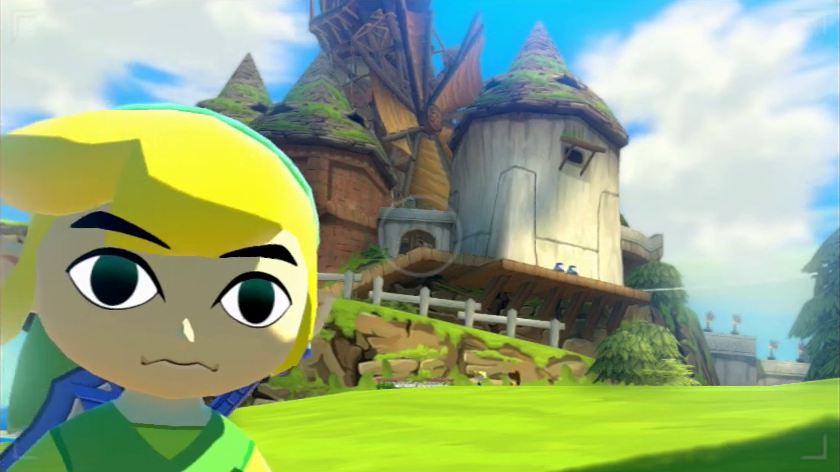
A Picto Box selfie in The Wind Waker HD.
The Swift Sail, auctioned on Windfall, doubles your speed and always keeps the wind behind you. Hero Mode, available from the start, doubles damage and removes Recovery Hearts. The Picto Box holds 12 photos and can take selfies, and the Deluxe Picto Box arrives after Lenzo’s photo requests without needing a bug from the Forest Haven.
Checked against Zelda Dungeon and the Zelda Universe Wind Waker HD changes list, November 2026.
Glitches, exploits and oddities
Speedrunners have been taking The Wind Waker apart for more than twenty years, and both versions have quirks of their own.
Barrier Skip
Hyrule Castle under the sea.
A magic barrier walls off the endgame until you have restored the Master Sword and assembled the Triforce of Courage. In August 2016 the runner LinkOscuro got through it in The Wind Waker HD using a remaster-only trick called Item Sliding. In January 2018 gymnast86 found a far more reliable method involving a Morth killed on the right frame. The GameCube original held out until July 2019, when runners found that filling memory with heaps of arrows stops the barrier loading at all.
Item Sliding and superswimming
Link swimming (The Wind Waker HD).
Found in the HD version in 2016, Item Sliding builds up huge momentum and unlocked superswimming and other skips. For years it made the HD speedrun the faster category; in November 2024 the GameCube record finally edged ahead again after a run of new discoveries.
Puppet Ganon skip
Puppet Ganon’s second form (The Wind Waker HD).
A frame-perfect trick that skips the Puppet Ganon fight, once only seen in tool-assisted runs, has since been attempted by GameCube runners.
Left in the disc
Data-miners have found a debug map select, development test maps, an unused model of Saria with parrots, and an unused cutscene of Tetra in the treetops.
Fixed in HD
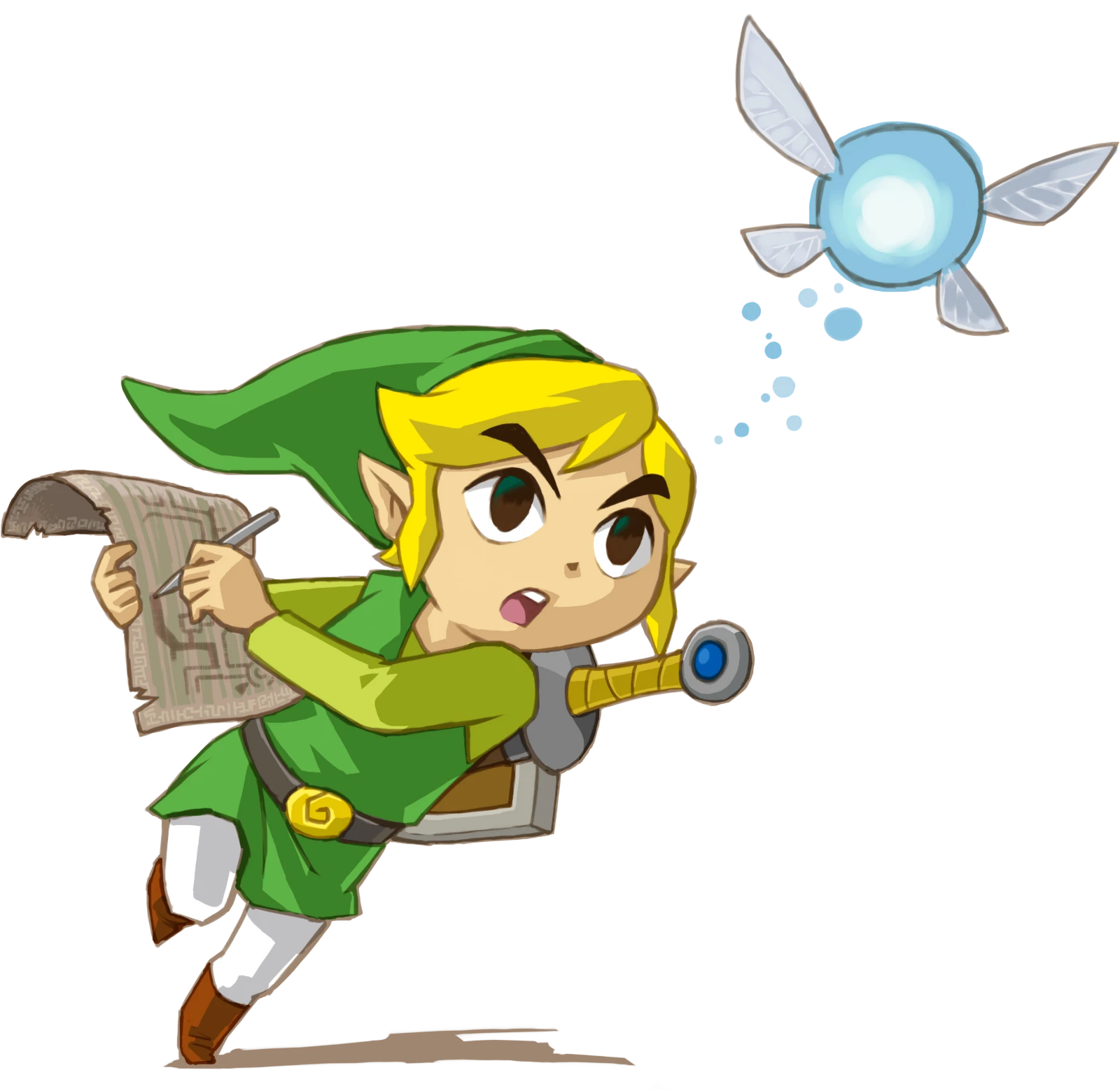
The Wind Waker, in art for the HD version.
The remaster removed a glitch that let Link conduct the Wind Waker while falling.
Videos & media
Two official Nintendo videos: Eiji Aonuma’s E3 2013 developer presentation on the HD remaster, and the trailer that brought the GameCube original to Nintendo Switch 2.
Nintendo of America’s E3 2013 Developer Direct, in which the team walks through the HD remaster.
Nintendo of America’s April 2025 announcement trailer for the GameCube library on Nintendo Switch 2, with The Wind Waker in its launch line-up.
Trivia & facts
The Japanese logo.Kaze no Takuto, the Japanese subtitle, means roughly “the wind baton”.
It was only the fourth game to score a perfect 40 out of 40 in Famitsu, after Ocarina of Time, SoulCalibur and Vagrant Story.
The Space World 2000 demo.The realistic Space World 2000 clip was made by Yoshiki Haruhana and Satoru Takizawa, the same two artists who went on to create the toon look.
Aryll was originally going to be called Mariru, in the tradition of Marin and Malon.
Aonuma wrote the King of Red Lions’ lines while his son was a newborn. For the HD version he toned down the boat’s speeches, which he felt sounded a little self-important.
Somebody on the team suggested Link could fire beams from his big eyes. It did not get far.
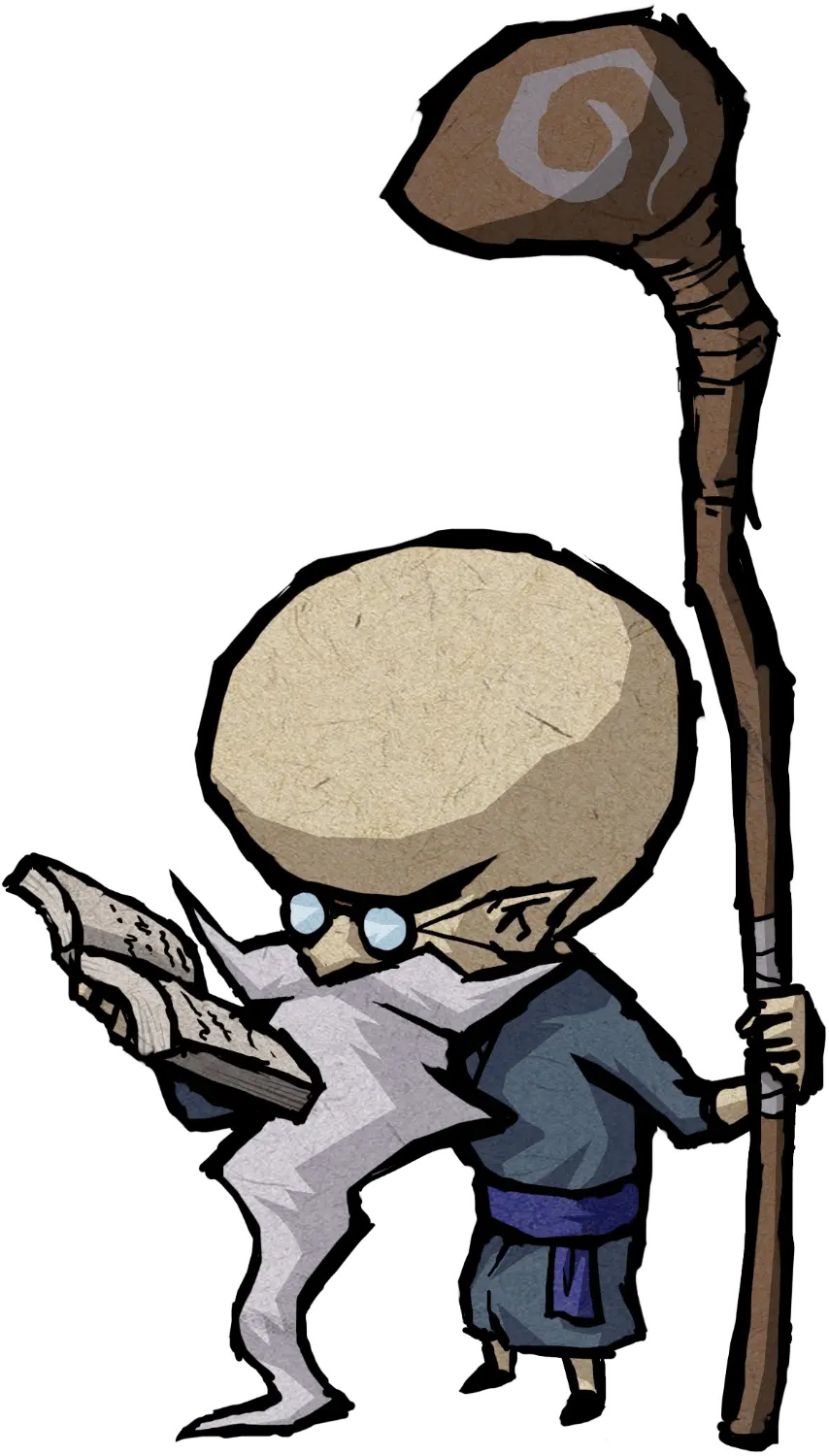
Official art of the Rito Chieftain.According to Aonuma, the Rito are an evolved form of the Zora, and the Koroks share the Kokiri bloodline. That is why Medli, a Rito, can inherit the role of Laruto, a Zora.
Makar’s instrument looks like a cello, but it is a violin.
Tingle charges 398 Rupees to decipher each Triforce Chart, more than 3,000 for the full set.
Rauru’s stained-glass window.The stained-glass windows around the Master Sword’s pedestal show the sages from Ocarina of Time.
In Japan the Ocarina of Time bonus disc was first meant to be in limited supply; on 22 November 2002 Nintendo promised one to every pre-order. The Japanese disc also carried 11 promotional videos for other games.
Nintendo of America shipped 1.1 million copies for its launch, and GameCube sales rose by a fifth in the following days.
Iwata suggested that because the GameCube sold modestly, many people who would have loved the game simply never got round to playing it until later.
The HD remaster took about six months to make, according to Aonuma. Rather than remodelling everything, the team converted the GameCube data and ran it through new Wii U lighting.
Official art of Sturgeon, Orca’s brother.The HD team pointed out that the sharper visuals make the brothers Orca and Sturgeon look much more obviously related.
Aryll’s Super Smash Bros. Brawl trophy says her telescope has turtle markings. It actually has seagulls.
Masanao Arimoto, Yoshiki Haruhana and Satoru Takizawa collected the 2004 Game Developers Choice Award for Excellence in Visual Arts.
Of the 1.15 million copies of The Wind Waker HD sold by the end of 2013, only about 90,000 were sold in Japan.
Media & artwork
Box art, official artwork and screenshots from The Wind Waker and its re-releases. Select any image to see it larger.
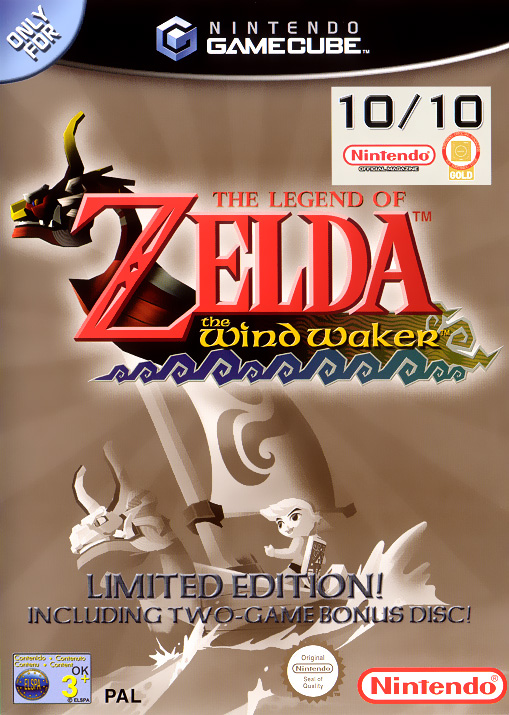
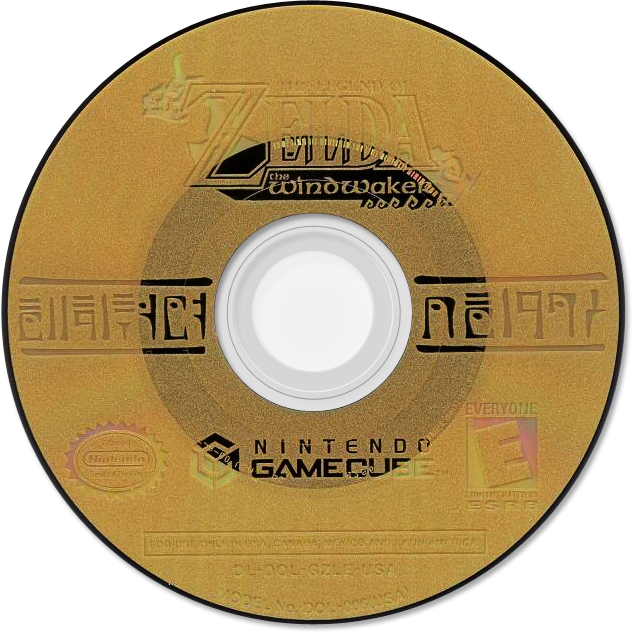
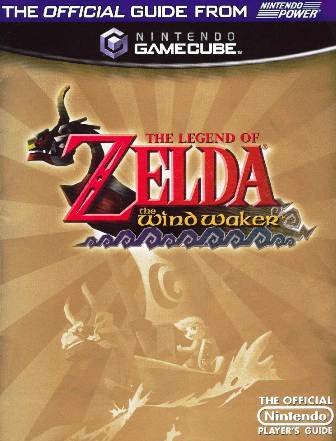
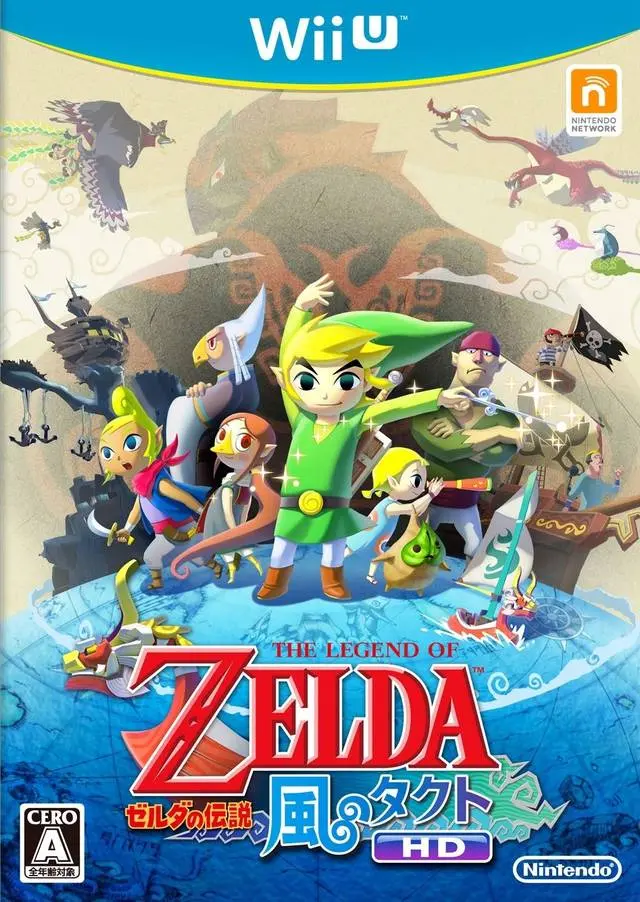
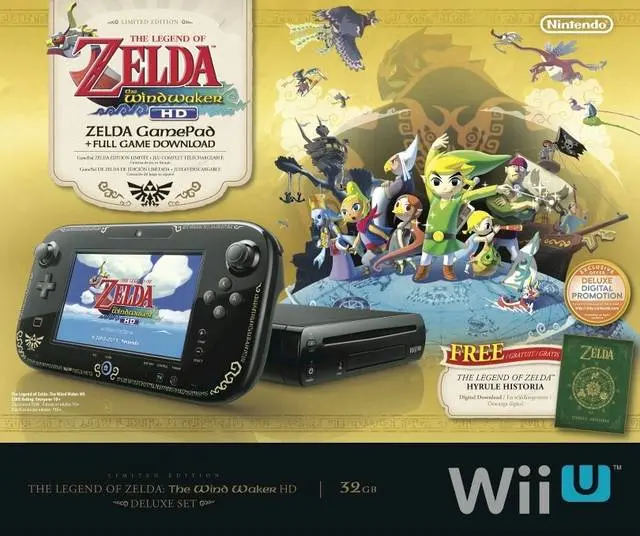
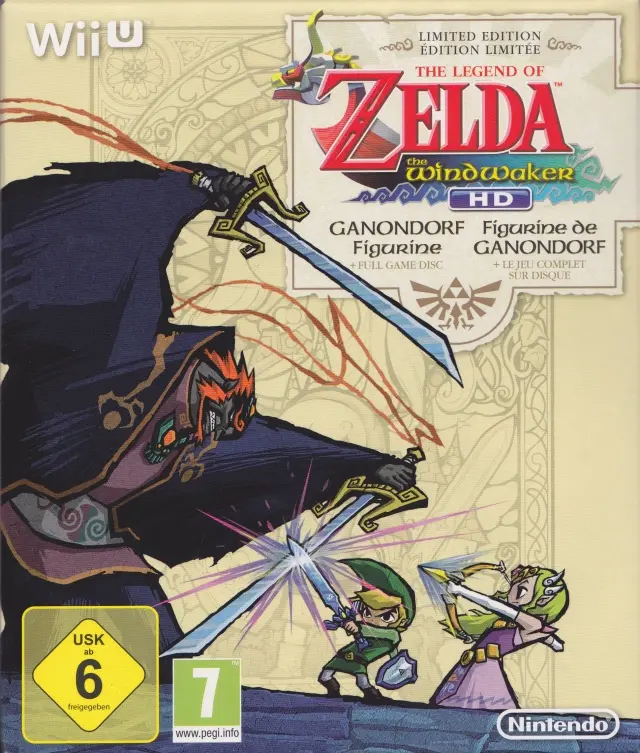
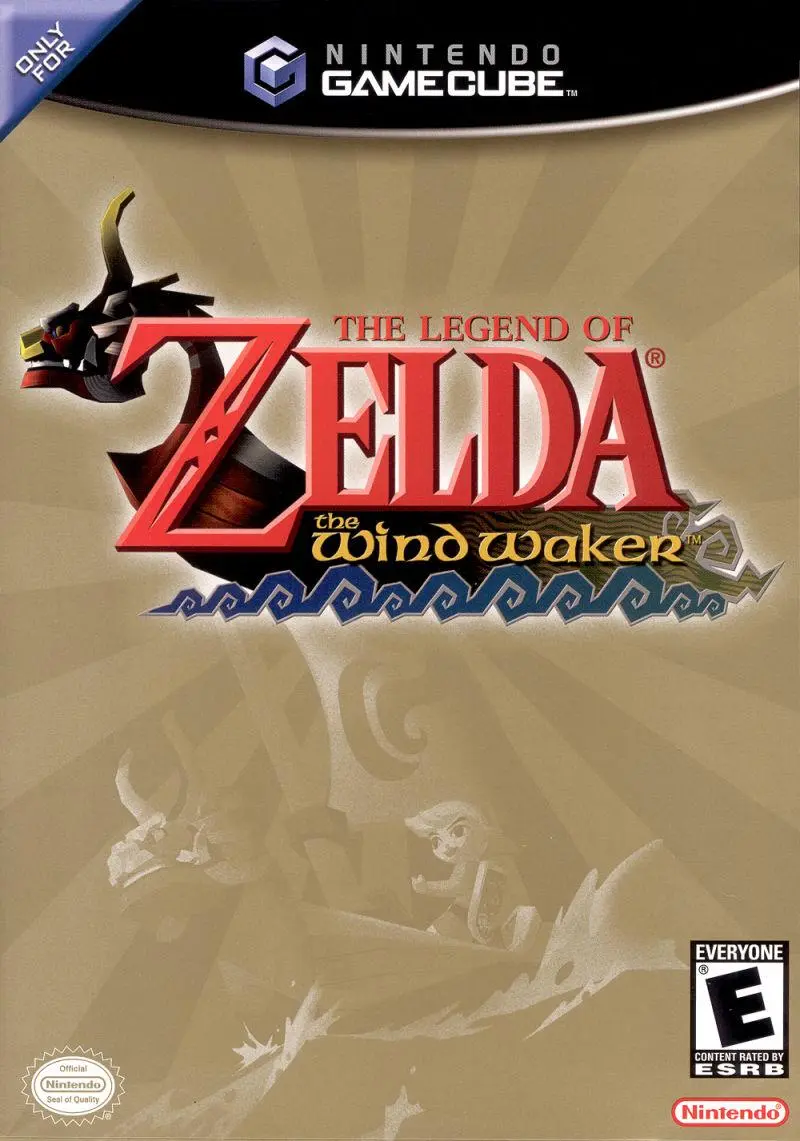
Japanese GameCube box (2002)UK GameCube box (2003)North American GameCube box, backEuropean limited edition boxNorth American game discThe Great Sea map screenNintendo Power guideThe Wind Waker HD, Japanese Wii U box (2013)European Wii U 32GB bundle with The Wind Waker HDEuropean limited edition of The Wind Waker HD with the Ganondorf figurine
The Wind Waker divided fans before anyone had played it, but few Zeldas have aged as gracefully. Its look and its cast have kept coming back for more than two decades.
From GameCube to Nintendo Switch 2
Space World 2000 tech demoAugust 2000 – A realistic Link fights Ganondorf at the GameCube’s unveiling.
Space World 2001 revealAugust 2001 – The cel-shaded Zelda is shown to the press.
Ocarina of Time / Master Quest discNovember 2002 – 2003 – Pre-order bonus in Japan and North America; packed in with the game in Europe.
GameCube13 December 2002 – Japan first; North America on 24 March 2003, Europe on 2 May and Australia on 7 May.
The Legend of Zelda: Collector’s EditionNovember 2003 – A promotional GameCube disc with four older Zeldas, a playable Wind Waker demo and a retrospective video.
Phantom Hourglass2007 – The direct sequel on Nintendo DS.
Spirit Tracks2009 – A DS follow-up set about a century later, in a new Hyrule.
The Wind Waker HD20 September 2013 – Wii U remaster: North American eShop first, Japan on 26 September, then Europe and North American shops on 4 October.
Nintendo GameCube – Nintendo Classics5 June 2025 – The original returns on Nintendo Switch 2 for Nintendo Switch Online + Expansion Pack members.
The “Zelda cycle”
Official art of Link laughing.
In the 2013 Iwata Asks, Nintendo openly discussed what NoA’s Bill Trinen calls the Zelda cycle: a new Zelda gets panned for being different, and a few years later fans hold it up as the gold standard. The Wind Waker is the textbook case. The same North American fans who had largely rejected it in 2001 cheered the HD remake when it was announced in January 2013.
The Wind Waker HD
The Wind Waker HD, North American Wii U box (2013).
Announced in a Nintendo Direct on 23 January 2013, the Wii U remaster was directed by Daiki Iwamoto and produced by Aonuma, with Takizawa, Arimoto and programmer Takuhiro Dohta refining the original data. Instead of rebuilding the models, the team ran the GameCube assets through new lighting and shaders, with outside artists helping with high-resolution textures. Gameplay changes aimed at the original’s slow second half: the Swift Sail, a shortened Triforce hunt in which five charts are replaced by the shards themselves, faster menus and text, Hero Mode, and the Tingle Bottle, which sent messages over Miiverse until that service closed. A limited Wii U bundle came with a black GamePad decorated in gold Hylian patterns; in North America it also included a download code for Hyrule Historia. It scored 90 on Metacritic and sold 1.22 million copies by March 2014.
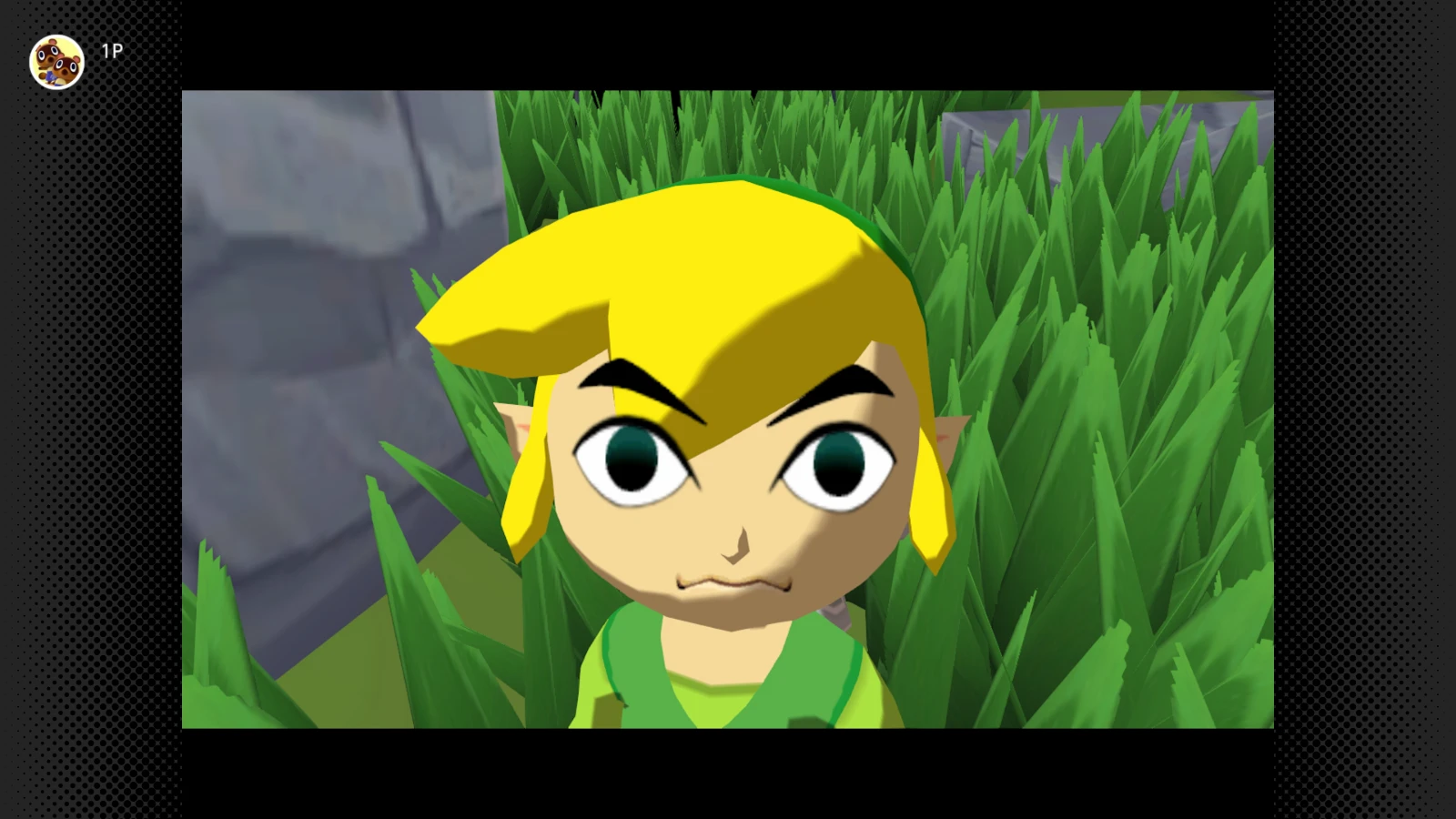
A Nintendo promotional screenshot for the Nintendo Classics release.
The GameCube original is available on Nintendo Switch 2 through Nintendo GameCube – Nintendo Classics, part of Nintendo Switch Online + Expansion Pack, with clearer images and a higher resolution than the original release.
Sales & reviews
Sales figures
Pre-orders were huge. Nintendo of America had more than 560,000 reservations a fortnight before launch, its best pre-sell to that point, and Gamasutra reported over 600,000 pre-sold copies and a launch shipment of 1.1 million. Sales then cooled, and the game finished at about 4.6 million copies worldwide. The Wind Waker HD added 1.15 million by the end of 2013 and 1.22 million by 31 March 2014, and Nintendo’s life-to-date figure for it stood at 2.37 million by 31 March 2026.
560,000+NA pre-orders by 12 March 2003
1.1minitial North American shipment
4.6mGameCube copies sold worldwide
1.22mWind Waker HD by March 2014
Reception and review scores
Critics loved it. Metacritic averages 80 reviews at 96. These are period reviews where we could confirm the outlet and score.
FamitsuJapan · December 2002 (10/10/10/10)
40/40
Game InformerUS · April 2003
10/10
Nintendo PowerUS · April 2003
5/5
Nintendo World ReportUS · 24 March 2003 (Billy Berghammer)
Reviewers raved about the animation and the sense of adventure; many compared it to a playable cartoon film. The common complaints were the amount of sailing, especially during the Triforce hunt, how often you have to stop and conduct a song to change the wind, and a low level of difficulty. GameSpot, for one, felt the easy puzzles and bosses and the late item hunt held it back, while still calling it a strong achievement. Famitsu’s reviewers went further: one said it outdid Ocarina of Time.
Honours
Game Critics Awards · E3 2002Best Console GameWon while still untitled, and runner-up for Best of Show.
Game Developers Choice Awards · 2004Excellence in Visual ArtsCollected by Masanao Arimoto, Yoshiki Haruhana and Satoru Takizawa.
Interactive Achievement Awards · 2004Outstanding Achievement in Art DirectionAt the 7th annual awards in Las Vegas.
Famitsu · 2002Perfect 40/40Only the fourth game ever to earn it.
Reader reviews
No reader reviews yet. Played it? Give it a score out of 10 and tell other fans what you think.
Every fact on this page was checked against the sources below in November 2026. Zelda Wiki (zeldawiki.wiki) could not be read, so character and story details were cross-checked between Zelda Dungeon, Zelda Universe, Nintendo’s own interviews and contemporary reporting.
To provide the best experiences, we use technologies like cookies to store and/or access device information. Consenting to these technologies will allow us to process data such as browsing behavior or unique IDs on this site. Not consenting or withdrawing consent, may adversely affect certain features and functions.
Functional
Always active
The technical storage or access is strictly necessary for the legitimate purpose of enabling the use of a specific service explicitly requested by the subscriber or user, or for the sole purpose of carrying out the transmission of a communication over an electronic communications network.
Preferences
The technical storage or access is necessary for the legitimate purpose of storing preferences that are not requested by the subscriber or user.
Statistics
The technical storage or access that is used exclusively for statistical purposes.The technical storage or access that is used exclusively for anonymous statistical purposes. Without a subpoena, voluntary compliance on the part of your Internet Service Provider, or additional records from a third party, information stored or retrieved for this purpose alone cannot usually be used to identify you.
Marketing
The technical storage or access is required to create user profiles to send advertising, or to track the user on a website or across several websites for similar marketing purposes.

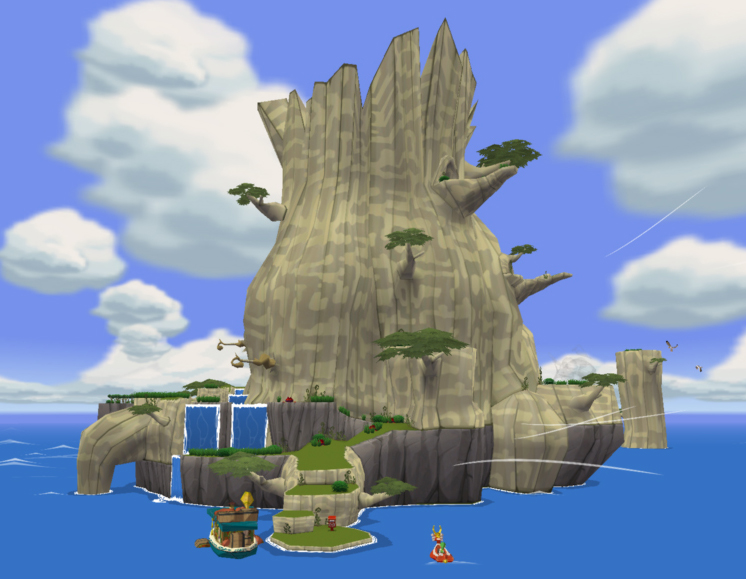
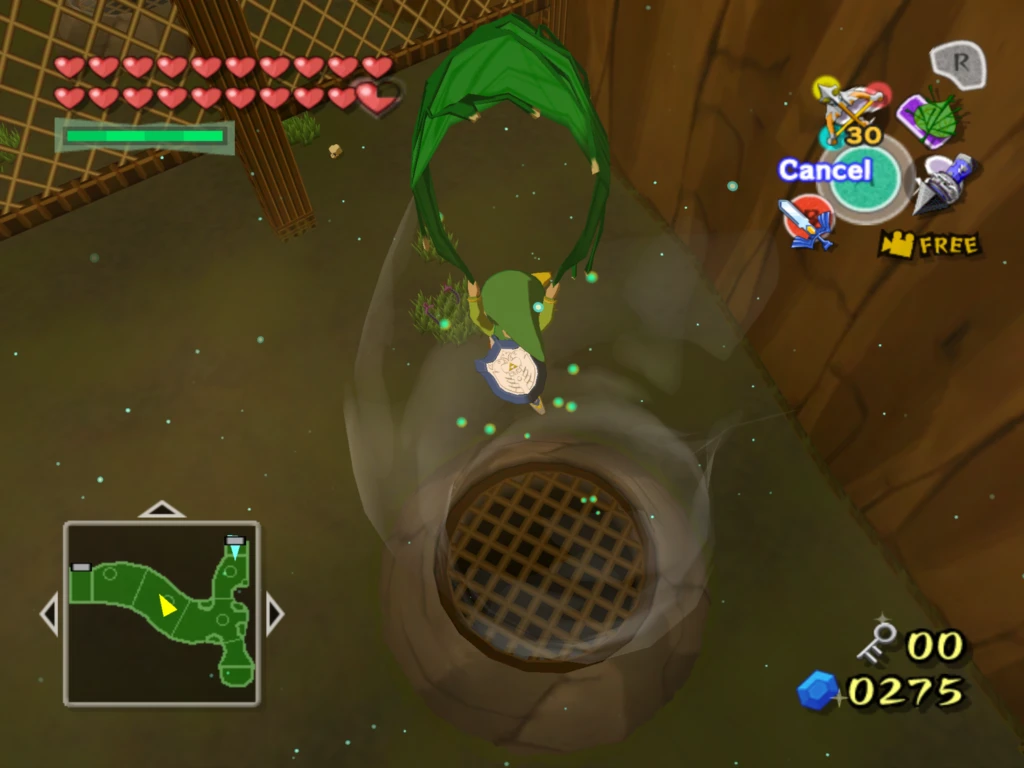
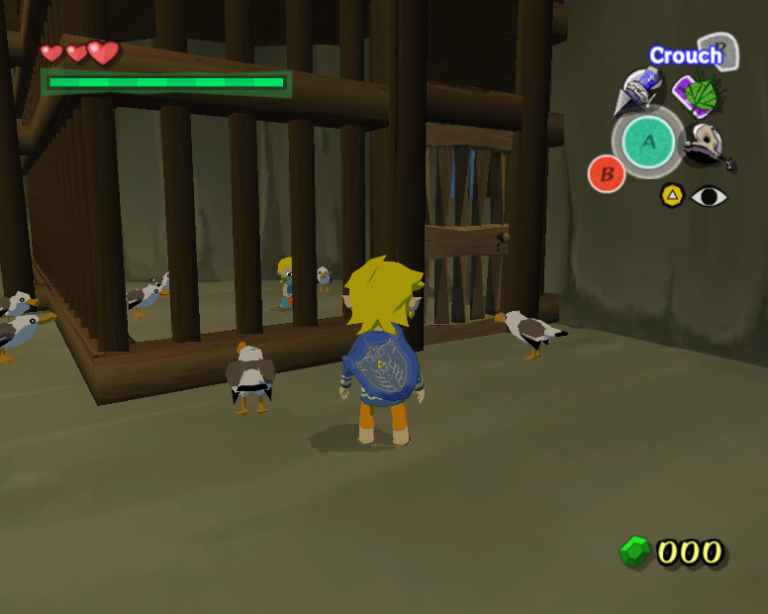 Forsaken Fortress (first visit)StealthSneak in without a sword to find Aryll. No boss: it ends with the Helmaroc King throwing Link out.
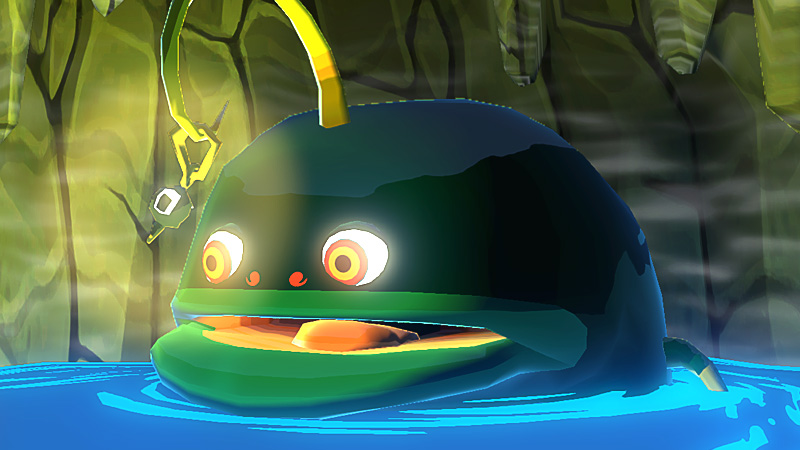
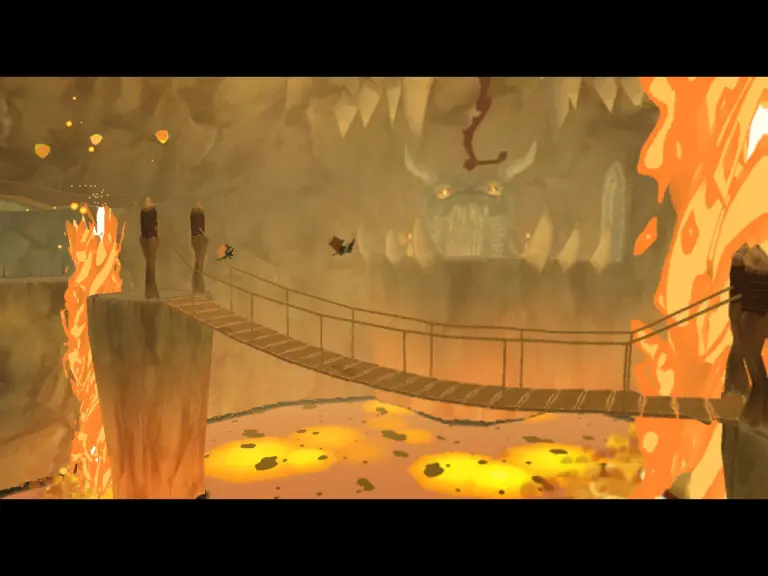 Dragon Roost CavernBoss: GohmaA volcanic cave inside Dragon Roost Island. Item: Grappling Hook. Reward: Din’s Pearl.
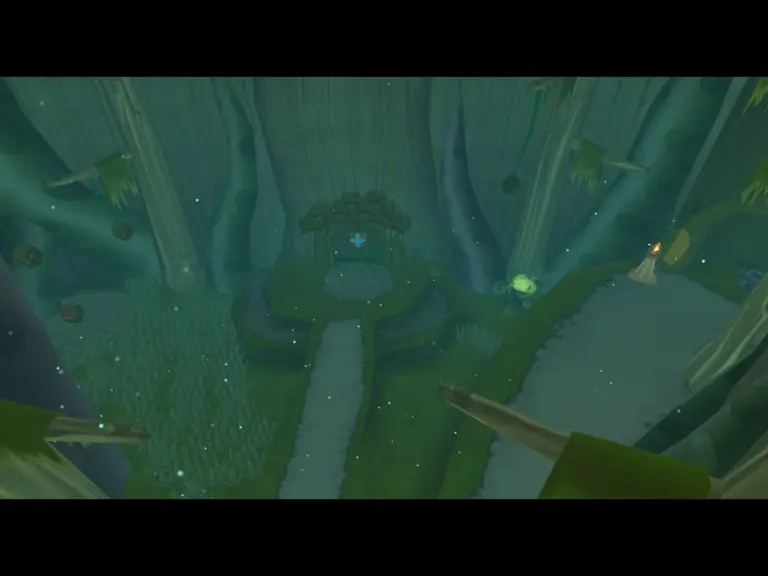 Forbidden WoodsBoss: Kalle DemosAn overgrown island next to the Forest Haven. Item: Boomerang. Reward: Farore’s Pearl.
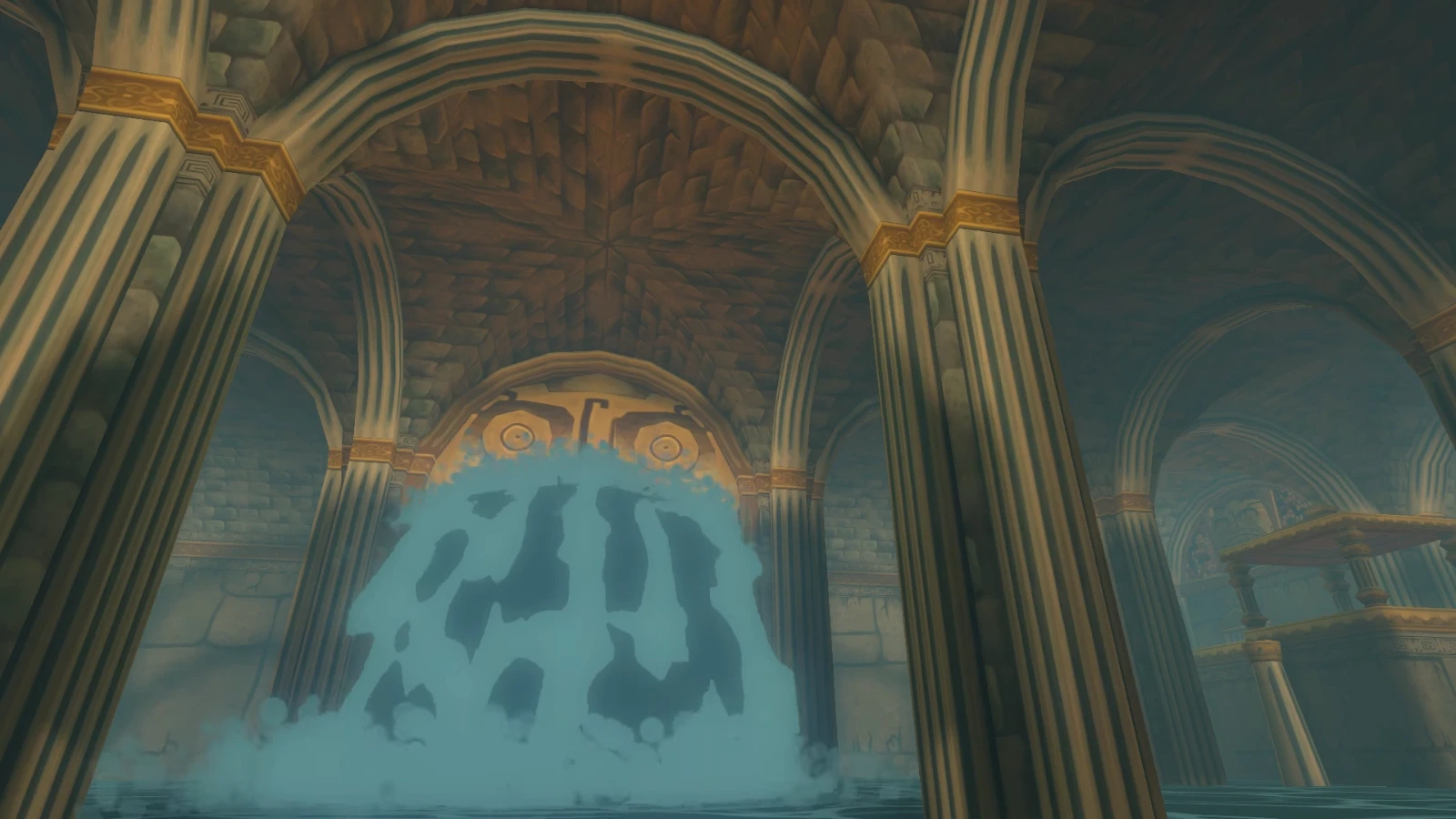
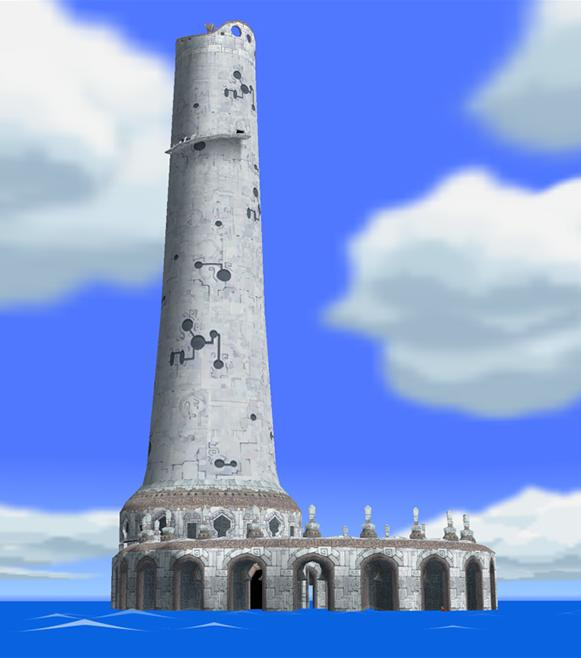 Tower of the GodsBoss: GohdanRaised by the three pearls; a test of courage. Item: Hero’s Bow.
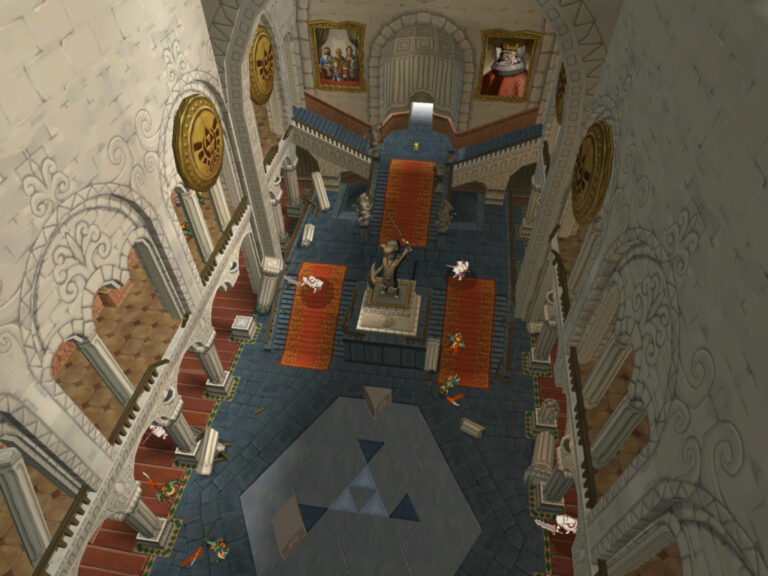 Hyrule CastleMaster SwordThe kingdom frozen beneath the sea, where Link draws the Master Sword.
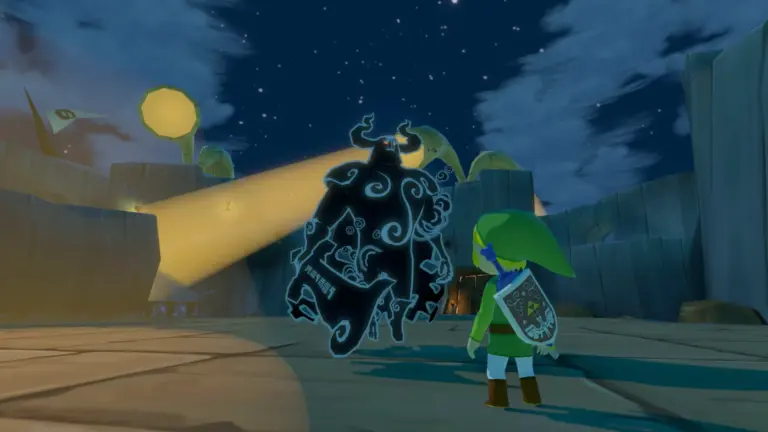 Forsaken Fortress (second visit)Boss: Helmaroc KingPhantom Ganon guards the way. Item: Skull Hammer. Aryll is rescued here.
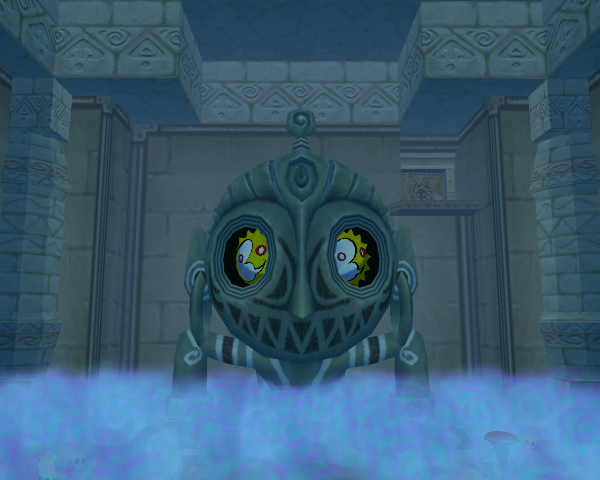 Earth TempleBoss: JalhallaOn Headstone Island, with Medli. Item: Mirror Shield.
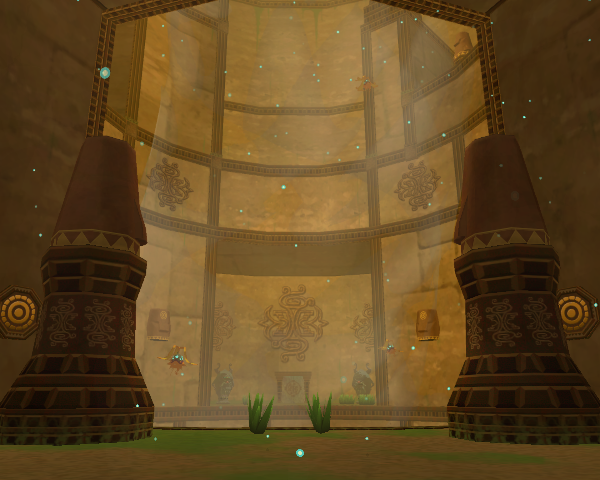 Wind TempleBoss: MolgeraOn Gale Isle, with Makar. Item: Hookshot.
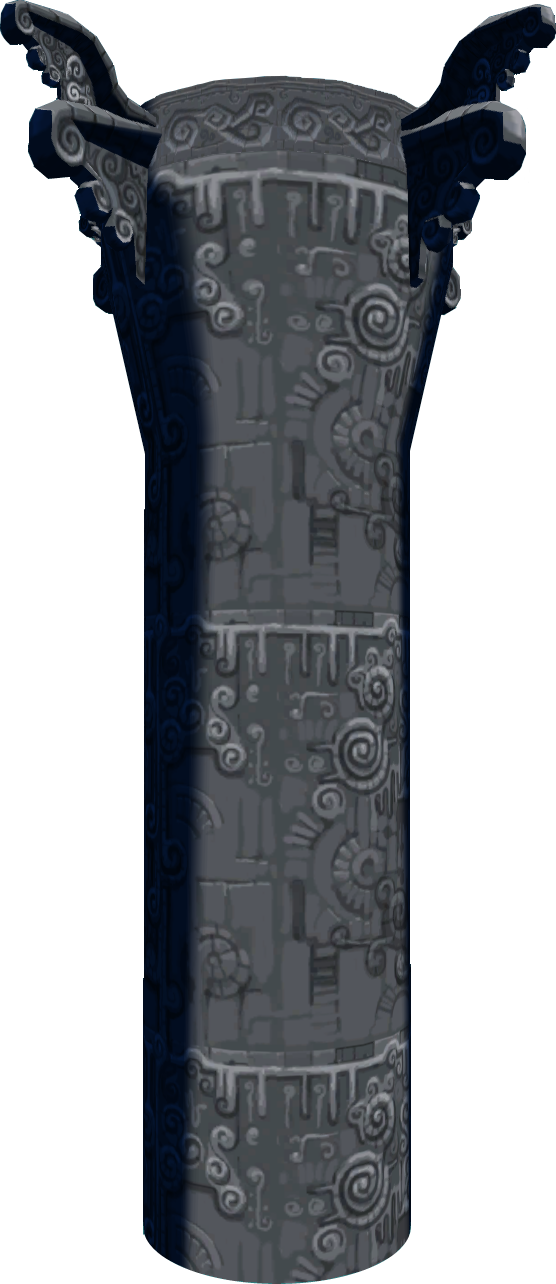 Ganon’s TowerBosses: Puppet Ganon, GanondorfRematches with four earlier bosses, Phantom Ganon’s maze and the Light Arrows.
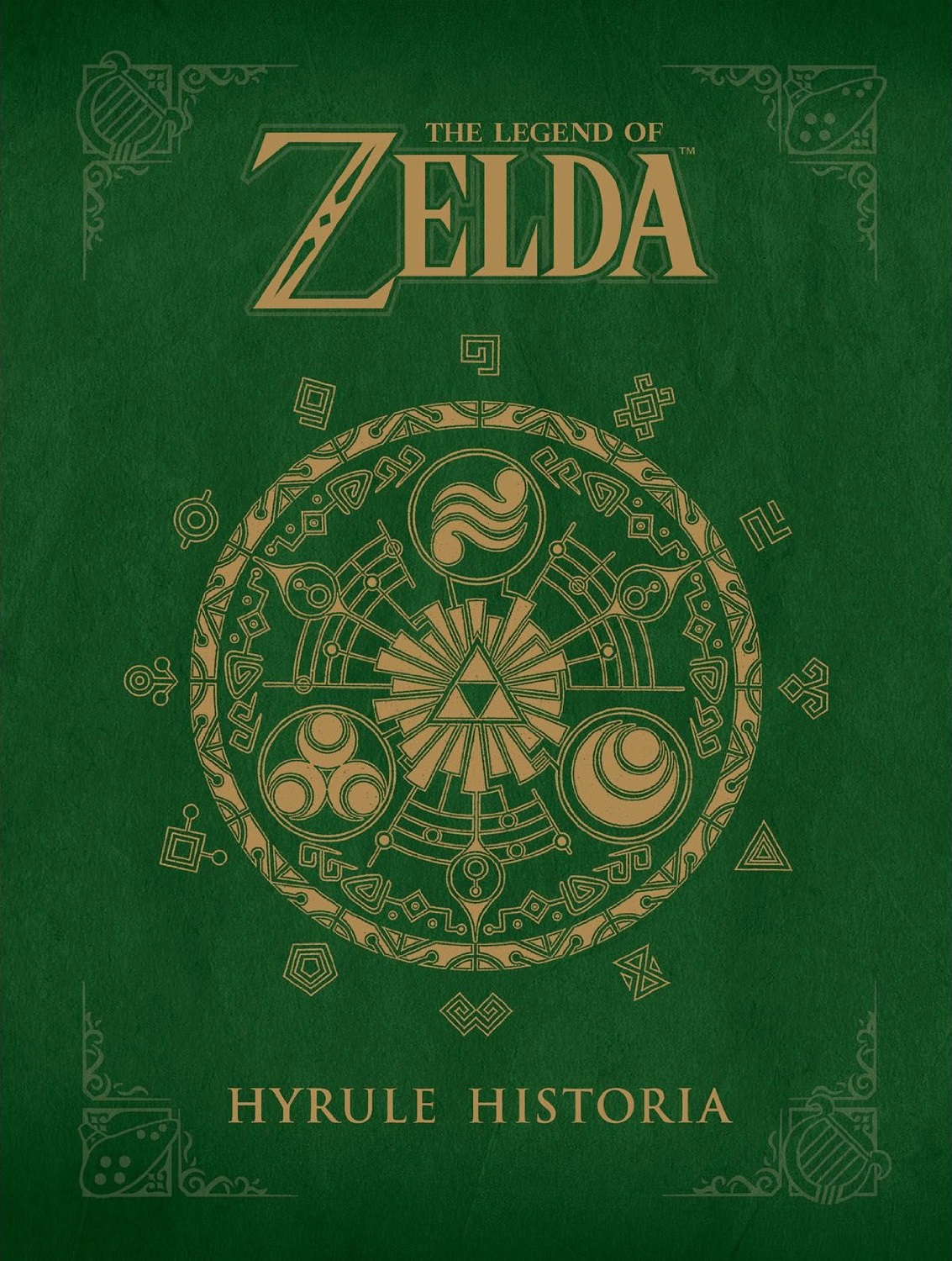 Hyrule HistoriaNintendo · book · 2011The official history that put the series timeline on paper. It places The Wind Waker in the branch where the Hero of Time is sent back to childhood and never returns to the adult future, and names Laruto as the Sage of Earth before Medli.
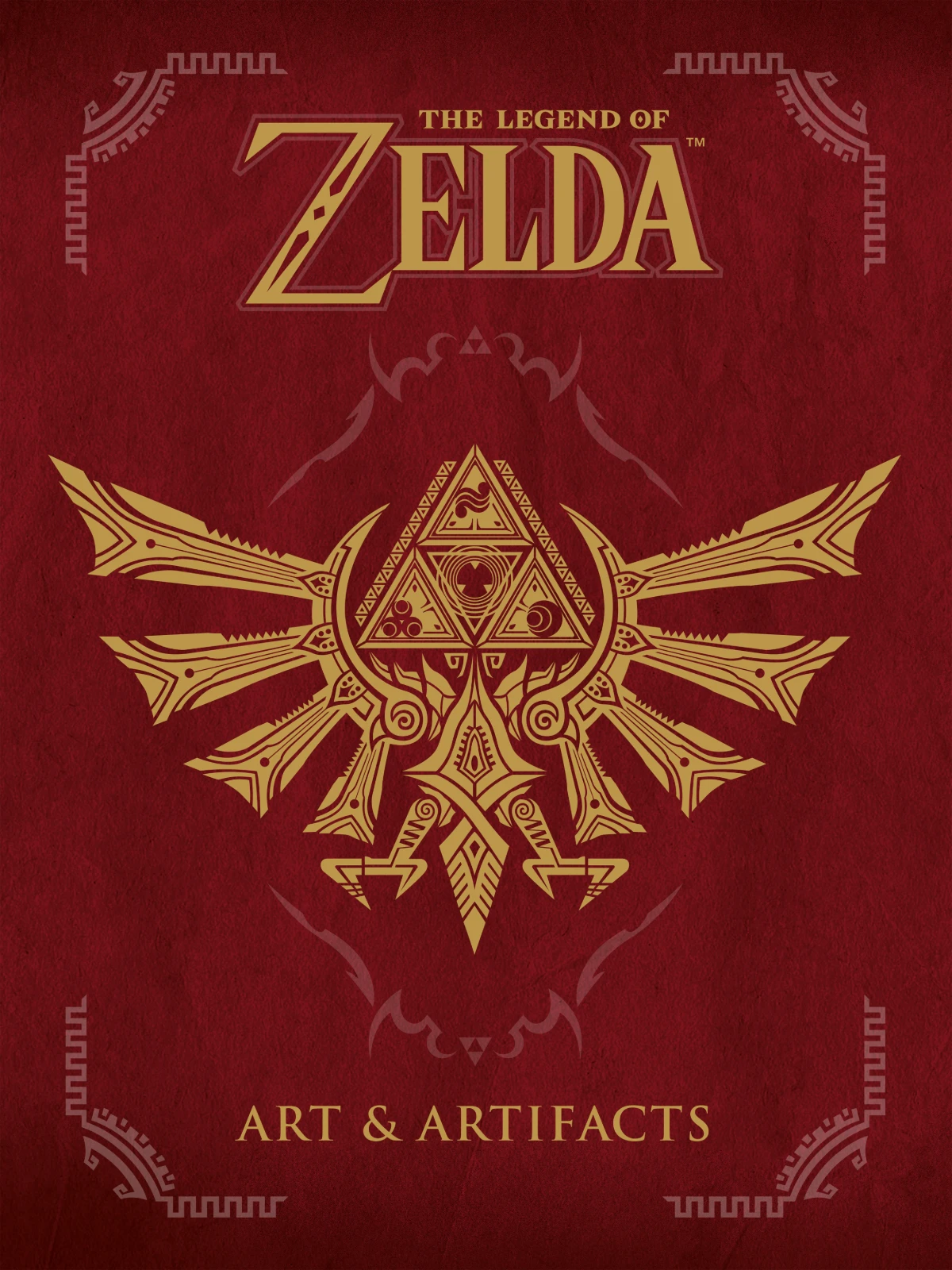 The Legend of Zelda: Art & ArtifactsNintendo · art book · 2017Includes an interview in which Haruhana and Takizawa, who made the Space World 2000 footage, explain why they turned away from realism.
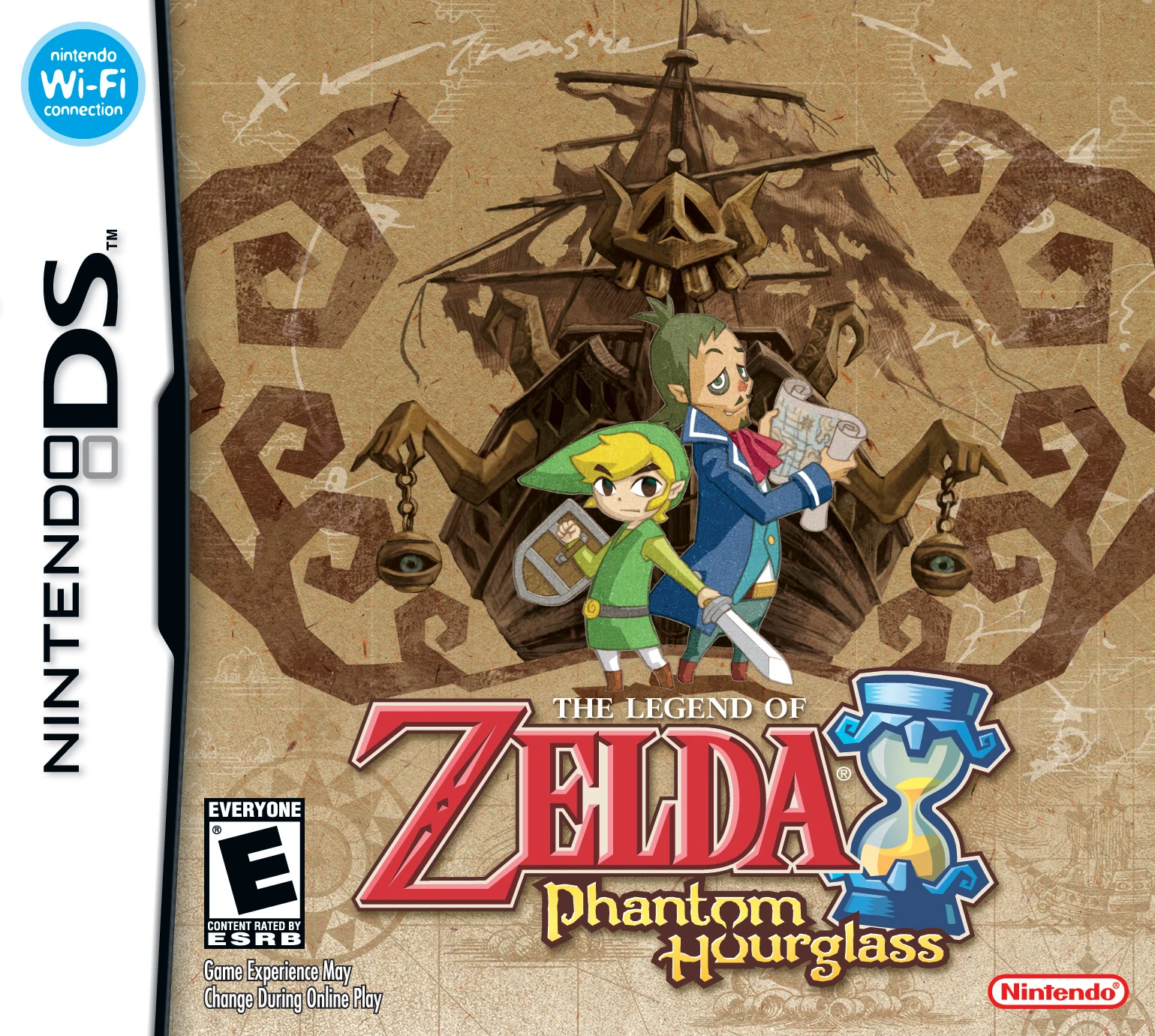 Phantom Hourglass and Spirit TracksNintendo DS · 2007 and 2009The direct sequel follows Link and Tetra across a new ocean; the second is set about a century later in a new Hyrule, and remembers Tetra in a stained-glass window in the castle.
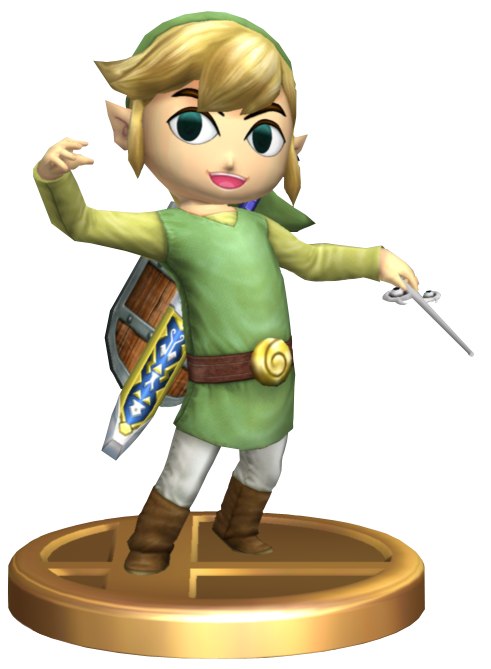 Super Smash Bros.Wii, 3DS, Wii U, Switch · 2008 onwardsToon Link has been playable since Super Smash Bros. Brawl, and characters such as Tetra, Medli and Aryll turned up as trophies and stickers.
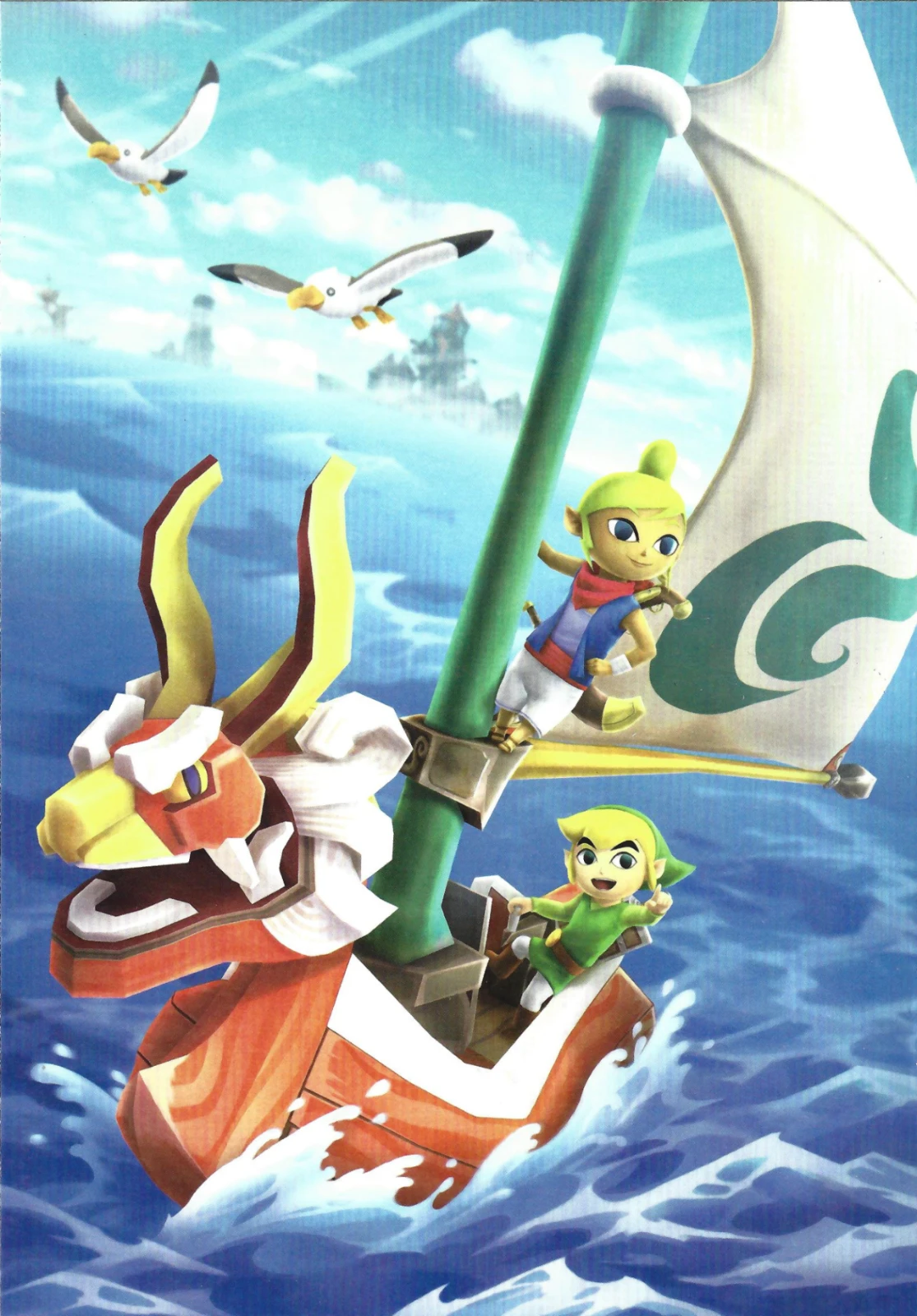 Hyrule Warriors Legends3DS · 2016Toon Link, Tetra (with cutlass and pistol) and King Daphnes, wielding a sail, became playable; Medli joined in a later update.
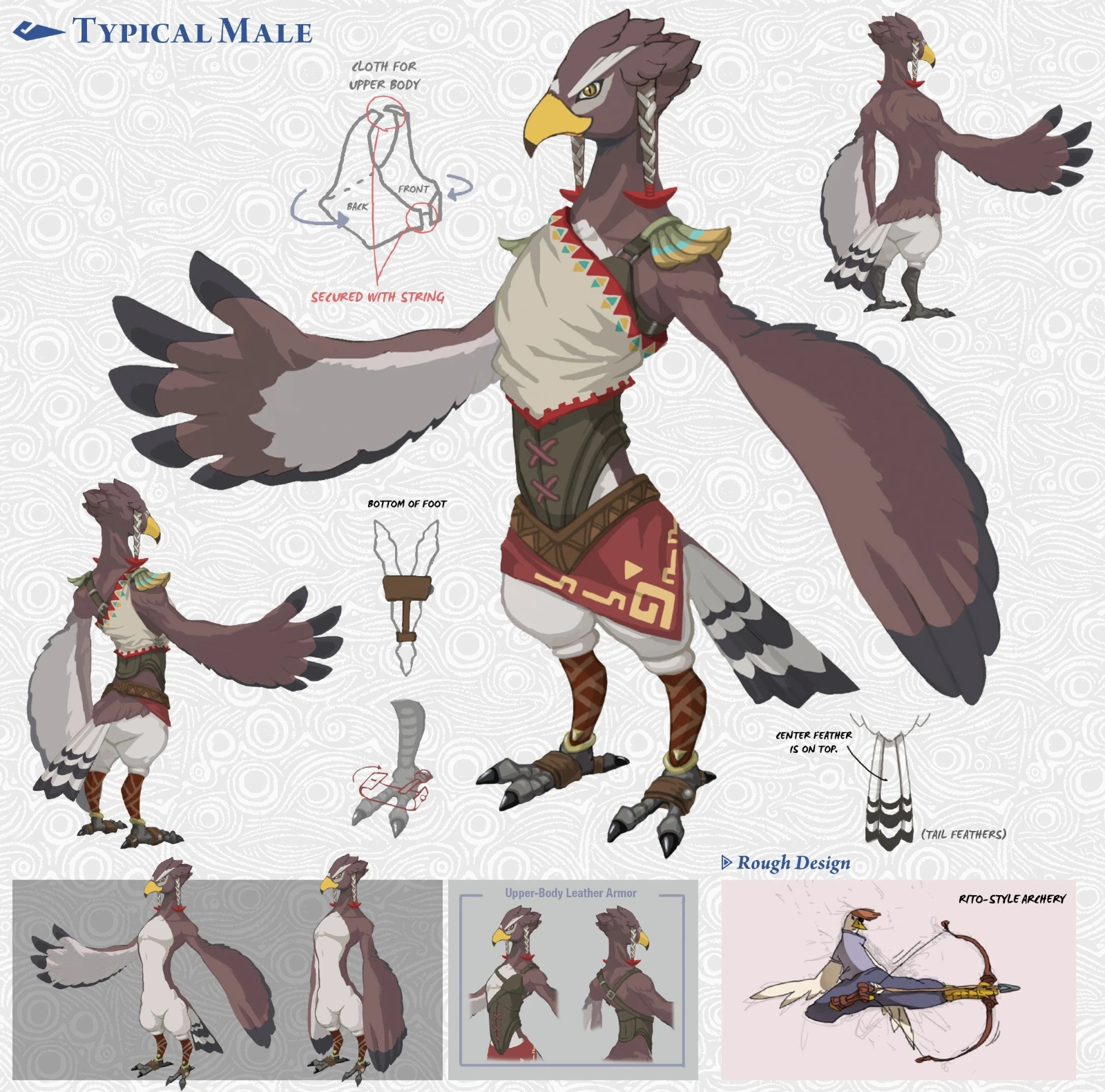 Breath of the Wild and Tears of the KingdomSwitch · 2017 and 2023The Rito and the Koroks, both introduced in The Wind Waker, are major peoples of the later Hyrule.
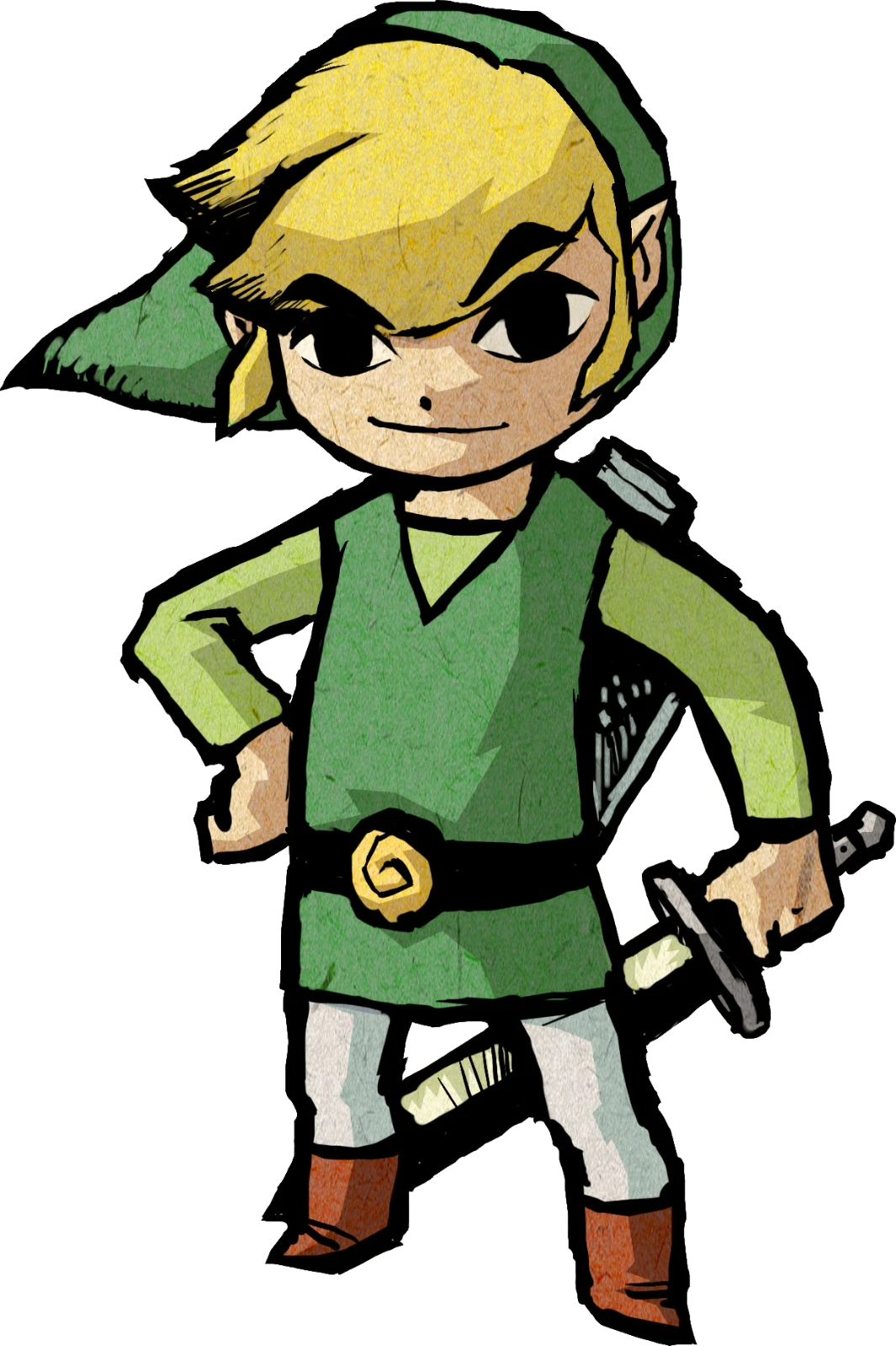 LinkThe Hero of Winds
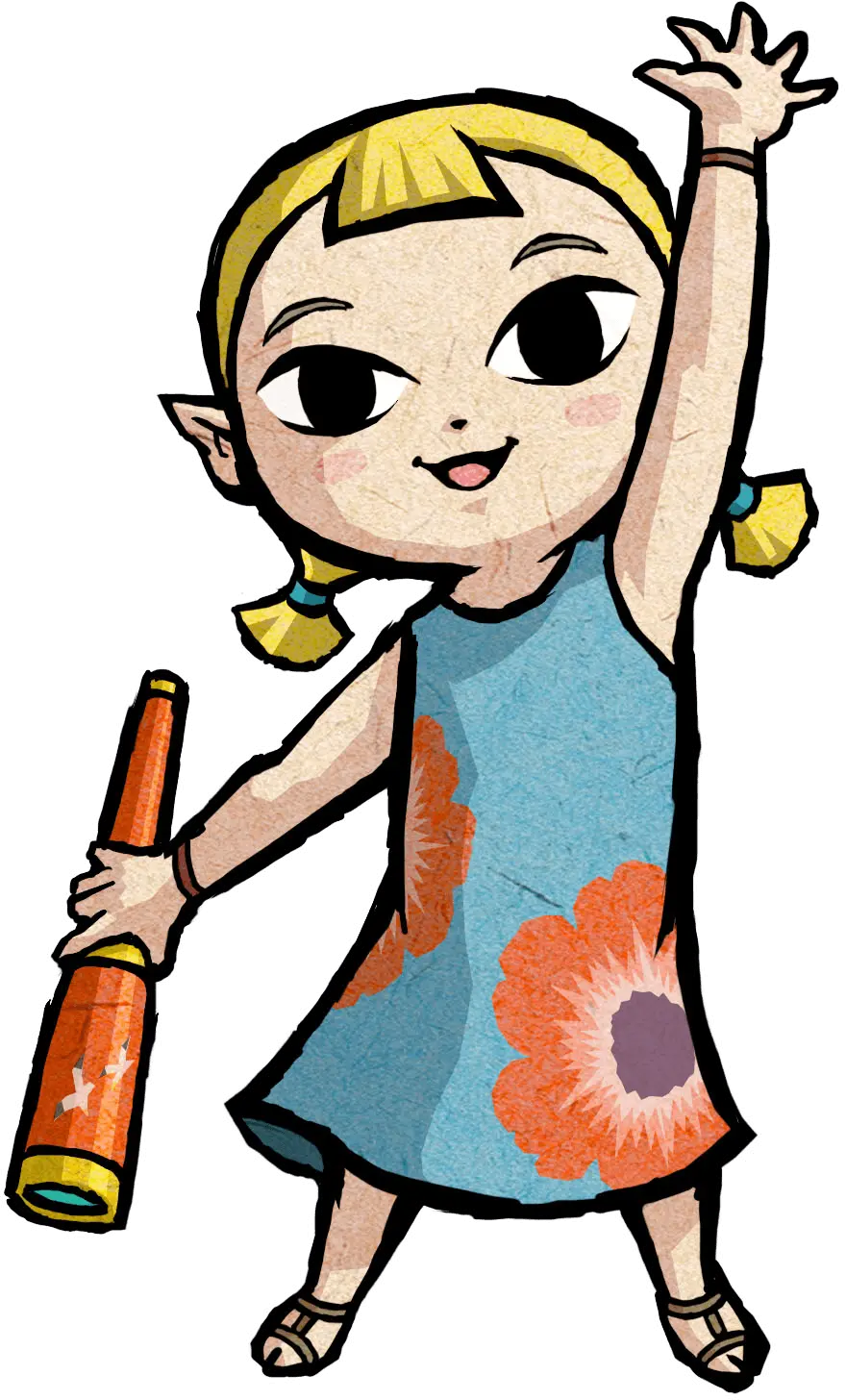 AryllLink’s little sister
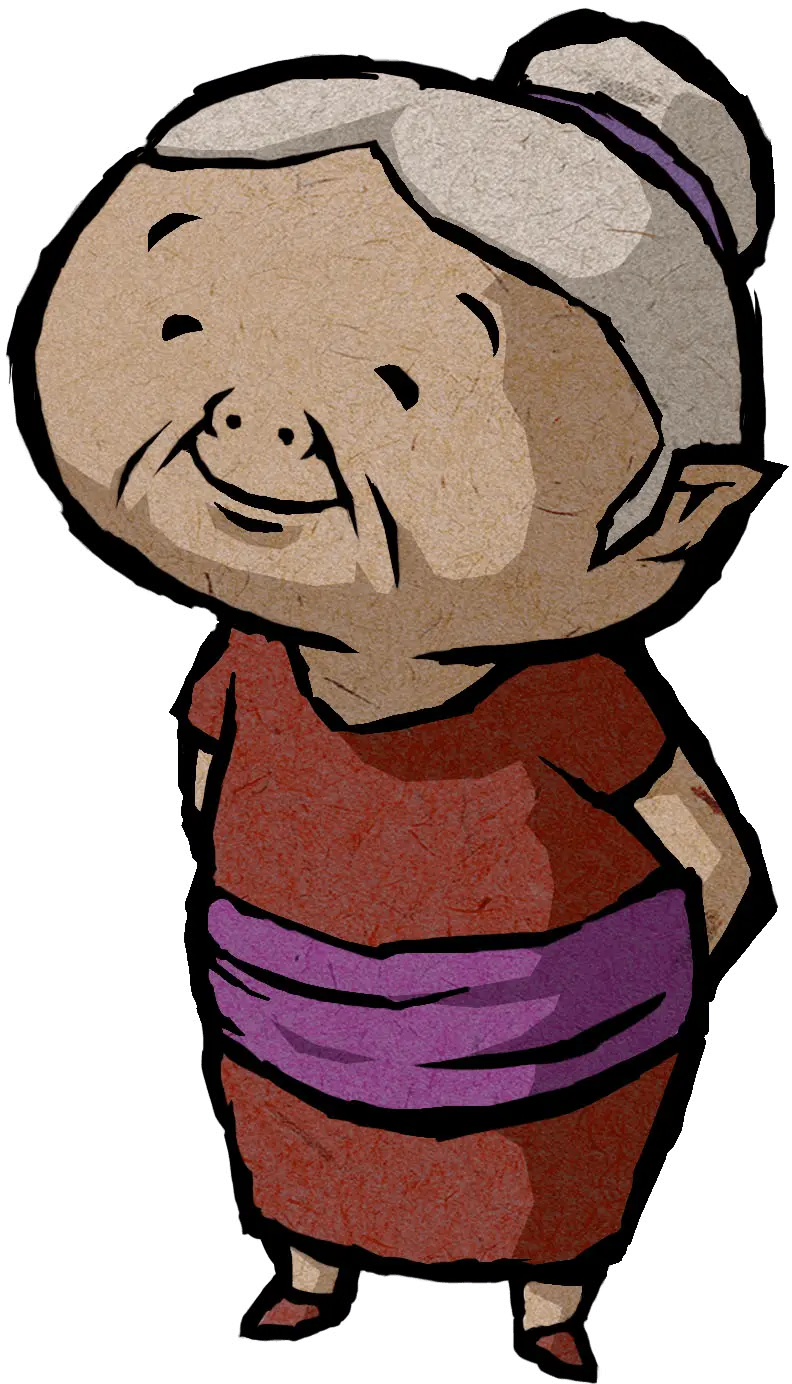 GrandmaLink’s grandmother
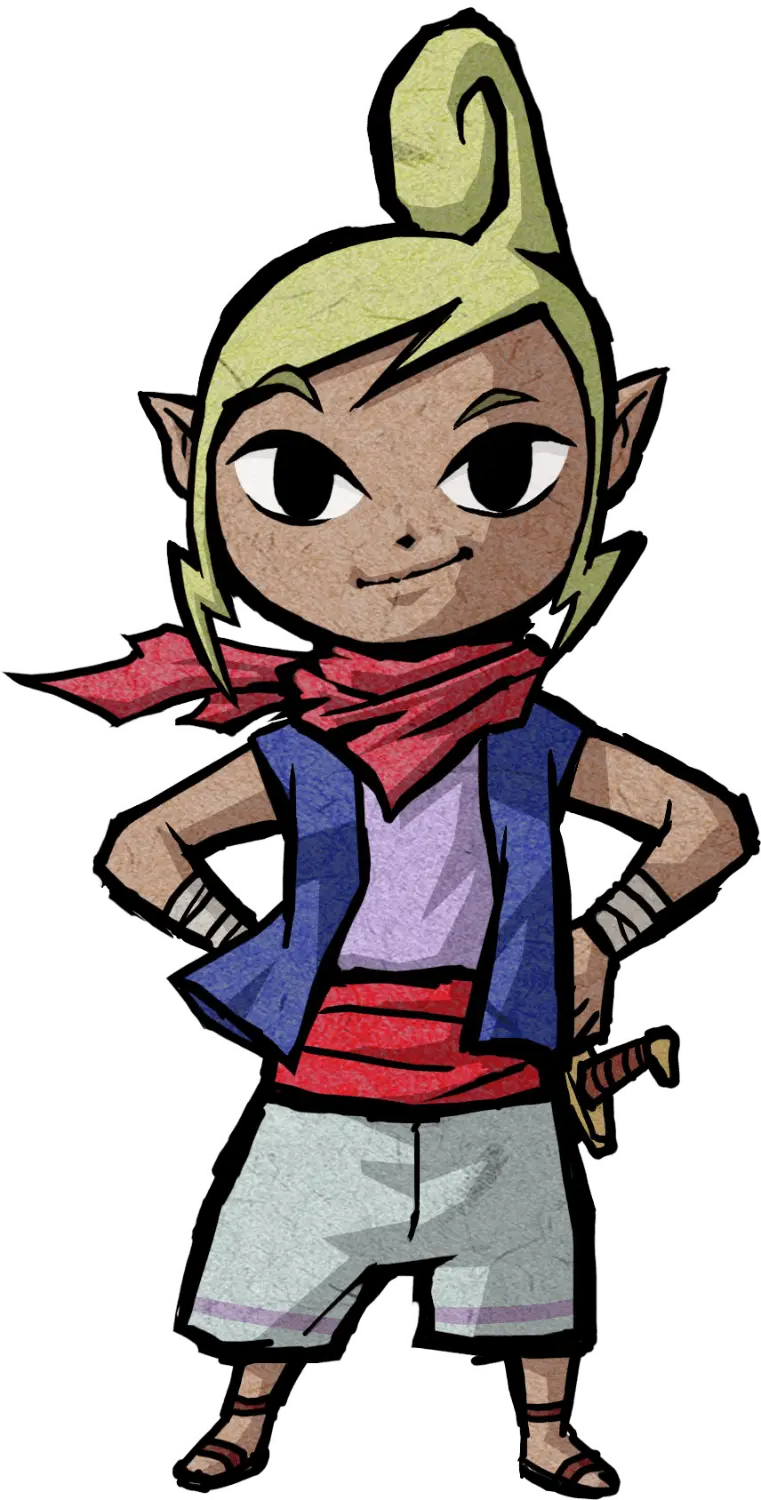 TetraPirate captain and Princess Zelda
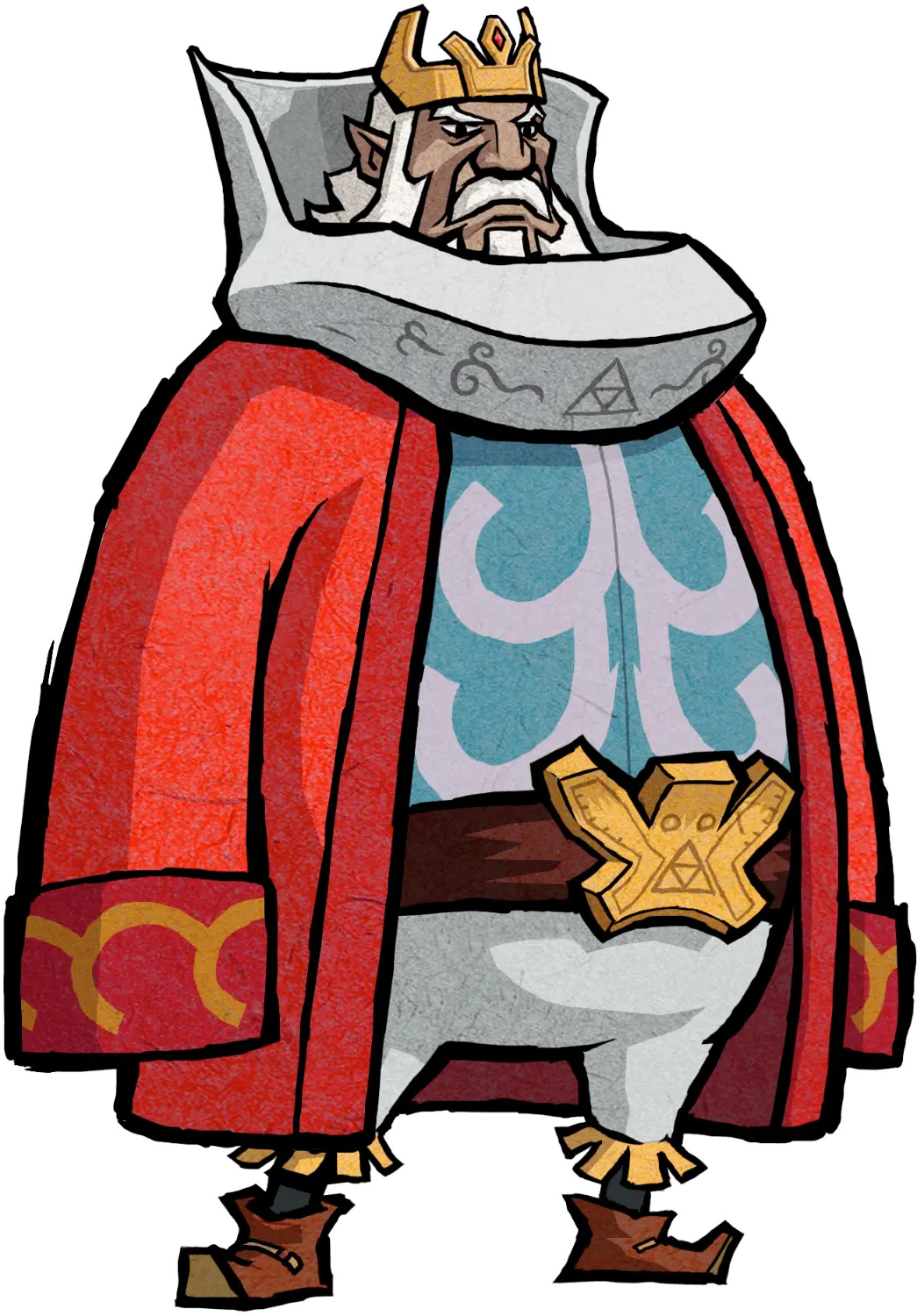 King of Red LionsKing Daphnes Nohansen Hyrule
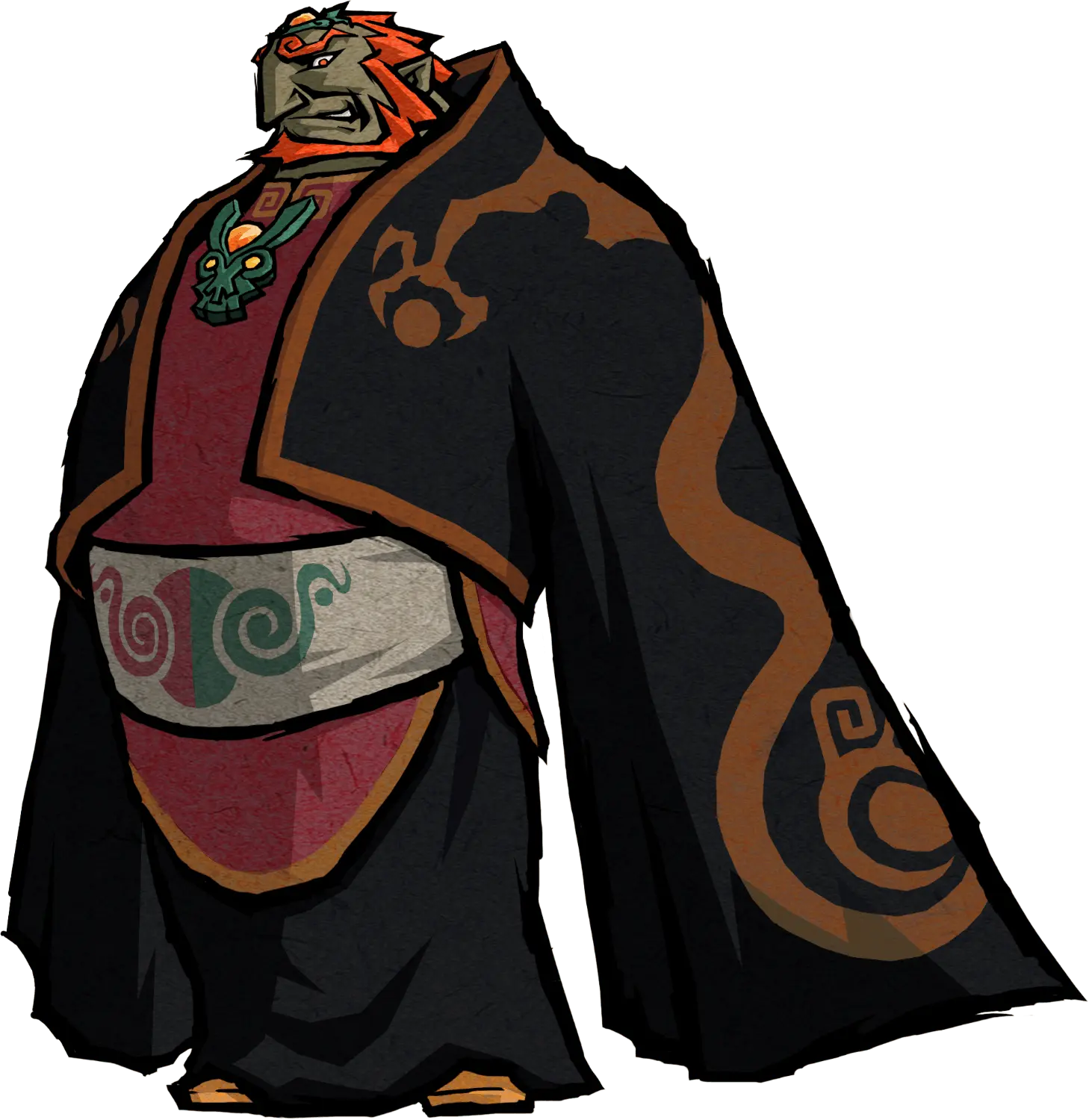 GanondorfThe Great King of Evil
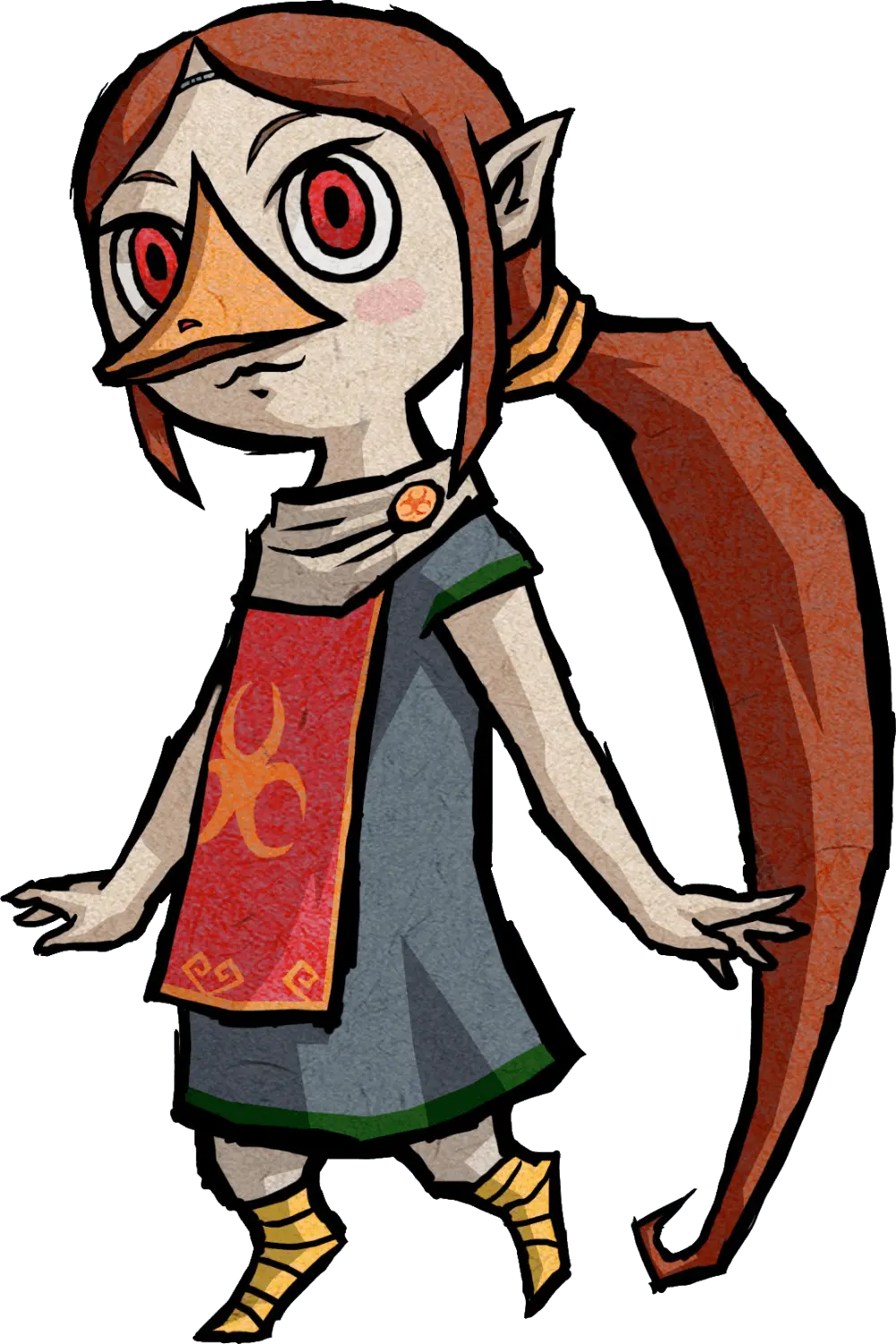 MedliRito attendant and Sage of Earth
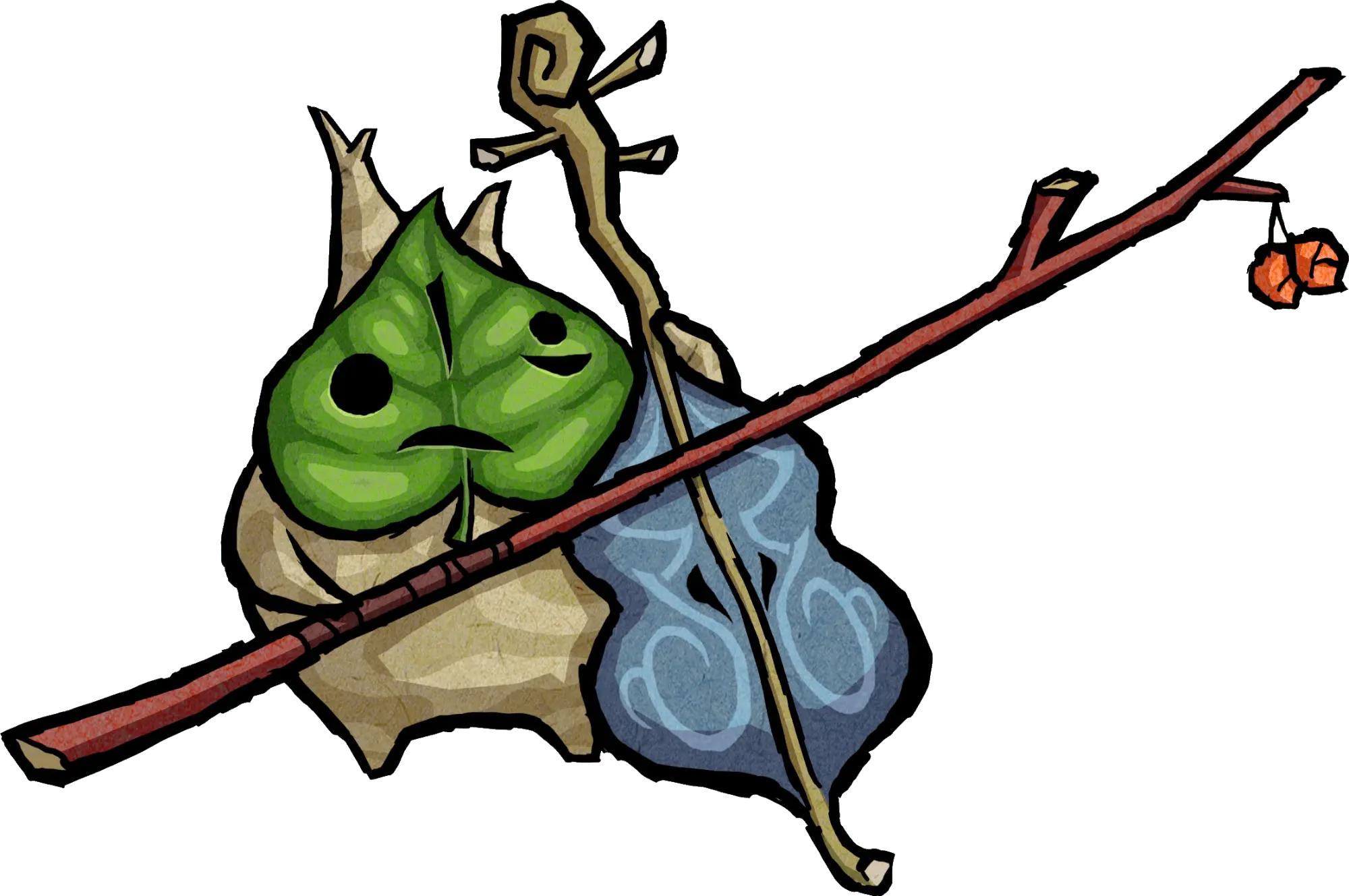 MakarKorok musician and Sage of Wind
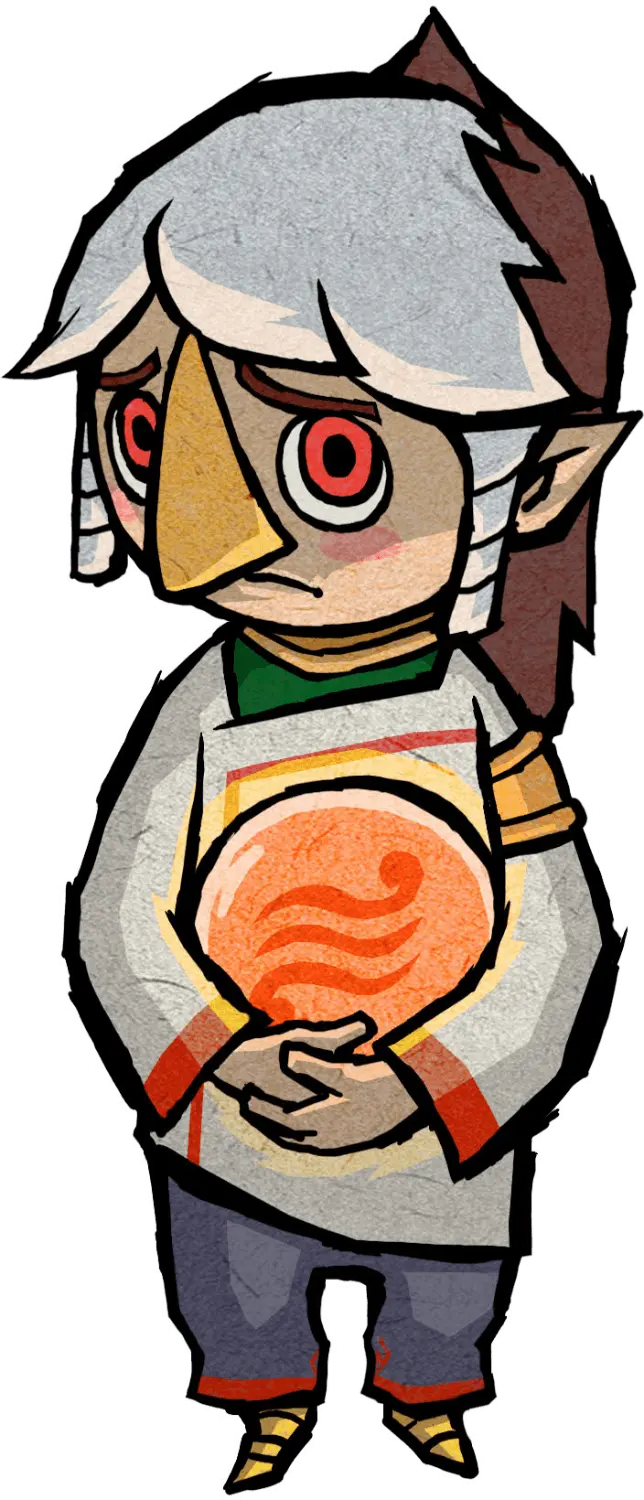 Prince KomaliRito prince
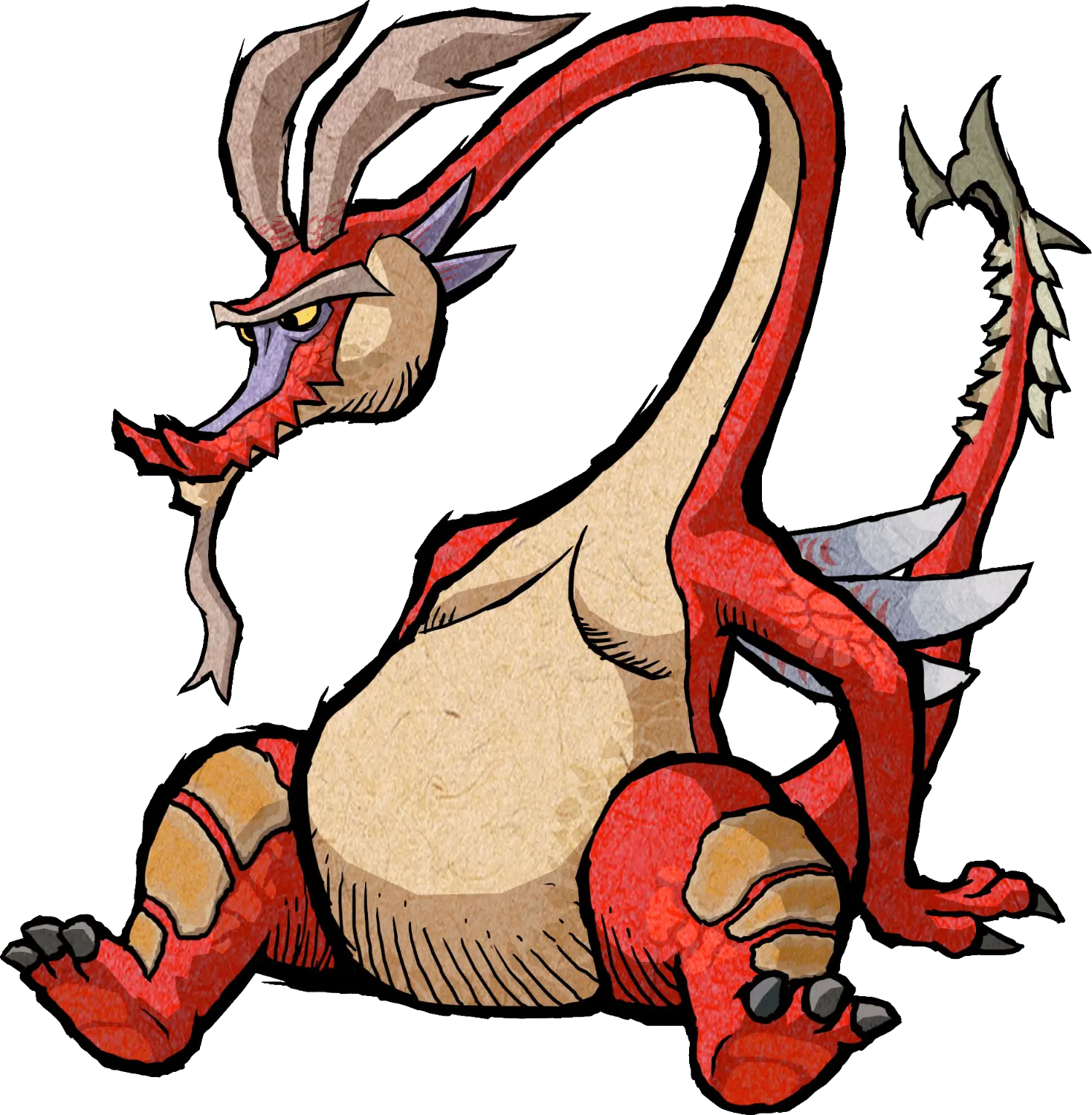 ValooThe sky spirit
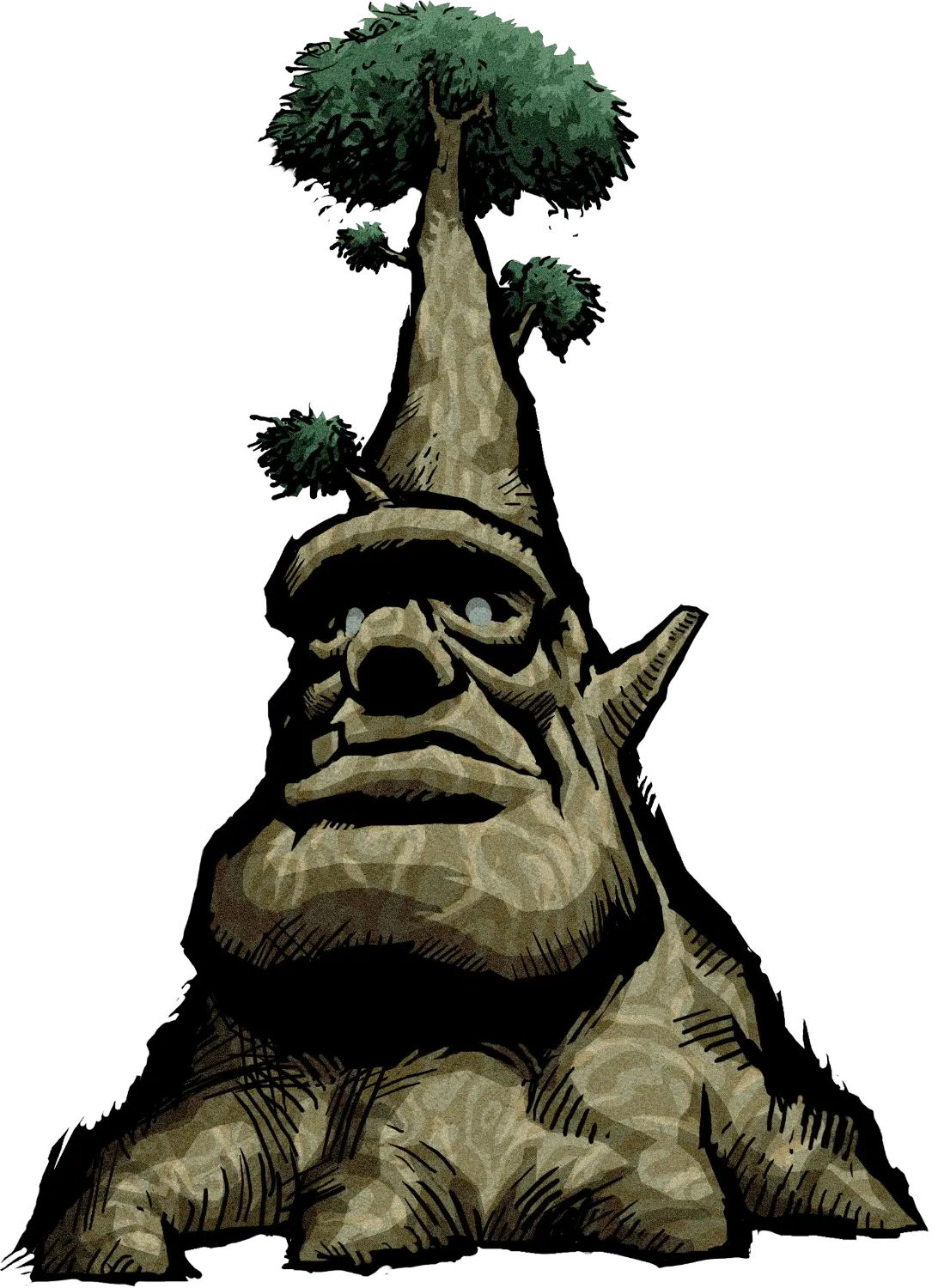 Great Deku TreeGuardian of the Forest Haven
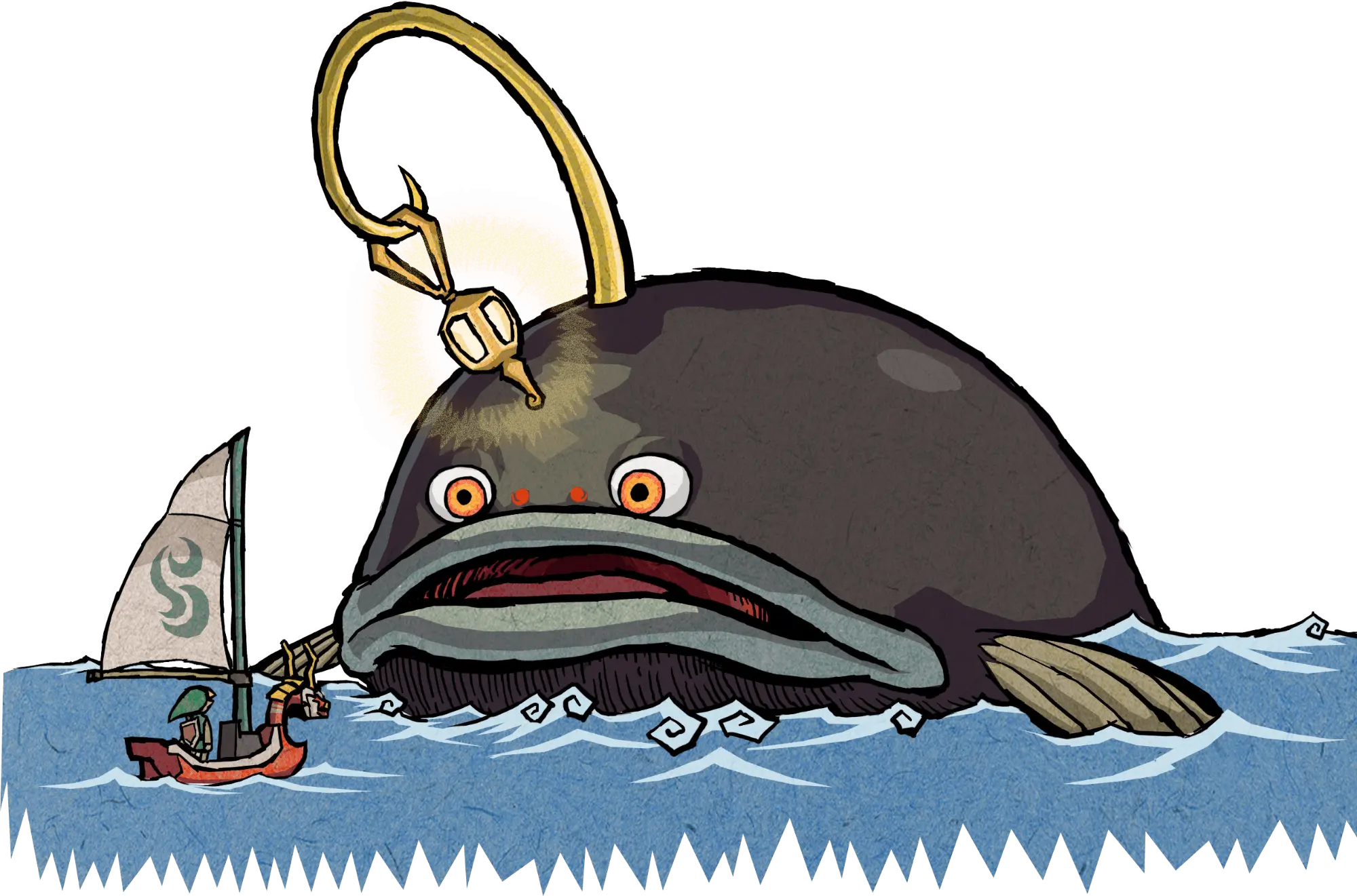 JabunThe water spirit
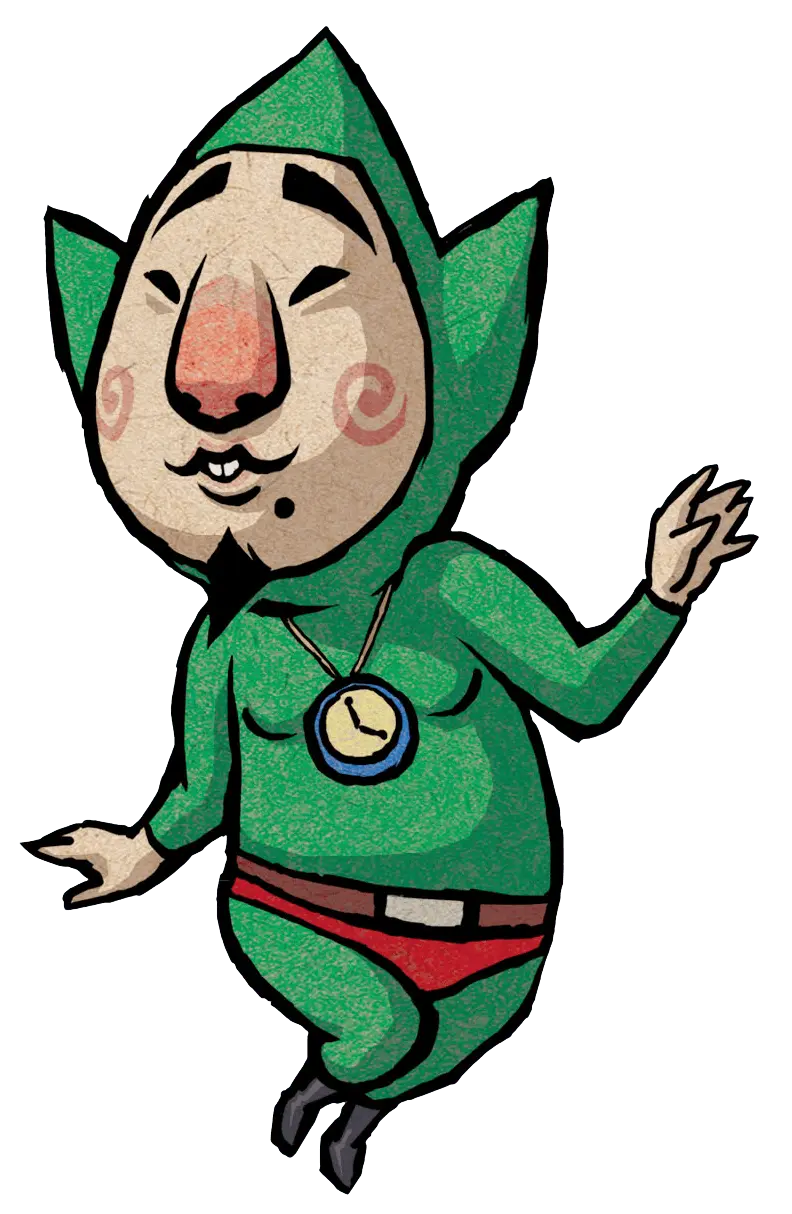 TingleMap-maker and chart translator
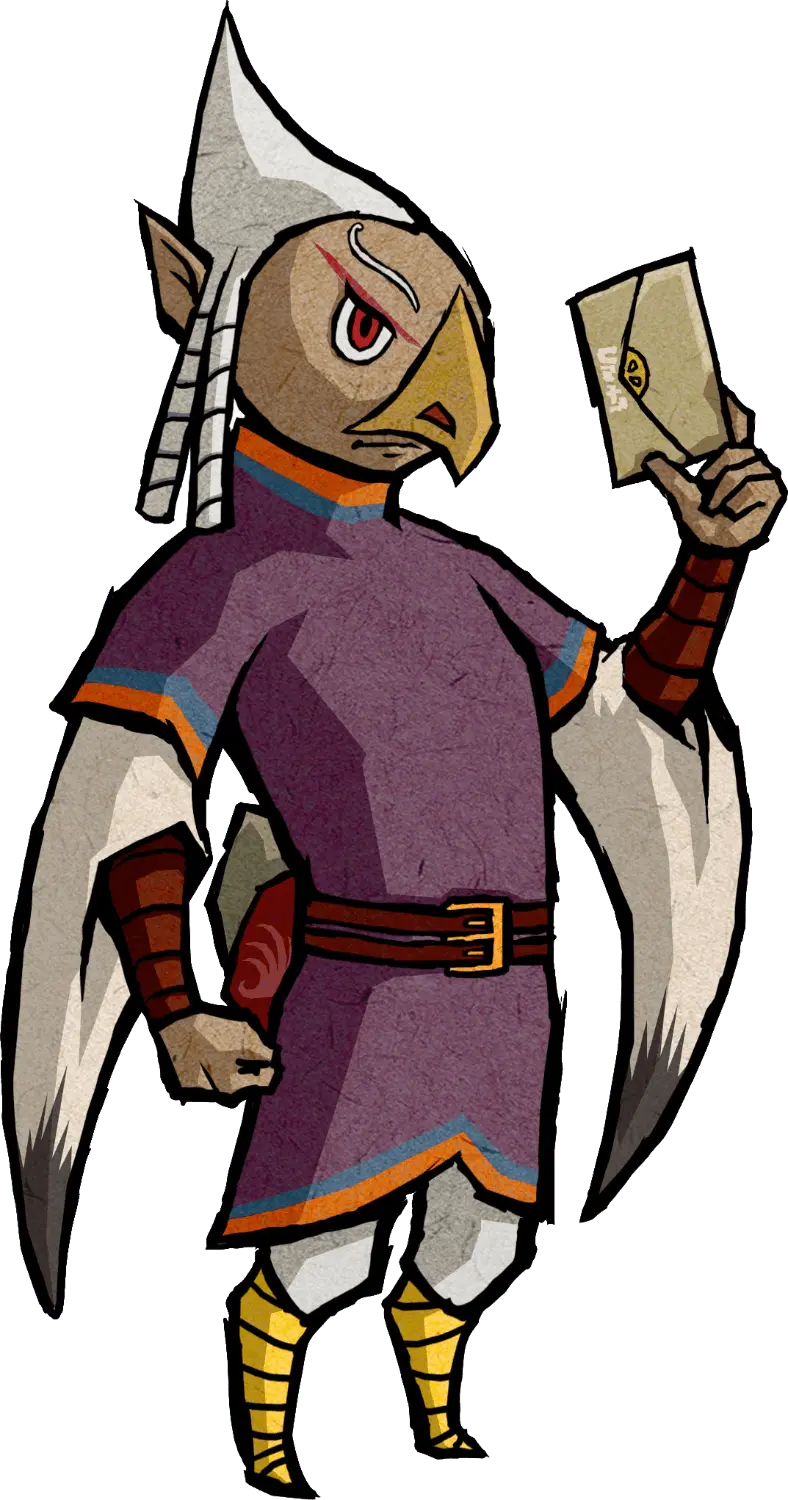 QuillRito postman
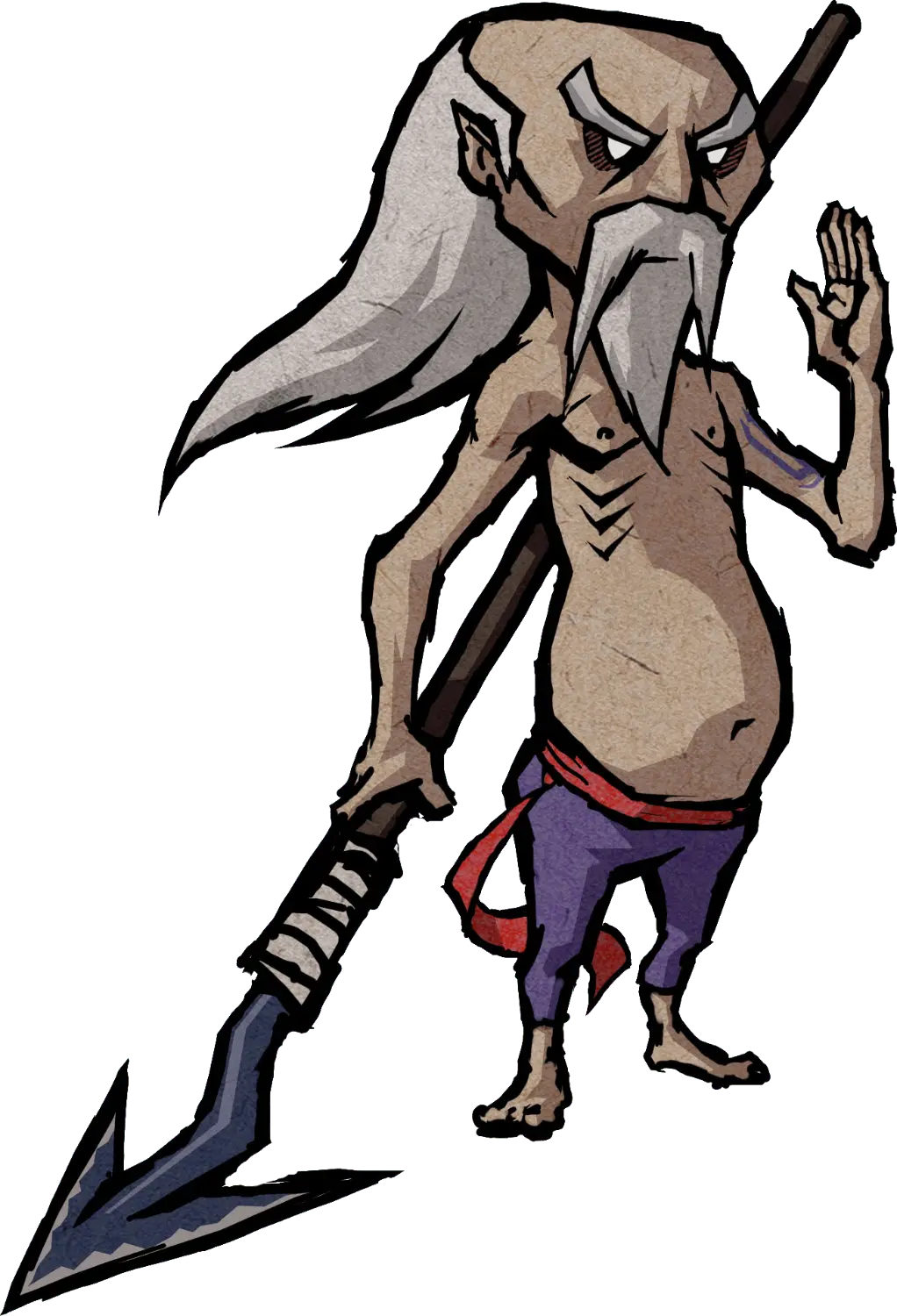 OrcaOutset Island swordsman
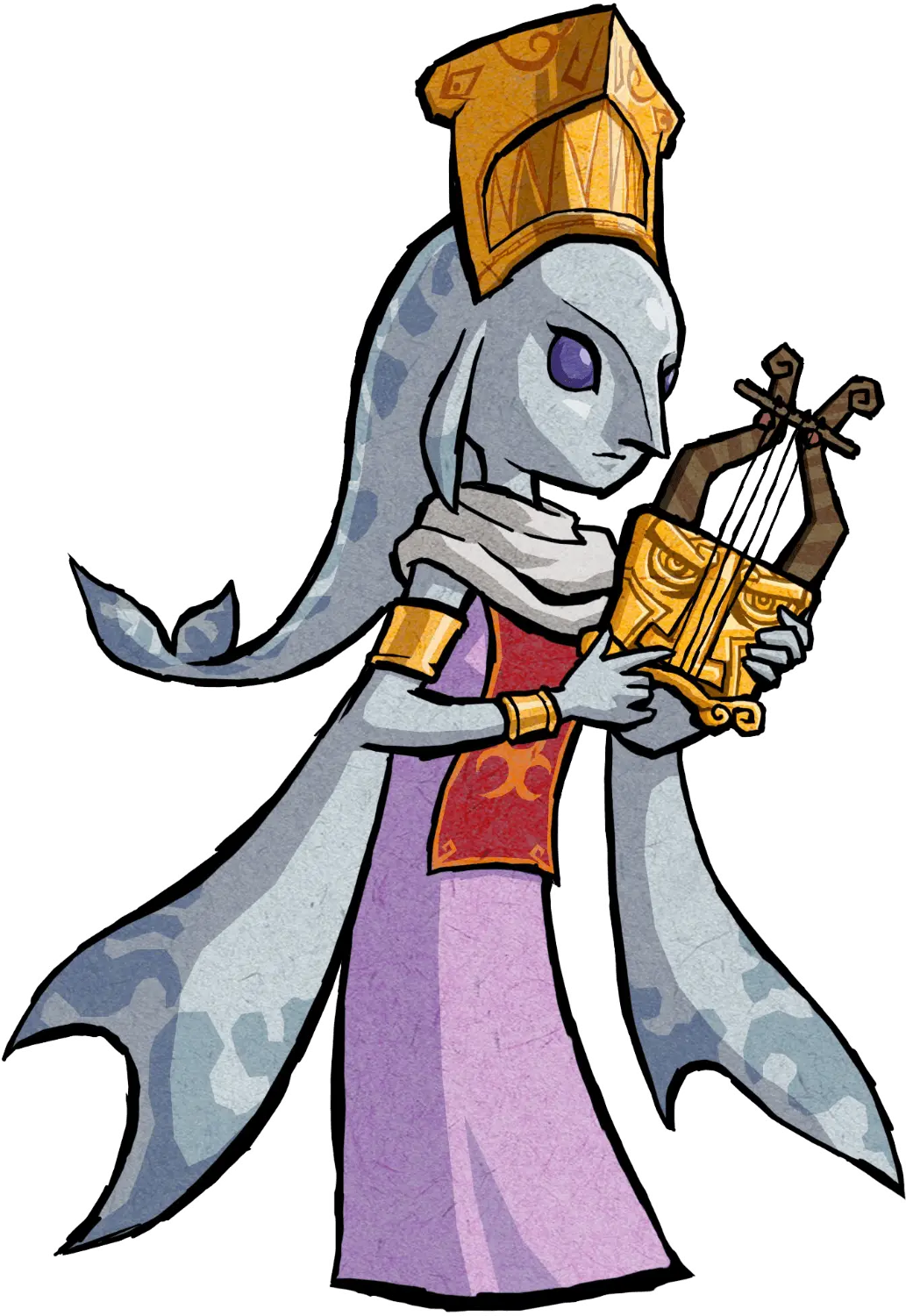 Laruto and FadoThe lost sages
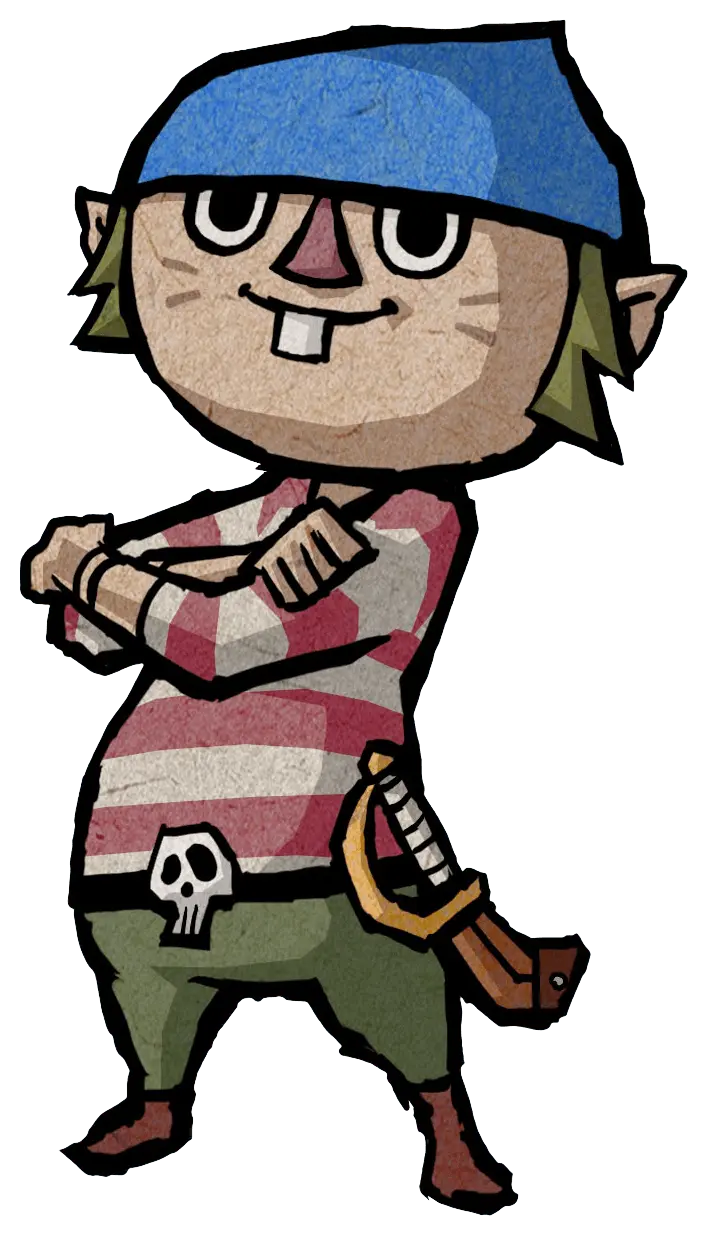 Niko and the piratesTetra’s crew
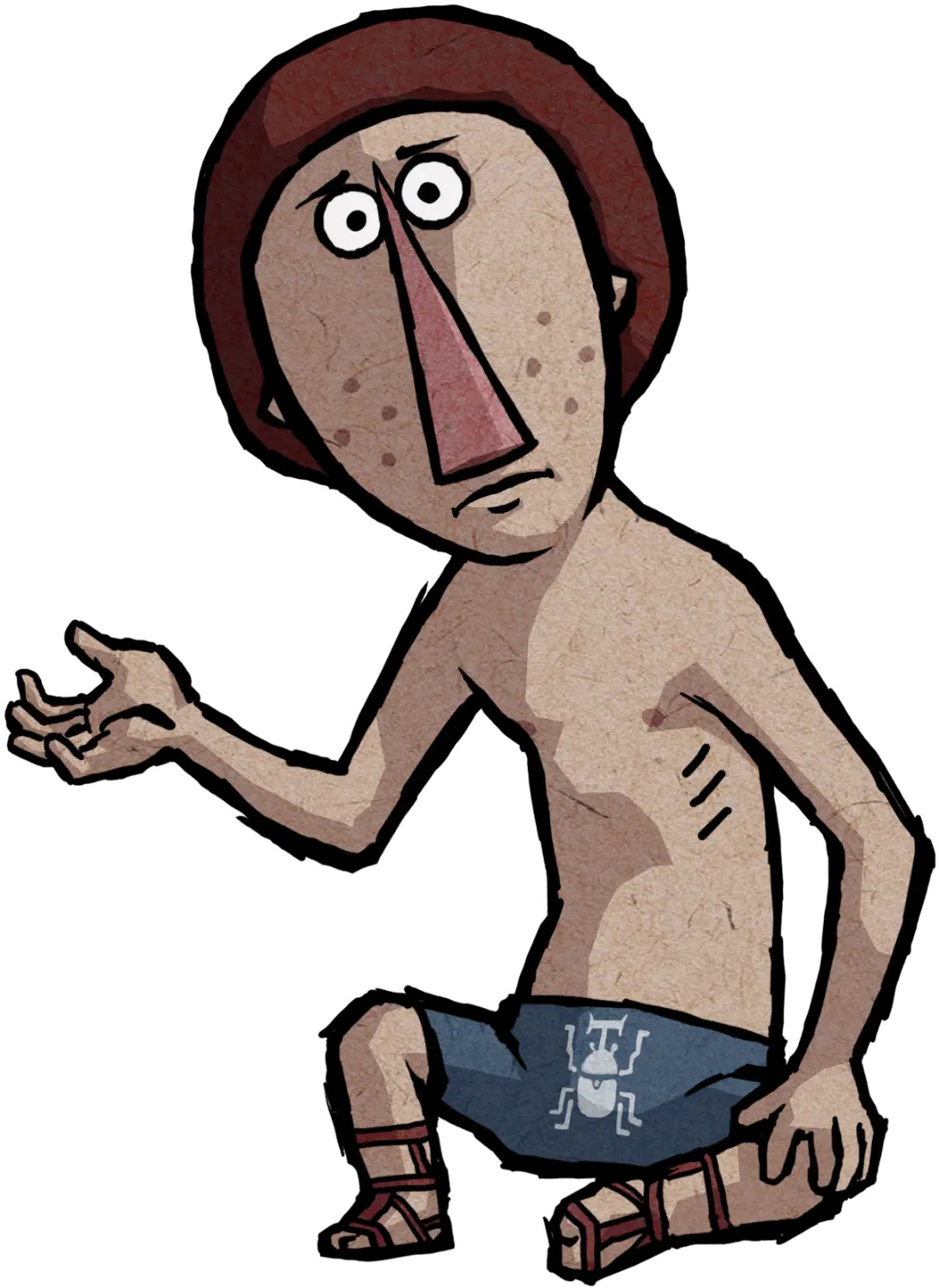 BeedleTravelling merchant
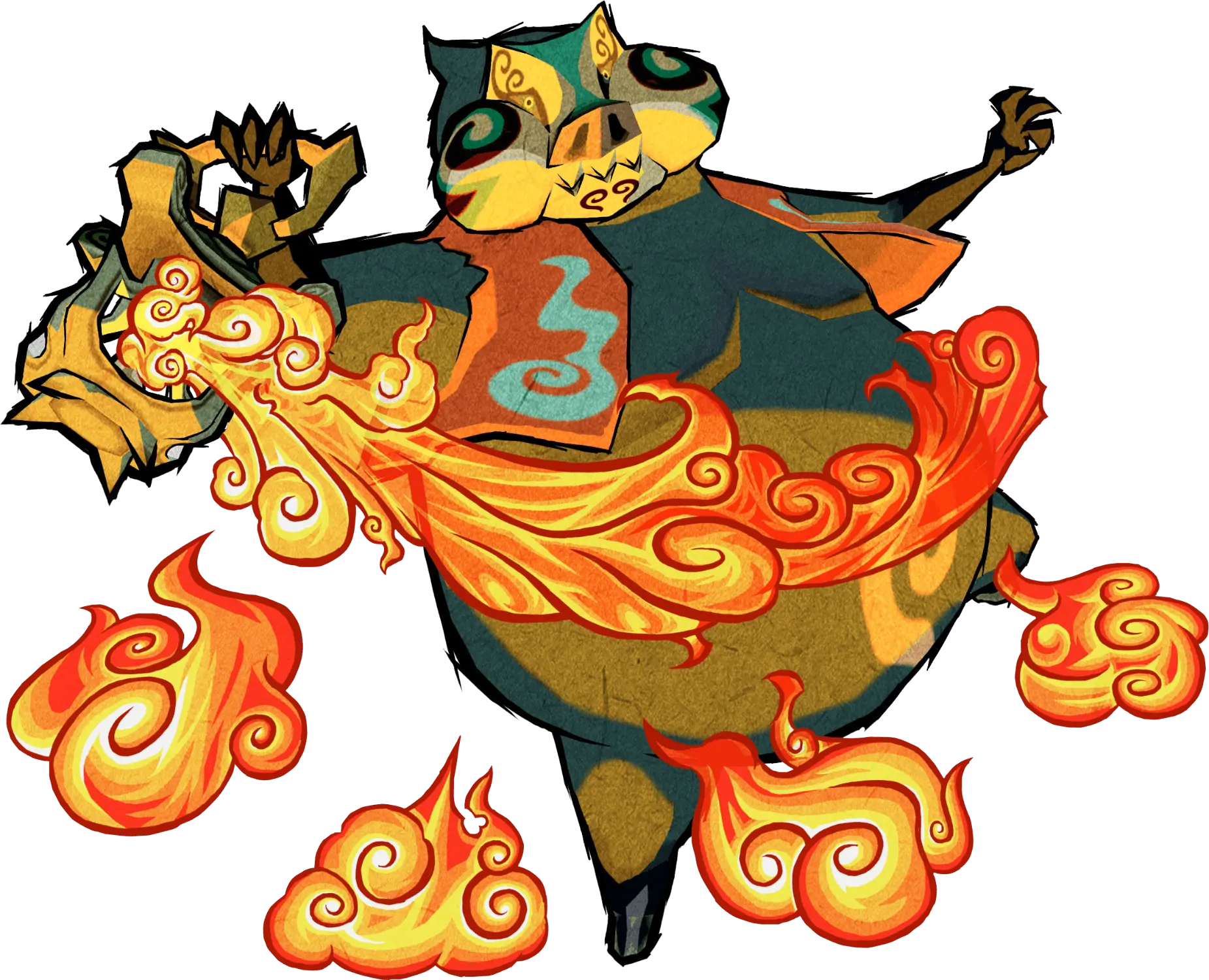
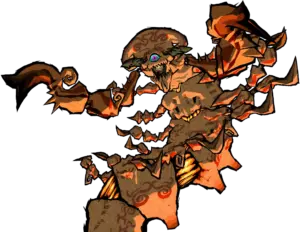 GohmaDragon Roost CavernAn armoured one-eyed monster under Valoo’s peak. Drop rubble on her shell with the Grappling Hook, then strike the eye.
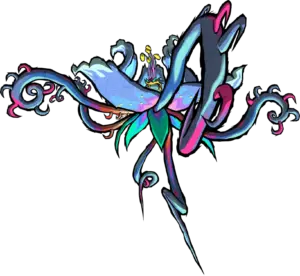 Kalle DemosForbidden WoodsA giant plant that swallows Makar. Cut its vines with the Boomerang to bring it down.
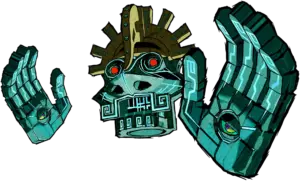 GohdanTower of the GodsA giant stone head with floating hands, testing the hero with arrows and bombs.
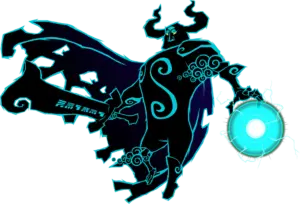 Phantom GanonForsaken Fortress · Ganon’s TowerGanondorf’s shadowy double, fought with energy-ball tennis and finished with the Light Arrows.
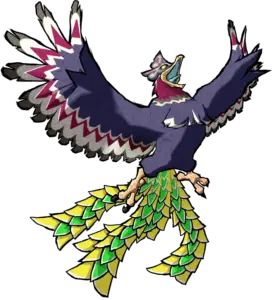 Helmaroc KingForsaken FortressThe masked giant bird that kidnapped Aryll. Crack its steel mask with the Skull Hammer.
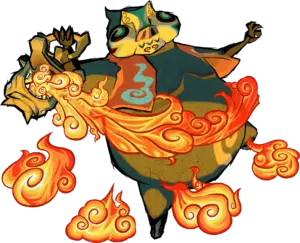 JalhallaEarth TempleA huge ghost made of Poes, the killer of Laruto. Expose it with light from the Mirror Shield.
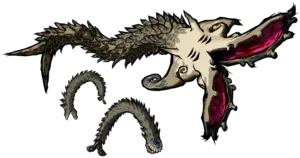 MolgeraWind TempleA sand-swimming worm. Hookshot its tongue to drag it out.
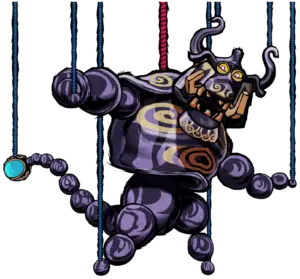 Puppet GanonGanon’s TowerA three-stage marionette of Ganon; shoot the glowing ball on its tail or leg.
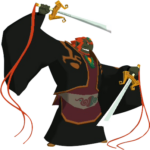 GanondorfGanon’s TowerThe final duel, with Zelda’s Light Arrows and Link’s parries.
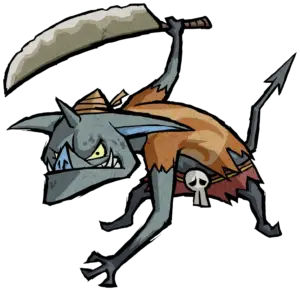 BokoblinEverywhereGoofy goblin foot soldiers in blue, green and red; the red ones keep lookout with telescopes.
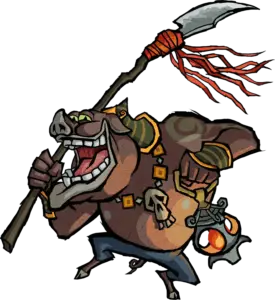 MoblinForsaken Fortress and beyondBig, burly brutes; Takizawa’s Moblin sketch was one of the first drawings in the new style.
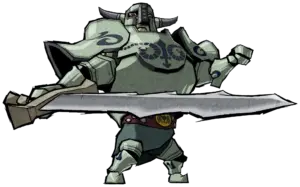 DarknutLater dungeonsArmoured knights whose plate has to be stripped off with parries before they can be hurt.
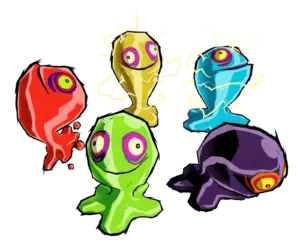 ChuChuEverywhereJelly blobs in several colours; the dark ones in the Earth Temple must be turned to stone with light.
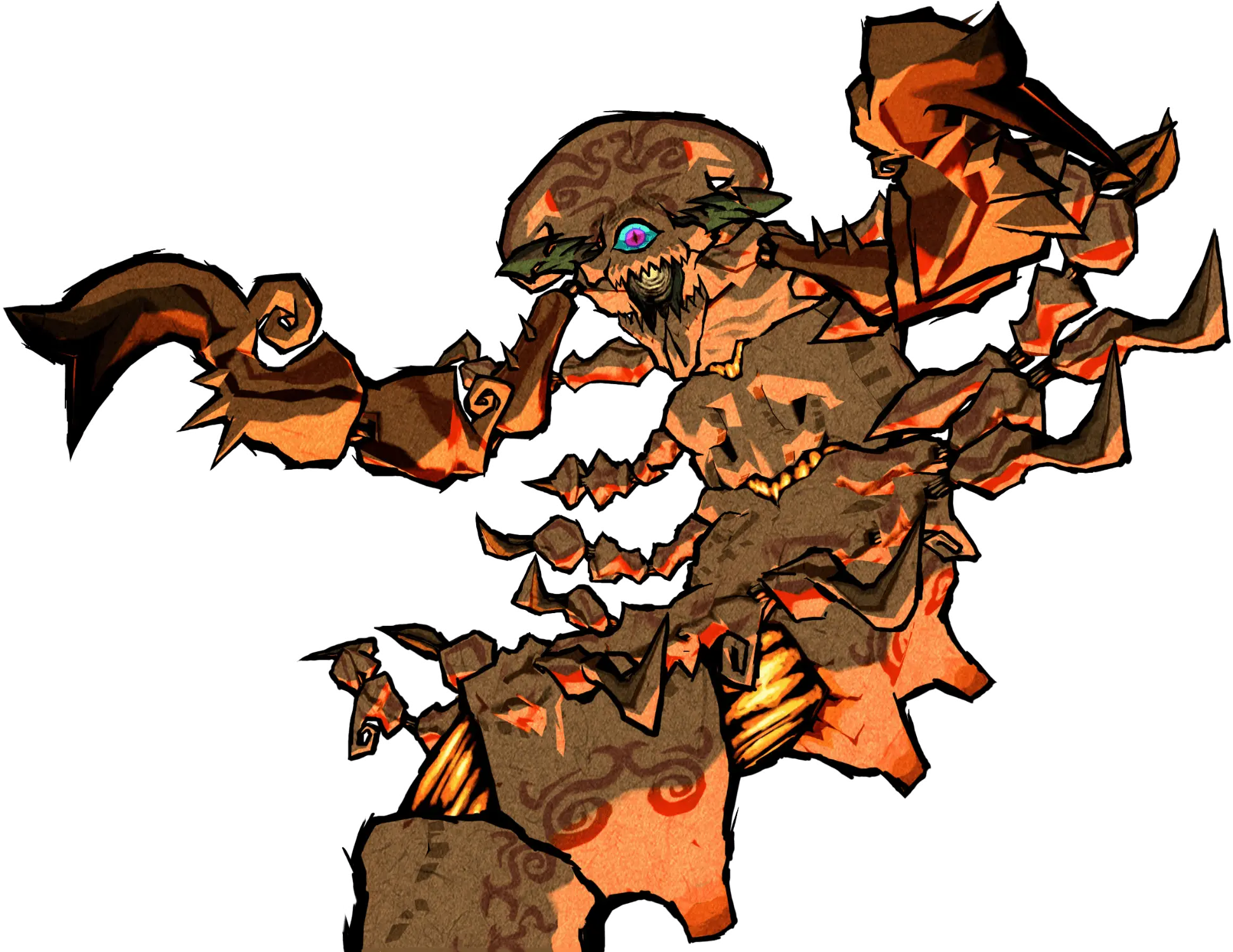
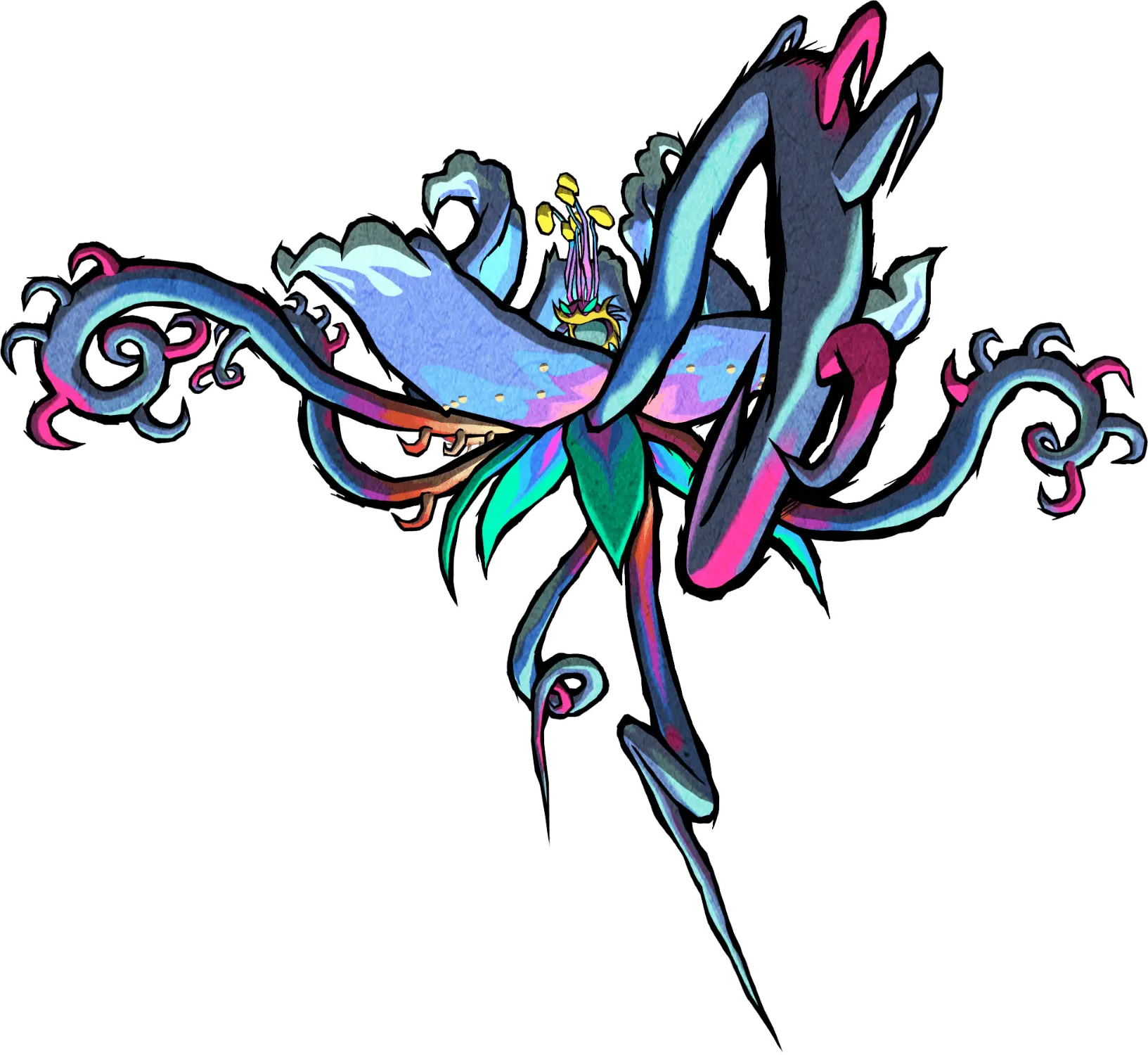
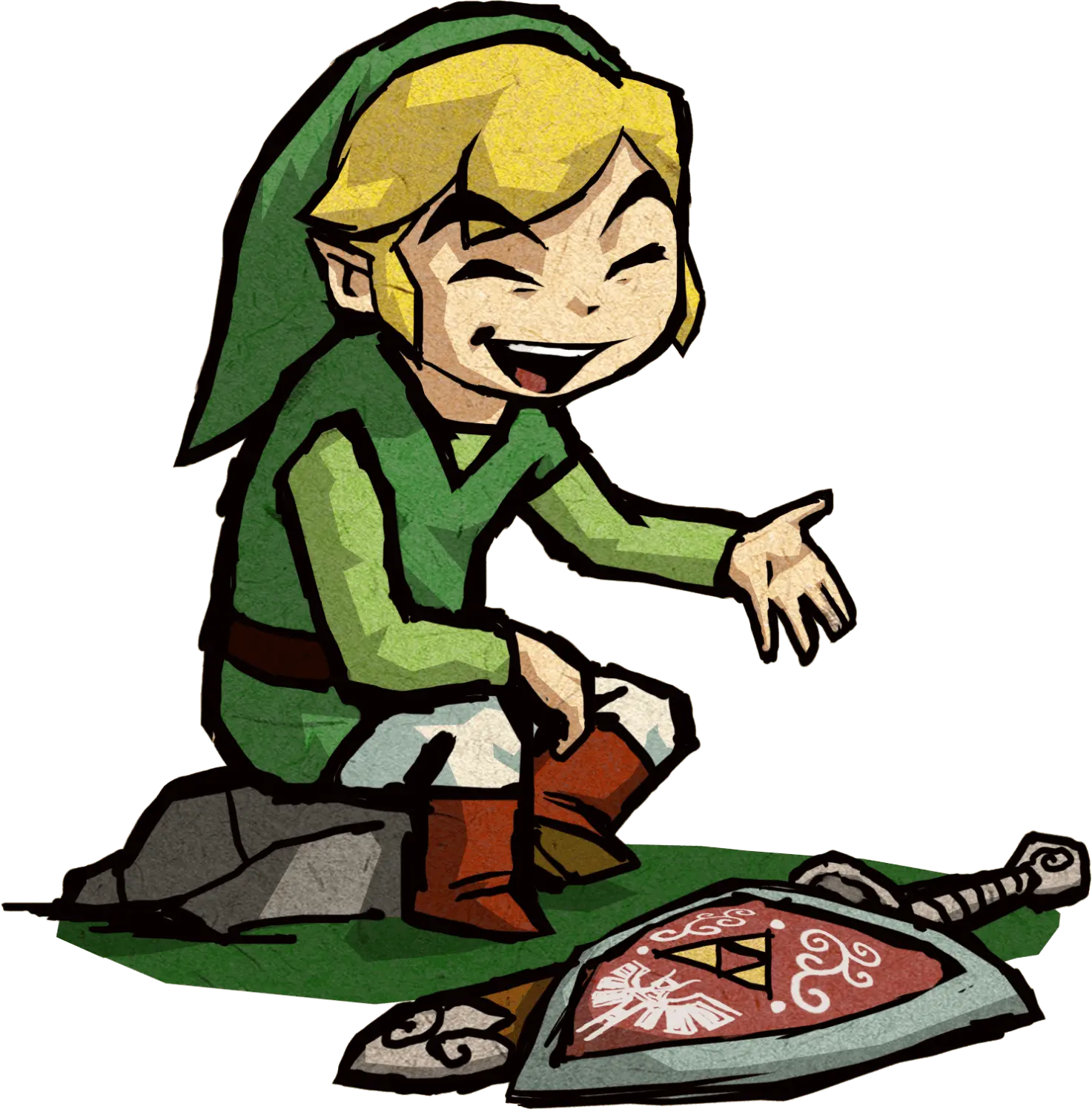 Cel-shading and Toon LinkThe first Zelda drawn in a cel-shaded, cartoon style, and the debut of the Link design later called Toon Link.
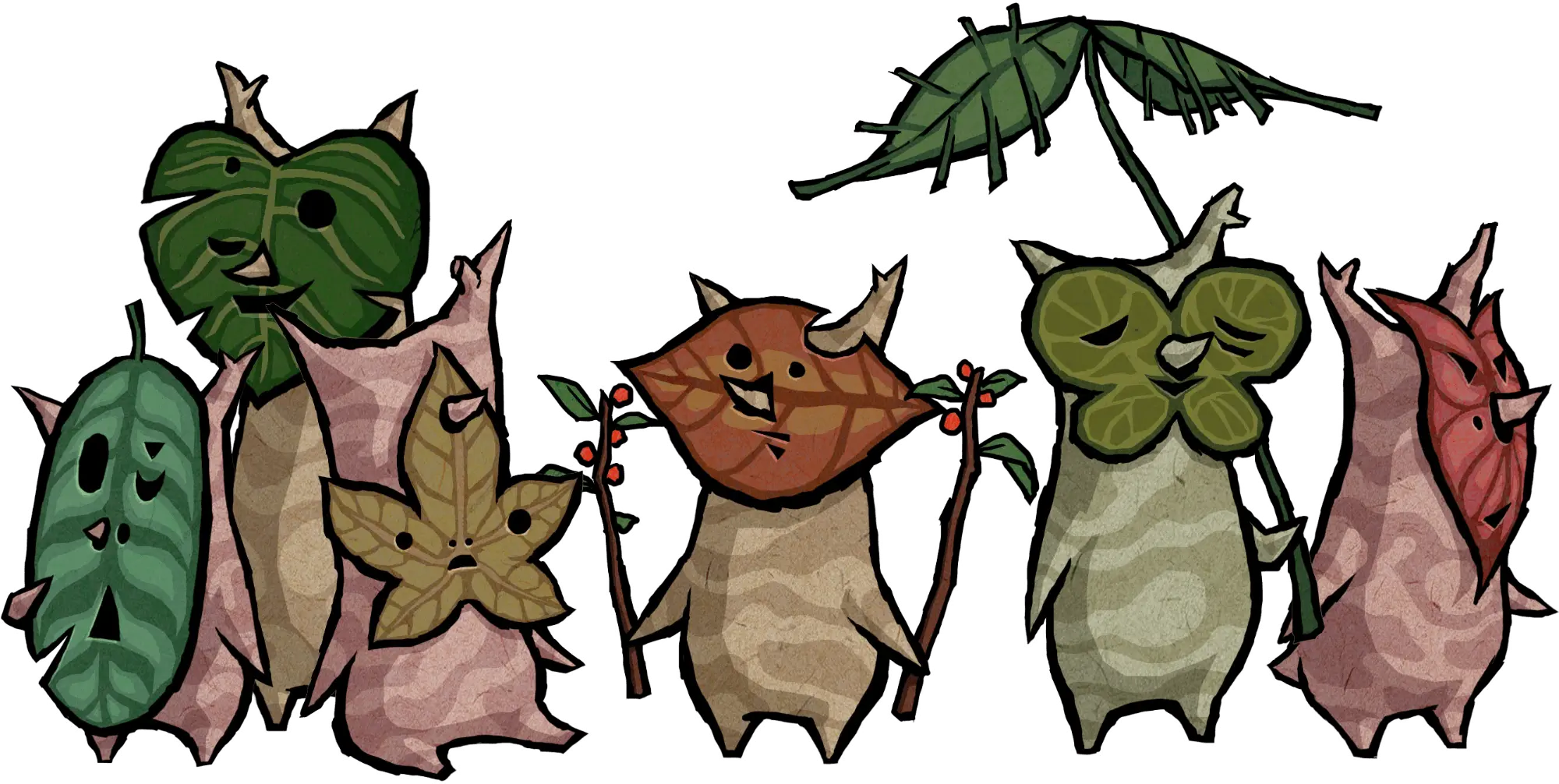 The Rito and the KoroksTwo new peoples, both descended from older ones: the Rito from the Zora, the Koroks from the Kokiri. Both are central to Breath of the Wild.
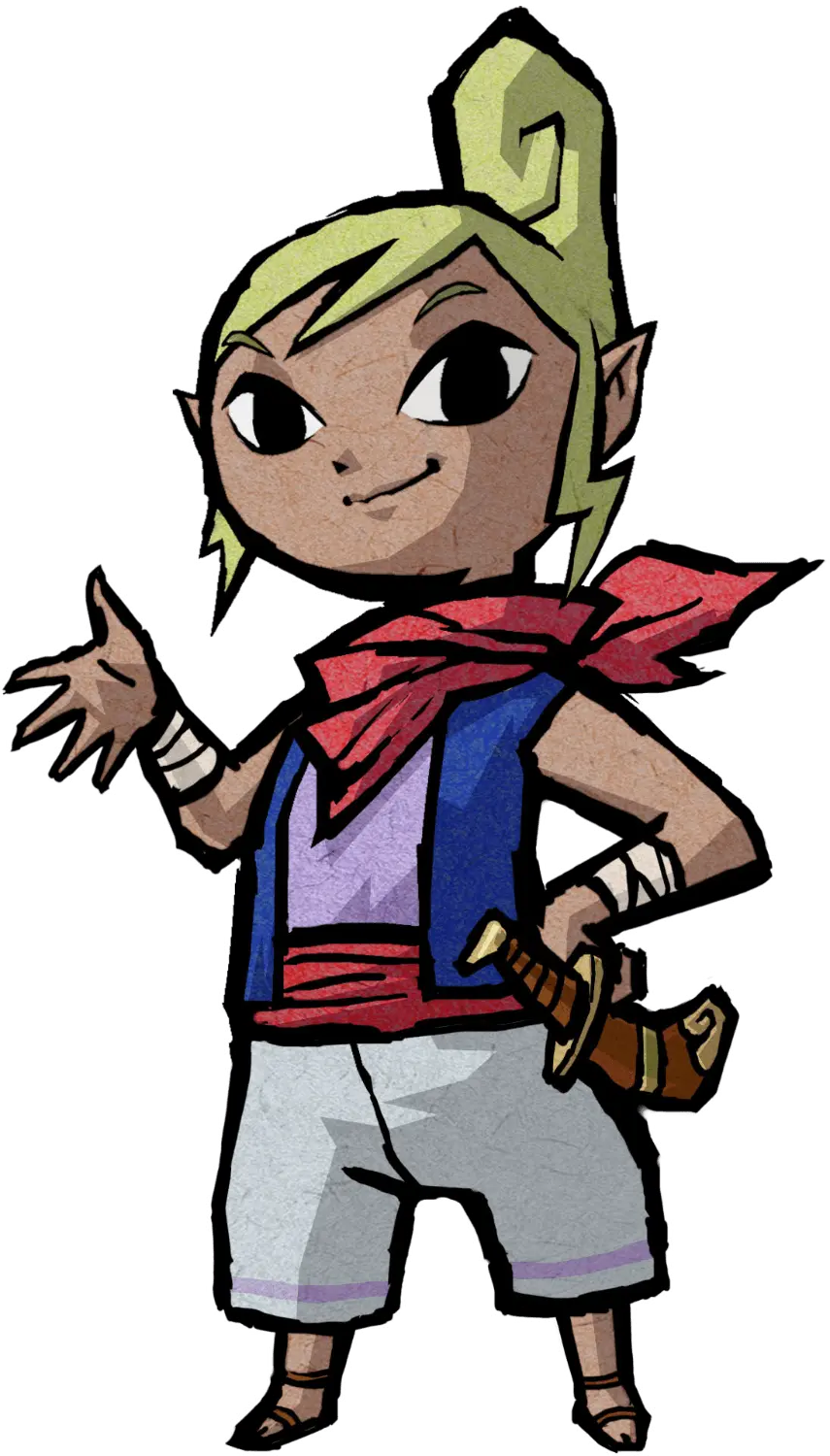 TetraZelda reimagined as a pirate captain who has no idea she is a princess.
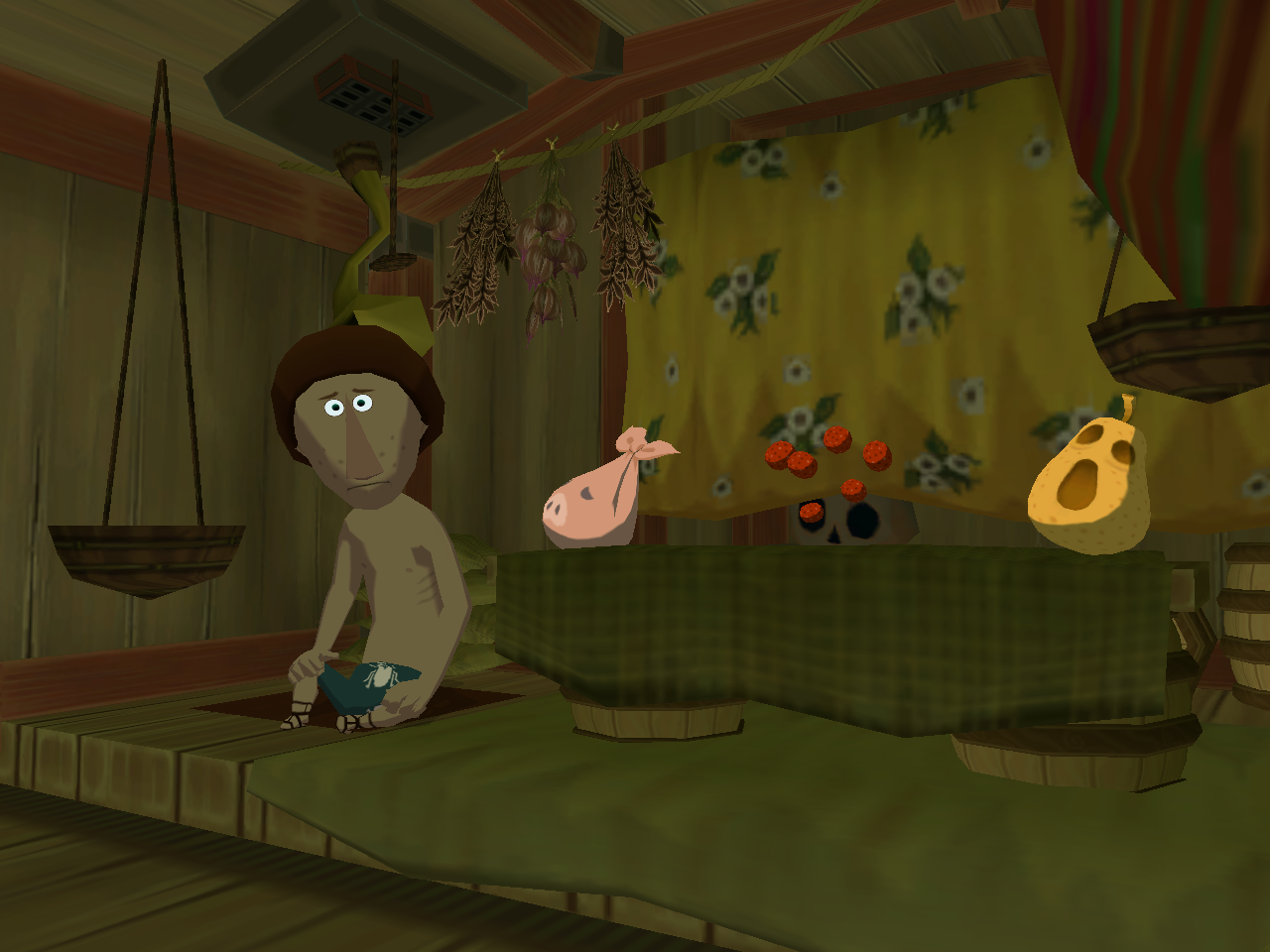 BeedleThe travelling merchant made his debut here and has turned up in many Zeldas since.
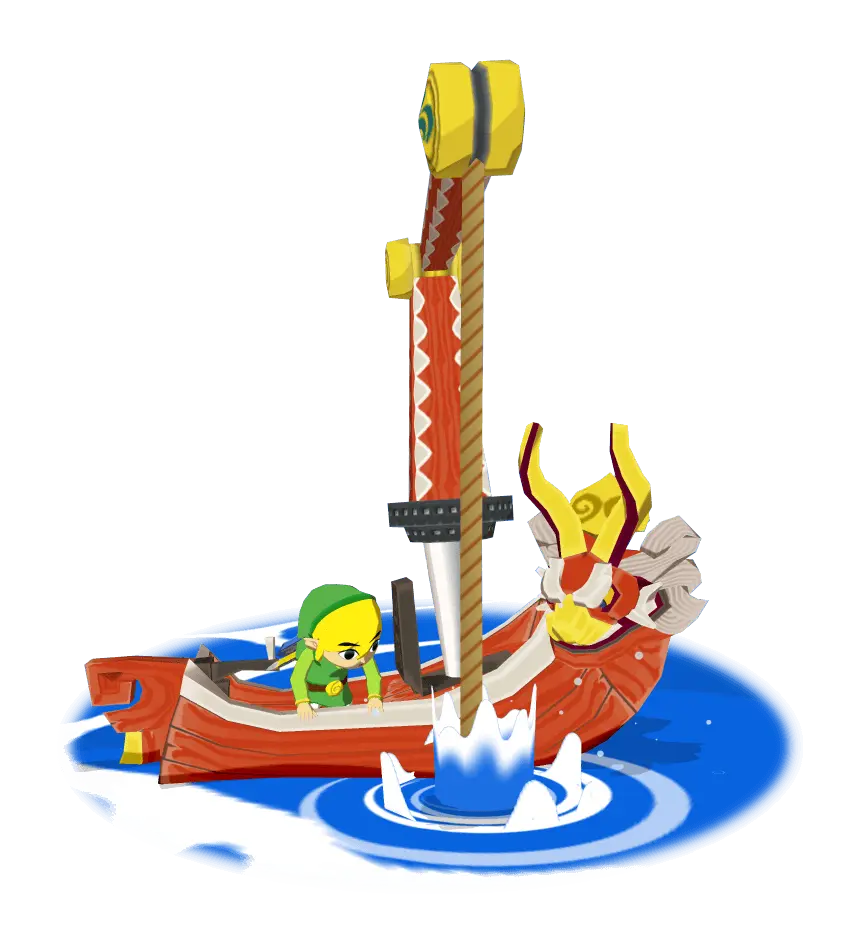 A sea to sailA whole overworld of open water, with wind direction, sea charts and salvage.
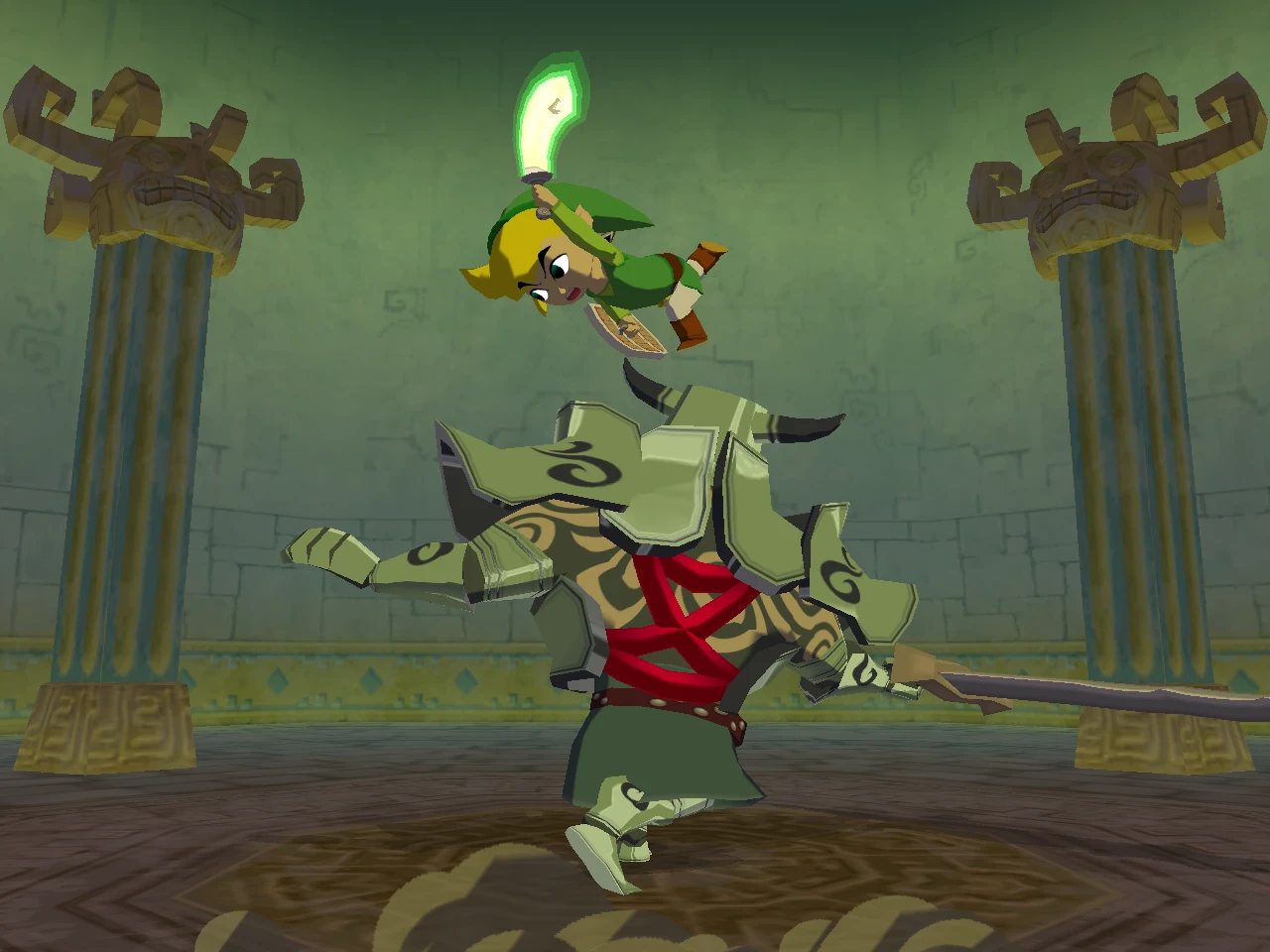 ParryingTimed counter-attacks, essential for stripping the armour off Darknuts.