Ataru Cagiva’s Zelda manga Link’s Awakening and A Link to the Past · 5 volumes
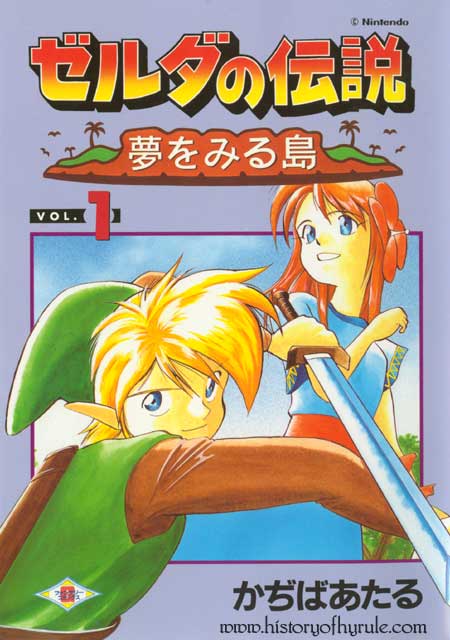
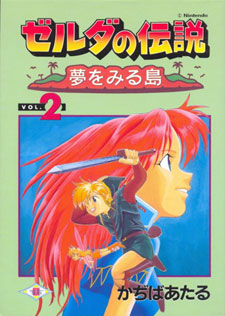
Two Game Boy and Super Famicom adventures retold for Enix’s Monthly GFantasy by one young artist: a Link who talks, a fairy who answers back, a hero who quits, and a Master Sword guarded by the spirit of an earlier hero.
Story & artAtaru Cagiva (Kajiba Ataru)
Volumes5: two for Link’s Awakening, three for A Link to the Past
MagazineMonthly GFantasy (Enix)
BooksEnix, May 1994 – May 1996
EnglishNone
Original titles
ゼルダの伝説 夢をみる島 (Zelda no Densetsu: Yume o Miru Shima, “The Dreaming Island”); ゼルダの伝説 神々のトライフォース (Kamigami no Triforce, “Triforce of the Gods”)
Toronbo Shores, as drawn for the Link’s Awakening manga.
Years before Akira Himekawa’s adaptations, Enix was publishing Zelda manga of its own. Between 1993 and 1996 its Monthly GFantasy ran two Zelda serials by the same young artist, Ataru Cagiva, one straight after the other: Zelda no Densetsu: Yume o Miru Shima (“The Dreaming Island”), based on the Game Boy’s Link’s Awakening, and Zelda no Densetsu: Kamigami no Triforce (“Triforce of the Gods”), the Japanese title of A Link to the Past. Enix collected them in two and three volumes between May 1994 and May 1996. Neither has ever been published in English.
They make an interesting pair. The Link’s Awakening manga, Cagiva’s first collected work, follows the game closely but turns its quiet melancholy into open drama: Link talks, falls for Marin, acquires a sharp-tongued fairy called Felicia and, when he learns that waking the Wind Fish will erase the island and everyone on it, gives up the quest altogether. The A Link to the Past manga strays further from its source, adding a martial-artist friend for Link, a Dark World scholar with divided loyalties and the spirit of an earlier hero who watches over the Master Sword.
Much less has been written in English about these books than about Himekawa’s, and they are hard to find today. Below you will find all five volumes, with chapter titles, what happens and how each differs from the game. For Link’s Awakening we can tell the story in some detail; for A Link to the Past the record in English is thinner, and we say so where it is.
Enix’s own cover blurbs for the five books have not surfaced online. MangaUpdates introduces the second series simply: Agahnim has locked Zelda in her own castle’s dungeon, Link answers her telepathic call, the two escape together, and Link sets out to find the Master Sword and free Hyrule from Agahnim’s rule.
Volume guide
The first two entries are the Link’s Awakening books, the last three A Link to the Past. Chapter titles are Zelda Dungeon’s English renderings of the Japanese. The Link’s Awakening summaries draw on the volume-by-volume synopsis kept by the Zelda Wiki on Fandom; for A Link to the Past, where no full synopsis exists in English, we have combined Zelda Dungeon and MyAnimeList (for the opening), the History of Hyrule blog and, where nothing better exists, the fan-written TV Tropes page, and we say which is which. Release dates are Zelda Dungeon’s; English Wikipedia gives dates a month earlier for the A Link to the Past books, which is probably the difference between on-sale and publication dates. Spoilers follow.
Link’s Awakening, Volume 1
Japan: Enix, 27 May 1994 · 186 pages · ISBN 4-87025-513-8 · not published in English
Link’s ship is struck by lightning as he sails away from Hyrule, and he washes up on Koholint, an island that appears on no map. The only way off, he learns, is to collect the eight Instruments of the Sirens and wake the Wind Fish. Cagiva’s Link talks, and has plenty to say. After the first dungeon the Owl sends him a fairy called Felicia to look after the instruments until they are needed; Link finds her a nuisance and teases her and shows off. After the second, Madam MeowMeow gives him an ocarina as thanks for bringing BowWow home. On the beach he meets Marin, who wants to visit her friends in Animal Village, and he takes her there, dodging monsters along the way; before long he has asked her to come back to Hyrule with him when the quest is over, and she has said yes.
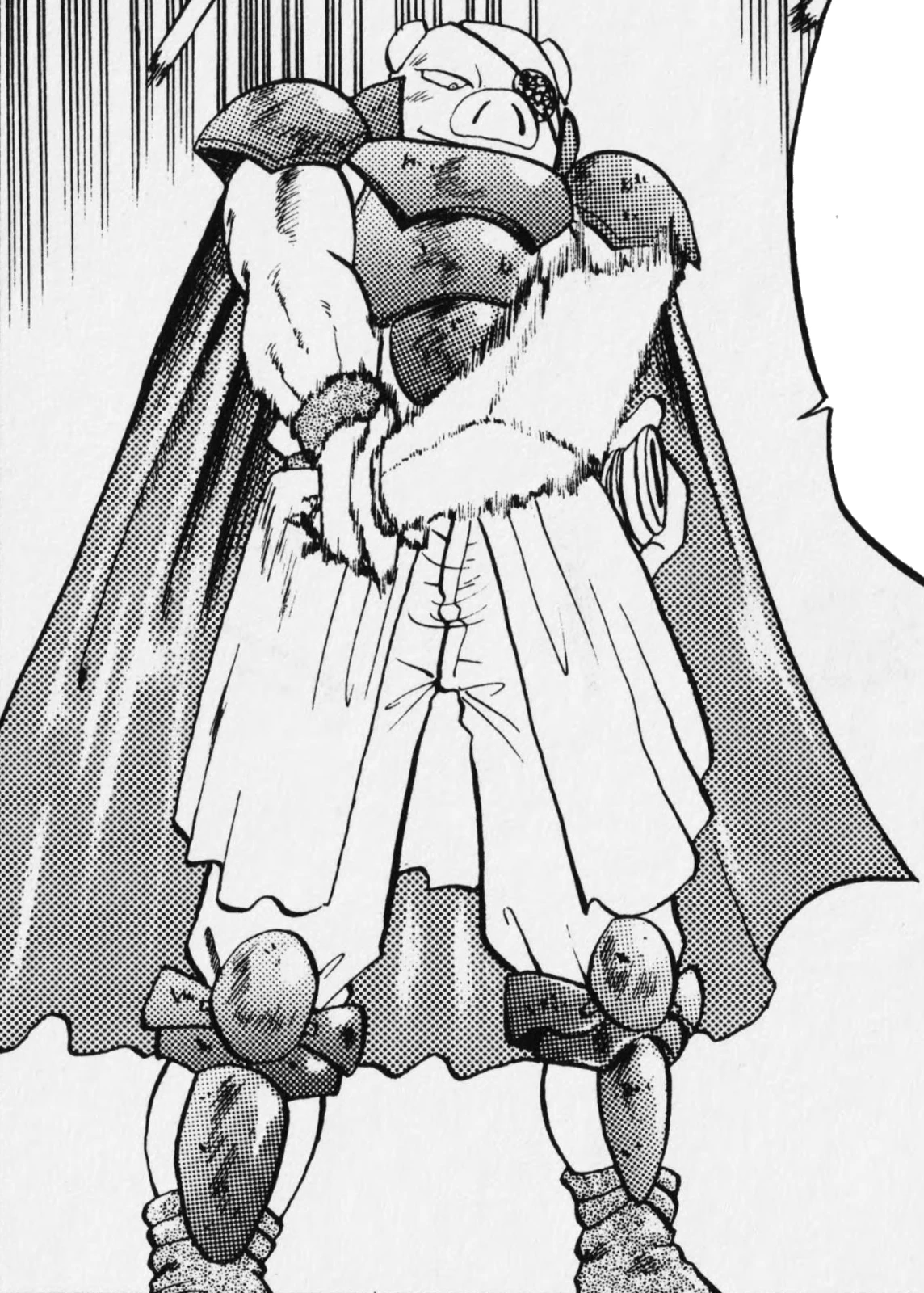
The last chapter belongs to a ghost. In Angler’s Tunnel Link’s sword shatters in the fight with the Angler Fish; he wins anyway, only to be knocked off a cliff by Karuna, a pig-faced swordsman. A spirit he met outside the dungeon possesses him to slow his fall. This is Nakura, once a soldier. Link sees him home, and Nakura gives him the sword he carried in life before passing on. Link settles the score with Karuna and sets off for the Face Shrine.
Chapters (4)
The Dreaming Island
The Island’s Peace
A Promise With Marin
Soldier Nakura
From game to page
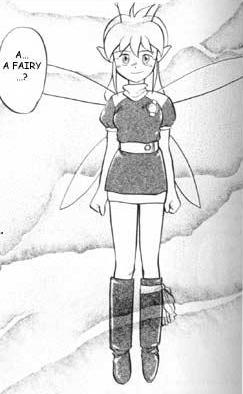
Felicia, a fairy partner who carries the instruments, is new. In the game Link explores Koholint alone.
Madam MeowMeow hands Link the ocarina; in the game he finds it in the Dream Shrine.
The game’s nameless ghost becomes Nakura, a soldier with a past, and his sword replaces the one Link breaks.
Karuna is invented for the manga, while the Key Cavern, the game’s third dungeon, barely gets a mention.
Link’s Awakening, Volume 2
Japan: Enix, 27 September 1994 · ISBN 978-4-87025-524-1 · not published in English
In the Face Shrine Link learns what nobody has told him: waking the Wind Fish will end the dream, and Koholint and everyone on it will vanish. Furious with the Owl and Felicia for hiding it, he abandons the quest, goes back to Mabe Village and asks to take Marin away. Tarin will not leave the island himself but lets her go. When monsters attack Animal Village to stop the Wind Fish waking, they ignore his news that he has quit, so he beats every one of them and sets sail with Marin. An invisible wall at sea blocks the boat, and Marin talks him round: the island is a dream, and everyone has to wake up some day. The Owl adds that in this dream there is no Hyrule; here Link is only the Messenger of Awakening.
Back on the quest, Link faces Master Drona, a hired warrior who fights for the fun of it, and while he is busy with a Hinox, Felicia is carried off to Eagle’s Tower. He beats Drona with a secret sword technique, rescues Felicia from the tower’s masters and gathers the last instruments. He says goodbye to Felicia at the Wind Fish’s egg and goes in alone to face the Nightmare, which calls itself Koholint’s god. The Wind Fish apologises (the Nightmare grew from a weakness in its heart) and asks him to play the Ballad. Link comes to among the broken timbers of his boat, his old sword returned to him, with the Wind Fish flying overhead.
Chapters (5)
The Truth is Revealed
The Messenger of Awakening
Felicia’s Burden
Separation
A New Journey
From game to page
Link actually gives up the quest and tries to leave with Marin, which never happens in the game.
Animal Village comes under attack, another event the manga adds.
Master Drona is new, and the Flying Rooster, an important helper in the game, is left out.
It is the Owl, not the Wind Fish, who tells Link that Koholint will live on in his memory, and that thought sends him back to the quest.
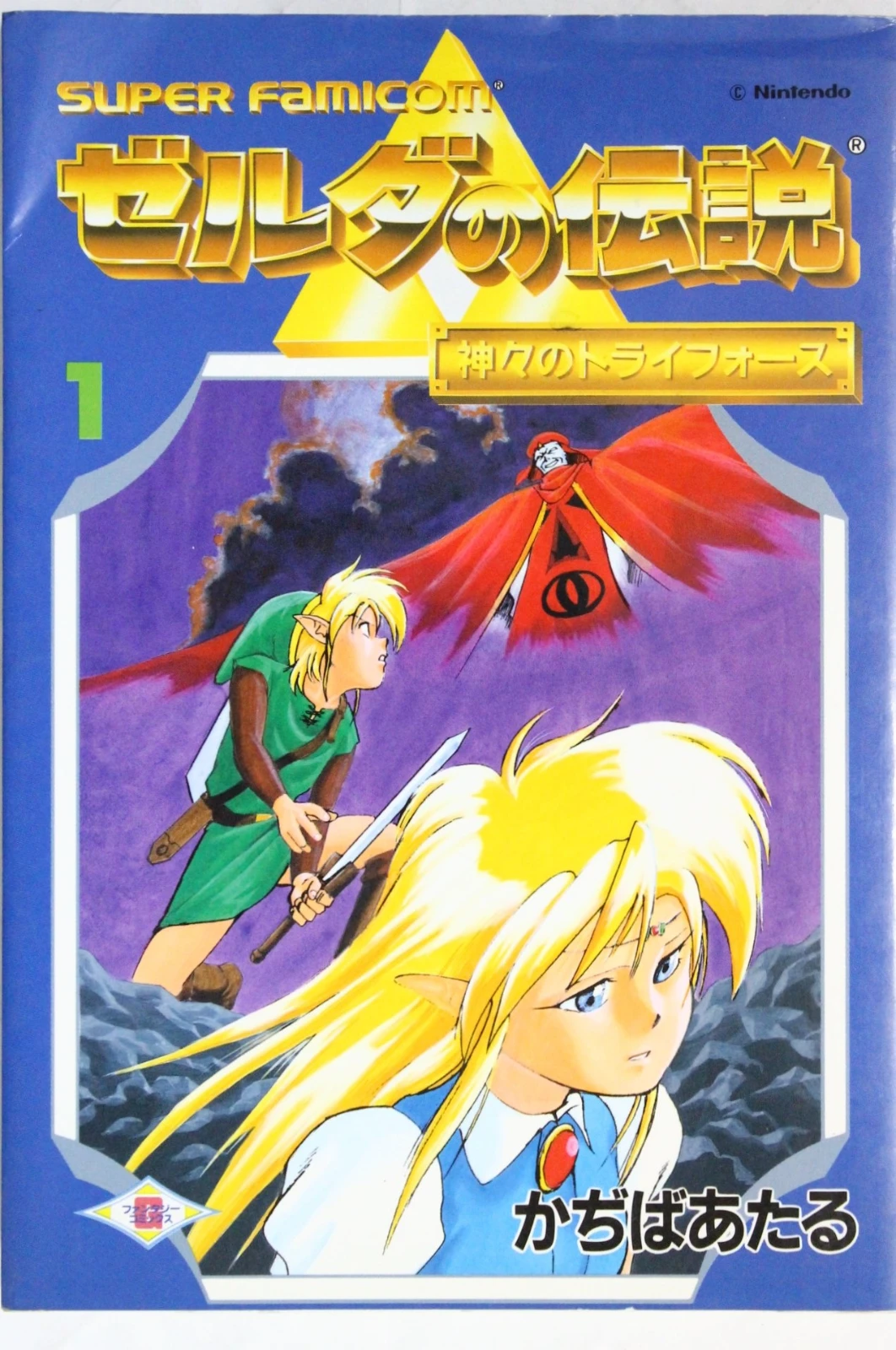
A Link to the Past (Kamigami no Triforce), Volume 1
Japan: Enix, 27 June 1995 · about 192 pages · ISBN 978-4-87025-541-8 · not published in English
Cagiva’s second Zelda series followed straight on from the first in Monthly GFantasy, and its opening sticks closely to the game. Agahnim, the priest who has made himself master of Hyrule, has locked Princess Zelda in the castle dungeon, and her telepathic plea reaches a boy named Link. His uncle takes up his sword and orders Link to stay in bed. Link ignores him, trails him to the castle and finds him gravely wounded. Armed with the wounded man’s sword and shield, Link breaks the princess out of the dungeon and leads her through the sewers to the Sanctuary.
From there the chapter titles (Setting Off, The Heart of a Hero, The Master Sword) trace the road to the legendary blade, and the manga adds a twist of its own at the end of it. The History of Hyrule blog, whose team has studied and translated the series, describes Link meeting the spirit of a hero from the past at the Master Sword, who tests him and then teaches him how to use it.
Chapters (6)
Priest Agahnim
Princess Zelda
Escape
Setting Off
The Heart of a Hero
The Master Sword
From game to page
The opening follows the game almost beat for beat, down to the uncle telling Link to stay in bed.
At the Master Sword Link meets the spirit of an earlier hero who tests and trains him. Nothing like it happens in the game, and History of Hyrule’s writers point out how closely it anticipates the Hero’s Shade of Twilight Princess (2006).
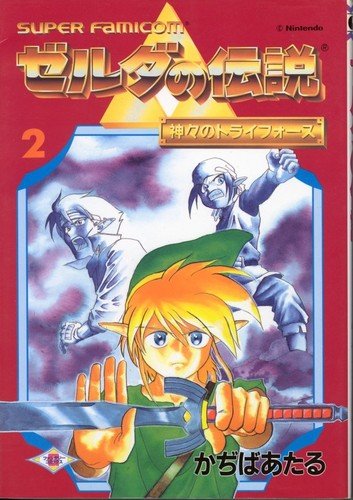
A Link to the Past (Kamigami no Triforce), Volume 2
Japan: Enix, 27 December 1995 · about 191 pages · ISBN 978-4-87025-552-4 · not published in English
The second volume takes Link into the Dark World. Its chapter titles (Confrontation, Dark World, Kanika, The Crystal Seal, Trap and Breakdown) are as much of the plot as English-language sources set down, so what follows is an outline. Kanika, who gives chapter 9 its name, is another of Cagiva’s inventions: the fan-written TV Tropes summary describes a scholar of the Dark World who admits to working for Ganon and then throws in his lot with Link. The Crystal Seal points to the crystals of the game, in which the maidens are imprisoned.
The volume seems to end badly for the heroes. History of Hyrule’s working script for the final chapter is raw dialogue, not a summary, but the lines hint at the shape of it: talk of a plan to awaken someone, a cry that all the crystals have been destroyed, heated arguments, and Ganon’s name.
Chapters (6)
Confrontation
Dark World
Kanika
The Crystal Seal
Trap
Breakdown
From game to page
Kanika, a Dark World scholar with divided loyalties, is the manga’s own creation.
Link has companions on his quest (per TV Tropes); in the game he travels alone.
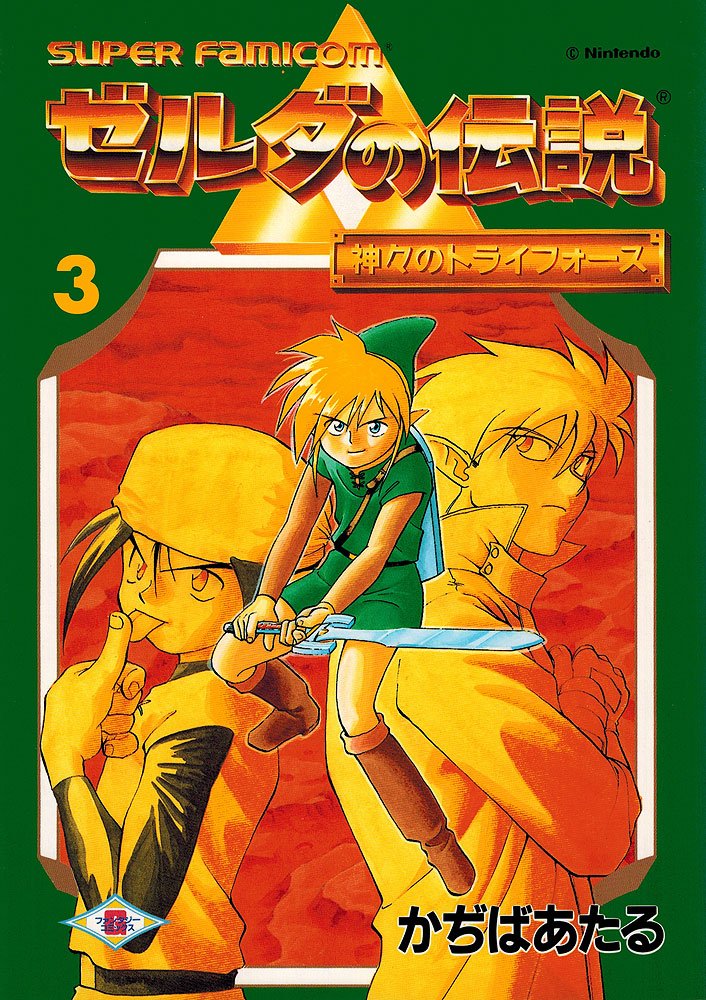
A Link to the Past (Kamigami no Triforce), Volume 3
Japan: Enix, 27 May 1996 · about 191 pages · ISBN 978-4-87025-559-3 · not published in English
The final volume (Sword of Light, Return, Betrayal, Fate, Dead Fighting and New Adventures) brings the story to its end, and again the English-language record is an outline. The betrayal of chapter 15 is probably Kanika’s: according to TV Tropes, the scholar proves to be Ganon’s spy, but gives the Master Sword back to Link before he dies. TV Tropes also says that Link’s companions, the martial artist Raska and the captain of the Hylian knights, travel with him, but that he walks into the last fight with Ganon alone. History of Hyrule notes that this volume’s Ganon fights with a technique of darkness, a detail taken from the game’s final battle, and that the manga gives Hyrule a history in which a hero of the Imprisoning War, six hundred years earlier, fought Ganon and lost. TV Tropes adds that the King of Hyrule, younger and slimmer than in the game, is still alive at the end.
Chapters (6)
Sword of Light
Return
Betrayal
Fate
Dead Fighting
New Adventures
From game to page
Per TV Tropes, Link loses the Master Sword for a time and gets it back from a traitor.
The manga writes a longer history for Hyrule, including a hero of six centuries earlier who failed to beat Ganon.
Ganon’s darkness technique comes straight from the game’s final boss fight.
Characters
Mabe Village, home to Marin and Tarin.
Both series keep the games’ heroes and villains and add companions around them. The Link’s Awakening manga names and expands minor figures (the game’s nameless ghost becomes Nakura) and invents a fairy, a swordsman and a mercenary. For A Link to the Past, Zelda Dungeon and the archived Zelda Wiki list two original characters, Raska and Raska’s father Tou; the other new faces below are known mainly from fan sources, and are marked as such. Link and Princess Zelda appear in both series.
Character
Who they are
In the cartoon
Voice
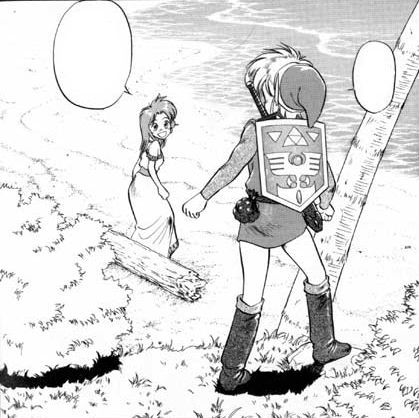
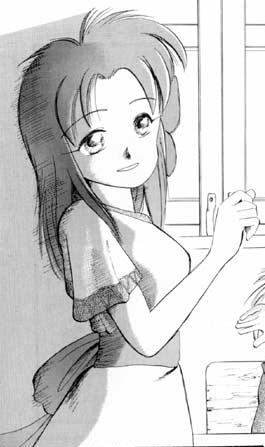
MarinLink’s Awakening
A girl of Mabe Village who dreams of leaving Koholint.
Link falls for her, takes her to Animal Village and plans to bring her home to Hyrule; when his escape fails, she is the one who persuades him to finish the quest.
From the game, with the romance played up.
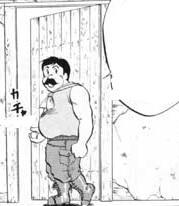
TarinLink’s Awakening
Marin’s father, in Mabe Village.
Turns down Link’s offer to leave the island but lets Marin go with him.
From the game.
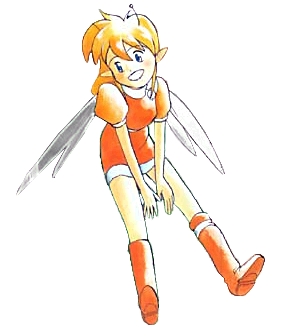
FeliciaLink’s Awakening
A fairy sent by the Owl to keep the Instruments of the Sirens safe for Link.
Cheeky and condescending at first, she becomes a close friend; she is kidnapped to Eagle’s Tower, rescued, and vanishes with the island when the Wind Fish wakes.
New to the manga. Her Japanese name is Ferisa.
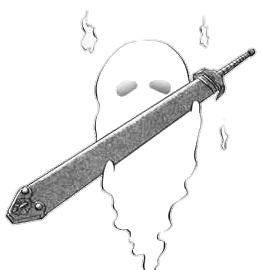
NakuraLink’s Awakening
The ghost of a soldier.
Possesses Link to break his fall from a cliff, is escorted home, and leaves Link the sword he used in life before passing on.
The game’s ghost, who has no name there.
KarunaLink’s Awakening
A pig-faced warrior serving the island’s monsters.
Knocks Link off a cliff after Angler’s Tunnel, and is killed when they meet again.
New to the manga.
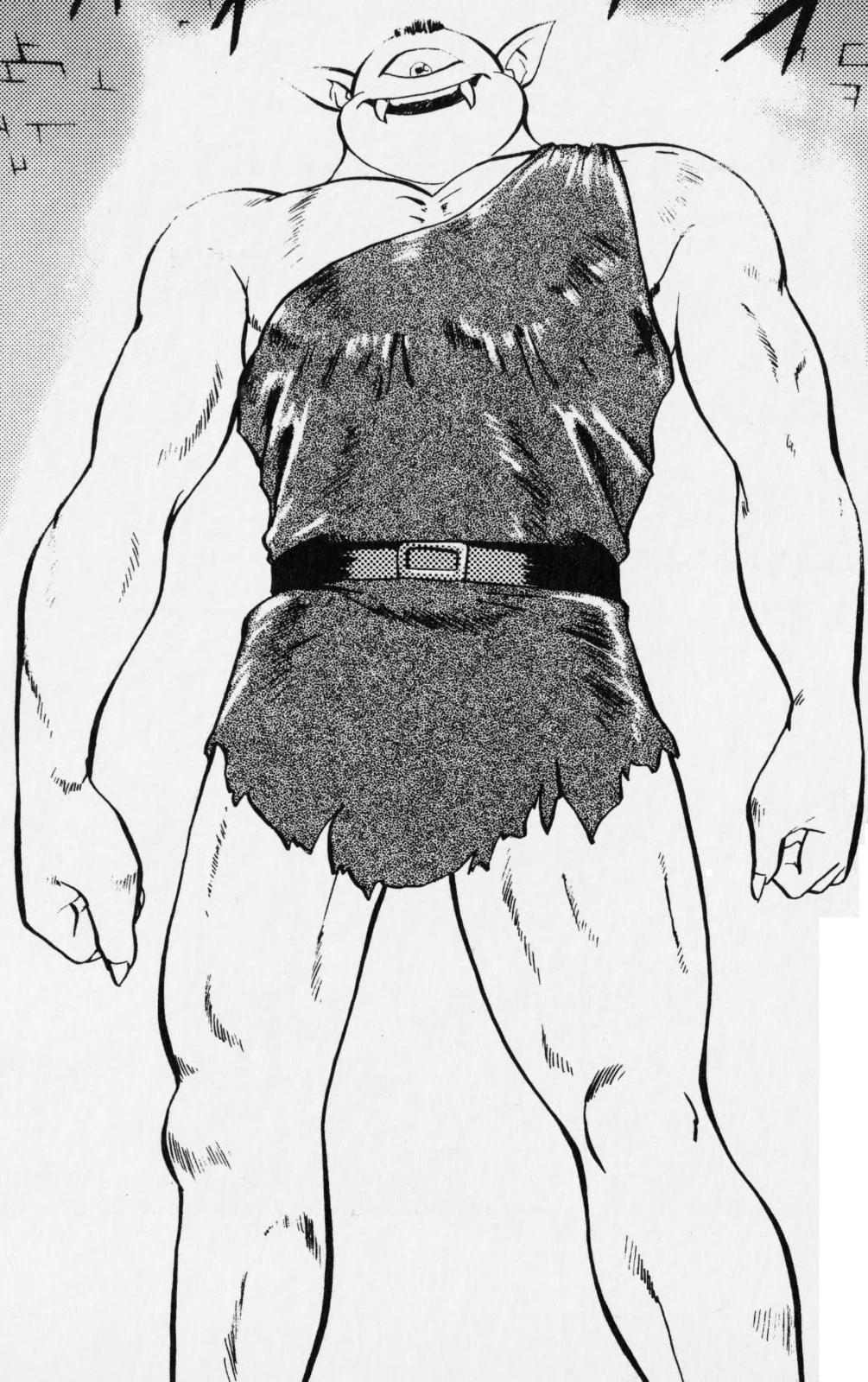
Master DronaLink’s Awakening
A warrior hired by the monsters who fights for the fun of it.
Ambushes Link in volume 2 and loses to a secret sword technique.
New to the manga.
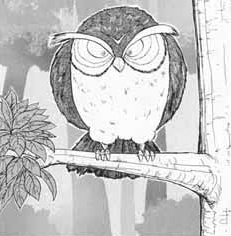
The OwlLink’s Awakening
The Wind Fish’s messenger.
Sends Felicia, and tells Link the hard truth that there is no Hyrule in this dream; he is the Messenger of Awakening.
From the game; here he also gives Link a comfort that comes from the Wind Fish in the game.
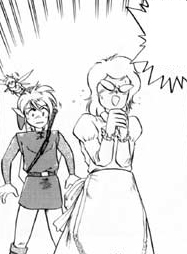
Madam MeowMeowLink’s Awakening
BowWow’s owner in Mabe Village.
Gives Link the ocarina as a reward for rescuing BowWow.
From the game, where the ocarina comes from the Dream Shrine instead.
RaskaA Link to the Past
Link’s childhood friend and a martial artist.
Travels with Link, according to TV Tropes, which describes the character as a bare-handed fighter and Link’s long-time rival.
New to the manga.
TouA Link to the Past
Raska’s father, also a martial artist.
TV Tropes describes him as a friend of Link’s uncle; his part in the story is not recorded in detail.
New to the manga.
KanikaA Link to the Past
A scholar of the Dark World (chapter 9 bears his name).
Per TV Tropes: admits to working for Ganon, joins Link, is revealed as a spy, and dies after giving Link back the Master Sword.
New to the manga.
The captainA Link to the Past
The leader of the Hylian knights (“Danchō”, rendered “Captain” by fan translators).
Per TV Tropes, a mentor to Link who travels with him.
New to the manga.
The past heroA Link to the Past
The spirit of an earlier hero, and Link’s ancestor, who guards the Master Sword.
Tests Link’s resolve and teaches him to wield the sword. TV Tropes notes that his fairy companion looks rather like Felicia.
New to the manga.
AgahnimA Link to the Past
The priest who has seized Hyrule and imprisoned Zelda (Agunimu in Japanese).
The villain of the opening chapters (chapter 1 is named after him). TV Tropes says he wins the people’s trust by reviving a puppy, and that Link finally runs him through with the Master Sword.
From the game.
From game to manga
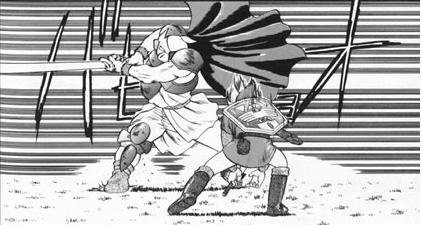
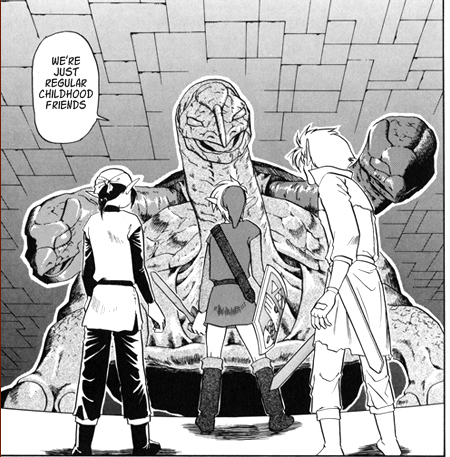
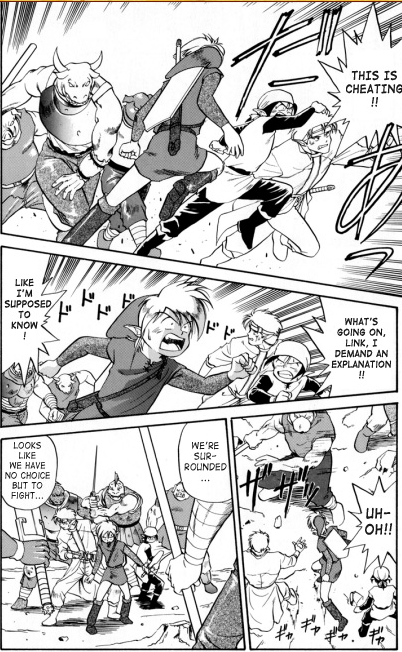
Link battling Karuna, one of the manga’s own villains.
Zelda Dungeon’s summary of the Link’s Awakening books is that they follow the game closely with a few slight differences, and the order of events bears that out: the eight dungeons, the instruments, the Face Shrine’s terrible secret and the Wind Fish’s egg all arrive on schedule. What Cagiva changes is the temperature. The game’s Link never says a word and never wavers; this one argues, teases, falls in love and, when he learns the truth, runs. Volume 2 is in effect a long detour the game never takes, as Link quits, tries to sail away with Marin and has to be talked back by her and by the Owl, before the quest resumes.
The A Link to the Past books take more liberties. The opening is the game’s almost scene for scene, but after that Cagiva gives Link a party of allies, a traitor among them, and a history to live up to in the ghost of an earlier hero who guards the Master Sword. History of Hyrule’s writers argue that the series sketched ideas, such as an ancient hero who trains his descendant, that the games themselves would only reach years later.
Link’s Awakening: what changes
Link talks, and takes Marin for Zelda, a goddess and an angel when he first sees her.
New characters: Felicia, Karuna and Master Drona; the game’s ghost becomes Nakura.
Cut back: the Key Cavern is barely mentioned and the Flying Rooster does not appear.
New events: Link quits, Animal Village is attacked, and an invisible barrier stops his escape by sea.
Swapped roles: Madam MeowMeow gives Link the ocarina, and the Owl delivers the comfort the Wind Fish gives in the game.
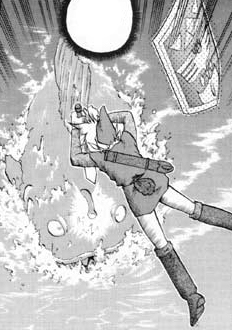
The Angler Fish, against which Link’s sword breaks.A Hinox, fought while Felicia is kidnapped.The Instruments of the Sirens, which Felicia keeps for Link.The Face Shrine, where Link learns the truth about Koholint.
A Link to the Past: what changes
Allies: Raska, the captain of the knights and, for a while, Kanika, where the game sends Link alone.
The Master Sword comes with a guardian spirit, a past hero who tests and trains Link.
A traitor: Link loses the Master Sword to one of Agahnim’s illusions, and it is Kanika, unmasked as Ganon’s mole, who brings it back at the cost of his life (per TV Tropes).
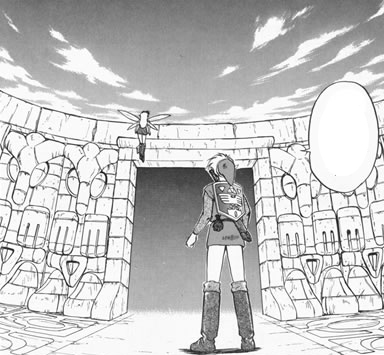
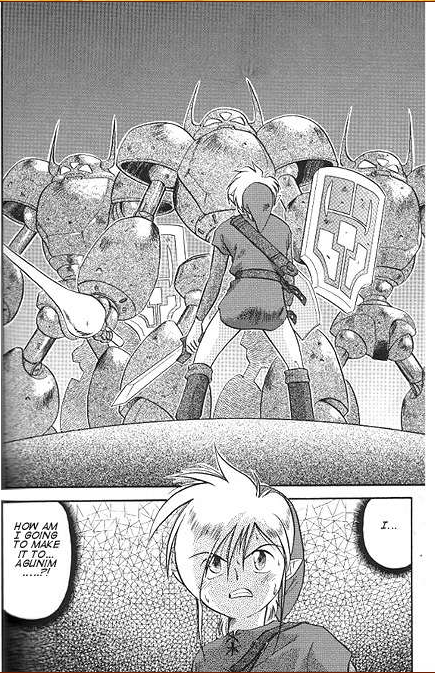
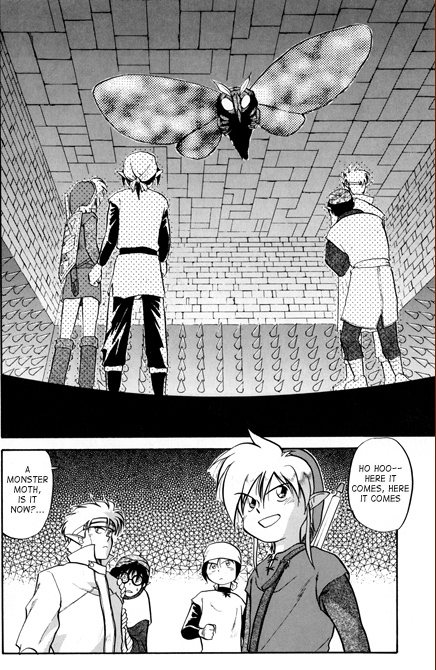
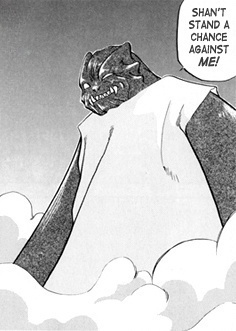
Familiar bosses: Zelda Wiki holds Cagiva’s drawings of the Armos Knights, Moldorm, Mothula, Blind and Trinexx, so the game’s dungeon guardians are there on the page.
The Armos Knights in Cagiva’s manga.Mothula, the boss of Skull Woods.Blind, the thief of Thieves’ Town.Trinexx, the guardian of Turtle Rock.
Ataru Cagiva
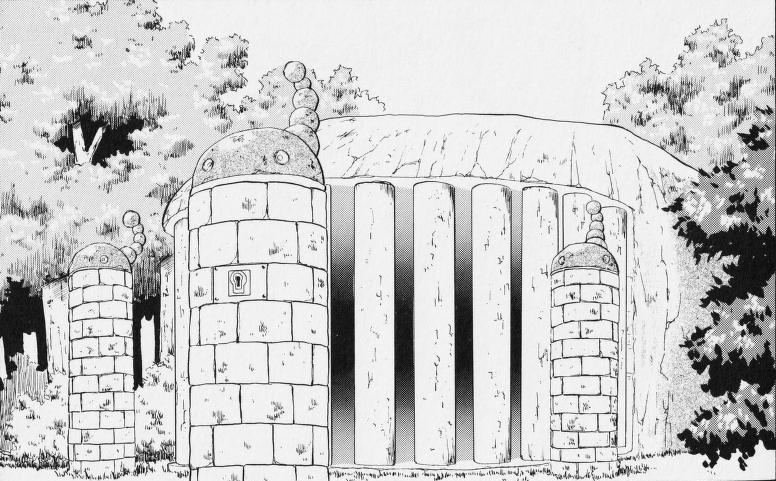
Tail Cave, the first dungeon of the Link’s Awakening manga.
Ataru Cagiva is the romanised pen name of かぢばあたる (Kajiba Ataru), a manga artist born on 27 February 1969 in Aichi Prefecture. According to Japanese Wikipedia, Cagiva began drawing in the second year of high school, moved to Tokyo about six months after leaving school, and took part-time jobs while sending work to publishers. In 1992 Cagiva won an honourable mention in an Enix newcomer competition with B.C. Science, and after a first debut spent time as an assistant to the manga artist Kōhei Nishino before debuting again.
The Zelda books came next. Japanese Wikipedia lists Yume o Miru Shima as Cagiva’s first collected work and says Kamigami no Triforce was serialised straight after it finished. Game comics remained the core of Cagiva’s early career: there followed a Star Ocean manga for Enix’s Monthly Shōnen Gangan, a Legend of Dragoon book for Famitsu Bros., and the three-volume Animun Sakushisu. Later work includes Mitsurugi Haruka Kiki Ippatsu!, a gamebook-style comic that was adapted as a live-action film in 2008, and Fly High! Ryūkyū Corazón Monogatari.
Interviews and commentary
English Wikipedia’s list of Zelda manga links to two pages of commentary by Cagiva on the Link’s Awakening and A Link to the Past books, hosted on an old Japanese personal site; we have not been able to read them, and no English-language interview with Cagiva about the Zelda books has turned up.
Editions
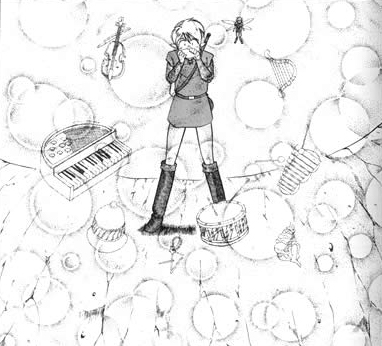
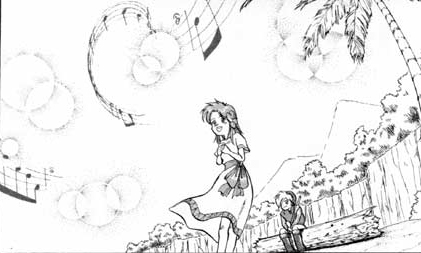
The Ballad of the Wind Fish, from the Link’s Awakening manga.
Both series were serialised in Enix’s Monthly GFantasy and collected by Enix; the Link’s Awakening books, in black and white according to Zelda Dungeon, carry the Gangan Fantasy Comics label in their Amazon Japan listings. History of Hyrule, which rescued the opening colour pages of the first Link’s Awakening chapter, traces that chapter to the December 1993 issue of the magazine; MyAnimeList dates the A Link to the Past serial from September 1994 to February 1996. We have found no reprint, and none of the books has been translated officially into English or, as far as we can find, any other language.
Volume
Japanese release
ISBN
Pages
Yume o Miru Shima 1
27 May 1994
4-87025-513-8 (978-4-87025-513-5)
186
Yume o Miru Shima 2
27 September 1994
978-4-87025-524-1
Not confirmed
Kamigami no Triforce 1
27 June 1995
4-87025-541-3 (978-4-87025-541-8)
About 192
Kamigami no Triforce 2
27 December 1995
4-87025-552-9 (978-4-87025-552-4)
About 191
Kamigami no Triforce 3
27 May 1996
4-87025-559-6 (978-4-87025-559-3)
About 191
Sources disagree slightly on the dates. Zelda Dungeon and the Fandom wiki give the dates above; English Wikipedia’s table gives May 1995, November 1995 and April 1996 for the A Link to the Past books, and History of Hyrule gives 27 June 1994 for the first Link’s Awakening volume. Page counts also vary by a few pages between sources.
Anime News Network lists Norma Editorial as a Spanish publisher of Cagiva’s A Link to the Past, but Norma’s own catalogue lists only Akira Himekawa’s Zelda books and Ishinomori’s comic, so we think the entry is a mix-up. The only English versions of Cagiva’s books are unofficial fan translations.
Trivia
Princess Zelda, as Cagiva drew her for the Link’s Awakening manga.As in the game, Link’s first thought on waking in Marin’s house is that she is Zelda; the manga has him take her for a goddess and an angel too.
Felicia was helping Link four years before Navi did the same job in Ocarina of Time (1998). The Fandom wiki compares her prickly friendship with Link to Tatl’s in Majora’s Mask.
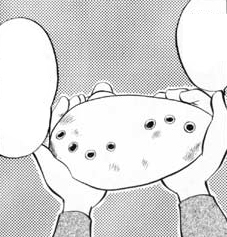
The ocarina, from the Link’s Awakening manga.In the manga the ocarina is a thank-you present from Madam MeowMeow for BowWow’s return; in the game Link finds it in the Dream Shrine.
Felicia’s Japanese name is Ferisa. The Fandom wiki traces the English spelling to the Latin for lucky.
Agahnim is Agunimu in the Japanese game and in the manga. Fan translators switched to Agahnim because that is the name English-speaking readers know.
Taros, Moblins and other Dark World monsters, drawn by Cagiva.History of Hyrule argues that the A Link to the Past manga’s ancestral hero, who trains Link at the Master Sword, is an early version of the Hero of Time and of Twilight Princess’s Hero’s Shade, and even spots a forerunner of Skyward Sword’s Fi.
The opening chapter of the Link’s Awakening manga ran with colour pages in Monthly GFantasy in December 1993; History of Hyrule only tracked down and scanned them in 2023.
The Japanese Wikipedia list of Zelda works credits かぢばあたる with a different series altogether, Kobunsha’s Oath of Riruto. Cagiva’s own Japanese Wikipedia article does not mention it, and the Fandom wiki credits that series to Junya Furusawa and Jin Munesue.
Enix was busy with Zelda at the time: alongside Cagiva’s serials it published the 4-koma Manga Gekijō gag anthologies, whose early volumes covered the same two games.
Further reading: Zelda Temple research dossier for the Comics & Books section (sources listed inside, including the en.wikipedia ISBN table)
Manage Consent
To provide the best experiences, we use technologies like cookies to store and/or access device information. Consenting to these technologies will allow us to process data such as browsing behavior or unique IDs on this site. Not consenting or withdrawing consent, may adversely affect certain features and functions.
Functional
Always active
The technical storage or access is strictly necessary for the legitimate purpose of enabling the use of a specific service explicitly requested by the subscriber or user, or for the sole purpose of carrying out the transmission of a communication over an electronic communications network.
Preferences
The technical storage or access is necessary for the legitimate purpose of storing preferences that are not requested by the subscriber or user.
Statistics
The technical storage or access that is used exclusively for statistical purposes.The technical storage or access that is used exclusively for anonymous statistical purposes. Without a subpoena, voluntary compliance on the part of your Internet Service Provider, or additional records from a third party, information stored or retrieved for this purpose alone cannot usually be used to identify you.
Marketing
The technical storage or access is required to create user profiles to send advertising, or to track the user on a website or across several websites for similar marketing purposes.

 MarinLink’s Awakening
 TarinLink’s Awakening
 FeliciaLink’s Awakening
 NakuraLink’s Awakening
 KarunaLink’s Awakening
 The OwlLink’s Awakening
 Madam MeowMeowLink’s Awakening