
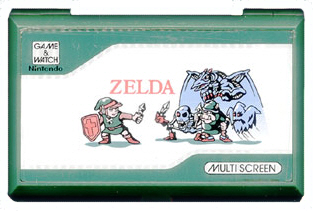
Zelda (Game & Watch)
Two screens, eight dragons and a Triforce in eight pieces: the Zelda that fitted in a shirt pocket four years before Link’s Awakening.
| Title | Zelda |
| Platform | Game & Watch Multi Screen, model ZL-65 |
| Developer | Nintendo Research & Development 1 (Gunpei Yokoi’s team) |
| Publisher | Nintendo |
| Released | August 1989 in North America; Zelda Dungeon and Wikipedia’s Game & Watch list give the day as 26 August |
| Genre | Action-adventure |
| Players | 1 |
| Screens | Two LCD screens in a folding clamshell case |
| Controls | D-pad (Down is marked WATER OF LIFE) and an ATTACK button; GAME, CONTINUE, TIME, ALARM and ACL buttons |
| Size | 7.2 × 11.7 × 2.5 cm closed; about 100 g (Young V&A catalogue) |
| Story | Eight dragons have kidnapped Princess Zelda and sealed her away; each one guards a piece of the Triforce |
| Series position | The 15th and last Multi Screen, and the second-to-last Game & Watch of the original line |
| Re-releases | Nintendo Mini Classics keyring (from 1998); Game & Watch Gallery 4 for Game Boy Advance (October 2002), itself reissued on Wii U Virtual Console (2015–2016) |
| Not to be confused with | Game & Watch: The Legend of Zelda (2021), which does not include it |
Overview
Before the Game Boy, a Nintendo handheld meant a Game & Watch: a pocket-sized LCD toy that played one game and doubled as a clock and alarm, hence the name. Nintendo made dozens of them from 1980 onwards, and the grandest were the Multi Screens, which folded shut like a powder compact and opened to show two screens.
Zelda, model ZL-65, was the last of those. It came out in North America in August 1989, four months after the Game Boy’s Japanese launch, and it squeezed a surprising amount of adventure into its fixed LCD shapes. On the lower screen Link fights his way up through a labyrinth, dodging skeletons and ghosts and duelling a spear-carrying Goblin on every floor. At the top, the action jumps to the upper screen, where a dragon is waiting. Beat eight dragons, collect the eight Triforce pieces they guard, and Princess Zelda goes free.
It was made by Nintendo itself, by Gunpei Yokoi’s R&D1 division, and it borrows more from Zelda II than from the first game: the view is side-on and the fighting is all about timing a sword and a shield.
Most people who have played it did so years later. In 2002 it turned up as the final unlockable game in Game & Watch Gallery 4 for Game Boy Advance, the subject of Zelda Temple’s original page here, and a miniature version has been sold as a Nintendo Mini Classics keyring.
Quick Answers
Quick answers to the questions people ask about the Zelda Game & Watch; there is more on each further down.

What is Zelda (Game & Watch)?
A handheld LCD game made by Nintendo in 1989, in its two-screen Game & Watch Multi Screen range. It is a small action game in which Link climbs labyrinths and fights dragons, and it also works as a clock and alarm. More →
When did it come out?
In August 1989 in North America. Zelda Dungeon and Wikipedia’s list of Game & Watch games both give 26 August 1989. More →
How do you beat it?
Defeat all eight dragons. Each one gives up a fragment of the Triforce, and the complete Triforce breaks the seal on Zelda’s prison. The game then starts again, faster and harder, with your score carried over. More →
How do you unlock Zelda in Game & Watch Gallery 4?
With stars. According to the Super Mario Wiki, Zelda appears in the Museum once you have 60 stars and becomes playable at 160, the highest requirement of any game in the collection. More →
Was it the last Game & Watch?
It was the last Multi Screen model and the second-to-last Game & Watch of the original line. Mario the Juggler followed in October 1991. More →
Is it on the 2021 Game & Watch: The Legend of Zelda?
No. The 2021 handheld contains three other Zelda games and nothing from this one. See its own page. More →
Plot / Story
The handheld cannot tell a story on its screens, so the instruction manual does it. Eight dragons have been causing ever greater havoc and mean to wrest the world from humankind. They have carried off Princess Zelda and shut her in a deep dungeon, behind a seal that only the complete Triforce can break.
The Triforce is in eight fragments, and Link wins one from each dragon he destroys. When the last dragon falls, the Triforce is whole again, the seal gives way and Zelda is rescued. Unusually for a Game & Watch, then, this one has an ending, though the game carries straight on into a harder second round.
The story is original to the handheld, with the manual as its only source, and Zelda Dungeon marks the game as possibly outside the series’ core canon.
How it plays
A Game & Watch does not draw pictures the way a console does. Every position a character can stand in is a fixed shape printed into the screen, and the game simply switches shapes on and off. Zelda uses its second screen to get round that limit: the lower screen is the labyrinth, and the upper one holds the map, your items and the dragon’s lair.
You move Link left and right with the D-pad and fight with a single ATTACK button. Up climbs a staircase when one appears, and Down drinks the Water of Life.
| Enemy or item | Where | What to do |
|---|---|---|
| Goblin | Lower screen, on the right | A spear-carrier in the mould of a Moblin. It stabs and throws spears. It is the only labyrinth enemy Link can hurt, and it must be beaten to move on |
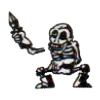
| Stalfos | Lower screen, from below | Up to four skeletons thrust up through the floor. They cannot be killed: step out of the way |
| Ghost | Lower screen, behind Link | Fires at Link’s back. It cannot be killed either: block its shots with the shield |
| Dragon | Upper screen | The boss at the top of each labyrinth. Dodge its fire and its tail, and strike when there is an opening |
| Tomahawk | Dragon fights | A heavy weapon used only against dragons; it hits three times as hard as the sword |
| Water of Life | Press Down | Refills all of Link’s hearts |
| Map | Upper screen | Shows the layout of the labyrinth |
| Heart | Pick-up | Restores one heart |
The lower screen: the labyrinth

Each chamber is a three-way squeeze. The Goblin stands to Link’s right and is the one you are trying to kill; pressing ATTACK both swings the sword and parries its spear. Letting go of the button swings the shield round to Link’s back, which is how he stops the shots the Ghost fires from behind. Meanwhile one Stalfos in the early chambers, and as many as four later on, stab upwards from under the floor, and the only answer to those is not to be standing there.
Wear the Goblin down and a staircase appears. Sometimes there are two, and you choose which way to climb, so the labyrinths branch. Link has a row of hearts rather than a simple count of lives, and when all five are full his sword fires beams, letting him hit the Goblin from the far side of the chamber.
The upper screen: eight dragons
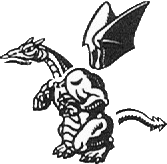
Climb to the top room and the fight moves upstairs. The right-hand side of the upper screen is the Dragon’s Lair, where the dragon breathes fireballs and lashes out with its tail while Link ducks between them and looks for a gap. Here he swaps his sword for the Tomahawk, which does nine points of damage a blow against the sword’s three.
Each dragon that falls leaves a fragment of the Triforce, and the eighth completes it and frees Zelda. The game then begins a second round with quicker enemies and tougher bosses, keeping your score, and after that it loops for as long as you can last.
Scores and the Continue button
Zelda has a CONTINUE button, a rarity in the range: Wikipedia’s list counts only two Game & Watch games with a continue feature. If Link dies, it lets you carry on instead of starting from scratch, and holding it down shows the best score the handheld has recorded. The score counter runs to 9,990; go past that and a sword symbol appears above the hearts to stand for 10,000 points.
The hardware
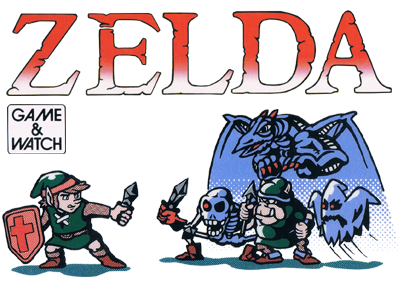
The case is green plastic, hinged along the spine with a clasp to hold it shut, and small enough to disappear into a pocket: 7.2 by 11.7 centimetres when closed and 2.5 centimetres thick, according to the Young V&A, which has one in its collection. The lid shows Link squaring up to three monsters. Inside, both screens are backed with castle scenery, and the lower half carries a red D-pad, the ATTACK button and five small buttons marked GAME, CONTINUE, TIME, ALARM and ACL.
Like the rest of the range it is a clock as well as a game, with TIME and ALARM buttons to prove it. On this model a little old lady on the lower screen is the one who sounds the alarm.
Where it came from
No interviews about the making of this particular handheld have come to light, but its place in Nintendo’s history is well recorded.
Game & Watch and the Multi Screens
The Game & Watch line began in 1980 with Ball and was Nintendo’s first handheld range. The two-screen Multi Screen models arrived on 28 May 1982 with Oil Panic, followed within a week by Donkey Kong, and fifteen were released in all. Zelda, numbered ZL-65, was the fifteenth, ten months after Gold Cliff. A sixteenth, Tetris Jr. (TR-66), reached the prototype stage but never went on sale.
Wikipedia and Zelda Dungeon both credit the handheld to Gunpei Yokoi and Nintendo Research & Development 1. That sets it apart from the other Zelda LCD games of the time, such as the Nelsonic wristwatch, which were licensed out to other companies.
A pocket-sized Zelda II
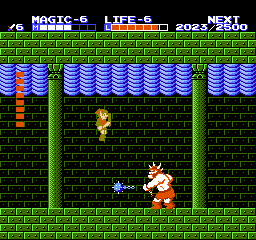
Wikipedia describes the gameplay as heavily inspired by Zelda II: The Adventure of Link, which had reached North America the previous December: Link is seen from the side, and fights are a matter of striking and guarding at the right moment. The hearts and the eight Triforce fragments held by bosses echo the first game. The tale of the eight dragons is original to the handheld, and Wikipedia notes that the Tomahawk appears nowhere else in the series.
The end of the line
By August 1989 the Game Boy was already on sale in Japan, and the Game & Watch was nearly finished. Only one more original model followed Zelda: Mario the Juggler, on 14 October 1991. A full-sized Zelda adventure did not reach a Nintendo handheld until Link’s Awakening in 1993.
Trivia & facts
- A Zelda Game & Watch is on show in London, in the Arcade section of the Play Gallery at Young V&A. It was given to the museum in 2016 by Alex Malloy, who had owned it with his younger brother as a child.
- The Down arrow on the D-pad has its job printed on it: WATER OF LIFE.
- Going by the dates the wikis give, this was the first Zelda game anyone could carry around: it beat the Nelsonic Game Watch to the shops by about six weeks and Link’s Awakening by almost four years.
- Inverse, marking the handheld’s 35th birthday in August 2024, called its row of hearts the first life bar in a Game & Watch, and reported that boxed examples with their manual were selling for up to US$500 on eBay.
- In April 2011 the website Pica Pic published a playable recreation of the handheld made in Adobe Flash. With Flash retired, it no longer runs in current browsers.
- The Mini Classics keyring packaging sold in the United States used artwork from A Link to the Past and Four Swords Adventures, games that did not exist when the handheld was designed.
- In Game & Watch Gallery 4 the screen that is not in use is squashed to about two-thirds of its height, so that both fit on the Game Boy Advance’s single display.
- Nintendo returned to the two-screen clamshell idea in 2004 with the Nintendo DS, and Zelda Dungeon counts the Multi Screens as its inspiration.
Media & artwork
The handheld open and closed, its box and manual, the LCD artwork, and the versions in Game & Watch Gallery 4 and the Mini Classics range. Select any image to view it larger.

Legacy
The original handheld had a short life, but the game has been brought back twice: shrunk onto a keyring, and tucked away as the last secret of a Game Boy Advance collection.
Release history
- Game & Watch Multi Screen August 1989 – Model ZL-65, North America.
- Nintendo Mini Classics 1998 onwards – A keyring-sized, two-screen version in the licensed Mini Classics range, sold first in Europe.
- Game & Watch Gallery 4 October 2002 – Game Boy Advance; Zelda is the last game to unlock in the Museum. Called Game & Watch Gallery Advance in Europe and Australia.
- Mini Classics in the US By early 2007 – Distributed in some American shops by It’s Outrageous.
- Game & Watch Gallery 4 on Wii U 2015–2016 – Virtual Console: PAL regions 10 December 2015, Japan 16 March 2016 (the game’s first release there), North America 7 April 2016.
Game & Watch Gallery 4
Game & Watch Gallery 4 is where most players have met this game. Developed by Tose and published by Nintendo for Game Boy Advance in October 2002 (25 October in Europe, where it was called Game & Watch Gallery Advance), it was the fifth and final entry in the Gallery series of Game & Watch collections. Its eleven main games each come in two forms: Classic, which copies the original LCD screens, and Modern, which redraws them with Mario characters.
Playing well earns stars, up to five for each mode and difficulty of each game and 220 in total, and stars open up the rest of the cartridge. Nine further games live in the Museum, playable only in their Classic form and worth no stars themselves. Zelda is the last of the nine. The Super Mario Wiki gives the thresholds: it is added to the Museum as an exhibit at 60 stars and becomes playable at 160, after Manhole, Tropical Fish, Mario’s Bombs Away, Parachute, Bomb Sweeper, Climber, Safe Buster and Life Boat.
The port is faithful, with one compromise. The original has two screens and the Game Boy Advance has one, so both are shown together and whichever is not in play is shrunk to roughly two-thirds of its height.
Japan never got the cartridge. The collection first appeared there, as Game Boy Gallery 4, on the Wii U Virtual Console on 16 March 2016, a few months after its Virtual Console release in PAL regions and shortly before North America’s.
The Mini Classics keyring
Nintendo Mini Classics are licensed miniatures, most of them reissues of Game & Watch games, built to look like tiny Game Boys and hung from a detachable keyring. The range dates from 1998; Wikipedia names Stadlbauer as its maker and main European distributor, and Toymax as its first American one. Zelda is one of a handful of two-screen models, alongside Donkey Kong and Oil Panic, with a screen much smaller than the original’s, and like the rest of the range it runs on two button cells and keeps the clock and alarm.
Wikipedia records that the Zelda keyring was at first sold only in Europe, and that by early 2007 it had reached some shops in the United States through the distributor It’s Outrageous.
The 2021 handheld
When Nintendo revived the Game & Watch name for the series’ 35th anniversary, with Game & Watch: The Legend of Zelda in 2021, the obvious bonus was left out: the new handheld has three full Zelda games and a Link version of Vermin, but not the 1989 game.
Sales & reviews
What the critics said
No review scores from 1989 are on record. The verdicts on the handheld come from later retrospectives; the scores below are for Game & Watch Gallery 4 as a whole, as collected by Wikipedia, and are converted to percentages for the bars.
Looking back in a retrospective column, Famitsu felt the handheld had captured the excitement and role-playing flavour of the Zelda series, but found it too easy once Link had stocked up on power-ups. Retro Gamer placed it fifth in its “Perfect Ten” of Game & Watch games in October 2008. Wikipedia’s summary is that it pushed the LCD format about as far as it would go while remaining far simpler than the NES game.
Writing for Nintendojo in 2014, Anthony Vigna argued against those who say it is not a real Zelda, and called it “a rare Nintendo gem”.
Reader reviews
No reader reviews yet. Played it? Give it a score out of 10 and tell other fans what you think.
Further reading
More from Zelda Temple on Zelda’s LCD games and the adventures that inspired this one:
Sources
Every fact on this page was checked against the sources below in November 2026. IGN’s 2006 retrospective, GameSpot’s review and Zelda Wiki could not be read automatically, so they were not used; Famitsu and Retro Gamer are quoted as reported by Wikipedia.
Show sources (8 sections)
- Overview: Wikipedia, “The Legend of Zelda LCD games”, section on Zelda (Game & Watch): model, developer, gameplay, manual story, Famitsu and Retro Gamer verdicts, Mini Classics and Game & Watch Gallery 4 versions; Wikipedia, “List of Game & Watch games” (the Multi Screen series in order, ZL-65 dated 26 August 1989, Tetris Jr., Mario the Juggler, the continue feature); Zelda Dungeon Wiki, “Zelda (Game & Watch)” (screens, controls, enemies, items and damage values, rounds, score counter, later versions); Victoria and Albert Museum, catalogue record B.606-2016, “Game & Watch Multi Screen: Zelda” (materials, dimensions, buttons, lid artwork, display at Young V&A); Inverse, Mo Mozuch, “The First Portable Zelda Game Was Not What You Think”, 26 August 2024 (Game Boy launch date, hearts and sword beams, life bar, collector prices); Nintendo Co., Ltd., Japanese official site for the 2021 Game & Watch (the Game & Watch line as Nintendo’s first handheld series, begun in 1980); Wikipedia, “Game & Watch Gallery 4” (developer, release dates, structure, Metacritic and review scores); Wikipedia, “Nintendo Mini Classics” (the range, its makers and distributors, dual-screen models, batteries)
- Quick Answers: Wikipedia, “The Legend of Zelda LCD games”, section on Zelda (Game & Watch): model, developer, gameplay, manual story, Famitsu and Retro Gamer verdicts, Mini Classics and Game & Watch Gallery 4 versions; Wikipedia, “List of Game & Watch games” (the Multi Screen series in order, ZL-65 dated 26 August 1989, Tetris Jr., Mario the Juggler, the continue feature); Zelda Dungeon Wiki, “Zelda (Game & Watch)” (screens, controls, enemies, items and damage values, rounds, score counter, later versions); Super Mario Wiki, “Game & Watch Gallery 4” (star system, Museum games and the stars each needs, regional titles, Virtual Console dates); Wikipedia, “Game & Watch Gallery 4” (developer, release dates, structure, Metacritic and review scores)
- Plot / Story: Wikipedia, “The Legend of Zelda LCD games”, section on Zelda (Game & Watch): model, developer, gameplay, manual story, Famitsu and Retro Gamer verdicts, Mini Classics and Game & Watch Gallery 4 versions; Zelda Dungeon Wiki, “Zelda (Game & Watch)” (screens, controls, enemies, items and damage values, rounds, score counter, later versions); Nintendojo, Anthony Vigna, “Retro Scope: Zelda (Game & Watch)”, 2 October 2014 (chamber layout, branching stairs, items, verdict)
- How it plays: Wikipedia, “The Legend of Zelda LCD games”, section on Zelda (Game & Watch): model, developer, gameplay, manual story, Famitsu and Retro Gamer verdicts, Mini Classics and Game & Watch Gallery 4 versions; Zelda Dungeon Wiki, “Zelda (Game & Watch)” (screens, controls, enemies, items and damage values, rounds, score counter, later versions); Nintendojo, Anthony Vigna, “Retro Scope: Zelda (Game & Watch)”, 2 October 2014 (chamber layout, branching stairs, items, verdict); Inverse, Mo Mozuch, “The First Portable Zelda Game Was Not What You Think”, 26 August 2024 (Game Boy launch date, hearts and sword beams, life bar, collector prices); Victoria and Albert Museum, catalogue record B.606-2016, “Game & Watch Multi Screen: Zelda” (materials, dimensions, buttons, lid artwork, display at Young V&A); Wikipedia, “List of Game & Watch games” (the Multi Screen series in order, ZL-65 dated 26 August 1989, Tetris Jr., Mario the Juggler, the continue feature)
- Where it came from: Wikipedia, “The Legend of Zelda LCD games”, section on Zelda (Game & Watch): model, developer, gameplay, manual story, Famitsu and Retro Gamer verdicts, Mini Classics and Game & Watch Gallery 4 versions; Wikipedia, “List of Game & Watch games” (the Multi Screen series in order, ZL-65 dated 26 August 1989, Tetris Jr., Mario the Juggler, the continue feature); Nintendo Co., Ltd., Japanese official site for the 2021 Game & Watch (the Game & Watch line as Nintendo’s first handheld series, begun in 1980); Zelda Dungeon Wiki, “Zelda (Game & Watch)” (screens, controls, enemies, items and damage values, rounds, score counter, later versions); Inverse, Mo Mozuch, “The First Portable Zelda Game Was Not What You Think”, 26 August 2024 (Game Boy launch date, hearts and sword beams, life bar, collector prices)
- Trivia & facts: Victoria and Albert Museum, catalogue record B.606-2016, “Game & Watch Multi Screen: Zelda” (materials, dimensions, buttons, lid artwork, display at Young V&A); Zelda Dungeon Wiki, “Zelda (Game & Watch)” (screens, controls, enemies, items and damage values, rounds, score counter, later versions); Inverse, Mo Mozuch, “The First Portable Zelda Game Was Not What You Think”, 26 August 2024 (Game Boy launch date, hearts and sword beams, life bar, collector prices); Wikipedia, “The Legend of Zelda LCD games”, section on Zelda (Game & Watch): model, developer, gameplay, manual story, Famitsu and Retro Gamer verdicts, Mini Classics and Game & Watch Gallery 4 versions; Wikipedia, “Nintendo Mini Classics” (the range, its makers and distributors, dual-screen models, batteries)
- Legacy: Wikipedia, “The Legend of Zelda LCD games”, section on Zelda (Game & Watch): model, developer, gameplay, manual story, Famitsu and Retro Gamer verdicts, Mini Classics and Game & Watch Gallery 4 versions; Wikipedia, “Game & Watch Gallery 4” (developer, release dates, structure, Metacritic and review scores); Super Mario Wiki, “Game & Watch Gallery 4” (star system, Museum games and the stars each needs, regional titles, Virtual Console dates); Wikipedia, “Nintendo Mini Classics” (the range, its makers and distributors, dual-screen models, batteries); Zelda Dungeon Wiki, “Zelda (Game & Watch)” (screens, controls, enemies, items and damage values, rounds, score counter, later versions); Wikipedia, “List of Game & Watch games” (the Multi Screen series in order, ZL-65 dated 26 August 1989, Tetris Jr., Mario the Juggler, the continue feature)
- Sales & reviews: Wikipedia, “The Legend of Zelda LCD games”, section on Zelda (Game & Watch): model, developer, gameplay, manual story, Famitsu and Retro Gamer verdicts, Mini Classics and Game & Watch Gallery 4 versions; Wikipedia, “Game & Watch Gallery 4” (developer, release dates, structure, Metacritic and review scores); Nintendojo, Anthony Vigna, “Retro Scope: Zelda (Game & Watch)”, 2 October 2014 (chamber layout, branching stairs, items, verdict)