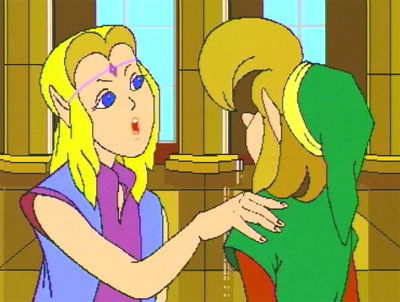
Link is the one in the dungeon and the princess does the rescuing, in a top-down quest that a tiny Los Angeles studio filmed with its own office staff, a ceiling mirror and a treadmill.
ReleasedFebruary 1996 (Netherlands) · 10 May 1996 (UK). Europe only
DeveloperViridis Corporation
PublisherPhilips Interactive Media
DirectorAnna Roth
ProducerLee Barnes
Players1
Title
Zelda’s Adventure
Platform
Philips CD-i
Developer
Viridis Corporation (West Los Angeles, California)
Publisher
Philips Interactive Media (the box credits Philips Media)
Director
Anna Roth
Producer
Lee Barnes
Game and technical design
Lee Barnes, Christopher Thompson
Lead programmer
Randy Casey
Art direction
Michael Hagler
Video and audio
Jim Belcher
Models and prosthetics
Jason Bakutis
Music
Mark Andrade
Cast
Zelda: Diane Burns and Annie Ward. Gaspra: Mark Andrade, reportedly with the voice of Hal Smith (not in the credits)
Players
1
Released (Netherlands)
February 1996
Released (United Kingdom)
10 May 1996
North America
Announced by Philips on 23 April 1996 for the second quarter at $39.99, then cancelled. Never released
No. Nintendo did not make it and does not count the CD-i games as part of the series
Overview
Zelda’s Adventure is the third and last Zelda game that Philips published for its CD-i player, and the odd one out. The two that came before it in 1993, Link: The Faces of Evil and Zelda: The Wand of Gamelon, are side-scrolling action games with cartoon cutscenes. This one came from a different studio and a different engine. It looks down on its heroine from above, in the manner of the very first Legend of Zelda, and it tells its story with filmed actors in costume.
The plot turns the usual arrangement on its head. Ganon has seized the land of Tolemac, stolen its seven celestial signs and locked Link away, so it is Princess Zelda who picks up a wand and goes to the rescue. Her road runs across an overworld of forests, deserts, swamp and coast to seven Shrines, each one guarded by a Shrine Keeper loyal to Ganon.
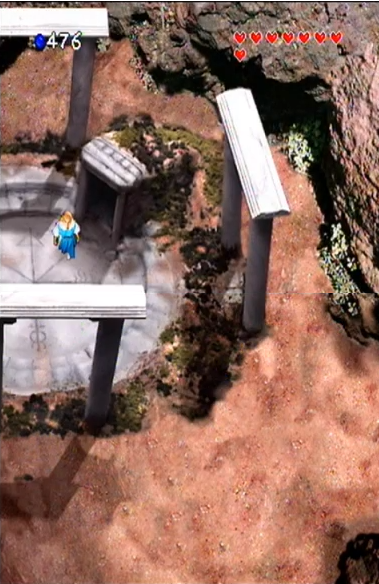
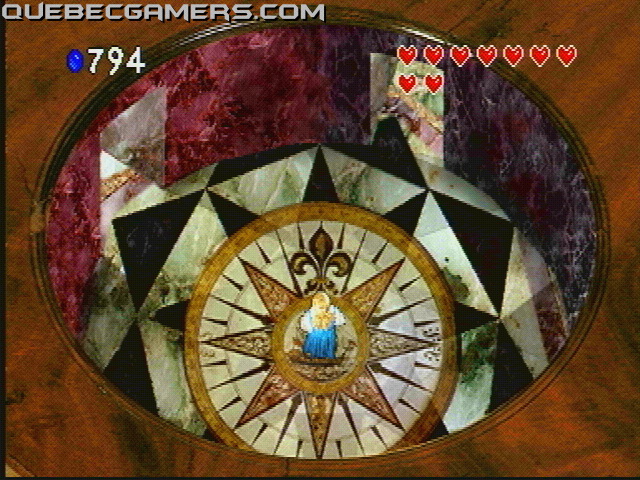
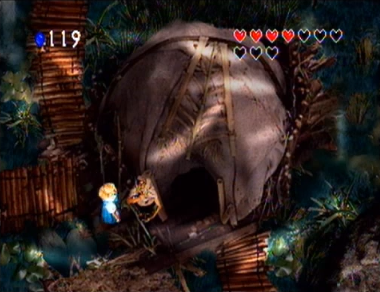
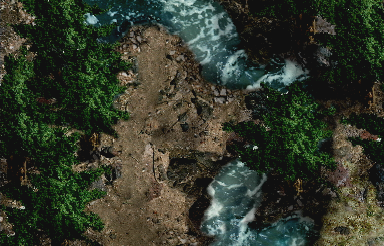
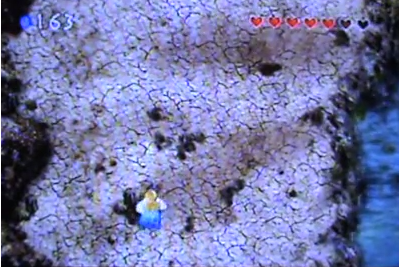
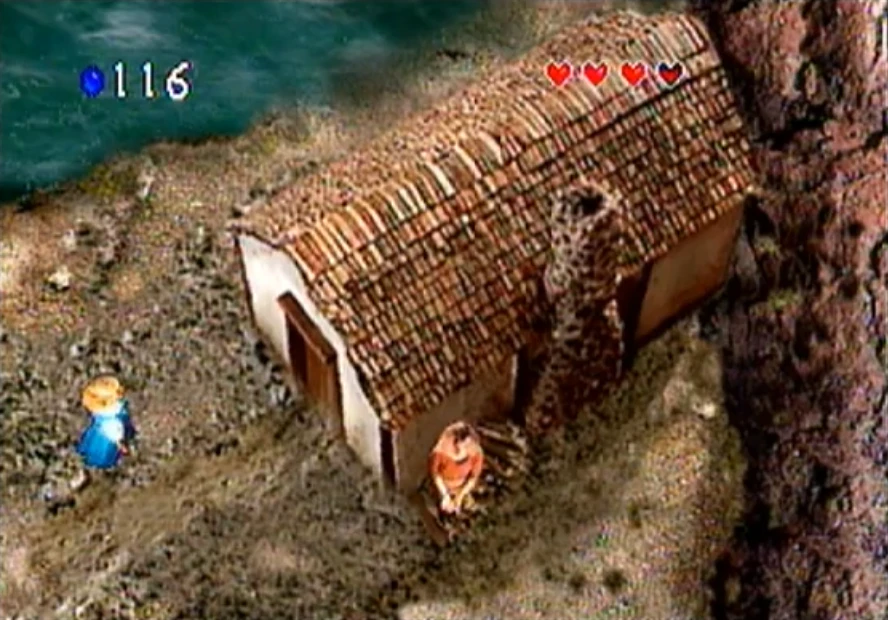
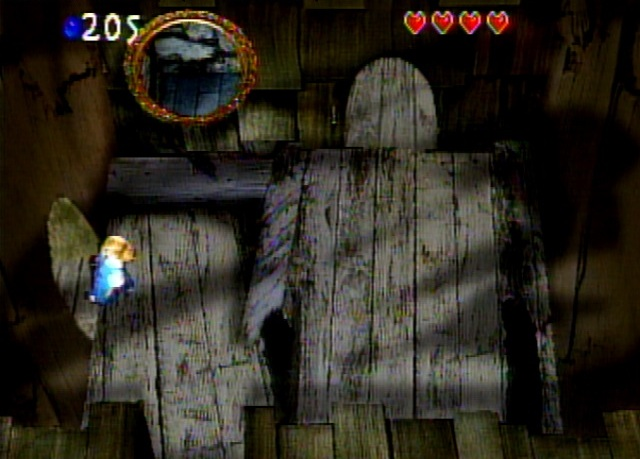
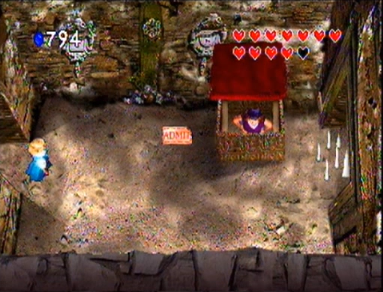
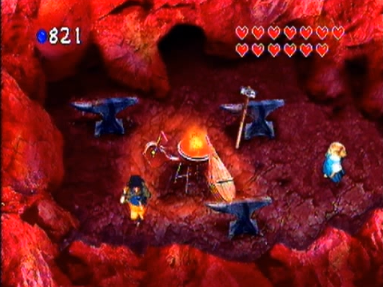
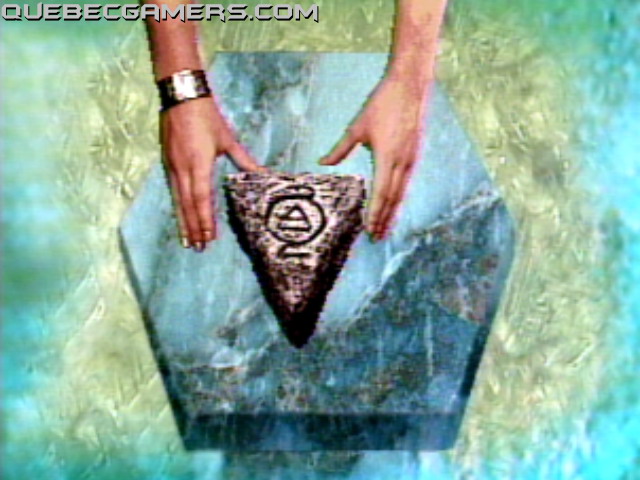
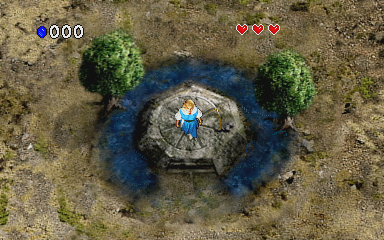
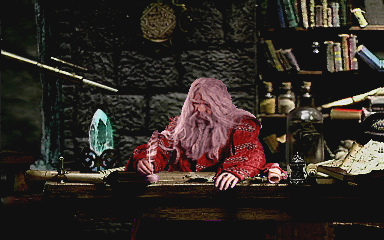
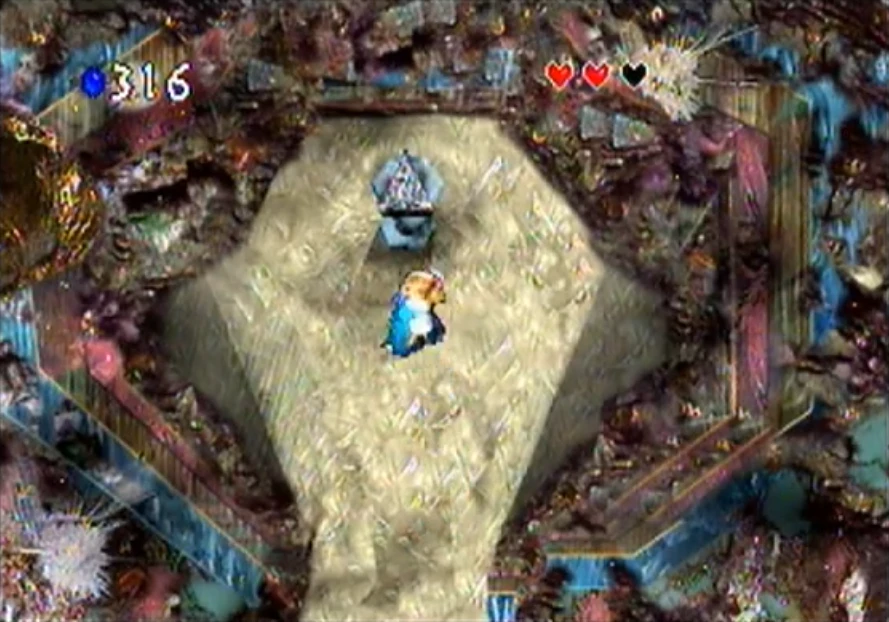
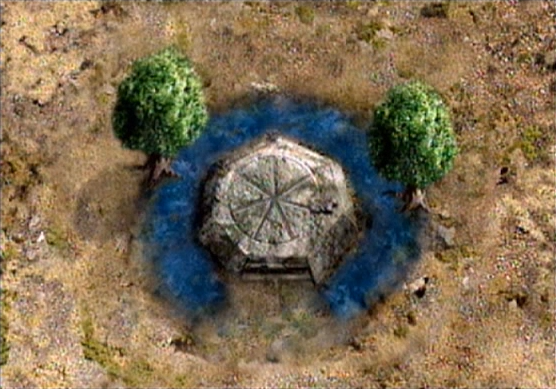
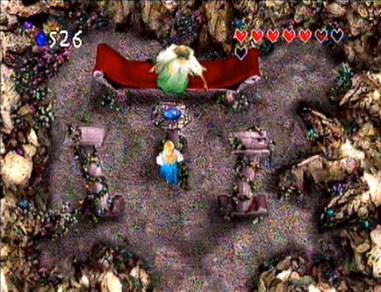
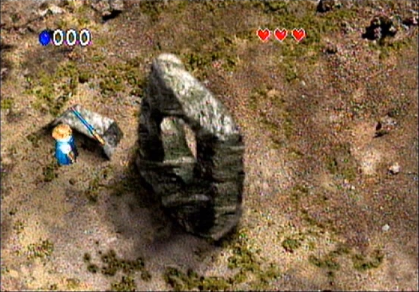
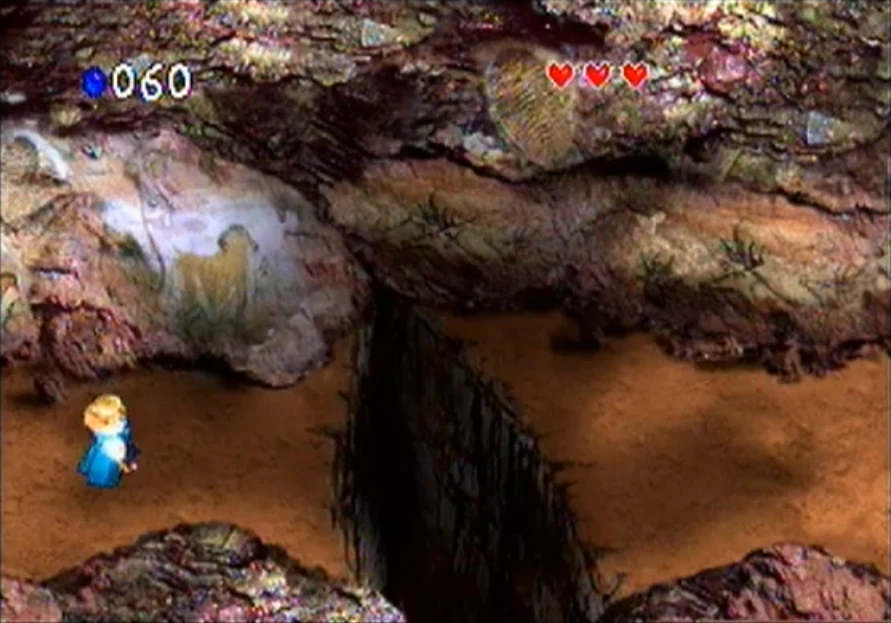
Zelda in the overworld of Tolemac, seen from above.Gaspra in one of the live-action cutscenes.Inside one of the seven Shrines.
It was made in Los Angeles by Viridis, a small company with big ideas and, by its own staff’s account, next to no money. Nearly everything on screen began as a photograph or a piece of video: office workers filmed from above by way of a mirror on the ceiling, latex monsters animated a frame at a time, and scenery pieced together from model sets and holiday snaps. The CD-i struggled to keep up, and the game stops to load whenever Zelda walks off the edge of a screen.
The first complete build went to Philips in 1993. It then spent about two years in testing and did not reach the shops until 1996, in Europe only, when the CD-i itself was nearly finished. A North American release was announced and quietly dropped. Complete copies now change hands for well over a thousand dollars, and the game’s reputation is dreadful. Even so, writers who have panned it tend to agree on one thing: of the three CD-i games, this is the one that comes closest to a traditional Zelda.
“It is the Age of Darkness. The evil Gannon has captured the young hero Link.”
That is how the game’s own instruction manual sets the scene, spelling the villain’s name with a double N, as the scroll in the opening film does. The manual goes on to send Zelda into Tolemac, which it calls an uncharted region in the south-east of Hyrule, and promises that her success will carry the land into an Age of Lightness.
— Zelda’s Adventure instruction manual, page 2 (Philips Media), as transcribed by the Zelda Wiki on Fandom. The rest is summarised by Zelda Temple.
Quick Answers
The questions people most often ask about Zelda’s Adventure, answered quickly and explained further down the page.
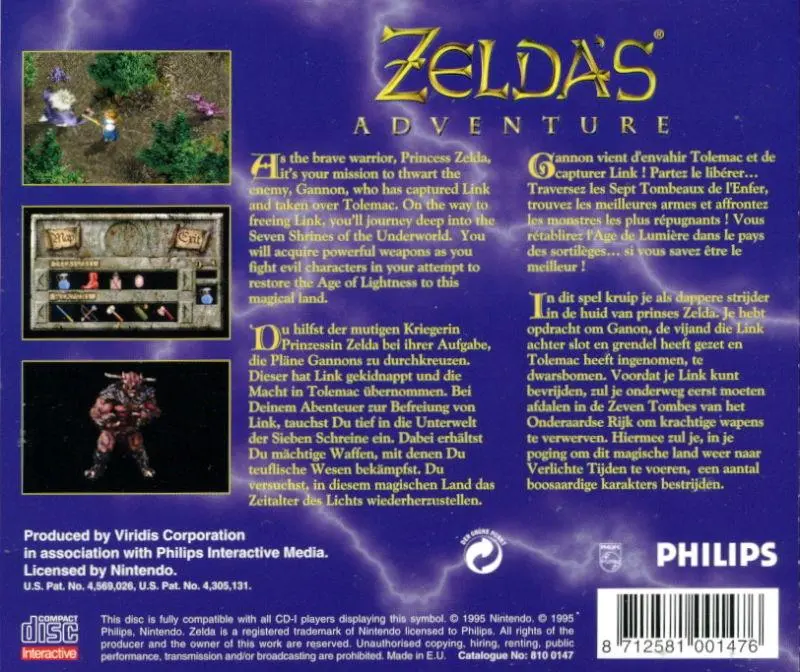
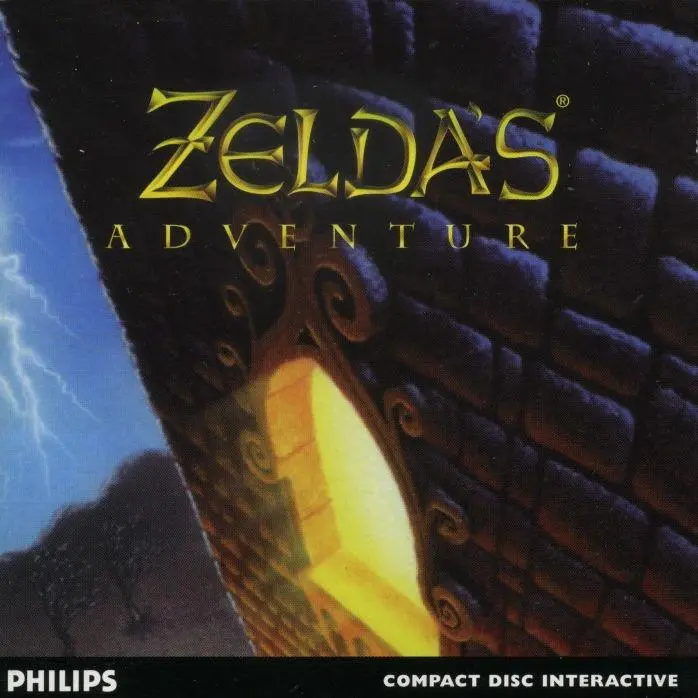
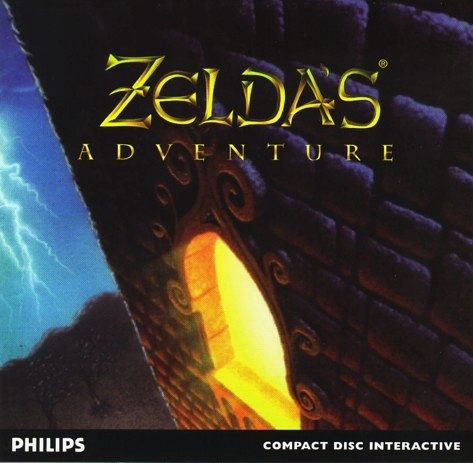
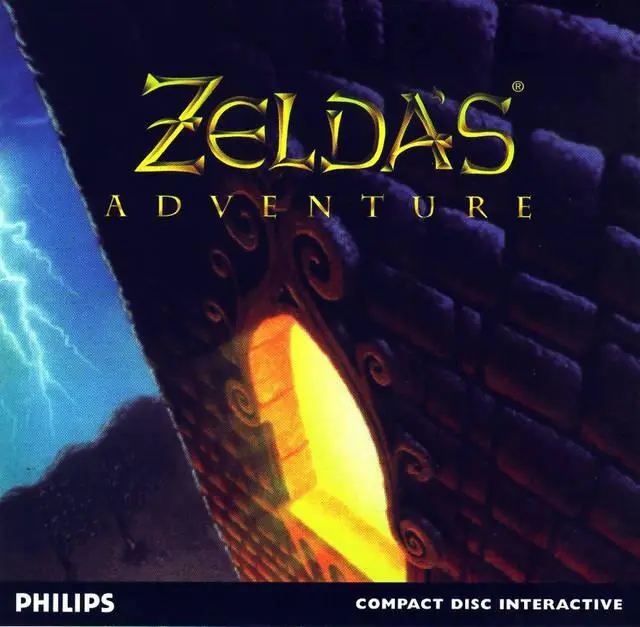
The European box of Zelda’s Adventure (1996).
When did Zelda’s Adventure come out?
In 1996, and only in Europe: February 1996 in the Netherlands and 10 May 1996 in the United Kingdom. You will often see 1994 or 1995 quoted. Magazines previewed and reviewed test versions in 1994, and the final build is dated March 1995, but the game was not on sale until 1996. More →
Who made it?
Viridis Corporation, a small Los Angeles studio, for Philips. Anna Roth directed, Lee Barnes produced, and Barnes and Christopher Thompson designed it. More →
Did Nintendo make Zelda’s Adventure?
No. Philips was allowed to use Nintendo’s characters after a plan to build a CD-ROM drive for the Super NES fell apart. Nintendo approved the games but took no part in making them, and does not count them as part of the Zelda series. More →
Do you play as Zelda?
Yes, from start to finish. Link has been captured by Ganon and only turns up in the ending. More →
Seven Shrines (Earth, Illusion, Air, Destiny, Water, Strength and Fire), which have to be cleared in that order, followed by a last run of boss rematches and the fight with Ganon. More →
How long does it take to finish?
Roughly 8 to 12 hours on a first playthrough, according to The Cutting Room Floor. Speedrunners who know every shortcut get through it in about an hour. More →
Why is it so rare and expensive?
It was sold only in Europe, at the very end of the CD-i’s life, and has never been reissued. On 14 November 2026 the price-tracking site PriceCharting listed a complete copy at about $1,499. More →
Can I play it today?
Only on the original disc and a CD-i player. There has been no official re-release. A fan, John Lay, has rebuilt the game for the Game Boy and Game Boy Color as an unofficial fan project. More →
Why does it load so slowly?
The photographic backgrounds were too much for the CD-i. Jim Belcher, who shot the game’s video, says the background format the team chose made scrolling too slow, and that staff ended up haggling over a kilobyte or two of memory. More →
Plot / Story
The game opens on film. Gaspra, an elderly astronomer, unrolls a scroll that reached him years ago from a woman named Shurmak, and it carries nothing but bad news. Gannon, Lord of Darkness (the scroll and the manual both spell him that way), has taken over the land of Tolemac. He has stolen the treasured celestial signs, and he has captured Link.
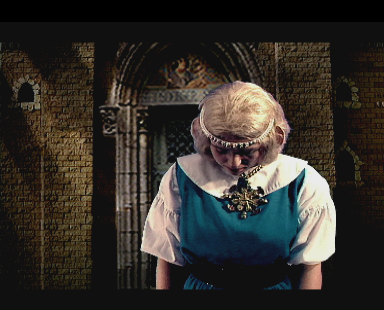
Somebody brave will have to face him, and Gaspra has found his champion: Princess Zelda. He hands her a magic pendant, tells her to find her wand and listen to her allies, and sends her off with the words “Go now my princess, restore the Celestial Signs and rescue Link!”
The Age of Darkness
Tolemac is new to the series. The manual describes it as an uncharted region in the south-east of Hyrule, and its name is simply Camelot written backwards. Ganon has hidden the seven signs in seven Shrines scattered across it, and put one of his followers, a Shrine Keeper, in charge of each.
Zelda begins at the Vision Henge on the barren Plain of Andor. Her wand is lying on a rock a short walk to the east, and it is worth fetching before anything else. Shurmak, who speaks to Zelda in her mind from far away, warns her not to wander about unprotected. “I am Shurmak your guide,” she says by way of introduction. “I have known you since you were a child.” Her first riddle points the way to the Shrine of Earth.
Princess Zelda in the live-action opening.The Vision Henge, where the quest begins and ends.
Seven signs, seven Shrines
The first Shrine is a cave in the Forest of Ogbam, home to Llort, a greedy troll who is convinced that Zelda has come to steal his treasure. Once he is beaten Gaspra sends her on to the Shrine of Illusion, a carnival tent with a trapdoor for an entrance, where a rhyming jester called Pasquinade promises that “nothing is what it seems”.
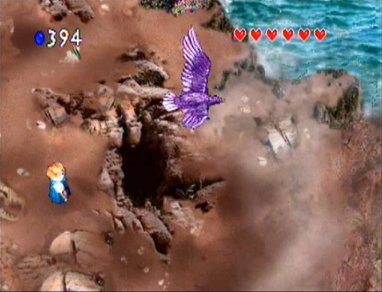
The people of Tolemac then point her towards the high country. A giant purple condor carries her up to the crystal Shrine of Air and its keeper Aviana, and a henge of white pillars in the Ubato Hills hides the Shrine of Destiny, where the scythe-carrying Malmord claims to hold Zelda’s fate in her hands.
The fifth sign lies across the southern sea in the Shrine of Water, guarded by Agwanda, a living mass of water who is sure the princess is after her Water of Life. The sixth is in the south-east, in a fortress where the bear Ursore holds tournaments of strength. The seventh is inside a volcano, in the forge of the dragon Warbane.
Shurmak, Zelda’s guide.The giant condor that flies Zelda to the Shrine of Air.Great Wimbich, the biggest town in Tolemac.
Ganon’s realm
Zelda never gets to pick up the last sign in peace. As she reaches for it Ganon’s claw stops her, and she drops through an opening at the Vision Henge into his realm. Gaspra has one last piece of cheerless advice: “Zelda, life is always one order more horrifying than you expect.”
Ganon calls his Shrine Keepers back for a second round. They are weaker this time, and Ursore alone does not return. Malmord has a new trick: she stands still and bursts into a swarm of dragonflies when struck. Warbane is the last of them, and then Ganon shows himself. When he is beaten he disappears in a whirlwind and his realm breaks apart.
Ganon, the Lord of Darkness.
The Age of Lightness
Link is free. In the ending he and Zelda stand hand in hand on the spot where the way into Ganon’s lair used to be, and the land around them is thriving again. Gaspra has the last word: “Your victory has brought peace and light back to Tolemac.”
Where it fits
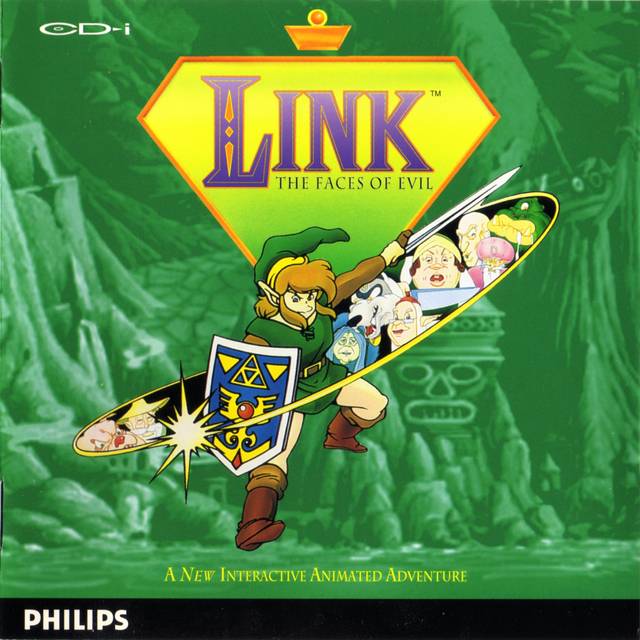
The North American box of Link: The Faces of Evil, one of the two earlier CD-i Zelda games.
Nowhere, officially. Nintendo did not make the CD-i games and has never placed them on the Zelda timeline. Zelda’s Adventure is not a sequel to the other two CD-i games either. Philips gave its Zelda projects to different developers, and Jim Belcher of Viridis says the earlier games had no influence on this one.
The seven Shrines of Tolemac
The dungeons of Zelda’s Adventure are called Shrines, and they must be cleared in a fixed order: turn up early and the entrance is barred. Each has a map and a compass to find, and each ends with a Shrine Keeper and a celestial sign. The names below are the ones the game gives its signs, maps and compasses.
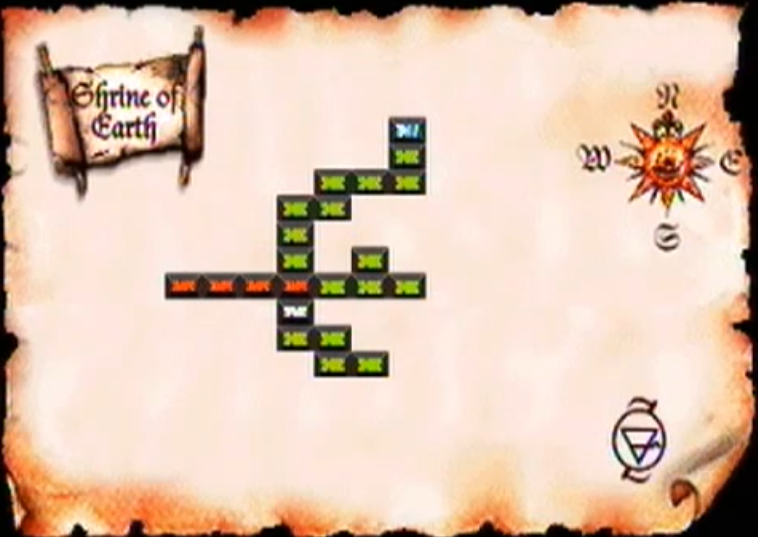
Shrine of EarthForest of Ogbam · Keeper: LlortA torch-lit cave beside a red willow tree, found by solving Shurmak’s riddle. Zelda needs the Ladder to get over a chasm and the Candle for a pitch-black cavern, and comes away with the Red Boots. The game’s only treasure chest is here: it talks, and it hands over the Jade Ring spell, the one thing that can hurt the three Sardaks who guard the electric barrier in front of Llort’s treasure room. Llort himself calls the place the Shrine of Rock.
Shrine of IllusionNorth-west of the Forest of Torian · Keeper: PasquinadeA white carnival tent. Zelda falls through a trapdoor and down a slide into a mixture of circus and haunted house, with a bridge that comes and goes, slippery floors, fake doors and a maze too dark to cross without the Candle. A Pols Voice blocks the way until she has the Noise spell. She cannot climb back up the slide, so the only way out is to play the Harp.
Shrine of AirAbove the cliffs of the North Gubasha Desert · Keeper: AvianaA palace of coloured crystal in the clouds, reached on the back of a giant purple condor. The floors are slippery, shards of crystal break loose and fly at Zelda, and the Tornadoes near the start can only be harmed with the Calm spell. Two Vaporas act as mini-bosses, and the second one drops the Rug, which cuts down the sliding.
Shrine of DestinyNorthern Ubato Hills · Keeper: MalmordHidden inside a henge of white pillars, this one looks like a marble mansion. Gibdos, Wizzrobes and Bubbles haunt its twisting corridors and narrow walkways. The map is not in the building at all: a woman in the Vendoss swamp gives it to Zelda.
Shrine of WaterAcross the southern sea · Keeper: AgwandaThe home of the Water of Life. Three Kelpies serve Agwanda, and all three must be beaten before the way to her chamber opens.
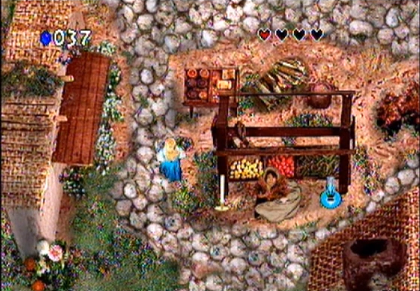
Shrine of StrengthPlain of Hobel · Keeper: UrsoreLess a dungeon than a public fortress, with merchants, ticket sellers and pickpockets in its entrance square and crowds who come to watch contests of strength. Zelda has to joust the Red Knight and then take on the Blue and Green Knights together in the Field of the Broadsword and get past a pair of Iron Knuckles, before she reaches Ursore.
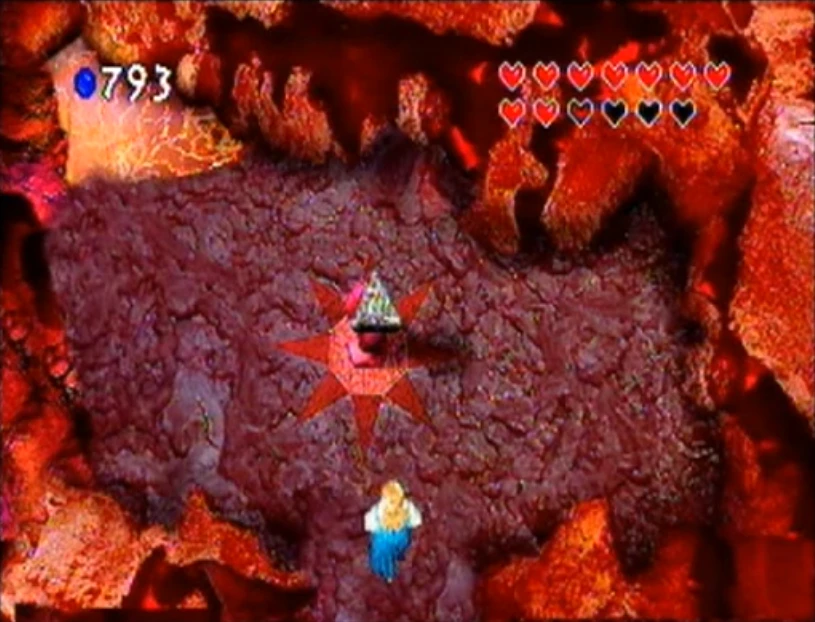
Shrine of FireForest of Canvula · Keeper: WarbaneA cave in a volcano that doubles as Warbane’s forge, all lava pools and fire barriers. It is the shortest Shrine of the seven and runs along a single path, past hostile blacksmiths and a mini-boss called Maxus.
Ganon’s realmBeneath the Vision Henge · Final boss: GanonThe finale. Six of the seven Shrine Keepers must be beaten again, one after another, before Ganon appears.
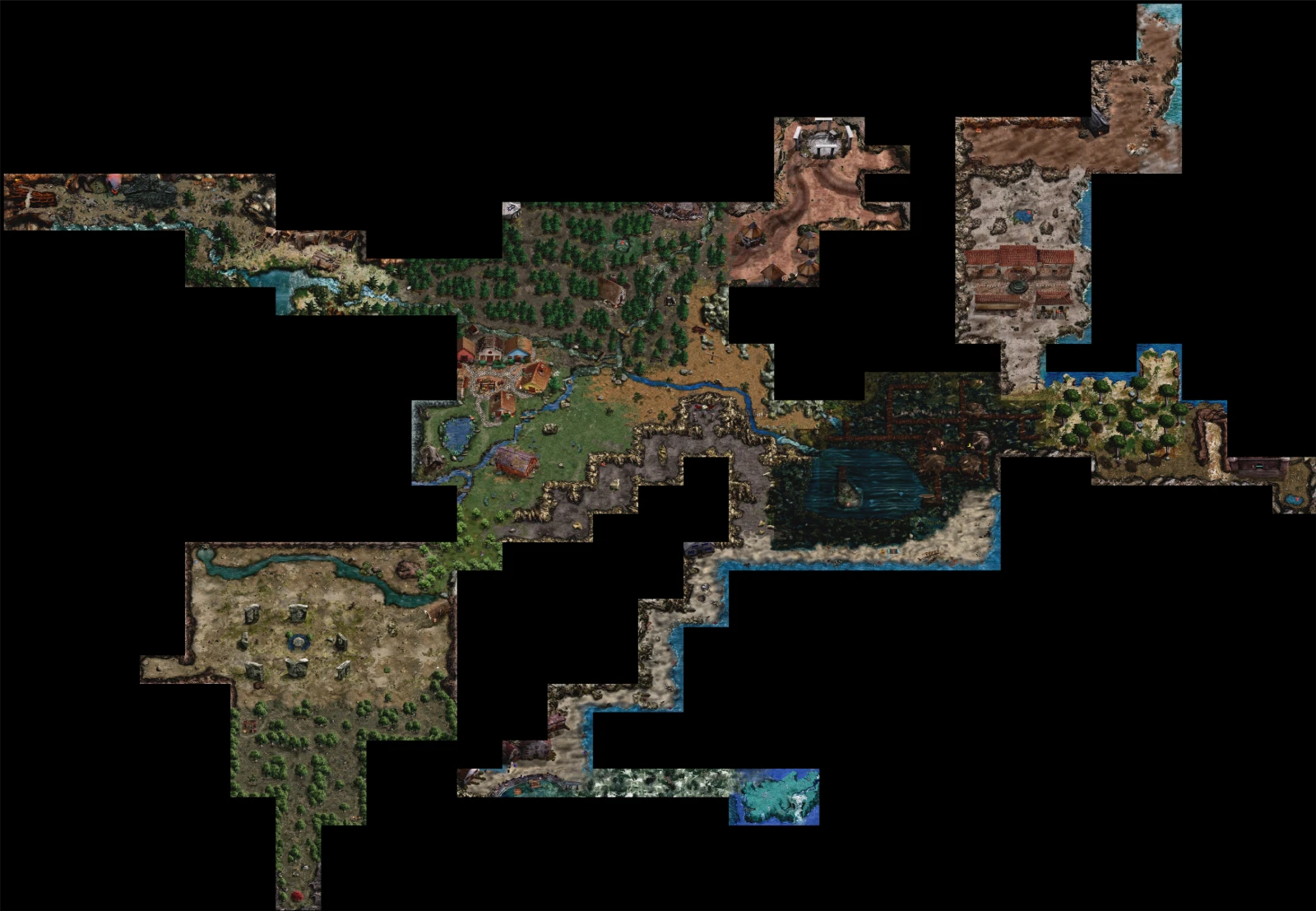
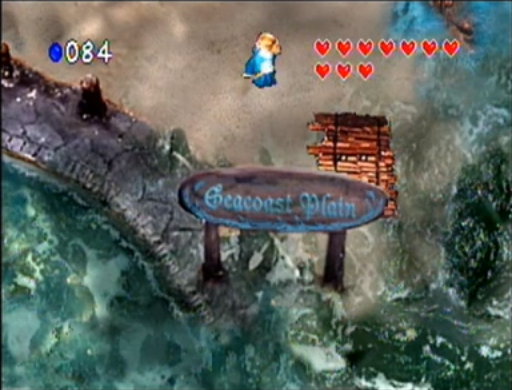
Between the Shrines lies the overworld. Its hub is the Meadow of Skotness, close to Great Wimbich, the largest town. Other stops include Port Town on the Seacoast Plain, a refuge village hidden in the Vendoss swamp, and two lodges, the Mobilin’s Head Inn and the White Steed Lodge. Fairies live in ponds across the land and heal Zelda when she walks up to them.
How it plays
The overworld map of Tolemac.
Forget the side-scrolling of the first two CD-i games. Zelda’s Adventure is a top-down adventure in the mould of the 1986 original: an overworld shown one screen at a time, with dungeons tucked into its corners, townsfolk full of hints and secrets that have to be worked out by trying things.
A first playthrough takes somewhere between 8 and 12 hours, by The Cutting Room Floor’s estimate. Some of that time is spent waiting for the next screen to load.
Spell or weapon
Where it matters
Good to know
Wand
Everywhere
Zelda’s main weapon, used like a sword. It hits harder with every celestial sign she collects.
Jade Ring
Shrine of Earth
Nothing else can harm the three Sardaks.
Noise
Shrine of Illusion
The spell meant for the Pols Voice that blocks the way.
Calm
Shrine of Air
The only thing that hurts the Tornadoes at the entrance.
Bow and Arrow
Shrine of Air
Shooting a moving skull bridges a chasm in the north hall.
Feather
Aviana
She can only be hurt by this spell, and only if it strikes her wings.
Joust
Shrine of Strength
Used to beat the Red Knight.
Broadsword
Ursore
A knight called Sir Basil recommends it. The Zelda Wiki on Fandom reports that it is not much use.
Hammer
Warbane
The dragon leaves it behind after his first meeting with Zelda, and it works well on him.
The first Zelda, seen from above again
The Seacoast Plain. Walk off the edge and the next screen loads.
The overworld and the Shrines are both divided into single screens, and the view flips to the next one when Zelda reaches an edge, just as it did on the NES. Wikipedia’s summary of an IGN retrospective says Viridis was asked to base the play on A Link to the Past while showing off what the CD-i could do, and the structure is familiar: explore, find the dungeon, find its map and compass, beat the boss, take the prize.
The Shrines cannot be tackled out of order, and some call for a tool picked up elsewhere in Tolemac. Shurmak drops hints from afar, and so do the people Zelda meets on the road.
A wand, spells and Rupees
The wand, found near the Vision Henge.
Zelda carries no sword. Her wand does the same job at close range, and it can be paired with the spells she learns along the way to throw magic across the screen. Every spell cast costs Rupees, so money is ammunition as well as shopping funds. Some enemies shrug off everything except one particular spell, which is where much of the game’s trial and error comes from.
Tolemac has only two kinds of Rupee in circulation, blue ones worth 5 and yellow ones worth 10. Coal is worth carrying, too: take a lump from the east of the country to the blacksmith in Great Wimbich and he hands back a Diamond, which the Zelda Wiki on Fandom values at up to 999 Rupees.
Treasures and tools
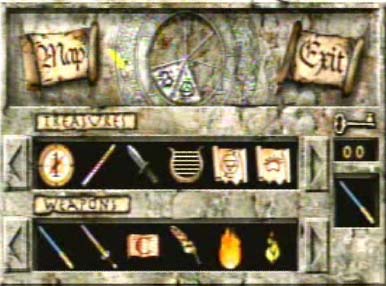
The inventory, with spells and treasures.
Everything else Zelda picks up is a treasure, and most treasures solve exactly one problem. The Ladder bridges a chasm in the Shrine of Earth. The Candle lights dark rooms. The Red Boots let her cross the river in the north of the Plain of Andor, the Raft takes her out to sea from Port Town, and the Knife cuts through the wall of a tent. The Harp is the most useful of all, because playing it lifts her out of a Shrine.
The Angry Video Game Nerd’s 2008 episode on the game complained that the inventory has to be opened and cycled through again and again to get anywhere.
Waiting for the disc
In the Shrine of Earth.
The complaint that turns up in almost every account of the game is the loading. The game pauses to load between screens, and almost everyone who has written about it mentions how long the pauses are. Nintendo Life adds that the music starts again at nearly every change of screen, and 1UP.com’s Danny Cowan, as reported by Wikipedia, found that the game could not play music and sound effects together.
The scenery is also harder to read than hand-drawn tiles would be. Belcher admits that the masking which decides where Zelda can and cannot walk was imperfect, and that players could get stuck in places.
Characters
A princess, a prisoner, a stargazer and a guide on a red couch. The human cast was played by the people who worked at Viridis, and the monsters were built by hand.
Character
Who they are
In this game
Stats & abilities
Princess ZeldaThe playable hero
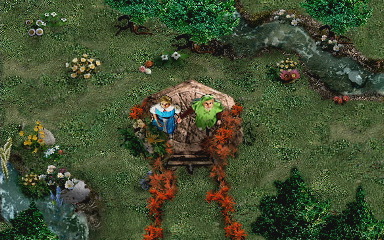
The princess of Hyrule, chosen by Gaspra as his “champion of strength and courage”. On film she is played by two women: Diane Burns, who worked in the Viridis office, in the opening, and Annie Ward elsewhere.
Crosses Tolemac alone, wins back the seven celestial signs from the Shrine Keepers, defeats Ganon and frees Link.
Fights with a wand, not a sword
Casts spells that cost Rupees
Carries a magic pendant from Gaspra
LinkThe one who needs rescuing
The young hero, as the manual calls him.
Captured by Ganon before the game begins. He is seen again only in the ending, safe and holding Zelda’s hand.
Not playable.
GaspraAstronomer
An old astronomer with an observatory in a tower. He was played by the game’s composer, Mark Andrade, under a full foam-latex prosthetic face, and, according to Wikipedia and the Zelda Wiki on Fandom, his voice was dubbed by Hal Smith of The Andy Griffith Show.
Reads the scroll of Shurmak, picks Zelda as his champion, gives her a magic pendant and reappears as the signs are won to congratulate her and point the way.
Appears in the live-action scenes.
ShurmakZelda’s guide
A woman of Tolemac who has known Zelda since the princess was small. She can be found sitting on a red couch in the Great Dry Canyon. It was her scroll, sent years earlier, that told Gaspra what Ganon had done.
Speaks to Zelda in her mind, offering advice and riddles, and has asked friends such as Sir Basil and Madame Kriggle to help. Townsfolk hint that she and Gaspra are a little jealous of each other.
Guide.
GanonLord of Darkness · “Gannon” on the scroll
The villain of the series, styled Lord of Darkness here.
Has taken over Tolemac, stolen the celestial signs, hidden them in the Shrines and imprisoned Link. He snatches the last sign from under Zelda’s hand and fights her in his realm below the Vision Henge.
Final boss.
The folk of TolemacAllies, merchants and oddities
Mostly ordinary humans, who address Zelda as their princess. The exceptions include a talking mushroom in the Forest of Findo and a pair of goblins in the Forest of Canvula.
They trade, gossip and give out tools and hints. Sir Basil advises on fighting Ursore, a thirsty child in the Shrine of Strength swaps a spell for a drink of well water, and the blacksmith of Great Wimbich turns coal into a Diamond.
24 people are credited as “Human Sprites”.
Shrine Keepers, bosses and monsters
Ganon’s seven Shrine Keepers, in the order Zelda meets them, followed by the mini-bosses and some enemies whose names will be familiar from the NES games.
LlortShrine of EarthA greedy troll (read his name backwards) who lurches round his hoard throwing pairs of axes. Beating him is worth 250 Rupees and the first sign.
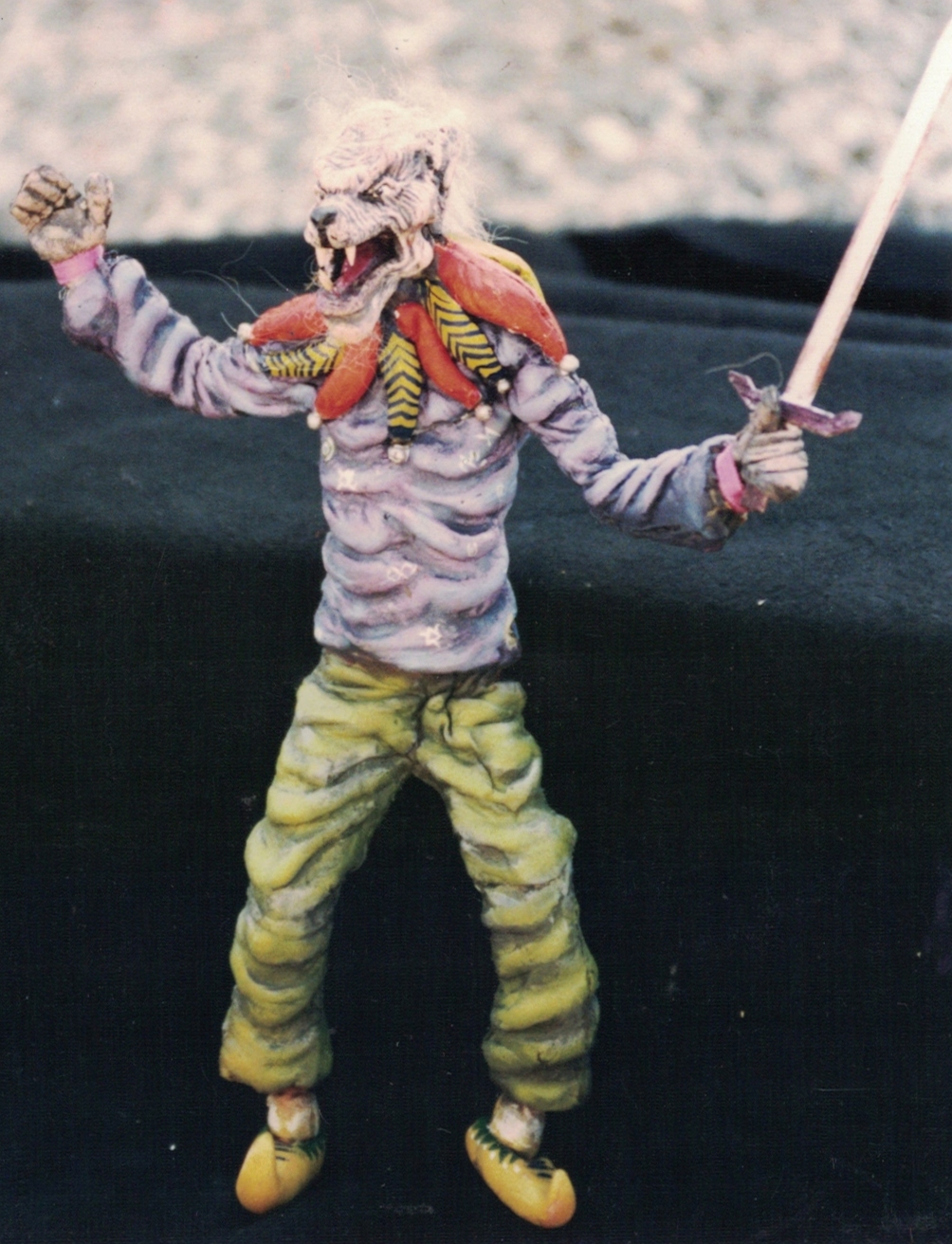
PasquinadeShrine of IllusionA werewolf-like jester who speaks in rhyme. He spins across the room with his staff, turns cartwheels and sets purple balls circling the arena.
AvianaShrine of AirThe “woman of the air”. She dive-bombs Zelda and throws feathers, and only the Feather spell hurts her, and only on the wings.
MalmordShrine of DestinyA Grim Reaper figure with a huge scythe who melts into the shadows and can be hit only in the moment she turns solid. “In my shrine, you have to play by my rules!”
AgwandaShrine of WaterA fast-moving blob of water that sprays bubbles in all directions and hits hard. The top-left corner of her room is a safe place to stand.
UrsoreShrine of StrengthA bear who admires strength above everything and greets Zelda with “A fool has entered my realm!” He is slow, and all he does is pounce. He is the only Keeper with no rematch.
WarbaneShrine of FireA fiery dragon who used to run a locksmith’s forge with a couple from Great Wimbich until Ganon forced him into service. He attacks by flying about his chamber.
GanonGanon’s realmThe last fight, after the Keepers have been beaten a second time. He vanishes in a whirlwind when he loses.
Mini-bossesSeveral ShrinesRed, blue and orange Sardaks in the Shrine of Earth, a Pols Voice in Illusion, two Vaporas in Air, three Kelpies in Water, the Red, Blue and Green Knights in Strength and Maxus in Fire.
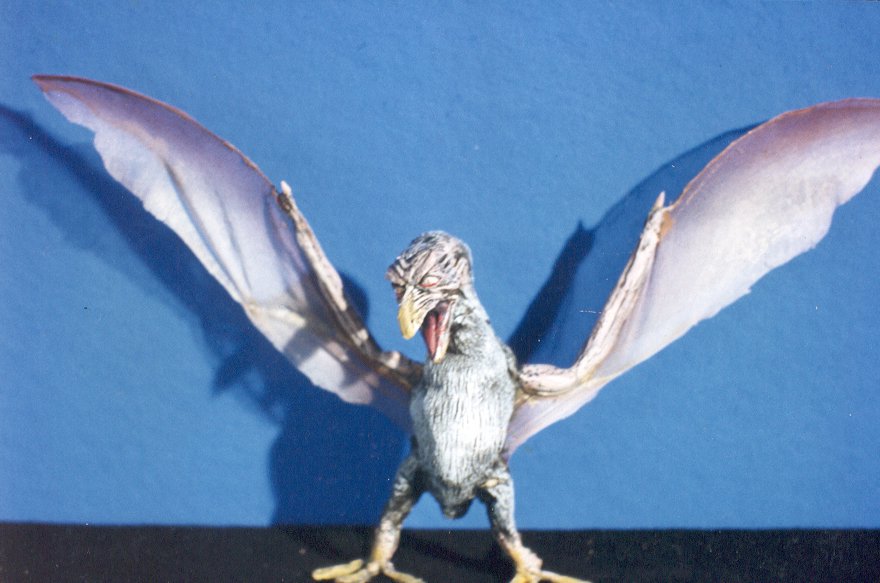
Familiar facesOverworld and ShrinesTektites, Keese, Stalfos, Wizzrobes, Gibdos, Goriyas, Patras, Bubbles and Iron Knuckles all appear, rebuilt as photographed models.
The people who made it
Viridis had 15 to 20 people when Zelda’s Adventure was in production, according to Jim Belcher, and a good many of them ended up in the game as well as in its credits. Five writers share the story credit, among them the director and both designers.
Anna RothDirectorCredited as director, and one of the five people credited for the interactive story and script.
Lee BarnesProducer, game and technical designProduced the game and shares both the design and story credits. Belcher names the owners of Viridis as “Christopher and Lee”.
Christopher ThompsonGame and technical designCo-designer and co-writer with Barnes.
Randy CaseyLead software engineering, sprite technologyWrote almost all of the code himself, on one of his first projects. He later moved to NovaLogic, where he led flight-simulator projects. He is also credited among the human sprites.
Jim BelcherVideo production, audio designA film-industry veteran who shot the blue-screen video and the top-down sprite footage and handled sound recording and mixing. He later became a producer at Philips.
Jason BakutisModels and prostheticsA Hollywood effects artist whose film work includes Critters 3 and 4. He sculpted the creatures, built the miniature sets, applied Gaspra’s make-up and played a few townsfolk himself.
Mark AndradeMusic · GaspraThe in-house composer, credited for the “Zelda Theme and Interactive Music Score”. He also sat in the make-up chair to play Gaspra, at about 23 years old.
Michael HaglerArt directionCredited with art direction. The artists cut the sprites out of the video and built the scenery from photographs.
Diane Burns and Annie WardZeldaBurns, credited for production co-ordination and described by Wikipedia and Time Extension as the office receptionist, plays Zelda in the opening. Ward plays her in the other scenes.
Hal SmithVoice of GaspraThe veteran actor from The Andy Griffith Show dubbed Gaspra’s lines, according to Wikipedia and the Zelda Wiki on Fandom, though the game’s credits do not name him. He died in January 1994, two years before the game went on sale.
How it was made
Zelda’s Adventure was made by people from film and effects work, in a rented office, on a machine that was never meant to be a games console. The best accounts come from two of them: Jim Belcher, interviewed by the CD-i blog Interactive Dreams in 2007, and Jason Bakutis, interviewed by Nintendo Player in 2012.
How Philips came to have Zelda
The short version: Nintendo wanted a CD-ROM drive for the Super NES. It signed with Sony in 1989, then walked away from that arrangement and teamed up with Philips, a partnership made public in 1991. No drive ever went on sale, but as part of winding the deal up Philips was allowed to use a handful of Nintendo characters, Link, Zelda and Ganon among them, in games for its own CD-i player.
Four games came of it: Hotel Mario and three Zeldas. Philips handed the Zelda projects to outside studios, and Link: The Faces of Evil and Zelda: The Wand of Gamelon were both made by another developer, Animation Magic; their pages tell that side of the story. Nintendo kept the right of final approval and commented on how its characters looked, and that was all. “I think they thought of CD-i as some little niche product that they could safely ignore,” Belcher said.
A green light for Viridis
Viridis was a small software house with offices on Santa Monica Boulevard in West Los Angeles. Its name plays on the Latin word for green. Work on its Zelda began in April or May 1992, by The Cutting Room Floor’s reckoning, and the instruction from Philips, as Wikipedia reports it from an IGN retrospective, was to take A Link to the Past as the model while making use of the CD-i’s sound and video.
Belcher had worked in film in the 1980s and had already directed the voice recording for another CD-i title. He was hired to handle the filming, because the plan was to turn real people into game characters. Then, with the design settled, it emerged that there was no money to do it properly. “Viridis had no money to rent a studio,” he recalled.
A mirror on the ceiling
Sprites for a top-down game have to be filmed from directly overhead, and the studio was an office of about 12 feet by 15 with an 8-foot ceiling. Belcher’s answer was to fix a large mirror to the ceiling, stand the camera on the floor pointing up at it, and film the reflection. For walking animations the actors, who were simply whoever was in the office, marched on a black motorised treadmill with its handrails taken off.
For the cutscenes he painted one wall of the room blue and shot the actors against it. Nothing could be captured in real time. Every frame was digitised separately on Mac Quadra 700 computers, usually overnight, and stripping out the blue background from a single sequence could tie up four or five machines for days. The lights once tripped the office’s breakers and brought down every development machine and server, after which the owners agreed to pay for extra power lines.
Latex monsters and a yardstick tower
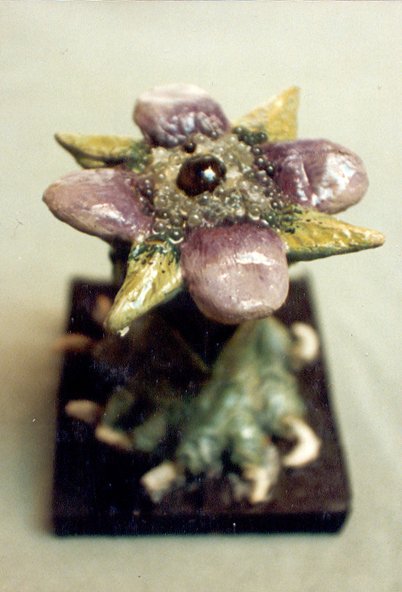
The monsters and buildings were the work of Jason Bakutis, who came from Hollywood creature shops. A work order for the game’s locations and enemies reached him on 22 January 1993. He sculpted each creature in plasticine, moulded it, cast it in latex and foam over a posable wire skeleton, then painted it and added fur, teeth and sometimes clothes. They were animated by stop motion in front of a blue screen, a few frames per walk or attack, and filmed with a broadcast news camera that Bakutis remembers costing $14,000.
The sets were made from whatever was lying about. The wizard’s tower in the opening is a wooden yardstick sawn into four, glued together, textured with clay and painted. Bakutis says he had a free hand creatively and blames the hardware for what happened next: “We were trying to get to the moon in horse-drawn buggies.”
Holiday photos and a kilobyte to spare
The Ubato Hills, one of the photographic overworld screens.
The ground Zelda walks on is made of photographs. Most were taken around Los Angeles, some were close-ups of textures that artists were sent out to shoot in the neighbourhood, and some were pictures of Hawaii that Belcher had taken from a helicopter on holiday the autumn before. “We were desperate for interesting terrain photos,” he said, so everyone’s holiday pictures were pressed into service.
All that detail had to fit into the CD-i’s memory. Every creature was cut down in size, resolution and colour. Belcher thinks the picture format chosen for the backgrounds, known as DYUV, was the fatal decision, because it made scrolling too slow: it “killed the gameplay for me”. Sound effects were squeezed in around the edges, with arguments over a single kilobyte or two of free memory.
Music suffered as well. Andrade wrote far more than the finished game uses. Bakutis recalls the owners saying they were talking to the band Echo & the Bunnymen about the soundtrack. Nothing came of it, and the job went to Andrade.
Two years in test
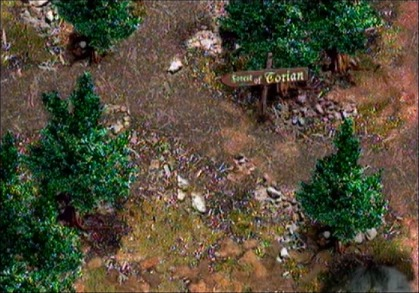
The Forest of Torian in the finished game. About a third of the planned screens were cut.
The Cutting Room Floor has pieced together what followed from magazines, catalogues and old newsgroup posts. The first test build, version 1.01, went to Philips in the spring of 1993, and Viridis laid off most of the team. A release was pencilled in for November of that year. In December 1993 the British CD-i magazine previewed a game of 600 screens and 160 characters and floated a playing time of 300 hours, a figure the wiki suspects was a misprint.
Then came the testing. Bugs in the terrain, slow sign-off from Nintendo and a list of required changes kept the game going round for about two years, during which roughly a third of the screens and more than half the characters were cut. Magazines announced it for August 1994 and then October 1994. The final build, version 1.12, is dated 27 March 1995. “It spent something like two years in test, which was longer than the game took to develop,” Belcher said. By the end, he believes, even the lead programmer had moved on.
A quiet release
The back of the European box.
Philips sat on the finished game for nearly another year. It went on sale in the Netherlands in February 1996 and in the United Kingdom on 10 May 1996. On 23 April 1996 Philips announced a North American edition for the second quarter of the year at $39.99, and it never appeared, most likely, The Cutting Room Floor suggests, because the CD-i market was dying. That makes Zelda’s Adventure a European exclusive, which is not what anyone planned when it was first listed in American CD-i catalogues in 1993.
Viridis itself did not survive. Belcher says the company grew to scores of staff after he left, then failed to meet its payroll and closed soon afterwards.
Firsts: what this game introduced
Nothing in Zelda’s Adventure was picked up by the games Nintendo made afterwards, but it did a few things no Zelda had done before, and one that none has done since.
1Zelda on filmIts cutscenes are live action, with costumed actors in front of model sets. Wikipedia describes it as the only Zelda game to tell its story that way.
2The princess in a top-down questZelda had been playable once before, in the side-scrolling Wand of Gamelon. This was the first time she led an adventure of the classic overhead kind, 28 years before Nintendo did the same in Echoes of Wisdom.
3The last of the licensed threeLeaving aside a game watch and a set of Barcode Battler cards, the three CD-i games are the only licensed Zelda games made for a system that was not Nintendo’s, and this was the final one to be released.
Secrets & debug codes
There are no official cheat codes, but the testers’ tools were left on the disc, and one very odd guest is hiding in the woods. The codes below were documented by The Cutting Room Floor. We have not tested them on a real CD-i.
Debug save names
Name a new save file MVBARICKMAN and Zelda does not die when her hearts run out. XYZNOGO lets her walk through walls, doors and barriers, switched on and off with the arrows on the treasure scroll. XYNOGOXYINV is meant to turn on both XYZ cheats together. A fourth name, XYZINVINCO, seems to have been an invincibility code and does nothing obvious now.
Food Dude
Give the Coal from the Plain of Hobel to the blacksmith in Great Wimbich and he gives back a Diamond (worth up to 999 Rupees, by the Zelda Wiki on Fandom’s account, so think twice before selling it). Take it to the south-eastern corner of the lake in the Forest of Canvula, equip it and hold Button One for about seven seconds. A skateboarder rolls out of the trees, says “Radical, dude! Totally!” and leaves. He is the star of Food Dude, a health-themed Viridis game that was never released. The secret went unnoticed until 2019.
Agwanda’s blind spot
Agwanda, keeper of the Shrine of Water.
Agwanda hits hard, but she never touches the top-left corner of her chamber. Stand there and fight from safety. The corner is not safe in the rematch.
The Harp is a way out
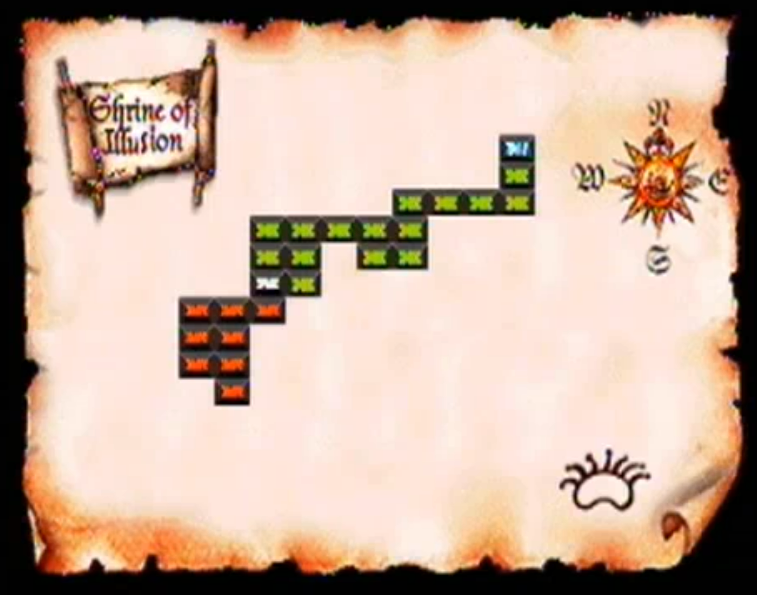
A map of the Shrine of Illusion, which Zelda can leave only with the Harp.
Playing the Harp lifts Zelda out of a Shrine. It is the only exit from the Shrine of Illusion, and it also rescues her from a room in the Shrine of Destiny whose exit is on the wrong wall.
The Noise Skip
Speedrunner Douggernaught found that the Pols Voice in the Shrine of Illusion can be beaten without the Noise spell by hitting it with the wand 280 times, which takes one minute and 47 seconds. He calls it his “most regrettable contribution” to the run.
Checked against The Cutting Room Floor, the Zelda Wiki on Fandom and Nintendo Life, November 2026.
Glitches, exploits and oddities
Two years of testing did not catch everything, and a lot of abandoned material is still on the disc. All of this comes from The Cutting Room Floor.
Skipping the condor
The Shrine of Air.
The wall beside the overworld entrance to the Shrine of Air is thin enough to squeeze through, but only if Zelda walks on to that screen from the north. Do it and she enters the Shrine without the condor, and without having cleared the first two Shrines.
Skipping Warbane’s arena
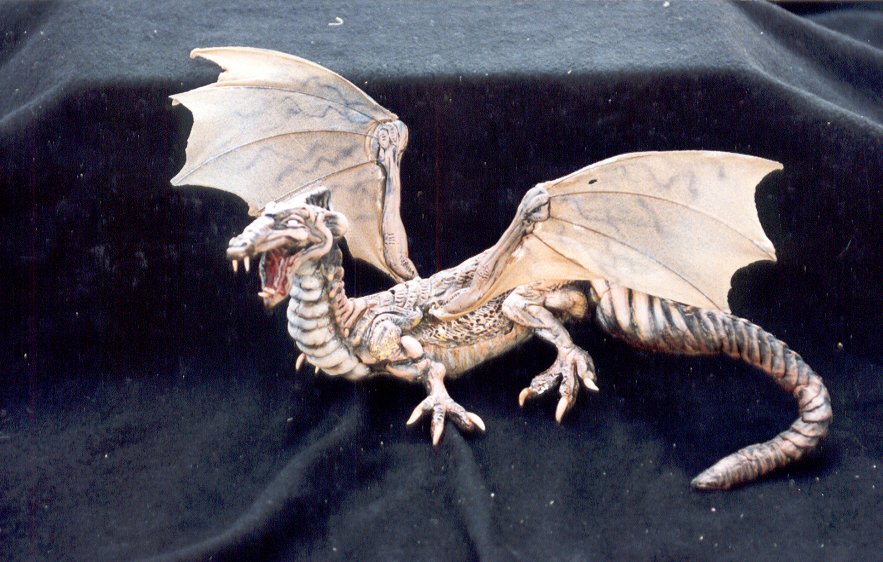
Warbane, whose arena can be skipped through a wall.
Wedging Zelda into the north-eastern corner of the Shrine of Fire pushes her through the wall. From one spot she skips the second blacksmith room, and from another she skips Warbane’s arena.
The room with no way out
In the Shrine of Destiny.
The room holding the Sign of Destiny has its exit set on the north side although the door is on the west. Zelda cannot walk out. She has to pick up the sign, play the Harp or quit.
The missing rematch
Ursore is the only Shrine Keeper who does not return before Ganon. A map for his rematch exists on the disc, but no sprites or objects load with it.
Cut treasures
The item list still has entries the game never hands out, among them an Opal Amulet that Shurmak was to give Zelda, a Vial of Acid, a Brown Jar, Alligator Shoes (once needed to enter the swamp), an Hourglass, a Trident and gold and silver trumpets.
Places you cannot reach
The Vendoss swamp, where the walled-off Forest of Albon path was heading.
With collision switched off, there turns out to be a river bank behind the shops of Great Wimbich with no bridge to it, and a path in the Forest of Albon that was meant to lead east to a marsh merchant and was walled off after three screens.
“Entering Cell”
The main program file still holds a debugging message, “Entering Cell %s”, that would have named each area as Zelda walked into it.
Videos & media
No official trailer for Zelda’s Adventure is online, so here are two reliable ways to see the whole game: a complete playthrough, and the charity speedrun that made it briefly famous in 2022.
A full playthrough of the CD-i game, cutscenes and loading pauses included. Video: NintendoComplete.
Douggernaught’s run at Awesome Games Done Quick 2022, with commentary, the Noise Skip and a visit to Food Dude. Video: Games Done Quick.
Trivia & facts
Tolemac is Camelot backwards, and Llort is troll backwards. Ursore looks like a mixture of ursa, the Latin for bear, and “sore”.
The scroll in the opening film spells the villain’s name “Gannon”, and so does the manual.
Gaspra: composer Mark Andrade under prosthetic make-up.Gaspra was played by the game’s composer. Mark Andrade was about 23 and wore a full foam-latex face made by Jason Bakutis to play the old man.
Twenty-four people are credited as “Human Sprites”, including the lead programmer and two of the background artists. Bakutis says he played a bearded man who lives in a stick hut, and that he built the hut too.
The whole game contains one treasure chest. It is in the Shrine of Earth, and it talks.
The credits include a special thank-you to “the beings and folk of Tolemac”.
A Peahat, one of the miniature monsters built for the game.Japanese executives visited the Viridis office once during production. Bakutis remembers that they admired his shelves of monsters and bowed to him.
Bakutis told Nintendo Player that the game had “the biggest budget EVER for a video game”. Belcher, who had to film it in a spare office, remembers there being no budget at all. Wikipedia sides with Belcher.
Viridis also worked on a health-themed game, first called Skate Dude and then Food Dude. It was never released, and its hero’s walk-on part in Zelda’s Adventure is nearly all that survives of it.
American CD-i catalogues listed the game from 1993 under the number 310-690-229-2, and the same number is printed on test discs from 1994.
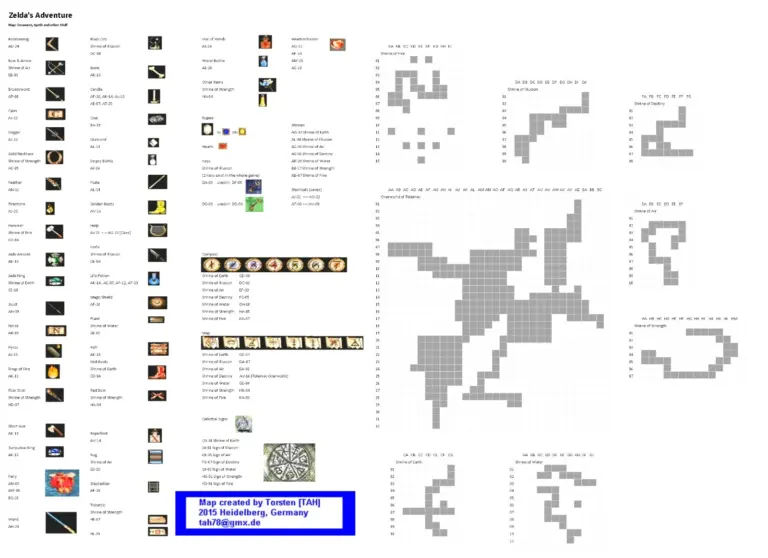
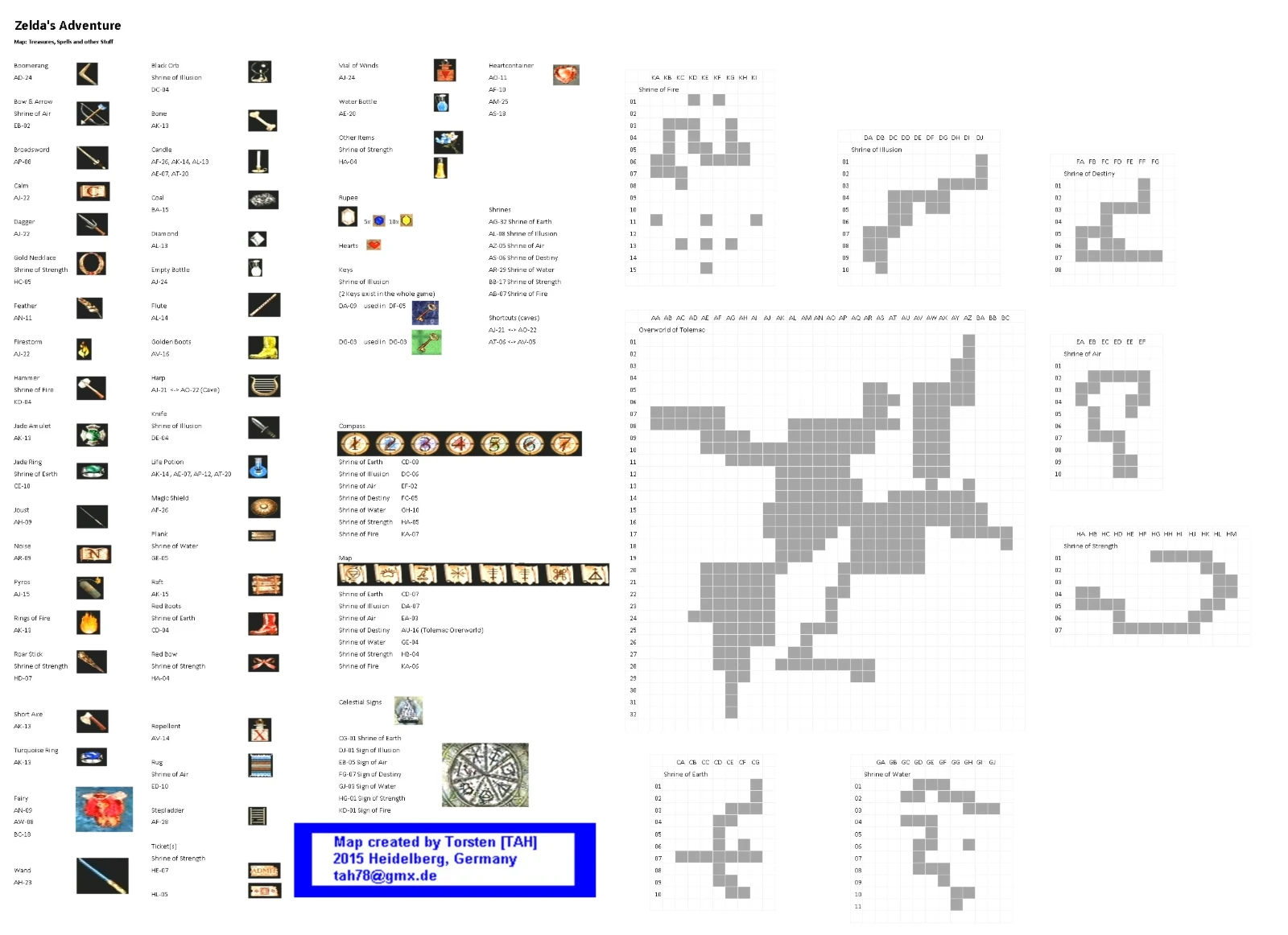
A map of Tolemac marking where the items are found.A complete guide to the game ran in the Dutch magazine CD-interactief in 1999. It had been written from an early test build, so it describes items and enemies that are not in the finished game.
Kotaku’s Luke Plunkett wrote in 2011 that the cutscenes were “the closest we’ve ever come to an official Zelda movie”.
The cover that 1UP.com singled out.Scott Sharkey of 1UP.com put the box on his list of the 15 worst video game covers, as Wikipedia records.
The Forest of Canvula, where Food Dude hides.At Awesome Games Done Quick 2022, viewers gave more than $15,000 to make the runner track down Food Dude, and $8,650 more to decide the name of his save file.
In the final gauntlet Malmord turns into a swarm of dragonflies, the only enemies down there that drop hearts.
Media & artwork
Box art, screenshots of the overworld and Shrines, stills from the live-action scenes and sprites of the cast. Select any image to view it larger.
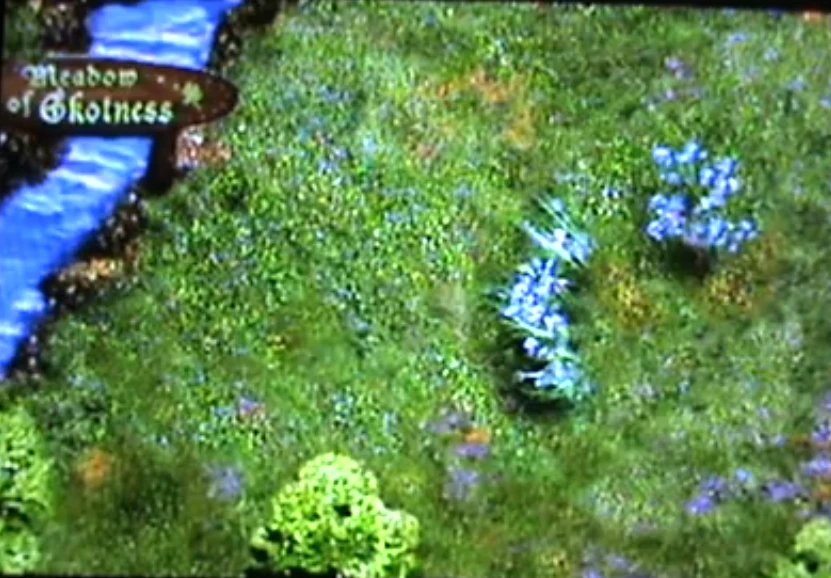
The spine of the European CD-i box.The Meadow of Skotness, the hub of Tolemac’s overworld.The Great Dry Canyon, the mountain road to the coast.The Gubasha Desert.The Mobilin’s Head Inn, one of Tolemac’s lodges.The Shrine of Illusion.The ticket booth at the Shrine of Strength.A blacksmith in the Shrine of Fire.The Celestial Sign of Earth.A map of the Shrine of Earth.
Zelda’s Adventure had no sequel and no re-release, and its maker went out of business. What it has had is a long afterlife as a curiosity.
Development and release history
Development beginsApril or May 1992 – At Viridis in West Los Angeles.
First test buildSpring 1993 – Version 1.01 goes to Philips. A November 1993 release is planned.
First previewDecember 1993 – The UK’s CD-i magazine, issue 3, promises 600 screens and 160 characters.
Dates come and go1994 – Shown in Electronic Gaming Monthly in February; announced for August by Computer and Video Games and for October by CD-i magazine.
Final build27 March 1995 – Version 1.12.
NetherlandsFebruary 1996 – The game finally goes on sale.
North America announced23 April 1996 – Promised by Philips for the second quarter at $39.99. Cancelled without a word.
United Kingdom10 May 1996 – The date printed in CD-i magazine, issue 17.
Game Boy fan versionApril 2023 – John Lay releases an unofficial remake built in GB Studio.
Zelda’s Adventure DXNovember 2025 – Version 2.0.0 of the fan remake adds colour, sound effects and Game Boy Color support.
Never reissued, never canon
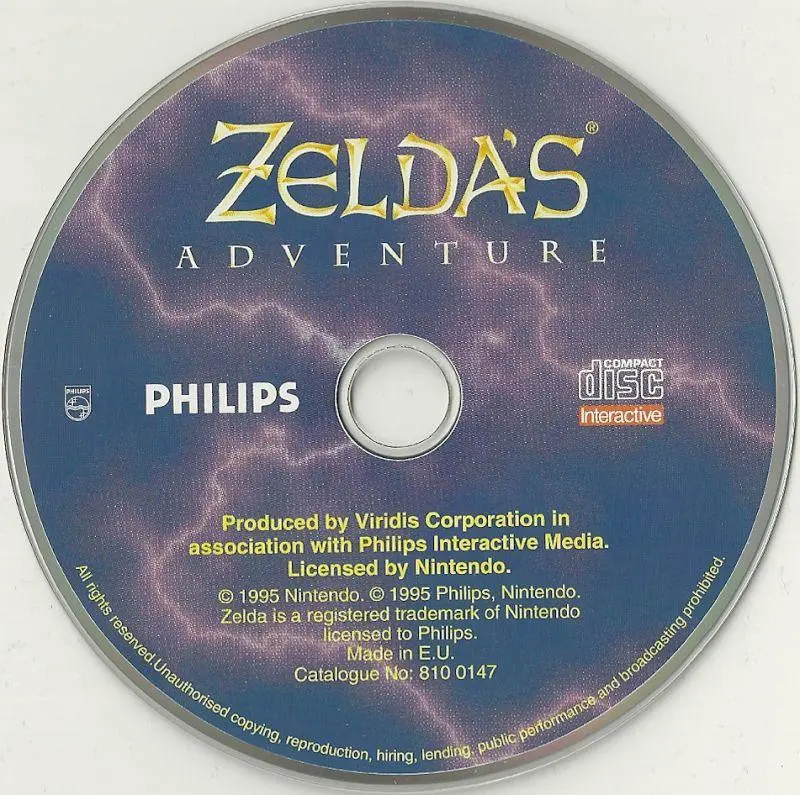
The Zelda’s Adventure disc, still the only official way to play it.
None of the CD-i games has ever been officially re-released, and they sit outside the series as Nintendo defines it. In 2013 Nintendo Life reported that series producer Eiji Aonuma does not regard them as canon. The only official way to play Zelda’s Adventure is still the 1996 disc in a CD-i player.
The princess as hero
The European cover of Zelda’s Adventure.
For a long time the two CD-i games named after her were the only ones in which Zelda was the lead. The Wand of Gamelon came first, in 1993; Zelda’s Adventure was the second, and the Zelda Wiki on Fandom counts it that way too. She became playable in spin-offs such as Hyrule Warriors and Cadence of Hyrule, but a main-series game built around her did not arrive until Echoes of Wisdom in 2024.
There is even a faint family resemblance. In Echoes of Wisdom, as here, the princess carries a magic rod rather than a sword, though there it conjures copies of objects and monsters instead of striking enemies.
From punchline to party piece
Zelda and Link in a cartoon cutscene from Zelda: The Wand of Gamelon.
The CD-i Zeldas found a second audience once video-sharing sites arrived, mostly through the cartoon cutscenes of the first two. Zelda’s Adventure stayed in their shadow: Time Extension calls it the less famous of the three. The Angry Video Game Nerd covered it in December 2008 and found it different from the others but not much better.
Its best moment in the spotlight came on 13 January 2022, when the speedrunner Douggernaught played it live at Awesome Games Done Quick. He had first learned it in 2016 for another charity event and describes the game as “an irresistible relic of video game history”, while declining to call it good. The Zelda Wiki on Fandom lists his best time for the main category as 57 minutes and 6 seconds, set in March 2022.
The Game Boy version
In April 2023 a developer named John Lay released his own version of Zelda’s Adventure for the original Game Boy, published on itch.io. It was built with the GB Studio tool, borrows the look of Link’s Awakening and a few ideas from the Oracle games, and runs in an emulator or on real hardware from a flash cartridge. “Zelda’s Adventure looked interesting and I thought it would be fun to play on a portable system,” Lay told Time Extension.
In November 2025 he followed it with version 2.0.0, renamed Zelda’s Adventure DX, which adds colour, sound effects and Game Boy Color support and fixes bugs. It is a fan project with no connection to Nintendo or Philips, but it is one way to see what Viridis was aiming for without the loading pauses.
Sales & reviews
Sales, rarity and prices
No sales figure for Zelda’s Adventure has ever been published. It cannot have been large. Wikipedia’s history of the CD-i says Philips had mostly abandoned the format in 1996, the year the game came out, and the game was sold only in Europe. Kotaku notes that all three CD-i Zeldas were commercial disappointments, and that their scarcity and notoriety are exactly what collectors now pay for.
Prices have climbed a long way. The articles Wikipedia cites from 2006 and 2007 put a genuine copy at more than $100. On 14 November 2026 PriceCharting, which tracks online sales, listed the disc alone at about $562, a complete boxed copy at $1,499 and a new one at $2,998.
1996released, in Europe only
$1,499complete copy (PriceCharting, 14 November 2026)
0official re-releases
Reviews then and now
Few magazines covered the game, and most of those saw test versions back in 1994. Wikipedia’s table records one period score, from the British magazine devoted to the machine.
CD-i magazineUK · issue 17, April 1996
84%
Later verdicts have been much harsher, and Wikipedia’s article on the game collects the main ones. Danny Cowan of 1UP.com (April 2006) called it “practically unplayable” because of its frame rate, sluggish controls and loading. John Szczepaniak, in Retro Gamer (August 2006), attacked its arbitrary design, in which items are either useless or essential and progress comes by trial and error. Chris Kohler of Wired (March 2008) rated the digitised graphics among the worst he had seen.
A few writers have found something to like. Peer Schneider of IGN (January 2002) thought it a “marked improvement” on the other CD-i games, though only worth buying for collectors. USgamer’s 2018 ranking of the whole series placed it second from bottom, “merely terrible” beside the other CD-i games, and summed it up as “dreadful, but not entirely without merit”. Nintendo Life in 2022 settled for “legendarily awful”.
Reader reviews
No reader reviews yet. Played it? Give it a score out of 10 and tell other fans what you think.
Every fact on this page was checked against the sources below in November 2026. The two Jim Belcher interviews and the Jason Bakutis interview were read as transcripts on the Zelda Dungeon wiki, because the original pages could not be opened. Magazine reviews and retrospectives from 1UP.com, Retro Gamer, Wired, IGN and USgamer, and the 1996 CD-i magazine score, are given as Wikipedia reports them. Zelda Wiki (zeldawiki.wiki) blocks automated reading, so the Zelda Wiki pages hosted on Fandom were used instead.
To provide the best experiences, we use technologies like cookies to store and/or access device information. Consenting to these technologies will allow us to process data such as browsing behavior or unique IDs on this site. Not consenting or withdrawing consent, may adversely affect certain features and functions.
Functional
Always active
The technical storage or access is strictly necessary for the legitimate purpose of enabling the use of a specific service explicitly requested by the subscriber or user, or for the sole purpose of carrying out the transmission of a communication over an electronic communications network.
Preferences
The technical storage or access is necessary for the legitimate purpose of storing preferences that are not requested by the subscriber or user.
Statistics
The technical storage or access that is used exclusively for statistical purposes.The technical storage or access that is used exclusively for anonymous statistical purposes. Without a subpoena, voluntary compliance on the part of your Internet Service Provider, or additional records from a third party, information stored or retrieved for this purpose alone cannot usually be used to identify you.
Marketing
The technical storage or access is required to create user profiles to send advertising, or to track the user on a website or across several websites for similar marketing purposes.

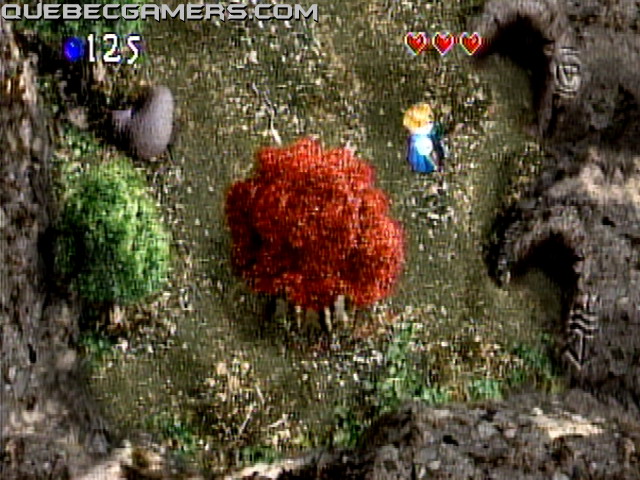 Shrine of EarthForest of Ogbam · Keeper: LlortA torch-lit cave beside a red willow tree, found by solving Shurmak’s riddle. Zelda needs the Ladder to get over a chasm and the Candle for a pitch-black cavern, and comes away with the Red Boots. The game’s only treasure chest is here: it talks, and it hands over the Jade Ring spell, the one thing that can hurt the three Sardaks who guard the electric barrier in front of Llort’s treasure room. Llort himself calls the place the Shrine of Rock.
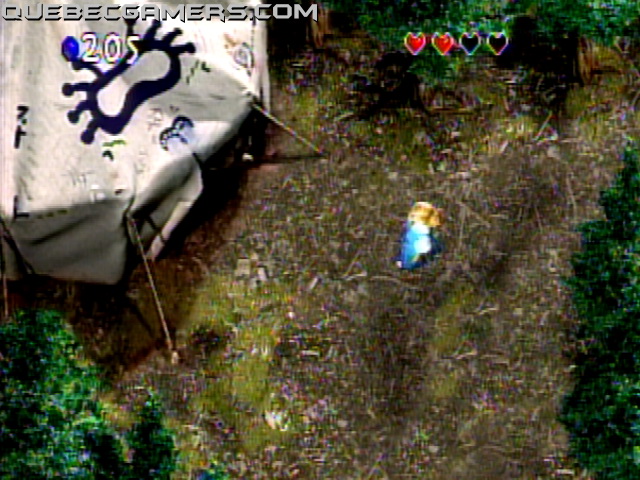 Shrine of IllusionNorth-west of the Forest of Torian · Keeper: PasquinadeA white carnival tent. Zelda falls through a trapdoor and down a slide into a mixture of circus and haunted house, with a bridge that comes and goes, slippery floors, fake doors and a maze too dark to cross without the Candle. A Pols Voice blocks the way until she has the Noise spell. She cannot climb back up the slide, so the only way out is to play the Harp.
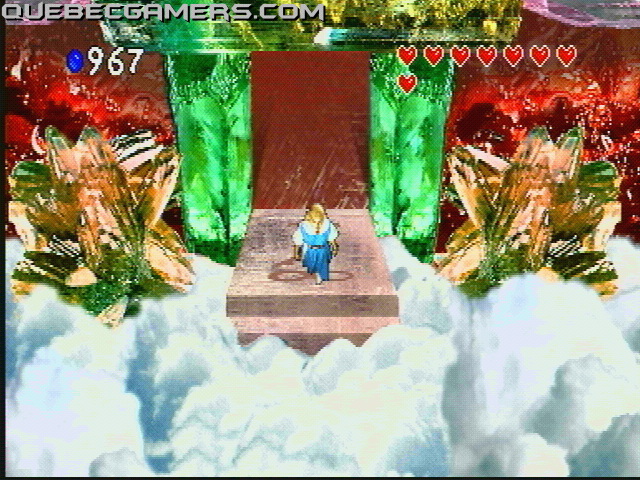 Shrine of AirAbove the cliffs of the North Gubasha Desert · Keeper: AvianaA palace of coloured crystal in the clouds, reached on the back of a giant purple condor. The floors are slippery, shards of crystal break loose and fly at Zelda, and the Tornadoes near the start can only be harmed with the Calm spell. Two Vaporas act as mini-bosses, and the second one drops the Rug, which cuts down the sliding.
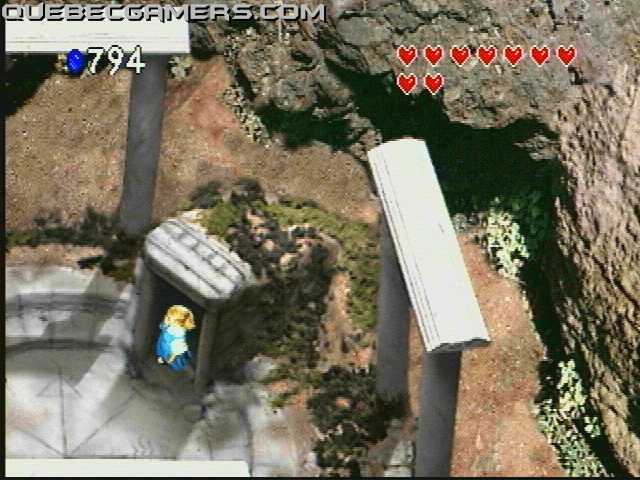 Shrine of DestinyNorthern Ubato Hills · Keeper: MalmordHidden inside a henge of white pillars, this one looks like a marble mansion. Gibdos, Wizzrobes and Bubbles haunt its twisting corridors and narrow walkways. The map is not in the building at all: a woman in the Vendoss swamp gives it to Zelda.
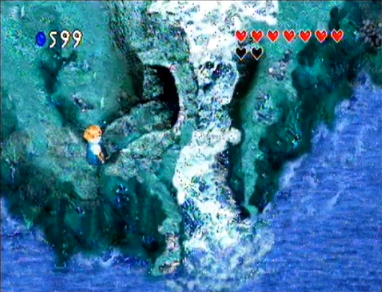 Shrine of WaterAcross the southern sea · Keeper: AgwandaThe home of the Water of Life. Three Kelpies serve Agwanda, and all three must be beaten before the way to her chamber opens.
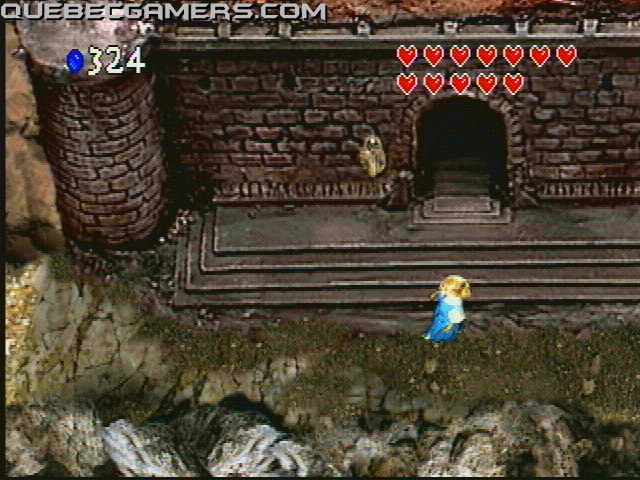 Shrine of StrengthPlain of Hobel · Keeper: UrsoreLess a dungeon than a public fortress, with merchants, ticket sellers and pickpockets in its entrance square and crowds who come to watch contests of strength. Zelda has to joust the Red Knight and then take on the Blue and Green Knights together in the Field of the Broadsword and get past a pair of Iron Knuckles, before she reaches Ursore.
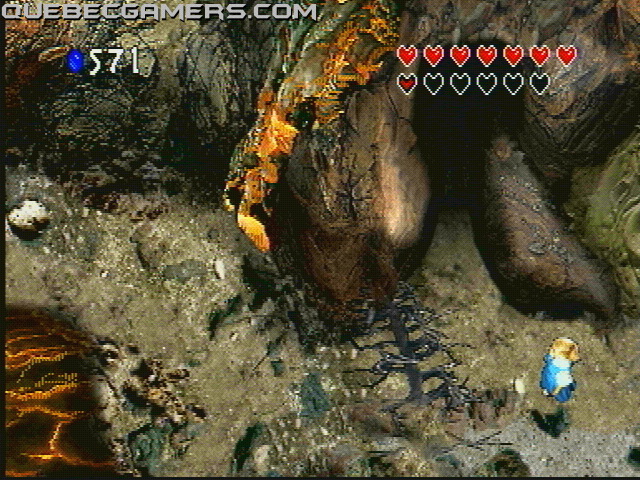 Shrine of FireForest of Canvula · Keeper: WarbaneA cave in a volcano that doubles as Warbane’s forge, all lava pools and fire barriers. It is the shortest Shrine of the seven and runs along a single path, past hostile blacksmiths and a mini-boss called Maxus.
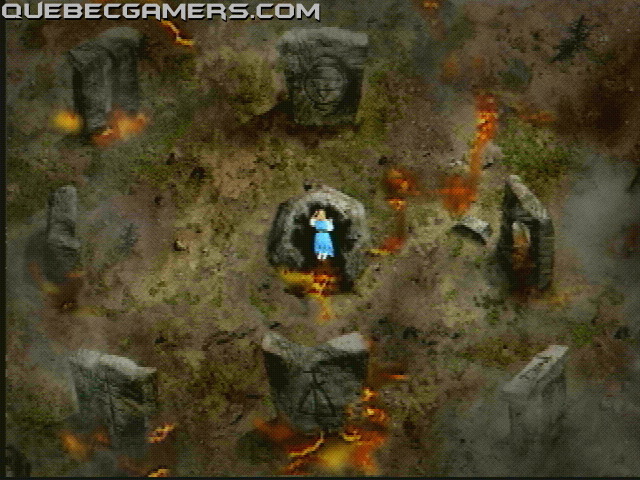 Ganon’s realmBeneath the Vision Henge · Final boss: GanonThe finale. Six of the seven Shrine Keepers must be beaten again, one after another, before Ganon appears.
 Princess ZeldaThe playable hero
 LinkThe one who needs rescuing
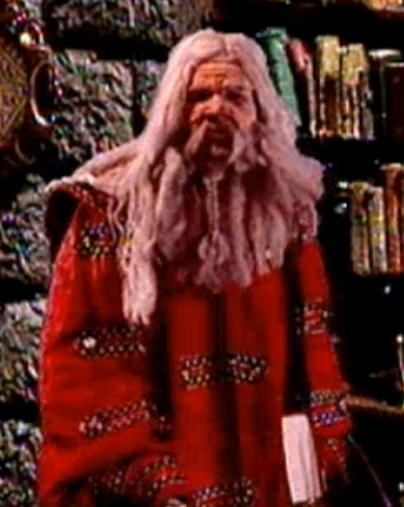 GaspraAstronomer
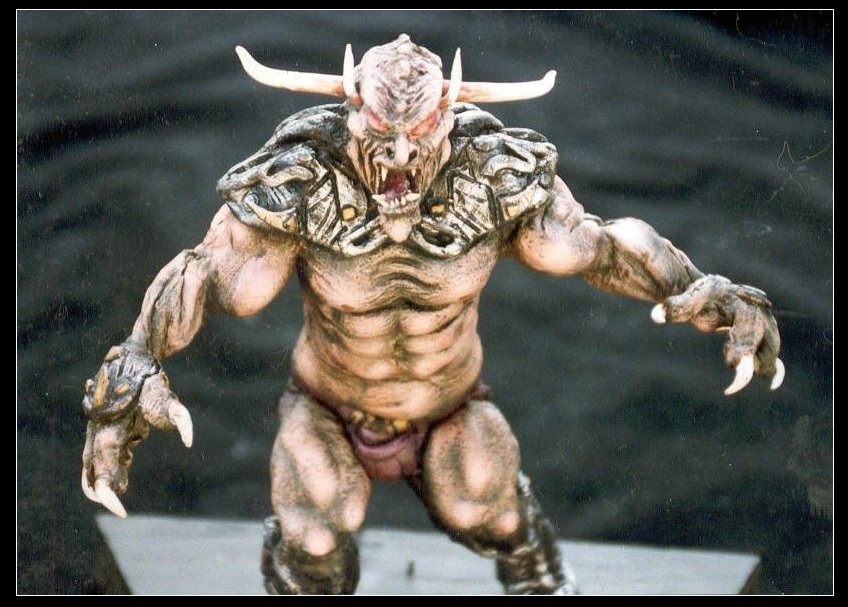 GanonLord of Darkness · “Gannon” on the scroll
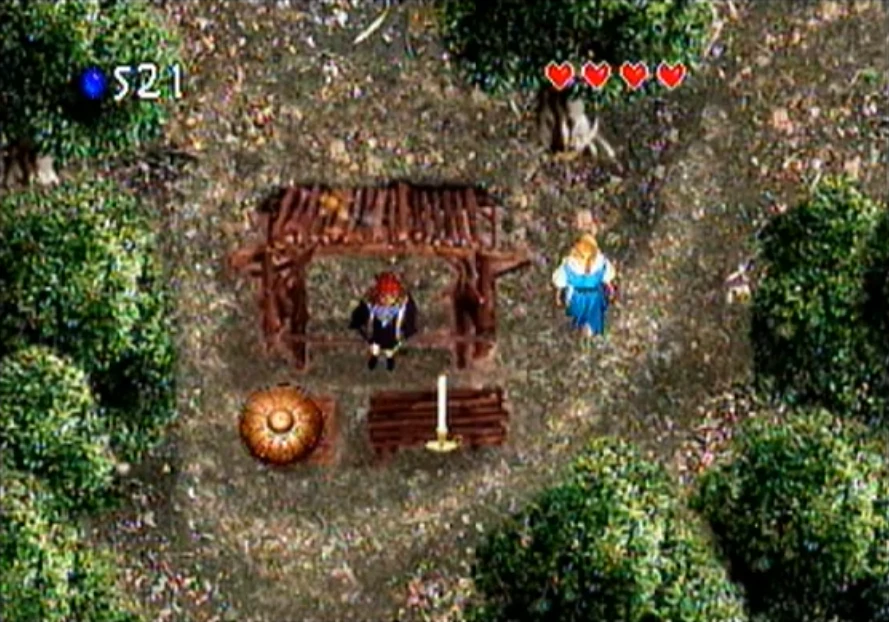 The folk of TolemacAllies, merchants and oddities
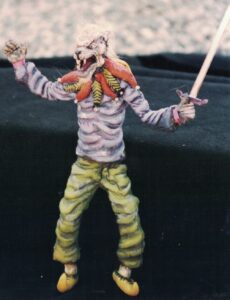 PasquinadeShrine of IllusionA werewolf-like jester who speaks in rhyme. He spins across the room with his staff, turns cartwheels and sets purple balls circling the arena.
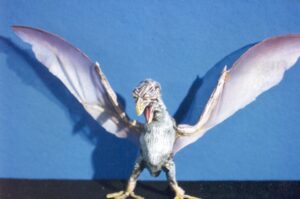 AvianaShrine of AirThe “woman of the air”. She dive-bombs Zelda and throws feathers, and only the Feather spell hurts her, and only on the wings.
 AgwandaShrine of WaterA fast-moving blob of water that sprays bubbles in all directions and hits hard. The top-left corner of her room is a safe place to stand.
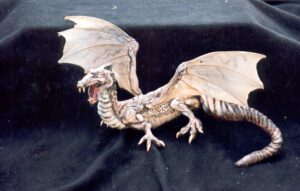 WarbaneShrine of FireA fiery dragon who used to run a locksmith’s forge with a couple from Great Wimbich until Ganon forced him into service. He attacks by flying about his chamber.
 GanonGanon’s realmThe last fight, after the Keepers have been beaten a second time. He vanishes in a whirlwind when he loses.
 Mini-bossesSeveral ShrinesRed, blue and orange Sardaks in the Shrine of Earth, a Pols Voice in Illusion, two Vaporas in Air, three Kelpies in Water, the Red, Blue and Green Knights in Strength and Maxus in Fire.
 Familiar facesOverworld and ShrinesTektites, Keese, Stalfos, Wizzrobes, Gibdos, Goriyas, Patras, Bubbles and Iron Knuckles all appear, rebuilt as photographed models.