The King has vanished, Link has vanished after him, and so Princess Zelda picks up a sword and sails for Gamelon herself. The CD-i game that made Zelda the hero, three decades before Nintendo did.
ReleasedOctober 1993 (North America and UK; usually dated 10 October)
DeveloperAnimation Magic
PublisherPhilips Interactive Media
ProducerDale DeSharone
Players1
You play asPrincess Zelda
Title
Zelda: The Wand of Gamelon (listed as “Zelda: World of Gamelon” in a late-1992 Philips catalogue)
Platform
Philips CD-i
Developer
Animation Magic, with its studio in Cambridge, Massachusetts and its animators from St Petersburg
Publisher
Philips Interactive Media of America
Licence
Nintendo’s characters, used by Philips under the two companies’ CD-ROM agreement. Nintendo neither made nor published the game
Producer
Dale DeSharone (credited as producer on the disc; he also led the design)
Script
Jonathan Merritt
Programming
Linde Dynneson, John O’Brien, John Wheeler
Art
Level sketches by Rob Dunlavey; backgrounds painted by Tom Curry
Music
Tony Trippi and William Havlicek
Voices
Bonnie Jean Wilbur (Zelda), Mark Berry (King Harkinian, Ganon, Gibdo), Jeffrey Rath (Link), Paul Wann (Mayor Cravendish, Harbanno)
Players
1
Released (North America)
October 1993; the usual date is 10 October 1993, the same day as The Faces of Evil, but the exact day is unconfirmed
Released (Europe)
1993: reviewed and on sale in the UK in October, with French, German and Dutch-language editions afterwards
The first game to make Princess Zelda the playable hero, and the first in which Impa appears on screen
Overview
For most of the series’ history, the answer to “can you play as Zelda in a Zelda game?” was “only on the Philips CD-i”. Zelda: The Wand of Gamelon, released in 1993, sends the princess to the island duchy of Gamelon with a sword, a shield and her old nurse Impa, to find out what has become of her father, King Harkinian, and of Link, who went to look for him and never came back.
It is one of a pair. Animation Magic, a small studio in Massachusetts, wrote, drew and programmed it at the same time as Link: The Faces of Evil, and the two were sold together from day one. They share an engine and a rulebook: stages chosen from a map, side-on sword fighting, Rubies to spend on lamp oil, rope and bombs, and townsfolk who swap useful items for odd ones. What differs is everything you see and hear: a new island, a new cast, new bosses and a story with a traitor in it.
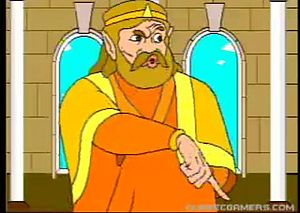
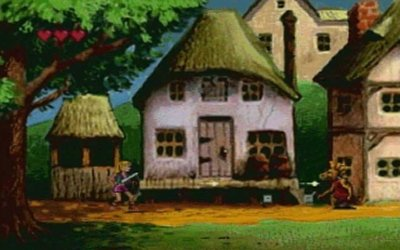
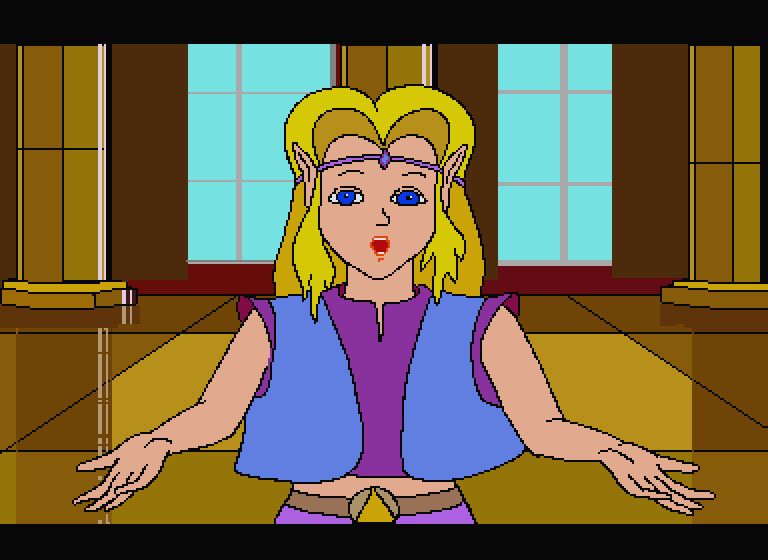
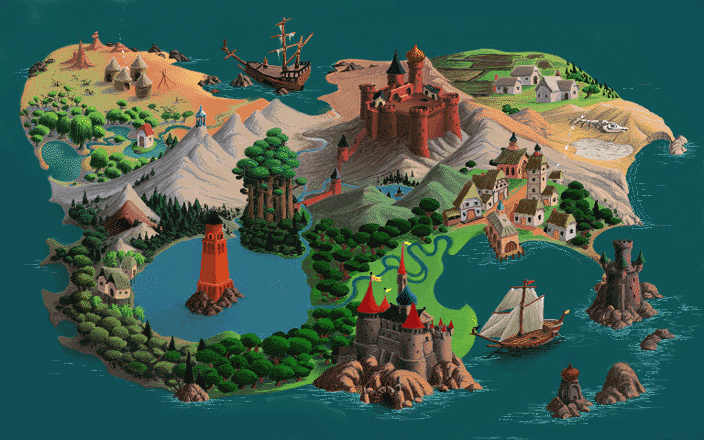
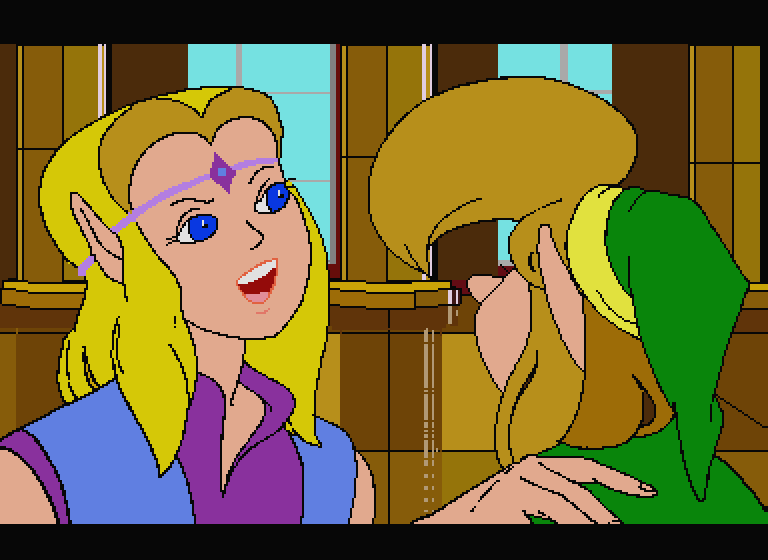
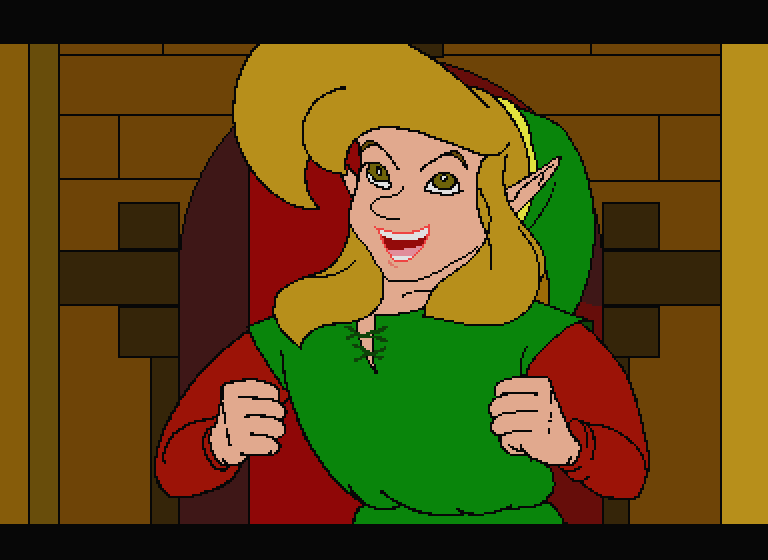
Zelda in Sakado, the main town of Gamelon.The King announces his voyage in the opening scene.The map of Gamelon.
Nintendo had no hand in any of this. Philips held the right to use the characters as a leftover from the two companies’ failed plan for a Super NES CD-ROM drive, and Nintendo’s involvement stopped at approving some sketches. The result, with its hand-drawn, fully voiced cutscenes animated by artists from St Petersburg, looks and sounds like no other Zelda.
It also has a reputation like no other Zelda. Praised in one British review as a reasonably good game, it was later named the fifth and the sixth worst game of all time by GameTrailers and by Electronic Gaming Monthly’s Seanbaby, and its King, with his interest in dinner, became an internet celebrity. Since then it has been defended, lovingly reanimated, remade by a fan, and honoured with a spiritual successor.
“If you don’t hear from me in a month, send Link.”
King Harkinian’s parting instruction sets up the whole game. He sails to help Duke Onkled against Ganon, carrying the Triforce of Courage for protection. A month passes without a word. Link is sent, and he does not return either.
— King Harkinian, opening cutscene of Zelda: The Wand of Gamelon (Philips Interactive Media, 1993; script by Jonathan Merritt), as transcribed on Wikiquote.
Quick Answers
Quick answers to the things people most often want to know about The Wand of Gamelon, with links to the fuller story below.
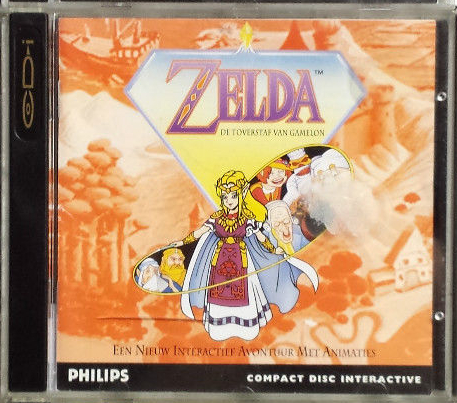
The European CD-i box.
Can you play as Zelda in The Wand of Gamelon?
Yes. Zelda is the only playable character, and this is the first game in which she is. Nintendo’s own first adventure with the princess in the lead, Echoes of Wisdom, did not arrive until 2024. More →
When was it released?
In October 1993 on the Philips CD-i, alongside Link: The Faces of Evil. The date normally quoted for North America is 10 October 1993. The British CD-i magazine reviewed it that month and listed it as available. More →
Who made it?
Animation Magic, an American studio led by Dale DeSharone, for Philips. It is not a Nintendo game: Philips had licensed the characters. More →
What is the Wand of Gamelon?
The one weapon that works on Ganon. It is kept in the Shrine of Gamelon by a shape-changing monster called Omfak, and Zelda throws it at Ganon in the final room to bind him in chains. More →
What happened to Link?
He spends nearly the whole game missing. In the last scene Zelda smashes Lady Alma’s hand mirror and Link tumbles out of it. How he got in there is never explained. More →
Who is Duke Onkled?
The ruler of Gamelon, whom the King sets out to help. He has in fact gone over to Ganon and handed the King to him. He ends the game sentenced to scrub every floor in Hyrule. More →
Where does “I wonder what’s for dinner” come from?
From this game’s opening scene. King Harkinian ends the discussion of his dangerous voyage by announcing that his ship sails in the morning, then wonders aloud about dinner. The line became a staple of YouTube Poop remixes. More →
Is it canon?
No. Nintendo does not include the CD-i games in the series, the timeline or Hyrule Historia, and Eiji Aonuma has said he does not think they fit in the franchise. More →
Is it the same game as The Faces of Evil with Zelda swapped in?
No. The engine and rules are shared, but Gamelon has its own 15 stages, its own characters and items, and six bosses of its own before the final fight with Ganon. More →
How can I play it now?
Officially, only with the original disc and a CD-i player. A fan remake for Windows and Linux was released in November 2020 and taken down by its author about two days later; his later game Arzette: The Jewel of Faramore is its spiritual successor. More →
Plot / Story
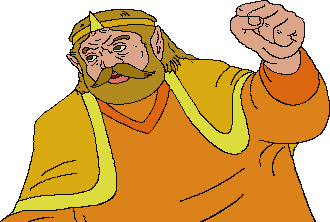
King Harkinian.
The Wand of Gamelon opens at Hyrule Castle with a king in a hurry. Duke Onkled of Gamelon, King Harkinian tells his daughter, is under attack by the evil forces of Ganon, and he is going to Gamelon to aid him. Zelda asks what will happen if something goes wrong. He will take the Triforce of Courage to protect him, says the King, and if she has heard nothing in a month she is to send Link.
Zelda turns to her old nurse, Impa, who consults the Triforce of Wisdom and reports that it promises the King’s safe return. “Enough!” says His Majesty. His ship sails in the morning. Then, in the line that made him famous: “I wonder what’s for dinner.” Link, who has been waiting for exactly that subject to come up, says he is so hungry he could eat an Octorok.
One month later
A caption reads ONE MONTH LATER, and there is still no word. Impa is certain the King is all right, and Link agrees that Ganon is no match for him, so Zelda does as she was told and sends Link to Gamelon to find her father. He is delighted: he cannot wait to bomb some Dodongos.
A second caption, LATER STILL, and Link has not come back either. Zelda has had enough of waiting. She wakes Impa, tells her they are going to Gamelon, and Impa goes to fetch the Triforce of Wisdom. From here on the princess does the fighting.
Zelda sends Link after the King.
An island under Ganon
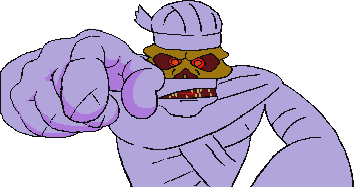
Gamelon is a wooded island of small towns, and Ganon’s forces have the run of it. Sakado, the port and the largest town, is nearly deserted: its mayor, its baker and many of its citizens are locked in Tykogi Tower, and in the church a Gibdo is raising the dead.
Impa travels with Zelda, and wherever the two meet she holds up the Triforce of Wisdom to show what lies ahead: the monster guarding the next stronghold, or a prisoner being taken. It is through these visions that Zelda learns the worst. Her father was not lost in battle. Ganon himself captured him. Link, the Triforce shows, got as far as a fight, and how it ended is not clear.
The few islanders still at liberty help where they can, and almost every one of them wants something first. Lubonga, the last person left in Aru Ainu, knits the shroud that will lay the Gibdo to rest. Starving Makoto in Kobitan swaps a flute for an Arpagos egg. Grimbo, an alchemist in a swamp hut, turns a rare spore into the Power Glove, and it is the Power Glove that shatters the armour of Iron Knuckle, the jailer of Tykogi Tower, and lets the mayor go.
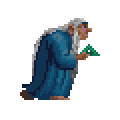
Impa and the Triforce of Wisdom.The Gibdo of Sakado church.
Lady Alma and the canteen
At the Fairy Pool three witches have frozen the Fountain of Life and plunged the place into darkness; Zelda cuts them down and the fairies reward her. At Shutoy Lake the Triforce shows a noblewoman, Lady Alma, telling the sorcerer Wizzrobe that she is not afraid of him, and being buried in stones for it.
Zelda beats Wizzrobe by bouncing his own spell back at him and digs Lady Alma out. Her thanks are a canteen, and a story about where she got it. She has met Link, she says; he told her all about Zelda. “Sure, he gave me his canteen for a kiss.” The princess is not pleased, and Lady Alma does not elaborate.
Lady Alma, with Link’s canteen.
The traitor in Dodomai Palace
The trail leads to Dodomai Palace, Duke Onkled’s own castle. One of the King’s men, Lord Kiro, tried to stop Ganon seizing his master, and Ganon ordered the wizard Hektan to keep “the runt” in chains there. Hektan taunts Zelda by vanishing and reappearing, and blows an Armos apart to show what he can do. Then she runs him through, and he melts into a bubbling puddle.
Kiro, freed, tells her the truth: “Duke Onkled betrayed the King!” There never was an attack to be rescued from. Onkled had thrown in his lot with Ganon, and the appeal for help was the trap. Kiro shows Zelda the way into the Duke’s hidden chamber, behind a portrait, where Onkled is cowering. He begs not to be hurt, gives up the secret way into Reesong Palace, where Ganon has made his headquarters, and hands over the key to its gate.
Hektan, Ganon’s wizard.Duke Onkled begs for mercy.
The Wand
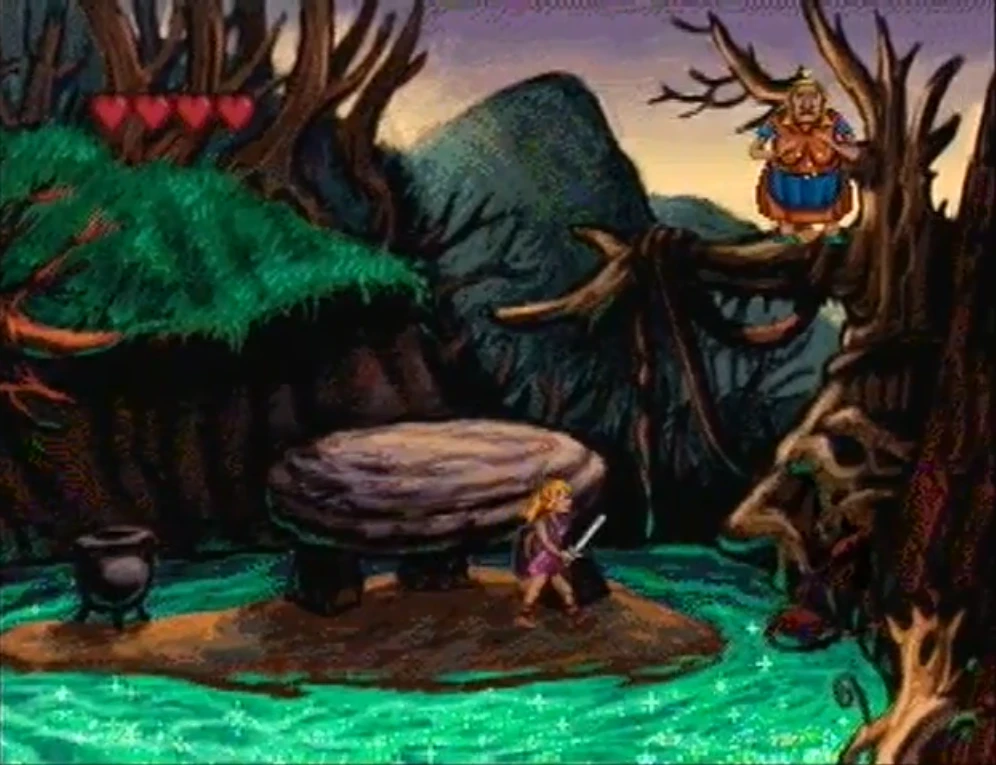
A sword will not be enough for Ganon. At the top of a tree in Nokani Forest a travelling woman called Myra, met earlier in Hanyu Forest, warns Zelda that only the Wand of Gamelon can defeat him, and the wand is in the Shrine of Gamelon. “Oh dear,” says Impa, peering into the Triforce. “Omfak is guarding the shrine.”
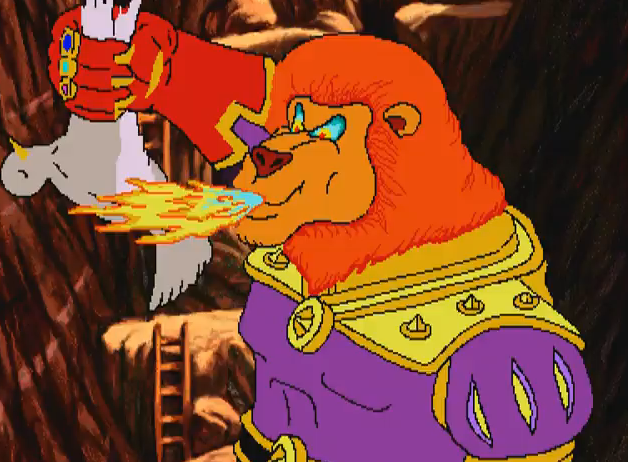
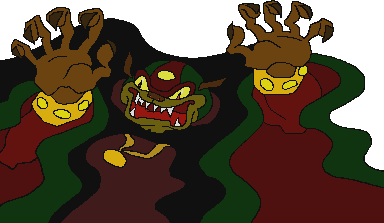
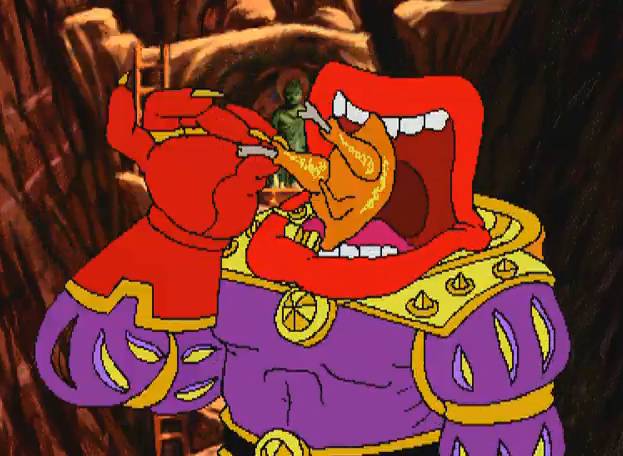
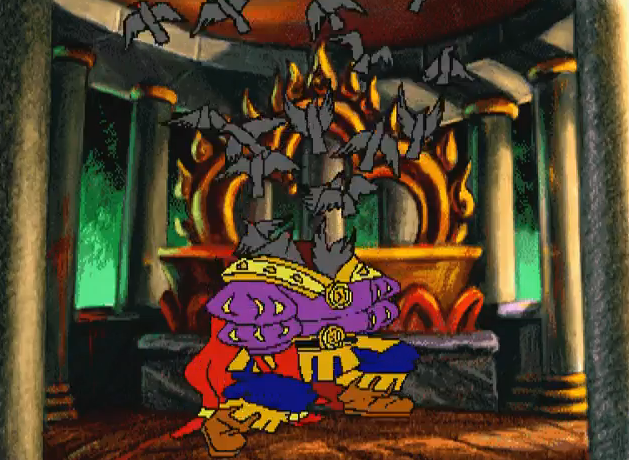
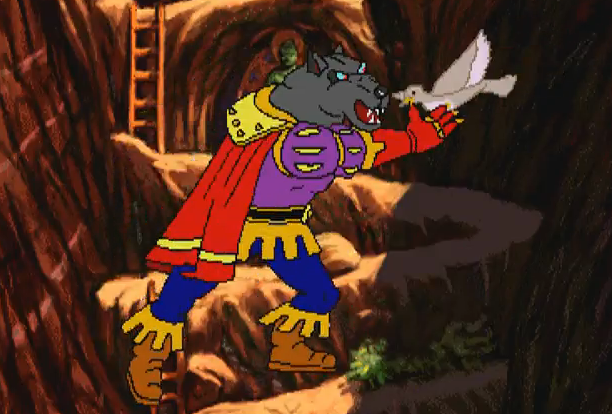
Omfak is a glutton who boasts that he will eat anything he sees, and proves it on a passing bird. He fights as a wolf that fires star-shaped bolts, then as a lion that breathes fireballs, then as an enormous pair of lips, and only the lips can be hurt. One stroke of the sword and he bursts into a flock of black birds, leaving the wand behind.
Omfak, keeper of the Shrine of Gamelon.
Reesong Palace, and a feast
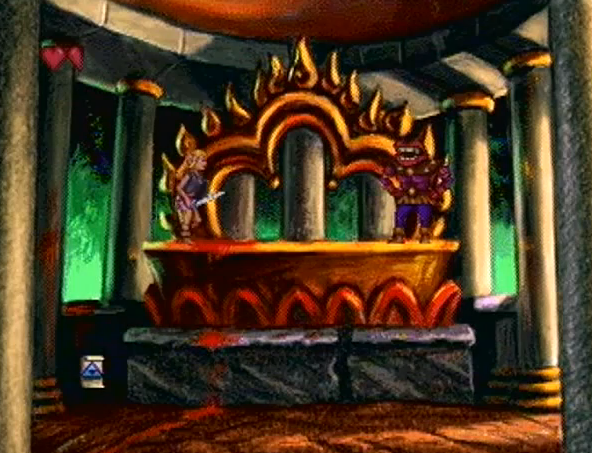
Reesong Palace is a long climb through tunnels, a cistern and a courtyard to the tower where Ganon waits. He hurls fireballs in threes. In the pause between volleys Zelda climbs up and throws the wand. Chains of magic wrap around Ganon, and he is drawn into the pages of a book that looks very like the Book of Koridai from The Faces of Evil. He drops a key. Behind a green door, the King is waiting to be let out.
In the closing scene Lord Kiro marches in the traitor. Onkled grovels to “your omnipotence” for mercy, and the King passes sentence: “After you’ve scrubbed all the floors in Hyrule, then we can talk about mercy! Take him away!”
That leaves one loose end. Zelda wonders what happened to Link. “Oh, he was a bore anyway,” says Lady Alma, who is busy admiring herself in a hand mirror. Zelda snatches it, tells her to stop looking at herself and throws it aside. The mirror shatters, and there is Link, blinking, with no idea what has happened. Nothing, Zelda tells him; they were just about to have a feast. “Great!” says Link.
Ganon in Reesong Palace.Zelda and Link, reunited by a broken mirror.
Where it fits
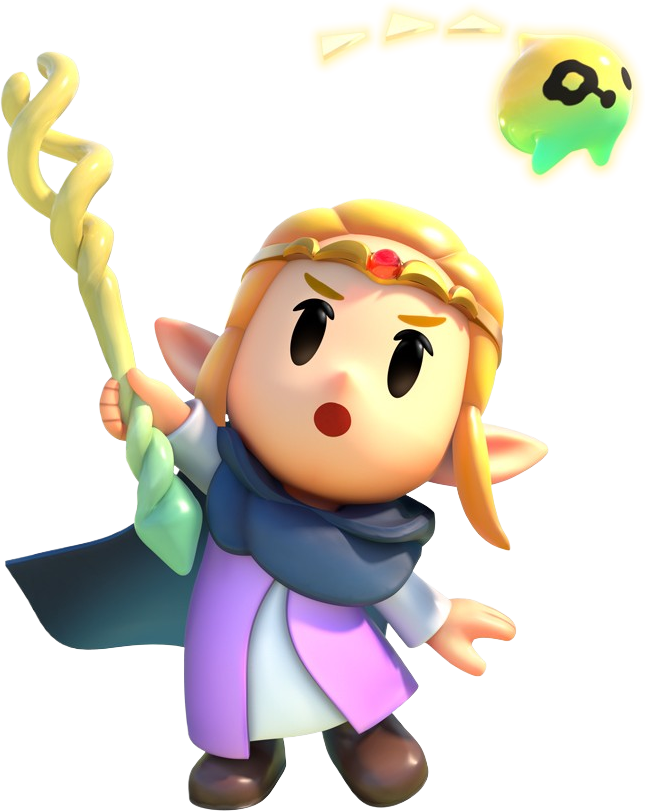
Princess Zelda in Nintendo’s Echoes of Wisdom (2024).
The Wand of Gamelon is not part of Nintendo’s Zelda. It appears on no official timeline and was left out of Hyrule Historia, and Eiji Aonuma, asked about the CD-i games by MTV in 2013, said with a laugh that he did not know that they really fitted the franchise.
Its roots are in the American spin-offs of the late 1980s as much as in the games. Researchers at the fan site Aypos Library trace the King’s name to the television cartoon and his look to the Valiant comics, where Impa also carries the Triforce of Wisdom about with her as she does here. The cartoon even has episodes in which the King is kidnapped by Ganon and in which Zelda has to rescue a captured Link. And the idea itself was eventually vindicated: in 2024 Nintendo released Echoes of Wisdom, in which Zelda sets out to save a missing Link.
Stages of Gamelon
Gamelon is divided into 15 stages on a map. Sakado, Aru Ainu and Kobitan are the first three in every guide, and Sakado, with the island’s only shop, is returned to again and again. The list follows the order of the walkthrough Philips wrote for its telephone helpline.
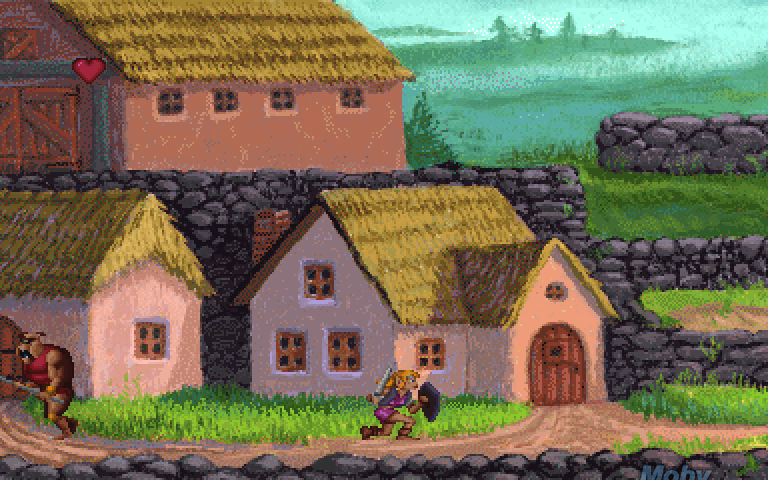
SakadoThe main town · boss: GibdoA harbour town of tall houses, patrolled by Dairas and Arpagos. Here are the Merchant’s shop, Lika’s house at the end of the main street, an Arpagos nest with an egg in it, the tavern where the Power Sword is kept, a bakery, a smithy and a cemetery of Ghini and Stalfos. The Gibdo waits in the church beside the graves; beating it opens Washubi Swamp.
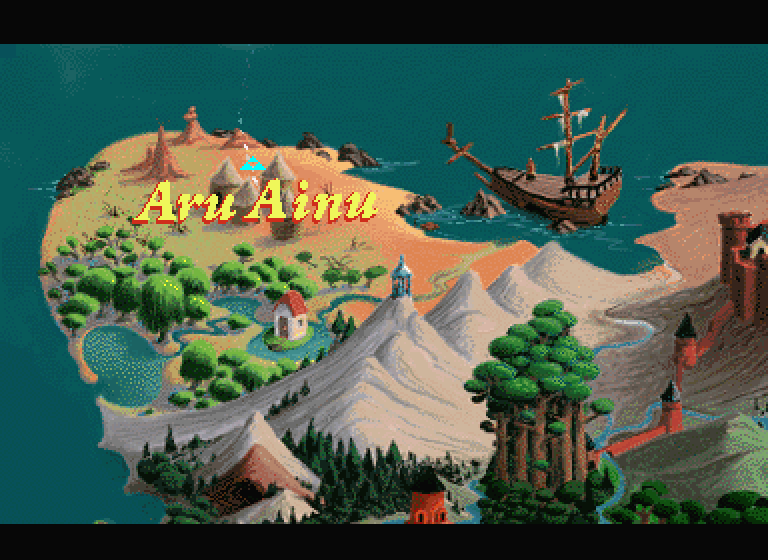
Aru AinuFirst visitsA village with one inhabitant left. Warthogs charge about outside, and a Dodongo in a cave holds the key to Lubonga’s hut, where Zelda is given the Shroud and a warning about Gleeok. Opens Tykogi Tower.
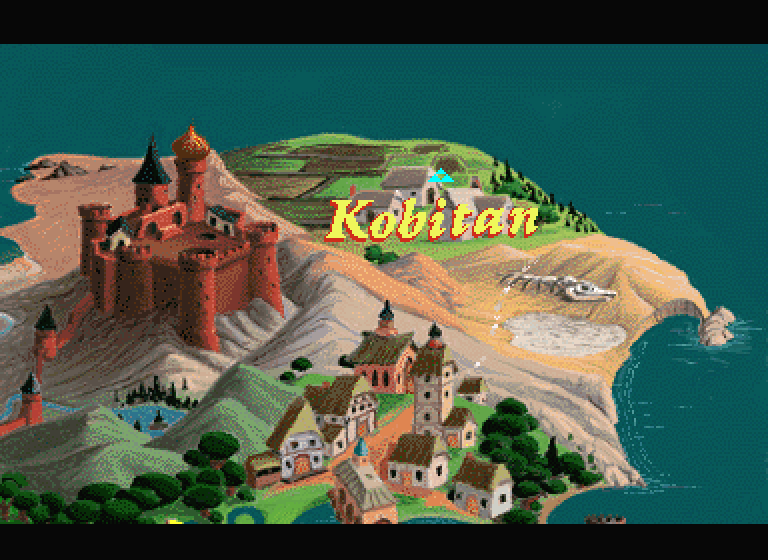
KobitanFirst visitsSpear-throwing Moblins guard a house with the Lantern in it, and a barn too dark to enter without one. The key from the barn opens Makoto’s house; bring her an Arpagos egg and she parts with her Flute. Opens Ahitaru.
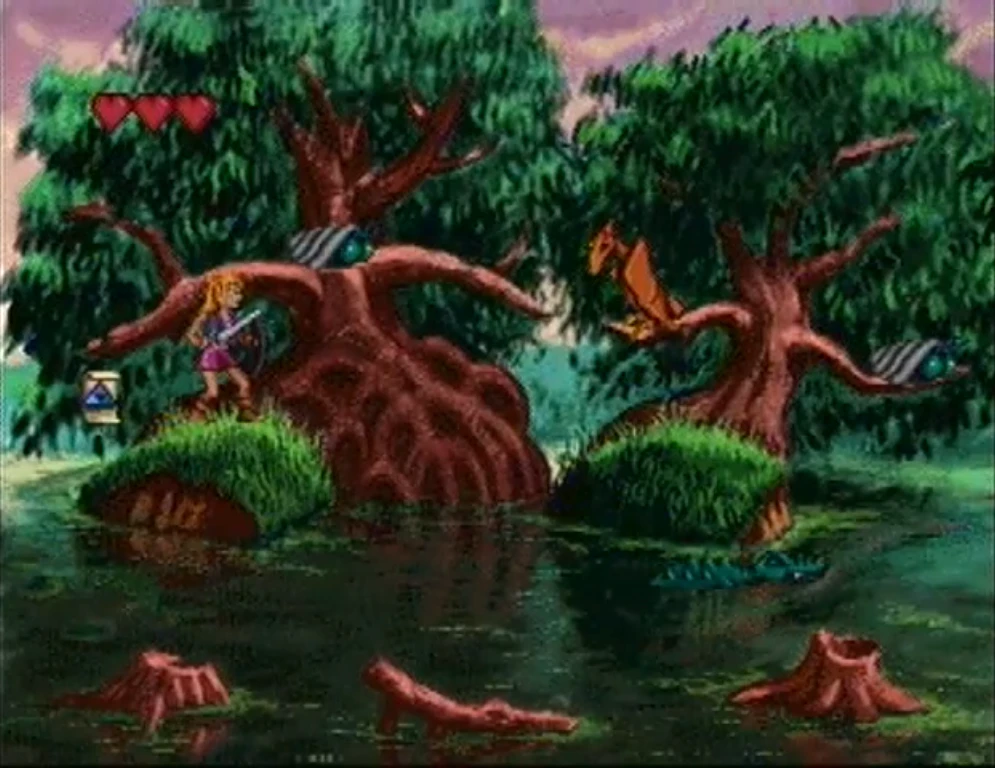
Washubi SwampOpened by beating GibdoThe first really hard stage: a crossing made on the backs of alligators and along the branches of drowned trees, among Arpagos and giant snails. Grimbo’s hut is at the far end. He wants a Hanyu Spore, and pays with the Power Glove.
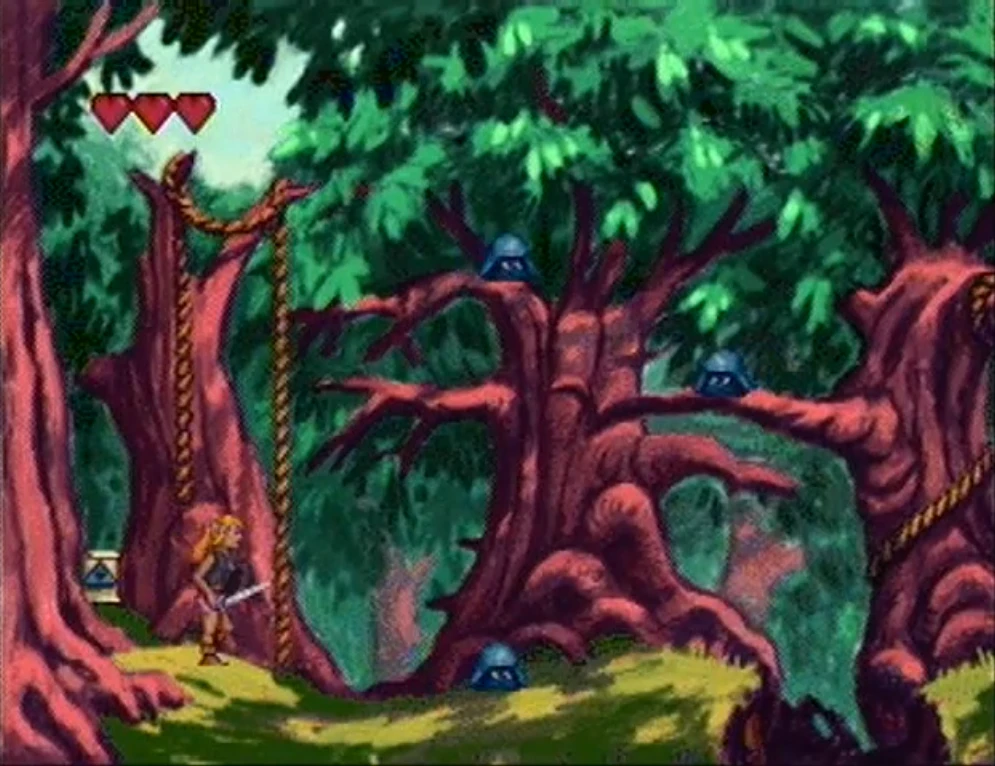
Hanyu ForestOpened by Washubi SwampWoodland full of Bots, which have to be struck from below, and green Vires. The Hanyu Spore sits on top of a rock. Myra is here too: for an Arpagos feather she turns the Shroud into the Magic Cape.
AhitaruOpened by KobitanA desert with the skeleton of a giant fish in it. Swarms of bees can be stilled with the Flute, Gohmas lurk in the caves, and Sanda the water bearer offers Water of Life. A boulder on the fish’s skull needs ten bombs or the Power Glove; inside is Yokan the fisherman, who leaves a key and heads for Sakado.
Tykogi TowerOpened by Aru Ainu · boss: Iron KnuckleThe island’s prison. Armoured Octoroks, Wallmasters that cannot be killed and clanking Tinsuits guard the cells. Harbanno the baker is freed on the way up, Iron Knuckle is felled with the Power Glove, and Mayor Cravendish, released from his chains on the top floor, hands over the Magic Lantern. Opens Dordung Cave.
Dordung CaveOpened by Tykogi TowerA dark cavern of Kargaroks, Dodongos and fire-spitting Gleeok heads, with gaps that need the Magic Cape. The Gleeok at the end guards the Heat Crystal, which Yokan needs for his forge. One of only two stages with no cutscene.
The Fairy PoolOpened by Hanyu Forest and the swamp · boss: the WitchesPitch dark until a lantern is lit. Three witches have frozen the Fountain of Life; one blow apiece deals with them. The freed fairies give a Life Heart, Fairy Dust and Water of Life, and later they will fill the canteen. Opens Gobiyan Ship.
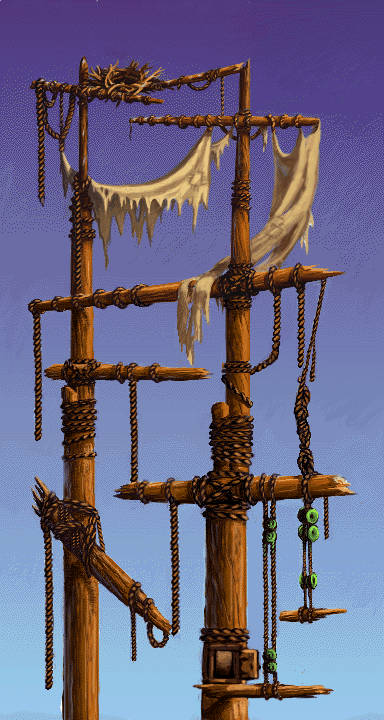
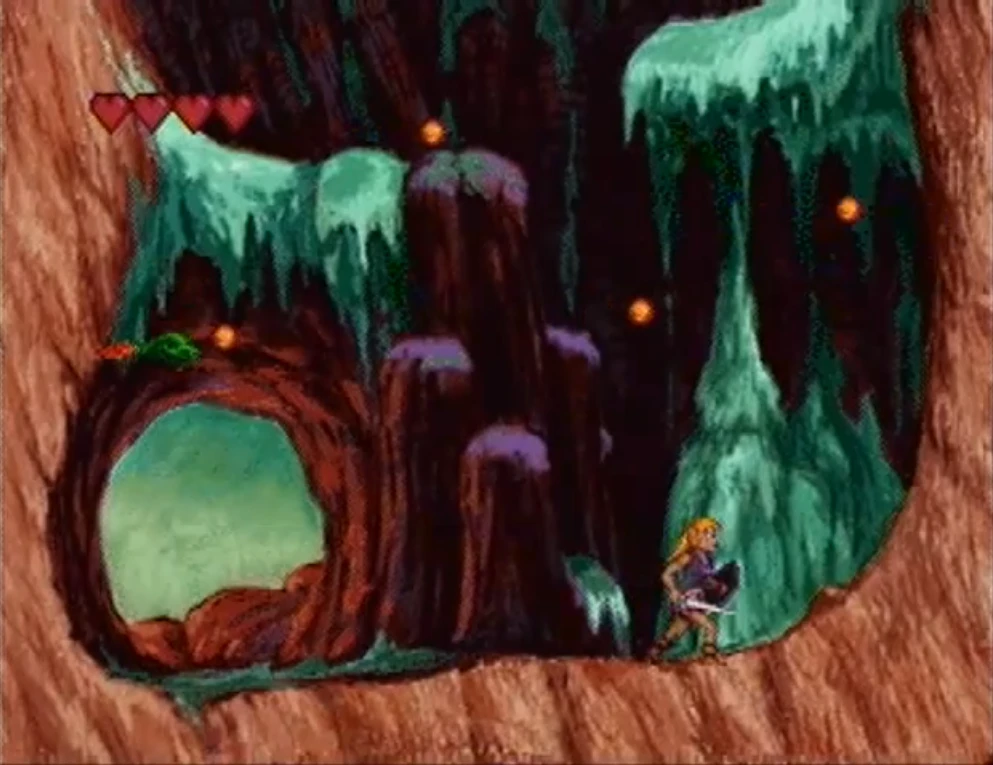
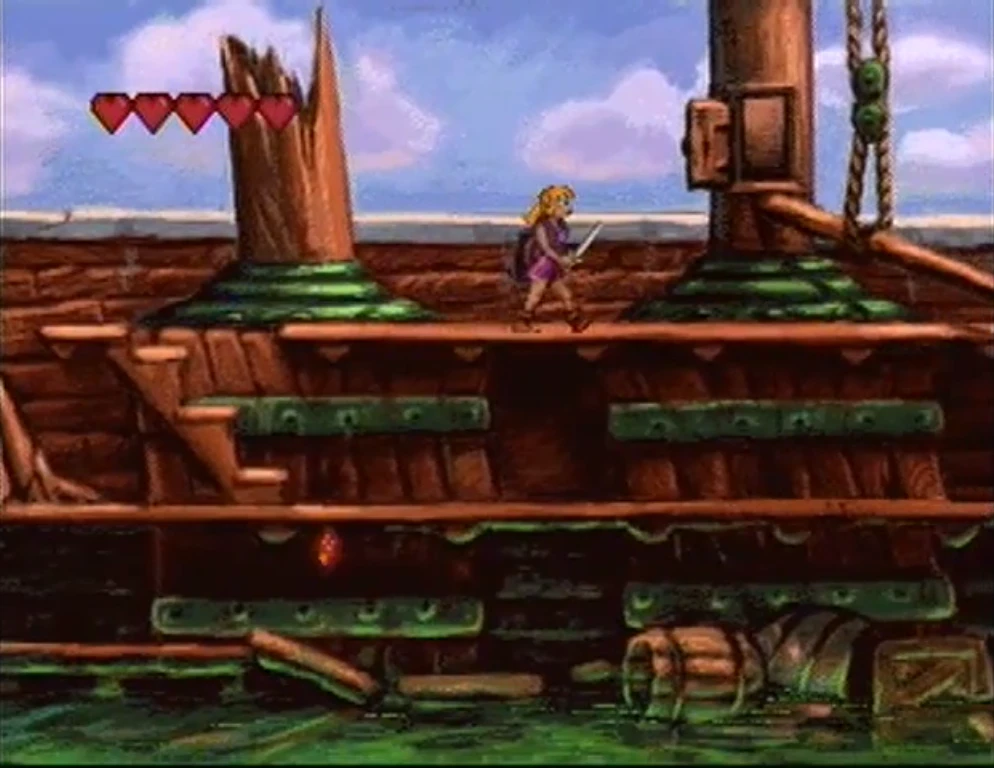
Gobiyan ShipOpened by the Fairy PoolA ghost ship off the coast, reached over the backs of more alligators while Zolas spit from the water. Stalfos and Ghini crew the decks. An Arpagos feather glows high in the rigging, and the Reflecting Shield lies in the cabin. The other stage without a cutscene.
Shutoy LakeBoss: WizzrobeA lake crossed by raft and alligator, with leaping fish, a hut with a key in it and a tower where rocks rain down the stairwell. Wizzrobe is beaten by reflecting his spell with the Reflecting Shield. Lady Alma, freed from the stones, gives the Canteen.
Dodomai PalaceBoss: HektanDuke Onkled’s castle, full of Skulltulas, Darknuts and more Gleeok heads. Hektan is fought on the rooftop plaza and leaves a Life Heart. Lord Kiro is in the tower; Onkled is behind the portrait. Opens Nokani Forest.
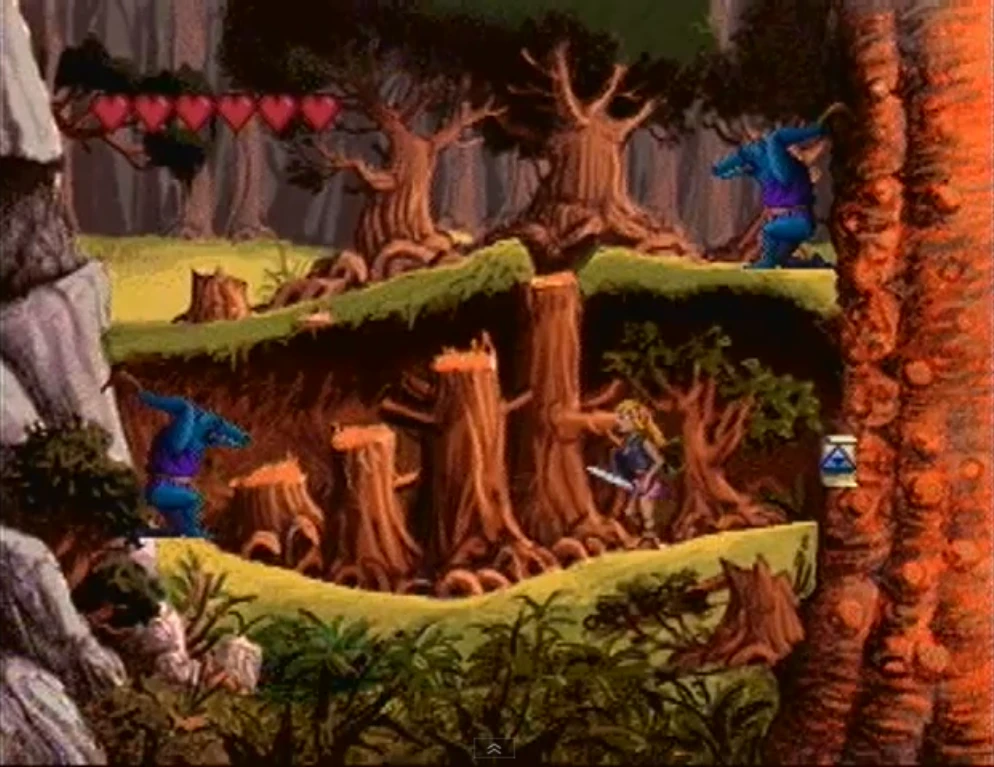
Nokani ForestOpened by Dodomai PalaceOne enormous tree to be climbed, through Goriyas, Vires, Zols and flying eyeballs called Moas that never stop coming. At the top Myra exchanges the lantern for the Fairy Lantern, which burns without oil.
Shrine of GamelonBoss: OmfakRolling fire barrels at the cave mouth (the Magic Cloak gets Zelda past), a rock spire to climb and a chasm that only the Magic Cape will clear. Inside the shrine Omfak guards the Wand of Gamelon.
Reesong PalaceFinal stage · boss: GanonGanon’s headquarters and a tour of nearly every enemy in the game, from Keese to Darknuts to Stone Heads that fall to a single bomb. A boulder to break with the Power Glove, a well to drop down, a courtyard, and at the top of the tower Ganon himself. Throw the wand, take the key, open the green door.
Sakado changes as the game goes on. Prisoners freed elsewhere come home and open up: Yokan sets up as the town’s smith, and Harbanno goes back to his bakery and hands out bread.
How it plays
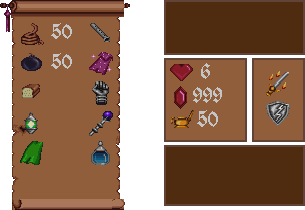
Zelda’s magic pouch.
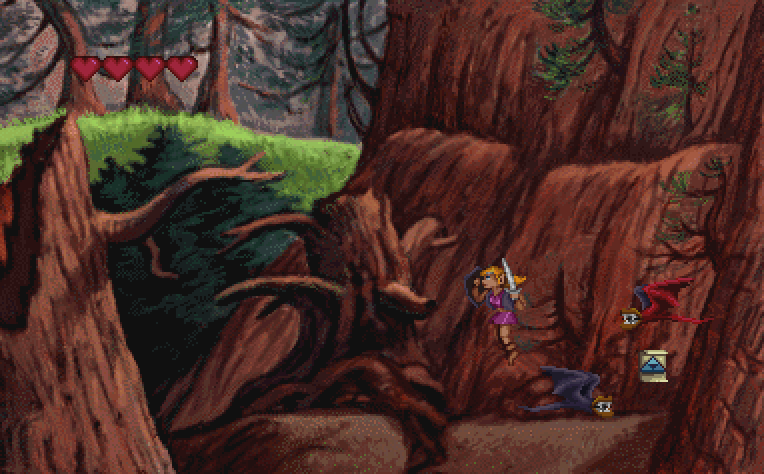
Anyone who has played The Faces of Evil will be at home here in a minute, because the two games run on one engine. The view is from the side, the stages are short and maze-like, and progress depends less on reflexes than on working out which islander wants which object.
Zelda herself plays exactly as Link does in the sister game: same sword, same shield, same jump. IGN’s Peer Schneider, looking back in 2001, thought that a missed chance, and complained that the game simply handed Zelda Link’s job.
Item
How Zelda gets it
Use
Lamp oil, rope, bombs
The Merchant in Sakado: three for 5, 10 or 20 Rubies
Lantern fuel, a way up to high doors, and the answer to boulders, Gohmas and Dodongos
Lantern
A house in Kobitan
Lights dark stages. Mayor Cravendish’s Magic Lantern lasts longer; Myra’s Fairy Lantern needs no oil at all
Power Sword
The top room of a dark building in Sakado
Sword beams when Zelda’s hearts are full
Magic Sword
Yokan’s smithy in Sakado, for the Heat Crystal
Sword beams at any time
Shroud
Lubonga, Aru Ainu
Thrown at the Gibdo to defeat it
Flute
Makoto, Kobitan, for an Arpagos egg
Freezes flying pests such as bees, bats and Arpagos
Power Glove
Grimbo, Washubi Swamp, for a Hanyu Spore
Breaks boulders and pillars, and Iron Knuckle’s armour
Magic Cloak
Lika, Sakado, for Fairy Dust
Hides Zelda from harm for a few moments, at 20 Rubies a time
Magic Cape
Myra, Hanyu Forest, for an Arpagos feather
Higher jumps and chasm crossings, 5 Rubies a time
Reflecting Shield
The cabin of Gobiyan Ship
Turns Wizzrobe’s spell back on him
Canteen
Lady Alma, Shutoy Lake
Filled with Water of Life by the fairies, for healing on the move
Wand of Gamelon
Omfak, Shrine of Gamelon
Useless on ordinary enemies; the only thing that stops Ganon
Life Hearts
The fairies, Iron Knuckle, Hektan
Take Zelda from three hearts to six
Picking a stage
Choosing where to go next on the map of Gamelon.
Everything starts from the map of Gamelon, where a cursor chooses the next stage. A stage is a chain of rooms joined by doors, ladders and ropes, and it has a Triforce Map at each end. Touching the one at the start leaves by the way Zelda came in. Reaching the one at the far end completes the stage and, more often than not, puts a new place on the map.
Stages are meant to be revisited. Sakado alone is the scene of four separate errands in Philips’s official guide, as each new tool opens another door in town.
The Smart Sword
Zelda sets out with a shield that comes up by itself when she stands or crouches, and a sword that does everything else. Monsters are stabbed. The Rubies they drop are stabbed to pick them up. People are stabbed too, harmlessly: hers is a Smart Sword that will not wound a friend, and touching one with it starts their cutscene.
The beam attack has to be earned twice. The Power Sword, found early in Sakado, shoots while Zelda is at full health, and once Yokan has reforged it with the Heat Crystal it shoots regardless. Several bosses fall to a single blow once Zelda can reach them, which is the hard part.
The Merchant of Sakado
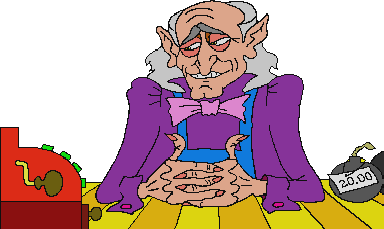
The Merchant, Sakado’s only shopkeeper.
Gamelon has a single shop, in Sakado, kept by a man the manual calls only the Merchant. His stock and prices are the same as Morshu’s in the sister game: lamp oil at 5 Rubies, rope at 10 and bombs at 20, three to a purchase. If Zelda is short, his advice is to go and kill a few Goriyas.
Two of the best items cost Rubies every time they are used. The Magic Cloak takes 20 and the Magic Cape 5, so a healthy purse matters more here than in most Zelda games. The helpline guide recommends banking a hundred Rubies from the Dairas and Arpagos of Sakado before doing anything else.
Hearts and continues
Zelda begins with three Life Hearts and loses at least half of one with every knock; a Dodongo’s horn takes a whole one. When the meter empties a Continue screen appears, and she starts again at the door of the room she was in. After the third failure she is returned to the map and the stage has to be begun again, with her items and money intact. Three further hearts are won during the adventure, from the fairies and from two of the bosses, and bottles and springs of Water of Life restore the meter in a few stages.
Controls
One button attacks. The other is for doors and for the magic pouch, which opens when it is pressed while Zelda is crouching and closes the same way. Inside the pouch that button selects whatever is to be used next, whether it is a rope, a bomb or the wand.
British reviewers in 1993 already marked the game down for its controls, and Schneider later called them sloppy, adding that it is often hard to tell where a platform begins and ends. The producer put much of the blame on the hardware: the CD-i’s infrared pad sent an analogue signal that was slow to register. The game’s champion John Szczepaniak advises a wired three-button controller.
Characters
The Hyrule party is small and the island is crowded. Names given on screen are few; the rest are taken from the manual and from Philips’s helpline guide, as catalogued by Aypos Library.
Character
Who they are
In this game
Stats & abilities
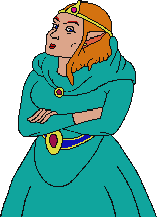
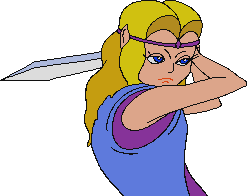
Princess ZeldaThe hero
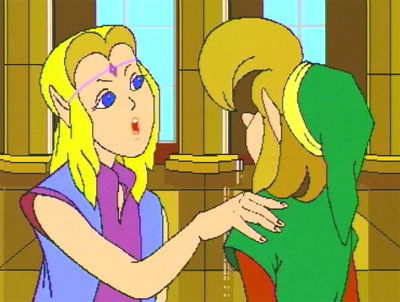
The King’s daughter: polite, dry-witted and perfectly ready to fight. She is voiced by Bonnie Jean Wilbur.
Waits a month for her father and longer for Link, then goes to Gamelon herself. She frees its prisoners, exposes the Duke, wins the wand and binds Ganon.
The only playable character
Smart Sword and shield
3 Life Hearts, rising to 6
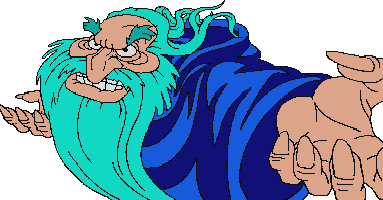
ImpaZelda’s nurse · keeper of the Triforce of Wisdom
The elderly nursemaid known until then only from the manuals of the NES games. Here she is drawn in blue, and carries the Triforce of Wisdom as she does in the Valiant comics.
Comes to Gamelon with Zelda and turns up in most strongholds, using the Triforce to show a vision of the boss or of events elsewhere.
Not playable. Gives visions and hints.
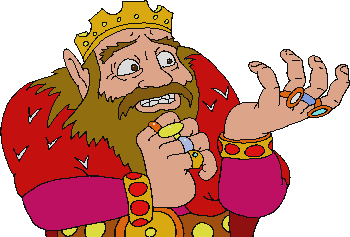
King HarkinianKing of Hyrule
Zelda’s father, named in the game’s manual after the king of the 1989 cartoon. Mark Berry provides the voice.
Sails to Gamelon with the Triforce of Courage to help Duke Onkled and is captured by Ganon in person. Freed at the end, he sentences the Duke and orders a feast.
Held in Reesong Palace
“I wonder what’s for dinner”
LinkMissing hero
Hyrule’s champion, hungry and keen as ever, with the voice of Jeffrey Rath.
Sent after the King when a month has passed, he vanishes in his turn. On the way he trades his canteen to Lady Alma for a kiss. He reappears in the final scene when her mirror is broken.
Seen only in the opening and ending.
Duke OnkledRuler of Gamelon
The Duke of Gamelon. The Zelda Wiki describes him as the King’s cousin.
Betrays the King to Ganon and lets Ganon’s army take the island. Cornered in his secret chamber in Dodomai Palace, he surrenders the key to Reesong Palace. Lord Kiro arrests him.
Gives the key to Reesong Palace. Sentence: every floor in Hyrule.
GanonConqueror of Gamelon
The same hooded, boar-faced Ganon as in the sister game, again voiced by Mark Berry.
Holds the island through a chain of monstrous deputies, keeps the King prisoner in Reesong Palace and is finally chained by the wand and shut in a book.
Fireballs in volleys of three
Only the Wand of Gamelon affects him
Drops the key to the King’s cell
Lady AlmaNoblewoman of Gamelon
A fearless and rather vain lady, entombed in stone by Wizzrobe in the tower on Shutoy Lake.
Once rescued, she passes on the canteen she had from Link, and is present at the ending, where Link turns out to have been inside her hand mirror.
Gives the Canteen.
Lord KiroThe King’s man
A nobleman who travelled to Gamelon with the King and was taken trying to defend him.
Imprisoned by Hektan in a tower of Dodomai Palace. He reveals the Duke’s treachery, gives Zelda the key to the Duke’s chamber and later brings the prisoner before the King.
Gives the key to Onkled’s chamber.
Mayor CravendishMayor of Sakado
The town’s mayor, chained up on the top floor of Tykogi Tower. Paul Wann voices him.
Set free when Zelda strikes his chains, he rewards her with the Magic Lantern.
Gives the Magic Lantern.
The MerchantShopkeeper of Sakado
Gamelon’s only shopkeeper, and this game’s answer to Morshu.
Sells the three basic supplies and suggests hunting Goriyas when Zelda cannot pay.
Lamp oil ×3: 5 Rubies
Rope ×3: 10 Rubies
Bombs ×3: 20 Rubies
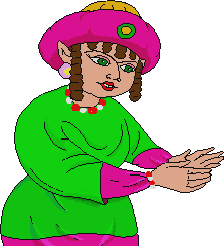
LikaCloak-maker of Sakado
A strange-looking but kindly woman in the last house on the main street.
Promises a magic cloak in exchange for Fairy Dust, and makes it when Zelda returns from the Fairy Pool.
Wants: Fairy Dust. Gives: Magic Cloak.
LubongaLast resident of Aru Ainu
An old woman who knits shrouds, alone in her village.
Gives Zelda a shroud for the Gibdo and some advice about Gleeok.
Gives the Shroud.
MakotoVillager of Kobitan
The last person left in Kobitan, a woman who is starving in her own house.
Asks for an Arpagos egg to eat and gives her Flute in return.
Wants: Arpagos egg. Gives: Flute.
GrimboHermit of Washubi Swamp
An alchemist living in a shack at the end of the swamp.
Sends Zelda to Hanyu Forest for a spore and uses it to make the Power Glove.
Wants: Hanyu Spore. Gives: Power Glove.
MyraTraveller
A wandering woman met first in Hanyu Forest and again at the top of the great tree in Nokani Forest.
Tells Zelda about the wand, makes the Magic Cape from the Shroud and an Arpagos feather, and later provides the Fairy Lantern.
Yokan and SandaFisherman and water bearer of Ahitaru
Sanda carries water in the desert. Yokan is a fisherman who has ended up shut inside the skull of a giant fish.
Sanda gives Water of Life and asks Zelda to free Yokan. He goes to Sakado, takes up smithing and reforges the Power Sword when brought a Heat Crystal.
Give: Water of Life (Sanda), Magic Sword (Yokan).
HarbannoBaker of Sakado
The town baker, another of Paul Wann’s voices, who reckons Link could eat ten loaves.
Locked in Tykogi Tower; once released he leaves Zelda the key to his shop, where bread is waiting.
Gives: a key, and bread.
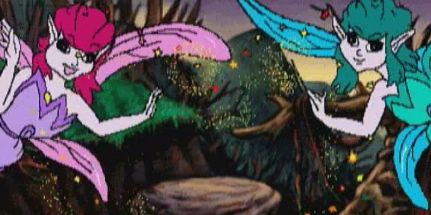
The FairiesFairy Pool
The fairies of the Fountain of Life, frozen in by the witches.
Freed, they reward Zelda and will refill her canteen.
Give: Life Heart, Fairy Dust, Water of Life.
Bosses and enemies
Seven bosses stand between Zelda and her father. Most are familiar Zelda monsters promoted to management, and most are beaten by one particular item.
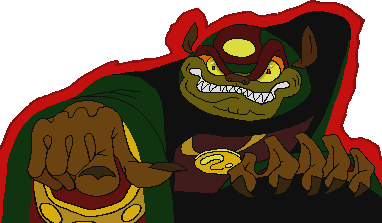
GibdoSakado churchA mummy that raises the dead and attacks with a slow, heavy lunge. Keep out of reach and throw the Shroud. The game’s first boss.
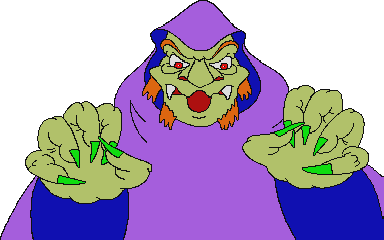
The WitchesThe Fairy PoolThree witches (writer Jonathan Merritt has called them the Tricell) who froze the Fountain of Life. Each dies to one hit; finding them in the dark is the challenge.
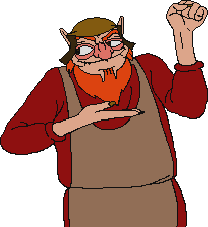
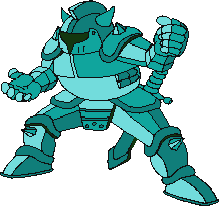
Iron KnuckleTykogi TowerThe armoured jailer of Sakado’s citizens. A punch from the Power Glove crumbles him, leaving a Life Heart and the key to the mayor’s cell. Two watching Armos run for it.
WizzrobeShutoy LakeThe sorcerer who buried Lady Alma. His skull-shaped spell has to be bounced back with the Reflecting Shield.
HektanDodomai PalaceGanon’s wizard, who throws fireballs across the palace roof. Block them, get close and strike once; a Dutch guide of the day suggested sneaking up under the Magic Cloak. Leaves a Life Heart.
OmfakShrine of GamelonWolf, lion and lips by turns. Only the lips are vulnerable, and one hit finishes him. He is the keeper of the wand.
GanonReesong PalaceWait out three fireballs, climb the ladder and throw the Wand of Gamelon.
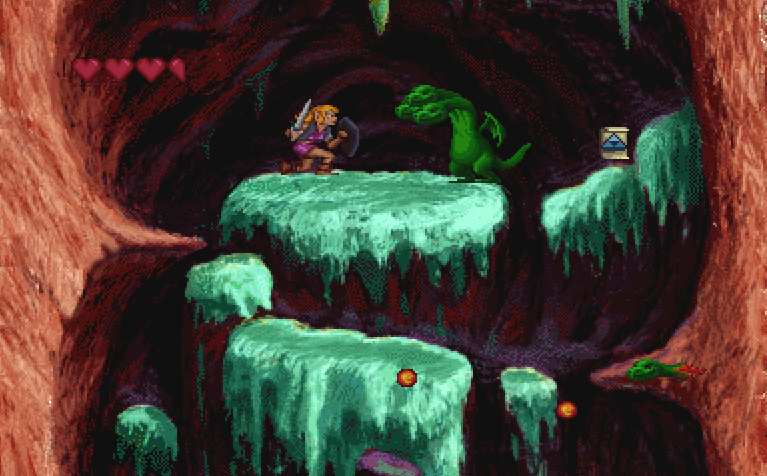
GleeokDordung CaveThe dragon at the bottom of the cave, with spare heads scattered through this stage and others. It falls to sword or bomb and leaves the Heat Crystal.
Dodongos and GohmasAru Ainu, Ahitaru, Dordung Cave, Shutoy LakeMid-sized beasts best handled with a well-timed bomb. The Dodongo of Aru Ainu carries the first key of the game.
The rank and fileAll over GamelonDairas, Arpagos, Moblins, Goriyas, Stalfos, Ghini, Keese, Octoroks, Zolas, Vires, Bots, Wallmasters, Darknuts and more. The Zelda Wiki notes that Darknuts and an Iron Knuckle had not shared a game before.
The people who made it
One team made both of Animation Magic’s Zelda games together. The disc credits for the two are identical; these are the people behind this one.
Dale DeSharoneProducer and lead designerA teacher turned game designer who had run the CD-i group at Spinnaker Software before founding his own studio. He proposed the paired Link and Zelda games to Philips. He died in 2008, aged about 52.
Jonathan MerrittScript and designThe freelance writer of both stories. Making Zelda the lead of one of them was his suggestion: a fun idea, he has said, and a fitting one for a series called The Legend of Zelda.
Rob Dunlavey and Tom CurryArtistsDunlavey sketched the layout of every stage in both games. For Gamelon the finished backgrounds were painted by Tom Curry.
Linde Dynneson, John O’Brien and John WheelerProgrammersFormer Spinnaker colleagues of DeSharone, credited with the programming of both games.
Tony Trippi and William HavlicekMusic and audioShare the music credit. DeSharone named Trippi as the composer; Havlicek is also credited with audio production.
Igor RazboffCo-founder of Animation MagicThe St Petersburg-born mathematician who set up the studio’s Russian arm and found the animators who drew the cutscenes.
Bonnie Jean WilburVoice of ZeldaA New England actor cast from local auditions. In 2024 she returned as the narrator of Arzette: The Jewel of Faramore.
Mark Berry, Jeffrey Rath and Paul WannVoicesBerry is the King, Ganon and, by his own account, a Gibdo. Rath is Link. Wann, who was Gwonam in the sister game, plays Mayor Cravendish and Harbanno here.
How it was made
The Wand of Gamelon was made by a core team of eleven or twelve people, with animators recruited in Russia, in a little over a year, on a machine its own manufacturer did not think of as a games console. Here is how it happened.
How Philips got Zelda
The story begins with Sony. From late 1988 Sony had been developing a CD-ROM system for Nintendo’s Super NES, but Hiroshi Yamauchi, Nintendo’s president, decided the contract gave too much away and opened secret talks with the Dutch electronics company Philips. The switch became public in the most awkward way possible, at the Consumer Electronics Show of June 1991: Sony showed off its SNES-compatible PlayStation on one day, and on the next Nintendo announced a partnership with Philips.
No Philips drive for the Super NES was ever sold. But the contract had given Philips permission to put Nintendo characters into a handful of titles for its own CD-i, and that permission outlived the project. According to Dale DeSharone it covered five characters. Hotel Mario was one result. The three CD-i Zelda games were the others.
The team from Spinnaker
DeSharone knew the CD-i better than almost anyone. A former schoolteacher who had drifted into programming through educational software for Atari computers, he had spent four years at Spinnaker Software in Boston leading the group that produced seven of the machine’s launch discs, among them Alice in Wonderland and Laser Lords. Philips, he recalled, saw its player as a tool for home learning and was cool towards games, until the games proved to be what people bought.
When Spinnaker pulled out of CD-i work he left, and most of his group went with him to a new company in Cambridge, Massachusetts, paid for by Philips’s American publishing arm. It became Animation Magic, founded in 1991 with a Russian partner, Igor Razboff.
A game for the princess
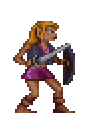
Zelda’s in-game sprite.
Philips’s publishing arm invited pitches for its Nintendo characters, and Animation Magic’s was unusual: not one game but two, the first starring Link and the second starring Zelda, sharing a single engine so that each could be better than its budget. Writer Jonathan Merritt has said that giving Zelda her own game was simply a fun idea that suited a series with her name on it. Schneider of IGN later wondered whether the CD-i’s library, which leaned towards a female audience, had something to do with it.
By DeSharone’s recollection each game was allotted about $600,000, a figure Wikipedia applies to the two together, and the pair had to be finished in not much more than a year. He, three more programmers, a composer who doubled as audio engineer, four artists, a producer and Merritt did the lot, working on both games in parallel through 1992. A Philips catalogue at the end of that year was already advertising the second of them, under the name “Zelda: World of Gamelon”, as the tale of Zelda and her nurse going to win back the “Triface of Courage”.
Painting Gamelon
Merritt imagined Gamelon and its neighbour Koridai as Pacific islands, drawing on the years he had lived on Kaua’i in Hawaii, and the name comes from gamelan, the percussion music of Indonesia. The CD-i decided the shape of the game. Since Philips wanted its discs to show off pictures, animation and CD sound, and since the machine could scroll only a couple of screens’ width, the team chose a side view with big painted backdrops; a view from above, DeSharone believed, would never have been approved.
Rob Dunlavey drew a layout sketch for each room, noting its enemies and prizes, and Tom Curry painted the finished Gamelon backgrounds from them. The painters slipped in some art history: a Holbein portrait of Henry VIII hangs in the main hall of Dodomai Palace, and the October page of the Très Riches Heures du Duc de Berry decorates Lika’s house.
Three of Dunlavey’s Gamelon sketches were shown at a Limited Run Games panel at PAX East in 2024, and they record ideas that fell away. Reesong Palace was to have had a kitchen, and a Gleeok in its tunnel. Nokani Forest had a whole extra screen and a prize called a Gobumo Nut where the Fairy Lantern now is. The cabin of Gobiyan Ship held a necklace, not a shield.
Cutscenes from St Petersburg
Sanda the water bearer, in a frame of the cutscene animation.
The ten or so minutes of animation in each game were the part of the brief the budget could least afford. The solution came through Razboff, who had left Russia years earlier, earned his living at Bell Labs and elsewhere in America, and now saw a chance to start a business in his home city as the Soviet Union came apart. He recruited around six artists there with some animation experience.
For half a year they lived in apartments in Massachusetts and animated both games, drawing on paper and then scanning and colouring the frames by computer. Denis Chernov, one of the animators, has confirmed the outline of the story in an interview. The studio went on to employ far more: 25 animators are named in the credits, and by 1994 Animation Magic had about 90 staff, some 60 of them animators and artists.
Casting and music
Link in the opening scene; Jeffrey Rath gives him his voice.
The cast was assembled from union actors in the Boston area. Bonnie Jean Wilbur became the first person to voice a playable Zelda; Mark Berry doubled as her father and her enemy; Jeffrey Rath had rather less to do as Link than in the other game. The recording was brisk. Rath remembers a quarter of an hour to rehearse and then two hours at the microphone.
Tony Trippi’s soundtrack was recorded as CD audio and plays straight from the disc. That ruled out one of the team’s ambitions, a score that reacted to what was happening on screen, though the studio later used the idea in its educational shooter I.M. Meen.
Nintendo’s part
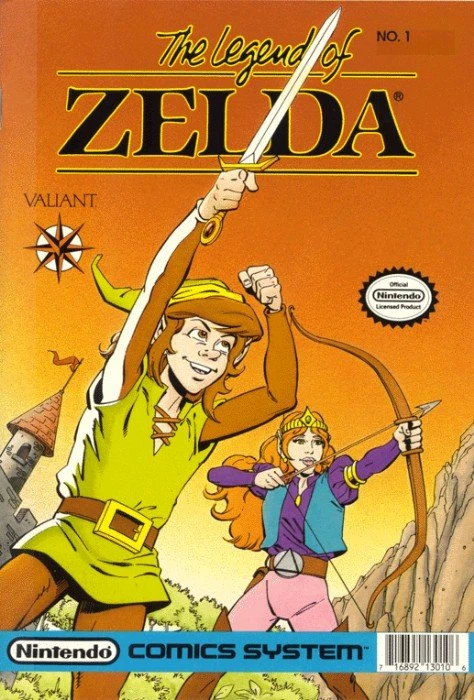
Cover of volume 1 of Valiant’s Legend of Zelda comics, a source for Impa’s look.
Nintendo’s contribution was a signature. It saw the design document and the drawings of the characters and passed them, with most of its attention on the appearance of Link and Zelda, and that was the end of it. Philips did not interfere much with the design either.
With so little to go on, the artists worked from the two NES games and their packaging and manuals, and seem to have looked further afield as well. Aypos Library has matched Zelda’s costume in two cutscenes to her outfit in the television cartoon, and Impa’s design to the Valiant comic. Asked much later about the games’ reception, DeSharone said he could understand people being disappointed, and that the team had done a good job in the circumstances: “Every game has its story.”
Release
Previews in the spring and summer of 1993 were glowing. Joystick in France liked what it saw of the voice acting, the plot and the backgrounds, and SNES Force in Britain was struck by the animation. Both Zelda discs went on sale together that autumn.
The day is uncertain. 10 October 1993 is the North American date in nearly every listing, and it may well be right, but it has never been traced to a document of the time; the 25 December 1993 sometimes given for Europe does not fit the evidence from Britain. Period evidence collected by Aypos Library puts the game in British shops in October (issue 2 of CD-i magazine reviews it with availability ‘Now’, and Dixons advertises it there) and in American advertising by the middle of that month. Editions dubbed into French, German and Dutch came next, and the Dutch magazine Power Unlimited was reviewing the game by November.
Firsts: what this game introduced
Whatever else is said about it, The Wand of Gamelon got to a few things before anyone else.
1Zelda as the heroThis is the first game in which Princess Zelda is the character you play. Zelda’s Adventure repeated the idea on the CD-i in 1996; Nintendo did not give her the lead in a main-series game until Echoes of Wisdom in 2024.
2Impa on screenImpa had been part of the story since the first game’s manual, but only on paper. According to the Zelda Wiki this is the first game in which she actually appears.
3A voice for ZeldaWith The Faces of Evil, released alongside it, this was among the first Zelda games with spoken dialogue, and so the first time the princess was given a voice in a game.
Cheats & secrets
The CD-i original has no known cheat codes. These are the tricks and shortcuts that guides of the time and later players have recorded, followed by the codes hidden in the fan remake.
Glove before bombs
Grimbo, who makes the Power Glove.
Two obstacles demand ten bombs each: the boulder on the fish skull in Ahitaru and the gate of Tykogi Tower. Both also give way to a single blow from the Power Glove, so fetching the glove from Grimbo first saves 140 Rubies’ worth of bombs.
Invisible against Hektan
Hektan dies to one sword stroke, but getting near him through the fireballs is the problem. The Dutch magazine CD Interactief advised putting on the Magic Cloak, which makes Zelda invisible, and simply walking up to him.
Free refills at the Fairy Pool
The fairies of the Fairy Pool.
After Lady Alma hands over the empty canteen, go back to the Fairy Pool. The fairies will fill it with Water of Life, which can then be drunk anywhere.
Hit Iron Knuckle from the front, Tinsuits from behind
Iron Knuckle, the jailer of Tykogi Tower.
Tinsuits in Tykogi Tower take three sword blows from the front but only one from behind. Their master cannot be hurt by the sword at all; only the Power Glove works.
Codes in the 2020 fan remake
Entered on the main menu or the map of Dopply’s remake; King Harkinian’s voice confirms a code. God Mode: Down, Attack, Up, Attack, Use (water is still fatal). All stages open: Left, Right, Left, Right, Attack, Use. Everything (99 ropes, bombs and flasks of oil, 999 Rubies, the three extra Life Hearts and all sword, shield and lantern upgrades): Right, Down, Right, Left, Up, Down, Attack, Use.
Compiled from the Zelda Dungeon walkthrough, the Philips helpline guide and Aypos Library, November 2026.
Leftovers, cut ideas and oddities
Nobody has catalogued famous bugs in The Wand of Gamelon, but the disc and the surviving design sketches are full of things that were dropped or forgotten.
A heart with nowhere to go
The graphics include an animated heart, with its own palette, that never appears. The Cutting Room Floor thinks it was drawn for the Life Hearts that Iron Knuckle and Hektan leave behind.
Four spare cutscene backgrounds
Four backgrounds in the files of the introduction and the ending never appear. Those from the introduction are scenery from The Faces of Evil, recoloured to match this game’s opening, and the first of them was recoloured again for the ending; those from the ending were drawn for this game. The very last frame of the ending is never displayed either, because the picture fades to black one frame too soon.
The attic nobody can enter
Kobitan.
The house in Kobitan where the Lantern is found has an attic drawn on its map. Zelda cannot get into it, probably because of the way the game handles collisions.
Out of sight
A room of Dordung Cave.
Parts of three backgrounds lie beyond what the screen will show: the top of one room in Dordung Cave, and the top of one room and the bottom of another in Reesong Palace.
The kitchen that was cut
Rob Dunlavey’s sketches give Reesong Palace a one-screen kitchen, reached by two doors in the tower and home to an enemy called a Hamati that nobody can now identify. The palace tunnel was twice as long and had a Gleeok in it, and its notes mention a Candle for lighting the dark. Octoroks and Leevers were pencilled in for the shore beside Gobiyan Ship; Leevers appear in neither finished game.
Teleporting for show
Omfak in his lion form.
Hektan flickers in and out of sight in his cutscene and never does it in the fight, exactly like Harlequin in The Faces of Evil. Omfak, on the other hand, is the one boss here whose behaviour is not borrowed from an ordinary enemy.
Bigger boxes abroad
As with its twin, the inventory window was redrawn for the translated editions: unchanged in French, wider in German and almost full-screen in Dutch.
Videos & media
There is no official trailer for a CD-i game from 1993, so the first video is the game itself from beginning to end. The second shows what its admirers went on to make.
The whole game on original hardware, with every cutscene. Video: LaTanaDiMrX on YouTube.
Limited Run Games’ trailer for Arzette (2024), the spiritual successor to the CD-i Zelda games. Video: Limited Run Games on YouTube.
Trivia & facts
The island of Gamelon.Gamelon is named after gamelan, the gong-and-metallophone orchestra music of Indonesia.
In its first catalogue listing, at the end of 1992, the game was called “Zelda: World of Gamelon” and the King’s talisman was the “Triface of Courage”.
Hans Holbein’s portrait of Henry VIII hangs in Dodomai Palace. It is in the main hall, not far from the portrait that hides the Duke.
A stock sound effect of a triangle rings just before the King says “I wonder what’s for dinner”: a dinner bell, in other words.
The two captions in the introduction are not equally helpful. ONE MONTH LATER is exact; LATER STILL could be any length of time.
Zelda wears her outfit from the television cartoon in only two scenes, those with Lubonga and Lika.
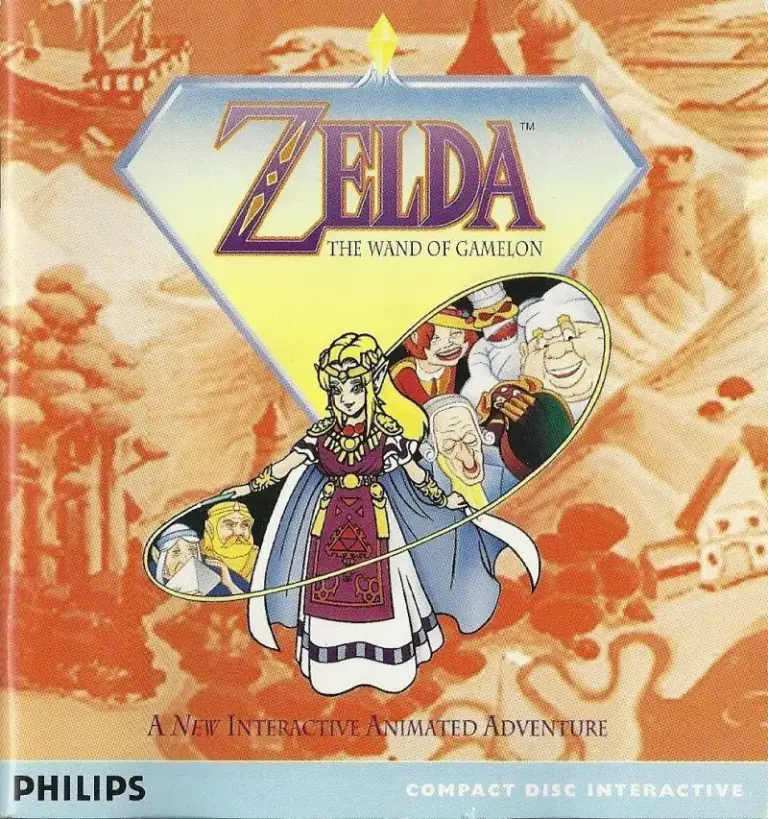
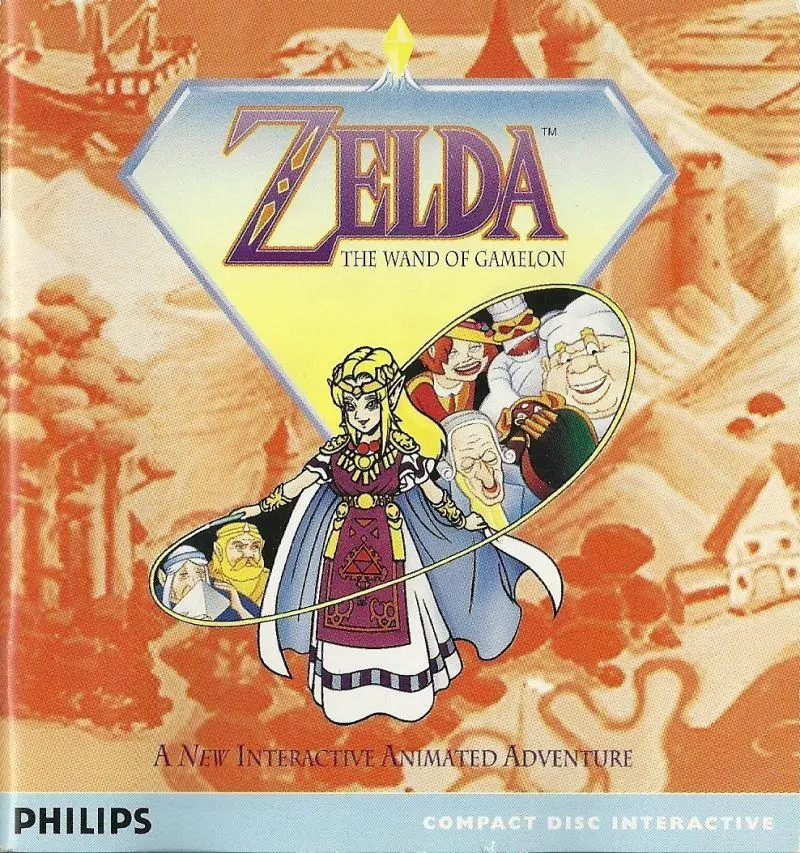
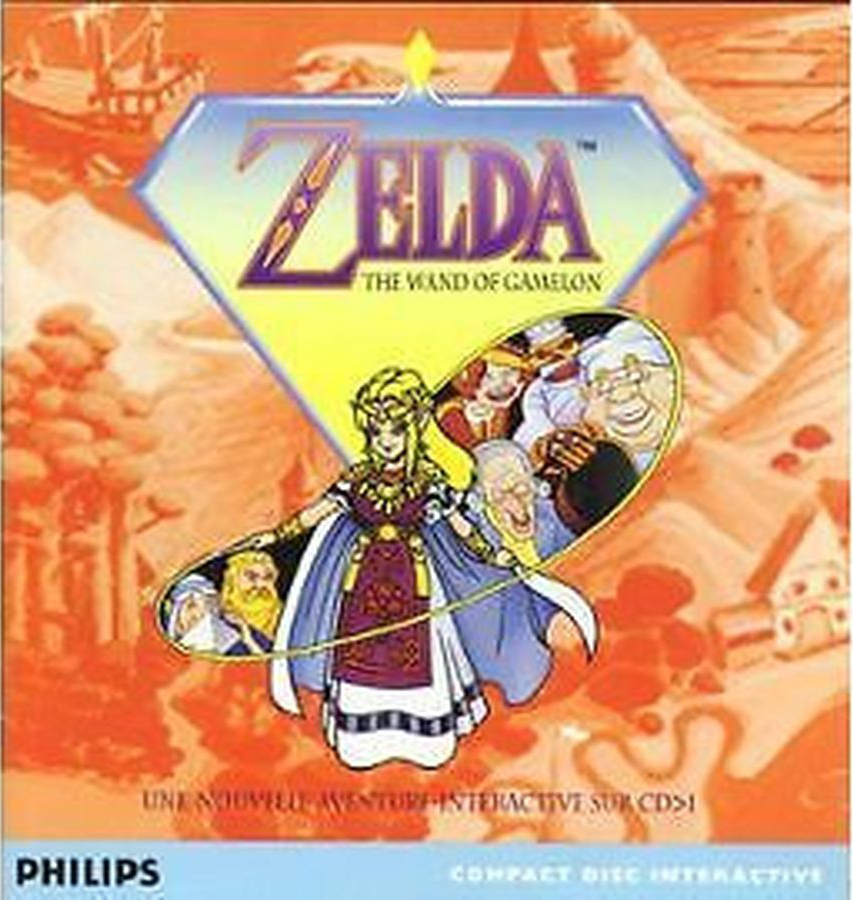
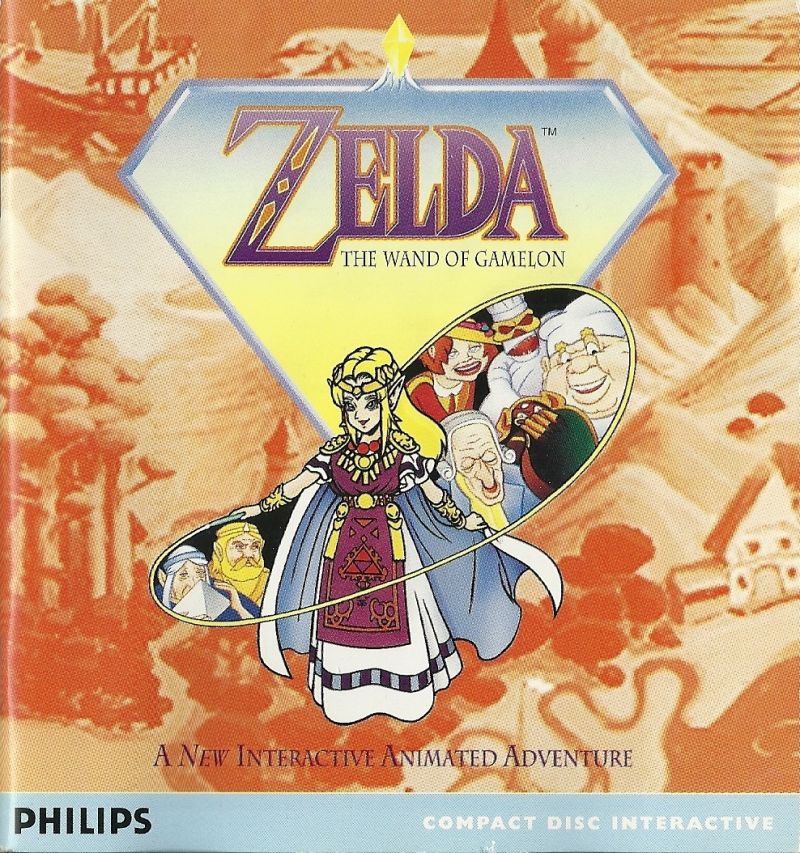
Front cover of the CD-i box.The seven figures on the box each match one frame of a cutscene. They are Impa, the King, Mayor Cravendish, Makoto, Ganon, the Gibdo and Harbanno. Zelda, the star, is not among the faces taken from the animation.
Ganon in The Faces of Evil, which ends with the same book animation.The shot of Ganon being sucked into a book is the same piece of animation used at the end of The Faces of Evil.
Hektan’s name may come from Hecate, the classical goddess of witchcraft, the Zelda Wiki suggests.
Writer Jonathan Merritt’s script for each Zelda game ran to about 15 pages. His script for Laser Lords was about 350.
The French magazine Joystick advertised both CD-i Zeldas in November 1993 and reviewed The Faces of Evil the following month, but not this one.
Philips’s helpline walkthrough for the game was printed in English in the August 1996 issue of CD-i magazine, and a shorter list of answers went up on the company’s British CD-Online website. The printed guide left out the Fairy Pool altogether.
The Zelda Wiki’s speedrun table gives the best time on a real CD-i as 28 minutes 53 seconds, set by Usui on 14 January 2021.
In 2011 IGN ran a knockout poll to find the greatest Zelda game. The Wand of Gamelon, entered jointly with Zelda’s Adventure, drew A Link to the Past in the first round and went out.
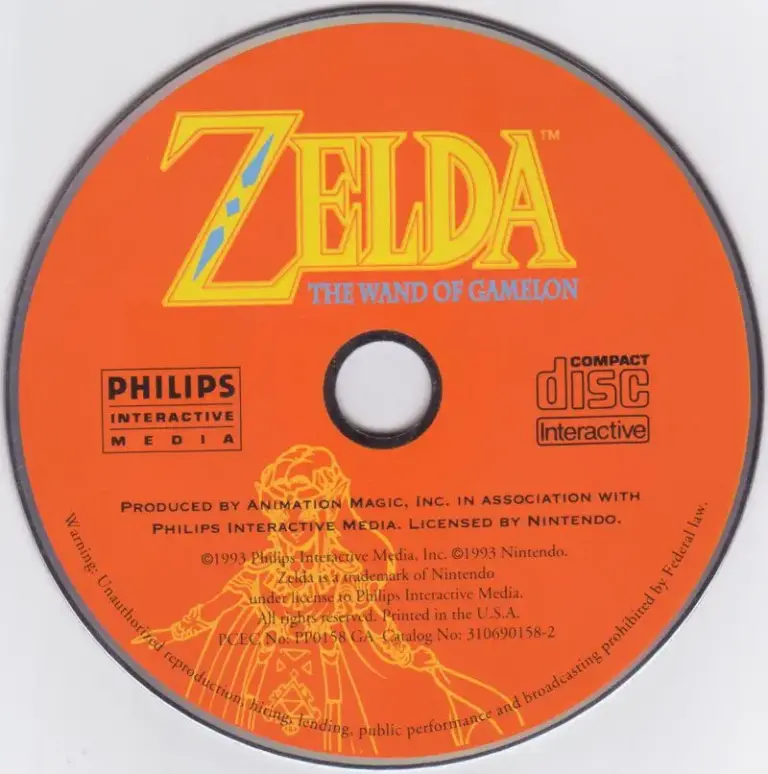
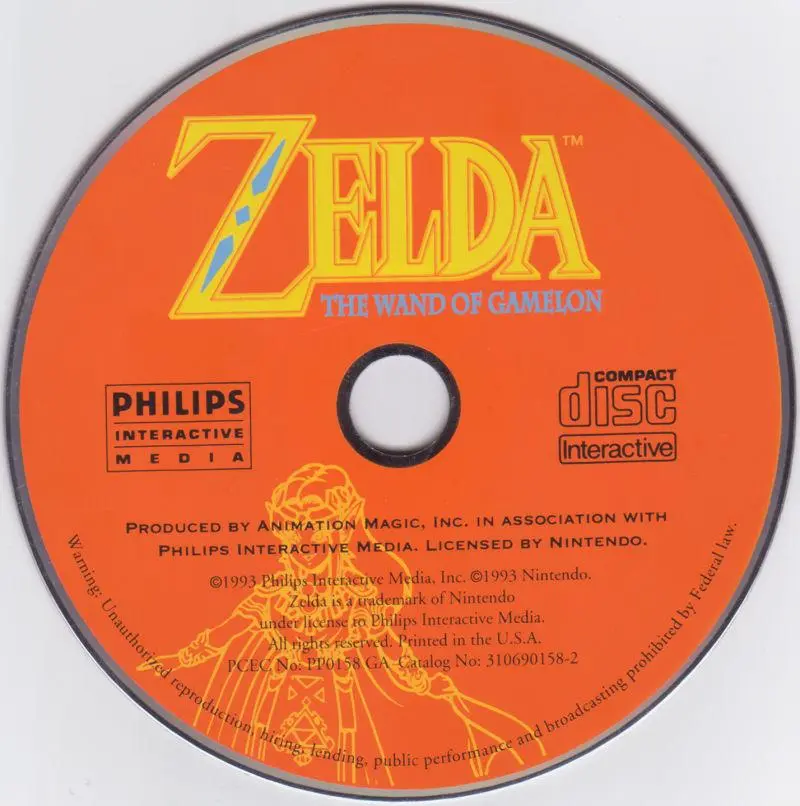
The CD-i disc.The game was being advertised about a year before it came out: the catalogue blurb dates from late 1992, while the disc bears a 1993 copyright of Philips Interactive Media of America.
Media & artwork
Box art from several countries, screenshots of the stages, cutscene stills and magazine scans. Select any picture to see it larger.
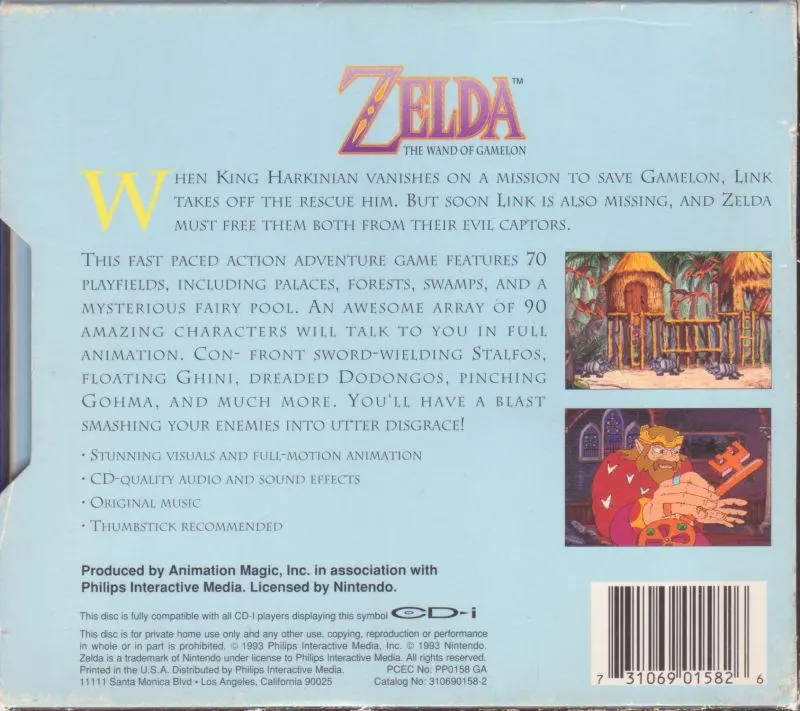
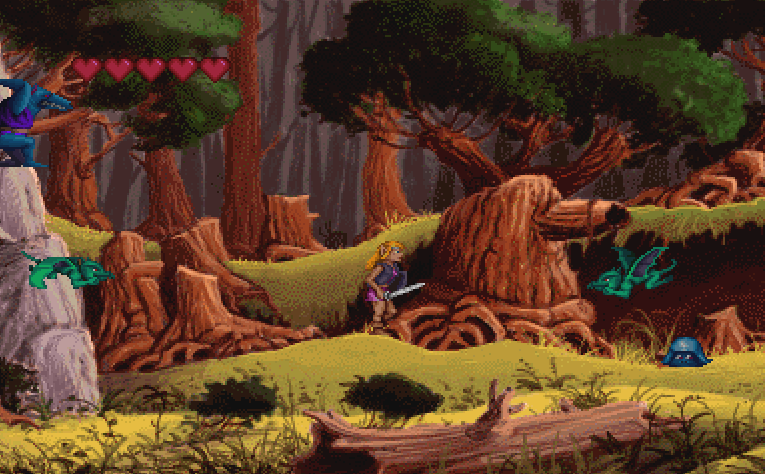
The French CD-i box.Back of the CD-i box.Another part of Nokani Forest.The mast of Gobiyan Ship.The library of Gobiyan Ship.The fight with Omfak.Omfak in his lips form.Omfak defeated.
The Wand of Gamelon was a curiosity in 1993 and a punchline by 2006. Since then its reputation has been on a stranger journey than any other Zelda game’s.
Timeline
Catalogue listingLate 1992 – Philips advertises “Zelda: World of Gamelon”.
Philips CD-iOctober 1993 – On sale in North America and Britain with The Faces of Evil; the usual date is 10 October.
Translated editionsLate 1993 – French, German and Dutch dubs; reviewed in the Netherlands in November.
Zelda’s Adventure1994 – Viridis’s CD-i game, the second with a playable Zelda.
Helpline guide in printAugust 1996 – CD-i magazine publishes the official solution.
“Worst games” lists2006 – GameTrailers names it the fifth worst game of all time.
ReanimationSeptember 2020 – Over 200 artists redraw the cutscenes of both games.
Fan remakeNovember 2020 – Released free for Windows and Linux, then withdrawn.
Arzette announced12 July 2023 – A spiritual successor from the remake’s author and Limited Run Games.
Arzette released14 February 2024 – With Bonnie Jean Wilbur as narrator.
The Zelda that Nintendo skips
Hyrule Historia, Nintendo’s official history, which leaves the CD-i games out.
Nintendo’s histories of the series pass over the CD-i in silence. Hyrule Historia, the official chronicle published for the 25th anniversary, has no entry for The Wand of Gamelon, and the timeline has no branch for it. Eiji Aonuma’s one recorded remark came in a 2013 interview with MTV: “I don’t know that those really fit in the ‘Zelda’ franchise.”
The CD-i line ended with Zelda’s Adventure in 1994, a top-down game by another studio that also starred the princess. DeSharone, who never played it all the way through, agreed when it was put to him that it could have been only half finished.
Dinner, the Duke and YouTube
King Harkinian, whose line about dinner became a YouTube Poop staple.
What rescued the game from obscurity was its opening scene. Once video sharing arrived, the cutscenes that few had watched on a CD-i were suddenly everywhere, and around 2006 they became a foundation of YouTube Poop, in which clips are cut, looped and re-voiced into nonsense. The Zelda Wiki singles out King Harkinian and Duke Onkled as the favourites from this game, and the King’s thoughts on dinner as one of his best-loved lines.
The joke gradually turned into fondness. In September 2020 a volunteer project a year and a half in the making re-created the cutscenes of both CD-i games with more than 200 animators, each taking a shot in a style of their own.
Remade by a fan
Less than three months after the reanimation, on the last weekend of November 2020, a hobbyist programmer who goes by Dopply (Seth Fulkerson) put complete remakes of The Wand of Gamelon and The Faces of Evil online for nothing. They were new programs, written in GameMaker for Windows and Linux across four years, wrapped around the original pictures, music and animation. He said he had wanted to prove to himself that he could make a game.
The list of improvements was aimed squarely at the old complaints: a wide-screen picture, captions for the dialogue, cleaner sprites, things to unlock and an optional Remastered Mode for less frustrating play. PC Gamer advised its readers to grab the files quickly, given Nintendo’s record with fan projects, and it was right to. Fulkerson withdrew them himself roughly two days later, before anyone asked him to, and announced that there would be no updates.
Arzette, the princess who came next
Having rebuilt the two games, Fulkerson wrote a third in their image. Arzette: The Jewel of Faramore came out on 14 February 2024 on Switch, PlayStation 4 and 5, Xbox Series X/S and PC, published by Limited Run Games after other publishers had turned the idea down. Its heroine is a sword-carrying princess, which makes it rather more a descendant of this game than of Link’s.
The echoes are deliberate. Arzette’s kingdom has been betrayed by a duke, its demon lord was once sealed inside a book, and the story closes with a feast. The original Zelda, Bonnie Jean Wilbur, narrates; the original Link, Jeffrey Rath, talks the player through the tutorial; and Rob Dunlavey was among the artists Fulkerson brought back. Critics took it in the spirit intended. Its Metacritic average is 77, and Nintendo Life’s review, headed “An Adroit Homage To The Worst Zelda Games”, scored it 7 out of 10.
How to play it now
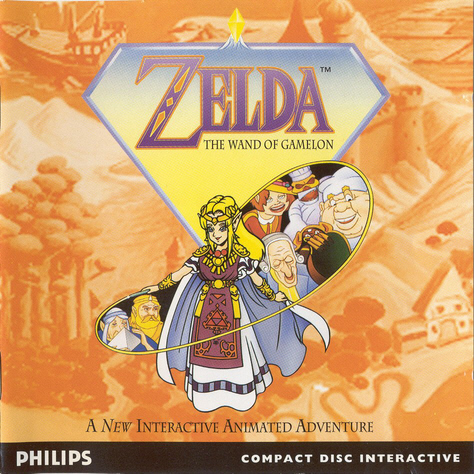
The box of the Dutch edition, one of the game’s three dubs.
There has been no reissue that any of our sources can point to. The Wand of Gamelon exists officially only as a CD-i disc, in English and in its French, German and Dutch dubs, and needs a CD-i player to run. The 2020 remake is no longer offered by its maker. Arzette, which is on sale for every current console, is the practical way to sample the style.
Sales & reviews
Sales
Philips never announced how many copies it sold. The only period clue is a line in Edge in August 1994, which said the two Zelda discs had shifted a “respectable number of units” even though they had done nothing to excite interest in the CD-i. The machine itself was a commercial failure, and IGN noted in 2001 that unsold CD-i Zeldas were still easy to come by.
What the critics said
Only one review score from the time of release can be pinned down, taken here from Wikipedia’s record of the magazine.
CDi MagazineUK · October 1993
75%
CDi Magazine’s Andy Stout gave The Wand of Gamelon ten points more than his colleague gave its twin. He judged it a “reasonably good game”, liked the puzzles and the animated sequences, and found fault with the plot and the controls. Wikipedia also reports a 90% from the Dutch magazine Power Unlimited, but attached to the comment that this beautifully designed platform game was “completely unplayable”; since the number and the words do not agree, we have not charted it.
The retrospective verdicts are harsher. In IGN’s 2001 history of the series Peer Schneider called the cutscenes entertaining for all the wrong reasons and the music “redbook audio CD pop”. GameTrailers, which had called the cutscenes an absolute joke in its Zelda retrospective that October, placed the game fifth in its November 2006 countdown of the worst games ever made, and Seanbaby, writing for Electronic Gaming Monthly, ranked it sixth worst.
There is another side. John Szczepaniak of Hardcore Gaming 101 and Danny Cowan at 1UP have both rated the Animation Magic pair among the strongest games in the CD-i catalogue, while agreeing that the controls let them down, and Retro Gamer praised their pacing, design and painted scenery. Szczepaniak’s point is that it is unfair to measure a small-budget CD-i game against Nintendo’s own.
On the lists
GameTrailers · 17 November 2006Fifth worst game of all timeIn its countdown of the ten best and ten worst games.
Seanbaby for Electronic Gaming MonthlySixth worst game of all timeFrom his list of the worst games ever.
Retro Gamer · issue 32, December 2006Tenth in the CD-i ‘Perfect Ten’Shared with The Faces of Evil, and described as “astoundingly good”.
Reader reviews
No reader reviews yet. Played it? Give it a score out of 10 and tell other fans what you think.
Every fact on this page was checked against the sources below in November 2026. Reviews from 1993 and later are reported as Wikipedia records them, not from the magazines themselves. Zelda Wiki (zeldawiki.wiki), IGN and Eurogamer could not be read directly, and The Cutting Room Floor’s prerelease page for this game refused automated access.
To provide the best experiences, we use technologies like cookies to store and/or access device information. Consenting to these technologies will allow us to process data such as browsing behavior or unique IDs on this site. Not consenting or withdrawing consent, may adversely affect certain features and functions.
Functional
Always active
The technical storage or access is strictly necessary for the legitimate purpose of enabling the use of a specific service explicitly requested by the subscriber or user, or for the sole purpose of carrying out the transmission of a communication over an electronic communications network.
Preferences
The technical storage or access is necessary for the legitimate purpose of storing preferences that are not requested by the subscriber or user.
Statistics
The technical storage or access that is used exclusively for statistical purposes.The technical storage or access that is used exclusively for anonymous statistical purposes. Without a subpoena, voluntary compliance on the part of your Internet Service Provider, or additional records from a third party, information stored or retrieved for this purpose alone cannot usually be used to identify you.
Marketing
The technical storage or access is required to create user profiles to send advertising, or to track the user on a website or across several websites for similar marketing purposes.


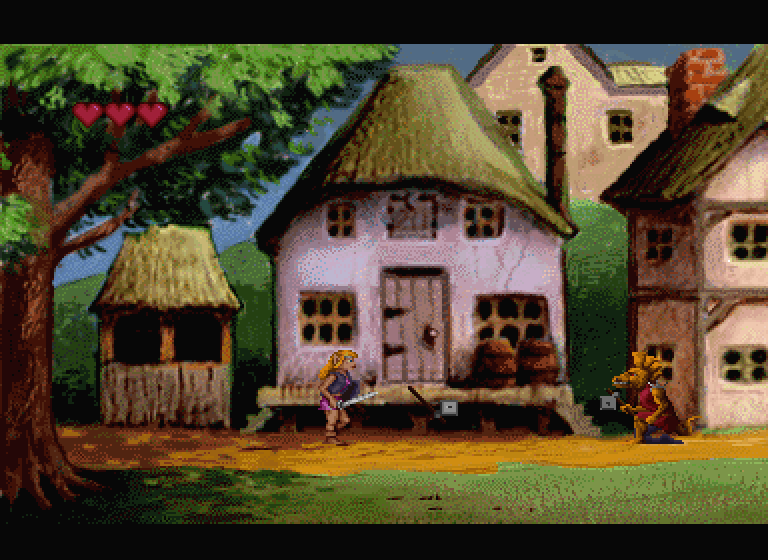 SakadoThe main town · boss: GibdoA harbour town of tall houses, patrolled by Dairas and Arpagos. Here are the Merchant’s shop, Lika’s house at the end of the main street, an Arpagos nest with an egg in it, the tavern where the Power Sword is kept, a bakery, a smithy and a cemetery of Ghini and Stalfos. The Gibdo waits in the church beside the graves; beating it opens Washubi Swamp.
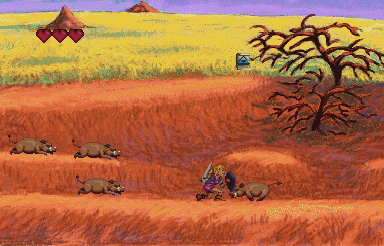 Aru AinuFirst visitsA village with one inhabitant left. Warthogs charge about outside, and a Dodongo in a cave holds the key to Lubonga’s hut, where Zelda is given the Shroud and a warning about Gleeok. Opens Tykogi Tower.
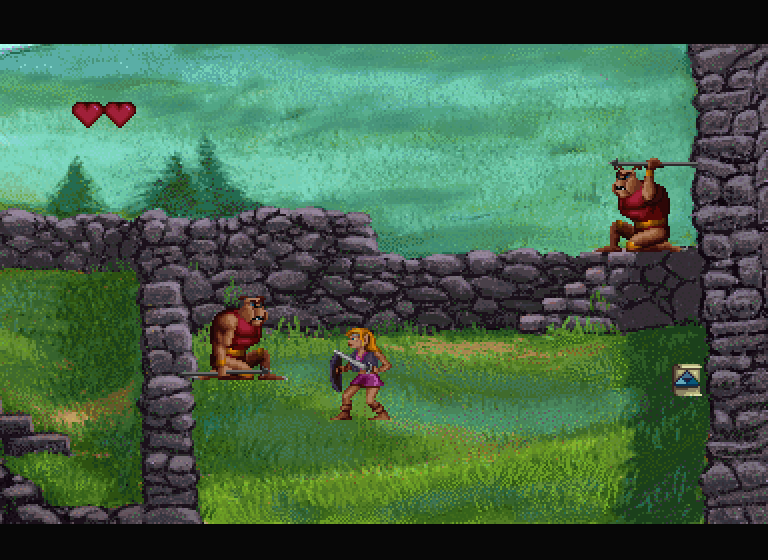 KobitanFirst visitsSpear-throwing Moblins guard a house with the Lantern in it, and a barn too dark to enter without one. The key from the barn opens Makoto’s house; bring her an Arpagos egg and she parts with her Flute. Opens Ahitaru.
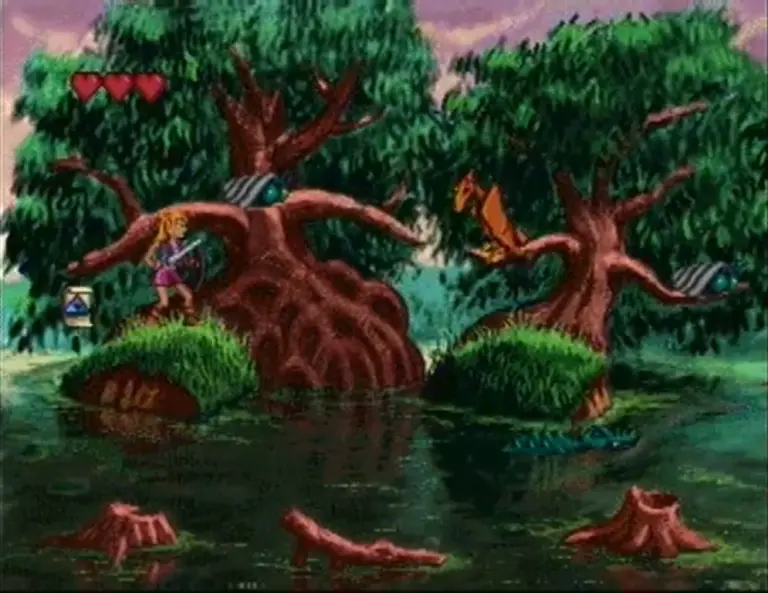 Washubi SwampOpened by beating GibdoThe first really hard stage: a crossing made on the backs of alligators and along the branches of drowned trees, among Arpagos and giant snails. Grimbo’s hut is at the far end. He wants a Hanyu Spore, and pays with the Power Glove.
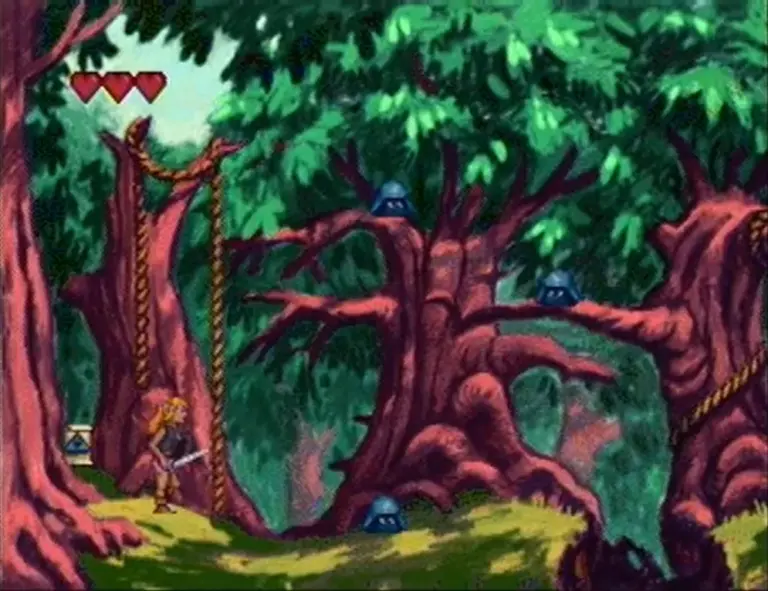 Hanyu ForestOpened by Washubi SwampWoodland full of Bots, which have to be struck from below, and green Vires. The Hanyu Spore sits on top of a rock. Myra is here too: for an Arpagos feather she turns the Shroud into the Magic Cape.
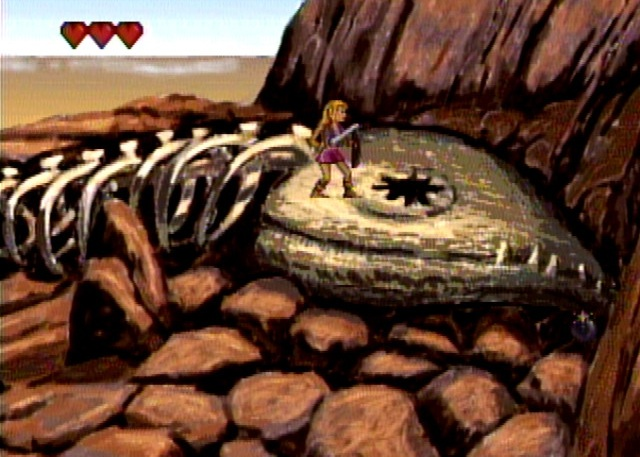 AhitaruOpened by KobitanA desert with the skeleton of a giant fish in it. Swarms of bees can be stilled with the Flute, Gohmas lurk in the caves, and Sanda the water bearer offers Water of Life. A boulder on the fish’s skull needs ten bombs or the Power Glove; inside is Yokan the fisherman, who leaves a key and heads for Sakado.
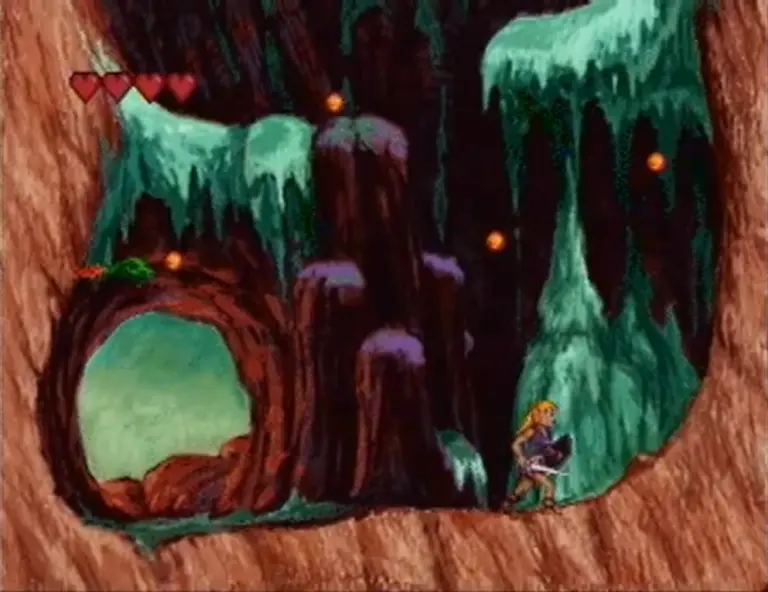 Dordung CaveOpened by Tykogi TowerA dark cavern of Kargaroks, Dodongos and fire-spitting Gleeok heads, with gaps that need the Magic Cape. The Gleeok at the end guards the Heat Crystal, which Yokan needs for his forge. One of only two stages with no cutscene.
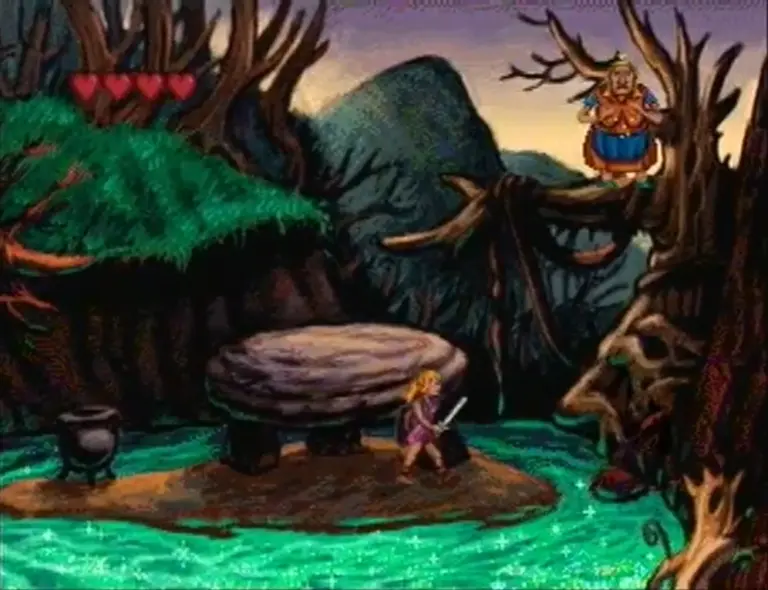 The Fairy PoolOpened by Hanyu Forest and the swamp · boss: the WitchesPitch dark until a lantern is lit. Three witches have frozen the Fountain of Life; one blow apiece deals with them. The freed fairies give a Life Heart, Fairy Dust and Water of Life, and later they will fill the canteen. Opens Gobiyan Ship.
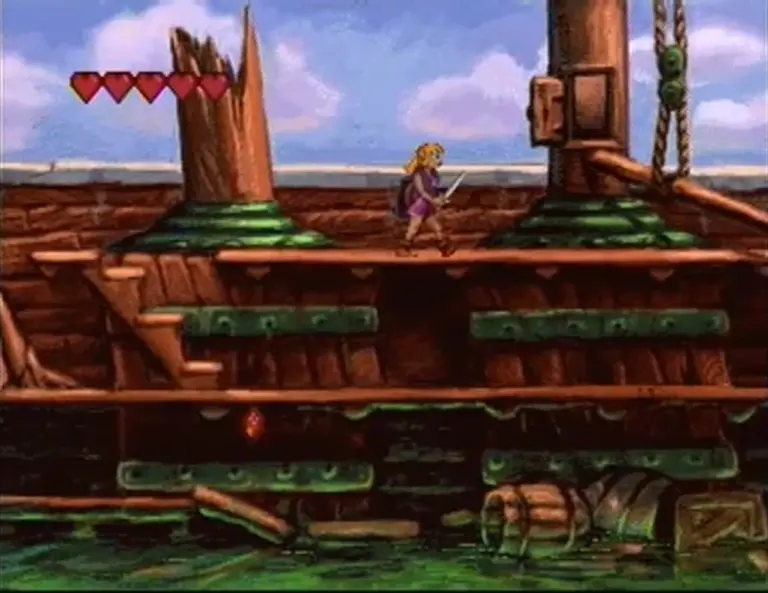 Gobiyan ShipOpened by the Fairy PoolA ghost ship off the coast, reached over the backs of more alligators while Zolas spit from the water. Stalfos and Ghini crew the decks. An Arpagos feather glows high in the rigging, and the Reflecting Shield lies in the cabin. The other stage without a cutscene.
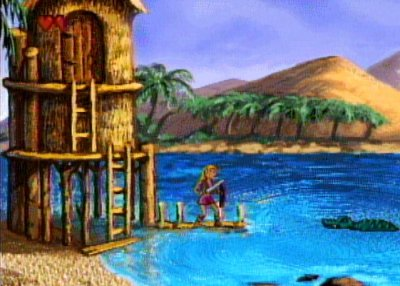 Shutoy LakeBoss: WizzrobeA lake crossed by raft and alligator, with leaping fish, a hut with a key in it and a tower where rocks rain down the stairwell. Wizzrobe is beaten by reflecting his spell with the Reflecting Shield. Lady Alma, freed from the stones, gives the Canteen.
 Dodomai PalaceBoss: HektanDuke Onkled’s castle, full of Skulltulas, Darknuts and more Gleeok heads. Hektan is fought on the rooftop plaza and leaves a Life Heart. Lord Kiro is in the tower; Onkled is behind the portrait. Opens Nokani Forest.
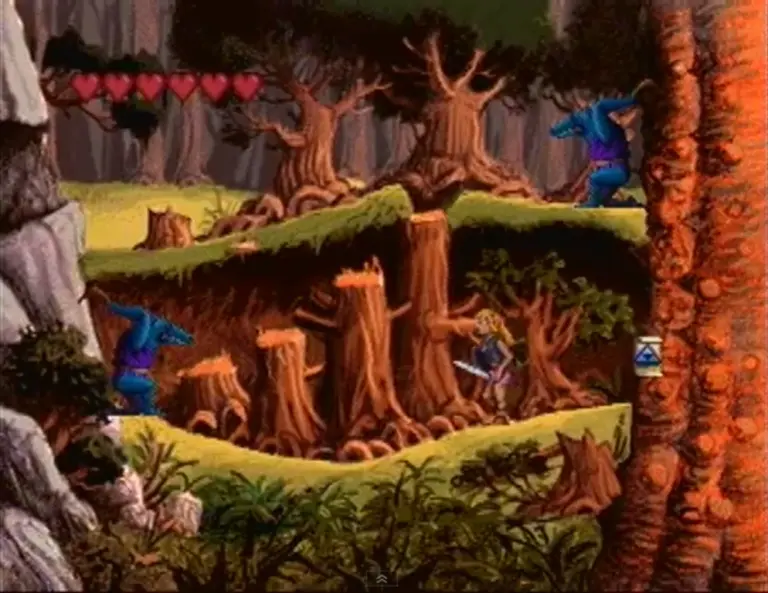 Nokani ForestOpened by Dodomai PalaceOne enormous tree to be climbed, through Goriyas, Vires, Zols and flying eyeballs called Moas that never stop coming. At the top Myra exchanges the lantern for the Fairy Lantern, which burns without oil.
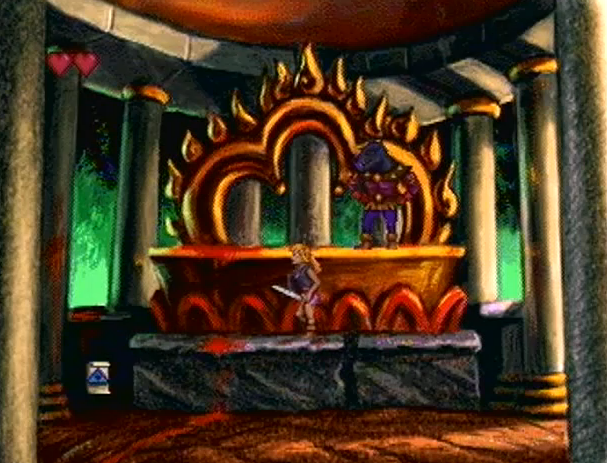 Shrine of GamelonBoss: OmfakRolling fire barrels at the cave mouth (the Magic Cloak gets Zelda past), a rock spire to climb and a chasm that only the Magic Cape will clear. Inside the shrine Omfak guards the Wand of Gamelon.
 Reesong PalaceFinal stage · boss: GanonGanon’s headquarters and a tour of nearly every enemy in the game, from Keese to Darknuts to Stone Heads that fall to a single bomb. A boulder to break with the Power Glove, a well to drop down, a courtyard, and at the top of the tower Ganon himself. Throw the wand, take the key, open the green door.
 Princess ZeldaThe hero
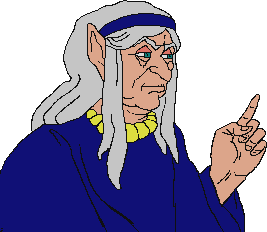 ImpaZelda’s nurse · keeper of the Triforce of Wisdom
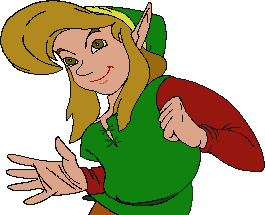 LinkMissing hero
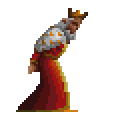 Duke OnkledRuler of Gamelon
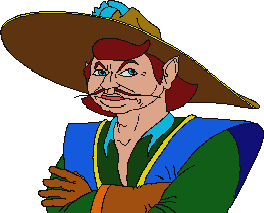 Lord KiroThe King’s man
 Mayor CravendishMayor of Sakado
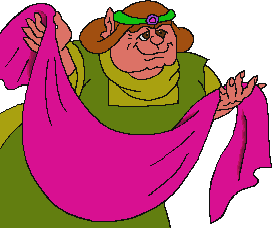 LikaCloak-maker of Sakado
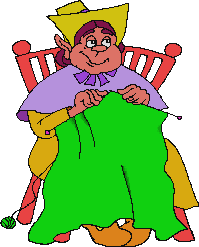 LubongaLast resident of Aru Ainu
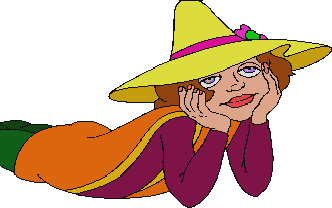 MakotoVillager of Kobitan
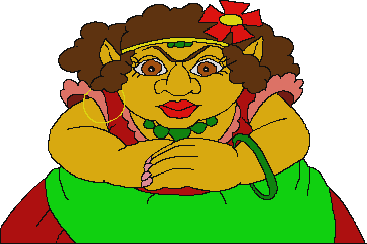 MyraTraveller
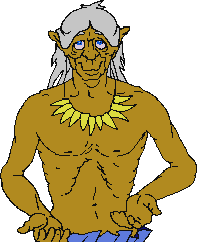 Yokan and SandaFisherman and water bearer of Ahitaru
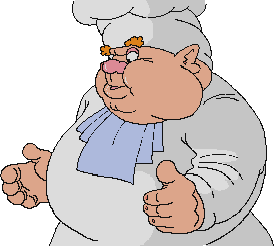 HarbannoBaker of Sakado
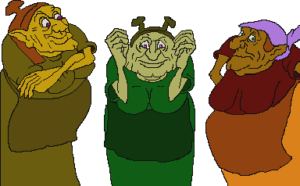 The WitchesThe Fairy PoolThree witches (writer Jonathan Merritt has called them the Tricell) who froze the Fountain of Life. Each dies to one hit; finding them in the dark is the challenge.
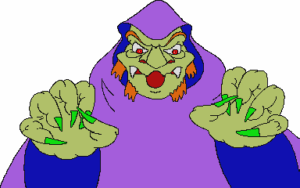 WizzrobeShutoy LakeThe sorcerer who buried Lady Alma. His skull-shaped spell has to be bounced back with the Reflecting Shield.
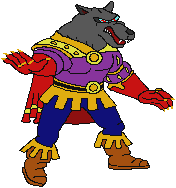 OmfakShrine of GamelonWolf, lion and lips by turns. Only the lips are vulnerable, and one hit finishes him. He is the keeper of the wand.
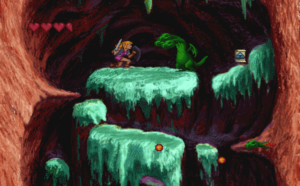 GleeokDordung CaveThe dragon at the bottom of the cave, with spare heads scattered through this stage and others. It falls to sword or bomb and leaves the Heat Crystal.
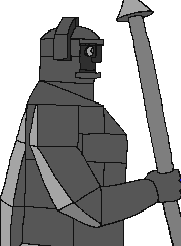 The rank and fileAll over GamelonDairas, Arpagos, Moblins, Goriyas, Stalfos, Ghini, Keese, Octoroks, Zolas, Vires, Bots, Wallmasters, Darknuts and more. The Zelda Wiki notes that Darknuts and an Iron Knuckle had not shared a game before.
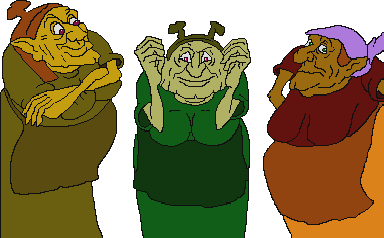
 Impa on screenImpa had been part of the story since the first game’s manual, but only on paper. According to the Zelda Wiki this is the first game in which she actually appears.