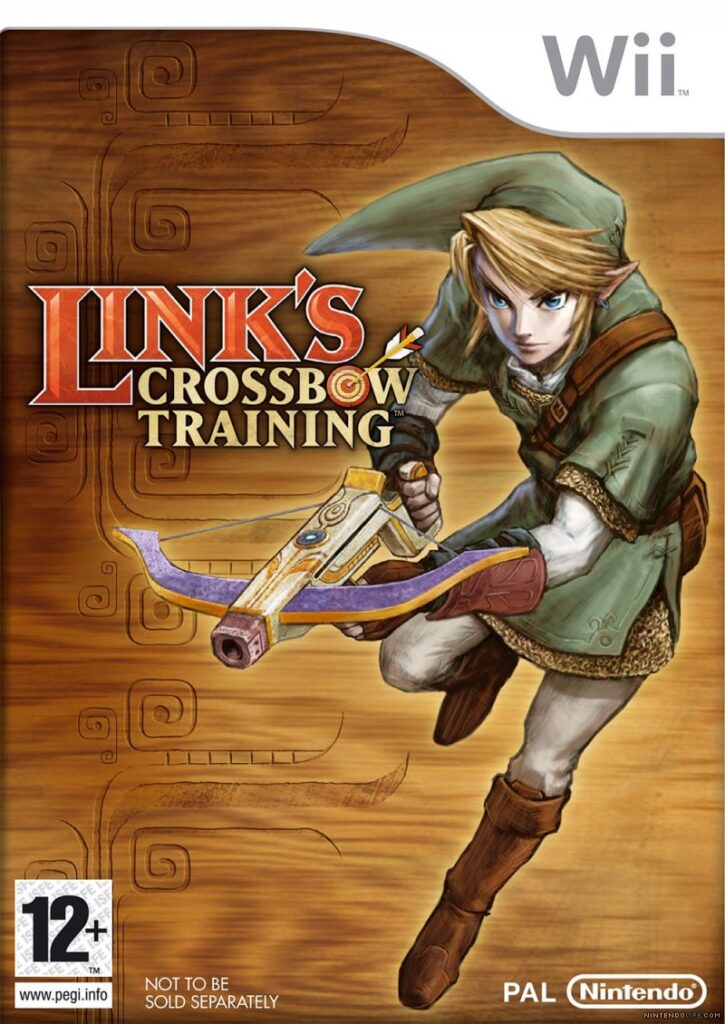
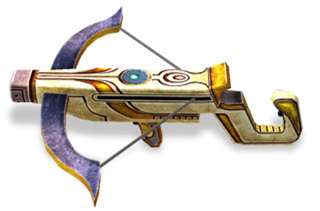
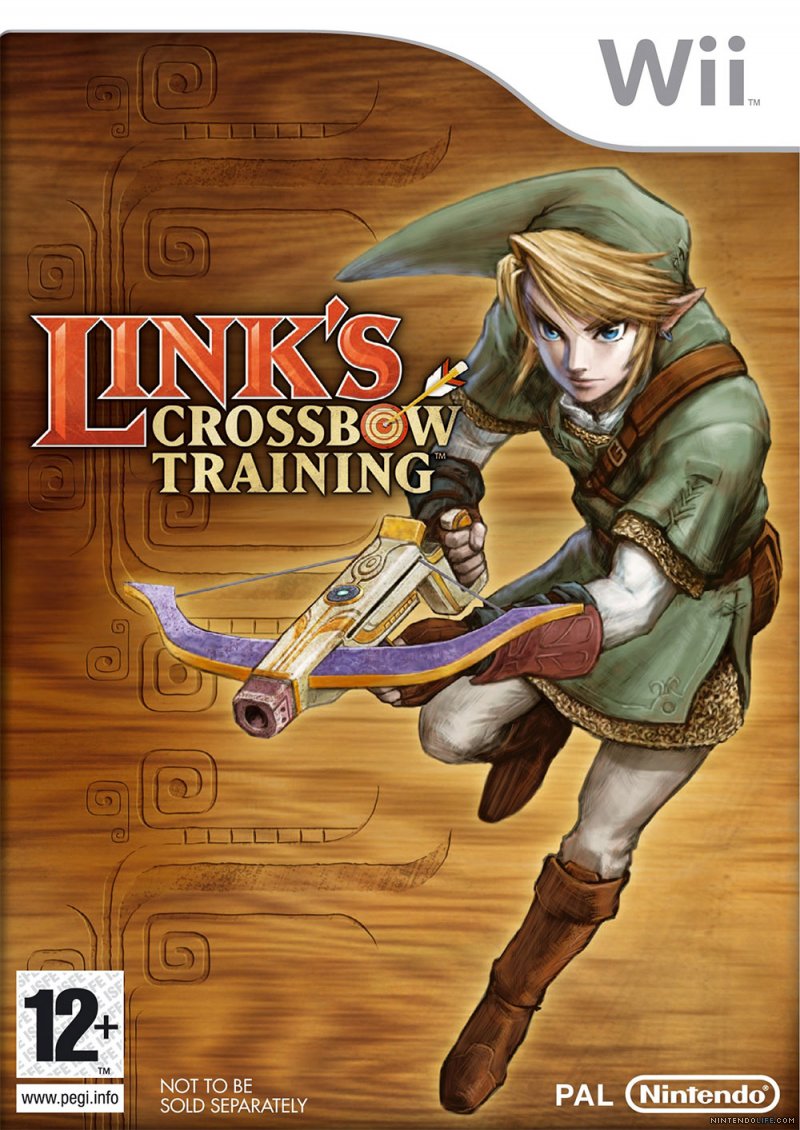
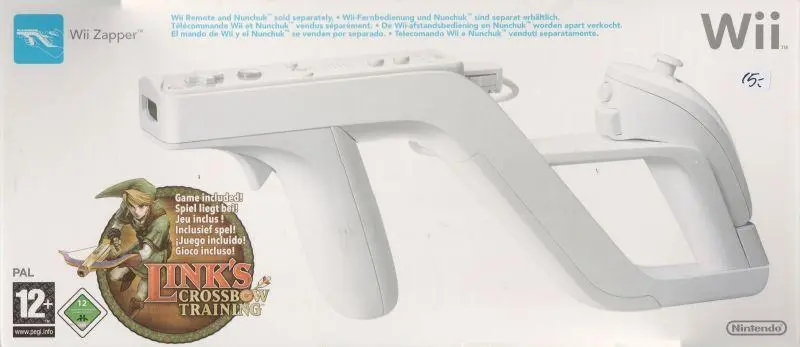
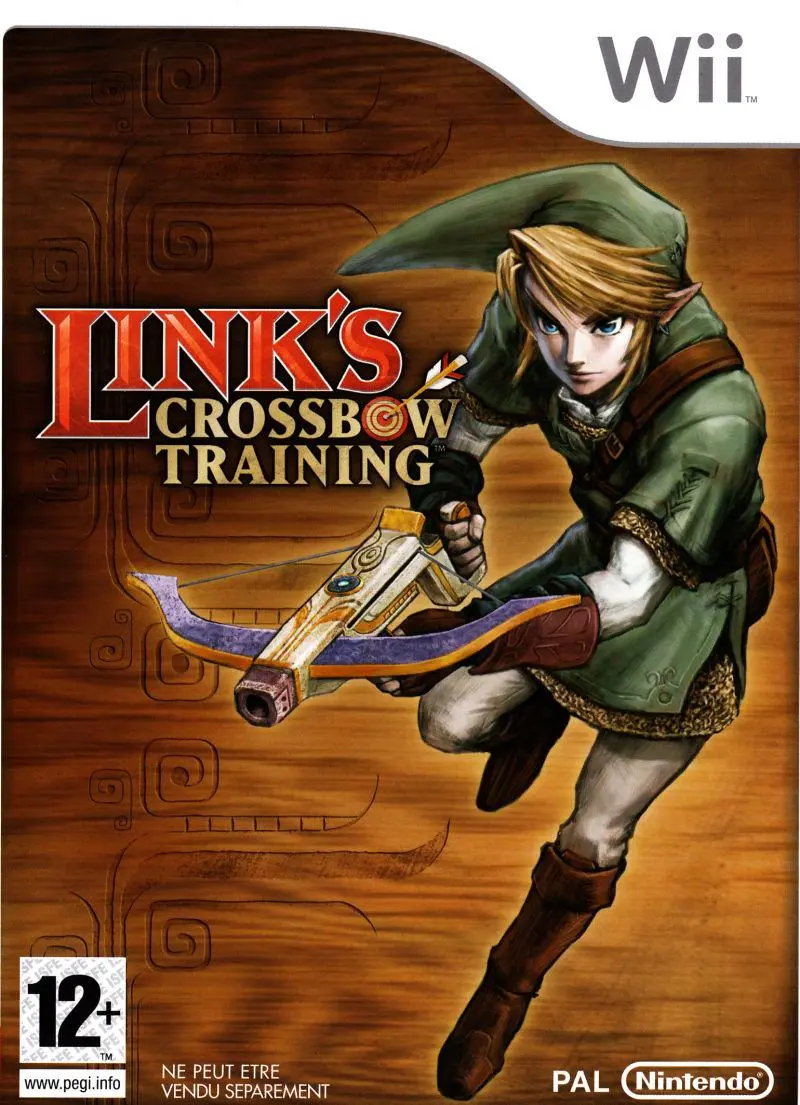
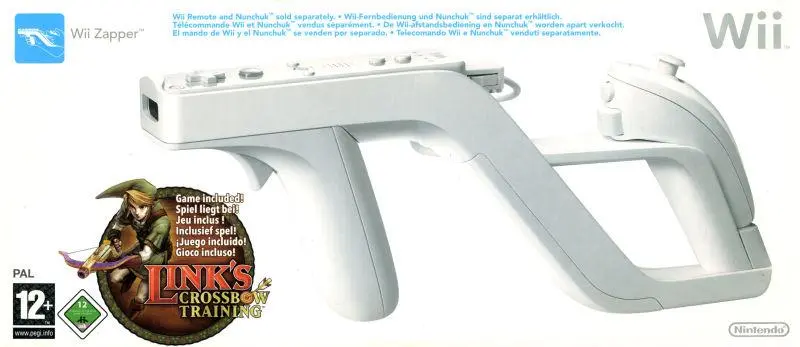
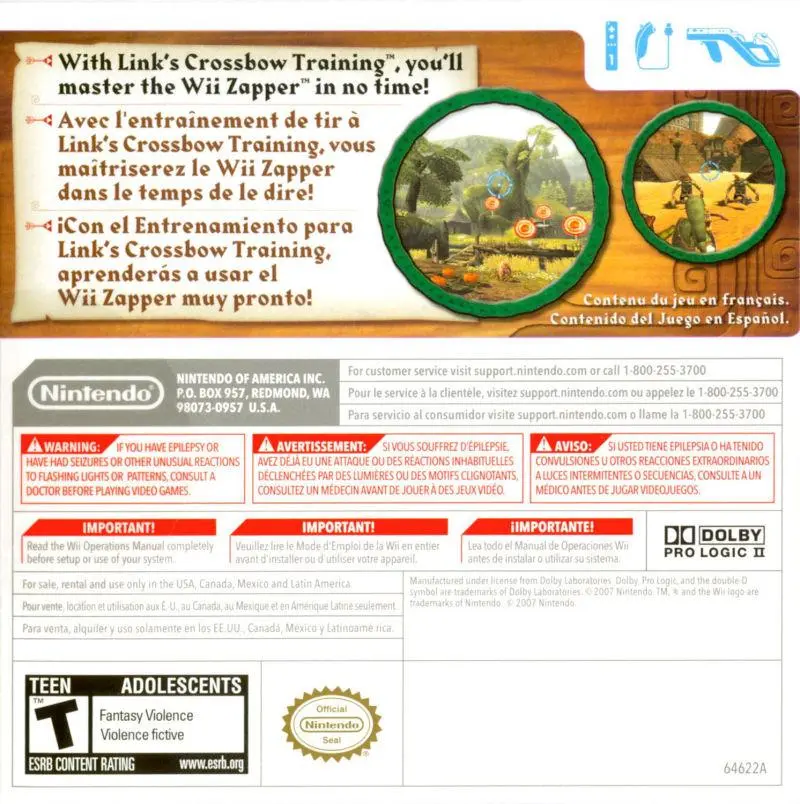
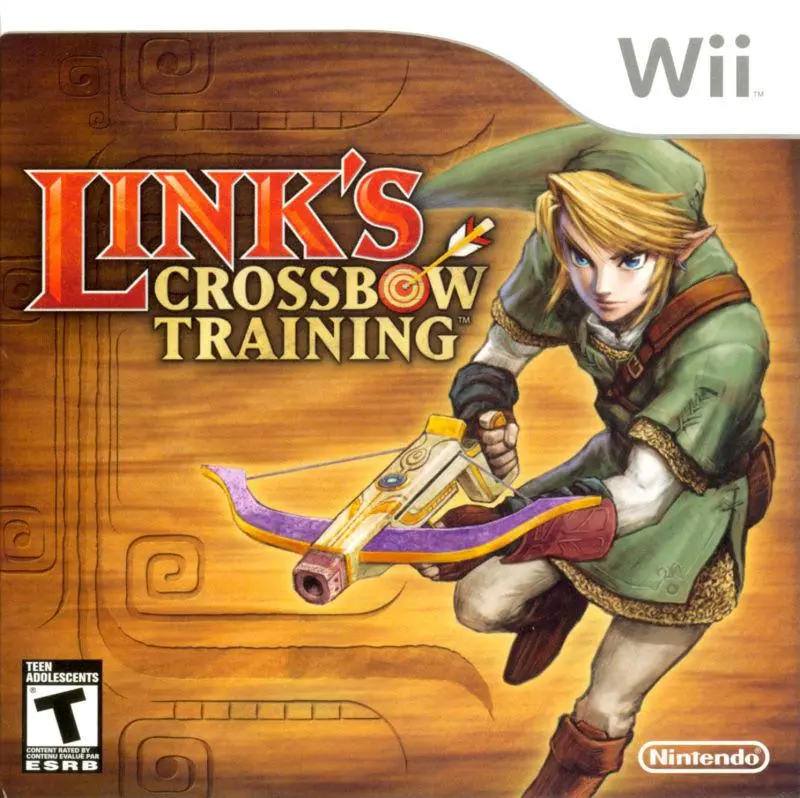
Link trades his sword for a rapid-fire crossbow in a pocket-sized shooting gallery built out of Twilight Princess’s Hyrule: the game that came in the box with the Wii Zapper.
Released19 November 2007 (NA) · 7 December 2007 (EU) · 13 December 2007 (AU) · 1 May 2008 (JP)
DeveloperNintendo EAD
DirectorMakoto Miyanaga
ProducersEiji Aonuma, Takashi Tezuka
Stages27, in nine levels of three
Players1–4, taking turns
Sales4.80 million by March 2010
Title
Link’s Crossbow Training リンクのボウガントレーニング (Rinku no Bōgan Torēningu, “Link’s Bowgun Training”)
Platform
Wii, sold in one box with the Wii Zapper
Developer
Nintendo Entertainment Analysis & Development (EAD)
Publisher
Nintendo
Director
Makoto Miyanaga
Producers
Eiji Aonuma, Takashi Tezuka
Concept
Shigeru Miyamoto
Music
Kenta Nagata, Toru Minegishi
Genre
Shooting gallery in three styles: Target Shooting, Defender and Ranger
4.80 million worldwide by 31 March 2010 (Nintendo)
Review average
68 on Metacritic, from 34 reviews
Overview
Link’s Crossbow Training is a very small Zelda game that sold in very large numbers. It is a shooting gallery: Link, a crossbow that fires as fast as you can pull the trigger, and 27 bite-sized stages cut out of the Hyrule of Twilight Princess. There is no story, no Zelda, no Ganondorf and no sword. There is a score counter, and the nagging feeling that you could have done better.
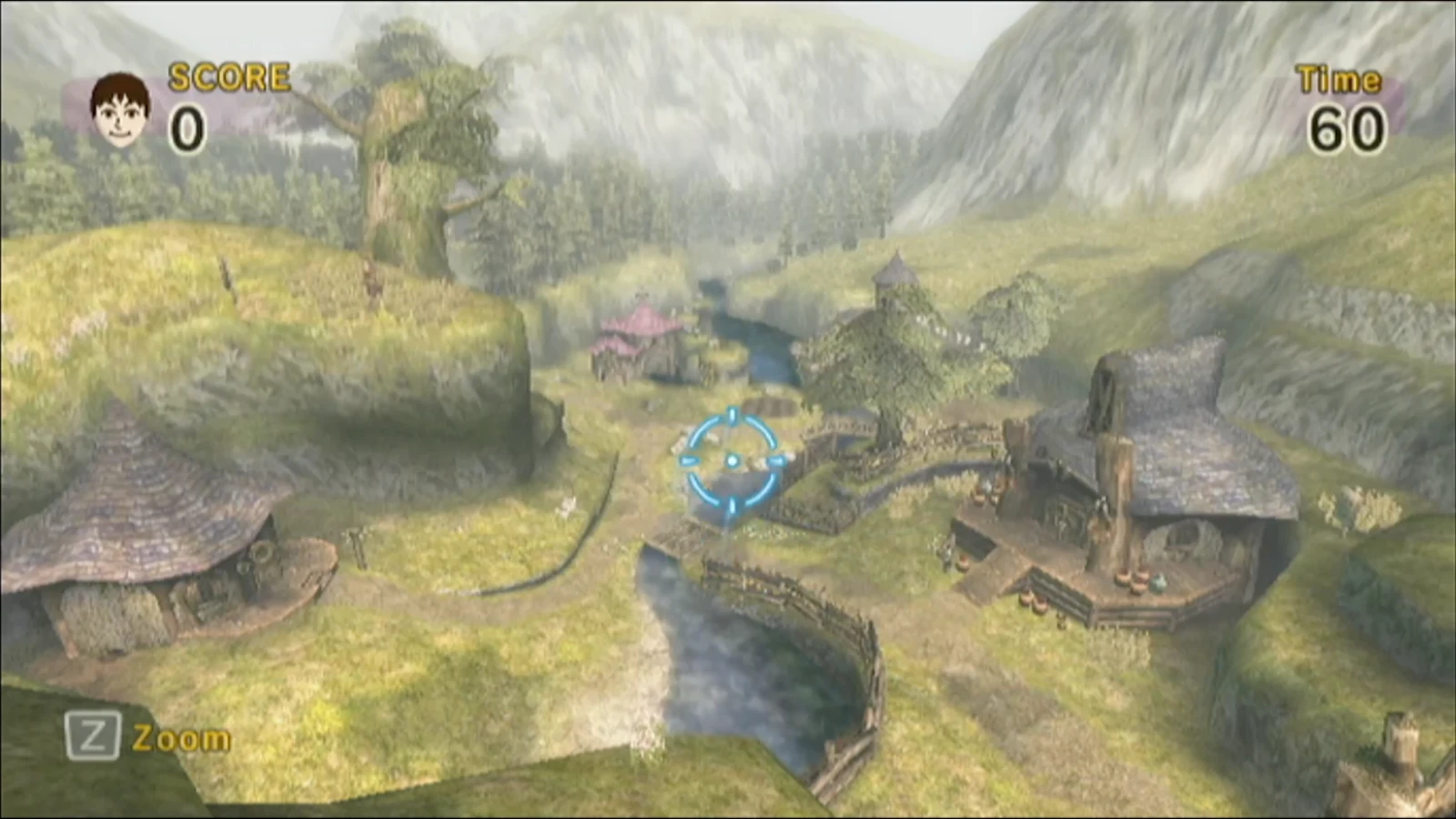
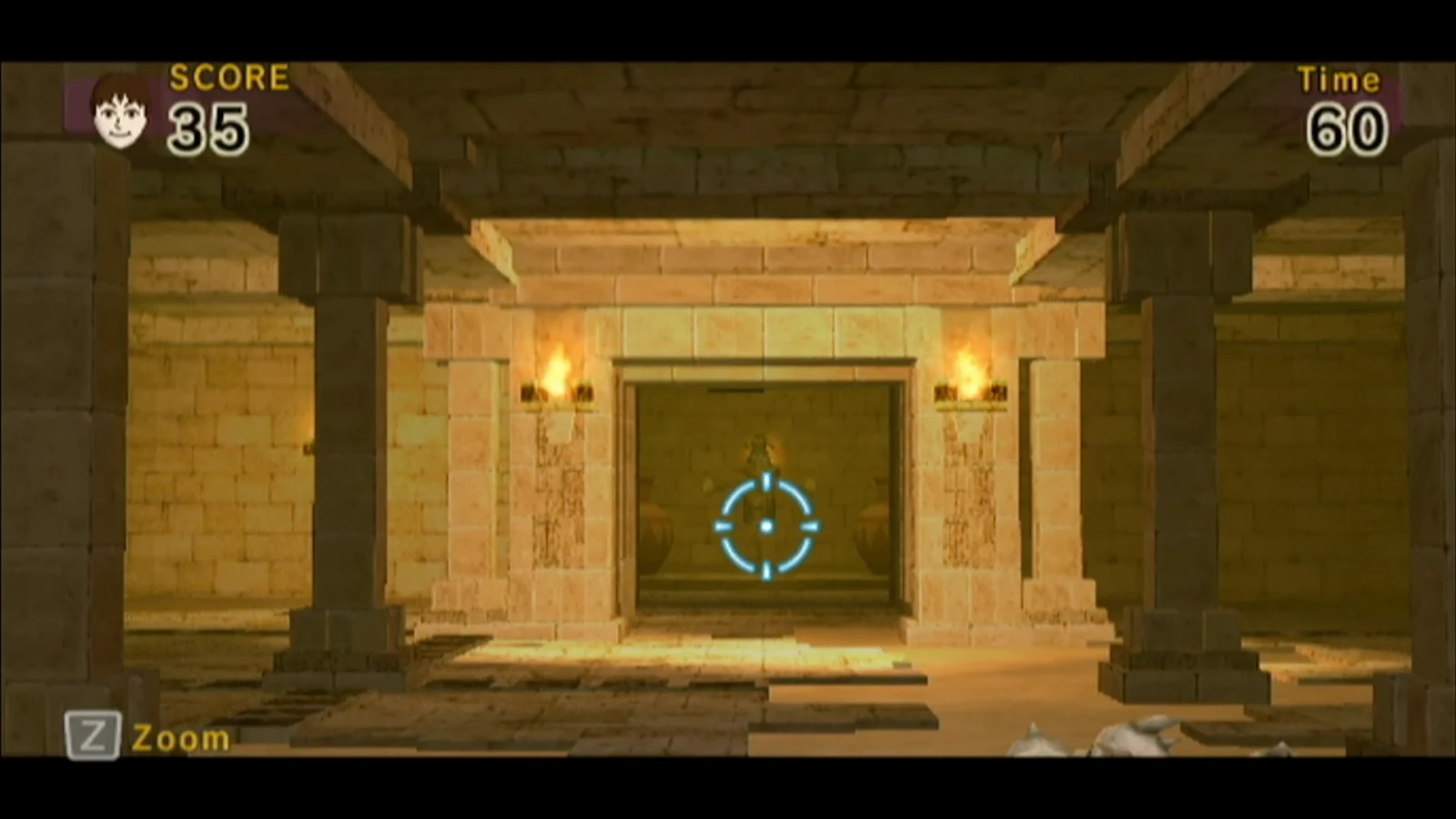
The stages come in three flavours. Target Shooting is a fairground range, with bull’s-eyes popping up around Ordon, Kakariko and the rest. Defender roots Link to the spot while Stalfos, Keese or wolves close in from every side. Ranger lets him walk, turning the game into a small third-person shooter in which he clears a Bulblin camp or a frozen mansion. Three stages make a level, the three scores are added together, and the total earns a bronze, silver, gold or platinum medal.
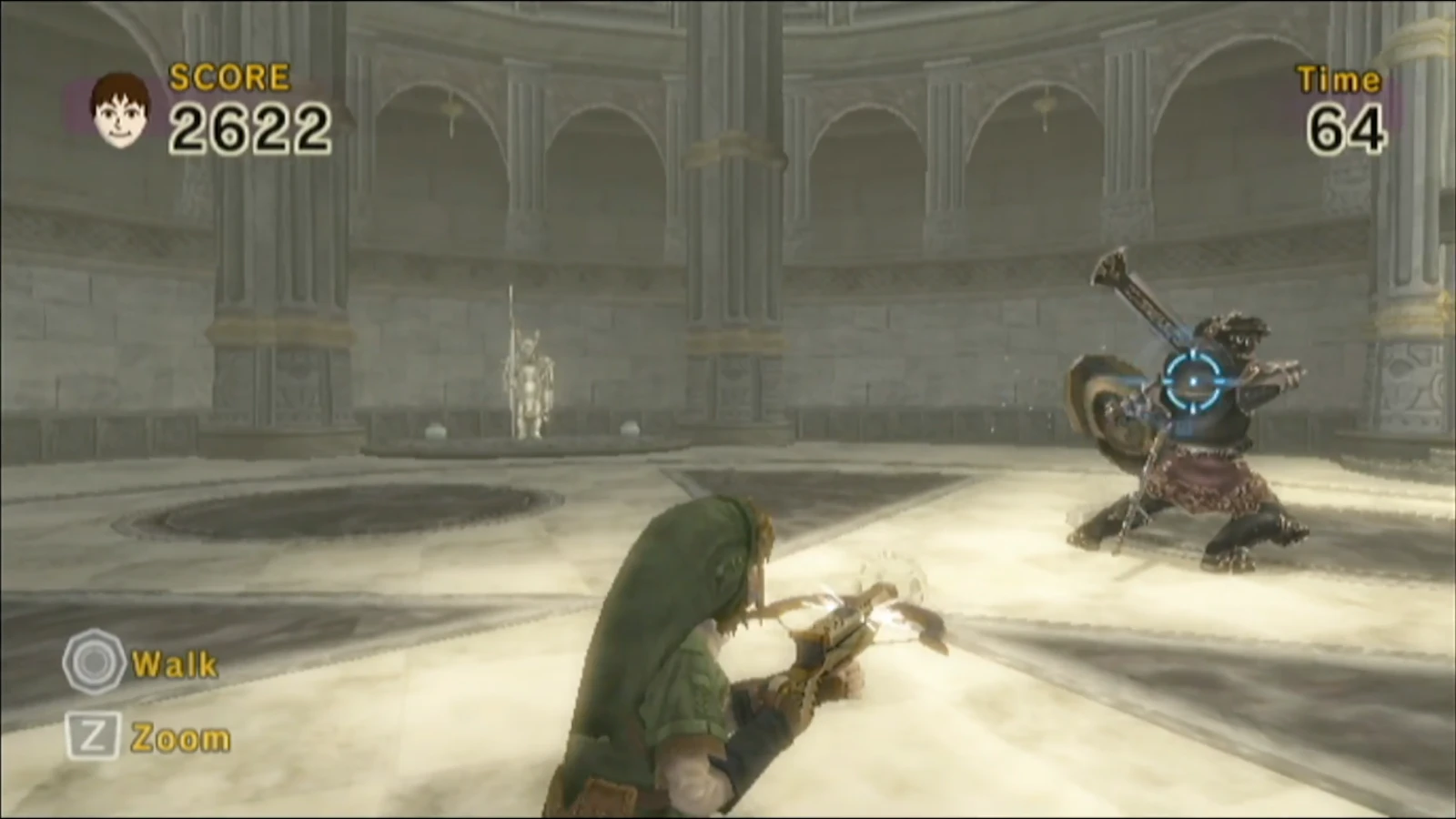
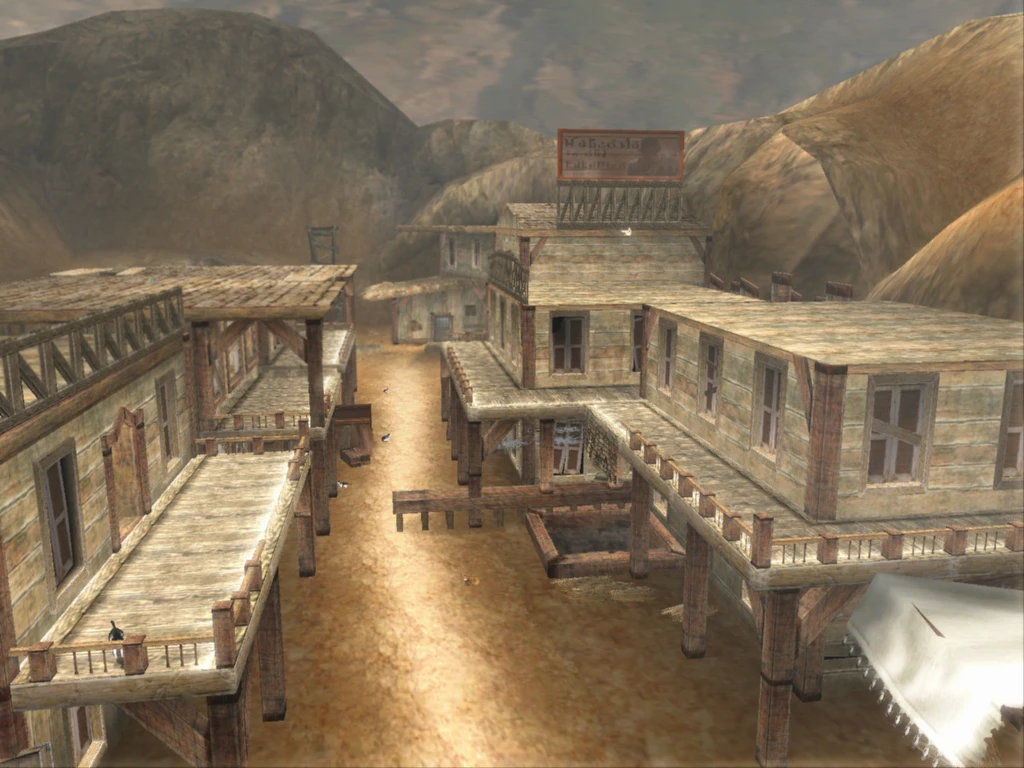
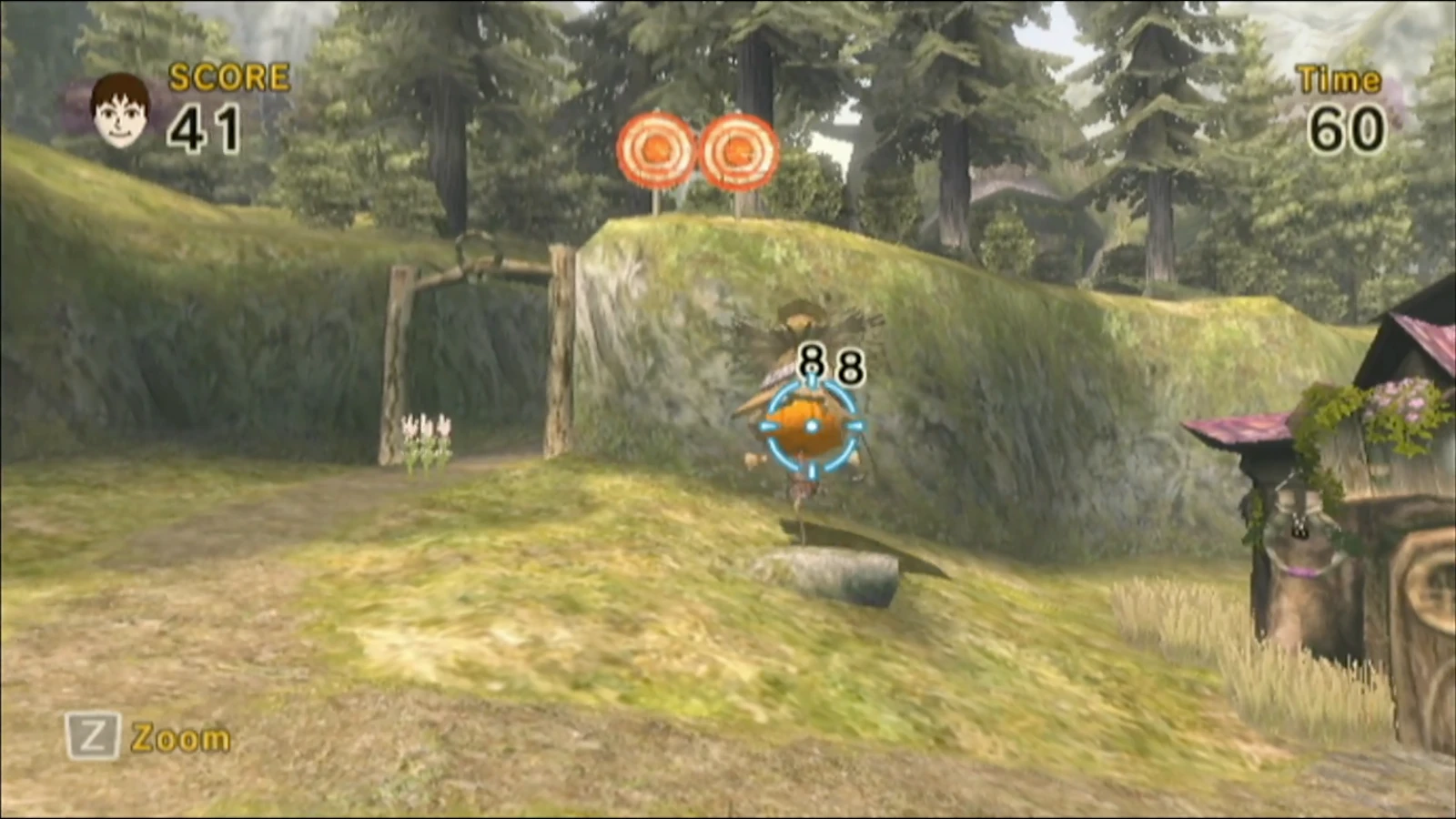
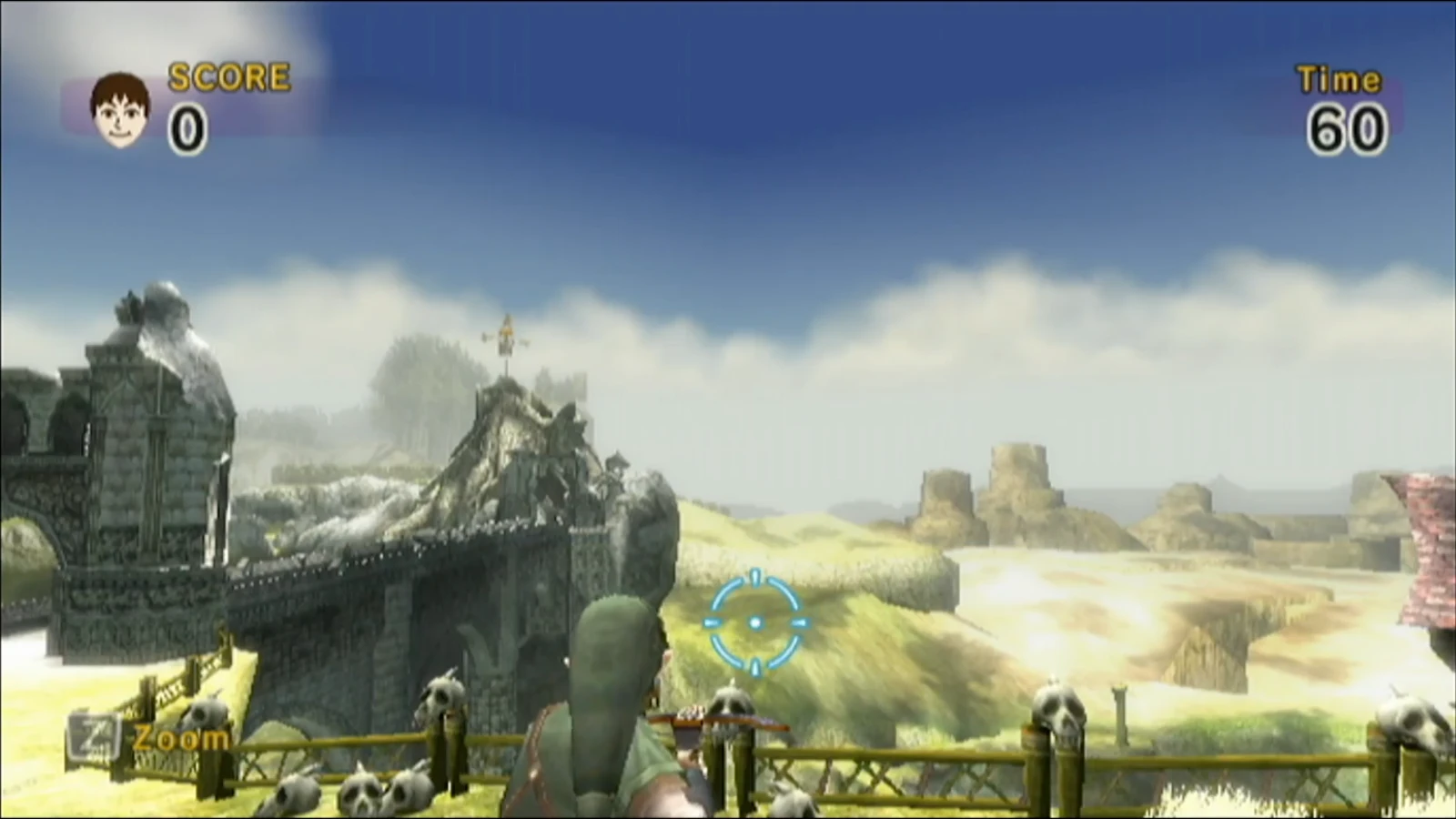
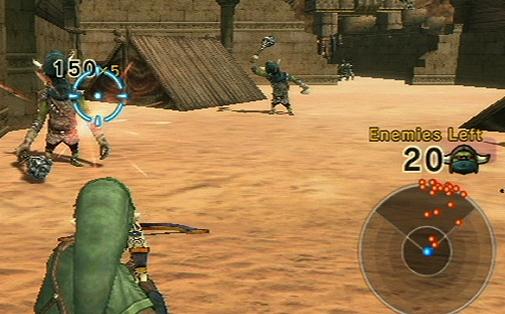
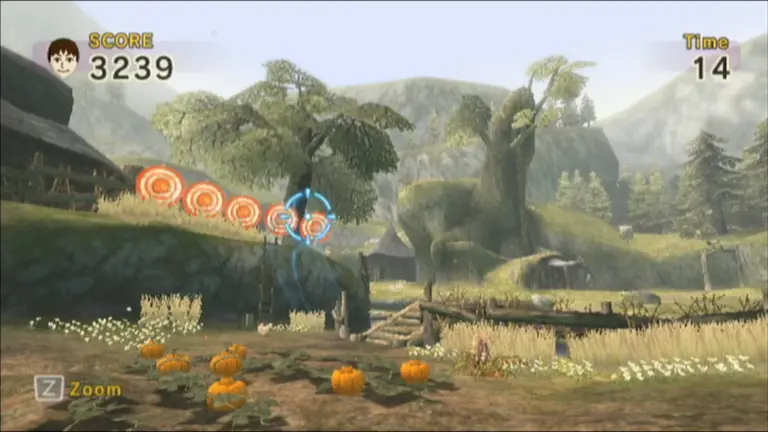
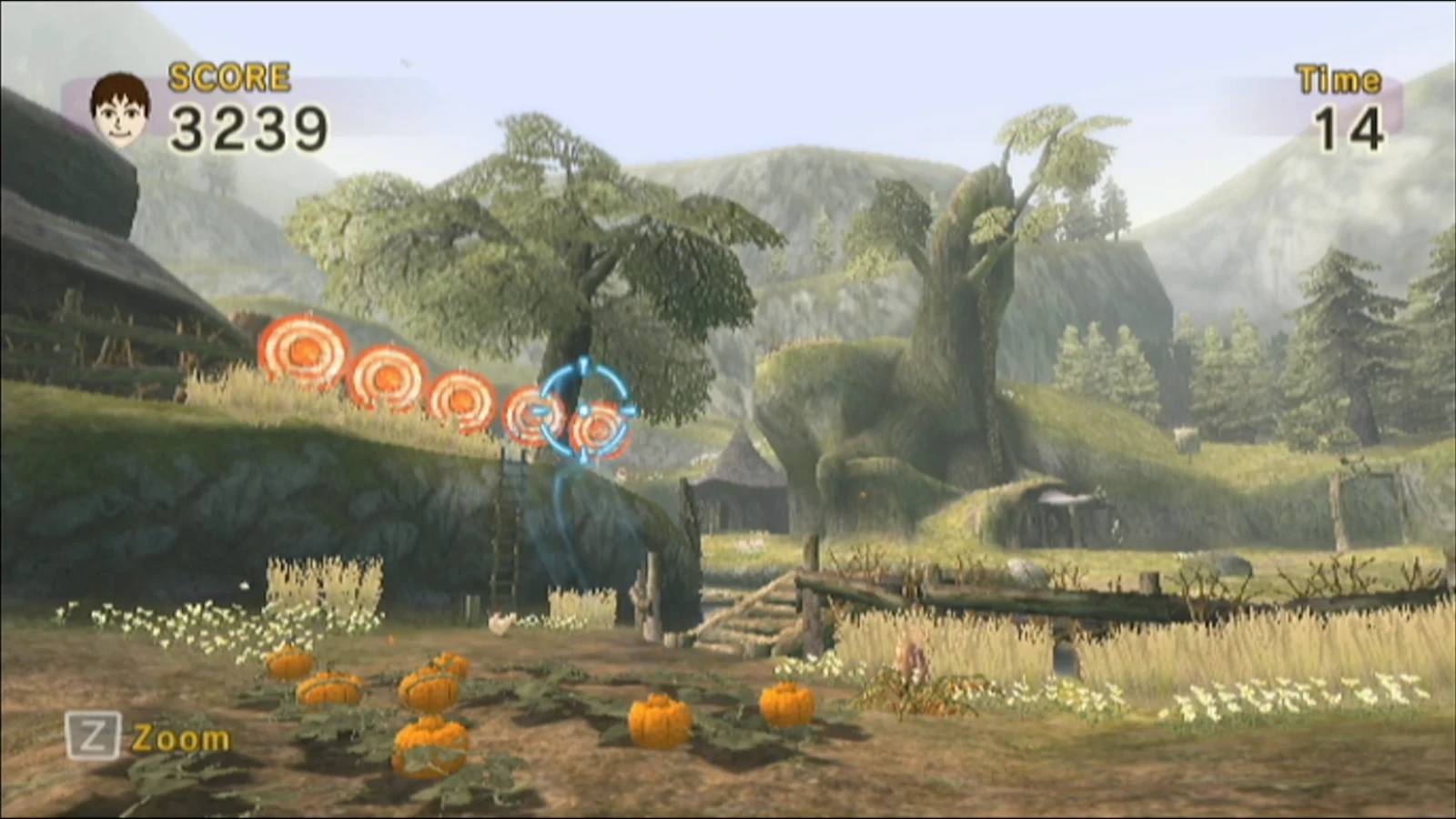
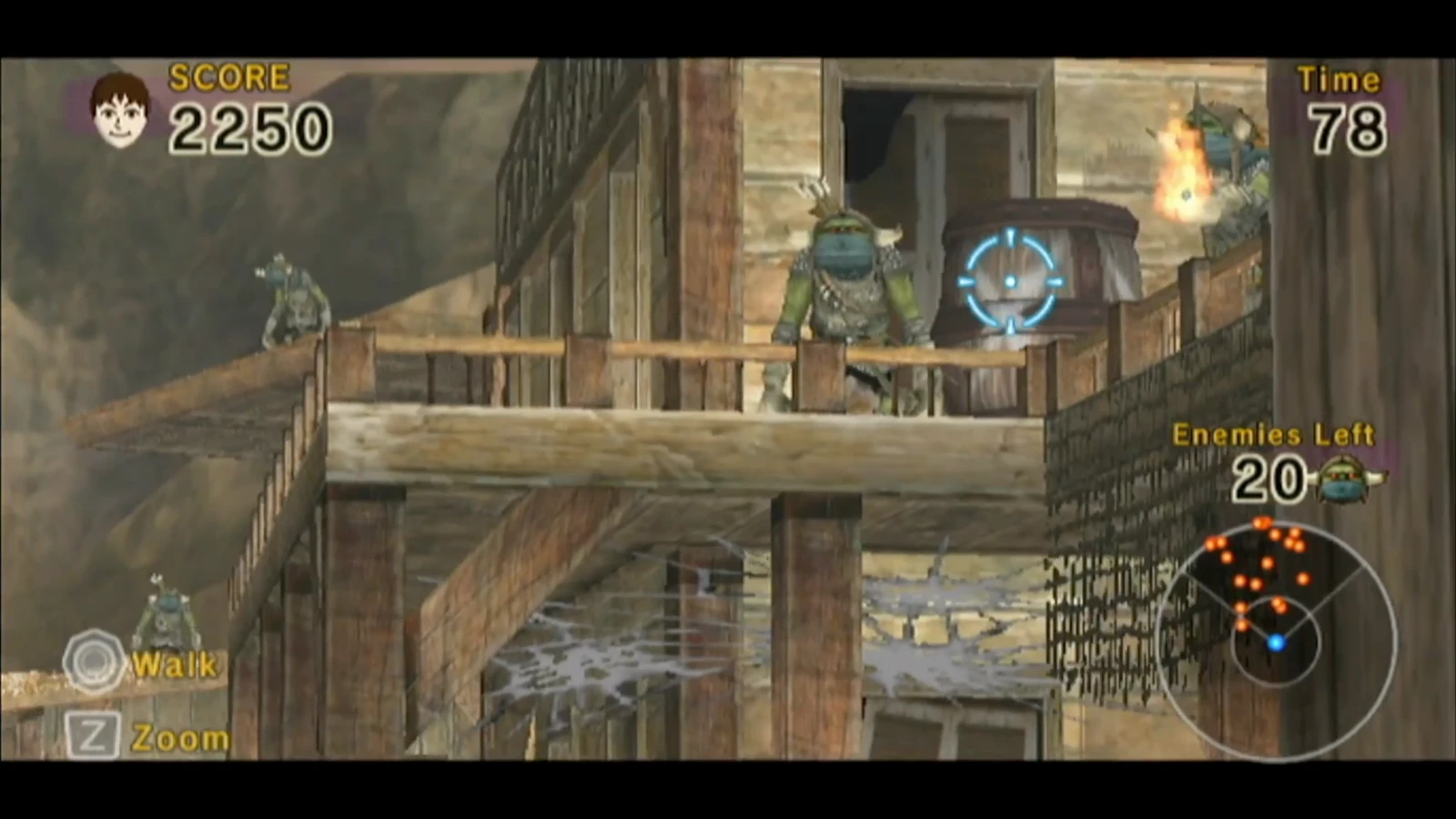
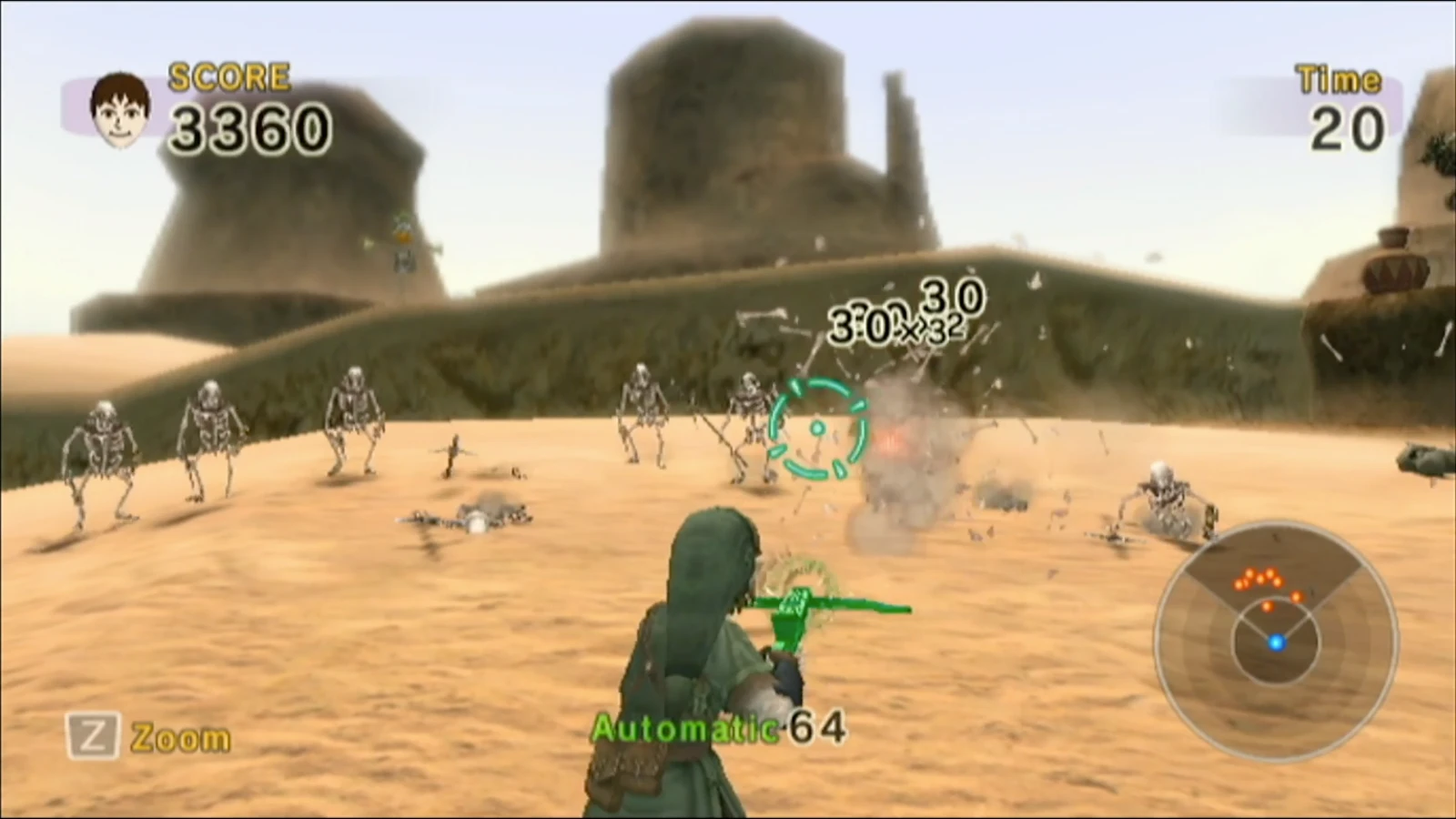
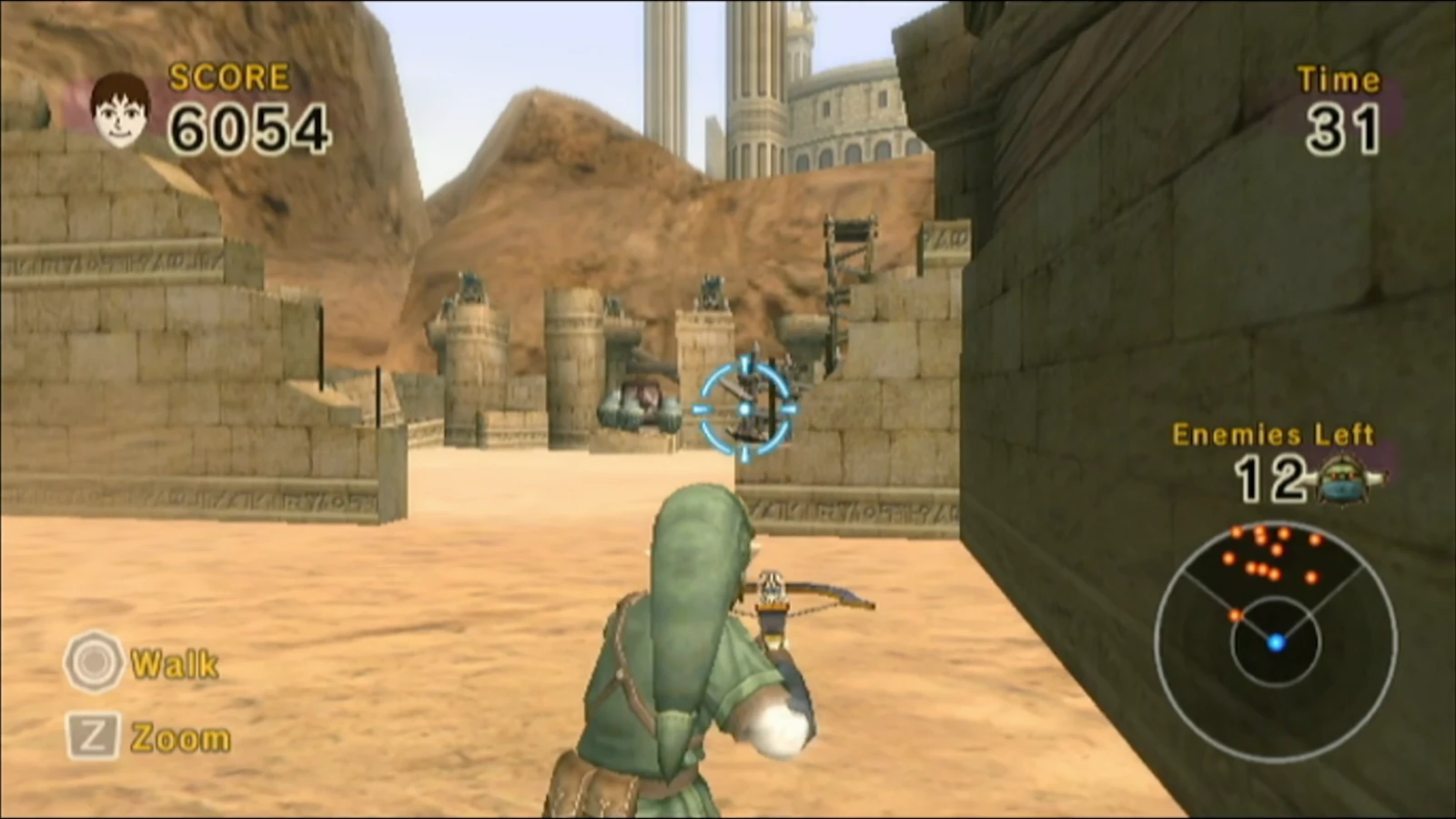
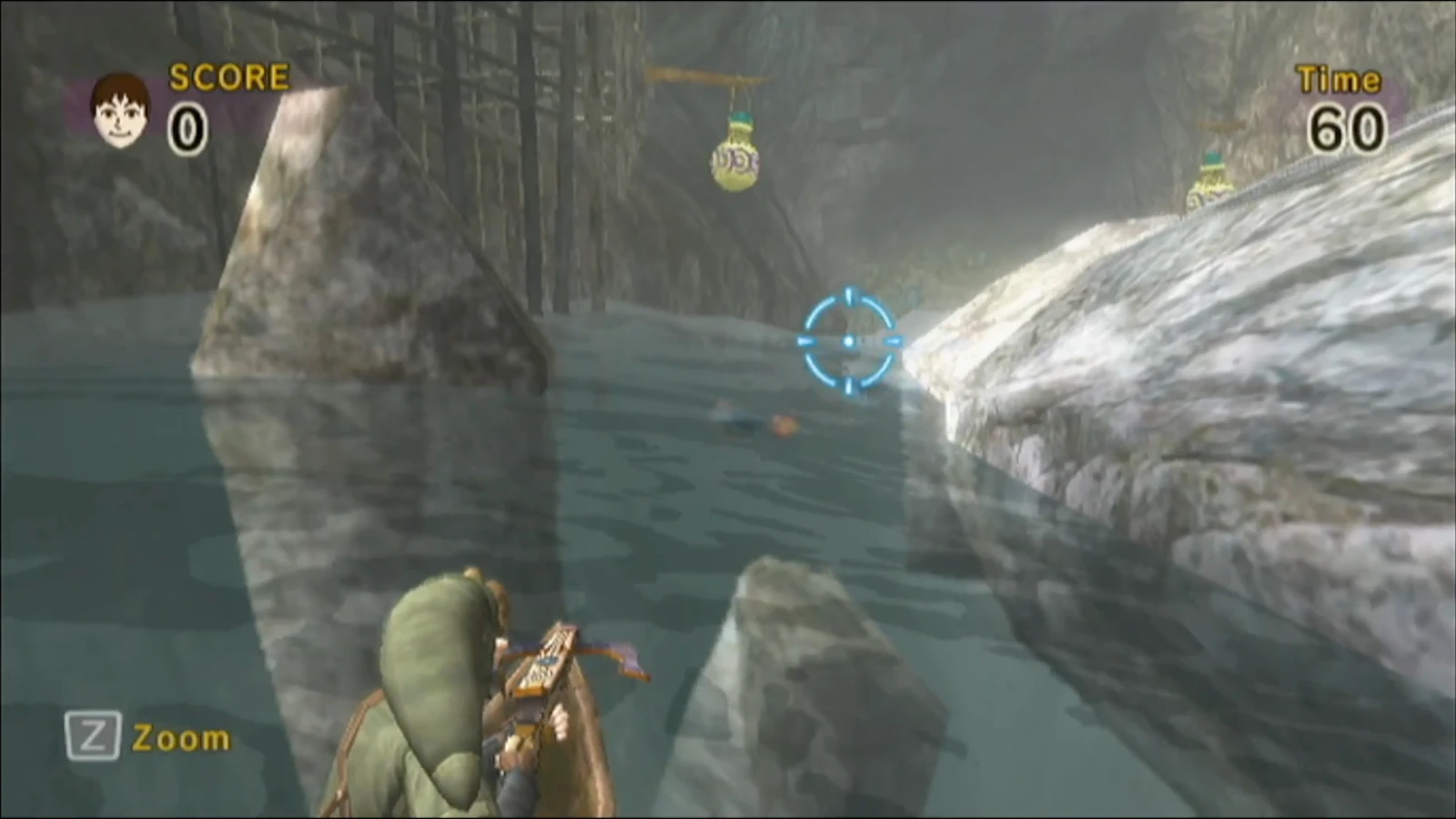
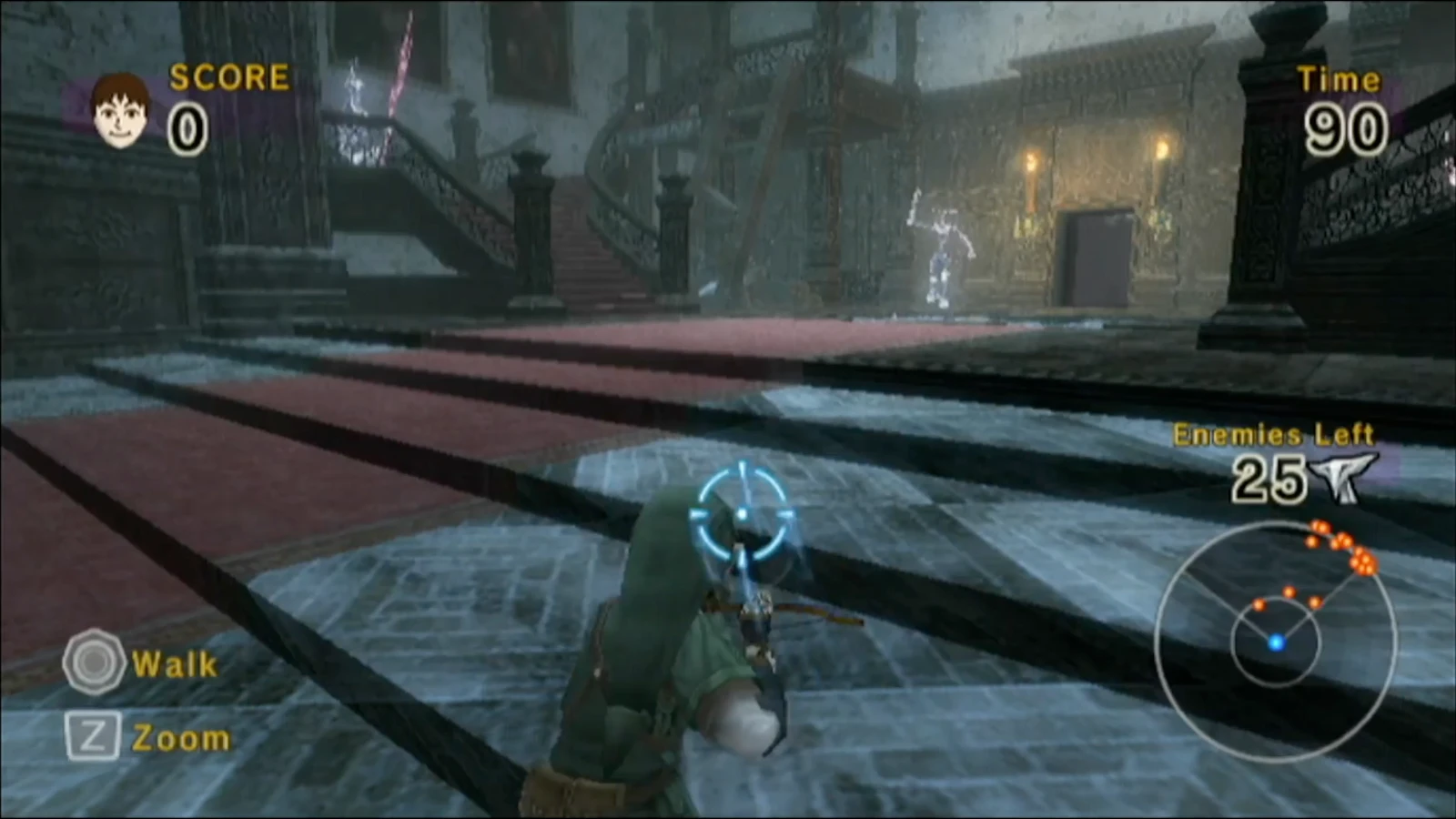
Target Shooting: bull’s-eyes in Ordon Village.Defender: Stalfos rise from the desert sand.Ranger: Link on foot in a Bulblin camp.
It exists because of a piece of white plastic. Nintendo needed a game to pack in with the Wii Zapper, the gun-shaped shell that holds a Wii Remote and Nunchuk, and Shigeru Miyamoto wanted a gentle first step into first-person shooters for people who had never played one. The team that had just finished Twilight Princess built it from that game’s world, and it was in North American shops on 19 November 2007, a year to the day after Twilight Princess and the Wii itself.
Reviewers called it fun, pretty and very short, which is fair: you can see everything in an afternoon. Sold for the price of an accessory, it went on to pass 4.8 million copies, more than Skyward Sword managed on the same console. It has never been re-released, so the original disc is still the only way to play it.
リビングで射的を楽しむ (“Enjoy target shooting in the living room”)
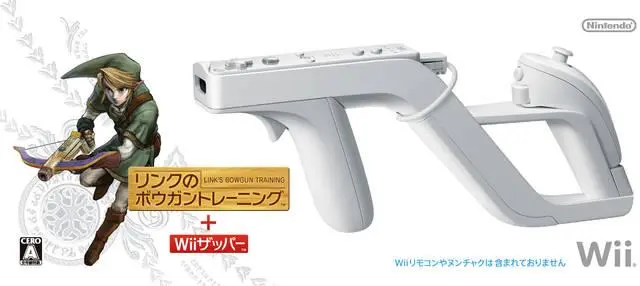
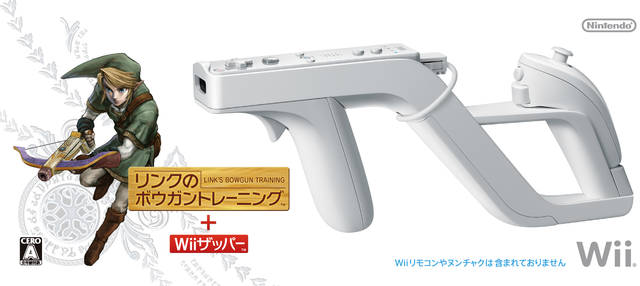
That is the heading on Nintendo’s Japanese official site, where the game is sold as リンクのボウガントレーニング+Wiiザッパー, the game plus the Zapper. The site promises three shooting styles, 27 stages in all (forests, rivers, deserts, snowy mountains, a village under attack and a city in the sky), nine levels to chase high scores on, and turn-taking contests for the family with a single Zapper.
— Official description: Nintendo Co., Ltd., Japanese official site for Rinku no Bōgan Torēningu (nintendo.co.jp). Heading quoted and translated by Zelda Temple; the rest summarised.
Quick Answers
The questions people most often ask about Link’s Crossbow Training, answered quickly and explained further down the page.
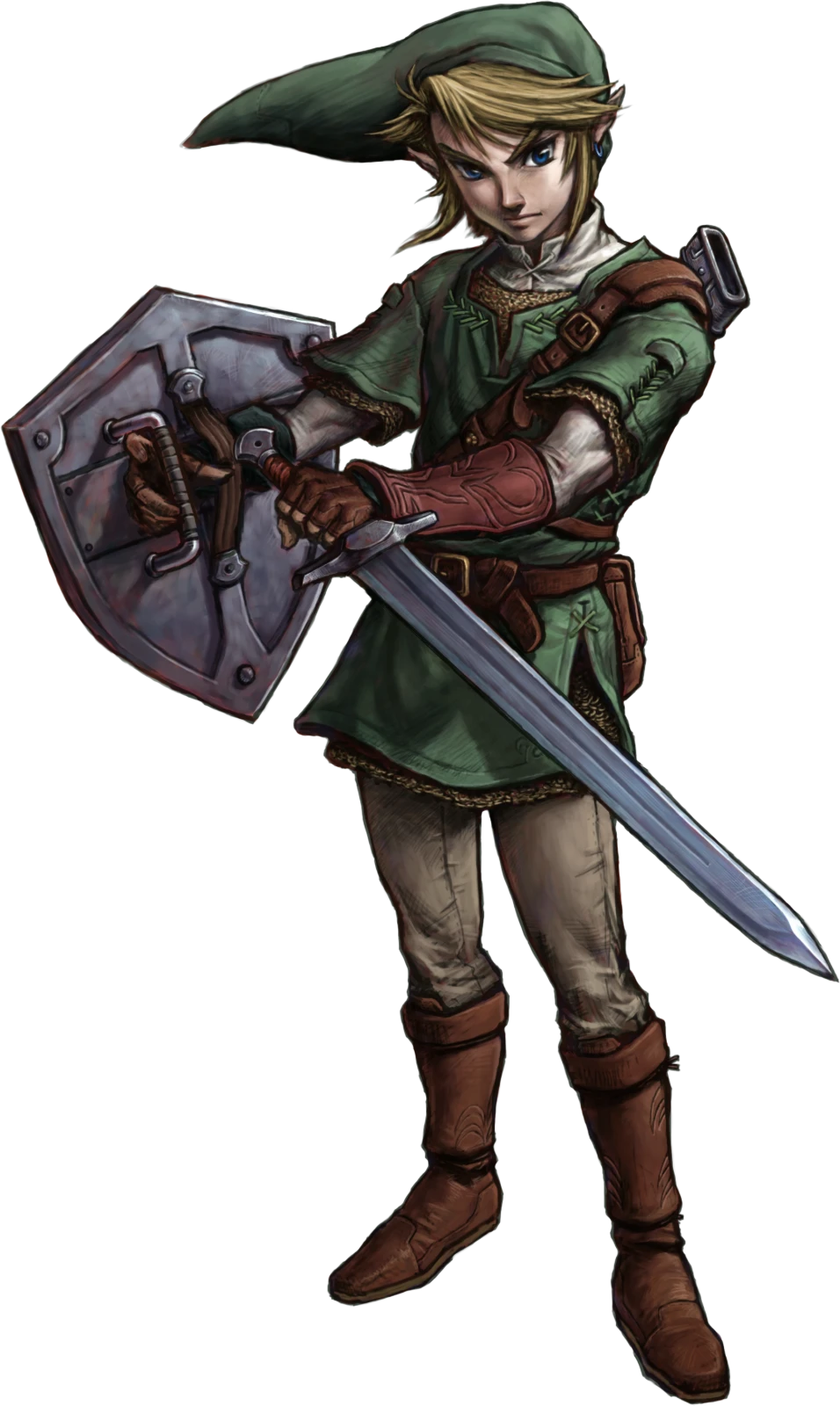
Link in official art for Twilight Princess, the look he keeps in this game.
What is Link’s Crossbow Training?
A short shooting game for Wii, made by Nintendo to show off the Wii Zapper and sold in the same box. Link works through 27 score-attack stages set in the Hyrule of Twilight Princess. More →
When did it come out?
On 19 November 2007 in North America, 7 December 2007 in Europe, 13 December 2007 in Australia and 1 May 2008 in Japan. A South Korean release followed on 28 October 2010. More →
Do you need the Wii Zapper to play it?
No. The Zapper is a plastic shell with no electronics of its own: the Wii Remote and Nunchuk inside do all the work. VideoGamer’s reviewer found the game played better with the two controllers held in the ordinary way. More →
How many stages are there?
27, arranged as nine levels of three stages each. Every stage lasts a minute or so, and two of them are boss fights. More →
Is it a proper Zelda game? Is it canon?
It is an official Nintendo spin-off set in Twilight Princess’s world, but it has no plot, and Nintendo’s Hyrule Historia leaves spin-offs like this one out of the series timeline. More →
Who made it?
Nintendo EAD, the Zelda team fresh from Twilight Princess. Makoto Miyanaga directed, Eiji Aonuma and Takashi Tezuka produced, and Shigeru Miyamoto came up with the idea and set the rules. More →
How long does it take to finish?
About two hours to see all 27 stages, according to Nintendo World Report’s review. Chasing platinum medals on every level takes a good deal longer. More →
Is there a final boss?
Yes: a resurrected Stallord, the fossil dragon from Twilight Princess’s Arbiter’s Grounds, closes the last level. A Darknut duel ends the level before it. Miyamoto originally wanted no bosses at all. More →
How many copies did it sell?
4.80 million worldwide by 31 March 2010, the last figure Nintendo published. Every copy came packed with a Wii Zapper. More →
Can you play it on Wii U or Switch?
Only from the original Wii disc, which a Wii U can also run. The game has never been re-released as a download, on Nintendo Switch Online or as a remaster. More →
Was there ever a sequel?
No. Eiji Aonuma said in 2009 that he had wanted to make Link’s Crossbow Training 2, but colleagues at Nintendo insisted he get on with a new Zelda instead. More →
Setting & stages
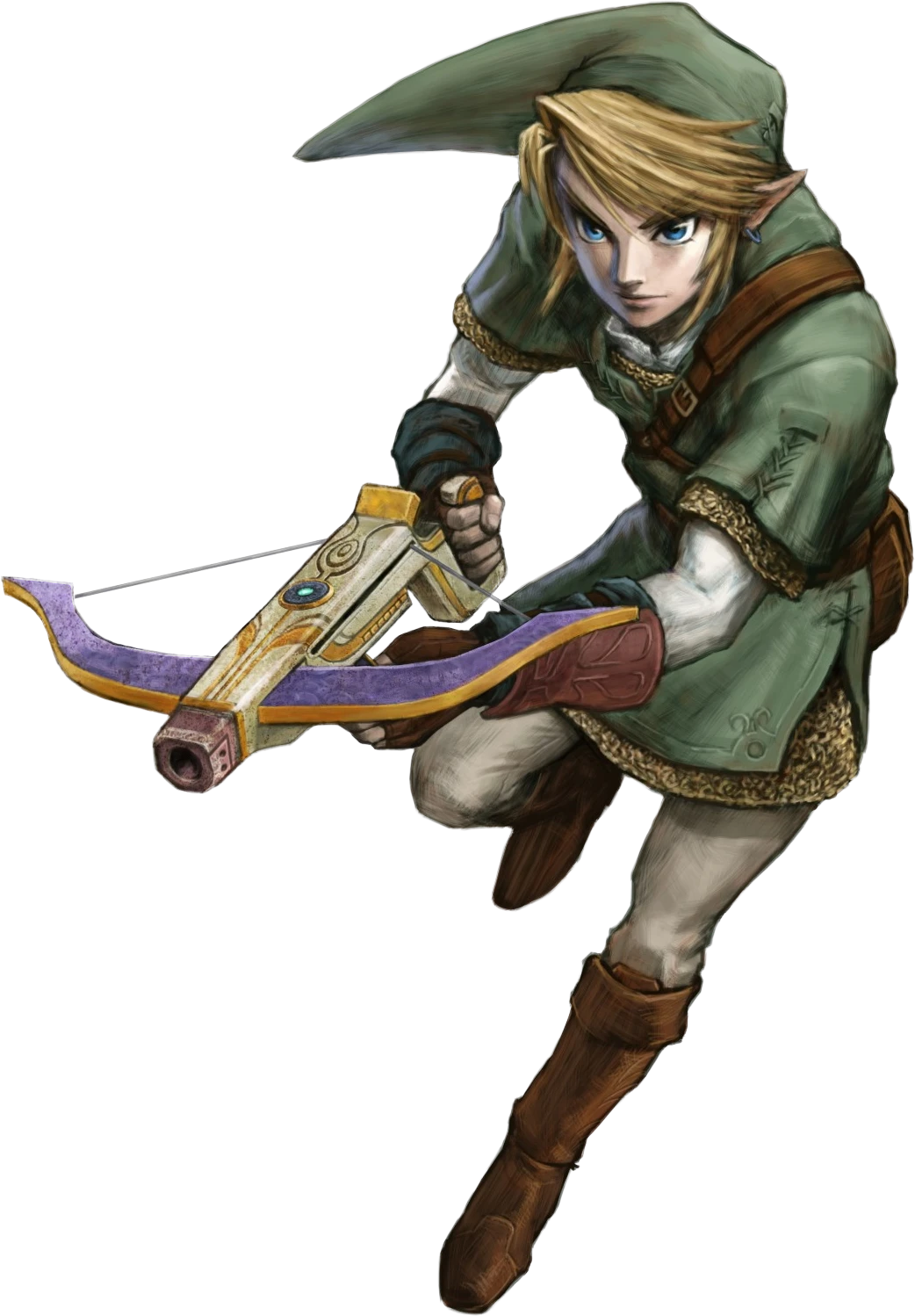
Official art of Link for Link’s Crossbow Training.
There is no plot to spoil. The premise fits in a sentence: Link is sharpening his aim with a crossbow, and a series of tests will show how good he is. The game never says when this happens or why. Nintendo Life’s reviewer summed it up as a quest “with no real ending”.
What it has instead of a story is a place. Every stage is a corner of the Hyrule that players had explored a year earlier, and the fun for a Zelda fan is in recognising them. Miyamoto’s starting point was simple, as he told Satoru Iwata: “The terrain created for Twilight Princess was vast,” and it seemed a waste to use it only once.
A second lap of Twilight Princess
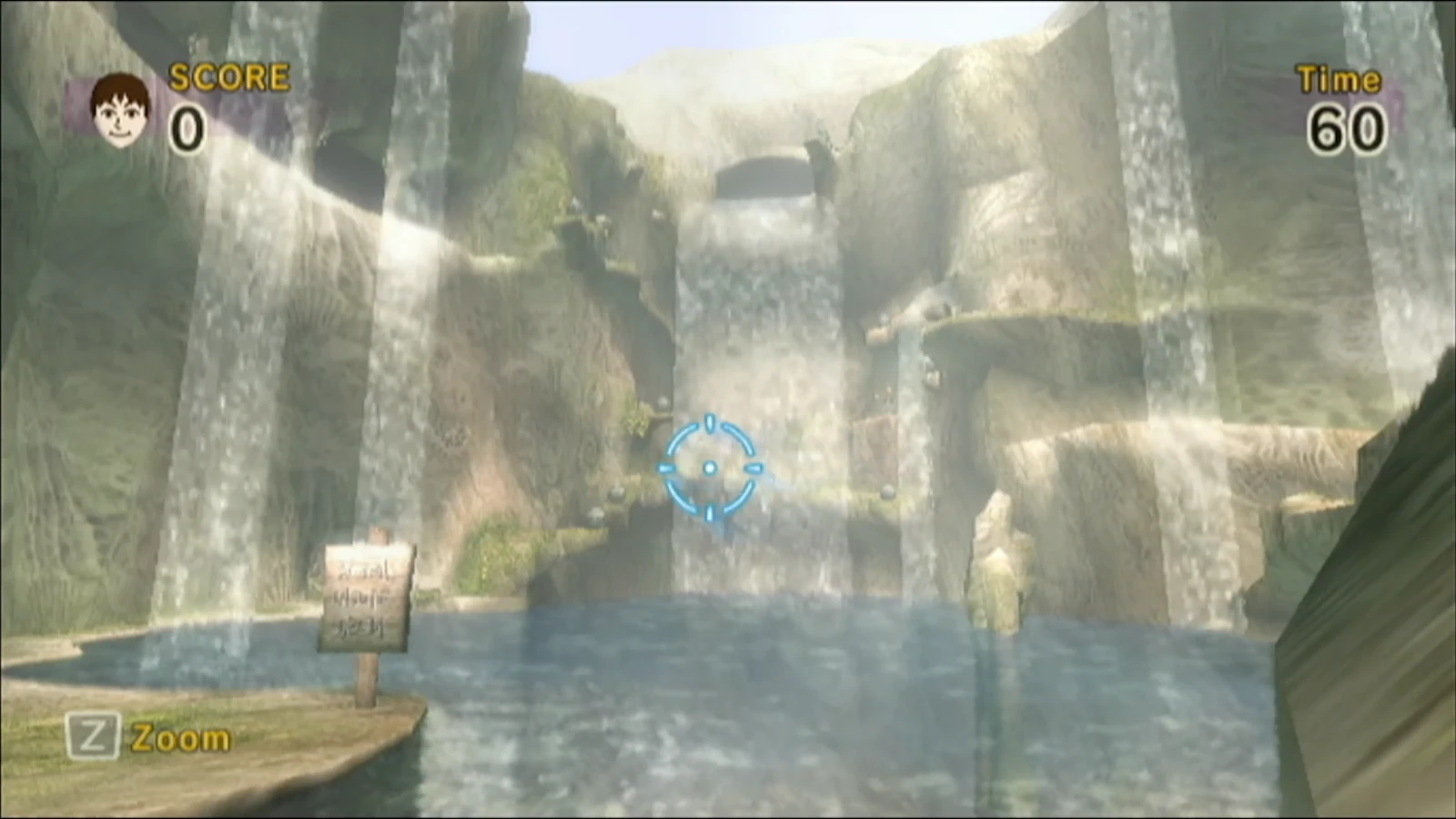
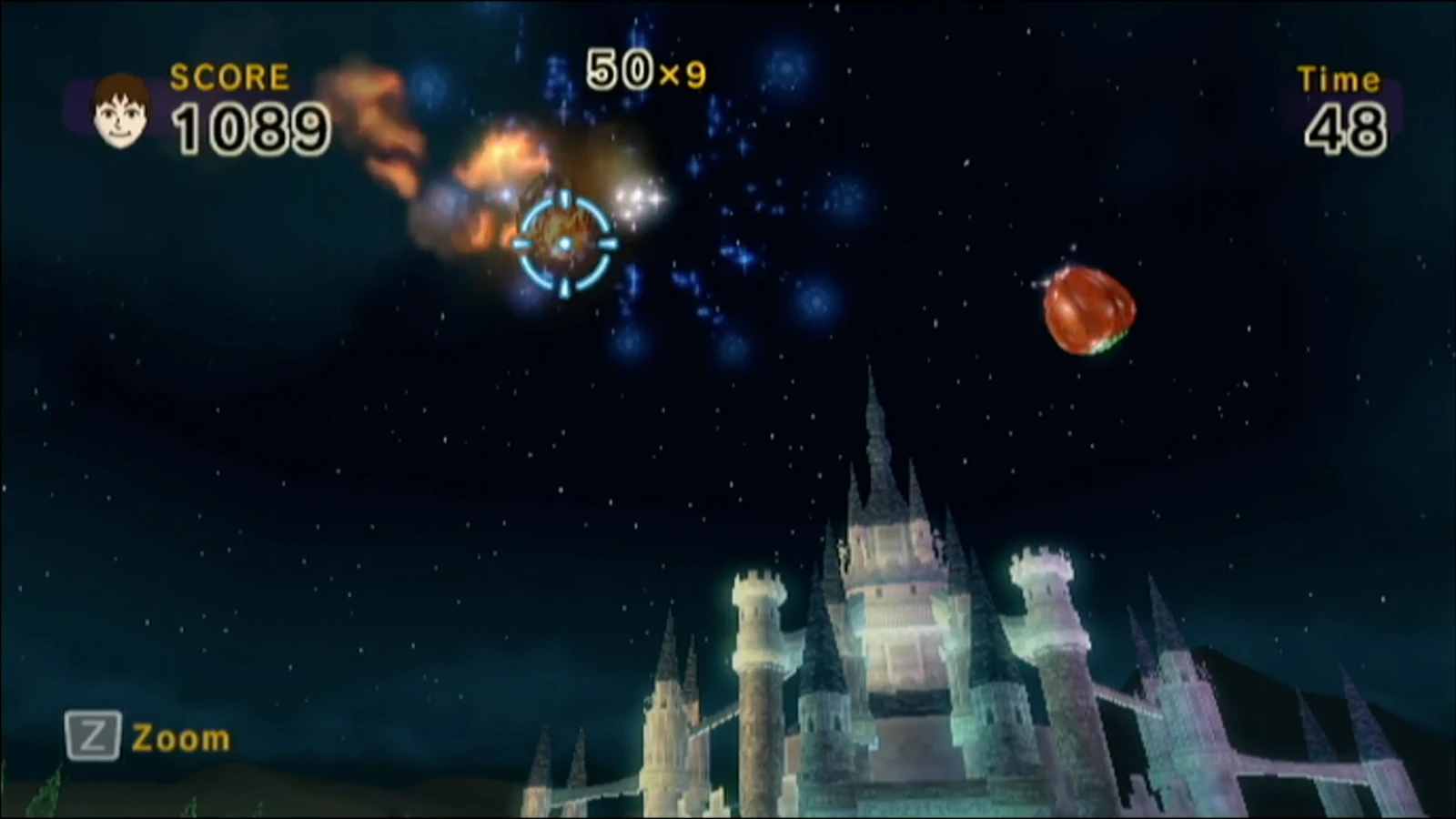
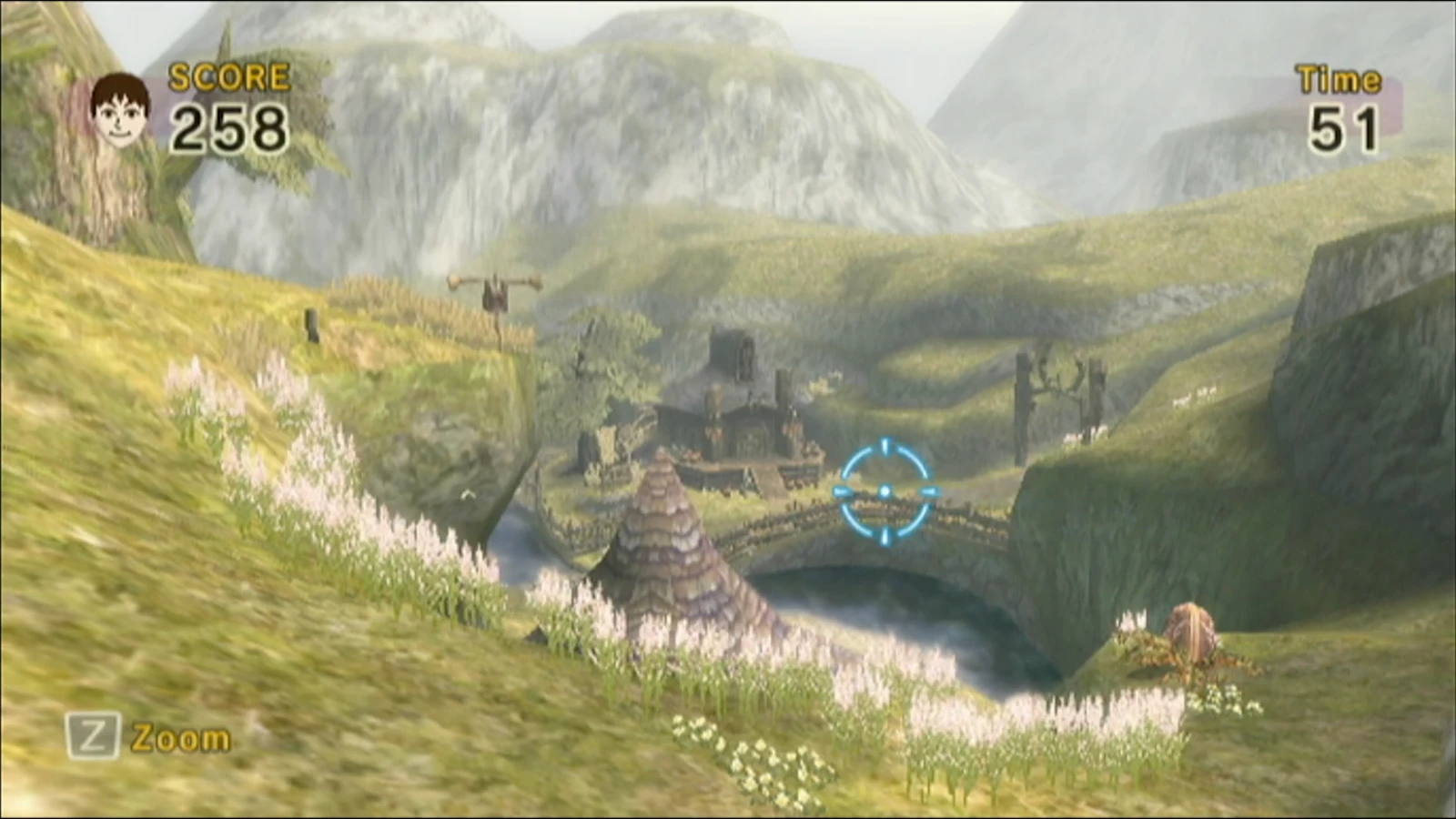
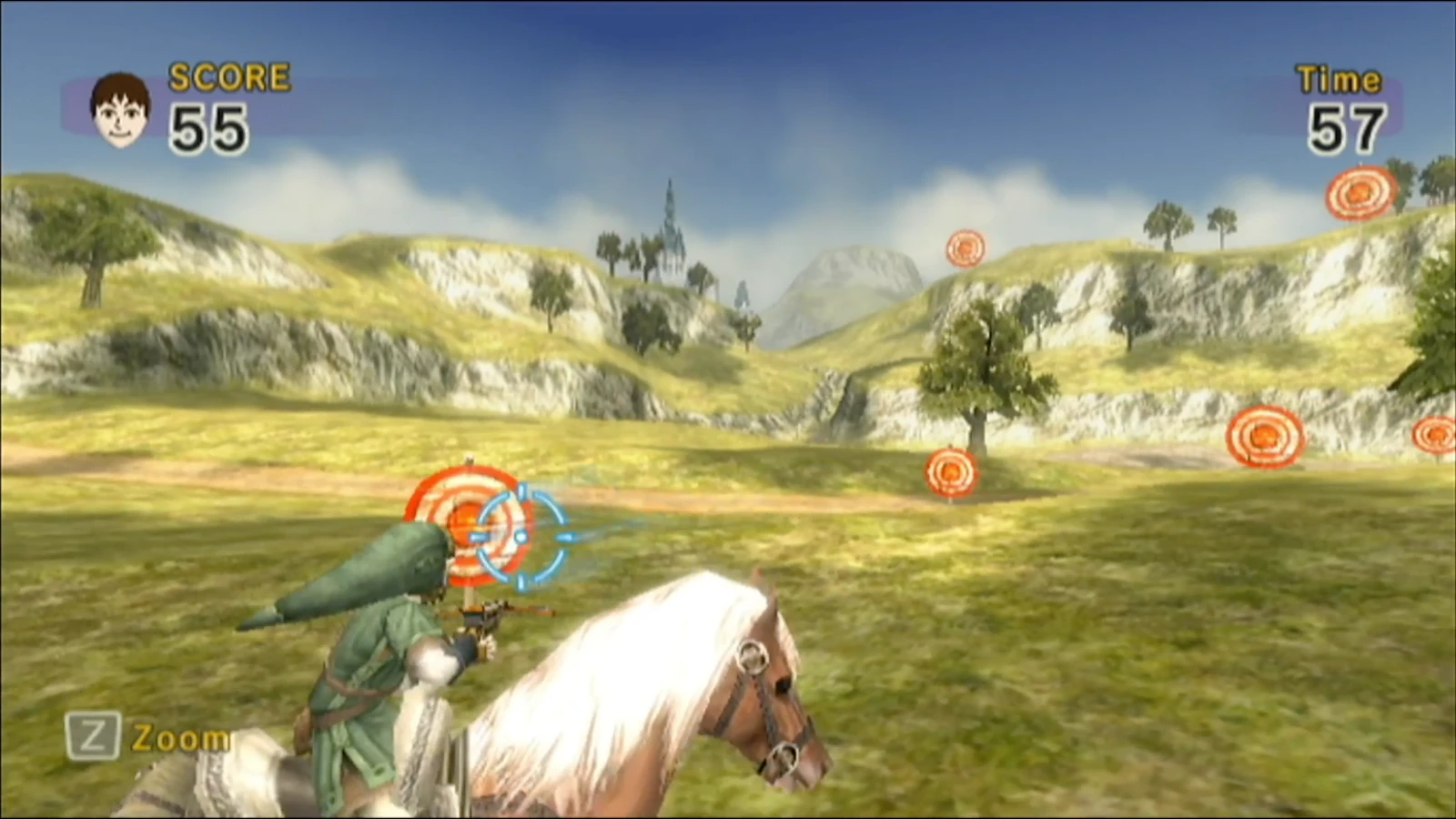
The first stage puts targets around Ordon Village, on the hill above Mayor Bo’s house and behind Jaggle’s, and the game ranges outwards from there much as Twilight Princess did. Kakariko Village gets a range that runs past the Elde Inn and Barnes’s bomb shop. The Gorons turn out for a target game of their own, rolling into place with boards on their bellies. Targets tumble down the waterfalls outside Zora’s Domain, and fruit-shaped balloons float up over Castle Town’s central square with Hyrule Castle behind them.
Several stages replay famous moments with a crossbow in place of a sword. A canoe ride down Zora’s River becomes a running fight with rock-spitting Toadpolis. Bridge of Eldin: Defender puts Link on the back of a moving carriage, an echo of the wagon escort that carried the sick Prince Ralis from Telma’s bar to Kakariko. Horseback Target Practice is a gallop across Hyrule Field on Epona. And The Shootout sends him back into the Hidden Village to clear out 25 Bulblins, a stage loosely based on the battle to reach old Impaz, and the scene Miyamoto singled out as his inspiration.
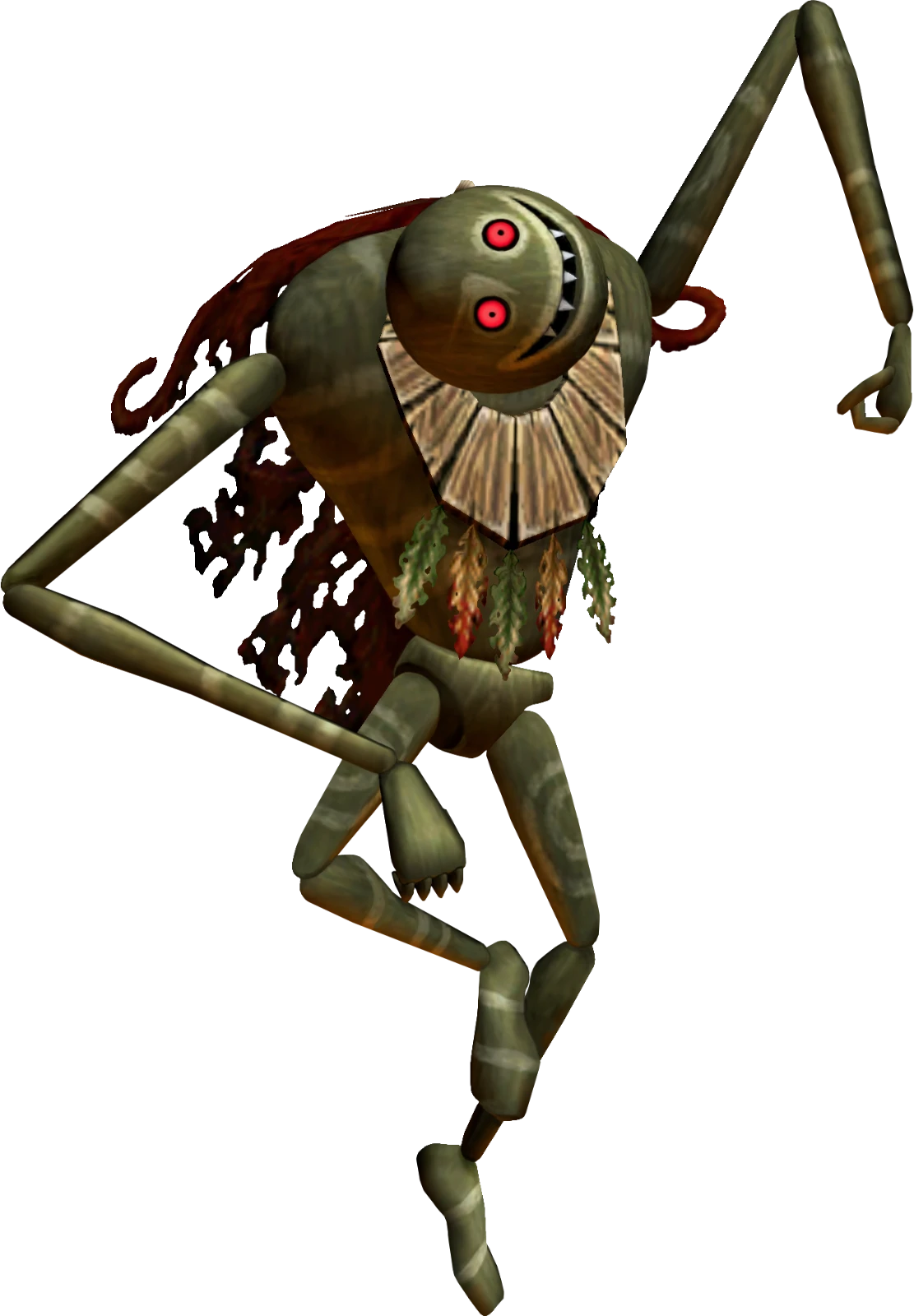
The dungeons are raided too. Link hunts Chilfos through Snowpeak Ruins, shoots targets in the depths of Arbiter’s Grounds, holds off the winged Aeralfos in the City in the Sky and works his way through the Temple of Time. The inhabitants have been recast to suit: the Oocca flap about carrying targets (do not shoot the Oocca), and Skull Kid sets his puppets on Link in the Sacred Grove.
Kakariko Target Practice.The Shootout, in the Hidden Village.Guarding the carriage in Bridge of Eldin: Defender.
The finale
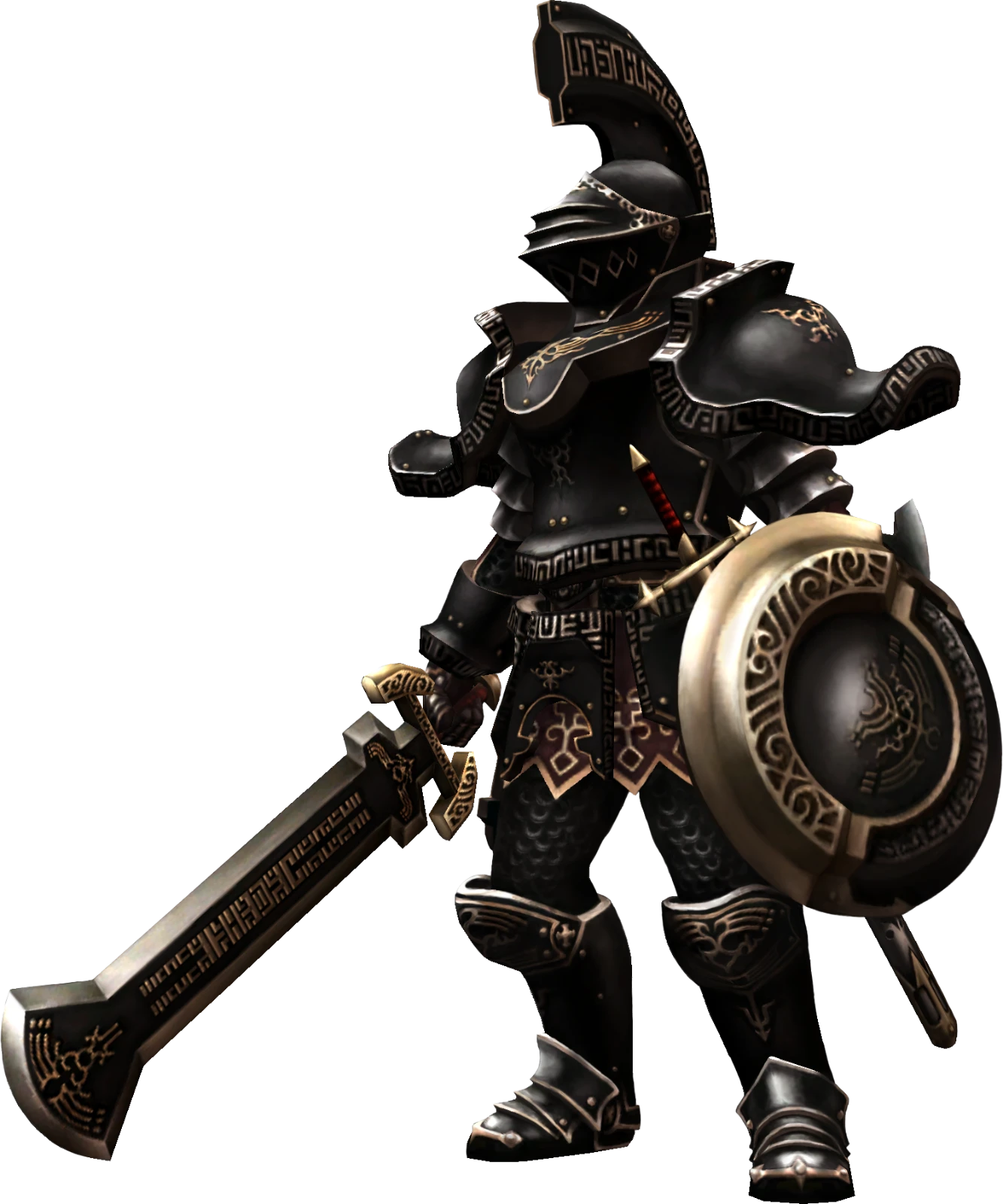
The nearest thing to a climax comes in the last two levels. Level 8 ends in the Temple of Time with a duel against a Darknut, the armoured knight who was that dungeon’s mini-boss in Twilight Princess. Link has 90 seconds to shoot the armour off him, and on this one stage a good score is not enough: fail to finish the knight and the level is failed.
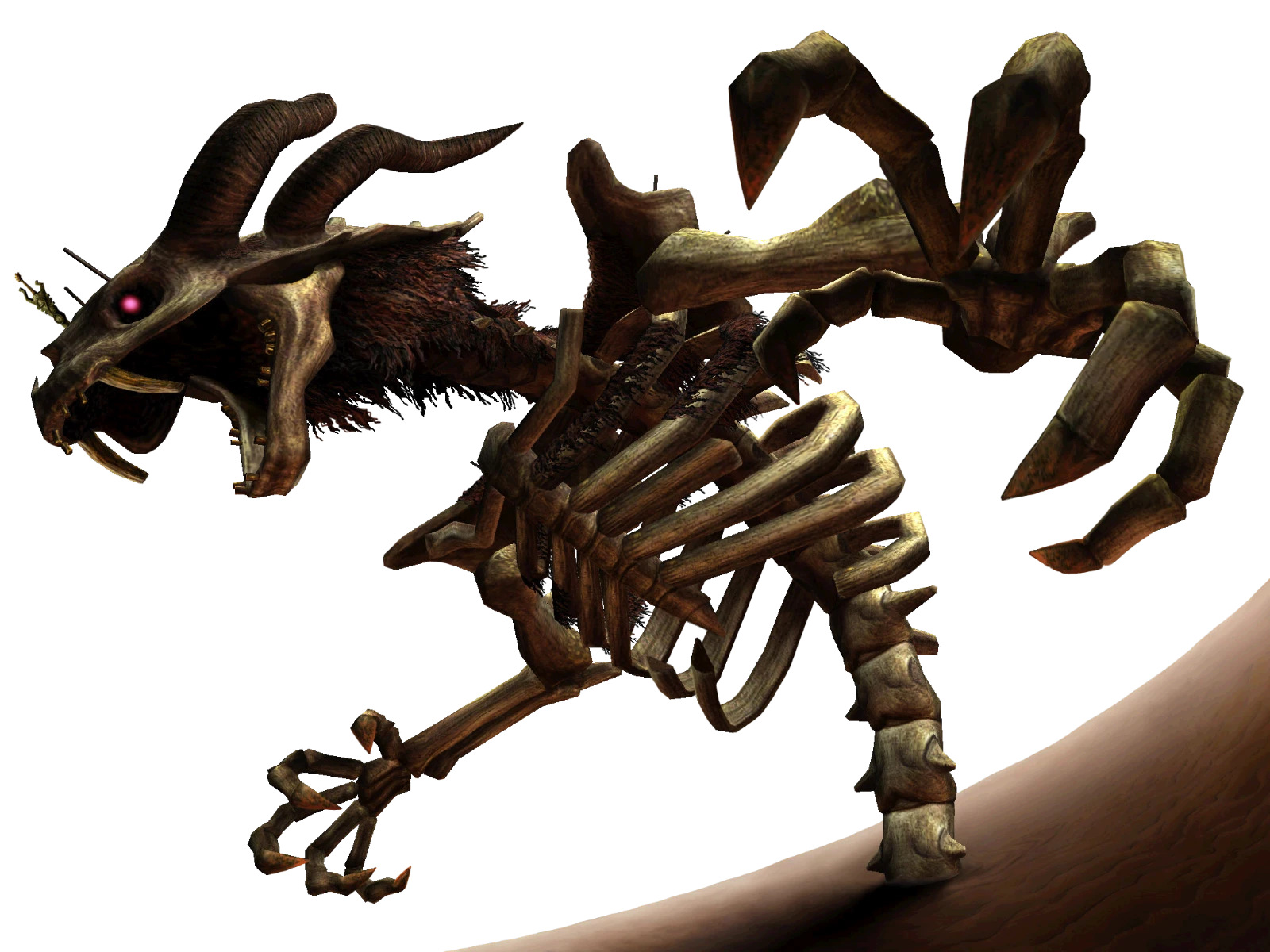
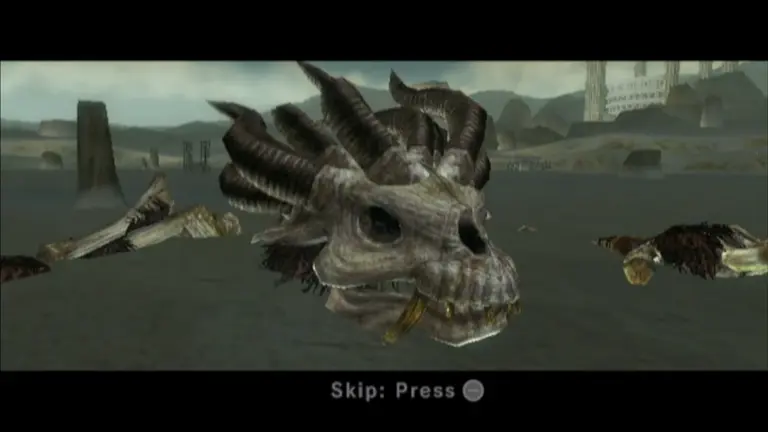
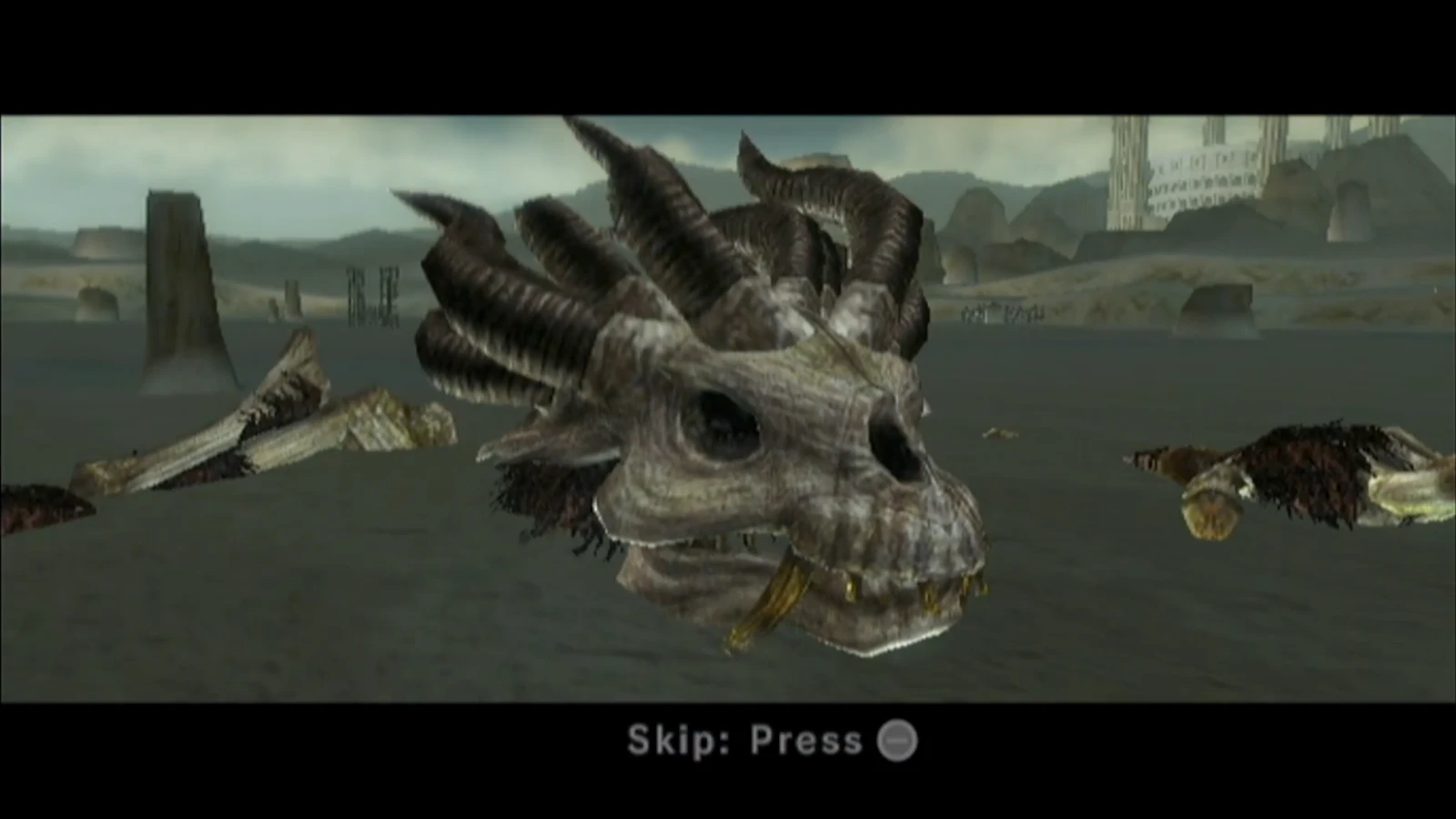
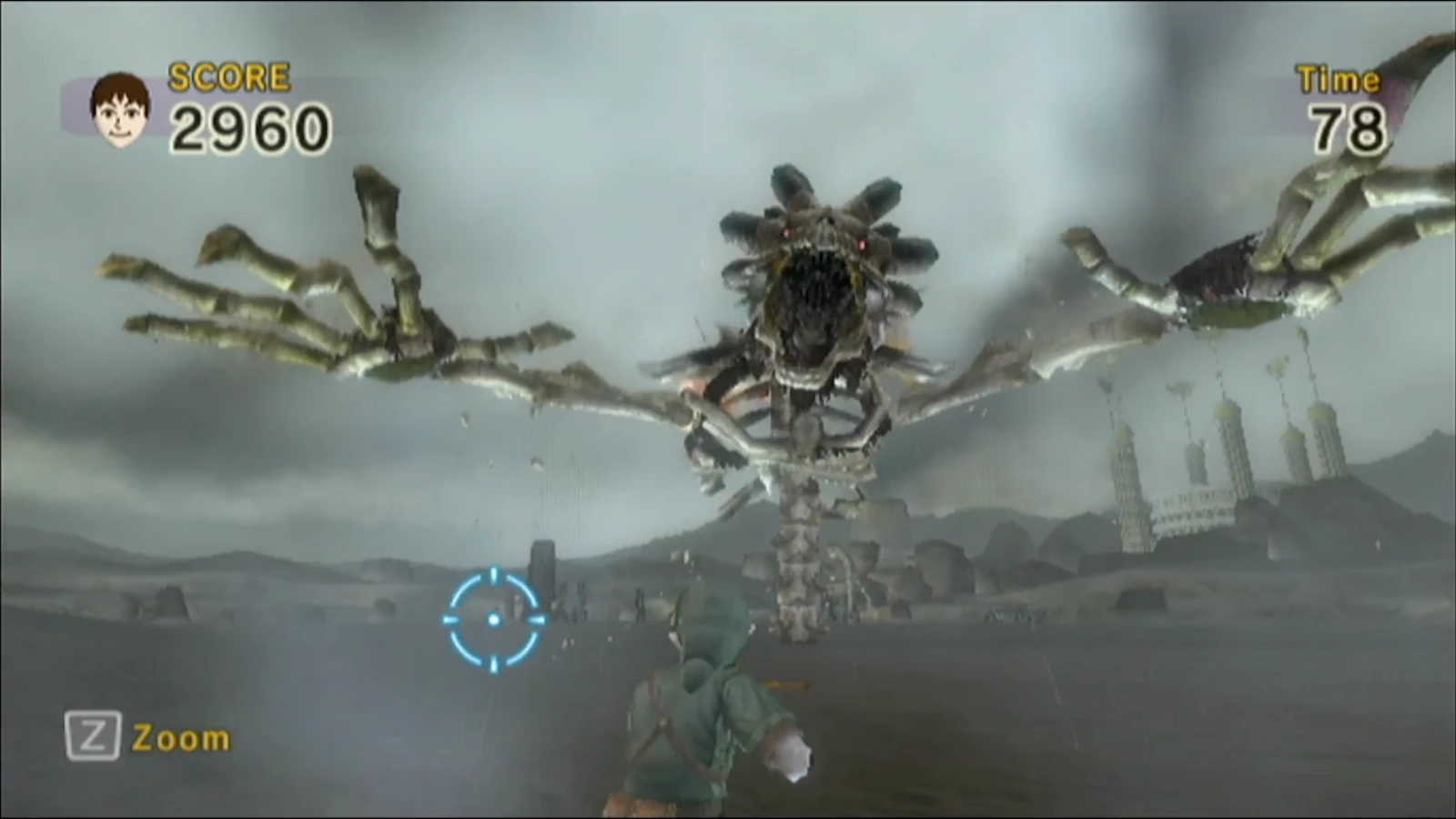
The ninth level, labelled Finale, starts by saving Ordon’s goats from Bokoblin rustlers, moves to the Sacred Grove for Skull Kid’s puppet show, and finishes in the desert against a Fossil Stallord, the skeletal monster of Arbiter’s Grounds brought back to life. “It’s the final battle!” says the stage card. “Crush the Fossil Stallord before time runs out!” Do it, collect your medal, and that is the game.
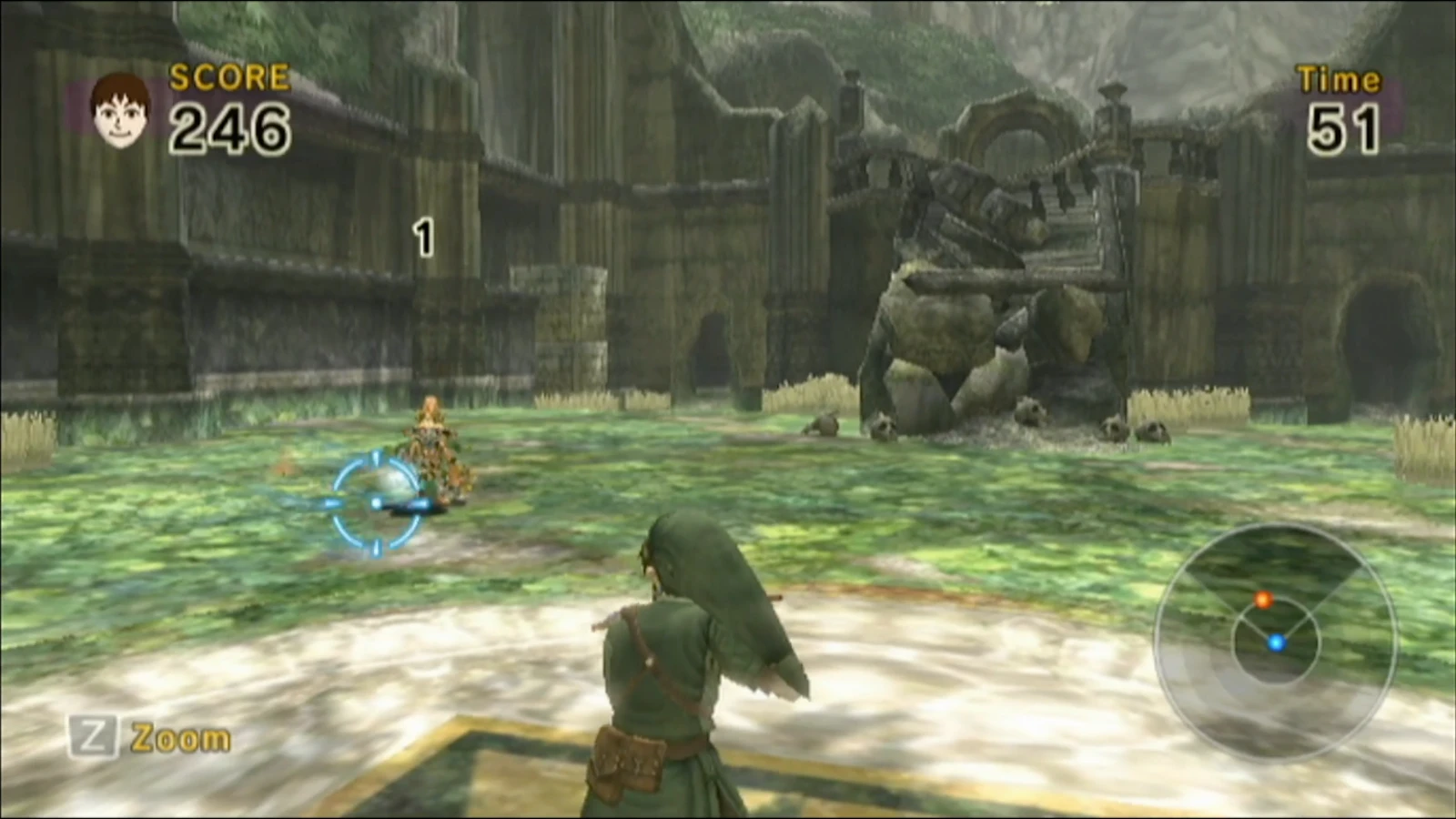
Skull Kid and his puppets in the Sacred Grove.The Fossil Stallord, the final boss.
All nine levels and 27 stages
Each level is three stages played back to back. Every level opens with a Target Shooting stage and includes a Defender stage, and the remaining slot is usually a Ranger stage. The names below are the North American ones. The European and Australian release renamed a good many stages, and those names are given where Zelda Dungeon’s wiki records them.
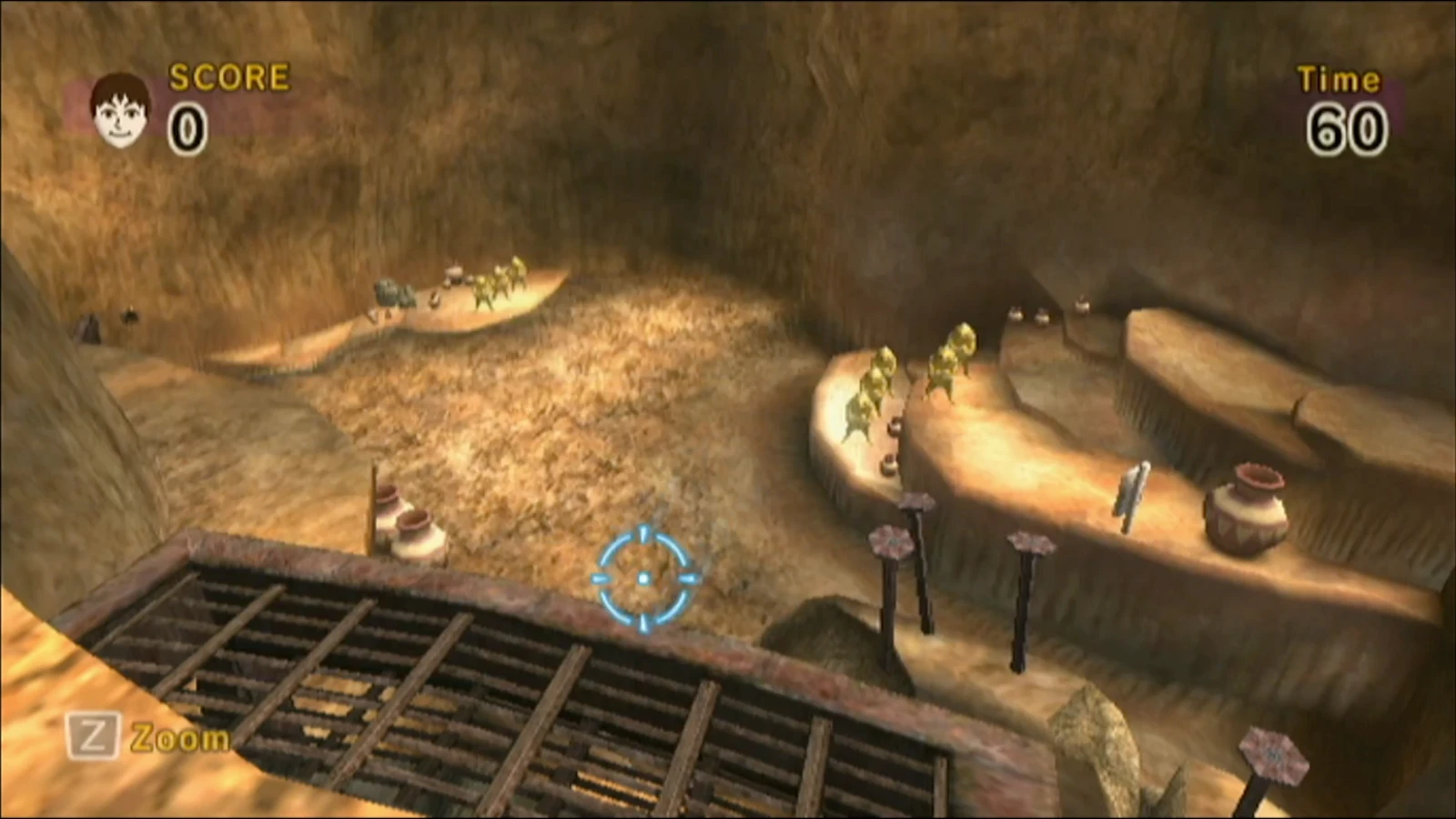
Level 1Ordon Target Practice · Gerudo Stalfos: Defender · Arbiter’s Grounds: RangerA gentle start: pop-up bull’s-eyes around Ordon Village, a minute of Stalfos climbing out of the Gerudo Desert sand, then a raid on a Bulblin hideout to defeat 25 of them, archers on scaffolds included. In Europe the second and third stages are Gerudo Stalfos Ambush and Bulblin Hideout Raid.
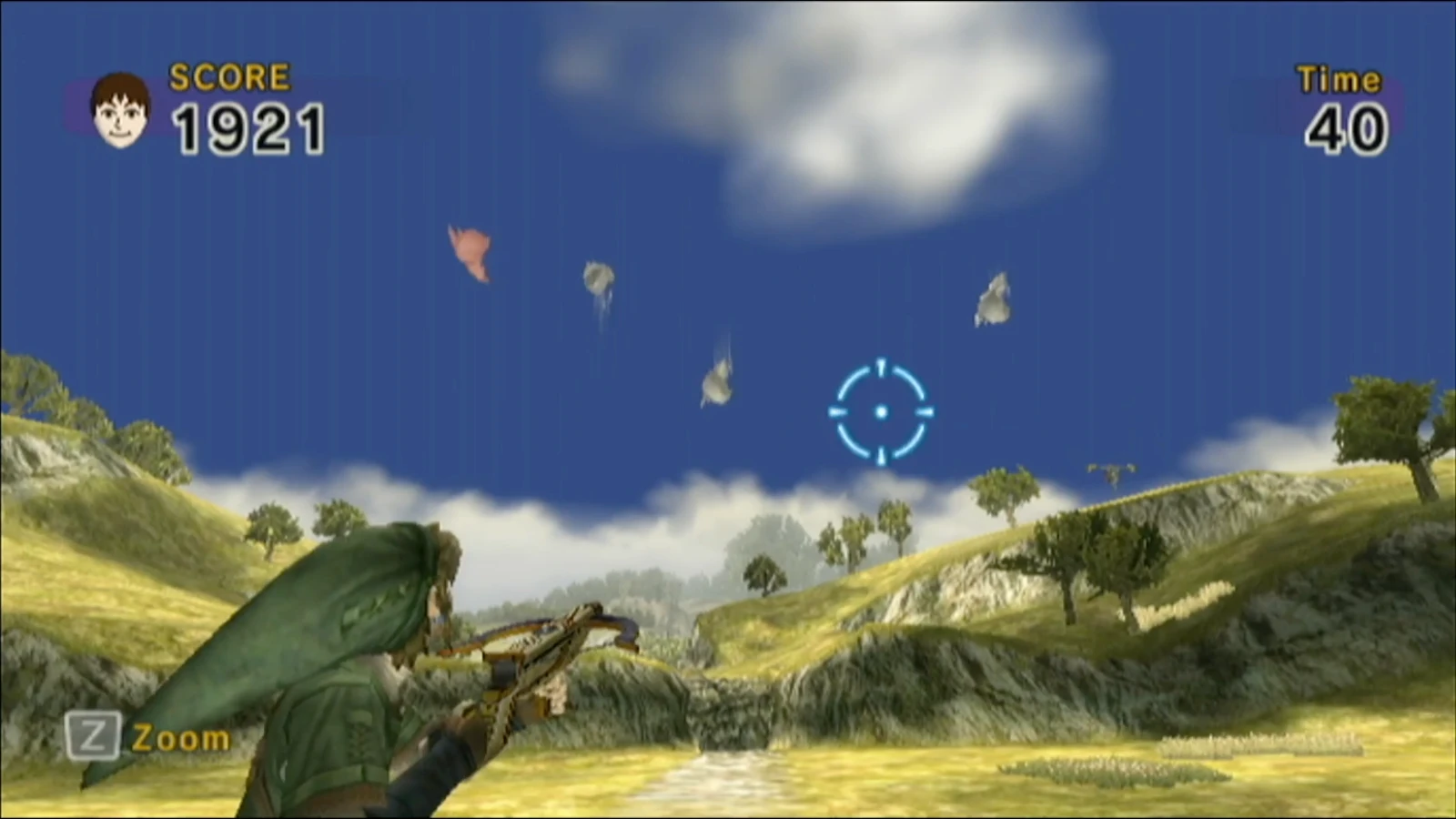
Level 2Goron Target Practice · Zora River: Defender · Skull ShootingGorons roll out holding targets, some marked with a blue X that costs 100 points. Then a canoe trip down Zora’s River under fire from Toadpolis and Tektites, and a round of clay-pigeon shooting with flung skulls: 50 points for a grey one, 100 for a red. European names: The Gorons’ Target Game and Battle on Zora’s River.
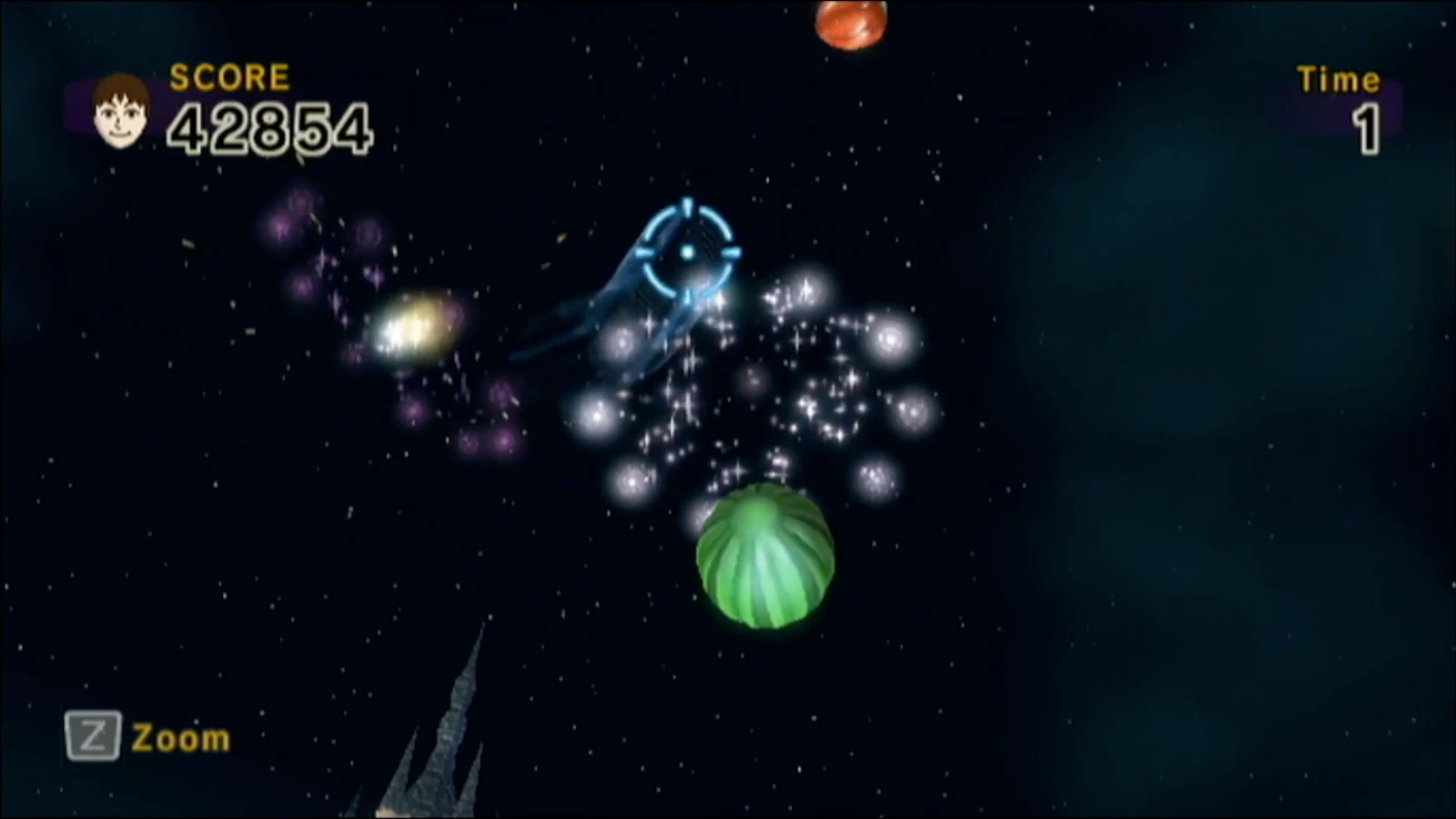
Level 3Kakariko Target Practice · Fruit Balloons · The Great Bridge: DefenderTargets through Kakariko Village; watermelon balloons over Castle Town that burst into oranges and then strawberries, with the odd 300-point meteorite; and a swarm of Kargaroks dive-bombing the Great Bridge of Hylia (Kargarok Assault in Europe).
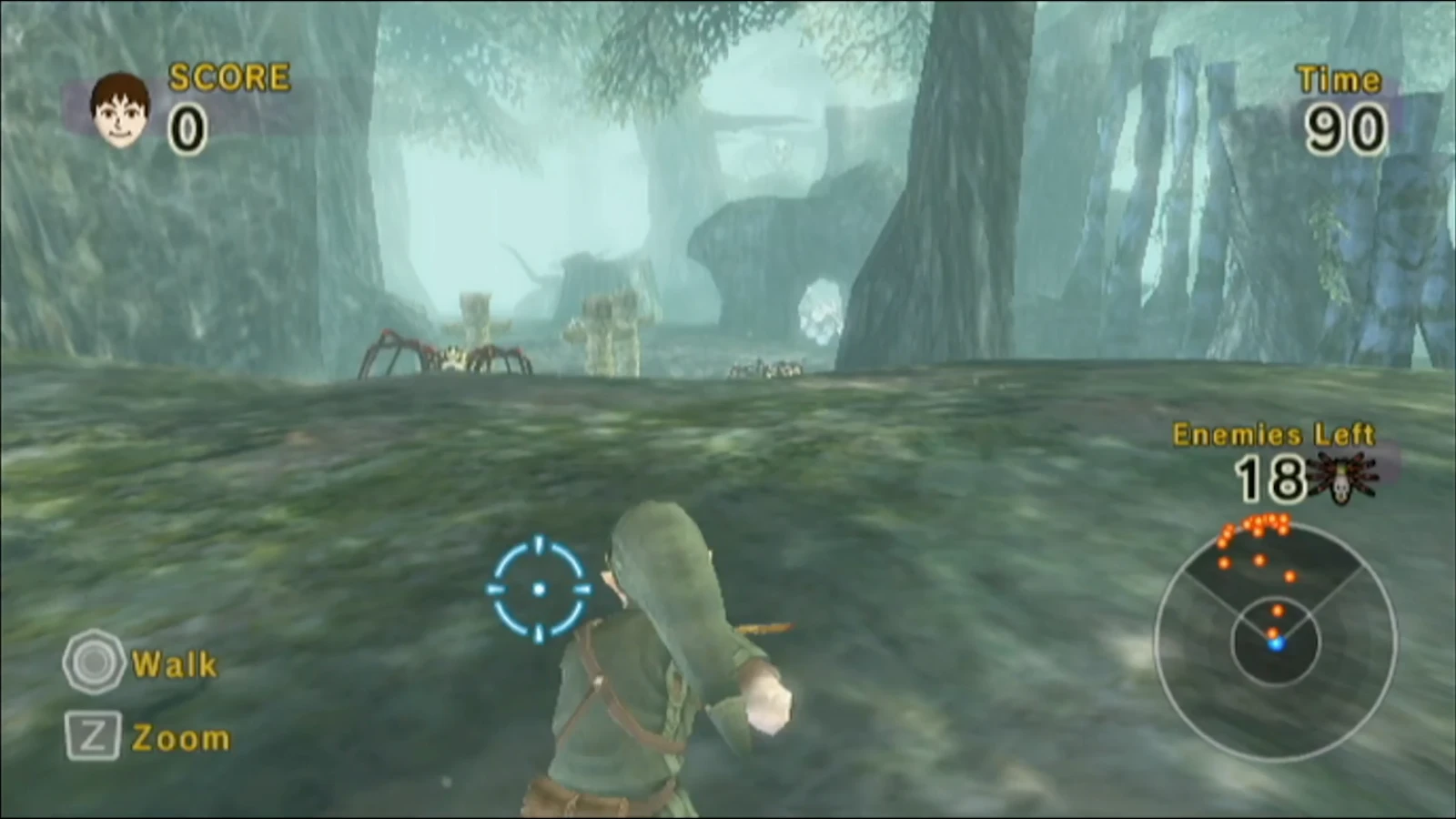
Level 4Zora River Target Practice · Hyrule Castle: Defender · Skulltula Forest: RangerTargets ride the waterfalls outside Zora’s Domain, Keese and Stalfos haunt the Hyrule Castle graveyard, and 18 Skulltulas lurk on the ground, the walls and the branches of a forest. The first two are Zora’s Waterfall Challenge and Graveyard Ambush in Europe.
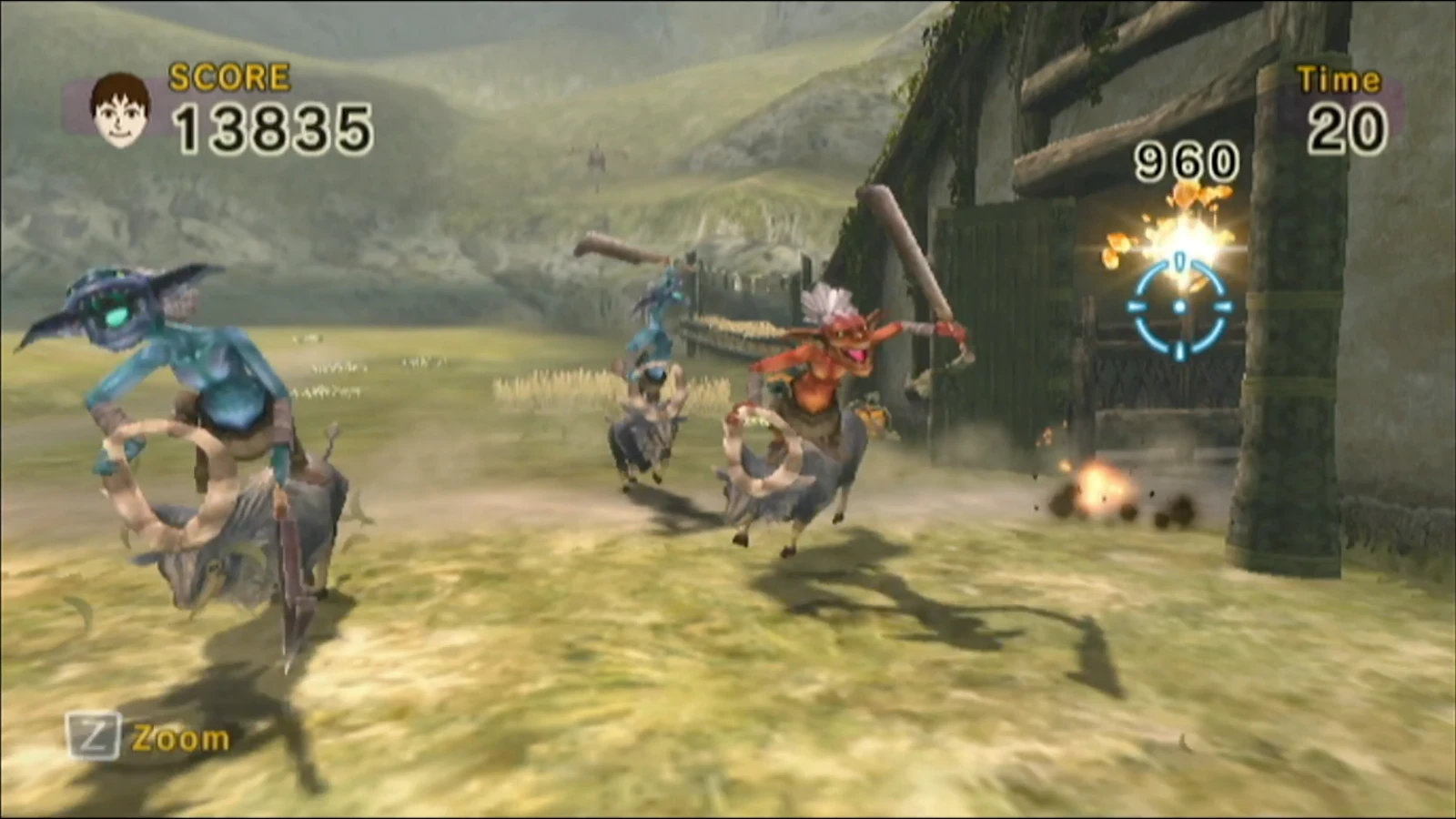
Level 5Oocca Target Practice · Gerudo Moldorm: Defender · The ShootoutIn the City in the Sky the Oocca carry the targets, and hitting a bird instead costs points. Moldorms burst out of the desert floor while Leevers circle. Then the western: 25 Bulblins holed up in the Hidden Village, some behind windows you have to shoot out first. Europe calls it Kakariko Shootout.
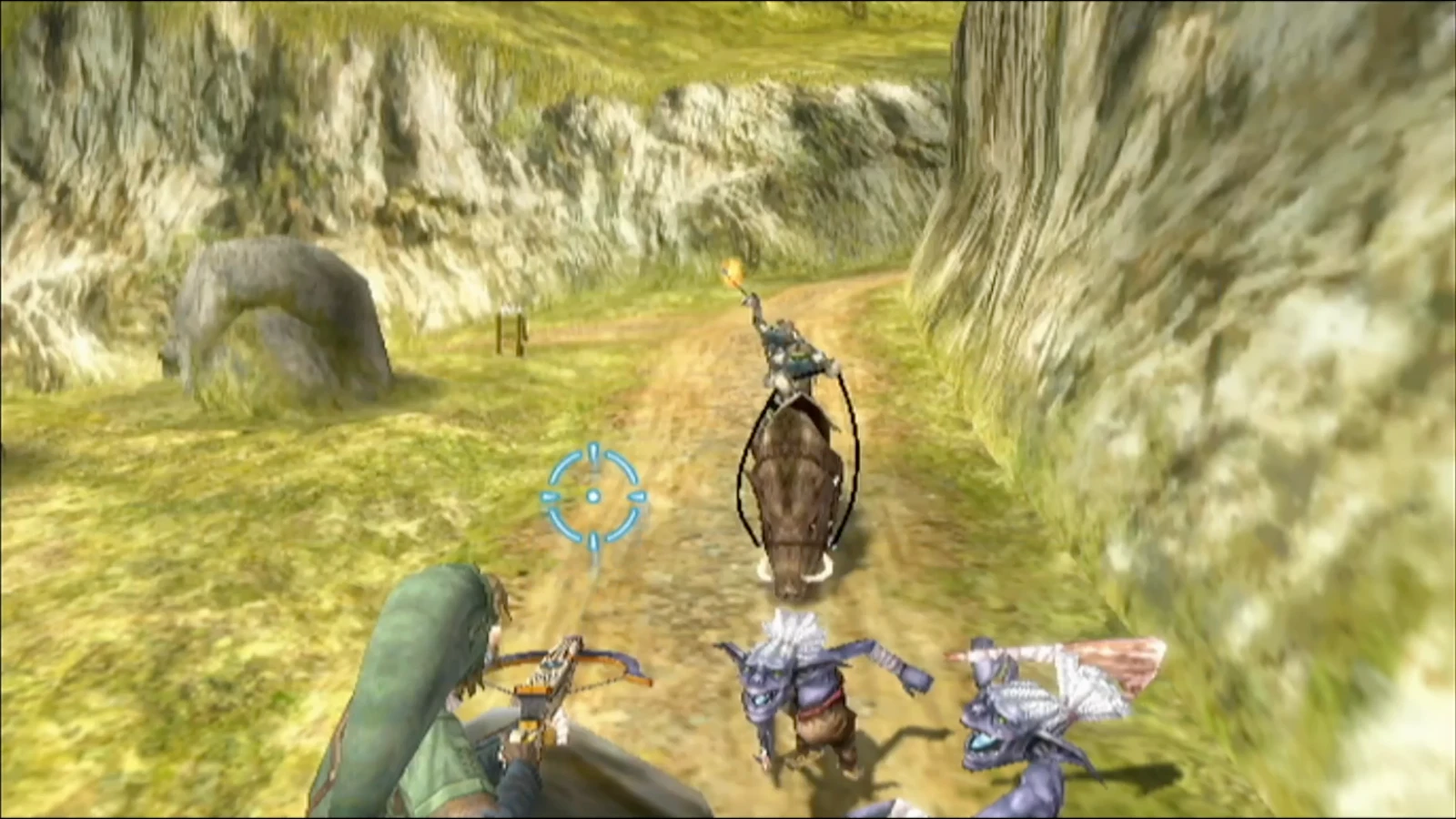
Level 6Ordon Target Practice 2 · Bridge of Eldin: Defender · Snowpeak Ruins: RangerOrdon again, this time in one unbroken camera sweep. A carriage to protect from Bokoblins, Kargaroks and Bulblins riding boars two at a time. And 25 spear-carrying Chilfos to find in Snowpeak Ruins, where a blocked shot scores a single point. European names: Back to Ordon Target Range, Carriage Escort and Snowpeak Ruins Encounter.
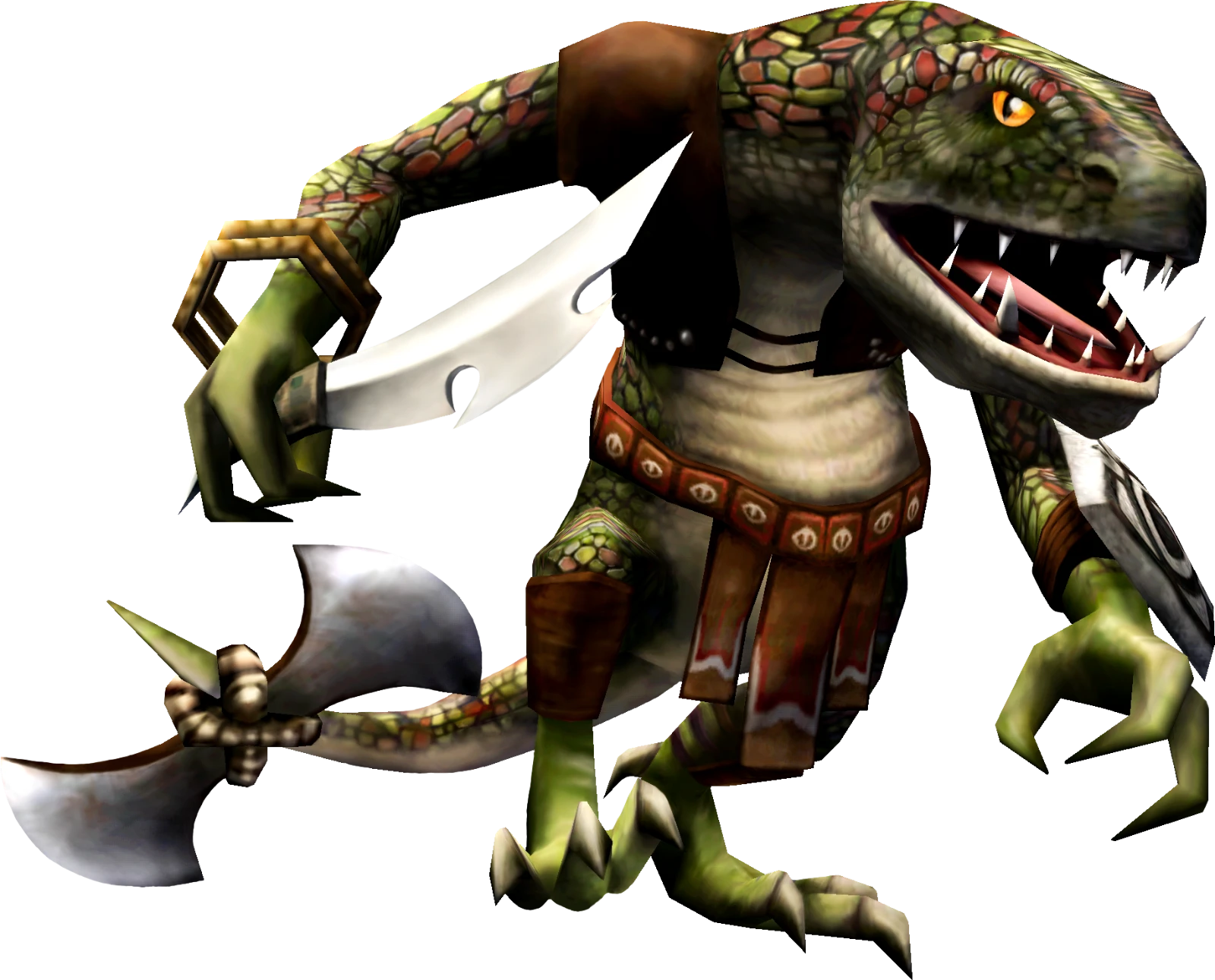
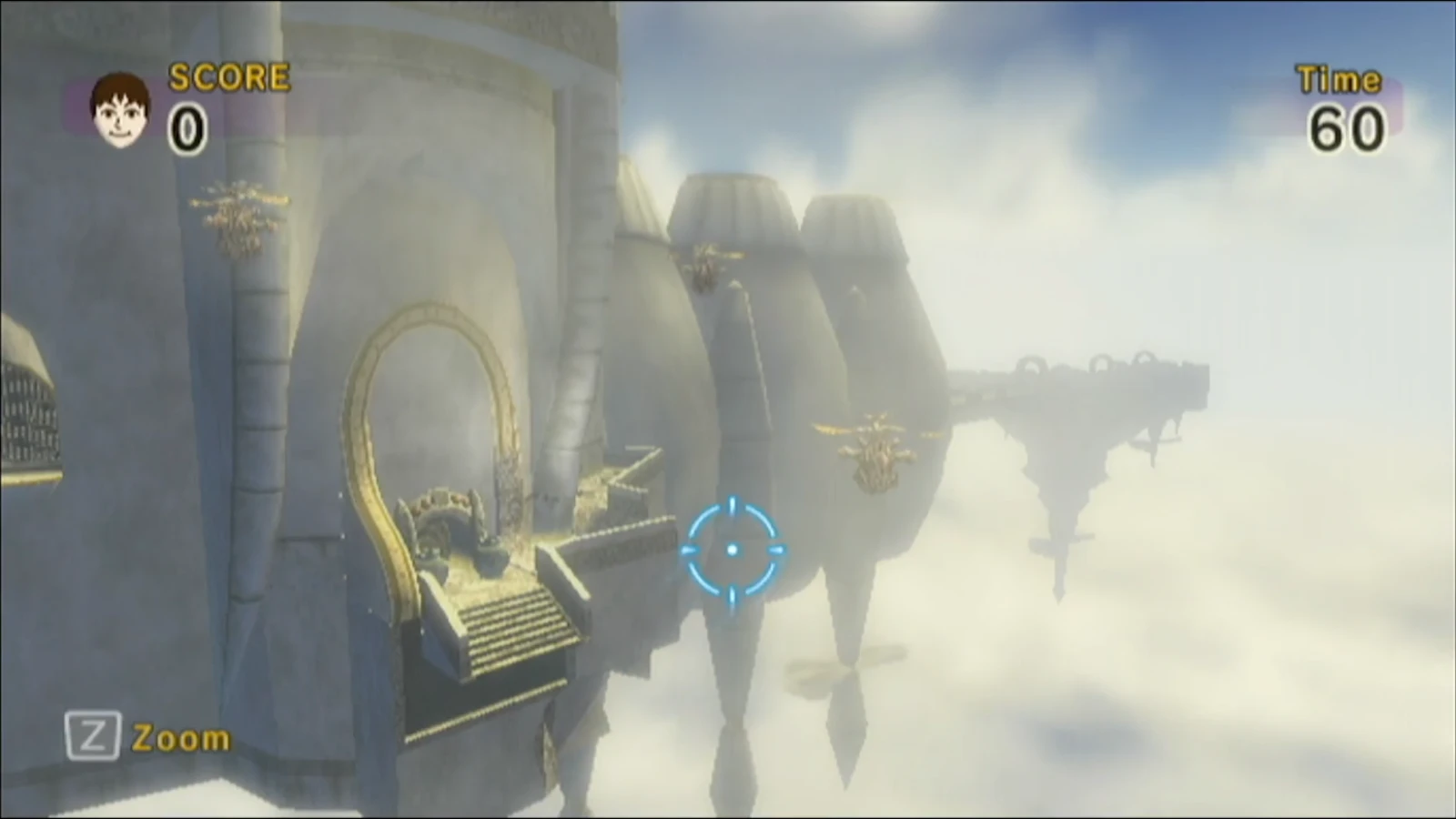
Level 7Underground Target Practice · City in the Sky: Defender · Temple of Time: RangerA target range in the gloom of Arbiter’s Grounds; Aeralfos that attack on foot behind shields and then from the air; and a march through the Temple of Time against 18 Lizalfos and Dynalfos, with Beamos statues and Keese in the way. In Europe: Underground Target Range and City in the Sky Defence.
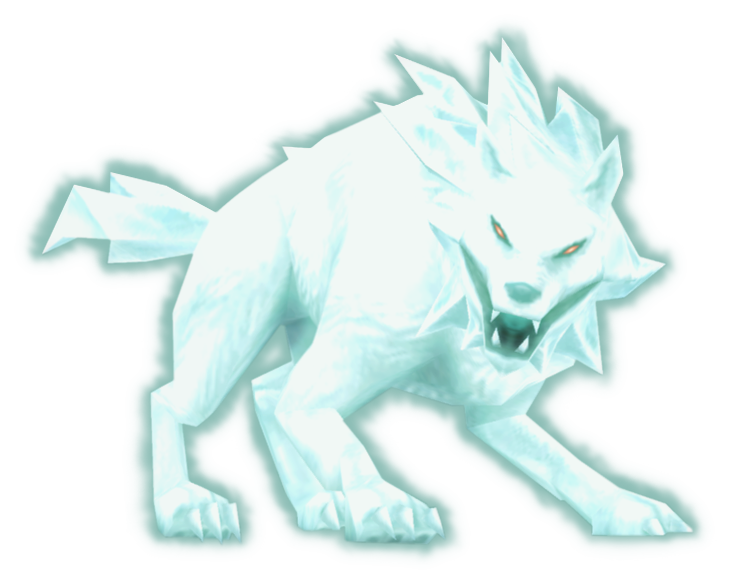
Level 8Horseback Target Practice · Snowpeak Ruins: Defender · Darknut BattleLink rides Epona across Hyrule Field shooting as he goes (Horseback Target Run in Europe), stands his ground against packs of White Wolfos on Snowpeak, and fights the Darknut in the Temple of Time: 90 seconds, and it has to be beaten.
Level 9: FinaleRanch Target Practice · Sacred Grove: Defender · Fossil Stallord BattleNo bull’s-eyes this time: the “targets” on Ordon Ranch are Bokoblins after the goats. Skull Kid’s Puppets come next, and the Fossil Stallord is the last stage of all. The first two are Ordon Ranch Defence and Sacred Grove Puppet Battle in Europe.
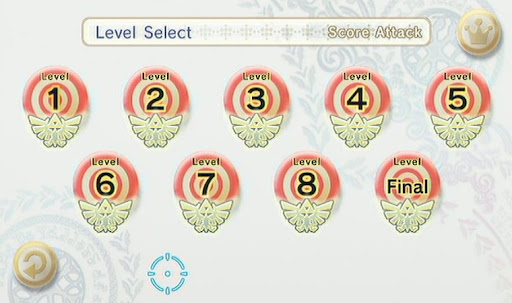
Levels 1 and 2 are open from the start. Each of the others unlocks when you earn a medal on the level before it, and a stage becomes available in Practice and Multiplayer once you have played it in Score Attack.
How it plays
Link’s Crossbow Training is a score-attack game. You point the Zapper at the television, a crosshair follows your aim, and the trigger looses a bolt. Being hit costs you points, a stage normally runs until its clock reaches zero, and what matters is the score you have when it does.
The main mode is Score Attack, in which you pick one of the nine levels and play its three stages in order for a combined score. Practice lets you replay any single stage you have unlocked, and Multiplayer turns the stages into a pass-the-gun contest.
Stage type
What you do
How it controls
Target Shooting (11 stages)
Shoot bull’s-eyes, skulls, balloons or Bokoblins as the camera carries you along, usually through three 20-second scenes.
Aim and fire only. The view, usually through Link’s eyes, moves by itself.
Defender (10 stages)
Hold your ground while enemies come at Link from all sides. Every hit you take costs 100 points.
Link cannot walk. Point the Zapper past the edge of the screen to turn, and watch the radar.
Ranger (6 stages)
Hunt down a set number of enemies, such as 25 Bulblins or 18 Skulltulas, in an area you can explore.
Third-person view. The Nunchuk’s Control Stick moves Link while the Zapper aims.
The Zapper and the controls
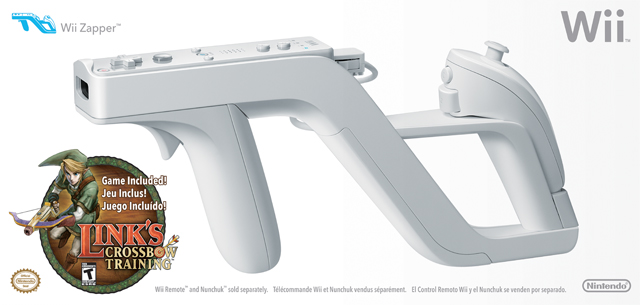
The Wii Zapper has no electronics in it. The Wii Remote clips into the barrel, the Nunchuk sits in the rear grip, and the Zapper’s trigger simply presses the Remote’s B Button. This is not a light gun of the kind the NES had: you steer a cursor on the screen with the Remote’s pointer instead of sighting down the barrel. Nintendo Life admitted that this “sounds quite naff” but “actually works pretty well”.
Pull the trigger to fire, as fast as you like. Hold it and let go, and Link looses a charged bolt that explodes like a Bomb Arrow, slower but far more powerful. The Nunchuk’s Z Button zooms in, much as the Hawkeye did in Twilight Princess, which is the only sensible way to hit the farthest targets. The A Button pauses, and the pause menu lets you recalibrate the cursor’s height and speed.
Because the shell is only a holder, the game runs perfectly well with a Remote and Nunchuk held normally, and VideoGamer’s reviewer preferred it that way. The box contains one Zapper and the disc; the controllers are not included.
Three kinds of stage
Target Shooting is the fairground game. The camera stops at three spots for 20 seconds each, a whistle marks the end of each one, and targets pop up, slide about or fly past. Later ranges swap the bull’s-eyes for skulls hurled into the air, fruit balloons, targets carried by Oocca and, in the Finale, Bokoblins.
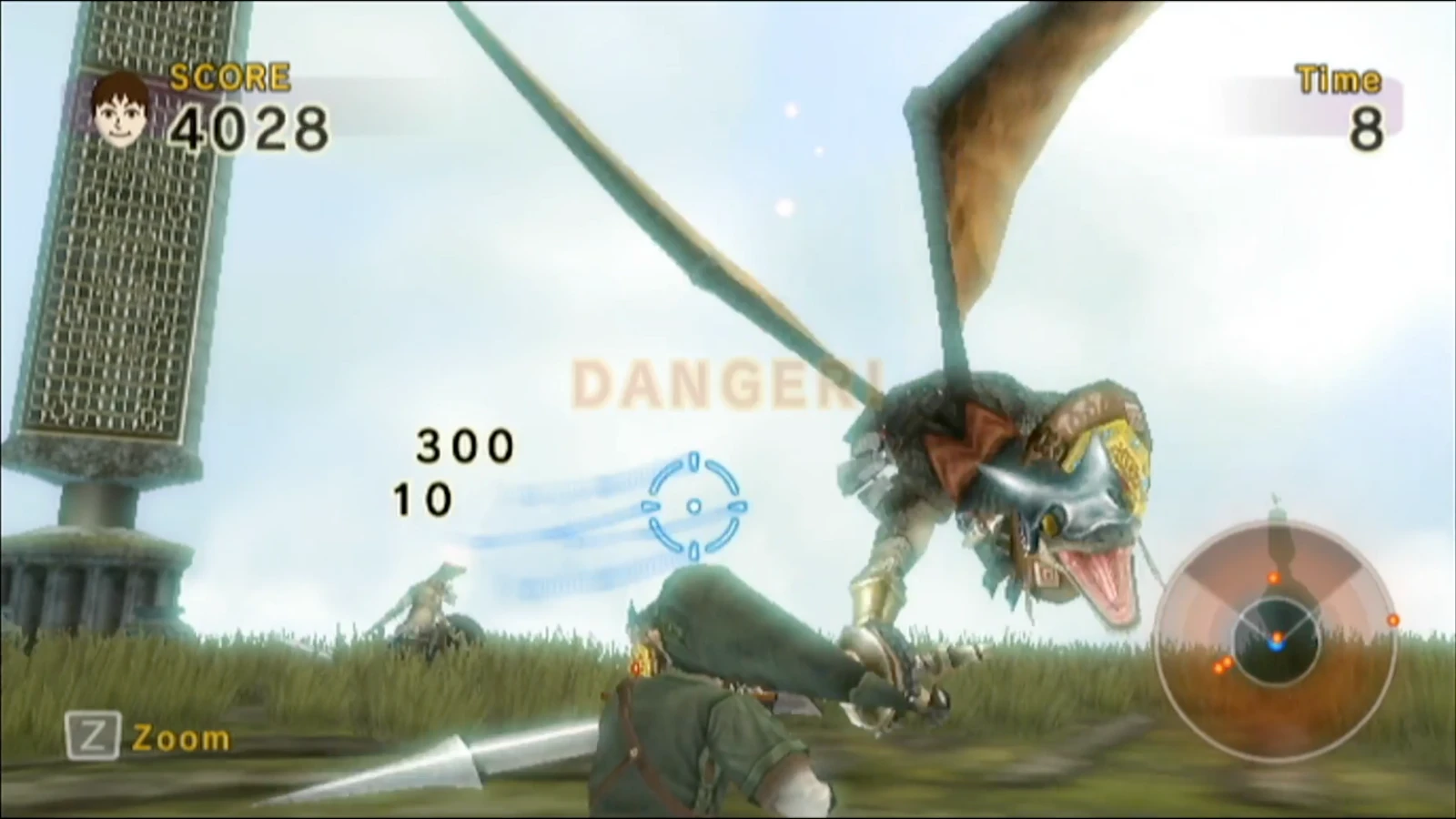
Defender plants Link on one spot, or on a canoe or a carriage that moves by itself, and sends enemies at him from every direction. Aiming off the side of the screen swings the view round, and a radar shows what is coming. Getting hit takes 100 points off your score and wipes out your combo.
Ranger is the one that feels like a real action game. Link walks freely, in a third-person view that Nintendo Life compared to Resident Evil 4, and has to find and defeat a fixed number of enemies before the clock runs out. Any time left over can be spent shooting the scenery for extra points. The two boss fights do not fit the pattern neatly, and the fan wikis disagree about how to file the Stallord battle; the Zelda Wiki on Fandom counts 11 Target Shooting, 10 Defender and 6 Ranger stages.
Target Shooting: avoid the blue X targets.Defender: the canoe ride down Zora’s River.Ranger: hunting Chilfos in Snowpeak Ruins.
Scoring and combos
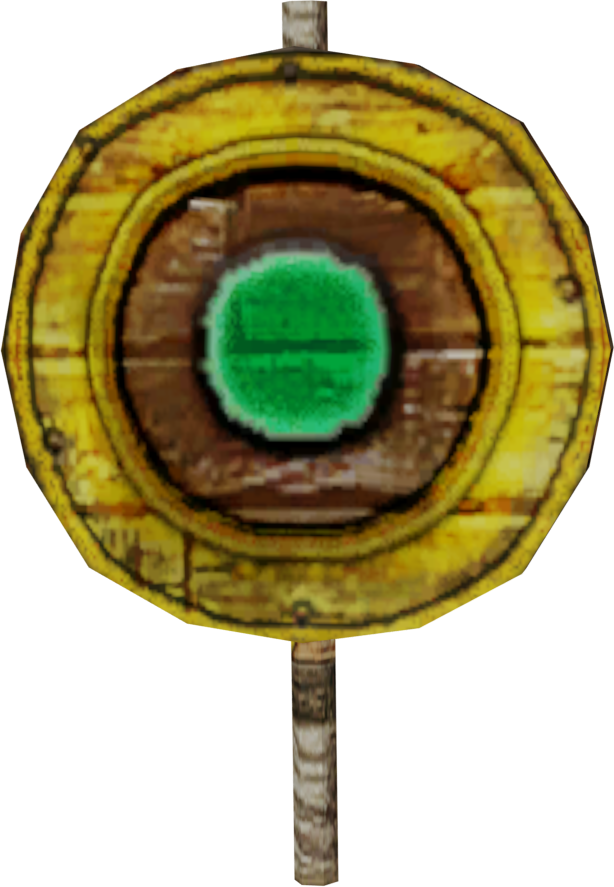
Model of a gold target, the most valuable kind.
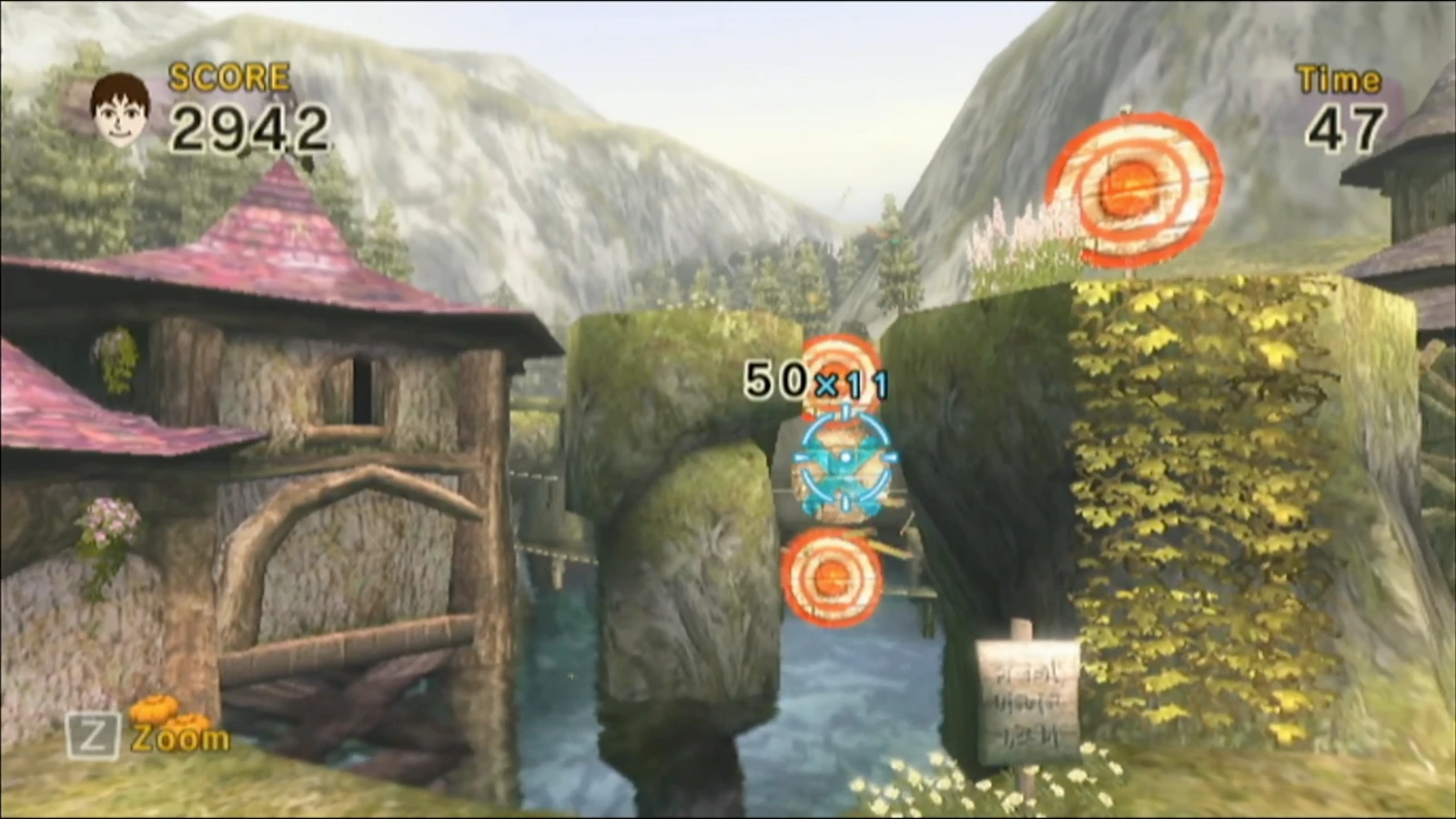
The whole game hangs on the multiplier. Each hit on the stage’s proper targets raises it by one, and the next hit is worth its points times that number. Miss once and it drops back to one. There is no upper limit, so a clean run through a stage is worth many times more than a scrappy one that hits just as many targets.
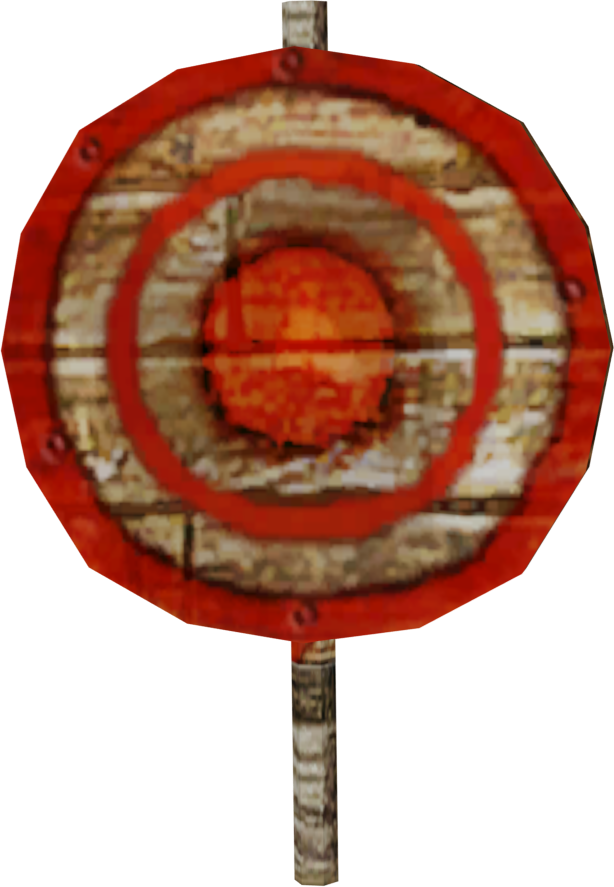
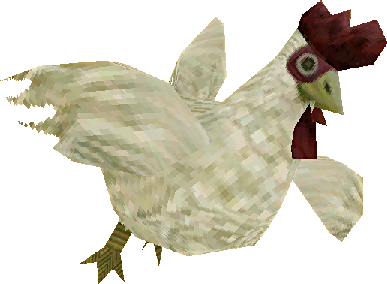
Accuracy counts as well. An ordinary red target pays 10 points at the rim and 30 in the centre; the rarer gold ones pay 50 and 150. Blue targets marked with an X take 100 points away and reset the multiplier, and shooting a Cucco or an Oocca costs 100 points too.
Almost everything else on screen can be shot for small change: pots, jars, barrels, skulls, signs, windows, even the pumpkins at Link’s feet in Ordon. These do not raise the multiplier, but they do not break it either, and some of them hide much bigger prizes.
Medals and unlocking
Platinum medals on every level.
A level’s three scores are added up and the total earns a medal: bronze at 20,000 points, silver at 40,000, gold at 60,000 and platinum at 80,000. Any medal unlocks the next level, so a bronze is all you need to keep moving. The game keeps a high-score table for each player, and according to Nintendo World Report up to eight Miis can be registered, each with their own records.
Bronze medals come easily, which is why most reviews called the game short. Platinum is another matter. It demands long unbroken combos and a working knowledge of every stage’s secrets, and it is where the game’s real lifespan lies.
Multiplayer and Practice
Two to four players can compete, but not at the same time. Everyone shares one Zapper, picks a stage and plays it in turn, and the highest score wins a star. You can keep going for as long as you like, though nothing is saved once you leave the mode. Critics were unimpressed: Nintendo World Report said it “misses on almost every level”, since most of the players spend most of the time watching, and Eurogamer thought it lacked substance.
Practice is the solo equivalent: any stage you have unlocked, on its own, with a separate best score kept for each.
Characters
Only one person is playable in Link’s Crossbow Training, but plenty of Twilight Princess’s cast turn up as targets, helpers or trouble.
Character
Who they are
In this game
Stats & abilities
LinkThe only playable character
The hero of Twilight Princess, looking just as he did there. Here he carries a crossbow, a weapon that is nowhere in that adventure’s inventory.
Takes on 27 shooting tests across Hyrule. Miyamoto called him the logical choice for a shooting game, and gave him a crossbow because Link does not use guns.
Rapid-fire crossbow
Charged shot that explodes
Zoom on the Z Button
Automatic fire for 100 shots after defeating a glowing green enemy
EponaLink’s horse
Link’s mare from Twilight Princess.
Carries him across Hyrule Field in Horseback Target Practice, a Target Shooting stage that shows Link in the saddle instead of looking through his eyes.
Not controlled by the player: she follows a set route.
The GoronsTarget holders
The rock-eating mountain people of Death Mountain.
In Goron Target Practice they roll into view and unroll with a target on their stomachs: three in the first scene, five in the second and seven in the third.
Red and gold targets score; blue X targets cost 100 points.
The OoccaSky people
The odd, human-faced birds who live in the City in the Sky.
Flutter about carrying targets in Oocca Target Practice. The stage card warns: “Be careful not to shoot the Oocca!”
Hitting one costs points.
Skull KidImp of the Sacred Grove
The imp who guards the way to the Master Sword in Twilight Princess’s Sacred Grove.
Sends waves of wooden Puppets at Link in Sacred Grove: Defender, the second stage of the Finale. He can be shot too, and when he glows green he hands over the automatic crossbow.
Each Puppet takes two hits.
The scarecrowsThe game’s running secret
A scarecrow is tucked away somewhere in a great many stages, sometimes behind Link, sometimes on a far-off ledge.
Shoot its body eight times and its head swells up; shoot the head and it is worth 1,000 points. In several Target Shooting stages doing this twice opens a secret final scene.
Every monster is borrowed from Twilight Princess. These are the ones the stages are built around, in the order you meet them.
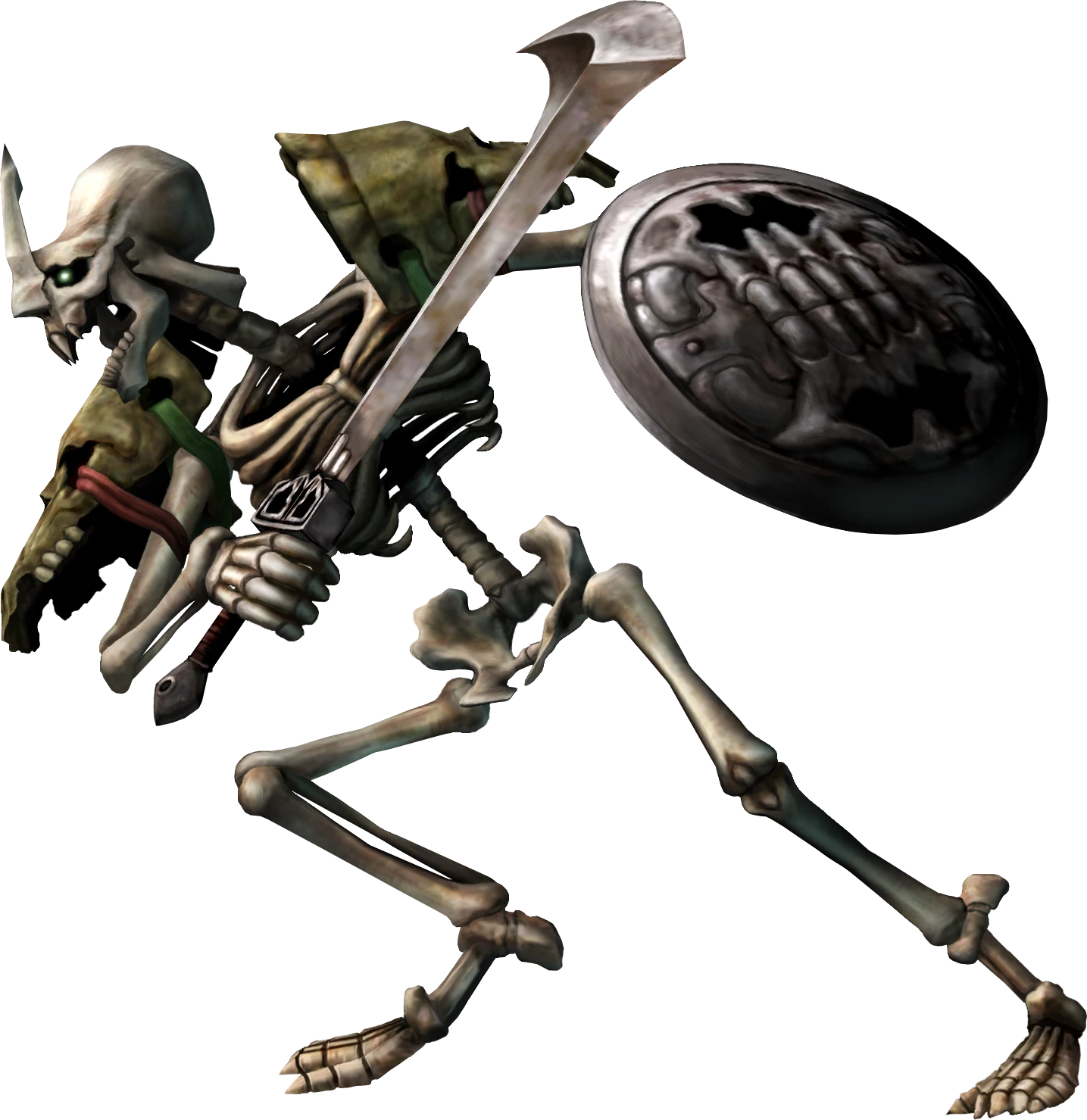
StalfosLevel 1 · Gerudo Stalfos: DefenderSkeleton soldiers that climb out of the sand, some carrying shields. A large glowing green one grants the automatic crossbow.
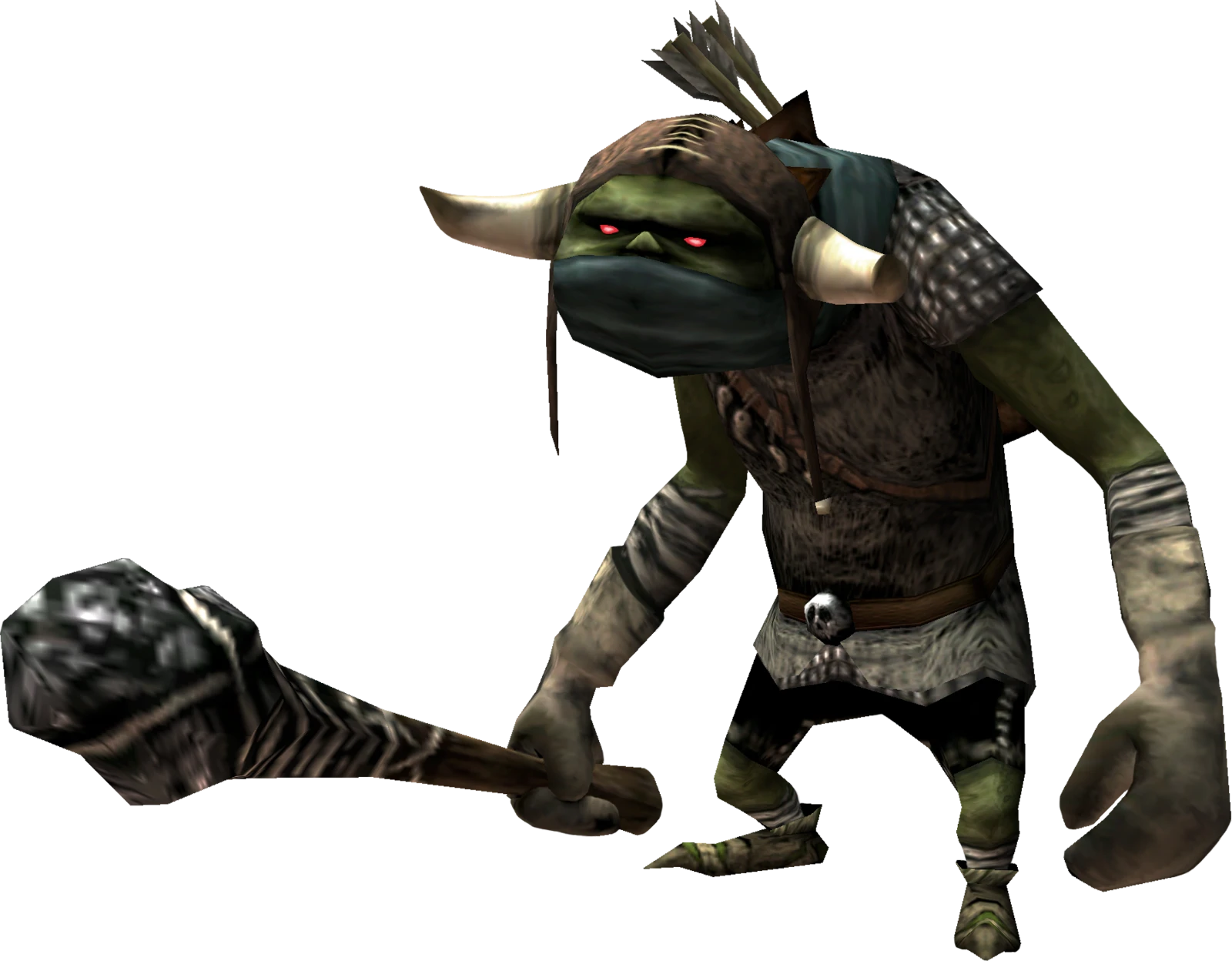
BulblinsLevels 1, 5 and 6The green raiders of Twilight Princess, on foot, on rooftops, on scaffolds with fire arrows and, on the carriage run, riding boars in pairs.
Toadpolis and TektitesLevel 2 · Zora River: DefenderToadpolis rise from the river and spit rocks, which can be shot out of the air. Red Tektites leap at the canoe.
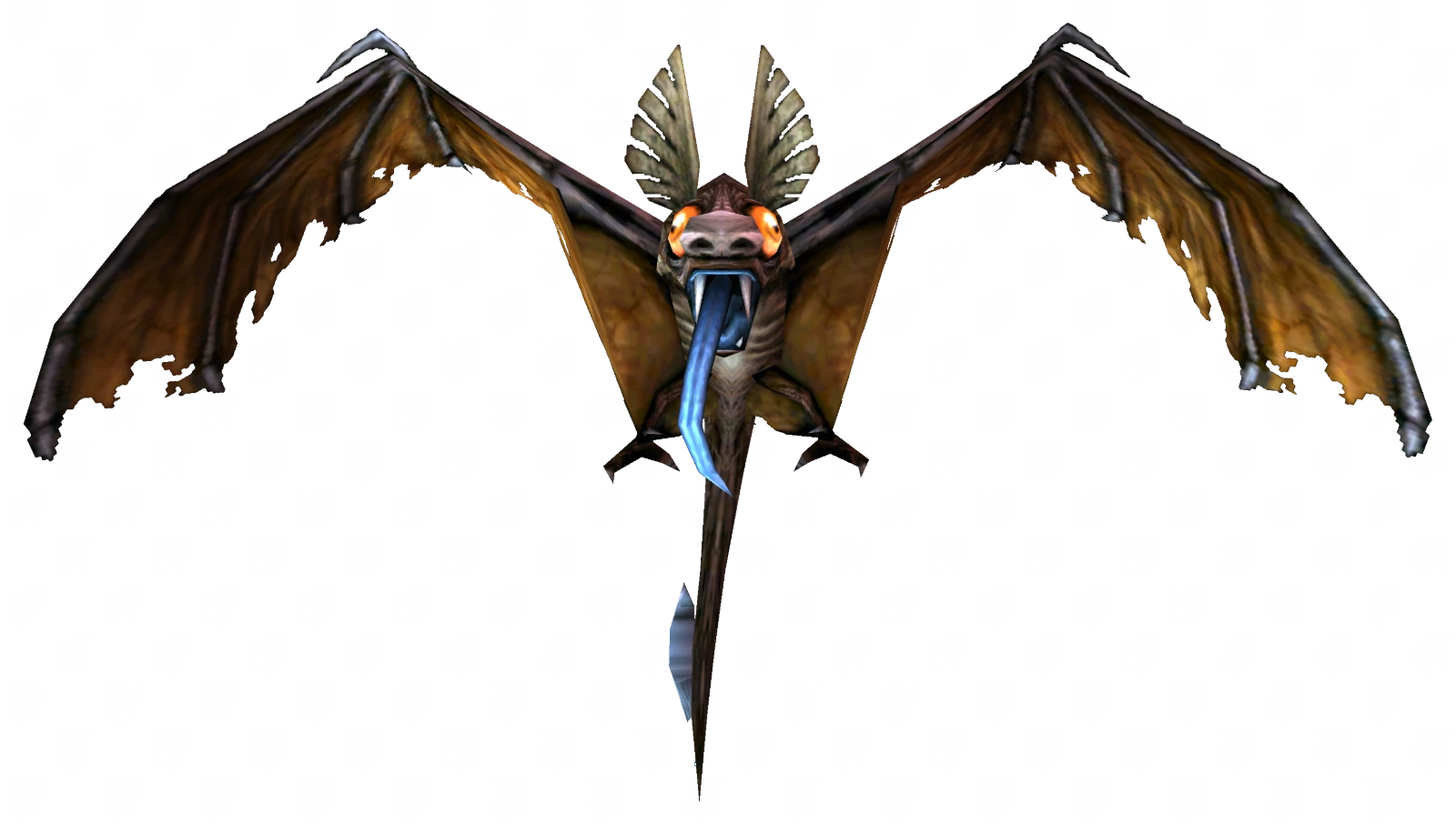
KargaroksLevel 3 · The Great Bridge: DefenderBird-monsters worth 30 points apiece before the multiplier. They spit stones if you let them get close, and red ones wheel about in the distance.
KeeseLevel 4 · Hyrule Castle: DefenderBats in swarms around the castle graveyard. Ice Keese turn up later on Snowpeak.
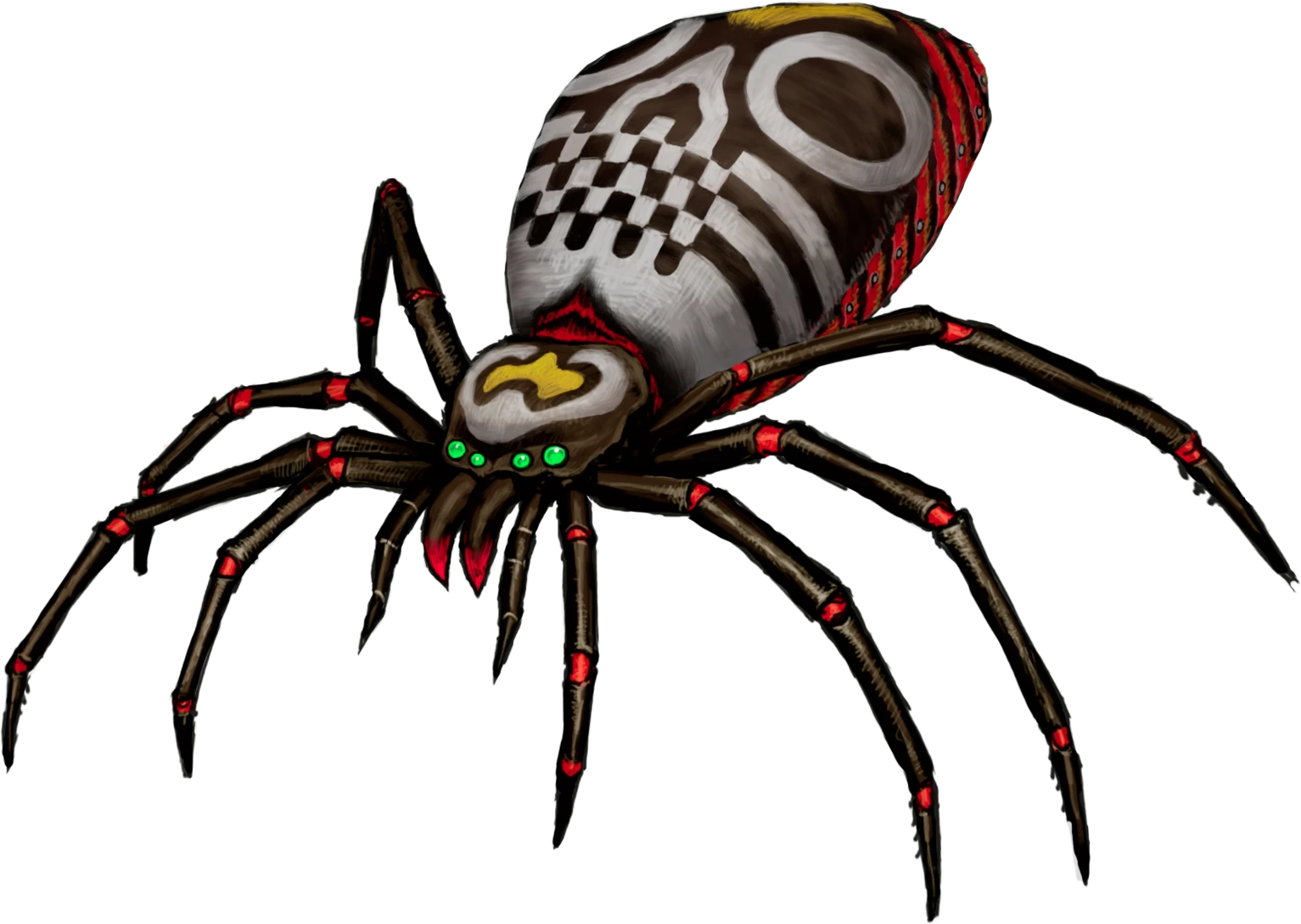
SkulltulasLevel 4 · Skulltula Forest: RangerEighteen giant spiders, two shots each. The ones in the trees drop on Link as he passes.
Moldorms and LeeversLevel 5 · Gerudo Moldorm: DefenderMoldorms burst from the desert floor while Leevers spin in circles around Link.
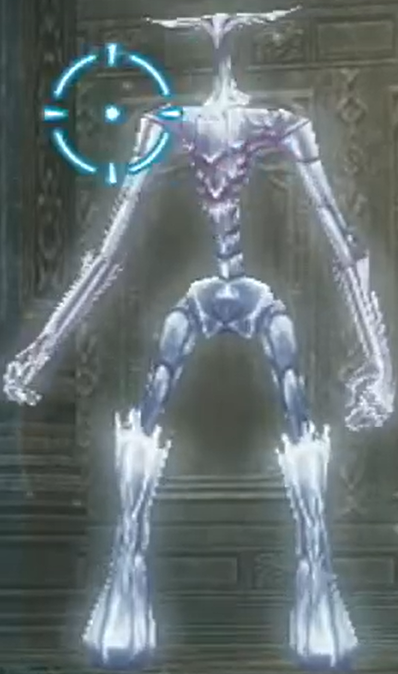
ChilfosLevel 6 · Snowpeak Ruins: RangerIce warriors worth 100 points each. Their spears block the first bolt fired at them.
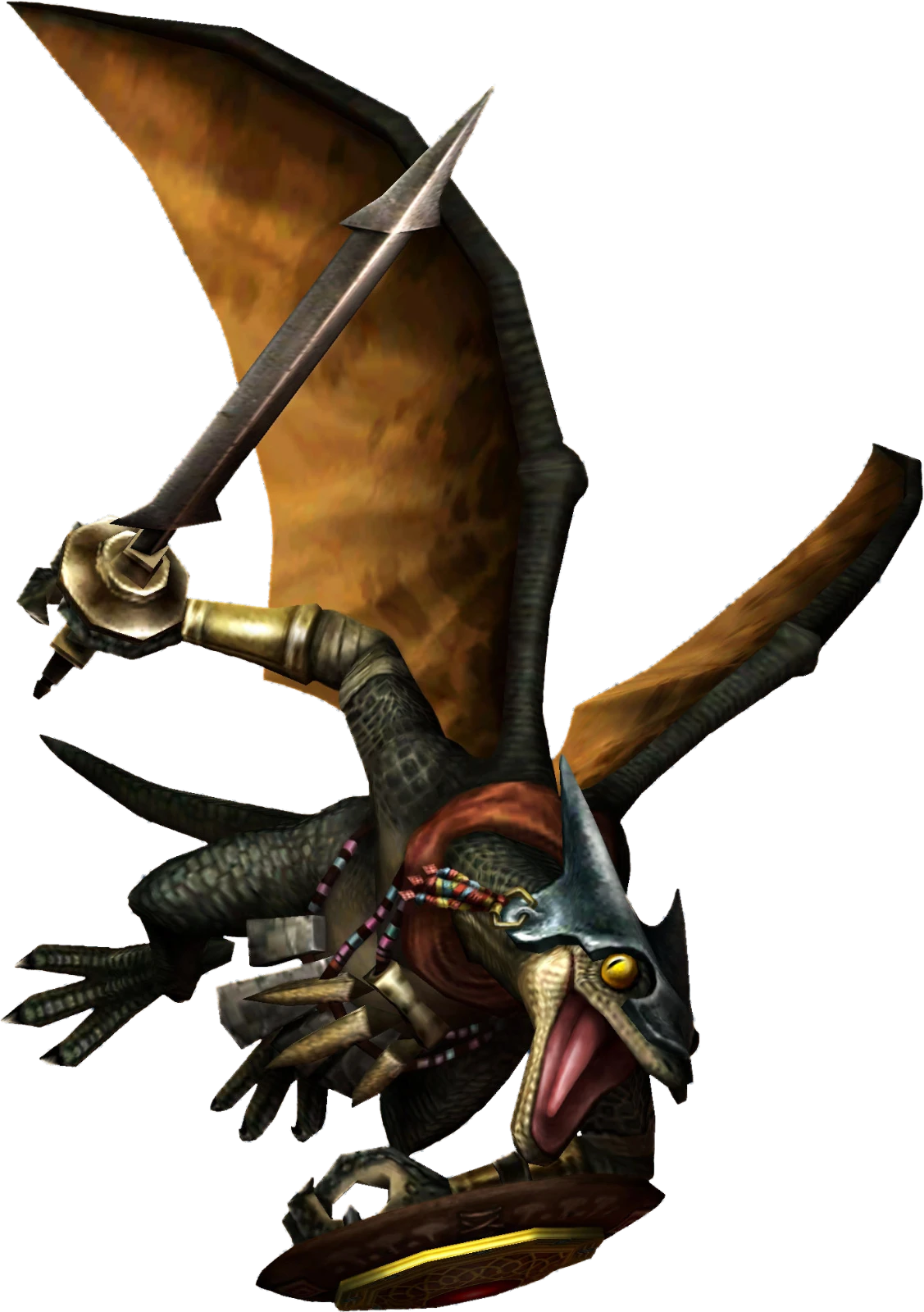
AeralfosLevel 7 · City in the Sky: DefenderWinged lizard knights, the City in the Sky’s mini-boss in Twilight Princess. Clip their wings to bring them down.
Lizalfos and DynalfosLevel 7 · Temple of Time: RangerEighteen lizard warriors guard the temple; the Dynalfos take more hits.
White WolfosLevel 8 · Snowpeak Ruins: DefenderSnow wolves that spring from the drifts and the icy water on all sides.
DarknutLevel 8 · Darknut BattleThe first boss. Bomb-arrow blasts knock off his armour, which turns into Keese; later he flings his sword, draws a smaller one and dissolves into a swarm of bats to close the distance.
BokoblinsLevel 9 · Ranch Target PracticeBlue and red goat rustlers on Ordon Ranch. Red ones score more; the goats must not be hit.
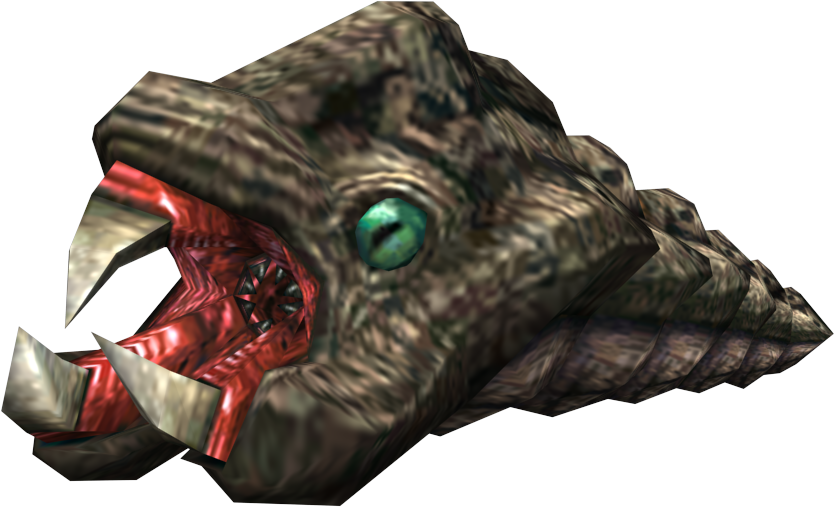
Fossil StallordLevel 9 · Fossil Stallord BattleThe final boss. Shoot the red marks on his hands to break his arms, then the mark on his head or back when he collapses, while picking off the rocks and Fire Bubbles he throws. It plays nothing like the Spinner duel in Twilight Princess.
The people who made it
Link’s Crossbow Training was made inside Nintendo EAD by members of the Twilight Princess team, with Shigeru Miyamoto steering unusually closely. A full staff list could not be checked for this page; these are the names given in Wikipedia’s credits and in Nintendo’s own interview.
Shigeru MiyamotoConcept and supervisionProposed the game, set its rules and answered for it alone in Iwata Asks. “I really felt there was room for a game that would bridge that gap,” he said of the distance between simple shooting galleries and full first-person shooters.
Makoto MiyanagaDirectorJoined Nintendo in the mid-1990s as a course designer on Super Mario 64 and was sub-director of Twilight Princess. He was later assistant producer of Breath of the Wild.
Eiji AonumaProducerThe director of Twilight Princess. He liked the result enough to want a sequel.
Takashi TezukaProducerA veteran of the Super Mario, Yoshi and Animal Crossing series and, at the time, general manager of EAD. Miyamoto remarked that it had been “a long time” since Tezuka had had anything to do with Zelda.
Kenta Nagata and Toru MinegishiMusicThe credited composers. Minegishi was one of the two credited composers of Twilight Princess, whose music the stages reuse.
Satoru IwataNintendo presidentInterviewed Miyamoto about the game, and personally asked for the Zapper to tuck the Nunchuk’s cable away inside the handle.
How it was made
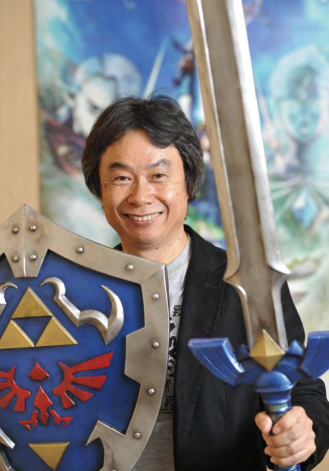
Almost everything known about the making of Link’s Crossbow Training comes from one source: the Iwata Asks interview that Nintendo published in May 2008, in which Satoru Iwata questions Shigeru Miyamoto on his own. Miyamoto opens by pretending to be put out. “What? Am I the only one being interviewed today?”
A side story for Twilight Princess
Shigeru Miyamoto, who asked for a side story and got a shooting gallery.
The project began with a precedent. After Ocarina of Time, Nintendo had followed up within about a year and a half with Majora’s Mask, a side story built on the same foundations. Miyamoto wanted to do something similar with Twilight Princess. A big Zelda, he pointed out, normally arrives only every three to five years, and he thought the people who had loved this one deserved something to play in the same world sooner than that.
So he asked the Zelda staff for a side story. What came back, he said, were proposals better described as “epic tales”. His view was that an epic by itself does not make a great game, and that piling on extras can bury the simple fun at the centre. So he made a counter-proposal: a small game built from Twilight Princess that used the Wii Zapper.
It did not go down well. The idea swept away everything the team had been planning, and some of them worried that it would look as though Nintendo was selling the same software twice. Miyamoto could tell that not everybody agreed with him, or even understood what he was after.
The prototype and the testers
Simple, readable and quick: targets on the falls at Zora’s Domain.
His answer was to stop arguing and build something. The team would make a playable prototype and put it in front of test players, and if they did not enjoy it the project would be cancelled.
Nintendo of America assembled the test group, and made sure it included a number of die-hard Zelda fans, the people most likely to be offended. Nintendo of America itself had been nervous about tinkering with so popular a series when Miyamoto first mentioned the idea on a business trip. Neither group’s fears survived contact with the game. Of the testers, Miyamoto reported, “none of them said; ‘What? This isn’t Zelda!?’” They simply enjoyed it. From then on the testers’ reactions were sent back to the developers in daily reports and used to tune the game.
Miyamoto’s list of don’ts
The Darknut duel: a boss fight in all but name.
To keep the game small, Miyamoto gave the team what he called a number of “don’ts”. Nothing unnecessary was to go in. There were to be no story sequences: “we cannot make a movie”. And “the player should be able to complete one stage within three minutes.” His reasoning was about failure. If a challenge takes ten minutes, a player who fluffs it may not have the heart to start again; if it takes three, they will.
He went further. The reward in most games, he argued, is getting to the next level or seeing the next boss, and developers sometimes lean on a spectacular ending to excuse a dull journey. Here the journey had to be the fun part, so: “I even told them not to make any bosses.” The staff would not let it go. “They kept bugging me to let them make three bosses,” and he finally allowed one, on the grounds that they could then pour all their energy into it. The finished game’s showpiece is the Fossil Stallord, though the Darknut duel that ends Level 8 is a boss fight in all but name.
Iwata summed up the philosophy as “it’s not the destination, but the journey that really matters”, and suggested that the hidden tricks and the thought needed to push a score higher sounded like quintessential Zelda. Miyamoto agreed that the staff had been determined to make “something more than just another shooting game”.
Why a crossbow, and why a western
The Hidden Village in Twilight Princess, the seed of the idea.
A Zapper game needs somebody holding a gun, and Nintendo’s heroes mostly do not. An Animal Crossing shooter did not feel right, Miyamoto said, and Iwata added that a first-person Mario would not fit either. Link was the logical choice, though he does not use guns, which was a problem at first.
Miyamoto’s first solution was science fiction: “I proposed a sort of Terminator style story about a time warp from the future.” Iwata’s reply was “Terminator!?” The team’s was shorter. “They vetoed that idea immediately.”
The idea that stuck came from inside Twilight Princess. Miyamoto was fond of the Hidden Village, the tumbledown settlement where Link picks off hidden enemies one at a time, and described it as a “spaghetti western-like setting”. A game that recreated that scene, with a crossbow standing in for a six-shooter, would give players the feel of a first-person shooter without leaving Hyrule. That left the question of how a crossbow could possibly fire so fast. Miyamoto’s ruling: “it’s really just for fun, so whatever.”
Wire and rubber bands: the Wii Zapper
The Zapper is older than the game. A prototype sat in a glass case at E3 in May 2006, where, Iwata recalled, visitors were “practically boring holes through the glass with their eyes”. That version had its own analogue stick on the handle. Then more than a year went by with nothing to play on it.
Its real origin was humbler. While everyone was busy finishing Twilight Princess, a member of the Zelda team showed Miyamoto a frame of bent wire with a Wii Remote and a Nunchuk strapped to it with rubber bands. His first reaction was that “this isn’t the time or the place to be making things like this!” Then he held it, found it comfortable, and took it to the hardware group.
Many prototypes followed. One vibrated when a shot hit its target, but it needed its own battery, and Miyamoto threw it out because he did not want customers to have to buy extra batteries. Late on, Iwata asked for the handle to swallow the Nunchuk’s cable, because he found it annoying when the cable got tangled. Meanwhile other companies were proposing gun attachments of their own, and Nintendo decided the Wii needed one standard holder that everybody’s shooting games could use. The name came from the NES Zapper, a word Miyamoto felt had a broader meaning than “gun” and was more familiar to him, and the shell was made white because it was a Wii product that would sit in the living room. The finished design was unveiled at E3 on 11 July 2007.
A bridge to first-person shooters
Behind all this was a long-standing enthusiasm. Miyamoto told Iwata that he had always liked the first-person view, had proposed making Ocarina of Time that way before the idea of showing a child Link on screen won out, and had backed projects such as GoldenEye 007. He also felt that shooters had split into two camps, with simple target games at one end and demanding first-person shooters at the other, and that Japan in particular had never really taken to the latter. Aiming with a Wii Remote, he thought, made the whole genre more approachable.
That is the sense of “Training” in the title. It is training for the player as much as for Link, and Miyamoto said he hoped people who had bought Wii Sports would try the Zapper and then move on to other companies’ more serious shooters. When Iwata suggested the game had a fairground feel, Miyamoto replied, “you don’t win any goldfish.”
The name took some finding. “Link’s Crossbow Classroom” sounded funny. The working title, Introduction to Wii Zapper, was too close to Introduction to Wii, the Japanese name of Wii Play. And something like “The Legend of Zelda: Phantom Crossbow” would have promised a grand sequel that this was never meant to be.
A fast turnaround and a big box
The North American bundle of the Wii Zapper and the game.
Nobody has put a figure on how long development took, but the calendar sets a limit. Twilight Princess shipped in November 2006; Nintendo named Link’s Crossbow Training as the Zapper’s pack-in game on 10 September 2007; and it was on sale in North America on 19 November 2007. From Miyamoto’s request for a side story to the finished disc took less than a year, which was possible because the scenery, the monsters, the music and Link himself already existed.
In North America the Zapper and game cost $19.99 together. Europe followed on 7 December and Australia on 13 December 2007. Japan was different: the Zapper went on sale there on 25 October 2007 with Sega’s Ghost Squad, and Link’s game did not arrive until 1 May 2008, bundled with a Zapper at ¥3,619 before tax. Miyamoto cheerfully called it the third product in his “large box” series, after Wii Fit and Mario Kart Wii.
The interview ends with a joke. For the next Zelda, Miyamoto mused, Link could simply hold a Zapper instead of a sword. “You’re getting rid of Link’s sword?!” said Iwata. “Well, that could be a problem, couldn’t it?”
Secrets & high-score tricks
There are no cheat codes, but the game is full of things it does not tell you. Miyamoto said the team had hidden “a number of tricks” in the stages so that players would notice something new on every attempt, and a platinum medal is out of reach without them.
The scarecrow trick
A scarecrow in Ordon Target Practice 2.
Look for a scarecrow in the scenery. Shoot its body eight times, and its head grows with each hit; then shoot the head for a 1,000-point payout. In Target Shooting stages such as Ordon, Kakariko, Zora River and Underground Target Practice, doing this in the first scene makes a second scarecrow appear in the next, and finishing that one off as well swaps the third scene for a secret one stuffed with gold targets. In Ordon Target Practice the secret scene faces the village pond and has eleven special targets among its 21.
Orange Rupees and fairies
Official render of an orange Rupee.
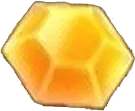
Some pots, jars, barrels and skulls hide an orange Rupee. It is worth anything from 100 to 1,000 points depending on how quickly you shoot it after it appears, so be ready. A few containers hold a fairy instead, worth 1,000 points for revealing her.
Triforce pieces
Every stage has a perfect-clear bonus, shown as a piece of the Triforce: hit every target, or defeat every enemy, and you collect it along with extra points. Speedrunners have a category for gathering all of them.
The automatic crossbow
Rapid fire in Temple of Time: Ranger.
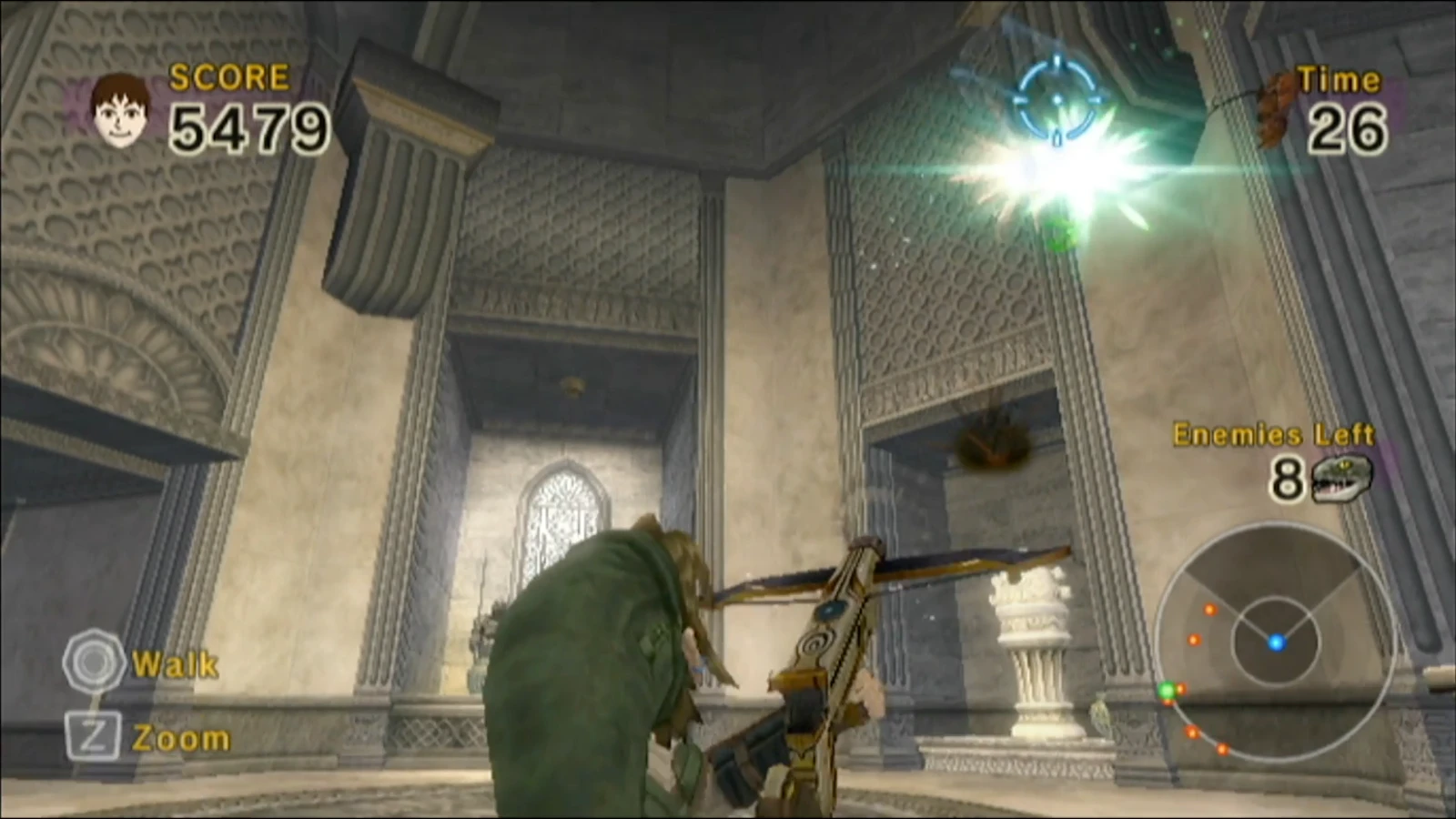
In Defender and Ranger stages, watch for an enemy glowing green. Defeat it and Link’s crossbow goes fully automatic for the next 100 shots: just hold the trigger down. It mows through crowds, but spraying bolts makes misses more likely, so it can cost you the multiplier you were building.
Charge shots
The Darknut’s armour in the Darknut Battle.
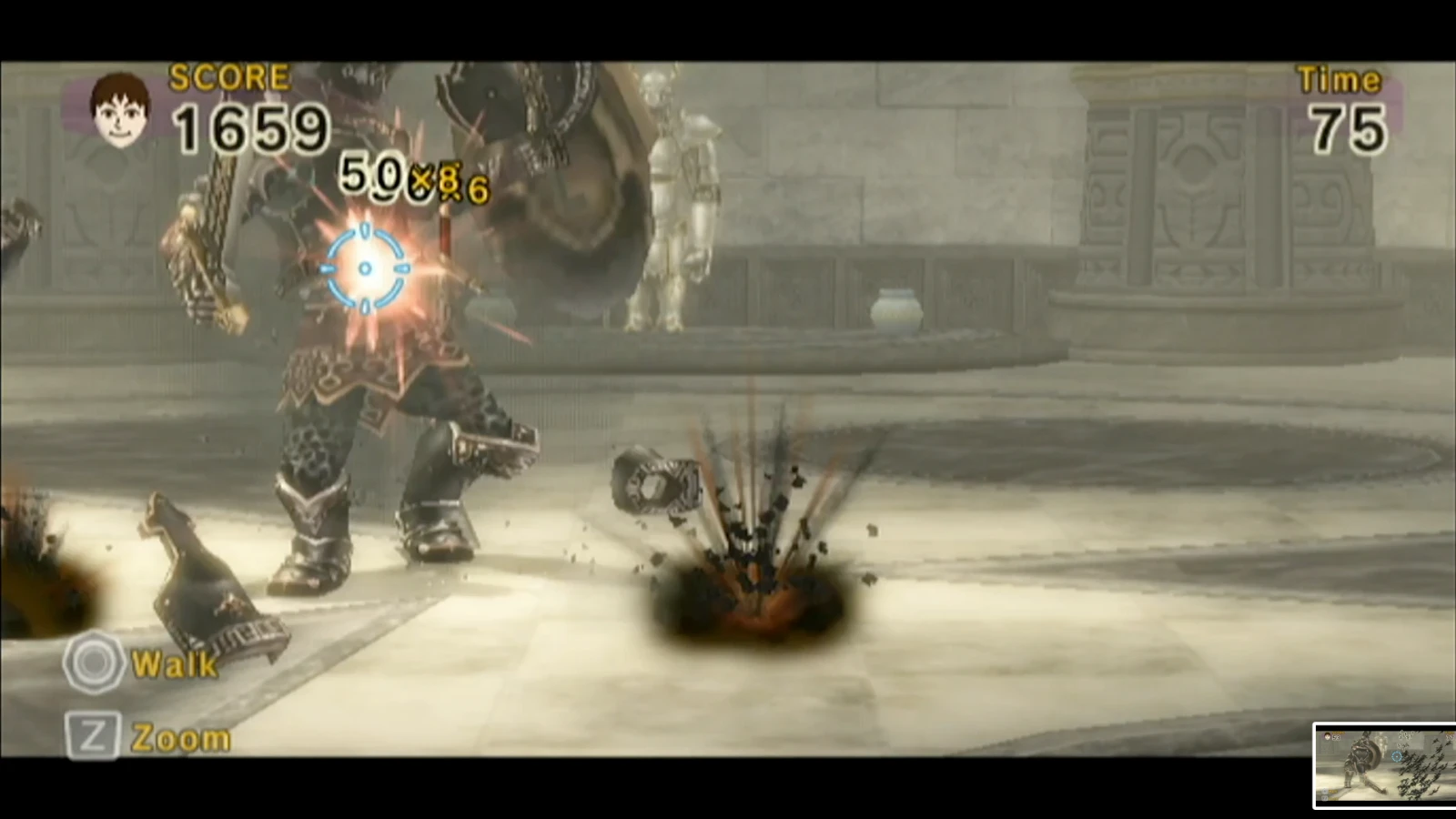
Holding the trigger and releasing it fires an explosive bolt. It is slow, but it will take out tough targets in one go, such as the boars that carry Bulblins in pairs towards the carriage, and it is the tool for blowing the armour off the Darknut.
Keep the chain alive
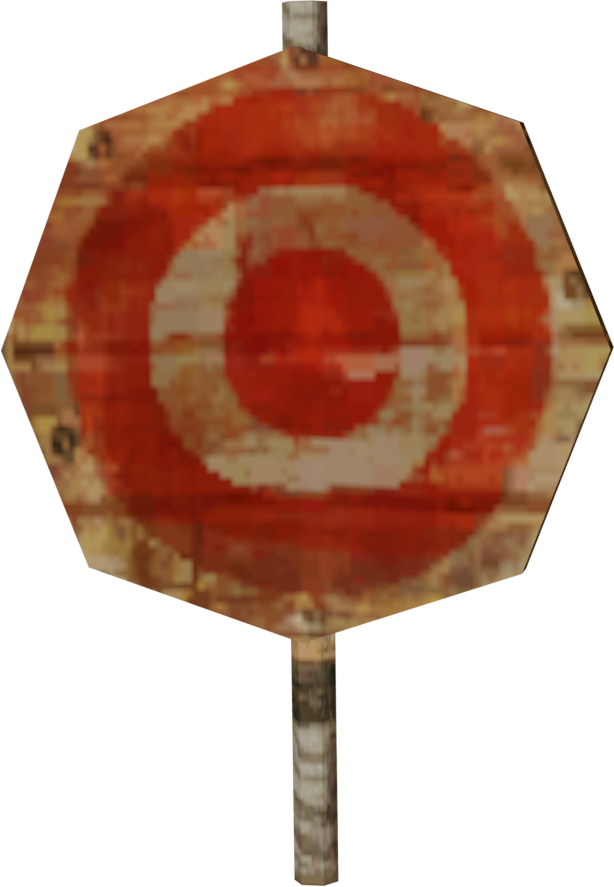
Model of an ordinary target.
Apart from blue X targets and hits taken from enemies, only a miss resets the multiplier, and scenery counts as a hit of sorts: shooting a pot or a sign does not raise the multiplier but does not break it. Take your time, use the zoom for distant targets, and never fire a speculative shot into empty air. Because the multiplier carries over between the scenes of a Target Shooting stage, the last targets of a clean run are worth dozens of times their face value.
Things not to shoot
A Cucco, as modelled for Twilight Princess: hitting one costs 100 points.
Blue X targets, Cuccos and Oocca all cost 100 points, and the X targets wipe out the multiplier as well. The goats on Ordon Ranch are there to be rescued, not shot.
Stage-specific extras
A meteorite in Fruit Balloons.
Meteorites streak across the sky in Fruit Balloons, at 300 points each before the multiplier. The Darknut’s thrown sword can be shot out of the air for a bonus, and a single white Keese among the black ones in that fight is worth hundreds of points. The Bulblin hideout of the first Ranger stage has two roast Bullbos, and yes, you can shoot those for points too.
Checked against Zelda Dungeon’s stage pages, the Zelda Wiki on Fandom, Marko Bagaric’s 2007 walkthrough and Nintendo’s Iwata Asks interview, November 2026.
Oddities & unused content
The disc holds some curious leftovers, documented by The Cutting Room Floor, and the stage pages on Zelda Dungeon’s wiki record a few quirks of the finished game.
Twilight Princess’s debug menu is still inside
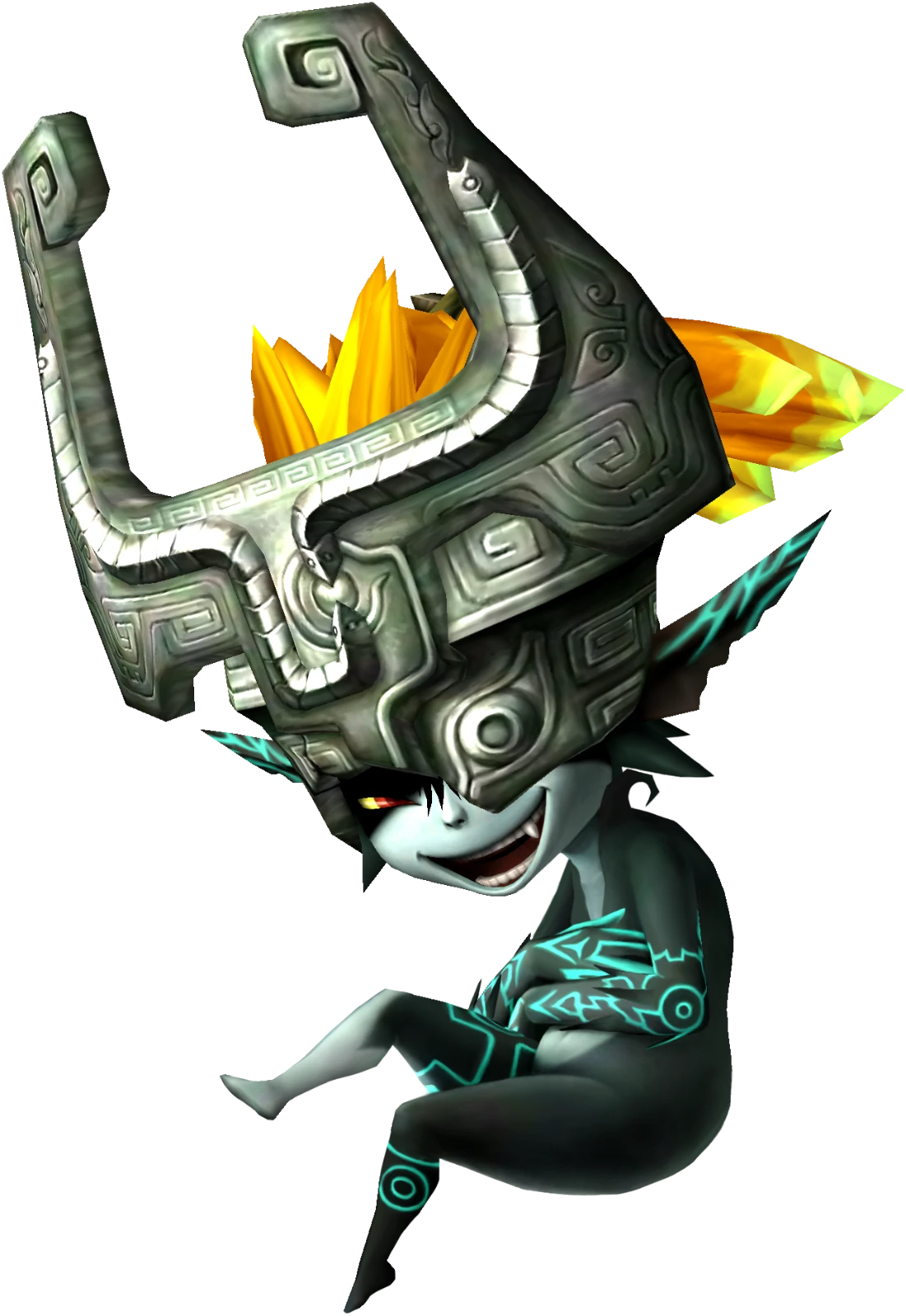
Midna, as rendered for Twilight Princess: the leftover debug menu has a switch for her.
The files contain the text of a Map Select debug menu, evidently inherited from Twilight Princess, with settings for the time of day, the stage and room to load, a “transform” option and even a switch for turning Midna on or off, though Midna plays no part in the finished game. A memory-usage display can also be switched on in the North American version with an Action Replay code.
Unused stage title cards
A set of stage title-card graphics goes unused. Their names often differ from the finished ones: Keese Crush, Forest of Spiders, Help the Mountain Goats, Target-Toting Oocca, Forest Ruins Puppet Master and The Dark Knight, Darknut among them. The files are numbered from 1 to 40, with gaps, although only 27 stages shipped.
A mode that was cut
One spare title card describes a mode in which five hits would end the game. Nothing like it exists in the finished game.
Stray graphics and a developer’s folders
An unused target model, another leftover on the disc.
Other leftovers include a placeholder Mii picture stamped with the Japanese character for “temporary”, an image that looks like the head of an Animal Crossing villager, and a text file listing folder paths from a developer’s computer.
The hovering hero
The Great Bridge: Defender, from its one fixed viewpoint.
Move the camera with an emulator’s free-look tool during The Great Bridge: Defender and you find that the scenery behind the fixed view is fully built, and that Link is standing several metres up in the air.
Hit by a dead Bulblin
Arbiter’s Grounds: Ranger, the Bulblin hideout.
In Arbiter’s Grounds: Ranger, a Bulblin you have just shot off a scaffold still counts as an attack if its body lands on Link, costing the usual 100 points. The “DANGER!” warning in that stage also goes off when Link is standing directly underneath an archer who cannot actually hit him.
Videos & media
Nintendo’s trailer from 2007, as archived by Nintendo World Report, and a review that shows the Zapper and all three stage types in action.
“Classic Game Room HD – LINK’S CROSSBOW TRAINING review Wii”, by Classic Game Room.
Trivia & facts
The European box.It reached North America on 19 November 2007, exactly one year after Twilight Princess and the Wii console launched there.
Miyamoto’s first pitch for putting a gun in Link’s hands was a Terminator-style time-travel story. The team vetoed it on the spot.
The Japanese box.The Japanese title, Rinku no Bōgan Torēningu, means “Link’s Bowgun Training”. Japan got the game more than five months after North America, on 1 May 2008.
Its working title was Introduction to Wii Zapper, dropped because Wii Play is called Introduction to Wii in Japan.
Render of Link’s crossbow.Miyamoto rejected “The Legend of Zelda: Phantom Crossbow” as a title because it sounded like a major sequel.
The Cutting Room Floor points out that it is one of only two games in the series with “Link” in the title but not “Zelda”. The other is Link: The Faces of Evil on the Philips CD-i.
The Zapper began as bent wire and rubber bands, cobbled together by a Zelda staff member while Twilight Princess was being finished.
A Zapper prototype with a rumble motor was scrapped because it needed its own battery.
Satoru Iwata personally asked for the Nunchuk’s cable to be hidden inside the Zapper’s handle.
A cutscene from the Fossil Stallord Battle.Miyamoto originally banned bosses altogether. The staff asked for three; he allowed one.
According to Zelda Dungeon’s wiki, Ordon Target Practice plays the Goron theme from Twilight Princess, although it is set in Ordon Village.
Many stages have different names in Europe and Australia. Arbiter’s Grounds: Ranger is Bulblin Hideout Raid there, and Hyrule Castle: Defender is Graveyard Ambush.
The targets in Goron Target Practice score 10 points at the edge and 30 in the bull’s-eye; gold ones score 50 and 150.
Ordon Target Practice, third scene.Zelda Dungeon’s wiki works out that the normal third scene of a flawless Ordon Target Practice pays up to 21,360 points, while the secret third scene can pay over 76,000.
The game appears in NPD’s list of the five best-selling Zelda games in the United States, published in August 2019, behind Breath of the Wild, Twilight Princess, Ocarina of Time and Majora’s Mask.
Director Makoto Miyanaga started at Nintendo designing courses for Super Mario 64.
Speedrunners race it. The Zelda Wiki on Fandom lists record categories for finishing the game, for earning every medal colour up to all-platinum and for collecting every Triforce piece, with an all-platinum record of a little over 40 minutes, set in 2021.
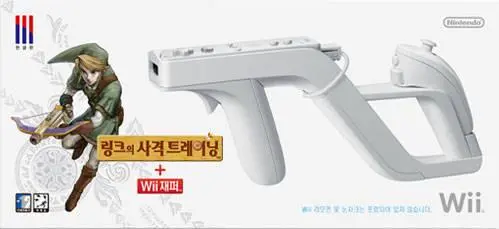
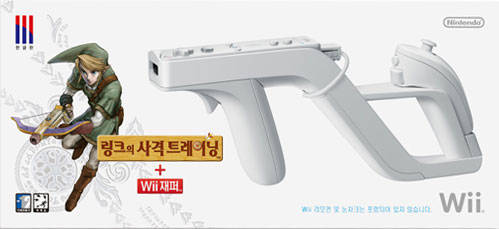
The South Korean box.A South Korean version was released on 28 October 2010, nearly three years after the American one.
Media & artwork
Box art from each region, the Wii Zapper, official artwork and screenshots of the stages. Select any image to view it larger.
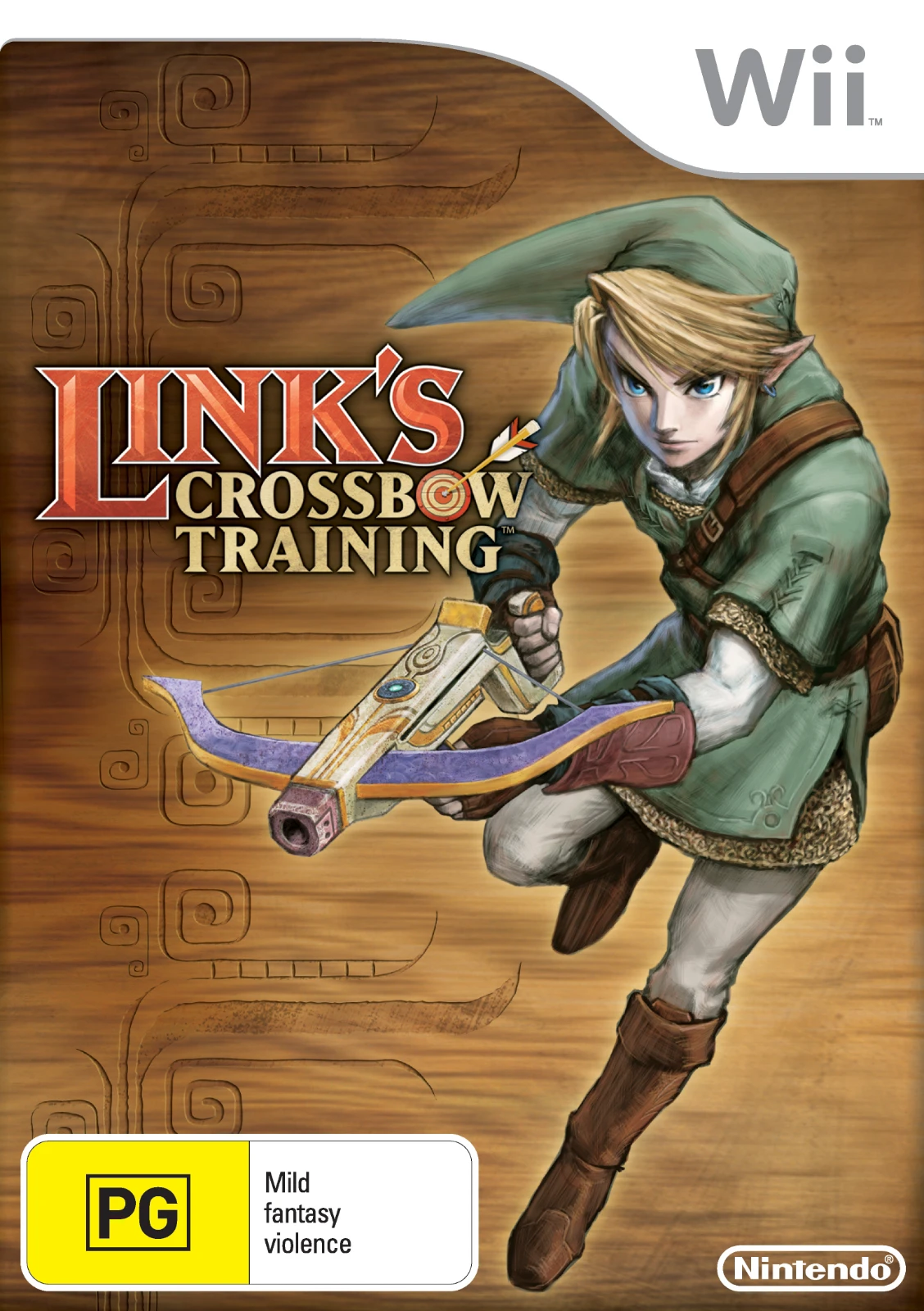
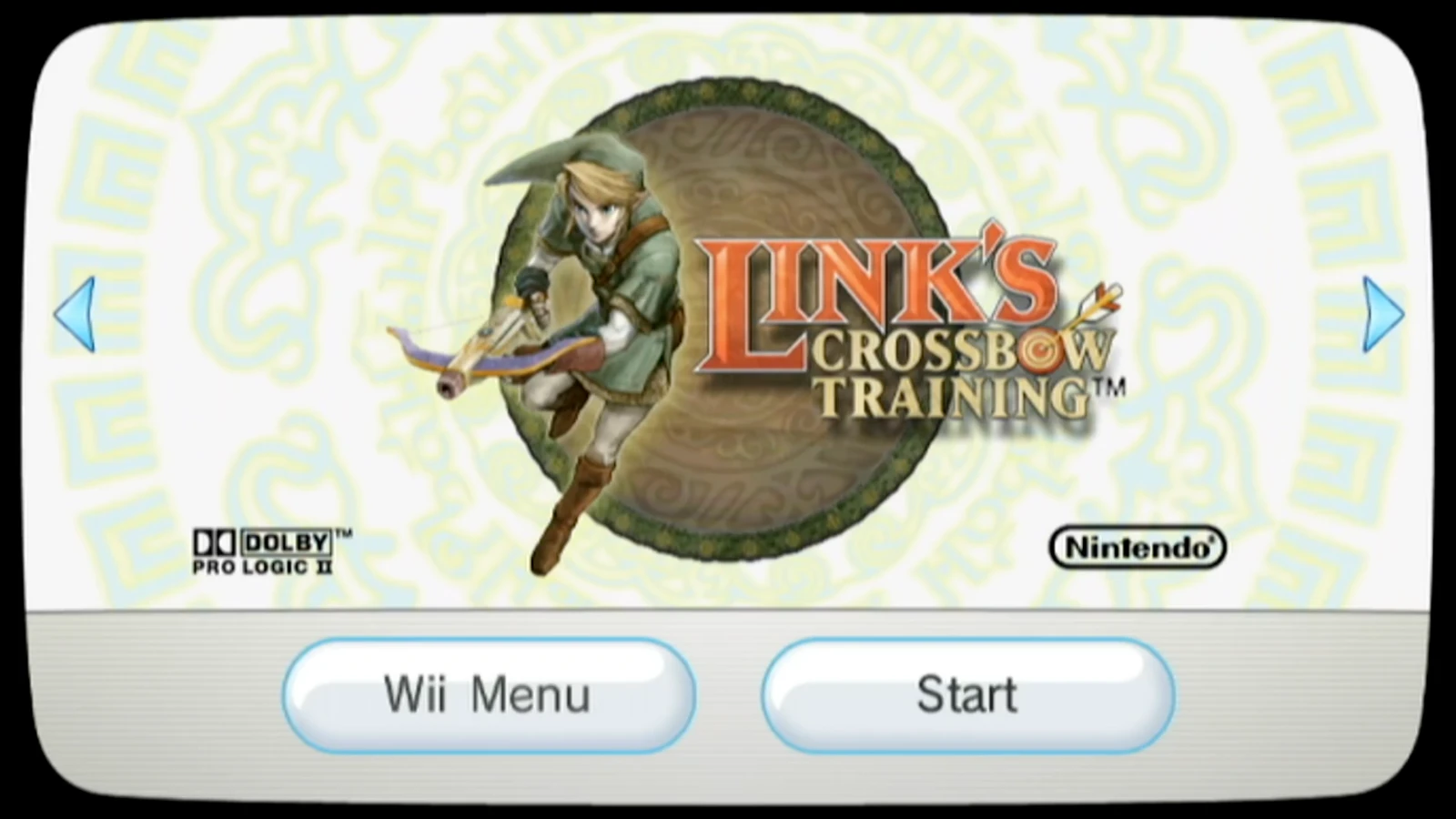
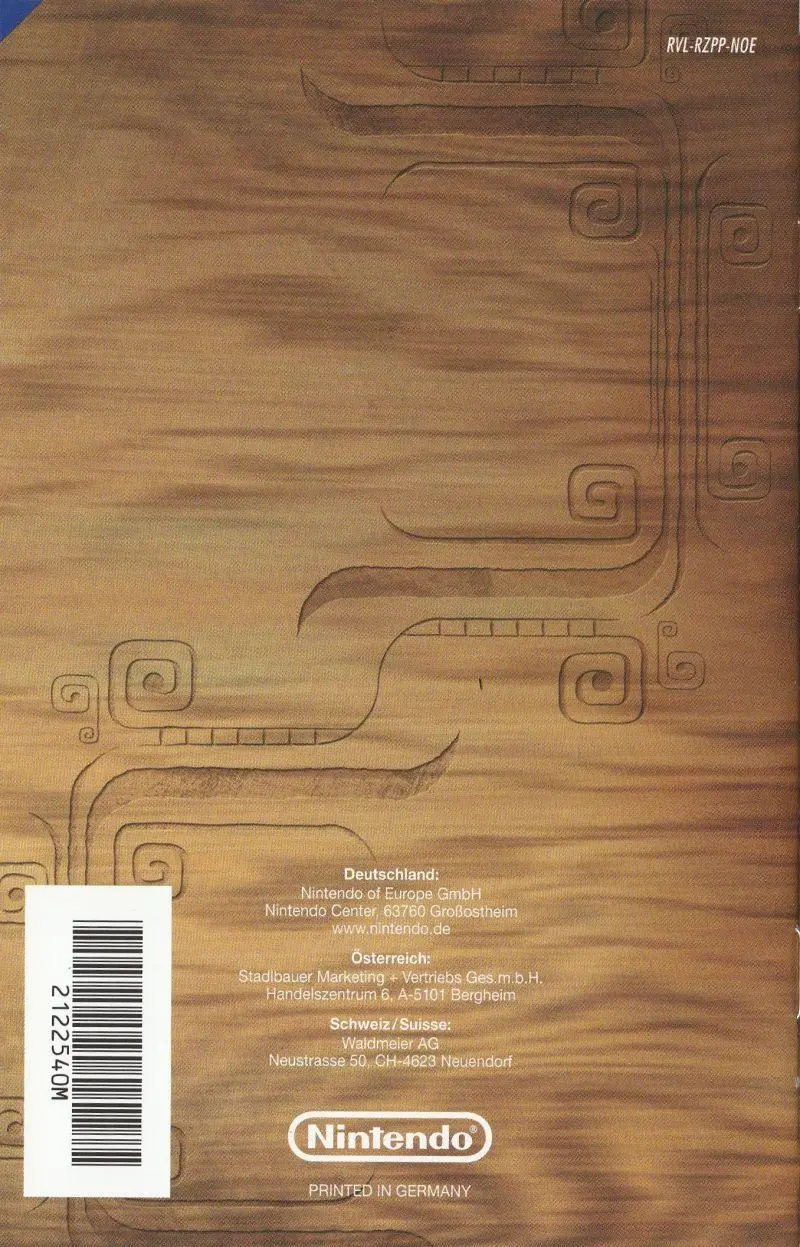
Australian box (2007).German box.French box.Italian box.North American box, back.The Japanese bundle with the Wii Zapper (2008).The South Korean bundle with the Wii Zapper (2010).Japanese logo.The game’s channel on the Wii Menu.From the German instruction manual.
Link’s Crossbow Training was a product of one moment, the first two years of the Wii, and it has stayed there: a huge seller that Nintendo has never returned to.
Release history
Zapper prototypeMay 2006 – A gun-shaped shell for the Wii Remote is shown in a glass case at E3.
Final Zapper11 July 2007 – The finished design is revealed at E3 2007.
Game announced10 September 2007 – Nintendo of America names Link’s Crossbow Training as the game in the box, at $19.99.
North America19 November 2007 – Released a year to the day after Twilight Princess and the Wii.
Europe and AustraliaDecember 2007 – Europe on 7 December, Australia on 13 December.
Japan1 May 2008 – Sold with a Zapper for ¥3,619 before tax. The Iwata Asks interview with Miyamoto follows on 8 May.
No sequelDecember 2009 – Eiji Aonuma reveals that he wanted to make Link’s Crossbow Training 2.
South Korea28 October 2010 – The last regional release.
The sequel that never was
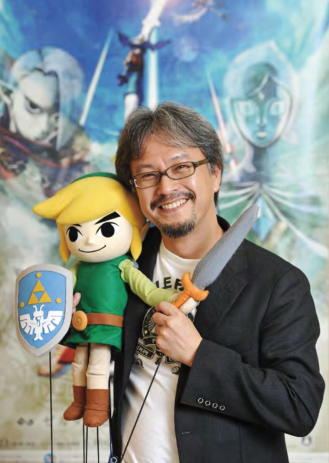
Eiji Aonuma, the producer who wanted to make a sequel.
The game’s biggest fan inside Nintendo may have been its producer. In an interview with the magazine gamesTM, reported by Kotaku in December 2009, Eiji Aonuma admitted: “To tell you the truth, I actually wanted to create Link’s Crossbow Training 2.” He felt Nintendo “should do something more and better” with first-person shooting, and according to the report what he chiefly wanted to expand was the multiplayer, the first game’s weakest part.
He was overruled. “A lot of people inside Nintendo insisted that I should work on a new Legend of Zelda title,” he said. The Zelda that followed on Wii was Skyward Sword (2011).
Never re-released
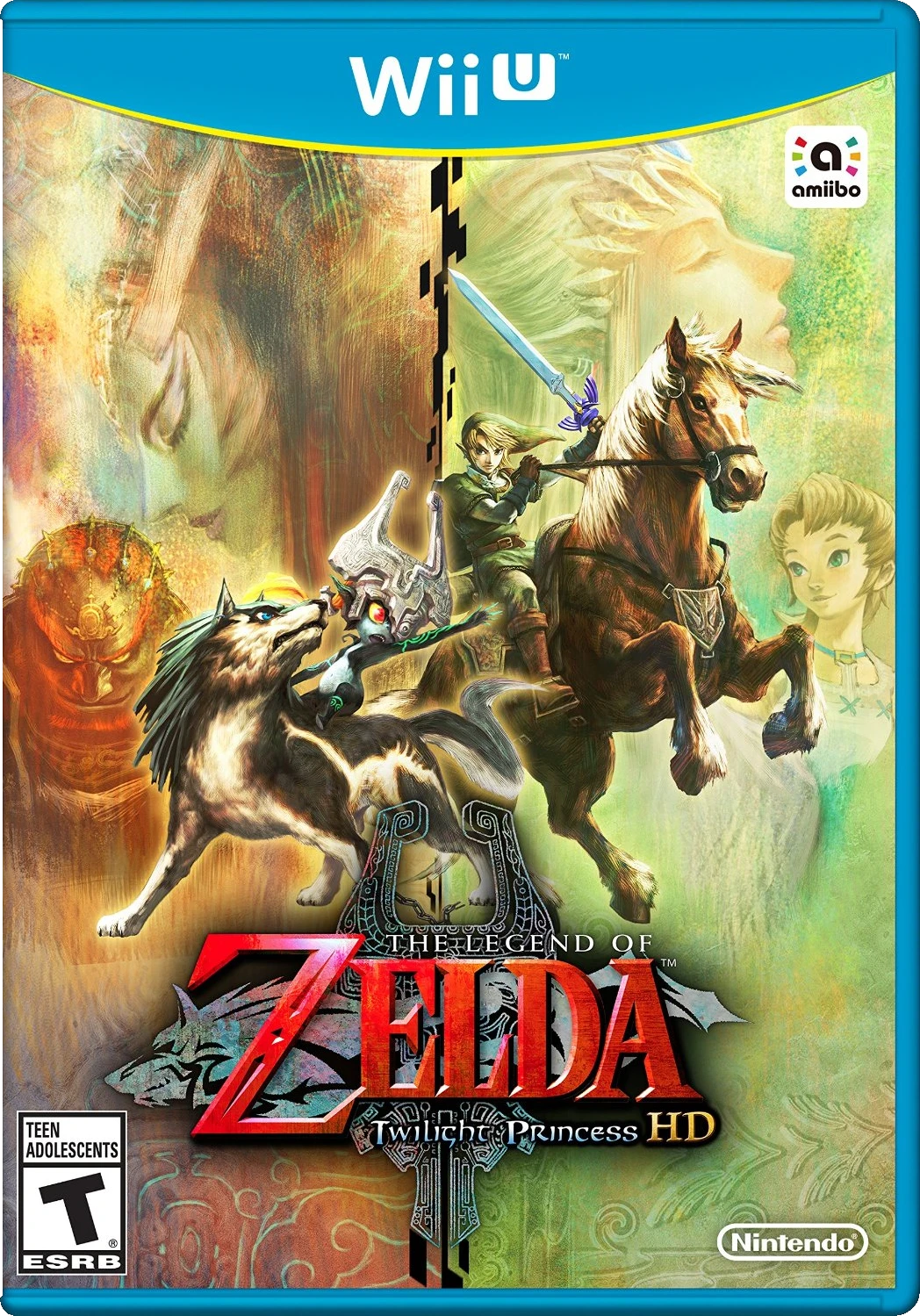
The North American box of Twilight Princess HD (Wii U, 2016).
Link’s Crossbow Training has only ever existed as a Wii disc. Nintendo has never offered it as a download, added it to Nintendo Switch Online or remastered it, even though Twilight Princess HD brought the parent game back on Wii U in 2016.
The good news is that, with 4.8 million copies sold, there is no shortage of discs in circulation, and since the Zapper is only a holder, a Wii Remote and Nunchuk are all you need. Speedrun leaderboards list the game under “Wii/Wii U”, the Wii U being able to run Wii discs.
How it is remembered
The Shootout: the Hidden Village, revisited.
Not everyone was charmed at the time: GamesRadar’s review listed “seeing Zelda sell out” among its reasons to steer clear. Most reviews were kinder than that, and the usual verdict was that it was good fun for an evening and fair value at the price.
It is better understood now as a snapshot of how Nintendo worked in the Wii years: a controller accessory, a small friendly game to explain it, and a big box. It was the same recipe as Wii Play with its extra Remote, and Mario Kart Wii with its wheel. It is also a Zelda spin-off shaped unusually directly by Miyamoto’s own rules, with everything he considered unnecessary taken out. And for anyone who loved Twilight Princess, it is a chance to walk around the Hidden Village again.
Sales & reviews
Sales figures
Sold as an accessory with a game thrown in, Link’s Crossbow Training reached far more homes than its reviews would suggest. Nintendo’s investor documents list it (as “packaged with Wii Zapper”) among its million-sellers for three years running. It had sold 1.71 million copies by 31 March 2008, all of them outside Japan, where it was not yet out; 2.75 million by 30 September 2008; 3.76 million by 31 March 2009; and 4.80 million by 31 March 2010, with another 1.04 million added in that final year. That is the last figure Nintendo published.
For comparison, Nintendo’s figures give Skyward Sword 3.52 million on the same console by March 2012. Japan accounted for only about 250,000 of the total, according to the same documents. In the United States it was still the seventh best-selling Wii game, and the sixteenth best-selling game overall, in December 2008, more than a year after launch. When the NPD Group’s analyst Mat Piscatella listed the five best-selling Zelda games in US history in August 2019, it was fifth. “Yes,” he added, “Link’s Crossbow Training was a strong seller.”
Wikipedia’s list of best-selling Wii games carries a higher lifetime total of 5.79 million. We could not trace that number to a Nintendo document, so treat 4.80 million as the confirmed figure and the larger one as unverified.
1.71mby March 2008, before the Japanese release
2.75mby September 2008
3.76mby March 2009
4.80mby March 2010 (Nintendo’s last figure)
Reception and review scores
Reviews were mixed but mostly friendly. These are the scores that could be confirmed, converted to percentages where needed; those marked Metacritic are shown as that site records them.
The game averages 68 on Metacritic from 34 reviews, and stood at 69.26% on GameRankings from 37. Nearly every review made the same two points: it is enjoyable, and it is over almost as soon as it starts. IGN’s Matt Casamassina wished for more stages and more options, “but for $19.99, I’m a little more forgiving.” Nintendo Life thought it “probably, just about, worth its budget title price”. Nintendo World Report praised the Twilight Princess visuals and the bottomless scoring system but scored its lasting appeal at 4 out of 10.
The Zapper divided people more than the game did. IGN found that the shell actually made the game harder; and VideoGamer complained that the trigger made the cursor wobble and that the walking stages suited it worst of all. Eurogamer and Nintendo World Report both dismissed the turn-taking multiplayer. Nintendo Power saw promise in the Zapper but, like everyone else, wanted more game.
Reader reviews
No reader reviews yet. Played it? Give it a score out of 10 and tell other fans what you think.
Every fact on this page was checked against the sources below in November 2026. Zelda Wiki (zeldawiki.wiki), IGN and Eurogamer refuse automated reading, so their scores and quotations are given as reported by Wikipedia, Metacritic and the Zelda Wiki on Fandom. Stage details come from Zelda Dungeon’s wiki, the Fandom wiki and a 2007 walkthrough, cross-checked against each other and against Nintendo’s Japanese site.
To provide the best experiences, we use technologies like cookies to store and/or access device information. Consenting to these technologies will allow us to process data such as browsing behavior or unique IDs on this site. Not consenting or withdrawing consent, may adversely affect certain features and functions.
Functional
Always active
The technical storage or access is strictly necessary for the legitimate purpose of enabling the use of a specific service explicitly requested by the subscriber or user, or for the sole purpose of carrying out the transmission of a communication over an electronic communications network.
Preferences
The technical storage or access is necessary for the legitimate purpose of storing preferences that are not requested by the subscriber or user.
Statistics
The technical storage or access that is used exclusively for statistical purposes.The technical storage or access that is used exclusively for anonymous statistical purposes. Without a subpoena, voluntary compliance on the part of your Internet Service Provider, or additional records from a third party, information stored or retrieved for this purpose alone cannot usually be used to identify you.
Marketing
The technical storage or access is required to create user profiles to send advertising, or to track the user on a website or across several websites for similar marketing purposes.

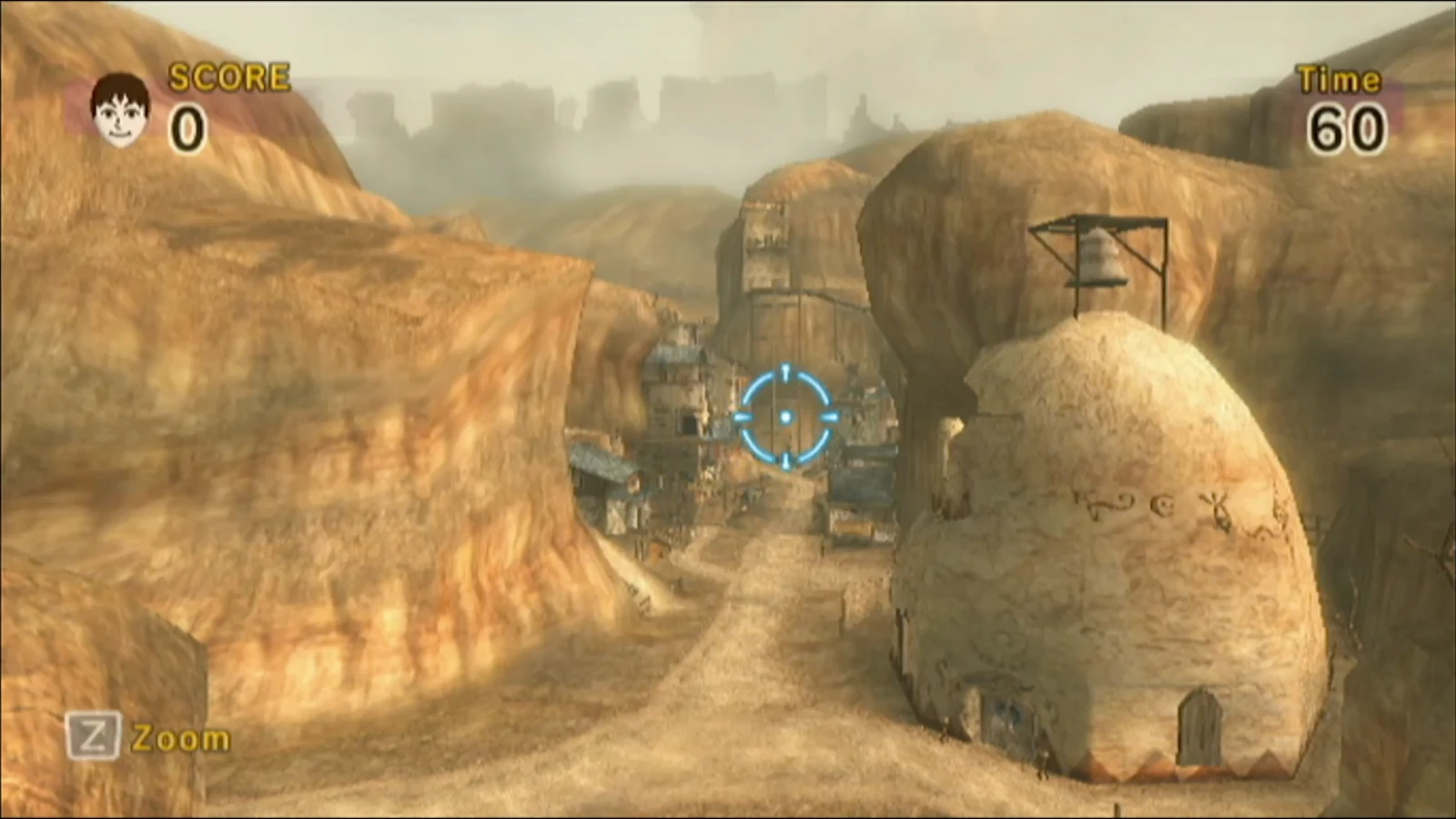
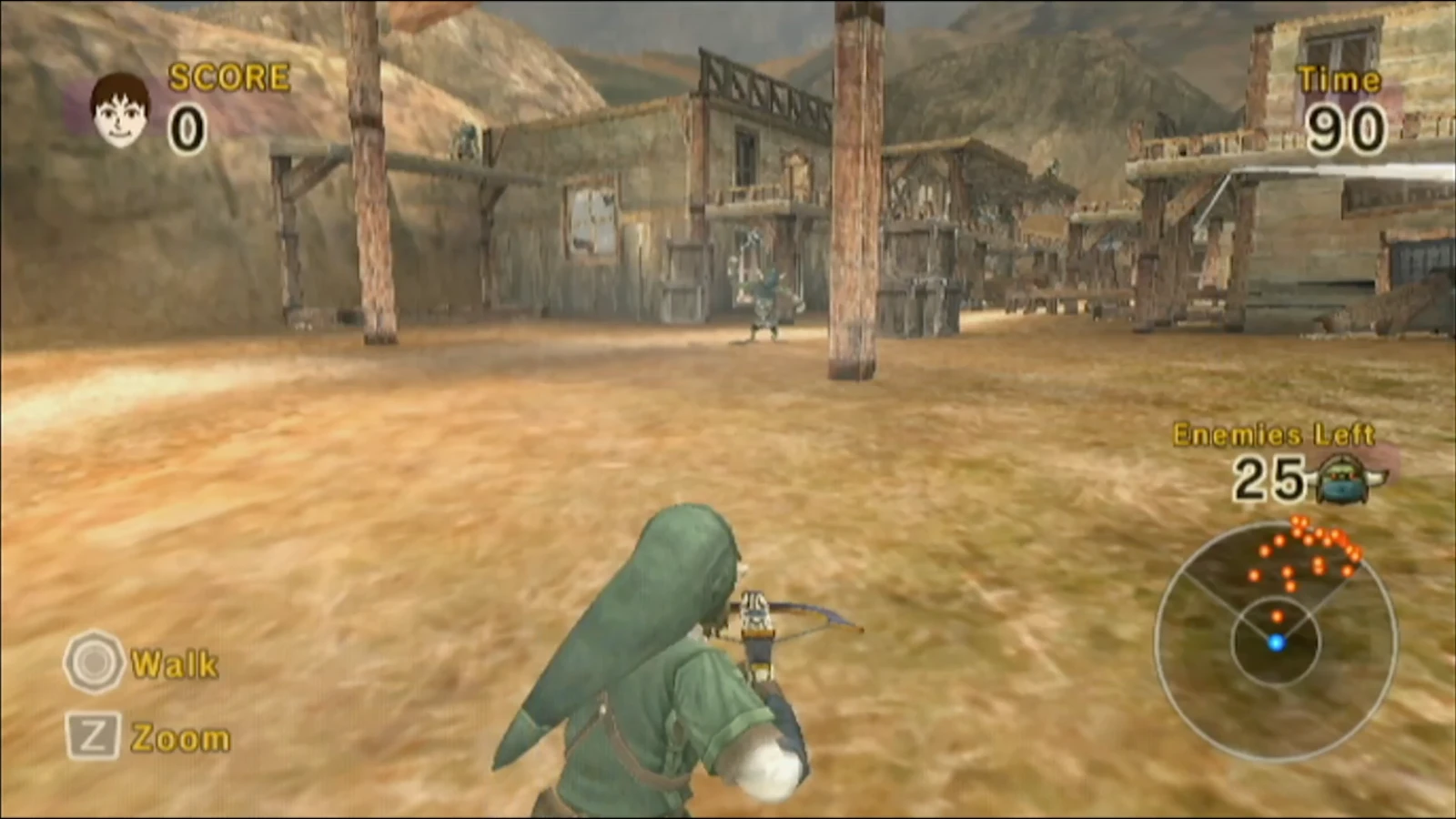
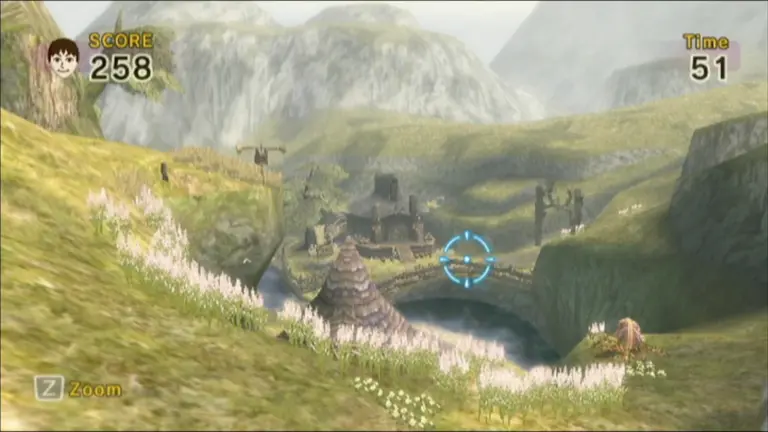 Level 1Ordon Target Practice · Gerudo Stalfos: Defender · Arbiter’s Grounds: RangerA gentle start: pop-up bull’s-eyes around Ordon Village, a minute of Stalfos climbing out of the Gerudo Desert sand, then a raid on a Bulblin hideout to defeat 25 of them, archers on scaffolds included. In Europe the second and third stages are Gerudo Stalfos Ambush and Bulblin Hideout Raid.
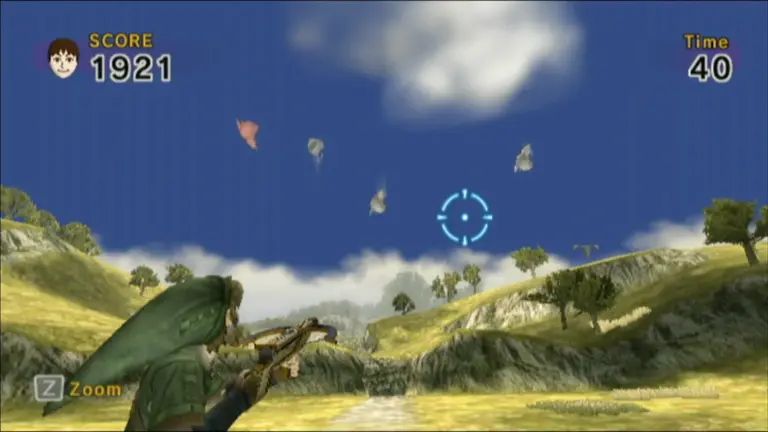 Level 2Goron Target Practice · Zora River: Defender · Skull ShootingGorons roll out holding targets, some marked with a blue X that costs 100 points. Then a canoe trip down Zora’s River under fire from Toadpolis and Tektites, and a round of clay-pigeon shooting with flung skulls: 50 points for a grey one, 100 for a red. European names: The Gorons’ Target Game and Battle on Zora’s River.
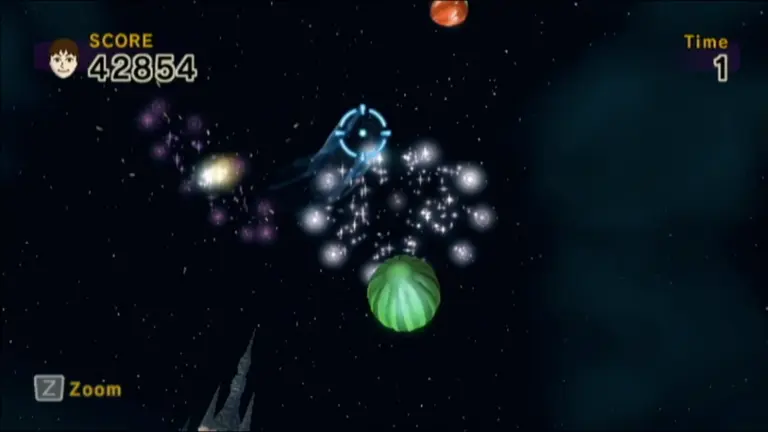 Level 3Kakariko Target Practice · Fruit Balloons · The Great Bridge: DefenderTargets through Kakariko Village; watermelon balloons over Castle Town that burst into oranges and then strawberries, with the odd 300-point meteorite; and a swarm of Kargaroks dive-bombing the Great Bridge of Hylia (Kargarok Assault in Europe).
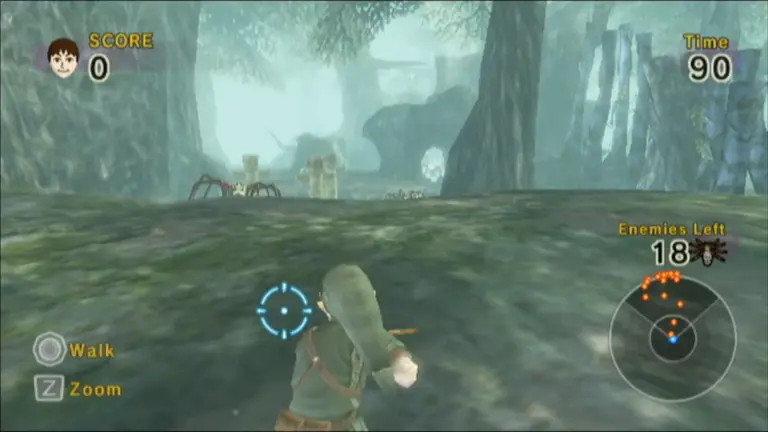 Level 4Zora River Target Practice · Hyrule Castle: Defender · Skulltula Forest: RangerTargets ride the waterfalls outside Zora’s Domain, Keese and Stalfos haunt the Hyrule Castle graveyard, and 18 Skulltulas lurk on the ground, the walls and the branches of a forest. The first two are Zora’s Waterfall Challenge and Graveyard Ambush in Europe.
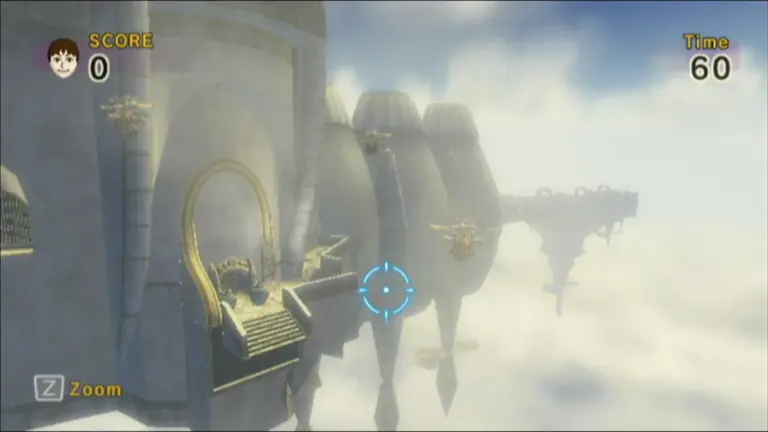 Level 5Oocca Target Practice · Gerudo Moldorm: Defender · The ShootoutIn the City in the Sky the Oocca carry the targets, and hitting a bird instead costs points. Moldorms burst out of the desert floor while Leevers circle. Then the western: 25 Bulblins holed up in the Hidden Village, some behind windows you have to shoot out first. Europe calls it Kakariko Shootout.
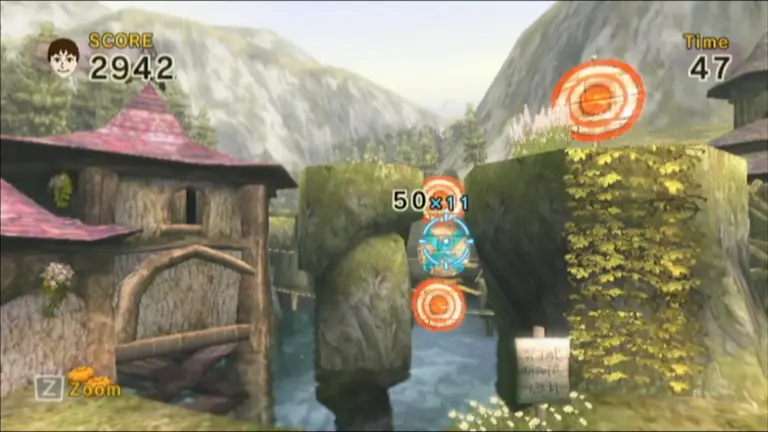 Level 6Ordon Target Practice 2 · Bridge of Eldin: Defender · Snowpeak Ruins: RangerOrdon again, this time in one unbroken camera sweep. A carriage to protect from Bokoblins, Kargaroks and Bulblins riding boars two at a time. And 25 spear-carrying Chilfos to find in Snowpeak Ruins, where a blocked shot scores a single point. European names: Back to Ordon Target Range, Carriage Escort and Snowpeak Ruins Encounter.
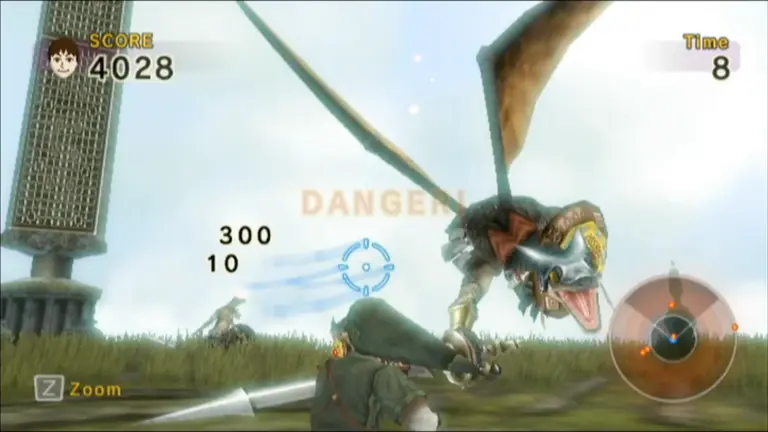 Level 7Underground Target Practice · City in the Sky: Defender · Temple of Time: RangerA target range in the gloom of Arbiter’s Grounds; Aeralfos that attack on foot behind shields and then from the air; and a march through the Temple of Time against 18 Lizalfos and Dynalfos, with Beamos statues and Keese in the way. In Europe: Underground Target Range and City in the Sky Defence.
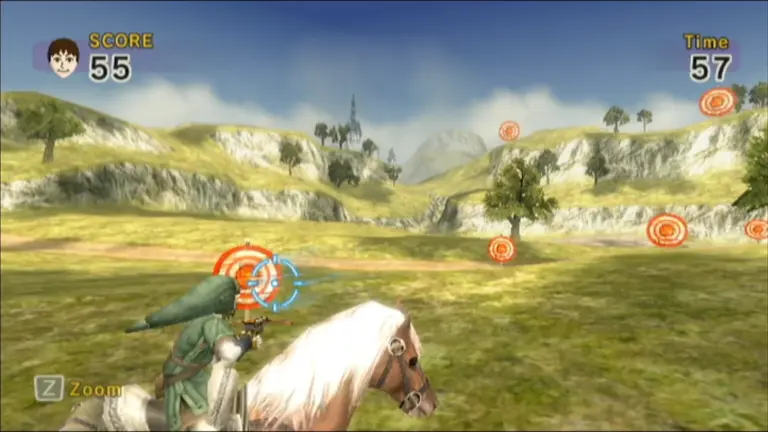 Level 8Horseback Target Practice · Snowpeak Ruins: Defender · Darknut BattleLink rides Epona across Hyrule Field shooting as he goes (Horseback Target Run in Europe), stands his ground against packs of White Wolfos on Snowpeak, and fights the Darknut in the Temple of Time: 90 seconds, and it has to be beaten.
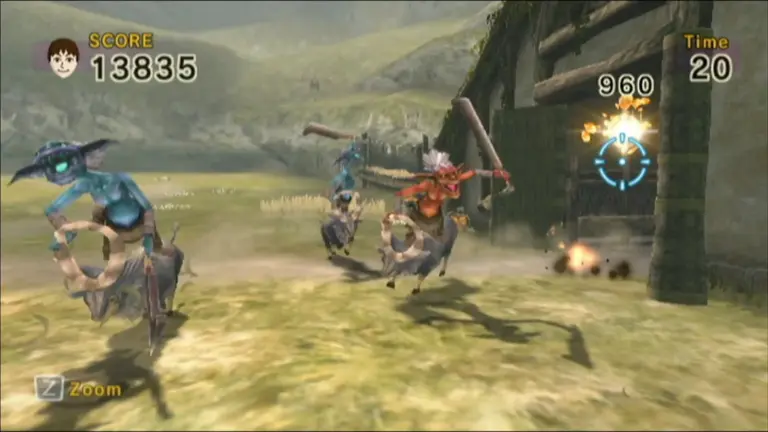 Level 9: FinaleRanch Target Practice · Sacred Grove: Defender · Fossil Stallord BattleNo bull’s-eyes this time: the “targets” on Ordon Ranch are Bokoblins after the goats. Skull Kid’s Puppets come next, and the Fossil Stallord is the last stage of all. The first two are Ordon Ranch Defence and Sacred Grove Puppet Battle in Europe.
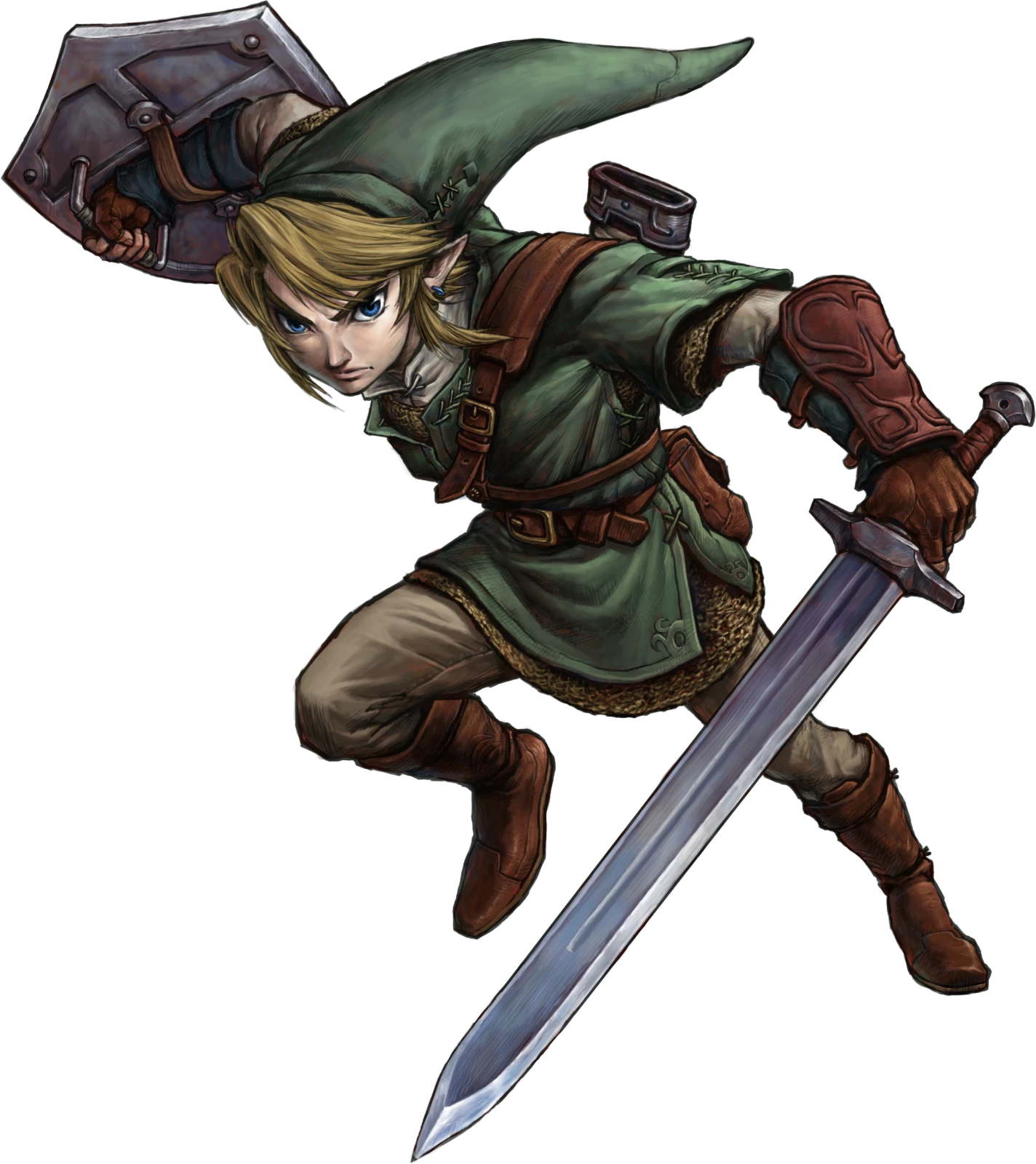 LinkThe only playable character
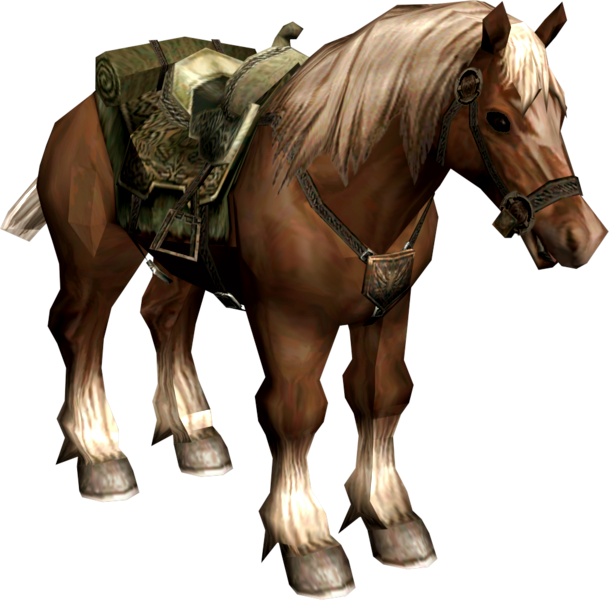 EponaLink’s horse
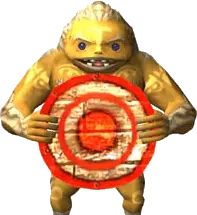 The GoronsTarget holders
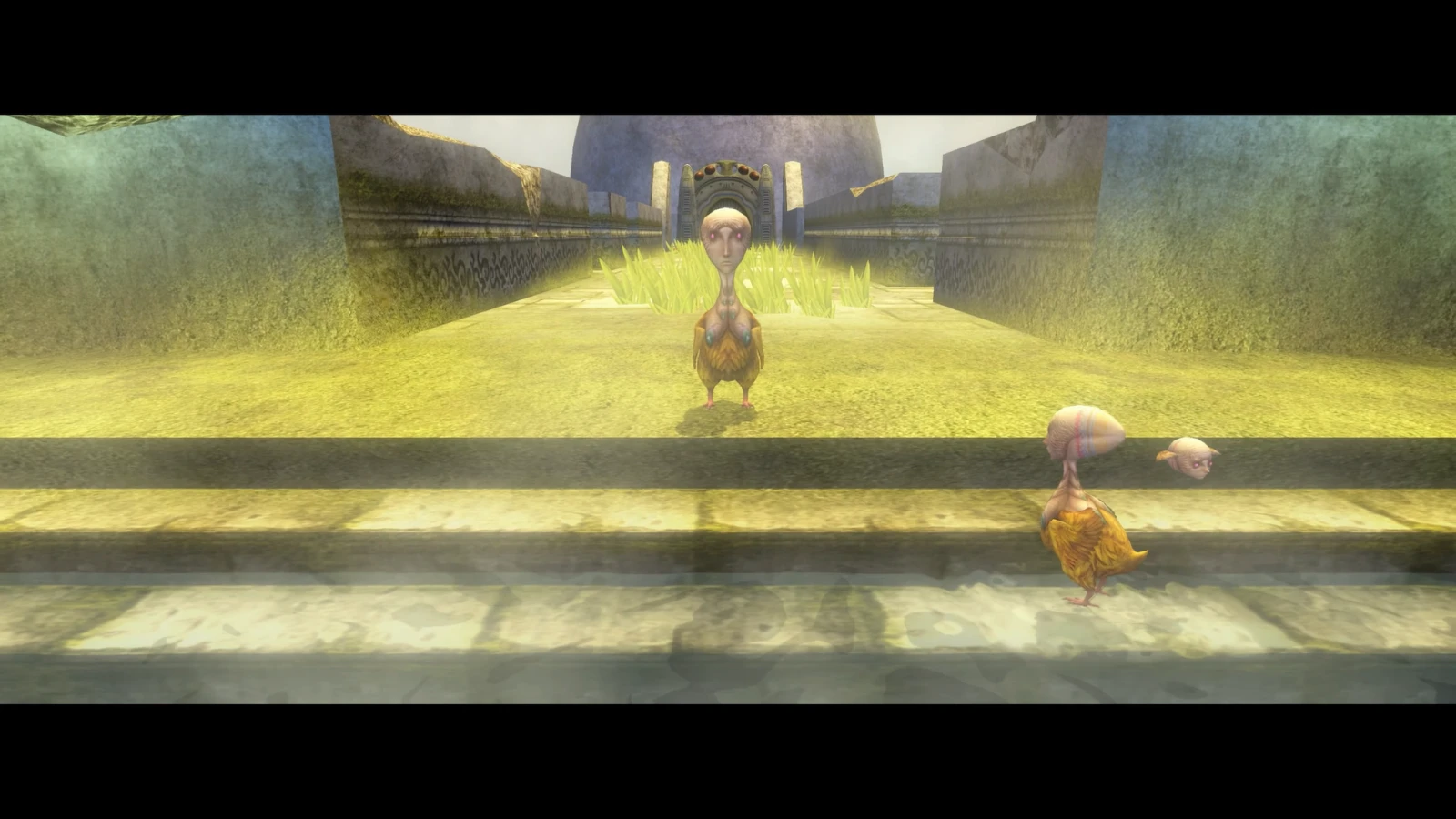 The OoccaSky people
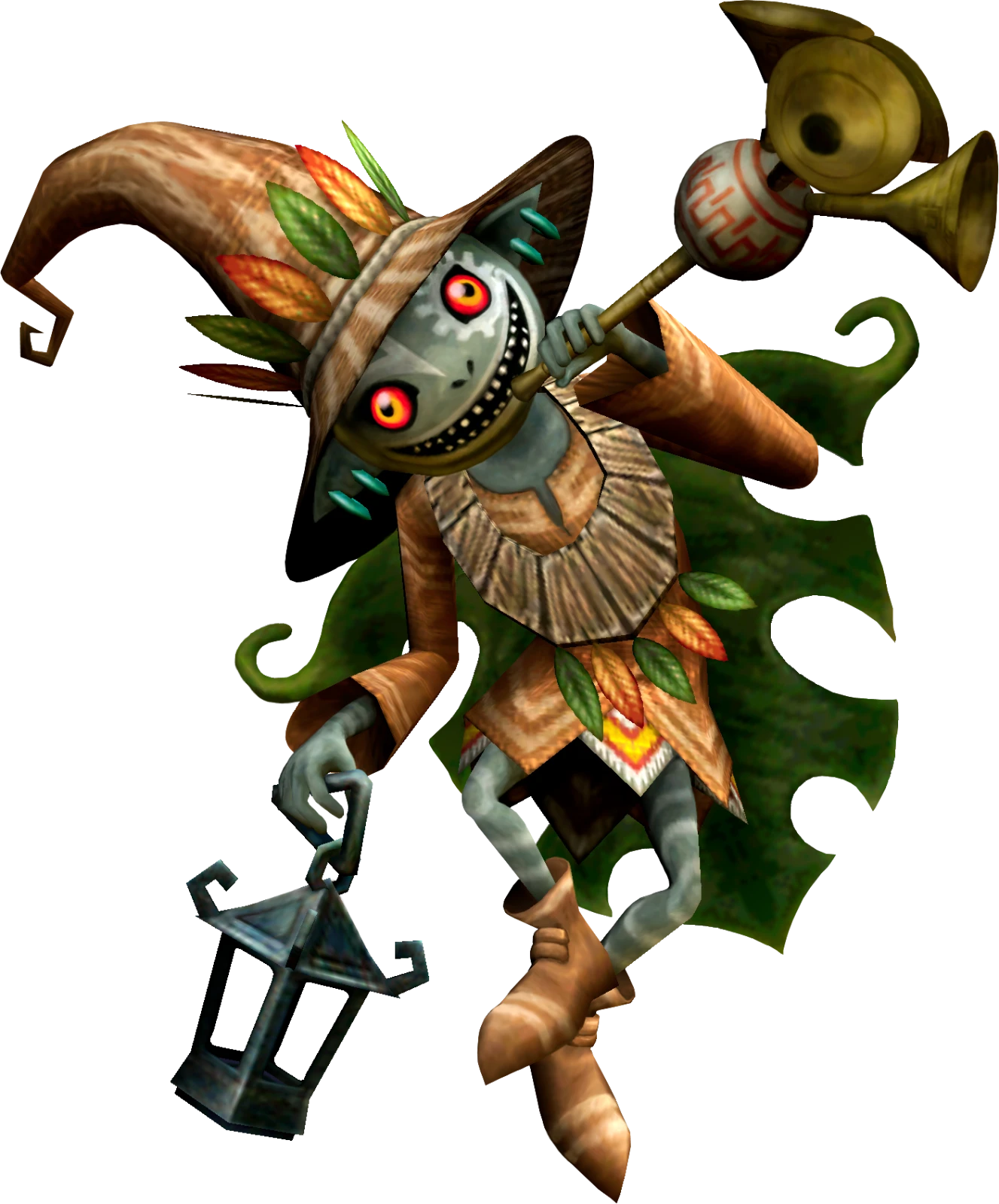 Skull KidImp of the Sacred Grove
 The scarecrowsThe game’s running secret
 StalfosLevel 1 · Gerudo Stalfos: DefenderSkeleton soldiers that climb out of the sand, some carrying shields. A large glowing green one grants the automatic crossbow.
 BulblinsLevels 1, 5 and 6The green raiders of Twilight Princess, on foot, on rooftops, on scaffolds with fire arrows and, on the carriage run, riding boars in pairs.
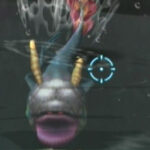 Toadpolis and TektitesLevel 2 · Zora River: DefenderToadpolis rise from the river and spit rocks, which can be shot out of the air. Red Tektites leap at the canoe.
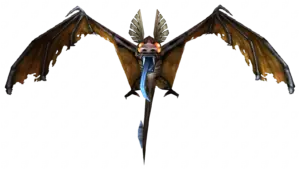 KeeseLevel 4 · Hyrule Castle: DefenderBats in swarms around the castle graveyard. Ice Keese turn up later on Snowpeak.
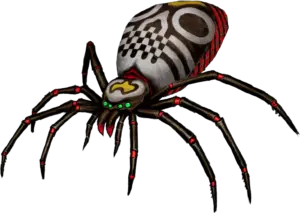 SkulltulasLevel 4 · Skulltula Forest: RangerEighteen giant spiders, two shots each. The ones in the trees drop on Link as he passes.
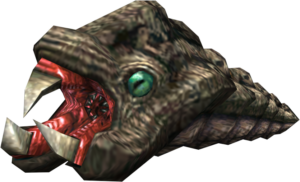 Moldorms and LeeversLevel 5 · Gerudo Moldorm: DefenderMoldorms burst from the desert floor while Leevers spin in circles around Link.
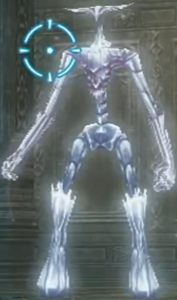 ChilfosLevel 6 · Snowpeak Ruins: RangerIce warriors worth 100 points each. Their spears block the first bolt fired at them.
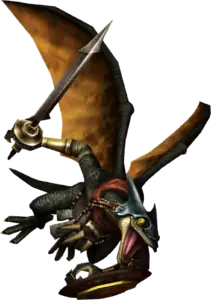 AeralfosLevel 7 · City in the Sky: DefenderWinged lizard knights, the City in the Sky’s mini-boss in Twilight Princess. Clip their wings to bring them down.
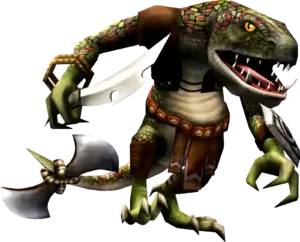 Lizalfos and DynalfosLevel 7 · Temple of Time: RangerEighteen lizard warriors guard the temple; the Dynalfos take more hits.
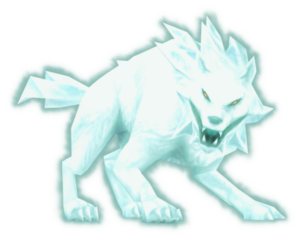 White WolfosLevel 8 · Snowpeak Ruins: DefenderSnow wolves that spring from the drifts and the icy water on all sides.
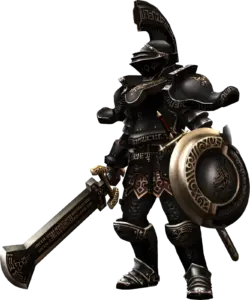 DarknutLevel 8 · Darknut BattleThe first boss. Bomb-arrow blasts knock off his armour, which turns into Keese; later he flings his sword, draws a smaller one and dissolves into a swarm of bats to close the distance.
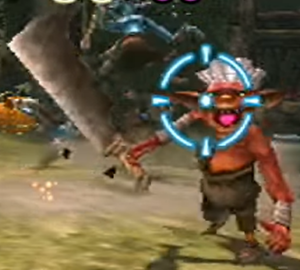 BokoblinsLevel 9 · Ranch Target PracticeBlue and red goat rustlers on Ordon Ranch. Red ones score more; the goats must not be hit.
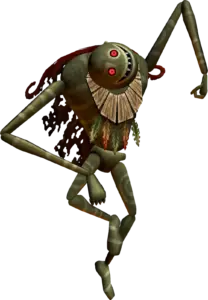 PuppetsLevel 9 · Sacred Grove: DefenderSkull Kid’s wooden marionettes, arriving in waves.
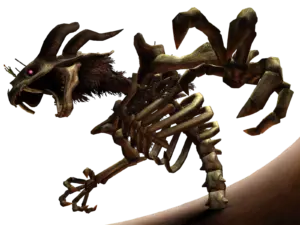 Fossil StallordLevel 9 · Fossil Stallord BattleThe final boss. Shoot the red marks on his hands to break his arms, then the mark on his head or back when he collapses, while picking off the rocks and Fire Bubbles he throws. It plays nothing like the Spinner duel in Twilight Princess.