Famicom Disk System / NES1986NintendoAction-adventure
The Legend of Zelda
Where Hyrule began: a boy with no sword, a princess who hid the Triforce of Wisdom in eight pieces, a pig-like Prince of Darkness and a whole world of caves, secrets and riddling old men to explore in any order you like.
Released21 February 1986 (JP, Disk System) · 22 August 1987 (NA) · 15 November 1987 (EU)
DirectorsShigeru Miyamoto, Takashi Tezuka
MusicKoji Kondo
DungeonsNine levels, plus a Second Quest
Players1
SalesAbout 6.5 million (2004)
Title
The Legend of Zelda ゼルダの伝説 (Zeruda no Densetsu); the Japanese packaging also carried the series name “The Hyrule Fantasy”
Platforms
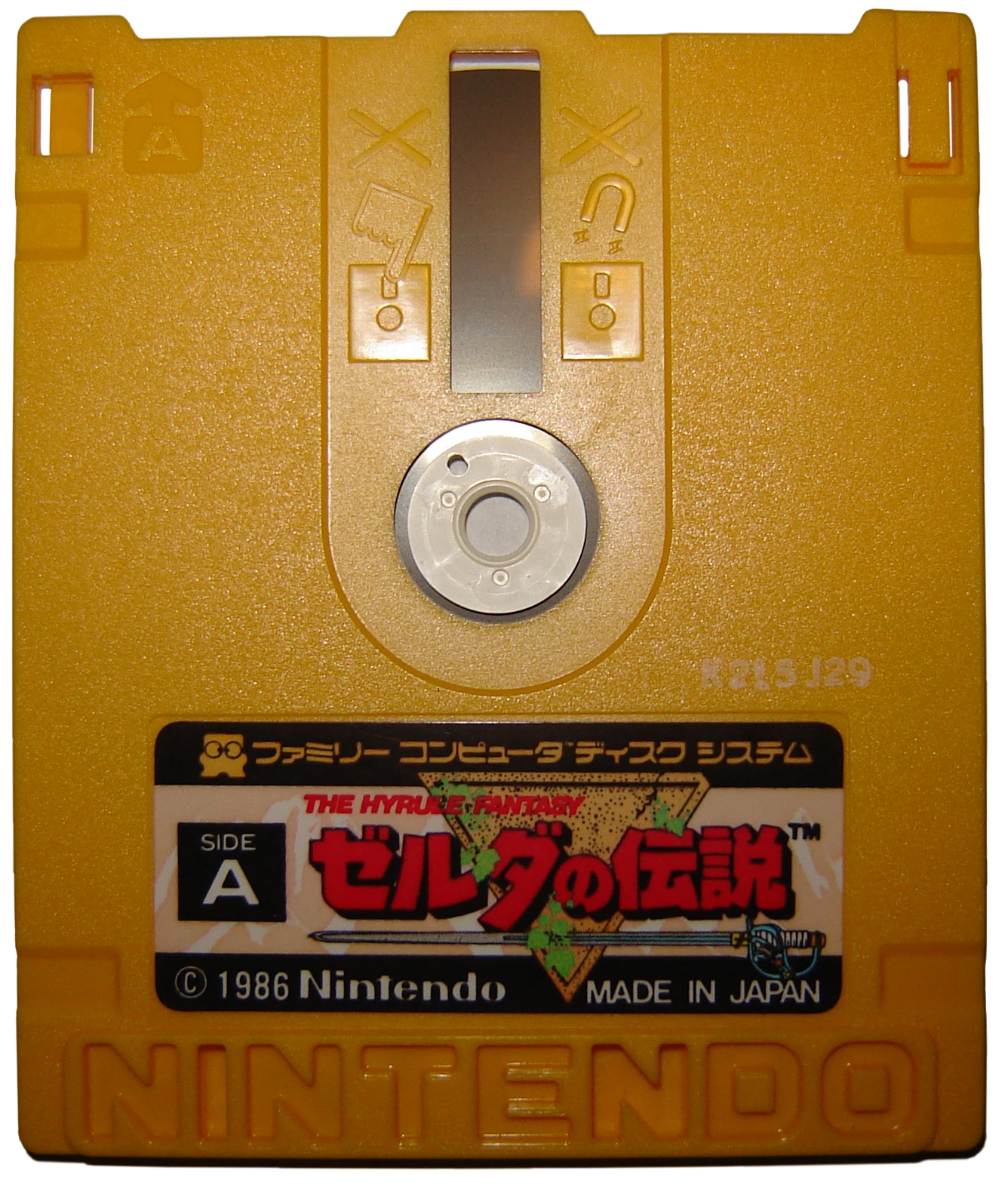
Famicom Disk System (Japan); NES (North America and Europe); Famicom cartridge (Japan, 1994)
Developer
Nintendo R&D4
Publisher
Nintendo
Directors
Shigeru Miyamoto and Takashi Tezuka
Producer
Shigeru Miyamoto
Programming
Toshihiko Nakago (SRD)
Music
Koji Kondo (credited as “Konchan”)
Manual story
Keiji Terui
Players
1
Released (Japan)
21 February 1986, Famicom Disk System launch title (¥2,600; ¥500 to rewrite a disk at a Disk Writer kiosk)
Released (North America)
22 August 1987, NES
Released (Europe)
15 November 1987, NES
Saving
Rewritable disk in Japan; battery-backed memory in the gold NES cartridge
About 6.51 million worldwide by 2004, including 1.69 million on Disk System
Honours
World Video Game Hall of Fame, 2016
Overview
Every Zelda game since has been measured against this one. Released in Japan in February 1986 as one of the first games for the Famicom Disk System, and on a gold NES cartridge in America and Europe in 1987, The Legend of Zelda dropped players into an open world with no sword and very little guidance, and trusted them to find their own way.
Shigeru Miyamoto and Takashi Tezuka built it alongside Super Mario Bros., deliberately making it the opposite: where Mario runs left to right, Hyrule spreads out in every direction, full of caves behind waterfalls, stairs under bushes and walls that crumble when you bomb them. Koji Kondo wrote the music, including the overworld theme that the series still plays today.
The cast and the furniture of forty years of Zelda start here: Link, Princess Zelda, Ganon and Impa; the Triforce; Rupees, Heart Containers and fairy ponds; Death Mountain; and a harder Second Quest for anyone who saw the ending. Nintendo’s official Zelda site still sums it up in a sentence: a young boy called Link has to reach Death Mountain and beat a pig-like monster named Ganon.
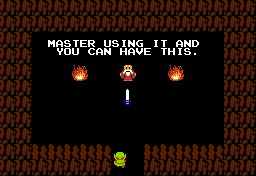
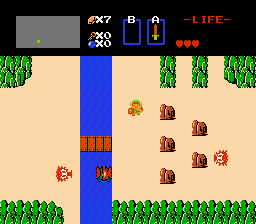
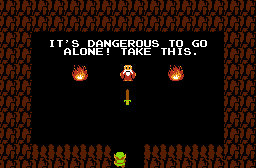
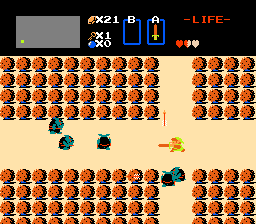
The first screen: a cave, a choice of paths, and no sword yet.“It’s dangerous to go alone! Take this.”Inside one of the nine underground levels.
A long, long time ago the World was in an age of Chaos.
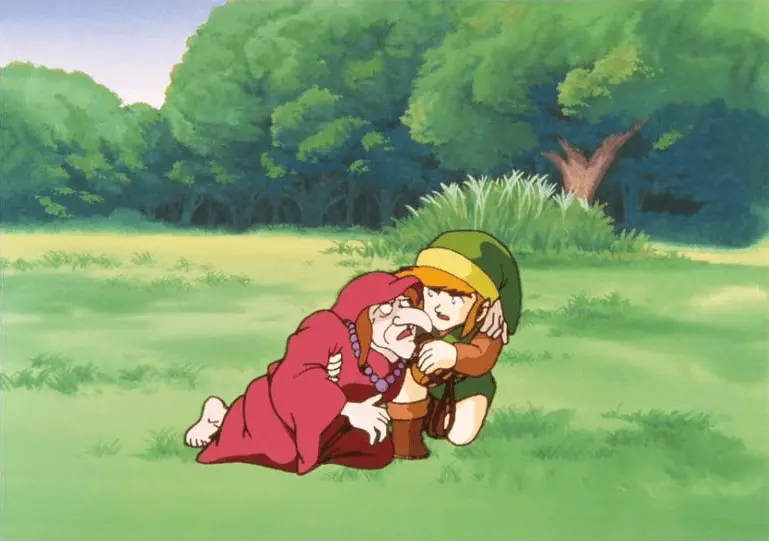
So begins the story page of the American instruction manual. It goes on to tell of a small kingdom in the land of Hyrule and the legend of the Triforce, golden triangles with mystical powers; of the army of Ganon, Prince of Darkness, which seized the Triforce of Power; of Princess Zelda breaking the Triforce of Wisdom into eight pieces and hiding them; and of her nursemaid Impa, cornered by Ganon’s henchmen until a young lad called Link drives them off.
— Official description: Nintendo of America, The Legend of Zelda NES instruction manual (1987). One line quoted; the rest summarised.
Quick Answers
The questions people ask most about the first Zelda, answered here and explained in more detail below.
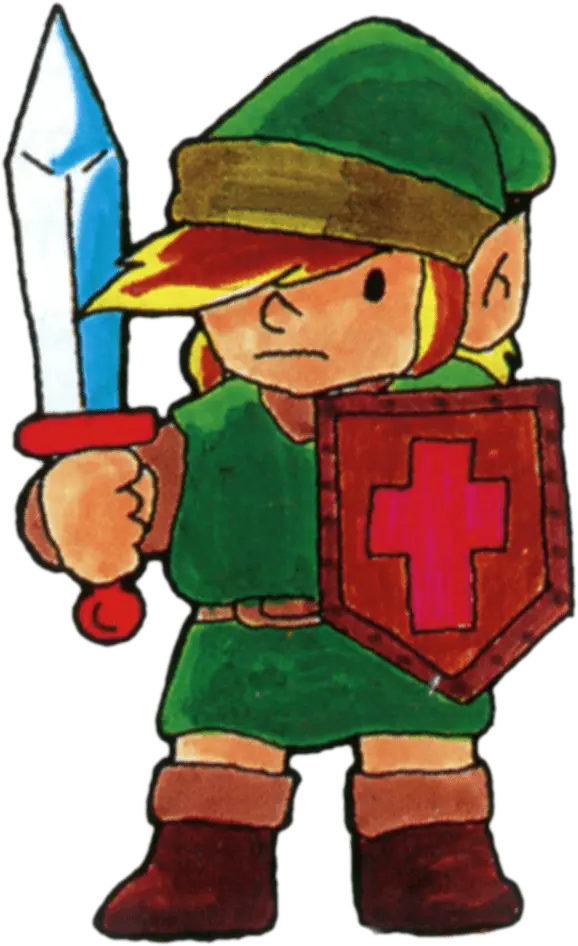
Link with sword and shield in Nintendo’s original artwork.
When did The Legend of Zelda come out?
On 21 February 1986 in Japan, for the Famicom Disk System. The NES cartridge followed on 22 August 1987 in North America and 15 November 1987 in Europe. More →
Who made the original Zelda?
Nintendo. Shigeru Miyamoto and Takashi Tezuka directed it, Miyamoto produced, Koji Kondo composed the music and Toshihiko Nakago of Nintendo’s partner SRD did much of the programming. More →
How many dungeons are there?
Nine, called levels. Eight each hide a piece of the Triforce of Wisdom; the ninth, inside Death Mountain, holds Ganon and the captive Zelda. The first six entrances are out in the open; the last three are hidden. More →
How do you start the Second Quest?
Finish the game, or simply type ZELDA as your name on the file screen. The Second Quest has new dungeon layouts, moved secrets and tougher enemies. More →
Why is the NES cartridge gold?
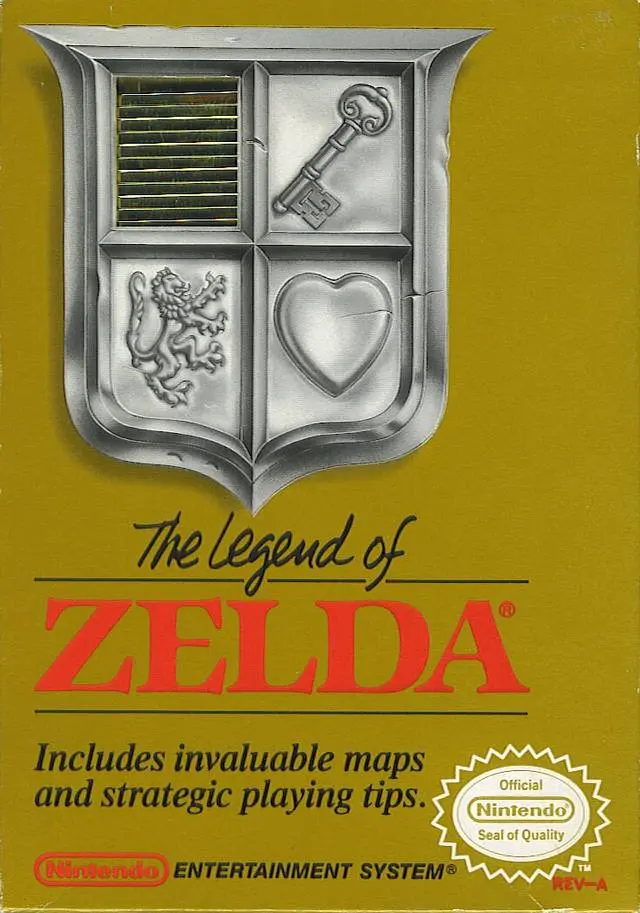
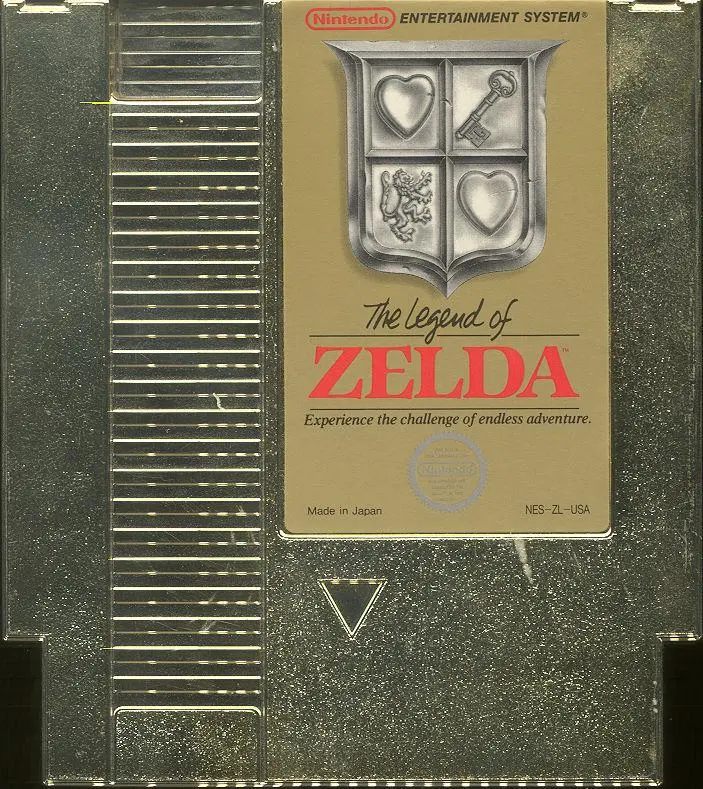
Outside Japan the game came on a gold-coloured cartridge, shown off through a cut-out window in the North American box. It also had a battery inside to keep your save, something the Disk System had handled with rewritable disks. More →
Where does “It’s dangerous to go alone! Take this.” come from?
It is what the old man in the very first cave says as he hands Link his first sword. Miyamoto made players go into that cave for the sword rather than starting with one. More →
How do you save or continue?
Press Up and A together on the second controller at any time to bring up the Continue, Save and Retry screen. More →
Is there a Triforce of Courage?
Not yet. In the first game the Triforce has only two parts, Power and Wisdom. The Triforce of Courage arrived in Zelda II. More →
How many copies did it sell?
About 6.5 million worldwide by 2004, according to figures compiled by the games site The Magic Box. It was the first NES game to pass a million sales in the United States, in 1987. More →
Where can I play it today?
It is part of the NES library for Nintendo Switch Online subscribers (since 18 September 2018), and it is built into the 2021 Game & Watch: The Legend of Zelda, in both its Japanese and international versions. More →
Plot / Story
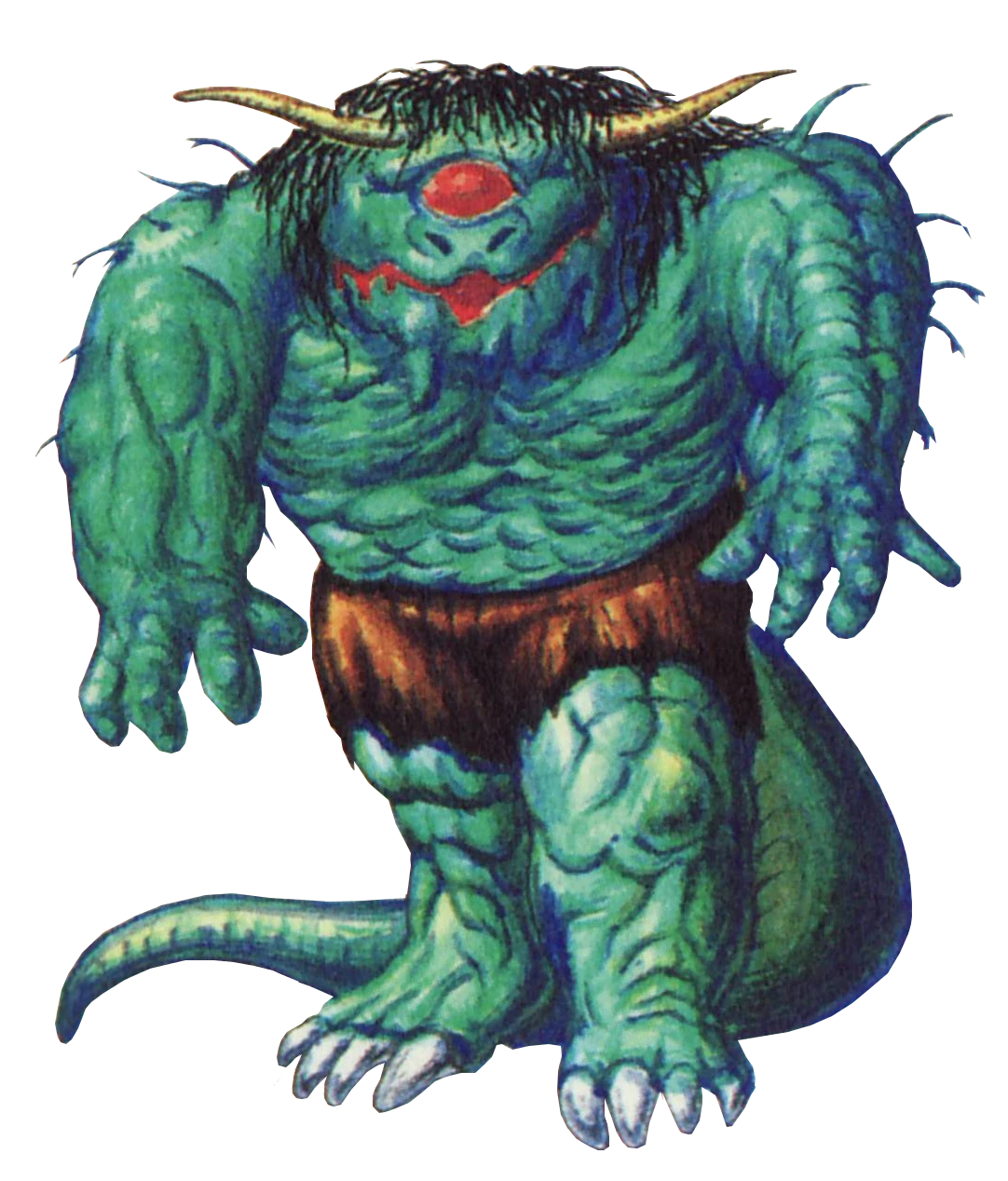
Ganon, Prince of Darkness, in Kadokawa Shoten artwork.
The game itself tells you very little. Its scrolling introduction hints at a tale, but the real story lived in the instruction manual, written by Keiji Terui, a screenwriter on the Dr. Slump and Dragon Ball anime, who borrowed the flavour of medieval European wars. Nintendo wanted that booklet to matter: Japanese players could copy the game onto a blank disk at a shop kiosk, so the printed manual became the tangible thing that made a purchase feel real, and the game even tells you to read it for details.
The legend in the manual
Long ago, the people of a small kingdom in Hyrule handed a legend down through the generations: the legend of the Triforce, golden triangles with mystical powers. Then an army of monsters invaded, led by Ganon. The Japanese manual calls him the Great Demon King; the English one, the Prince of Darkness. He seized the Triforce of Power.
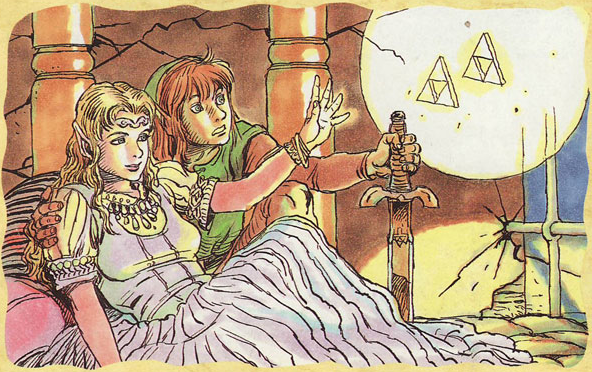
Princess Zelda knew he would come for the other piece too. To keep the Triforce of Wisdom out of his hands, she broke it into eight fragments and hid them in secret underground labyrinths. Then she sent her nursemaid Impa out to find someone brave enough to stop him. Ganon’s forces captured the princess and hunted Impa down, and they had her cornered when a passing boy named Link chased them off. Hearing her story, he decided to find the eight pieces and save Zelda himself.
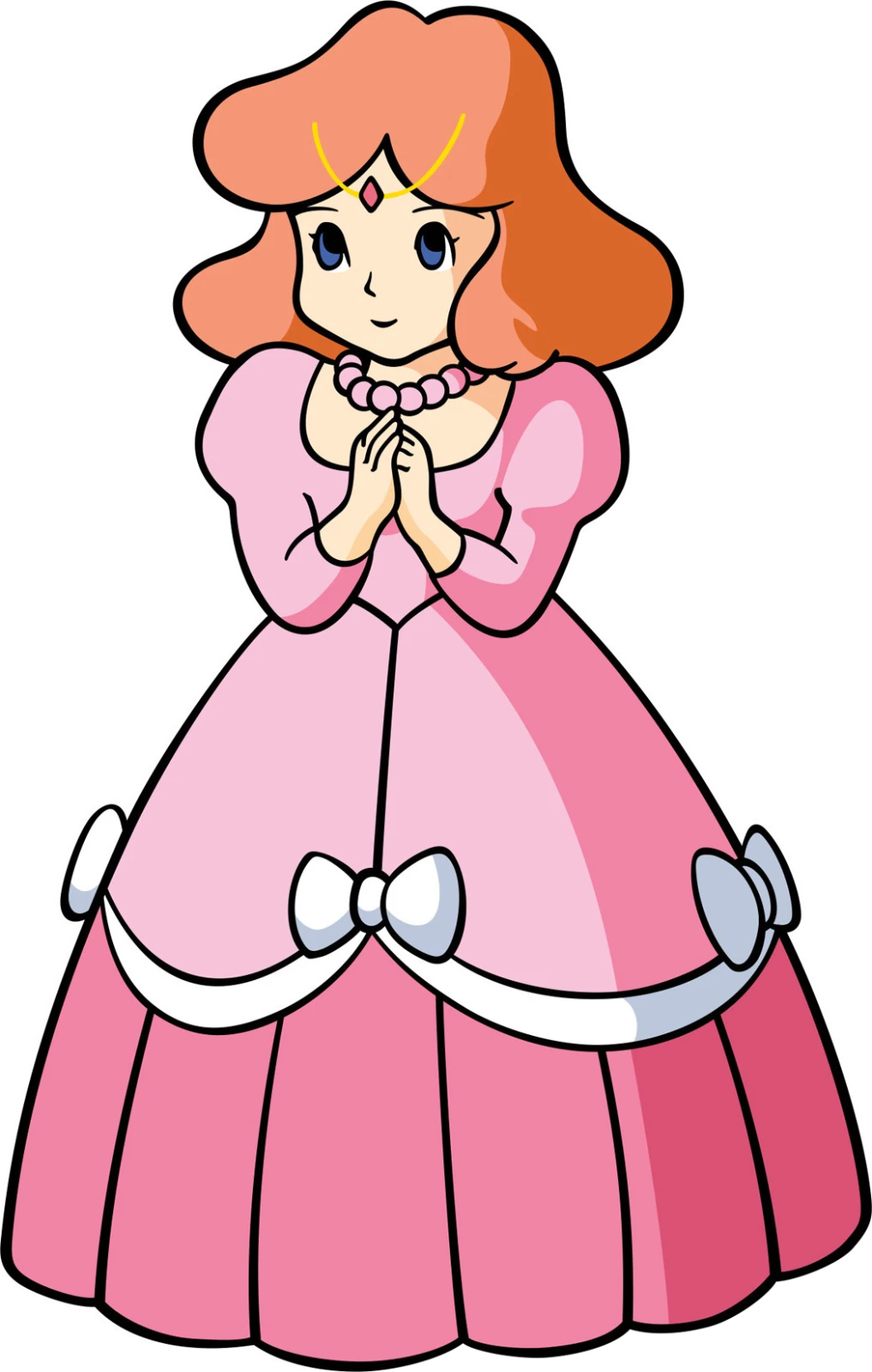
The story page of the instruction manual.Princess Zelda in the original artwork.Impa, Zelda’s nursemaid, as drawn for the manual.
A boy, a cave and a sword
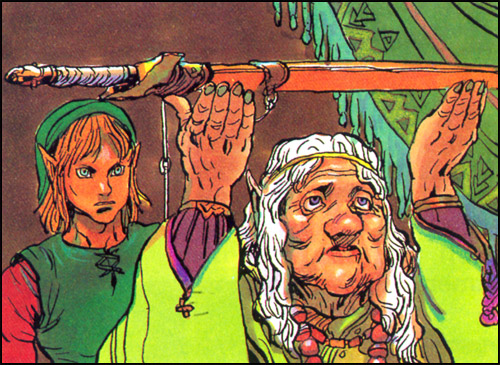
Link starts with a small shield and nothing else. Step into the cave on the very first screen and an old man offers a wooden sword with the most famous line in the series: “It’s dangerous to go alone! Take this.” Miyamoto had originally given Link the sword from the start; making players find it, and listen to the old man, was a deliberate push to explore and to talk to each other about what they had found.
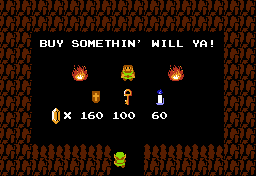
From there, Hyrule is yours. Rupees buy equipment and information, Heart Containers lengthen your life bar, rings soften the blows and more powerful swords wait for anyone strong enough to wield them. Much of the best stuff is hidden: in caves behind waterfalls, under rocks and trees, and behind walls you have to bomb open. Old men in caves dispense riddles, some helpful and some famously baffling.
The old man and his wooden sword.The overworld of Hyrule: forests, lakes, graveyards and mountains.A cave shop, where Rupees buy bombs, arrows and shields.
Eight pieces of Wisdom
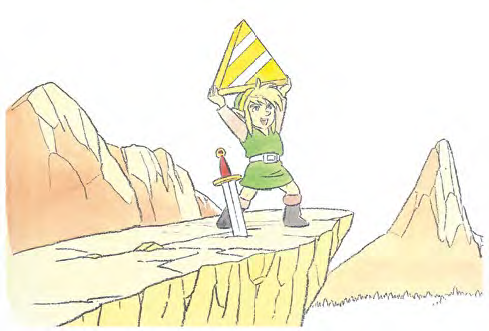
Each of the eight underground levels is a maze of rooms, locked doors and secret passages, ending with a guardian boss and a shard of the Triforce. The levels hold the tools that open the rest of the world: a bow and boomerang in the first, a raft and a stepladder for crossing water and gaps, and a recorder whose tune summons a whirlwind that carries Link to levels he has already cleared. The first six entrances are easy to spot. The last three are hidden, and finding them is a puzzle in itself.
You can, in theory, tackle much of it out of order. The game is so open that it is even possible to reach Ganon without ever picking up a sword.
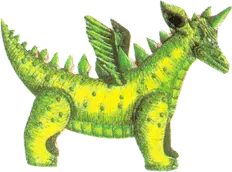
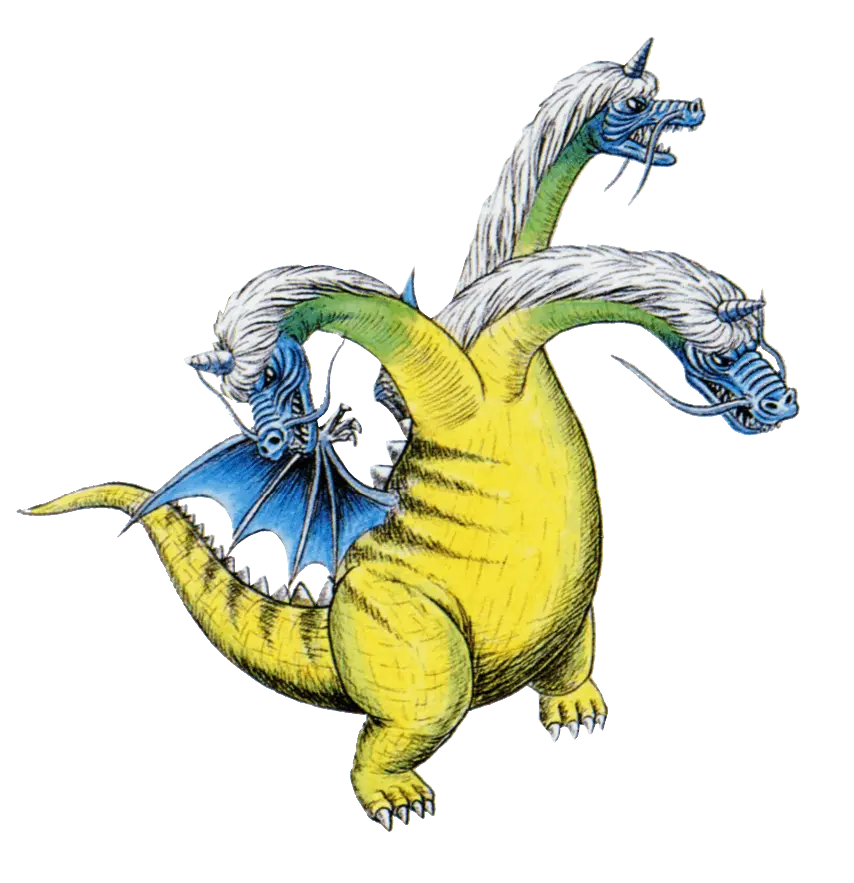
Collecting a piece of the Triforce of Wisdom.Aquamentus, the first boss.The many-headed dragon Gleeok.
Death Mountain and the ending
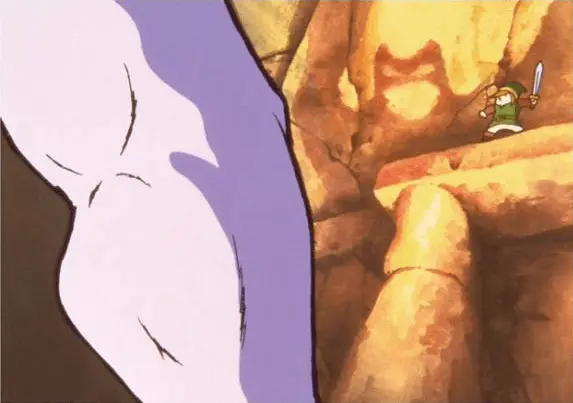
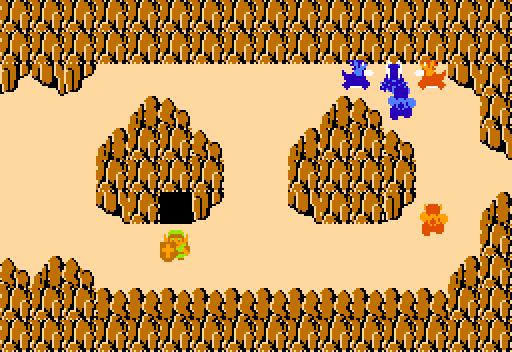
With all eight fragments assembled, Link can enter the ninth level, beneath Spectacle Rock on Death Mountain. Ganon waits at its heart, and only one thing can finish him: the Silver Arrow, which Link finds inside the mountain. When the Prince of Darkness falls, Link takes the Triforce of Power from his ashes, frees Zelda and returns both pieces of the Triforce to her. The closing text announces that peace has returned to Hyrule and the story is over, and then adds a teaser: another quest will start from here.
The final battle with Ganon.Link and Zelda reunited.
Another quest will start from here
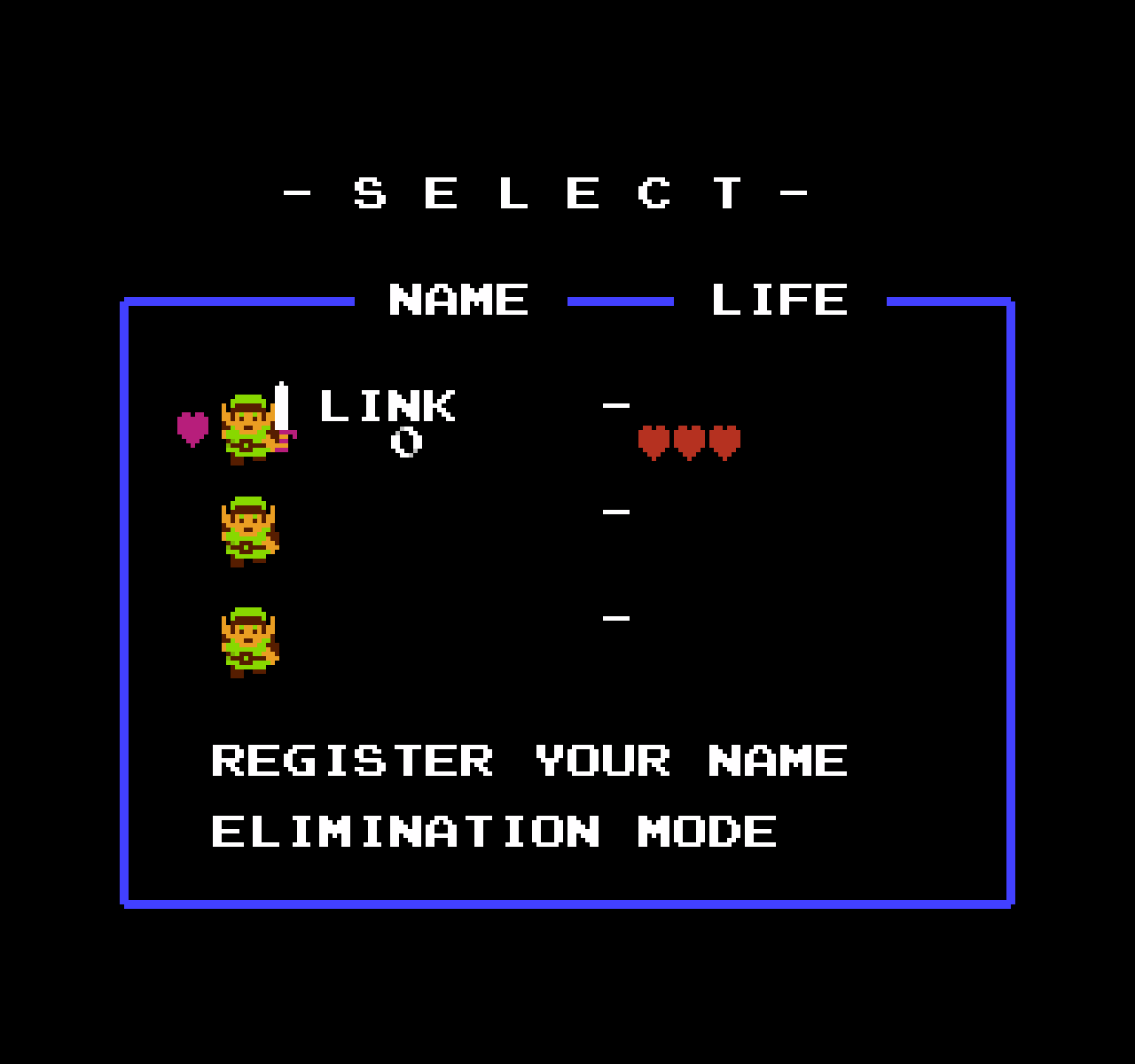
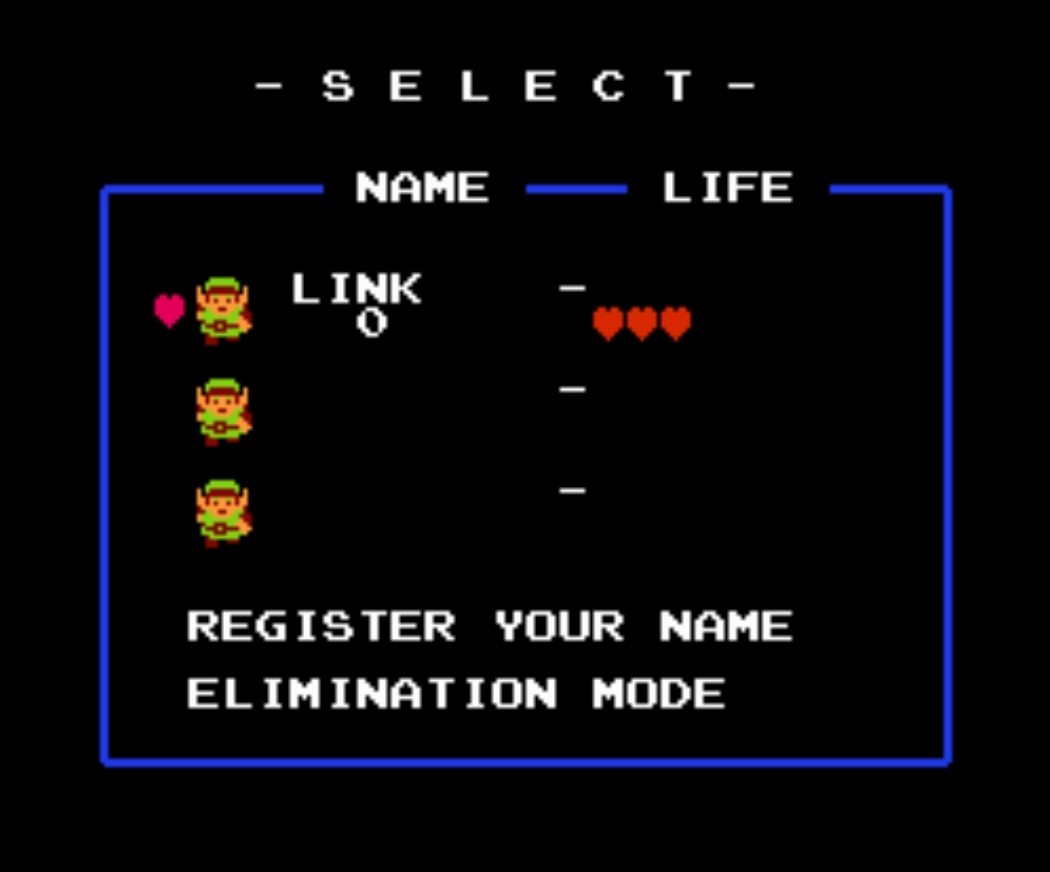
Finish the game and you unlock the Second Quest (Ura Zelda, “reverse Zelda”, in Japan), marked on the file screen by a little Link holding a sword. The overworld looks the same, but the levels are new, the secrets have moved and the monsters hit harder. It exists almost by accident: Tezuka drew the original dungeon maps for programmer Toshihiko Nakago and filled only half of the space available, and rather than fill it with more of the same, the team used the rest for a second, harder adventure.
Levels in The Legend of Zelda
The overworld of Hyrule surrounds nine underground levels. These are the First Quest’s, with their main treasures and bosses; the Second Quest shuffles everything.
Level 1Boss: AquamentusThe bow and the boomerang.
Level 2Boss: DodongoThe magical boomerang. An old man’s hint, “Dodongo dislikes smoke”, points the way.
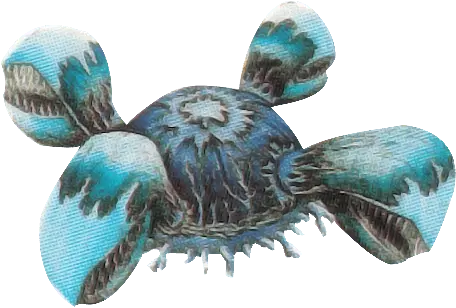
Level 3Boss: ManhandlaThe raft.
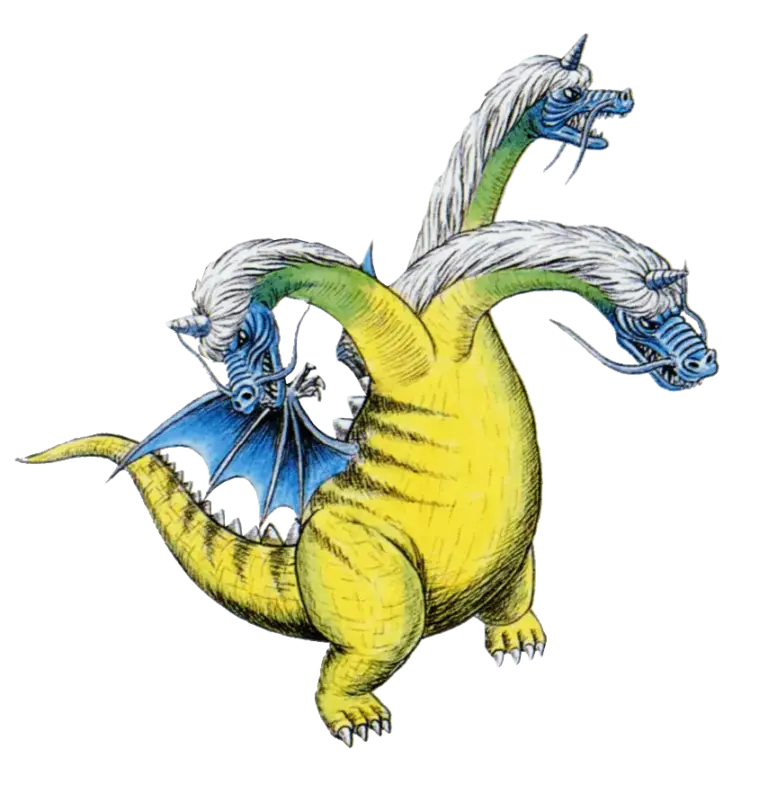
Level 4Boss: two-headed GleeokThe stepladder, for crossing gaps.
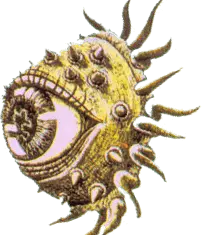
Level 5Boss: DigdoggerThe recorder, whose tune summons the warp whirlwind.
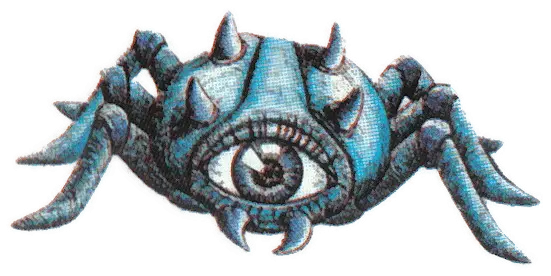
Level 6Boss: GohmaBring arrows: Gohma is only vulnerable in its eye.
Level 7Boss: AquamentusThe red candle, which can be used without limit.
Level 8Boss: four-headed GleeokThe magic book and the all-purpose magic key.
Level 9Death Mountain · GanonEntered at Spectacle Rock once all eight fragments are found. The Silver Arrow is inside.
Our list follows the First Quest; item details for every room are in the walkthroughs listed under Sources.
In comics, TV & other media
Link and Zelda had been in American homes for barely two years when they got their own cartoon. These adaptations borrowed from the first game (and its sequel); there is more in our cartoon and comics sections.
The Legend of Zelda (TV series)DiC · 1989 · 13 episodesThirteen short cartoons shown on Fridays from 8 September to 1 December 1989 inside The Super Mario Bros. Super Show!, based on the first two NES games. Link, Zelda and Ganon fight over a Triforce of only two pieces, just as in this game.
Captain N: The Game MasterNBC · 1990The same voice actors brought Link, Zelda and Ganon into four episodes of the second season of DiC’s Saturday-morning series.
The Legend of Zelda (Valiant Comics)Nintendo Comics System · 1990Five issues based on the two NES games and loosely on the cartoon, reprinted in 1991 with changes.
Television advertsJapan · USAJapan advertised the Disk System game with straightforward commercials and a longer promotional film that animated the manual’s story. American commercials were much quirkier, including a rap commercial (see Videos).
Breakfast cerealUSAZelda even appeared on a breakfast cereal advertised on American television.
Characters
A small cast, most of it introduced only in the manual, but every one of them is still with us four decades later.
Character
Who they are
In this game
Stats & abilities
LinkThe hero
Designed by Takashi Tezuka from Miyamoto’s idea, with Peter Pan as an influence, Link is an ordinary boy, “a young lad” in the English manual, who happens to be passing when Impa needs help. Miyamoto’s early concept had the Triforce pieces as electronic chips in a story that moved between past and future; Link was to be the link between them. He would go on to be the hero of every main Zelda game until Echoes of Wisdom (2024) gave that role to Zelda, usually as a new incarnation of the same heroic spirit.
The only playable character. He collects the eight fragments of the Triforce of Wisdom, defeats Ganon with the Silver Arrow, takes the Triforce of Power and rescues Zelda.
Swords: wooden, White and Magical
Hearts from Heart Containers; rings reduce damage
Bombs, bow and arrows (arrows cost Rupees), boomerangs, candles, recorder, raft, stepladder, magic book, magic key and more
Princess ZeldaThe princess of Hyrule
Named by Miyamoto after Zelda Fitzgerald, the wife of the novelist F. Scott Fitzgerald, a name a Nintendo PR planner suggested and Miyamoto loved the sound of. She lent her name to the whole series, which is why so many people assume the hero in green is called Zelda.
Breaks the Triforce of Wisdom into eight pieces before Ganon can take it, sends Impa for help and is held prisoner in Death Mountain until Link frees her.
Not playable. Appears only at the end.
GanonThe Prince of Darkness
The Great Demon King in Japanese, the Prince of Darkness in English, and a pig-like monster in Nintendo’s own description. In development he was called Hakkai, after the pig character Zhu Bajie from Journey to the West. His human alter ego, Ganondorf, was introduced in the backstory of A Link to the Past and first appeared in person in Ocarina of Time. The in-game story spells his name “Gannon”; later English versions fixed it.
Steals the Triforce of Power, captures Zelda and waits in Level 9 under Death Mountain.
Can only be finished with the Silver Arrow
Leaves the Triforce of Power in his ashes
ImpaZelda’s nursemaid
Zelda’s nursemaid makes her debut in the manual and the artwork rather than the game. She became a series fixture: in Zelda II she sends Link after the Triforce of Courage, and from Ocarina of Time onwards she is a Sheikah warrior and guardian.
Sent by Zelda to find a hero, she is cornered by Ganon’s henchmen until Link rescues her, and it is her story that sends him on his quest.
Not seen in the game itself.
The old menHyrule’s hint-givers
Mysterious old figures who wait in caves and dungeon rooms. They are the game’s only real conversation partners, and they sound like wise old sages in the Japanese script.
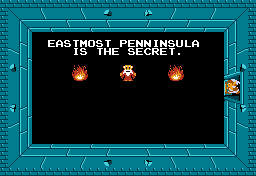
One hands over Link’s first sword, others hold back stronger blades until Link is tough enough, and many give clues, from the useful (“Dodongo dislikes smoke”) to the notorious (“Eastmost penninsula is the secret”, a line with no equivalent in the Japanese script).
Not every cave is friendly: bomb your way into the wrong one and you will be told to pay “the door repair charge”.
MoblinsGanon’s spear-throwers
Soldiers of Ganon’s army (“Molblins” in the early manuals; the Japanese name, Moriburin, may combine mori, forest, with goblin).
Common overworld enemies, but one friendly Moblin, hidden in a cave, hands Link Rupees with the line “It’s a secret to everybody.” Miyamoto, who wrote it, says he was thinking like a copywriter: it is a secret from your friends and family, and the Moblin is quietly betraying his comrades.
Common overworld enemies.
GoriyaBoomerang-throwing dungeon dwellers
Monsters who live in the underground levels.
One hungry Goriya blocks a passage, muttering “Grumble, grumble…”. Neither version of the game tells you that bait from a shop is the answer.
Bait is sold in the cave shops.
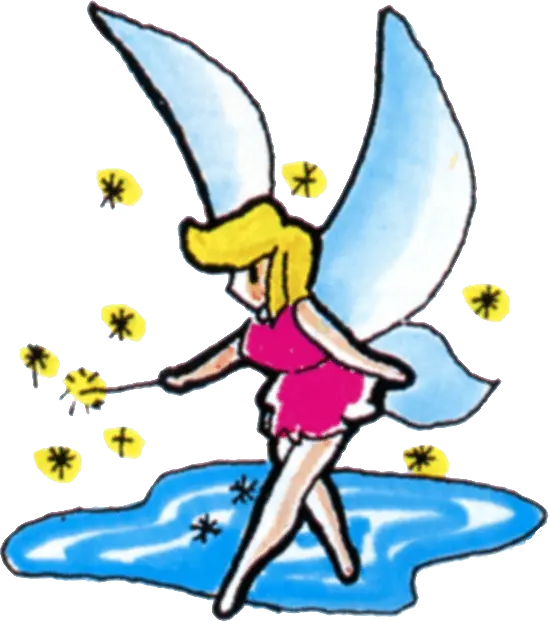
The fairiesHyrule’s healers
Fairies live beside ponds dotted around the overworld; in Tezuka’s original sound brief their springs were called “Life Fountains”.
The fairy ponds are where Link goes to recover his strength.
One pond is the landmark for a Second Quest secret.
Bosses and monsters
Every boss of the First Quest, and a selection of the monsters that roam Hyrule and its levels. Almost all of them became series regulars.
AquamentusLevels 1 and 7The first boss most players face, and the guardian of Level 7 too.
DodongoLevel 2The beast behind the old man’s hint “Dodongo dislikes smoke”.
ManhandlaLevel 3A man-eating plant, Testitart in Japanese. The Japanese manual calls it a jumbo-sized Pakkun Flower, the Japanese name for Mario’s Piranha Plant.
GleeokLevels 4 and 8A many-headed boss: two heads in Level 4, four in Level 8.
DigdoggerLevel 5A giant spiky creature, a giant “Unira” in the Japanese manual. The English manual’s advice on fighting it was wrong.
GohmaLevel 6A shelled beast that can only be hurt through its eye; a single arrow does it.
GanonLevel 9The Prince of Darkness himself.
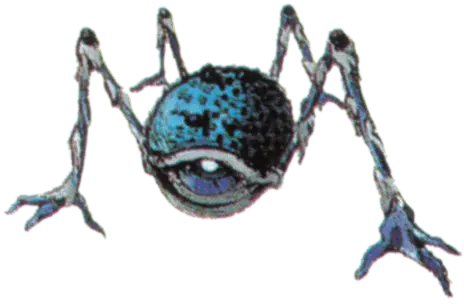
OctorokOverworldOctopus monsters, among the first enemies most players meet.
TektiteOverworldHopping overworld creatures.
PeahatOverworldA flying flower creature, the “ghost of a flower” in the English manual.
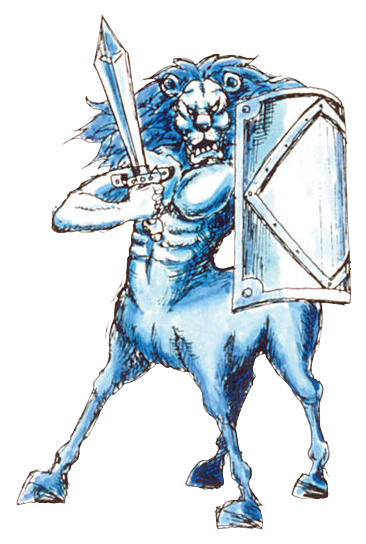
LynelOverworldPowerful guardians (guardian deities, in Japanese); the Magical Shield blocks the swords they fire.
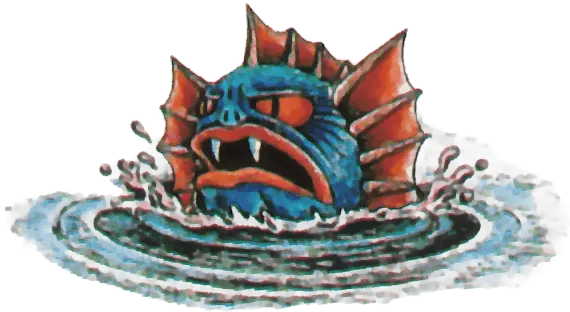
ZolaOverworld watersRises from the water to fire at Link; later games spell the name Zora.
DarknutLevelsShield-carrying knights (Tartnuc in Japanese), and Miyamoto’s own favourite enemy.
WizzrobeLevelsRobed wizards (the English manual’s invented “Master of Movement”).
Pols VoiceLevelsIn Japan you could shout into the Famicom’s second-controller microphone to kill it.
WallmasterLevelsA monster that lurks in the dungeon walls; it gave many young players their first real fright.
Zol and GibdoLevelsZols, blobby dungeon pests, and Gibdos, mummies of superhuman strength according to the Japanese manual.
The people who made it
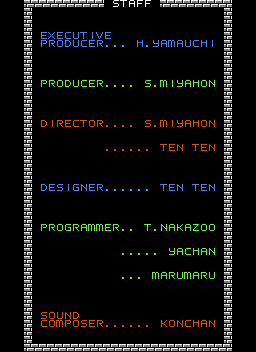
The team credited itself under nicknames, such as “S. Miyahon”, “Ten Ten” and “Konchan”.
Shigeru MiyamotoDirector and producer · “S. Miyahon”Built the game around the thrill of exploration he remembered from boyhood, and around getting players to share discoveries. He decided which ideas belonged to Zelda and which to Super Mario Bros.
Takashi TezukaDirector · “Ten Ten”Wrote the fairytale setting with Tolkien in mind, designed Link’s sprite, drew the dungeon maps and wrote the sound brief for Kondo.
Koji KondoMusic · “Konchan”Composed the game’s five pieces of music, including the overworld theme, which he reworked overnight into a new title tune when Boléro had to go.
Toshihiko NakagoProgramming · SRDNintendo’s partner programmer, who entered Tezuka’s maps and spotted that half the space was unused, which led to the Second Quest.
Keiji TeruiManual storyA screenwriter on Dr. Slump and Dragon Ball who wrote the manual’s backstory, drawing on medieval European conflicts.
How it was made
Nintendo’s own 2016 interview with Miyamoto, Tezuka and Kondo for the launch of the Nintendo Classic Mini: NES, an Iwata Asks aside, Miyamoto’s 1994 liner-note interview and decades of other interviews tell the story of how it was made.
Two games at once
The Legend of Zelda on its Famicom disk.
Work began in the autumn of 1984, and for a while the same small team was building Zelda and Super Mario Bros. side by side. Miyamoto sorted ideas into Mario ideas and Zelda ideas: Mario would be linear, Zelda would not. Zelda was always meant to launch Nintendo’s new Famicom Disk System, so Super Mario Bros., a cartridge game, was finished first, in September 1985, and then its programmers moved over to help Zelda over the line.
The Disk System gave Zelda things cartridges of the day could not easily match: 128 KB of rewritable storage for a large world, better sound, a name-entry screen and the ability to save your progress instead of writing down passwords.
Lost in the countryside
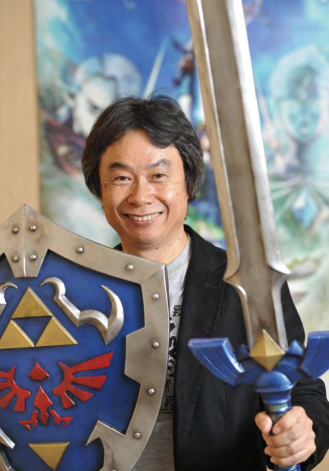
Shigeru Miyamoto, as pictured in Hyrule Historia.
Miyamoto has often described the boyhood that inspired it: exploring the fields, woods and caves around his home near Kyoto, and getting lost among the sliding doors of his family’s house. In Nintendo’s 2016 interview he added Indiana Jones and the treasure hunt, and the sight of computer role-playing fans bragging about their swordsmen and swapping tips by phone late at night. He chose a world of swords and sorcery and built an adventure around hunting for treasure; Tezuka wrote the fairytale setting with The Lord of the Rings in mind.
Miyamoto also wanted players to feel the adventure physically through the controller, rather than reading their way through it as in text adventures. When players struggled, he went the other way from what you might expect: he took the sword away from the start of the game, so that players had to find the old man, and each other, to make progress.
The theme that nearly was not
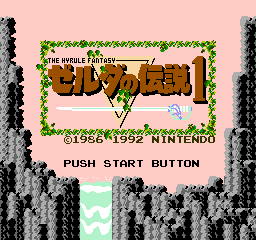
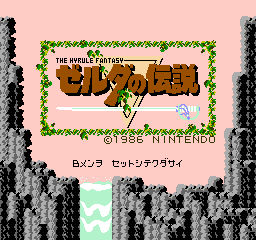
The title screen of the Famicom Disk System version.
Tezuka’s written request to Kondo, dated 27 September 1985, was rough: the cave music was simply “short BGM” and the fairy fountains were “Life Fountains”. For the title screen Kondo used an arrangement of Ravel’s Boléro as a placeholder, and it suited the scrolling story so well that it stayed. Then, just before the game was finished, the team discovered the piece was still under copyright in Japan; as Miyamoto remembers it, it had been “something like 49 years and 11 months” since Ravel’s death, with a month of protection left to run (Ravel in fact died in December 1937, about 48 years earlier). The release could not wait, so Kondo stayed up all night and reworked music already in the game into a new opening. Miyamoto compares the result to a spaghetti western theme and says it suggests courage.
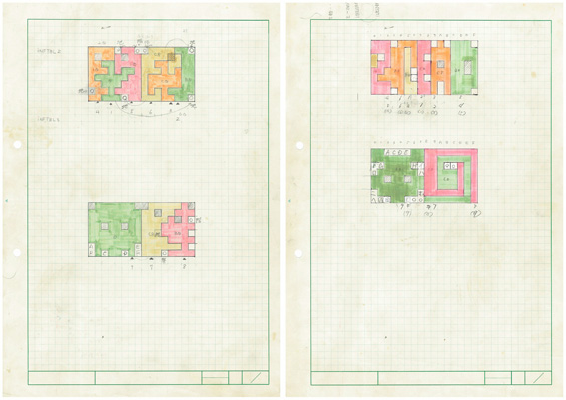
The half-empty disk
Concept art of the dungeon maps.
Memory was tight, so Tezuka designed the dungeons on squared paper, one square per room, and Nakago entered them. When Nakago asked where the rest of the data was, it turned out Tezuka had used only half the space. Miyamoto was relaxed about it, and the empty half became the Second Quest: a harder version for players who had finished the game. Satoru Iwata, hearing the story from Nakago and Tezuka years later, called it turning a setback into an opportunity.
Words, names and a manual
The Japanese logo.
Miyamoto wrote lines such as “It’s a secret to everybody” himself and says he treated them like copywriting. The currency got its name because Rupee sounded cute and suggested rubies, not because of the Indian rupee. Japanese copies carried the name “The Hyrule Fantasy”, intended as a series title in case Zelda continued; it was dropped later, possibly because A Link to the Past had a subtitle of its own or because Final Fantasy had arrived in the meantime; Miyamoto jokes that Nintendo might have looked like a copycat.
The princess’s name came from a planner who suggested Zelda, after Zelda Fitzgerald; Miyamoto liked it and asked if he could use it. Toshihiko Nakago, of Nintendo’s partner company SRD, did much of the programming, and Keiji Terui wrote the manual’s backstory.
Going west on a gold cartridge
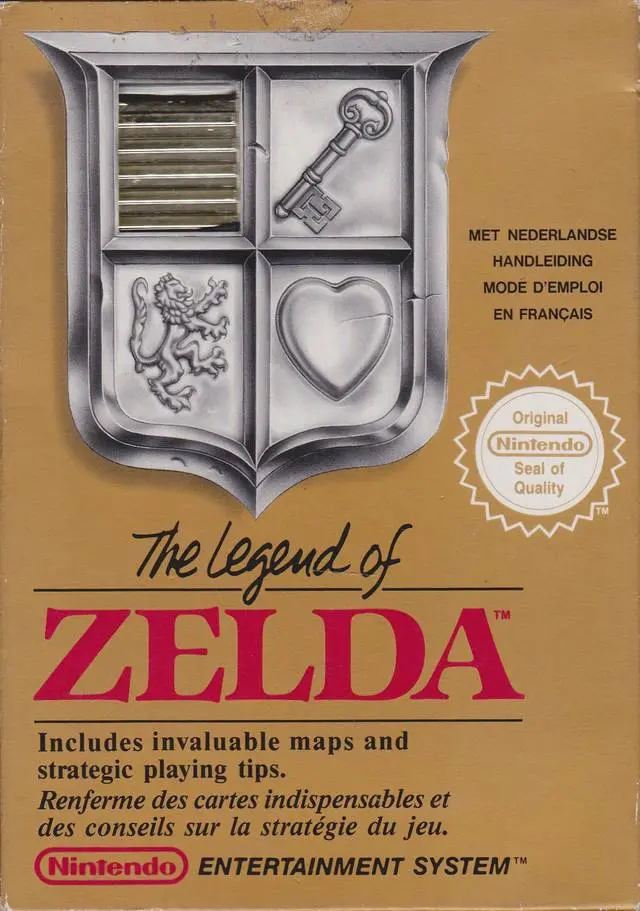
The European NES box.
The Disk System never left Japan, so the 1987 Western release had to be a cartridge. It used Nintendo’s MMC1 chip and battery-backed memory to save games, one of the earliest console cartridges to do so, and its sound effects were reworked for the cartridge hardware, which lacked the Disk System’s extra sound channel. The famous gold plastic peeked through a cut-out window in the North American box.
Copies also came with a map and hints, sealed with a warning that they should be used only as a last resort. Miyamoto, who thought players would have more fun without help, has joked that everyone broke the seal anyway. The English translation brought its own quirks, from “Gannon” to the cryptic clues listed under Glitches.
Firsts: what this game introduced
As the first game in the series, almost everything here was a first. These are the highlights.
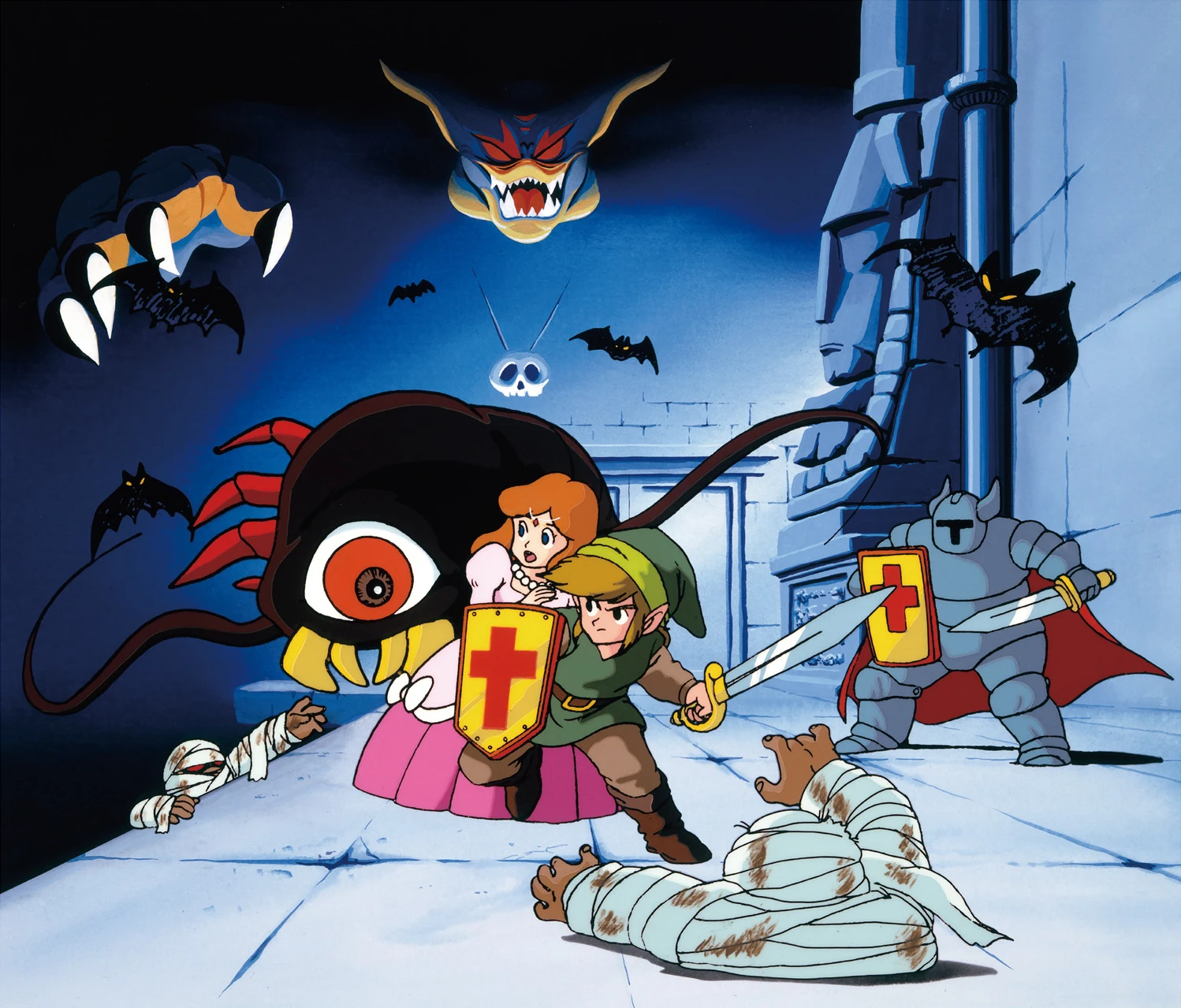
1Link, Zelda, Ganon and ImpaThe series’ core cast all debut here, though Impa only in the manual.
2Hyrule and the TriforceThe kingdom and its golden triangles. This game’s Triforce has just two parts, Power and Wisdom; Courage joined in Zelda II.
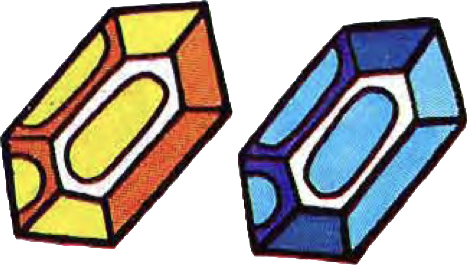
3Rupees, hearts and fairiesThe currency, the heart-based life meter with Heart Containers, and the fairies of Hyrule’s ponds.
4Dungeons and their toolsUnderground levels with keys, a boss and a treasure, and the boomerang, bombs, bow and candle that unlock the world.
5The Second QuestA harder remix for anyone who finished the game, an idea the series returned to with Ocarina of Time’s Master Quest.
6Saving your adventureDisk saves in Japan and a battery-backed cartridge in the West, so a big adventure could be played over many sessions.
7The overworld themeKondo’s main theme, still heard in Zelda games today. His overnight replacement for Boléro on the title screen is an arrangement of it.
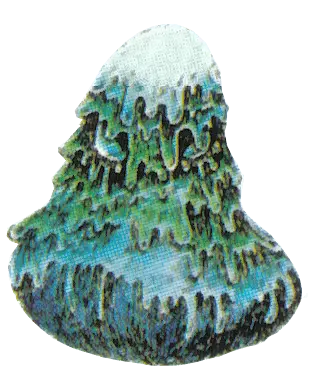
8Death MountainGanon’s lair, and a fixture of Hyrule ever since.
Cheats & secrets
There are no button-code cheats in the original Zelda, but it is full of secrets and tricks worth knowing.
Jump straight to the Second Quest
The file-select screen for the Second Quest.
Enter ZELDA as your name on the registration screen and the file starts in the Second Quest, no need to finish the first. It works in both the Japanese and English versions.
Save at any time
Press Up and A together on the second controller to bring up the Continue / Save / Retry screen. (The English manual garbled this as pressing “the Control Pad”; the Japanese manual gets it right.)
The tenth-enemy bomb
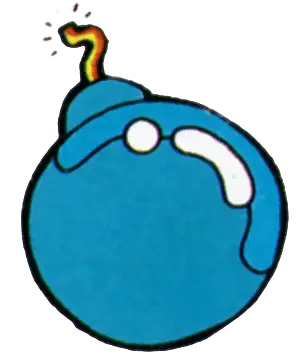
Official art of the bomb.
The old man’s hint “10th enemy has the bomb” refers to a real trick: defeat nine enemies in a row without being hit, then finish a tenth with a bomb, and it drops a bomb for you. (The Japanese hint at that spot points to a key instead.)
Arrows cost Rupees
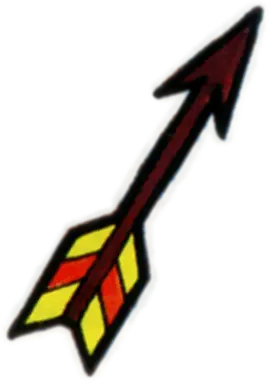
Official art of the arrow.
Once you have the bow, every arrow you fire spends a Rupee, so an empty wallet means no arrows. The Japanese version has an old man who tells you so; the English line in its place became “Eastmost penninsula is the secret”.
Feed the grumbling Goriya
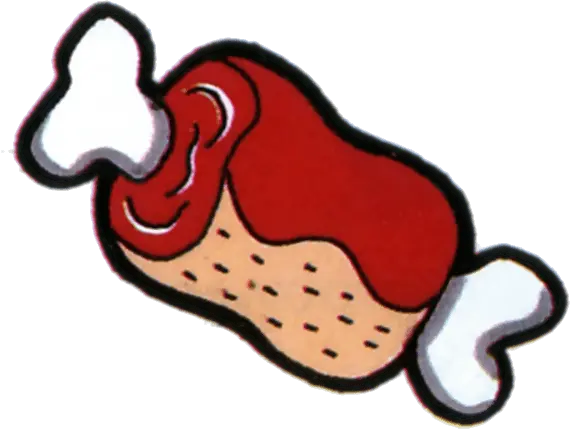
Official art of the food used as bait.
If a Goriya blocks your path saying “Grumble, grumble…”, buy bait from a shop and hand it over.
Stronger swords
The old man who holds the White Sword.
Better swords, the White Sword and the Magical Sword, are held back until you have enough heart containers. The game never tells you how many you need.
Shout at Pols Voice
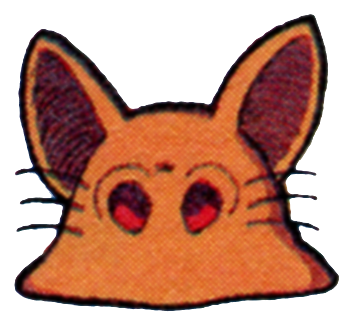
Pols Voice, as drawn for the Million Publishing guide.
On the Famicom Disk System, blowing or shouting into the microphone on the second controller kills Pols Voice. The NES pads had no microphone, but the US manual still said Pols Voice “hates loud noise”, leading many to try the recorder, which does nothing.
Who needs a sword?
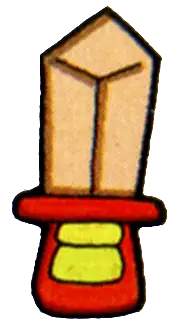
Official art of the sword.
The world is so open that you can reach Ganon without ever collecting a sword, a favourite challenge for experienced players.
Compiled from Legends of Localization’s comparison of the Japanese and English versions, Wikipedia and Zeldapedia.
Glitches, exploits and oddities
The first Zelda is remarkably solid, but its translation and its many versions left plenty of oddities.
Gannon
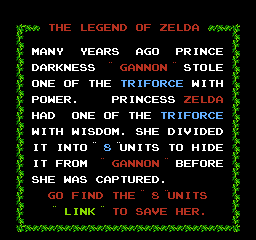
The introduction shown by the game itself.
The story text in the original NES cartridge spells the villain “Gannon”. The manual and later English releases use “Ganon”.
Clues that lead nowhere
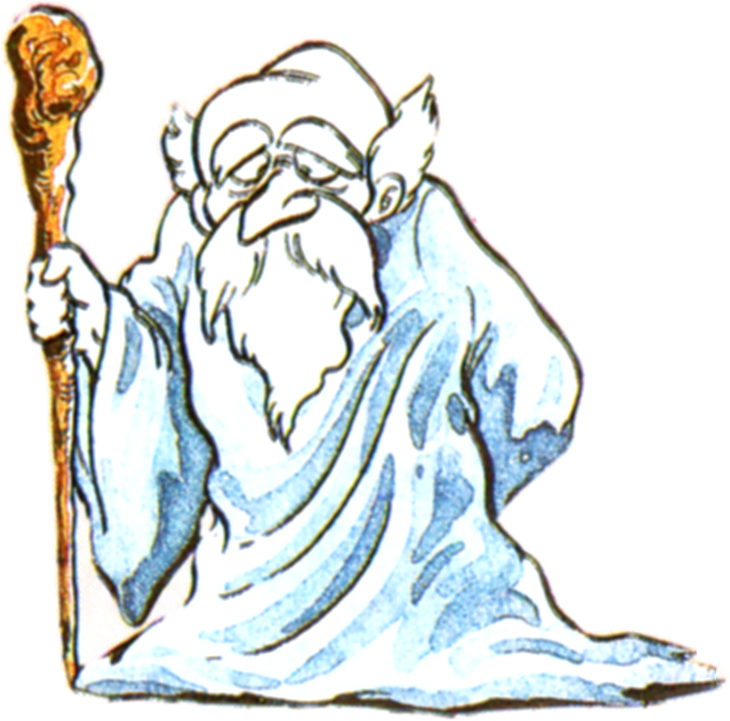
Official art of the old man.
“Eastmost penninsula is the secret” has no counterpart in the Japanese script, “10th enemy has the bomb” replaced a hint about a key, and in the Second Quest one old man still says the secret is in a tree at a dead end, even though nothing is there any more.
The manual’s whirlwind fib
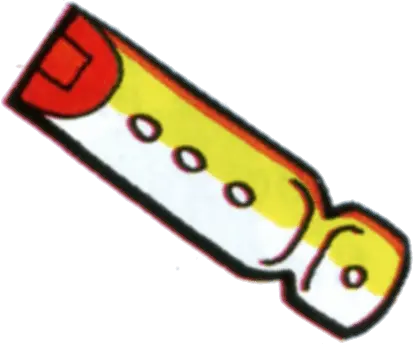
Official art of the recorder.
The English manual claims the recorder’s whirlwind can carry you to the ninth level once you have all eight pieces. It cannot; the Japanese text only promised trips to levels you had already completed.
Bible and crosses
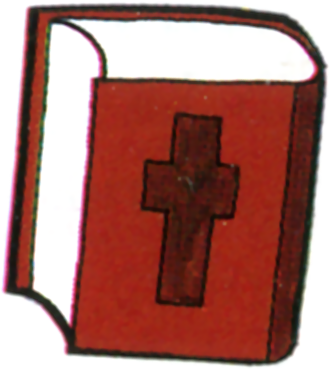
Official art of the Book of Magic.
The Japanese Book of Magic was a “Bible”, renamed, most likely because of Nintendo of America’s content rules, though the cross-shaped graphics stayed.
Two Disk System versions and a ramen disk
The Disk System game exists in versions 1.0 and 1.1, and a rare promotional disk was given to winners of a Charumera ramen contest; a technical comparison found its data identical to the normal release.
Gentler flashing
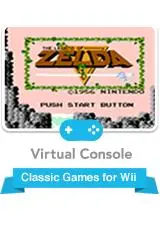
The cover image of the Wii Virtual Console release.
The Virtual Console versions slowed the screen flashing when Link collects a piece of the Triforce, most likely to reduce the risk of seizures.
Videos & media
Two period adverts from Nintendo, preserved by fans: the Japanese promotional film that animated the manual’s story, and the American rap commercial that introduced the game to the West. (We could not find an official Nintendo upload of either.)
Nintendo’s 1986 Famicom Disk System promotional film, with an animated telling of the manual’s story, subtitled in English by the uploader.
The American NES television commercial, uploaded by the fan site Zelda Dungeon.
Trivia & facts
Development began in the autumn of 1984, before Super Mario Bros., but Mario was finished first.
Miyamoto’s inspirations include his boyhood explorations around Kyoto, Indiana Jones, and PC role-players phoning each other at night to trade tips.
The Japanese packaging named the series “The Hyrule Fantasy”.
The title music was going to be Ravel’s Boléro, until the team found it was still under copyright in Japan, with about a month left to run as Miyamoto remembers it.
Official art of a fairy in a spring.Koji Kondo wrote the game’s five pieces of music; in his work order the fairy fountains were called “Life Fountains”.
The Second Quest exists because Tezuka’s dungeon maps filled only half of the available space.
Miyamoto’s favourite enemy is the Darknut, which faces Link with its shield and changes speed, elaborate behaviour for its time.
“It’s a secret to everybody” was written by Miyamoto, who says he saw himself as a copywriter.
Official art of the Rupees, which the English manual called rubies.Rupees are named for their cute sound and for rubies, not for the Indian currency.
Link’s name comes from an early idea in which the story linked the past and the future.
Official art of Ganon facing Link.Ganon’s working name was Hakkai, after the pig in Journey to the West.
Japanese players could have the game written onto a blank disk at a shop kiosk for ¥500, which is why Nintendo made the printed manual so rich.
The Western map was sealed with a warning to use it only as a last resort. Miyamoto says everyone opened it.
The staff credits screen.The staff credits use nicknames: S. Miyahon, Ten Ten, Konchan and more.
The manual’s story was written by Keiji Terui, a screenwriter on Dr. Slump and Dragon Ball.
In the Disk System version, the second controller’s microphone is a weapon against Pols Voice.
Second Quest save files are marked by a tiny Link holding a sword.
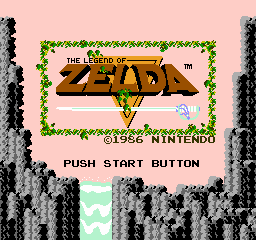
The title screen of the Famicom cartridge version.The 1994 Famicom cartridge re-release added a “1” to the title.
The Triforce has only two parts in this game; the Triforce of Courage did not exist yet.
In 1987 it became the first NES game to sell more than a million copies in the United States.
Media & artwork
Box art, manual pages, artwork and screenshots from The Legend of Zelda. Select any image to view it larger.
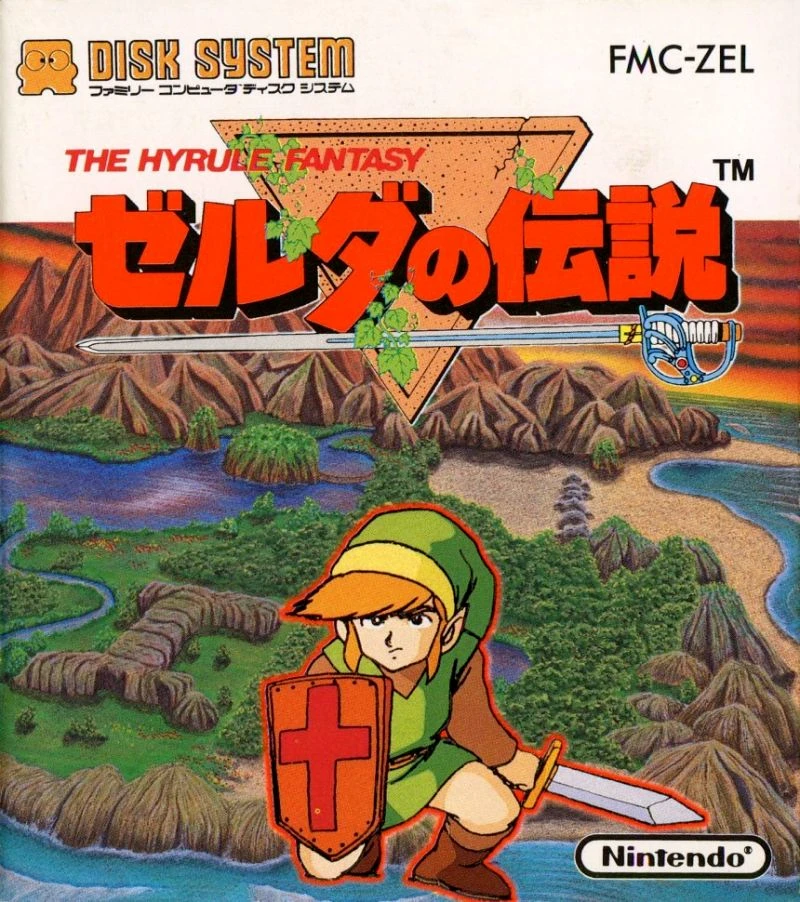
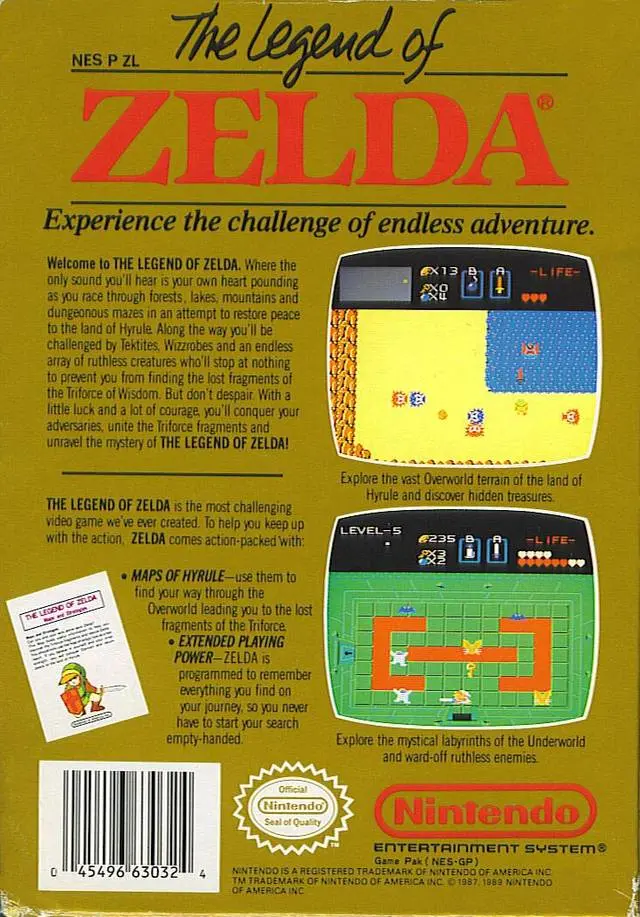
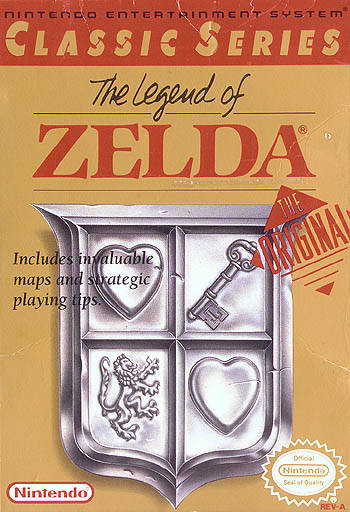
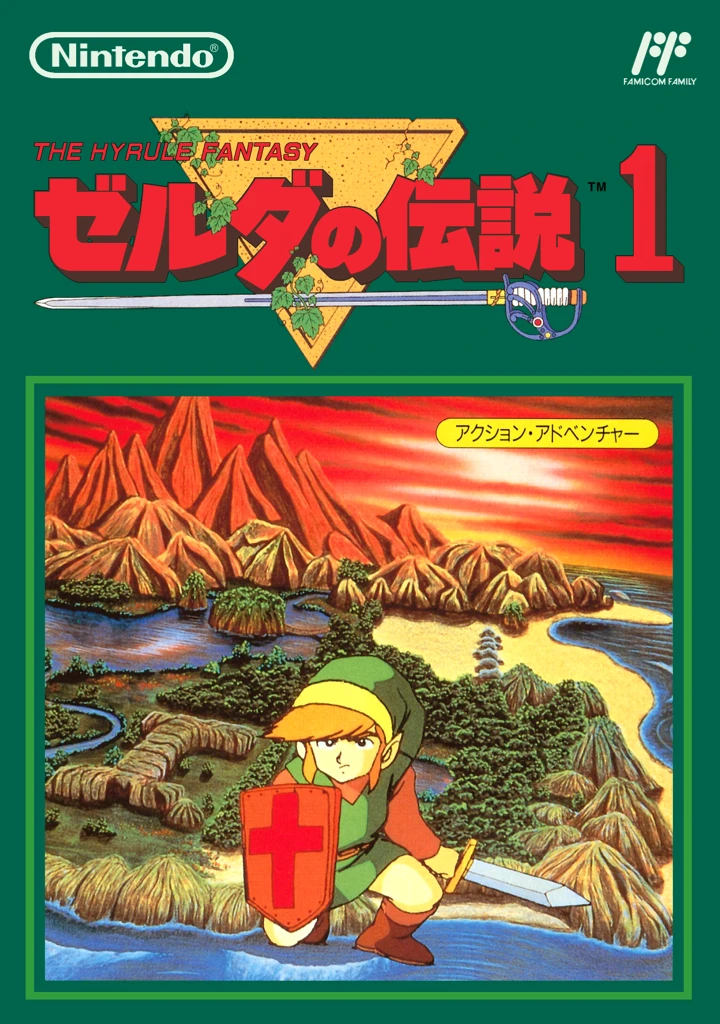
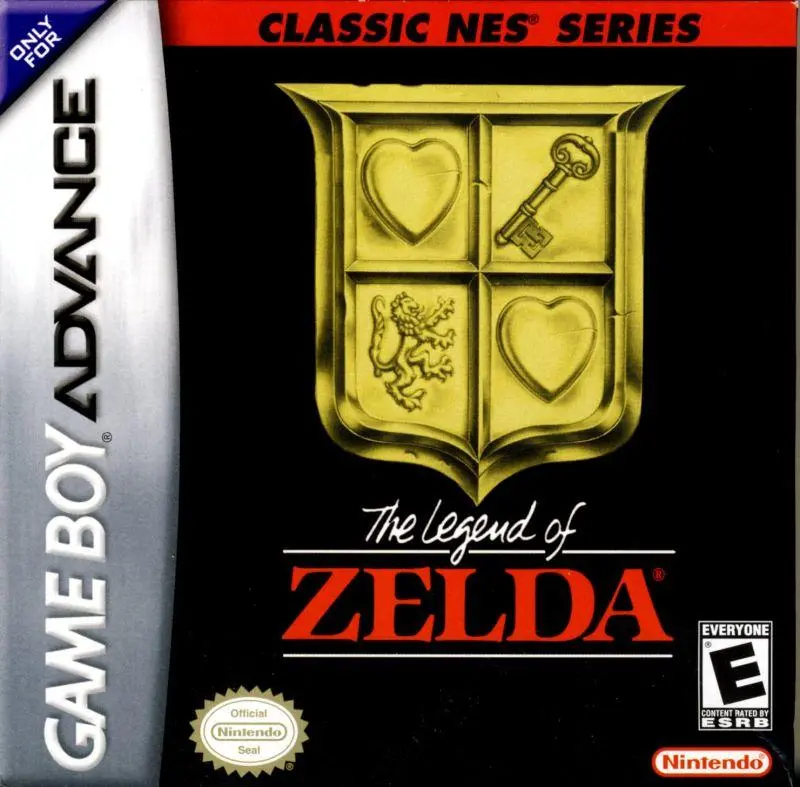
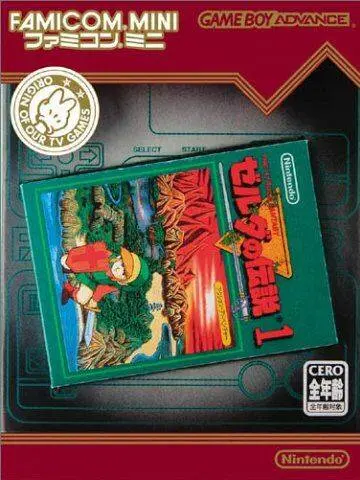
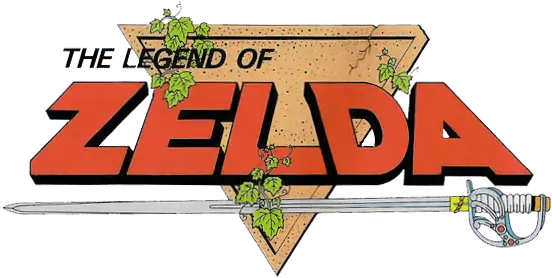
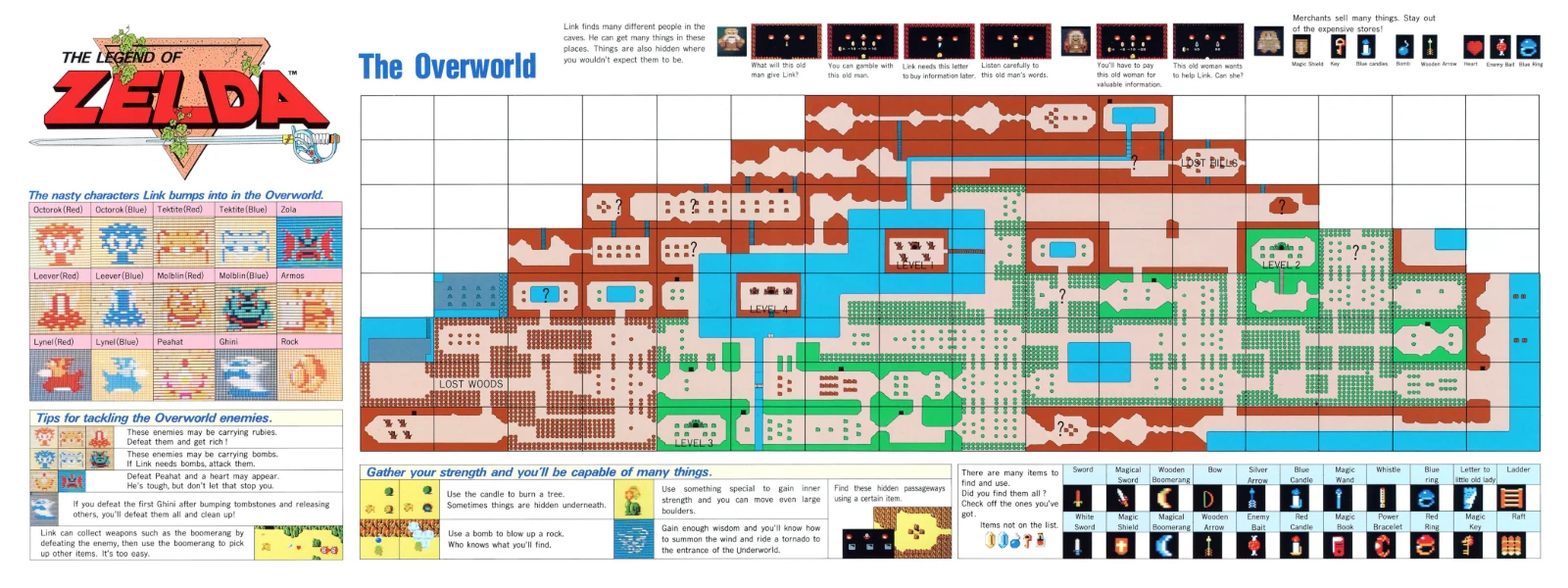
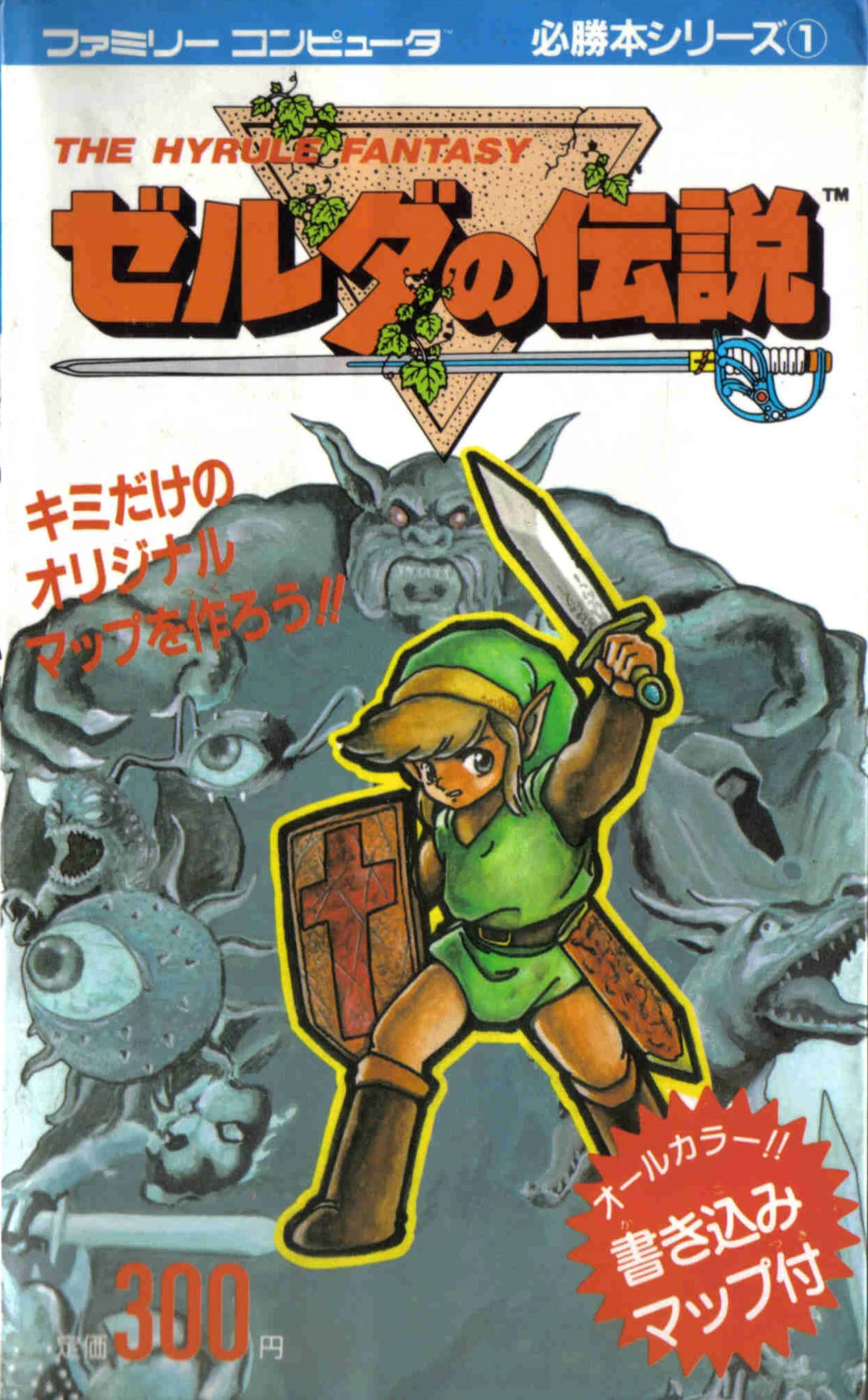
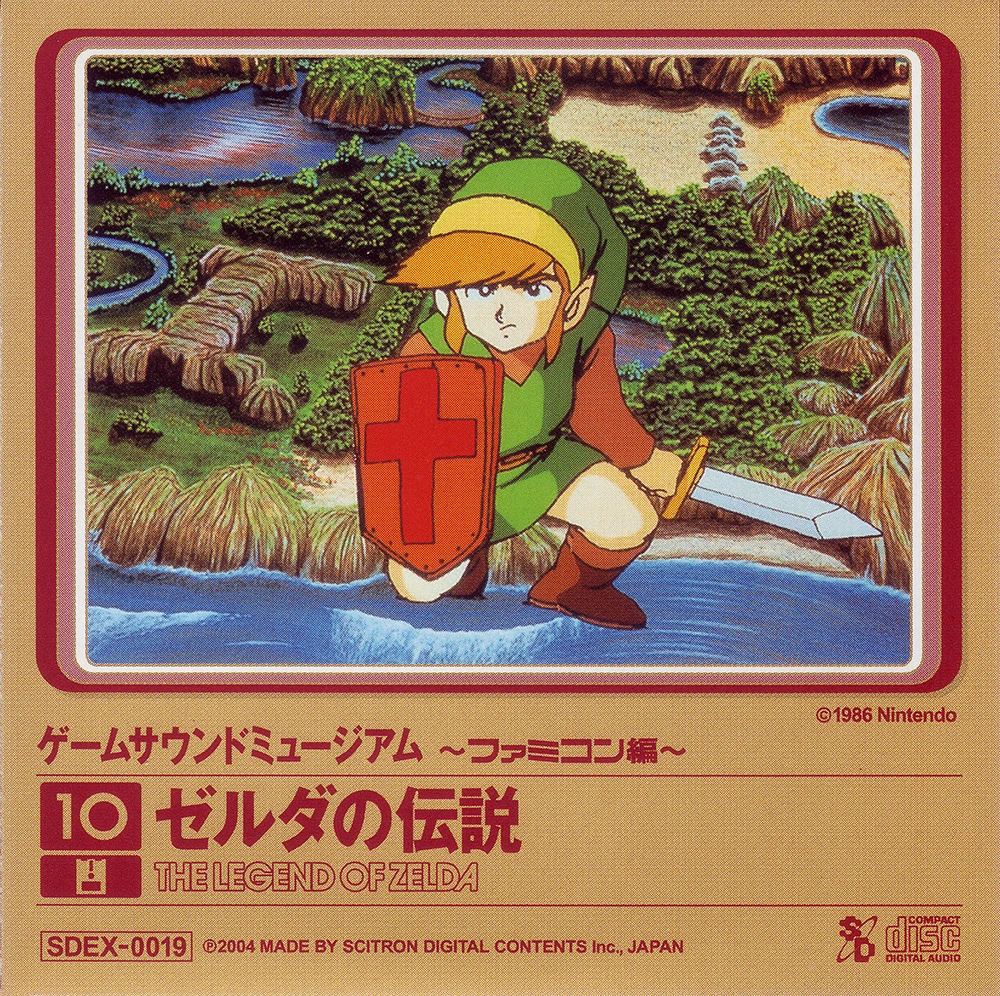
Famicom Disk System box (Japan, 1986)Back of the North American NES box (1987)Classic Series reissue box (North America)Famicom cartridge box (Japan, 1994)Classic NES Series box for Game Boy Advance (North America, 2004)Famicom Mini box for Game Boy Advance (Japan, 2004)The English logoThe complete overworld map of HyruleCover of the Million Publishing guideThe Game Sound Museum soundtrack CD
The first Zelda has rarely been out of reach. Nintendo has re-released it on almost every console and handheld it has made, and its DNA runs through the whole series.
From Disk System to Switch
Famicom Disk System21 February 1986 – Japanese launch, one of the system’s first games.
NES1987 – North America 22 August, Europe 15 November, on a gold cartridge with battery save. A grey cartridge followed later in Nintendo’s Classic Series.
Famicom cartridge19 February 1994 – Zelda no Densetsu 1, essentially the NES version with Japanese text.
BS Zelda no DensetsuAugust 1995 – A 16-bit reimagining broadcast to Super Famicom owners via the Satellaview, with new dungeons and live voice narration (see below).
The Legend of Zelda: Collector’s EditionNovember 2003 – GameCube promotional disc with this game, Zelda II, Ocarina of Time and Majora’s Mask (Japan 7 November, Europe 14 November, North America 17 November).
Classic NES Series2004 – Game Boy Advance: Japan 14 February, North America 2 June, Europe 9 July.
Wii Virtual ConsoleNovember–December 2006 – North America 19 November, Japan 2 December, Europe 8 December.
Nintendo 3DS2011–2012 – First on 3DS in September 2011, then on sale in the eShop in Japan (22 December 2011), Europe (12 April 2012) and North America (5 July 2012).
Wii U Virtual ConsoleAugust 2013 – Japan 28 August, North America and Europe 29 August.
Nintendo Classic Mini: NES2016 – One of the 30 built-in games, with a digital manual reached by QR code.
Nintendo Switch Online18 September 2018 – In the NES library from the service’s launch day; a special version with extra items and Rupees followed in October 2018.
Game & Watch: The Legend of Zelda12 November 2021 – A 35th-anniversary handheld with the Japanese and international versions built in, plus Zelda II and Link’s Awakening.
BS Zelda: the radio-game remake
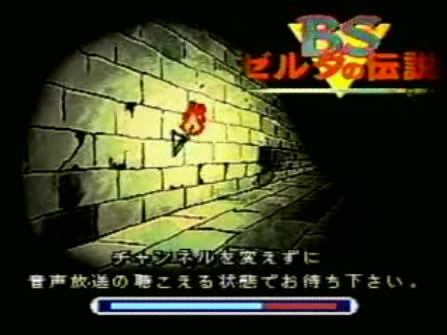
The title screen of BS Zelda no Densetsu.
In August 1995 Nintendo and the broadcaster St.GIGA beamed BS Zelda no Densetsu to Japanese Super Famicom owners with the Satellaview add-on. It redrew the first game in 16-bit style, swapped Link for the boy or girl avatar of the Satellaview menu, rearranged the dungeons (fans call it the Third Quest) and ran in four weekly one-hour episodes against a real-time clock, with voice actors’ narration streamed alongside the game. A second map aired from 30 December 1995. Because the voice data was streamed and never stored, it cannot be played as it was broadcast, and Nintendo has never re-released it.
The template for a series
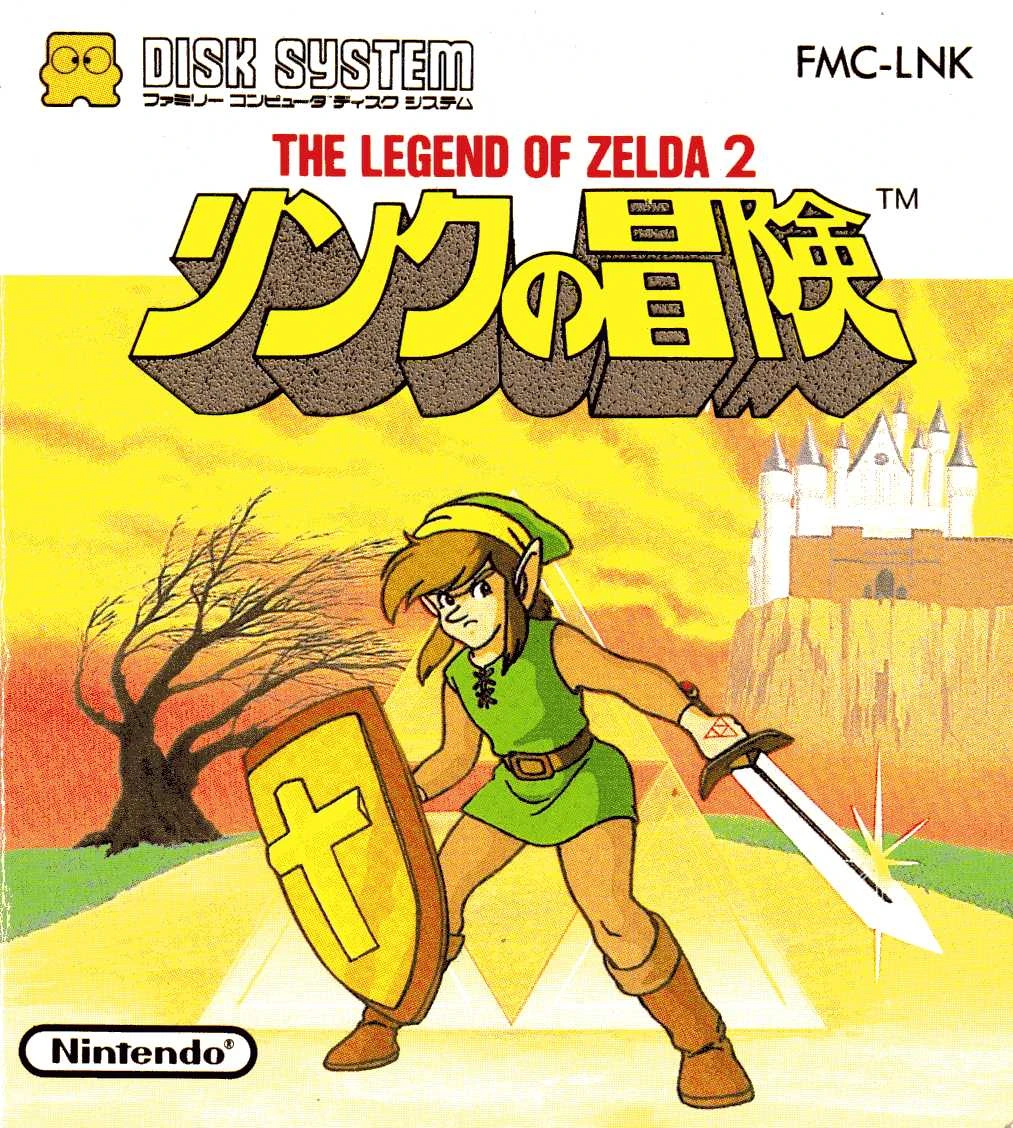
The Japanese Disk System box of Zelda II: The Adventure of Link.
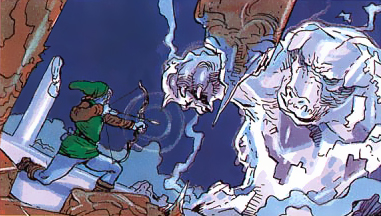
Its sequel, Zelda II: The Adventure of Link, arrived in Japan less than a year later, and nearly every Zelda since has been built on the foundations laid here. Game Informer ranked it the greatest game of all time in both 2001 and 2009, GameSpy put it in its Hall of Fame in 2000, and in 2016 it was inducted into the World Video Game Hall of Fame at The Strong museum.
Sales & reviews
Sales figures
In 1987 it became the first NES game to sell more than a million cartridges in the United States; by 1990 American sales had reached three million. Worldwide figures compiled by the games site The Magic Box in 2004 put the total at about 6.51 million, including 1.69 million on the Famicom Disk System.
1m+US sales in 1987
3mUS by 1990
1.69mDisk System, Japan
6.51mworldwide by 2004
Reception and review scores
Period reviews were glowing, and the retrospective verdict has been even kinder. Scores below are as reported by Wikipedia’s reception section from the original magazines.
Famicom HisshoubonJapan · May 1986 (three reviewers)
4.5 / 5 / 5
ACEUK
905/1000
Computer and Video GamesUK · August 1988
9/10
Nintendo LifeWii U VC · 30 Aug 2013
8/10
Computer Entertainer called it an excellent adventure in 1987; Famicom Hisshoubon’s only grumble was the price. Famitsu’s Best Hit Game Awards gave it Best BGM and third place for Game of the Year, and Computer Gaming World named it best adventure in 1988. Revisiting it in 2013, Nintendo Life’s Philip J Reed found that it had aged surprisingly well and was still rightfully legendary.
Honours
The Strong · 2016World Video Game Hall of FameInducted into the Hall in Rochester, New York.
Game Informer · 2001 and 2009Number oneTop of its Top 100 (2001) and Top 200 (2009) games of all time.
Nintendo PowerReaders’ number oneFirst in the magazine’s first Top 30 readers’ poll.
GameSpy · 2000Hall of FameInducted, and later voted the tenth best game of all time.
Reader reviews
No reader reviews yet. Played it? Give it a score out of 10 and tell other fans what you think.
Every fact on this page was checked against the sources below. Nintendo’s own interviews were preferred for development history; Legends of Localization’s detailed comparison of the Japanese and English versions was used for the script, manual and version differences. zeldawiki.wiki blocks automated reading and was not used.
To provide the best experiences, we use technologies like cookies to store and/or access device information. Consenting to these technologies will allow us to process data such as browsing behavior or unique IDs on this site. Not consenting or withdrawing consent, may adversely affect certain features and functions.
Functional
Always active
The technical storage or access is strictly necessary for the legitimate purpose of enabling the use of a specific service explicitly requested by the subscriber or user, or for the sole purpose of carrying out the transmission of a communication over an electronic communications network.
Preferences
The technical storage or access is necessary for the legitimate purpose of storing preferences that are not requested by the subscriber or user.
Statistics
The technical storage or access that is used exclusively for statistical purposes.The technical storage or access that is used exclusively for anonymous statistical purposes. Without a subpoena, voluntary compliance on the part of your Internet Service Provider, or additional records from a third party, information stored or retrieved for this purpose alone cannot usually be used to identify you.
Marketing
The technical storage or access is required to create user profiles to send advertising, or to track the user on a website or across several websites for similar marketing purposes.

 Level 2Boss: DodongoThe magical boomerang. An old man’s hint, “Dodongo dislikes smoke”, points the way.
 Level 3Boss: ManhandlaThe raft.
 Level 4Boss: two-headed GleeokThe stepladder, for crossing gaps.
 Level 5Boss: DigdoggerThe recorder, whose tune summons the warp whirlwind.
 Level 6Boss: GohmaBring arrows: Gohma is only vulnerable in its eye.
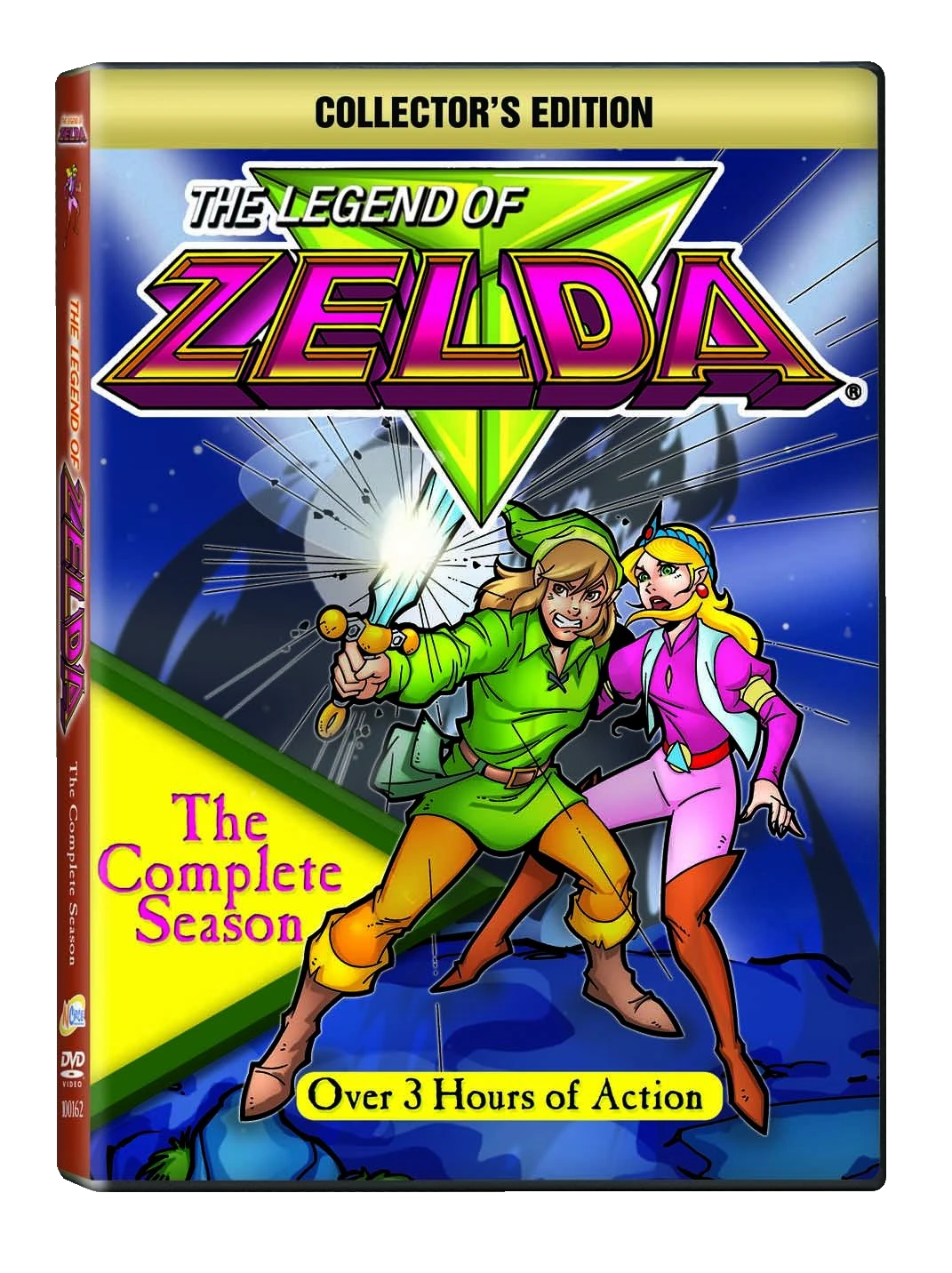 The Legend of Zelda (TV series)DiC · 1989 · 13 episodesThirteen short cartoons shown on Fridays from 8 September to 1 December 1989 inside The Super Mario Bros. Super Show!, based on the first two NES games. Link, Zelda and Ganon fight over a Triforce of only two pieces, just as in this game.
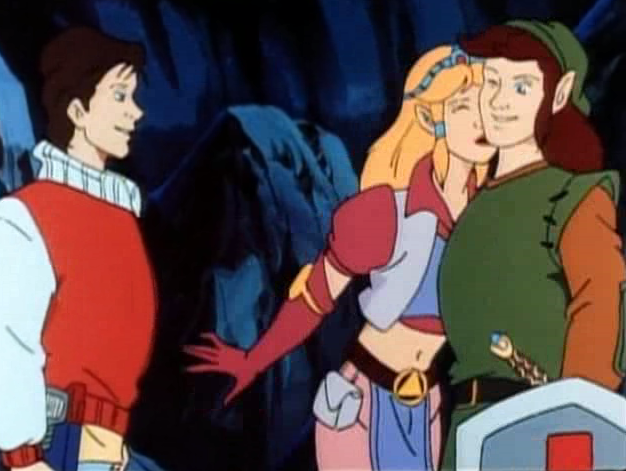 Captain N: The Game MasterNBC · 1990The same voice actors brought Link, Zelda and Ganon into four episodes of the second season of DiC’s Saturday-morning series.
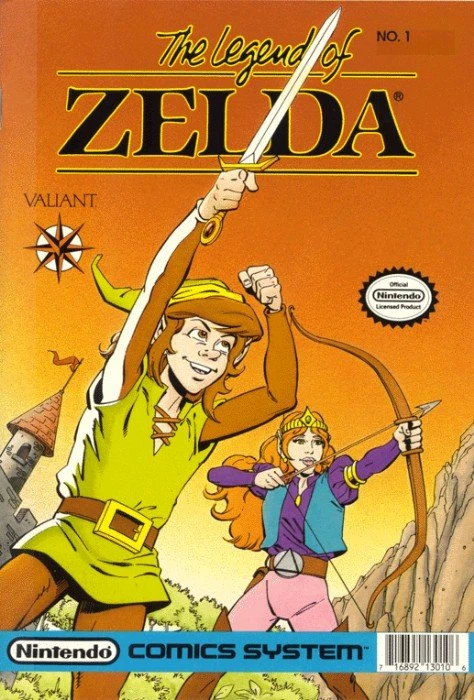 The Legend of Zelda (Valiant Comics)Nintendo Comics System · 1990Five issues based on the two NES games and loosely on the cartoon, reprinted in 1991 with changes.
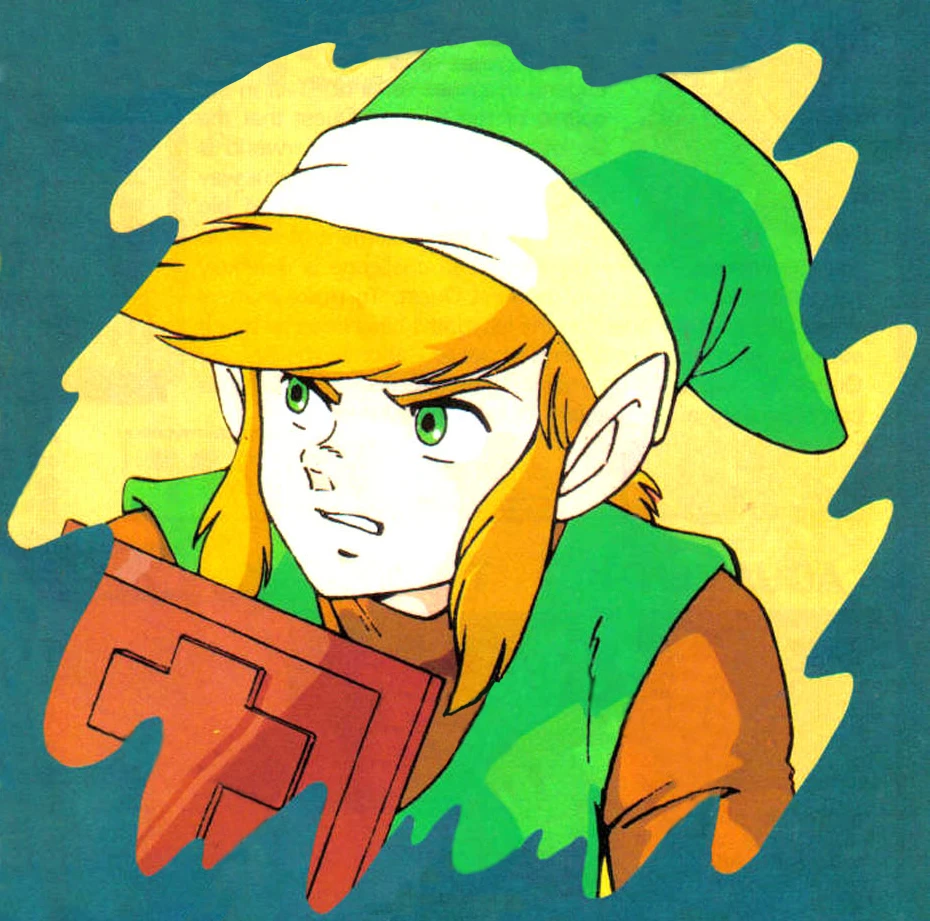 LinkThe hero
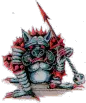 MoblinsGanon’s spear-throwers
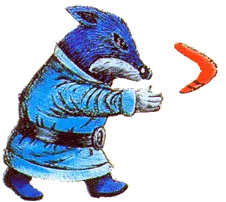 GoriyaBoomerang-throwing dungeon dwellers
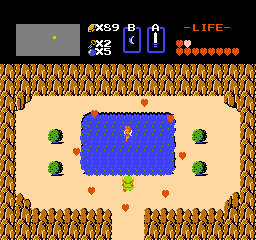 The fairiesHyrule’s healers
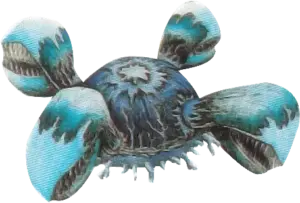 ManhandlaLevel 3A man-eating plant, Testitart in Japanese. The Japanese manual calls it a jumbo-sized Pakkun Flower, the Japanese name for Mario’s Piranha Plant.
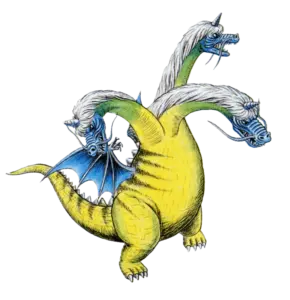 GleeokLevels 4 and 8A many-headed boss: two heads in Level 4, four in Level 8.
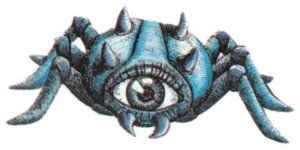 GohmaLevel 6A shelled beast that can only be hurt through its eye; a single arrow does it.
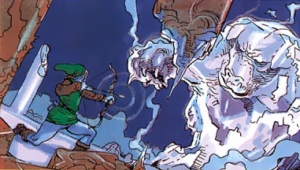 GanonLevel 9The Prince of Darkness himself.
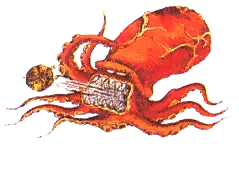 OctorokOverworldOctopus monsters, among the first enemies most players meet.
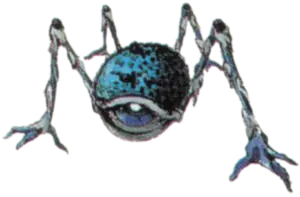 TektiteOverworldHopping overworld creatures.
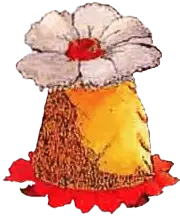 PeahatOverworldA flying flower creature, the “ghost of a flower” in the English manual.
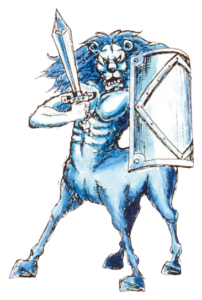 LynelOverworldPowerful guardians (guardian deities, in Japanese); the Magical Shield blocks the swords they fire.
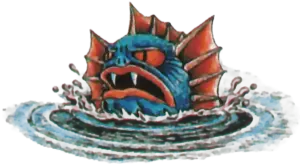 ZolaOverworld watersRises from the water to fire at Link; later games spell the name Zora.
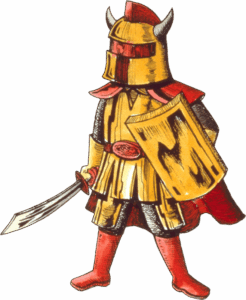 DarknutLevelsShield-carrying knights (Tartnuc in Japanese), and Miyamoto’s own favourite enemy.
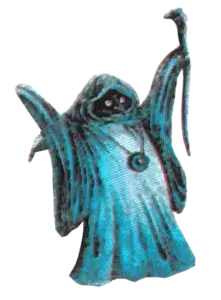 WizzrobeLevelsRobed wizards (the English manual’s invented “Master of Movement”).
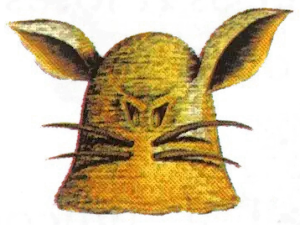 Pols VoiceLevelsIn Japan you could shout into the Famicom’s second-controller microphone to kill it.
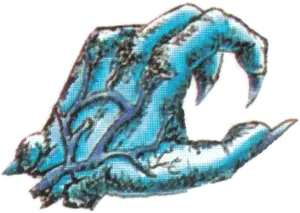 WallmasterLevelsA monster that lurks in the dungeon walls; it gave many young players their first real fright.
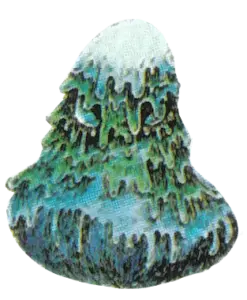 Zol and GibdoLevelsZols, blobby dungeon pests, and Gibdos, mummies of superhuman strength according to the Japanese manual.
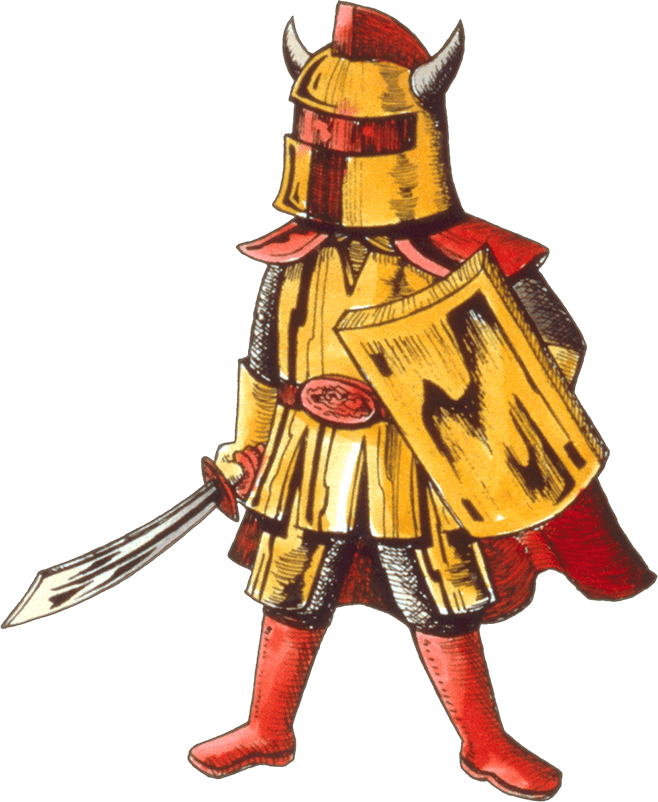
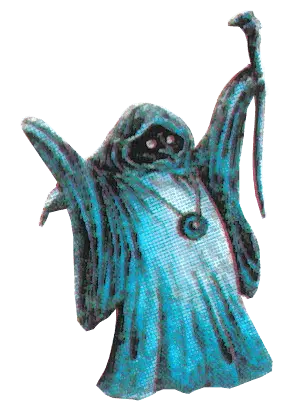
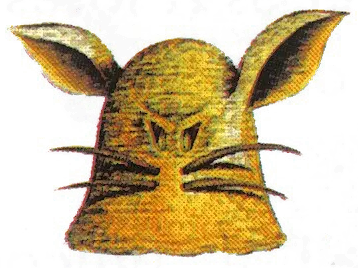
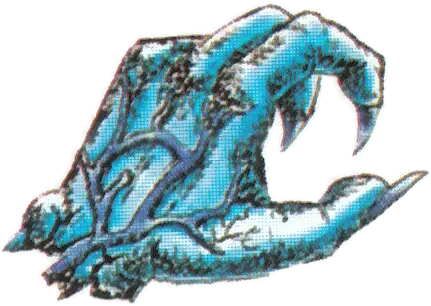
 Link, Zelda, Ganon and ImpaThe series’ core cast all debut here, though Impa only in the manual.
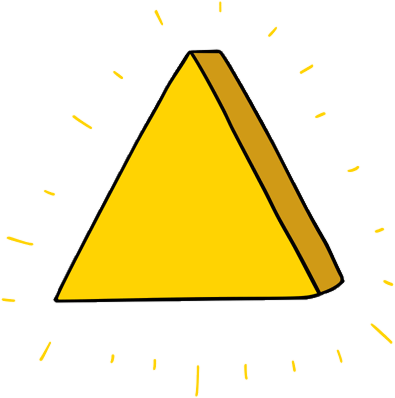 Hyrule and the TriforceThe kingdom and its golden triangles. This game’s Triforce has just two parts, Power and Wisdom; Courage joined in Zelda II.
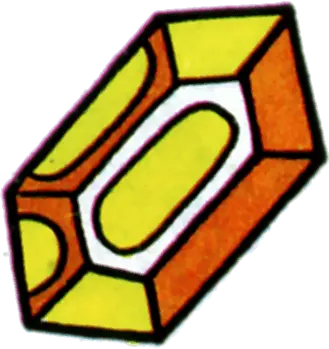 Rupees, hearts and fairiesThe currency, the heart-based life meter with Heart Containers, and the fairies of Hyrule’s ponds.
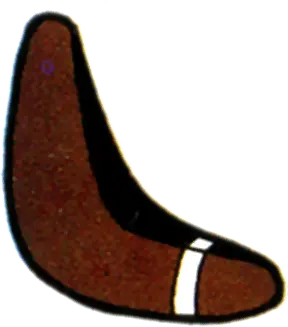 Dungeons and their toolsUnderground levels with keys, a boss and a treasure, and the boomerang, bombs, bow and candle that unlock the world.
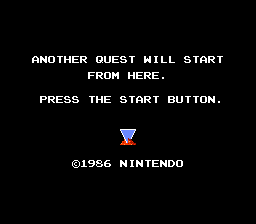 The Second QuestA harder remix for anyone who finished the game, an idea the series returned to with Ocarina of Time’s Master Quest.
 Saving your adventureDisk saves in Japan and a battery-backed cartridge in the West, so a big adventure could be played over many sessions.
 Death MountainGanon’s lair, and a fixture of Hyrule ever since.