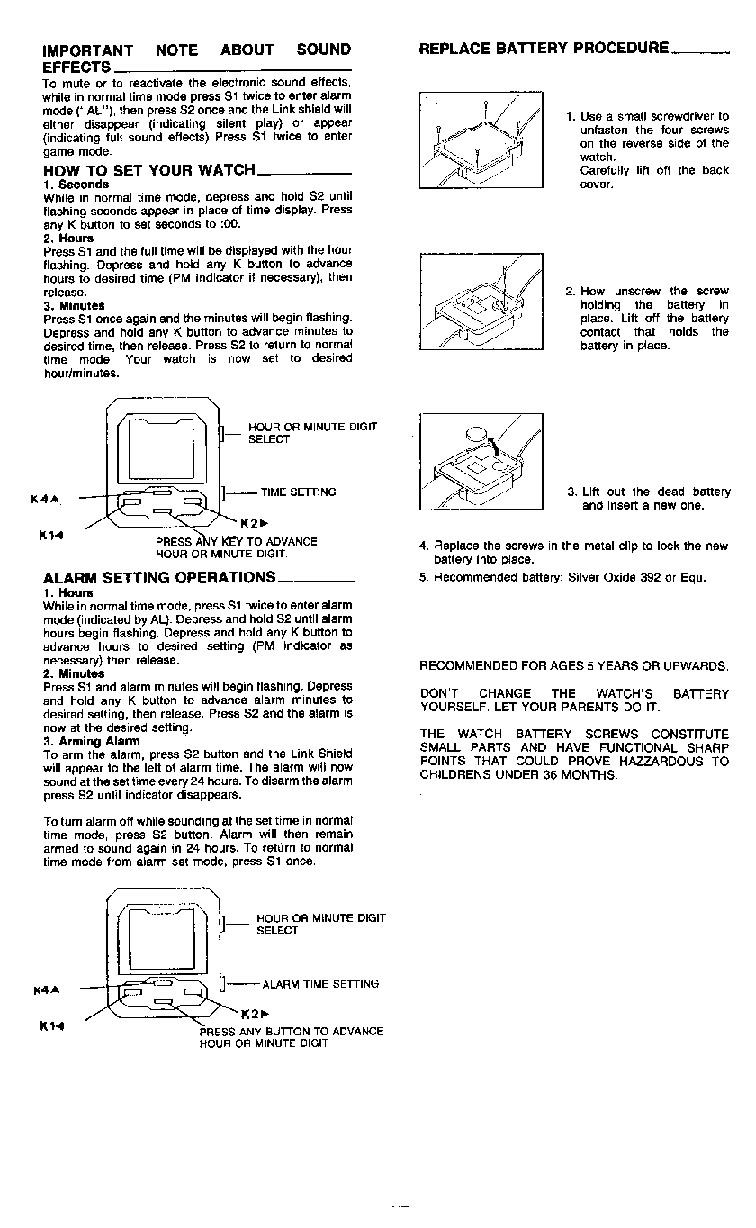
One watch cell: size 364 in the black watch, size 392 in the red
Controls
A direction control and two buttons: one picks things up, the other attacks
Structure
Four levels of four rooms each, with a dragon at the end of every level
Price when new
US$19.97 in a December 1989 Service Merchandise catalogue
Sister watch
Nelsonic’s Super Mario Bros. Game Watch (1989)
Overview
In 1989 there was a new way to take Zelda everywhere: wear it. The Legend of Zelda Game Watch is a digital wristwatch that tells the time and also turns its little LCD face into a dungeon. It was not made by Nintendo but by Nelsonic Industries, a New York firm that had been building games into watches since 1981 and that signed up Nintendo’s biggest names in 1989.
The game is a boiled-down take on the original Legend of Zelda. Link walks into a cave unarmed, grabs a boomerang and a sword as they appear, clears out the monsters, takes the key and moves on. Four rooms make a level, a fire-breathing dragon guards the end of each level, and every dragon beaten yields a piece of the Triforce. Collect four pieces and you have won, at which point the watch simply starts again.
It reached North America in 1989, a few weeks after Nintendo’s own Zelda Game & Watch, and came in black, red, white and pink. In 1992 the distributor Zeon brought it to Europe, and British magazines took a look. They liked the idea of the thing on a wrist rather more than the game inside it.
Quick Answers
Quick answers about the Zelda watch, with more detail further down the page.
What is The Legend of Zelda Game Watch?
A digital wristwatch from 1989 with a small Zelda-themed LCD game built into its face. It is an officially licensed product, made by the American company Nelsonic. More →
Did Nintendo make it?
No. Nintendo licensed the name; Nelsonic Industries produced the watch, alongside a Super Mario Bros. watch the same year. More →
When did it come out?
In 1989 in North America (Zelda Dungeon gives 5 October 1989) and in December 1992 in Europe, where it was reissued by Zeon. More →
How do you win?
Clear four levels. Each has four rooms of enemies and then a dragon, and each dragon leaves a piece of the Triforce. The fourth piece completes the game, which then returns to level one. More →
Is it the same as the Zelda Game & Watch?
No. The Zelda Game & Watch is a two-screen handheld made by Nintendo itself, released a few weeks earlier in 1989. The two share dragons and Triforce pieces but are different games. More →
How much did it cost?
A Service Merchandise catalogue from December 1989 lists the Zelda and Super Mario Bros. watches at US$19.97 each. More →
How it plays
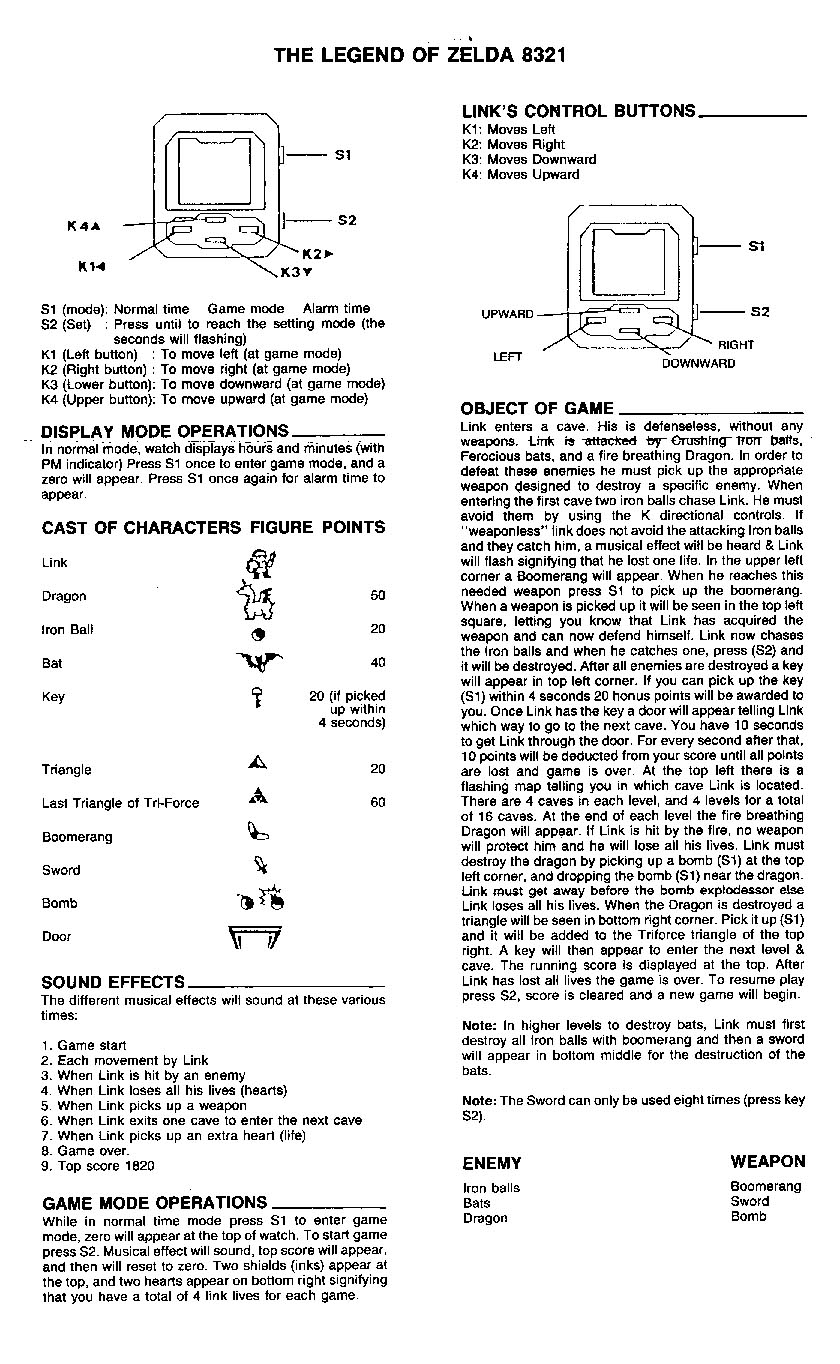
Everything happens on one small screen. What story there is comes from the instruction leaflet: Link enters a cave with no weapons and is set upon at once by Iron Balls, ferocious bats and fire-breathing dragons. Each kind of enemy can only be beaten with the right tool, and none of the tools are in his hands when a room begins.
A direction control moves Link around the cave. One button picks up whatever item has appeared; the other uses it, and also starts a new game after a Game Over.
On screen
What it does
Points
Iron Ball
The weakest enemy; touching one costs a life. Destroyed with the Boomerang
20
Bat
Tougher than an Iron Ball. Destroyed with the Sword
40
Dragon
The boss of each level. Its fire kills at a touch; only a Bomb will finish it
50
Boomerang
Appears in the upper-left corner; the weapon for Iron Balls
–
Sword
The weapon for bats; good for eight swings
–
Bomb
Appears during dragon fights; drop it by the dragon and get clear
–
Key
Appears when a room is cleared and opens the way on
20 bonus if taken within four seconds
Hearts
Found in the third room of each level; restore Link’s health
–
Triforce piece
Left behind by each dragon
20; the fourth is worth 60
Four levels, sixteen rooms
The instruction leaflet, the only place the game’s story is told.
The game is built from four levels of four rooms each. In a room, Link first collects the Boomerang to deal with the Iron Balls; in the later levels a Sword then appears at the bottom of the screen for the bats. When everything is dead a key appears, and the key opens the door to the next room. A small flashing map in the corner shows which room you have reached.
The catch is that Link carries nothing with him. Stepping into a new room wipes out the weapons he has collected, so every room starts with a scramble for the Boomerang. Reviewers praised the way the watch gives the illusion of many screens on its single small one.
The dragon and the Triforce
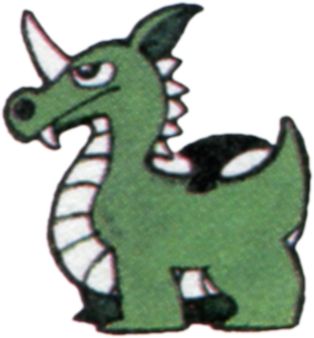
Aquamentus from the first Legend of Zelda; Zelda Dungeon links the watch’s dragons to it.
Clear the fourth room of a level and its dragon appears, spitting fire that travels around the cave. Only a Bomb will beat it: Link has to pick one up, set it down next to the dragon and retreat before it goes off, because being caught in his own explosion costs him every life he has left.
A beaten dragon leaves a Triforce piece in the corner of the screen, which joins the tally at the top and opens the next level. The fourth piece completes the Triforce and the game, and play loops back to level one.
Racing the clock
The second page of the watch’s instruction leaflet.
As well as points for each kill, there are rewards for speed and penalties for dawdling. Grab a key within four seconds of its appearing and you earn a 20-point bonus. Once a door has opened you have ten seconds to go through it; after that the score drains by ten points a second, and if it reaches zero the game is over.
The watch itself
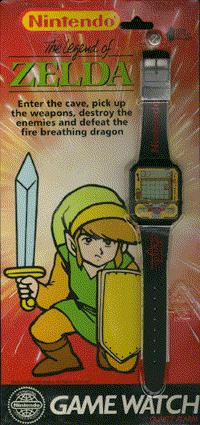
The watch was sold in several colours.
Wikipedia describes Nelsonic’s game watches as typically moulded plastic digital watches with an LCD display and an alarm. The Zelda model was sold in black, red, white and pink, and runs on a single watch battery, a size 364 cell in the black version and a 392 in the red.
Nelsonic and its Nintendo watches
The Zelda watch was one small part of a long line of game watches from a company that few players would recognise by name.
Who Nelsonic was
Nelsonic Industries was founded in 1981 in Long Island City, in the New York borough of Queens, and according to Wikipedia it was the first American electronics company to make game watches. The idea grew out of the calculator watch: a digital timepiece with a simple LCD game squeezed in beside the time. Its first, Space Attacker, appeared in 1981, and licensed arcade names soon followed, including Pac-Man in 1982, which sold more than half a million, and Frogger and Q*bert in 1983.
In 1990 the company was bought by the watchmaker M.Z. Berger, which kept the Nelsonic name on game watches for most of the following decade. Production of game watches had stopped by the late 1990s.
The Nintendo watches
Nelsonic already had a connection with Nintendo: the Super Mario Wiki records that it was the main North American distributor of Nintendo’s Game & Watch handhelds from late 1985. In 1989 it began turning Nintendo games into watches of its own, starting with Super Mario Bros. and The Legend of Zelda.
More followed over the next five years: two watches based on Super Mario Bros. 2 (Luigi’s Hammer Toss and Princess Toadstool’s Castle Run), Super Mario Bros. 3 and Tetris in 1990; Super Mario Bros. 4, based on Super Mario World, in 1991; Super Mario Race in 1992; Star Fox in 1993; and Donkey Kong in 1994. Zelda got only the one game.
In the shops
Zelda Dungeon dates the watch’s North American release to 5 October 1989. By that Christmas it was in the catalogues: the writer Benj Edwards has published a page from a December 1989 Service Merchandise circular offering the Zelda and Super Mario Bros. watches side by side at US$19.97 each.
Europe had to wait. In December 1992 the British distributor Zeon reissued the Zelda watch along with Nelsonic’s Super Mario Bros. 3 and Tetris watches, and UK magazines such as Total! and Super Play covered them.
Trivia & facts
The Zelda watch followed Nintendo’s own Zelda Game & Watch by about six weeks, going by the dates Zelda Dungeon gives for the two (26 August and 5 October 1989). Both have Link fighting dragons for pieces of the Triforce.
The battery depends on the colour: Wikipedia lists a size 364 cell for the black watch and a 392 for the red.
The Sword wears out. It can be swung eight times.
Standing next to your own Bomb when it goes off costs Link every remaining life at once.
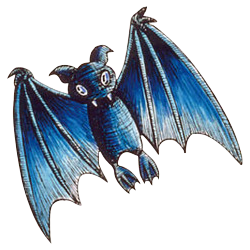
Official art of a Keese from The Legend of Zelda.The enemies are named in the leaflet as Iron Balls, bats and dragons. Zelda Dungeon matches the bats to Keese and the dragons to Aquamentus, the first boss of the NES game.
Nelsonic made a second Zelda watch in 1989 that has no game at all: the Flip Watch, a black watch whose moulded plastic cover, showing Link, lifts to reveal a plain time display.
Writing in 2014, Benj Edwards filed the Zelda and Mario watches under the headline “The Nintendo Smartwatch”, and worked out that their US$19.97 price came to about US$38 in that year’s money.
Kris Randazzo of Stone Age Gamer, who owns a black one, remembers begging for the watch at a shopping-mall kiosk as a child. He did not get one then; now that he owns one, a gift from a friend, his verdict on the game is: “I have no idea how to play this.”
Media & artwork
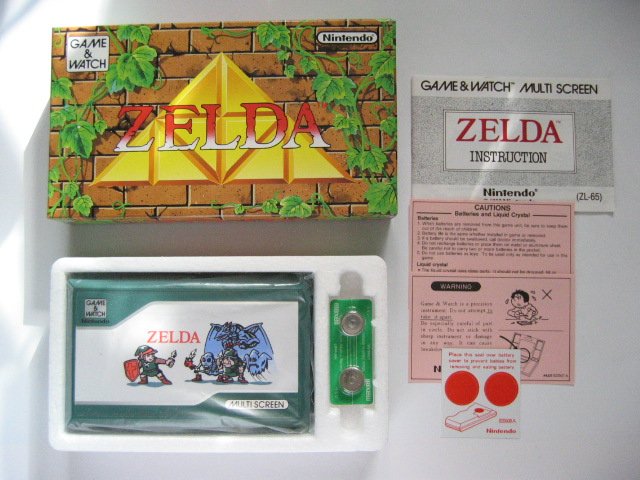
The watch in its different colours, its packaging and leaflet, and the LCD face. Select any image to view it larger.
Legacy
The Zelda Game Watch had one reissue and no sequel, though Nelsonic went on making Nintendo watches until 1994.
Release history
North America5 October 1989 – Released by Nelsonic (date from Zelda Dungeon; Wikipedia gives only the year).
In cataloguesDecember 1989 – US$19.97 in Service Merchandise’s Christmas circular.
EuropeDecember 1992 – Reissued by Zeon.
Its place in Zelda history
With the Zelda Game & Watch, the watch is one of two dedicated Zelda LCD games from 1989, and the only one of the pair that Nintendo did not make itself. Zelda Dungeon marks it as possibly outside the series’ core canon, and its tiny plot exists only in the leaflet.
Unlike the Game & Watch, which Nintendo later included in Game & Watch Gallery 4, the watch game is not recorded, in any source we read, as having been reissued on other hardware.
Sales & reviews
What the magazines said
The watch was covered by British magazines in 1992, the year Zeon brought it to Europe. No scores are on record; this is how Wikipedia summarises the coverage.
Total! magazine, in a news piece headed “Wrist action!” in its May 1992 issue, liked how cheap and how portable the watch was. Super Play, rounding up Nintendo game watches in December 1992, was far less kind: it thought the game had little to do with the Zelda it was named after, and judged it “very poor”.
That split runs through the reviews in general. The watch was praised as a stylish thing to wear and for the way it conjures several rooms out of one small screen, and criticised for simple play that did little to recall the NES adventure.
Reader reviews
No reader reviews yet. Played it? Give it a score out of 10 and tell other fans what you think.
Every fact on this page was checked against the sources below in November 2026. The watch’s instruction leaflet and the 1992 magazine reviews could not be read directly; they are used as reported by Zelda Dungeon and Wikipedia. Zelda Wiki and IGN block automated reading and were not used.
To provide the best experiences, we use technologies like cookies to store and/or access device information. Consenting to these technologies will allow us to process data such as browsing behavior or unique IDs on this site. Not consenting or withdrawing consent, may adversely affect certain features and functions.
Functional
Always active
The technical storage or access is strictly necessary for the legitimate purpose of enabling the use of a specific service explicitly requested by the subscriber or user, or for the sole purpose of carrying out the transmission of a communication over an electronic communications network.
Preferences
The technical storage or access is necessary for the legitimate purpose of storing preferences that are not requested by the subscriber or user.
Statistics
The technical storage or access that is used exclusively for statistical purposes.The technical storage or access that is used exclusively for anonymous statistical purposes. Without a subpoena, voluntary compliance on the part of your Internet Service Provider, or additional records from a third party, information stored or retrieved for this purpose alone cannot usually be used to identify you.
Marketing
The technical storage or access is required to create user profiles to send advertising, or to track the user on a website or across several websites for similar marketing purposes.